Bay leaf: Flavor, Cooking Use and Health Facts
Bay leaf is herbal and slightly floral and simmered whole in soups, stews and curries, then removed; one small trial of capsules and one liver case report exist, so supplement use is unproven.
Content last updated . This page has not been medically reviewed.
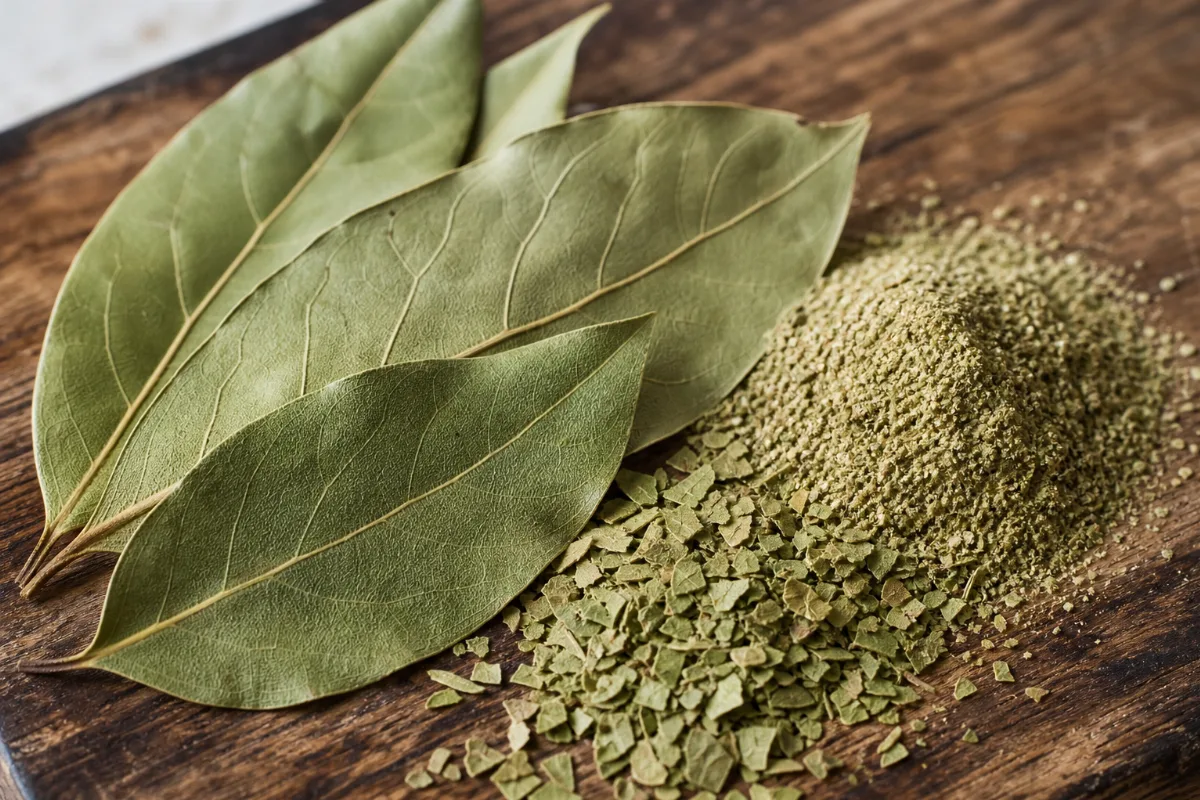
In the kitchen at a glance
Flavor:EarthyFloral
Aroma: Herbal and slightly floral, a little like oregano and thyme.
Used in: soups and stews, curries, rice and grains, desserts, tea and drinks
Usual amount in food: USDA lists 0.6 g per teaspoon of crumbled bay leaf and 1.8 g per tablespoon; we found no source that sets a usual recipe amount.
What it is
Bay leaf is the dried leaf of the bay laurel, Laurus nobilis, an evergreen tree or large shrub native to the Mediterranean region. [2] The leaves are smooth, about 6 to 12 cm long, with a plain edge. [2] Many unrelated plants are also called "bay" or "laurel". [1][2] Examples used in cooking are Indian bay (Cinnamomum tamala, also called tejpat), Indonesian bay (Syzygium polyanthum), West Indian bay (Pimenta racemosa) and Mexican bay (Litsea glaucescens). [1] California bay (Umbellularia californica) looks similar but contains a toxin, umbellulone, that can cause methemoglobinemia (a blood problem that limits oxygen). [1]Flavor and aroma
Dried bay leaf smells herbal and slightly floral, somewhat like oregano and thyme. [1] It tastes mild rather than sharp. Fresh leaves are mild, and the full flavor develops over several weeks of drying. [1]The leaf holds about 1.3% essential oil. Roughly 45% of that oil is eucalyptol (also called 1,8-cineole), and 8 to 12% is terpinyl acetate. [1][2] These compounds are the main reason for the smell, though the sources we read do not say which one matters most for the taste. Boiling bay leaf for tea for more than about 3 minutes can make it bitter. [1]
How it is used in cooking
Bay leaf is usually added whole and removed after cooking. [1][2] It is a quiet background flavor, not a main one.- Mediterranean and European cooking: broths, stocks, soups and stews, including French and Italian dishes, often tied in a bouquet garni. [1]
- Filipino cooking: menudo, beef pares and adobo. [1]
- Thai and Laotian cooking: massaman curry. [1]
- Caribbean cooking: jerk chicken, soups and stews. [1]
- Indian cooking: Western bay is sometimes used in place of tejpat, mainly in biryani and garam masala. The flavors differ. [1]
- Desserts: cakes, cookies, ice cream and puddings, often infused into milk or butter. [1]
- Other: ground leaf appears in soups, stocks and Bloody Marys. [2]
Ground bay leaf can stand in for whole leaves and does not need to be removed, but it is much stronger. [1] The sources we read do not say when to add it or whether to toast it, so we give no rules here.
Normal food amounts
| Measure | Grams | Source |
|---|---|---|
| 1 teaspoon, crumbled | 0.6 g | USDA [4] |
| 1 tablespoon, crumbled | 1.8 g | USDA [4] |
| Typical recipe amount | Not found | We opened no source that states one |
What one teaspoon (0.6 g) of crumbled bay leaf provides, calculated from USDA values per 100 g:
| Nutrient | One teaspoon |
|---|---|
| Energy | about 2 kcal |
| Fiber | about 0.16 g |
| Calcium | about 5 mg |
| Iron | about 0.26 mg |
| Potassium | about 3 mg |
| Vitamin C | about 0.3 mg |
The USDA SR Legacy data are from 2018, and real products vary. [4] We did not compare these numbers with official daily values, so we do not call bay leaf a "good source" of anything. A leaf or two in a pot adds flavor, not nutrition.
Buying, storing and preparing
- Forms: whole dried leaves, ground bay leaf, and fresh leaves. Dried berries and pressed leaf oil are also used as spices. [2]
- Shelf life: one reference says whole leaves keep for about one year. [2] That is the only figure we found. A cool, dry, dark place is a sensible choice, but no source we read says so.
- Quality rules: Canada sets limits for ground bay leaf, including at most 7% moisture in dried leaves and at least 1 mL of oil per 100 g. [1] That shows oil content is a quality marker.
- Check the name: a jar labeled "bay leaf" may be a different tree, such as Indian or Mexican bay. [1] Never swap in leaves from garden plants called laurel without knowing the species. The belief that bay is poisonous comes from confusion with poisonous look-alikes such as cherry laurel and mountain laurel. [1]
Health: what research says
Eating bay leaf as flavoring is very different from taking capsules or strong tea.Food amounts vs supplements
| In normal cooking | In supplements and extracts | |
|---|---|---|
| Typical amount | About 0.6 g per teaspoon of crumbled leaf (USDA); whole leaves are removed [4][1] | One small trial used capsules of 1, 2 or 3 g of ground leaf per day for 30 days [3] |
| What studies mostly used | We found no study of bay leaf used only as a cooking flavor | Capsules, tea, and lab extracts [3][5][6] |
| What we can say about benefit | Nothing in the sources we read; its flavor is the clear benefit | One 30-day trial reported lower blood sugar and cholesterol in 40 adults with type 2 diabetes; no larger confirming trials were found [3] |
| Main safety limit | Do not swallow whole leaves [1] | A 2026 case report links daily bay leaf tea to liver injury [5] |
What the evidence shows
| Use | What the sources found | Strength of evidence | Form and population |
|---|---|---|---|
| Blood sugar in type 2 diabetes | In a 2009 trial of 40 adults, 1, 2 or 3 g of ground leaf per day for 30 days was linked to lower blood sugar (21 to 26%), and no change was seen with placebo. [3] The authors called their finding a suggestion. We found no larger trial. [3] | Promising but limited | Capsules of ground leaf; adults with type 2 diabetes [3] |
| Blood fats | The same trial reported lower total and LDL cholesterol, lower triglycerides in the 1 g and 2 g groups, and higher HDL in those groups. [3] | Promising but limited | Capsules; 40 adults, 30 days [3] |
| Cancer | An ethanol leaf extract killed some human cancer cells in a dish. [6] | Lab or animal only | Lab cell lines, not people [6] |
| Liver | A 55-year-old woman had liver injury judged "probable" after months of regular bay leaf tea, and she improved after stopping. [5] | Insufficient evidence (one case) | Tea, large or regular amounts; one person [5] |
| Anything from bay leaf used only in cooking | No study found | Insufficient evidence | Food amounts |
The sources we read describe no regulator-approved use for bay leaf. We did not find a herb guide for bay leaf on this site, so there is no longer supplement page to link here.
Official statements
We opened no statement from EMA, EFSA, FDA, WHO or NCCIH about bay leaf, so none is listed here. Canada's rules for ground bay leaf quality are mentioned above. [1]Related pages
Health connections for Bay leaf
What research links to this spice, and how strong the evidence is. Most studies use concentrated extracts or doses far above what you eat; each card says which.
Blood sugar in type 2 diabetes
Preliminary or mixedOne small 2009 trial of 40 adults found lower blood sugar after 30 days of bay leaf capsules.
Supplements: Capsules only; one small trial, no larger confirming trial found; not shown for food amounts.
Blood fats (cholesterol and triglycerides)
Preliminary or mixedThe same trial reported lower total and LDL cholesterol and, in two groups, lower triglycerides and higher HDL.
Supplements: Capsules only; not shown for food amounts.
Laboratory activity against cancer cells
Lab or animal research onlyAn ethanol extract of bay leaf killed some human cancer cell lines in a dish.
Supplements: Lab extract only; no human evidence read.
Connected topics
Open a group to see how each topic connects and how strong the evidence is.
Health goals (2)
- Blood Sugar BalancePreliminary or mixed
One small 30-day trial of bay leaf capsules in 40 adults with type 2 diabetes reported lower blood sugar; no larger trial was found and it is not about bay leaf in cooking.
- Cholesterol BalancePreliminary or mixed
The same small trial reported lower total and LDL cholesterol with capsules; no larger confirming trial was found.
Body systems (3)
- Digestive SystemDocumented risk
Whole bay leaves stay stiff after cooking and may harm the digestive tract or cause choking if swallowed, so recipes say to remove them.
- Blood Sugar SupportPreliminary or mixed
One small 30-day trial of bay leaf capsules in 40 adults with type 2 diabetes reported lower blood sugar; no larger trial was found and it is not about bay leaf in cooking.
- Hepatic / Liver SystemDocumented risk
A 2026 case report links months of regular bay leaf tea to probable herb-induced liver injury in one woman, who improved after stopping. One case does not show cause for everyone.
Body parts (2)
- GutDocumented risk
Whole bay leaves stay stiff after cooking and may harm the digestive tract or cause choking if swallowed, so recipes say to remove them.
- LiverDocumented risk
A 2026 case report links months of regular bay leaf tea to probable herb-induced liver injury in one woman, who improved after stopping. One case does not show cause for everyone.
Functional actions (1)
- Blood Sugar RegulationPreliminary or mixed
One small 30-day trial of bay leaf capsules in 40 adults with type 2 diabetes reported lower blood sugar; no larger trial was found and it is not about bay leaf in cooking.
Biomarkers (6)
- ALTDocumented risk
In the case report, ALT rose to 357 U/L and fell after bay leaf tea was stopped; one patient.
- ASTDocumented risk
In the case report, AST rose to 196 U/L and improved after bay leaf tea was stopped; one patient.
- Blood GlucosePreliminary or mixed
In one 30-day trial of capsules (1 to 3 g of ground leaf a day), serum glucose fell 21 to 26% in adults with type 2 diabetes; the trial was small.
- HDL CholesterolPreliminary or mixed
The small trial reported higher HDL in the 1 g and 2 g groups; results are from one 40-person study.
- LDL CholesterolPreliminary or mixed
The same small trial reported lower total and LDL cholesterol with capsules; no larger confirming trial was found.
- TriglyceridesPreliminary or mixed
The small trial reported lower triglycerides in the 1 g and 2 g groups; results are from one 40-person study.
Conditions & symptoms (3)
- ChokingDocumented risk
Whole cooked bay leaves stay stiff and may cause choking or harm the digestive tract if swallowed.
- Diabetes Mellitus, Non-Insulin-DependentPreliminary or mixed
One small 2009 trial of capsules in 40 adults reported lower blood sugar and cholesterol; no larger trial was found. Not a treatment.
- Drug-Induced Liver DiseaseDocumented risk
One 2026 case report links regular bay leaf tea to probable herb-induced liver injury; improved after stopping.
Documented risks and interactions (3)
- Liver injury with daily tea (documented risk). A 2026 case report describes probable liver injury after regular bay leaf tea in one woman, who improved after stopping.
- Whole leaf swallowed (documented risk). Whole bay leaves stay stiff when cooked and may harm the digestive tract or cause choking if swallowed.
- Look-alike plants (documented risk). California bay contains umbellulone, which can cause methemoglobinemia; other plants called bay or laurel are not true bay.
Frequently asked questions
Do you eat bay leaf?
Usually no. The whole leaf stays stiff and is taken out before serving. [1][2] Ground bay leaf can be eaten. [2]
Is bay leaf sweet?
No. It is herbal and slightly floral, a bit like oregano and thyme, and mild. [1]
How much is normal?
USDA lists 0.6 g per teaspoon of crumbled leaf. [4] We found no source for a usual recipe amount. Recipes mostly use whole leaves and remove them.
Is it safe in pregnancy?
The sources we read do not describe it, so ask your midwife or doctor, mainly about teas and capsules.
Can I take it with medicines?
In cooking, the sources we read name no problems. One trial reported lower blood sugar with capsules, so ask a pharmacist if you take diabetes medicine. [3]
Does bay leaf lower blood sugar?
One small 30-day trial of capsules reported that it did. [3] No larger trial was found, so it is not a treatment.
More details: evidence, limits and cautions
The details behind this page: cautions, limits of the evidence and where sources disagree. Open any note to read it.
Safety note at a glance
Safety in more detail
- Medicines: the sources we read do not describe medicine interactions. The one trial reported lower blood sugar, so a person on diabetes medicine should ask a pharmacist before taking bay leaf capsules or daily tea. [3]
- Pregnancy: the sources we read do not describe pregnancy safety.
- Breastfeeding: the sources we read do not describe it.
- Children: the sources we read do not describe it.
- Allergy: the sources we read do not describe food allergy to bay leaf.
- Liver and kidney: a 2026 case report of liver injury after regular bay leaf tea warns that culinary herbs may harm the liver in large amounts or as strong infusions. [5] The sources we read do not describe kidney problems. One case does not prove cause for everyone.
- Surgery: the sources we read do not describe a surgery warning. Tell the surgical team about any supplement.
- Quality and contamination: the sources we read give no contamination data for bay leaf. Confusion with other "bay" plants is the main quality risk. [1]
- Amounts that cause trouble: whole leaves can injure the digestive tract or cause choking if swallowed, so remove them. [1] Methyleugenol makes up about 3% of the leaf oil, according to the sources we read; they do not give a safe amount. [1][2]
References
- Wikipedia — Bay leaf (overview of species, oil composition, culinary use and safety). https://en.wikipedia.org/wiki/Bay_leaf (accessed 2026-10-24)
- Wikipedia — Laurus nobilis (plant description, culinary use, leaf oil). https://en.wikipedia.org/wiki/Laurus_nobilis (accessed 2026-10-24)
- Khan A, Zaman G, Anderson RA — Bay leaves improve glucose and lipid profile of people with type 2 diabetes. J Clin Biochem Nutr 2009; abstract read via Europe PMC. https://pubmed.ncbi.nlm.nih.gov/19177188/ (accessed 2026-10-24)
- USDA FoodData Central, SR Legacy (April 2018) — Spices, bay leaf (fdc_id 170917), per-100 g values and household portions from the site's USDA data file.
- Herb-induced liver injury by Laurus nobilis: a case assessed for causality using the updated RUCAM. Life (Basel) 2026; abstract read via Europe PMC. https://pubmed.ncbi.nlm.nih.gov/41598335/ (accessed 2026-10-24)
- The therapeutic potential of Laurus nobilis L. leaves ethanolic extract in cancer therapy. 2025; abstract read via Europe PMC. https://pubmed.ncbi.nlm.nih.gov/41097432/ (accessed 2026-10-24)