Baharat: What It Is, Flavor, Cooking Use and Health Facts
Baharat is a warm, sweet and peppery Middle Eastern spice blend for meat, soups and vegetables; it is rarely studied as a blend, so health facts come from its single spices.
Content last updated . This page has not been medically reviewed.
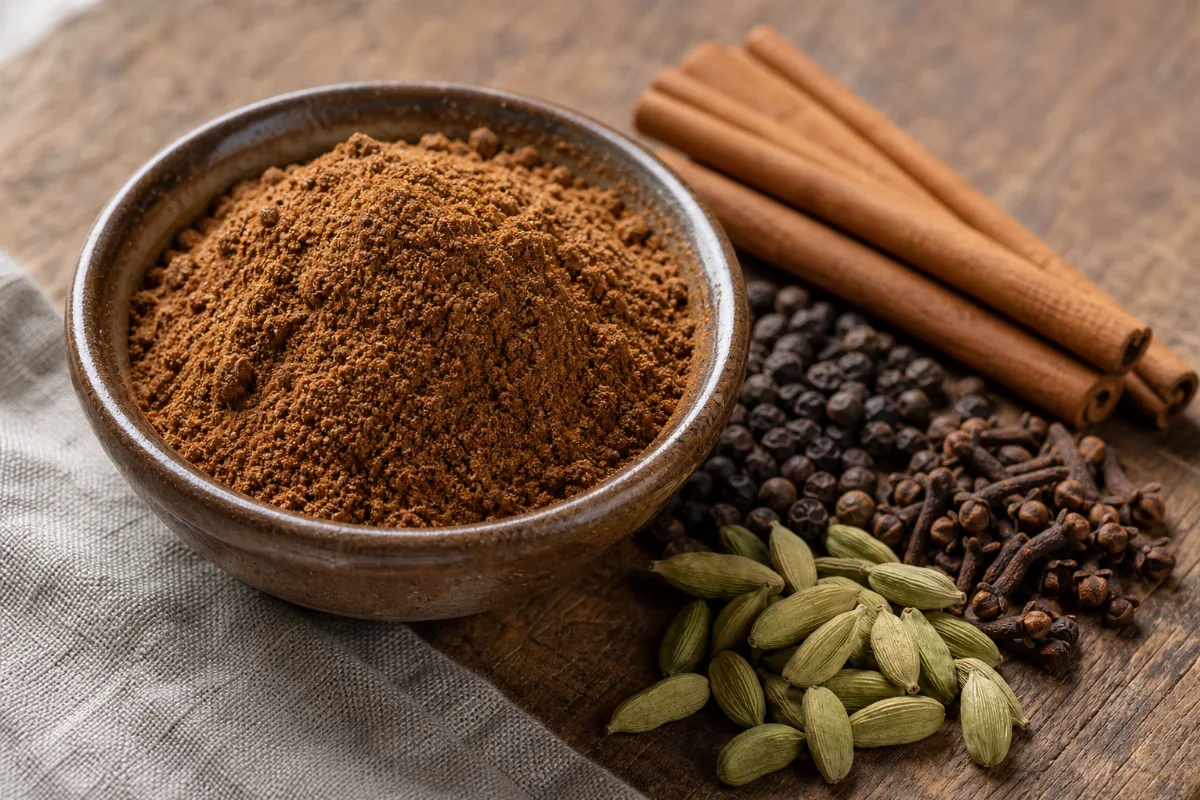
In the kitchen at a glance
Flavor:Warm / woodySweetHot / pungent
Aroma: Warm and sweet like cinnamon and cloves, with a peppery edge.
Used in: grilling and rubs, soups and stews, vegetables
Usual amount in food: No source gives a usual amount; one home recipe makes about 3 tablespoons of blend, and USDA has no entry for baharat.
What it is
Baharat is a spice blend used across Middle Eastern cooking. The word is Arabic for "spices," and it usually means spices in general, not one fixed recipe. [1] Many sources link it to the Persian word for spice, and some historians also link it to Bahar, an old name for India. [1] Medieval Arabic cookbooks recorded spice mixes under other names, and the term baharat for a mix probably grew in the Ottoman Empire. [1]There is no single correct version. The makeup changes by region, maker and household. [1][2] The sources we read name these parts as typical, not as fixed:
| Typical ingredient | Role in flavor | Link |
|---|---|---|
| Black pepper | Peppery bite | More about Black pepper → |
| Allspice | Warm, clove-and-cinnamon-like | More about Allspice → |
| Cinnamon or cassia | Sweet, warm | More about Cinnamon or cassia → |
| Cloves | Strong, sweet, warm | More about Cloves → |
| Cumin | Earthy, savory | More about Cumin → |
| Coriander seed | Mild, citrusy | More about Coriander seed → |
| Cardamom | Sweet, floral | More about Cardamom → |
| Nutmeg | Sweet, warm | More about Nutmeg → |
| Paprika or dried chili | Color, mild to hot | Paprika, Chili |
| Ginger, turmeric, saffron | Sometimes added | Ginger, Turmeric, Saffron |
The ingredients come from one encyclopedia article that lists them all. It says cloves, black pepper, allspice and cinnamon are often the main ones. [1] The role words are general descriptions from our single-spice pages, not from a baharat source.
Local versions differ. Turkish baharat usually has cinnamon, dried rose buds, black pepper and often mint. The Levantine "seven spices" mix uses cinnamon, black pepper, white pepper, allspice, cloves, nutmeg and coriander. Gulf versions can add dried black lime and saffron. [1]
Flavor and aroma
The sources we read do not describe the taste in detail. Going by its parts, baharat is warm and sweet-spiced with a peppery edge. [1][2] Cinnamon, cloves and allspice bring the sweet warmth. Pepper brings bite. Cumin and coriander add an earthy base. [2]How it is used in cooking
Baharat is rubbed on or stirred into lamb, mutton, fish, chicken, beef and soups, and it can also serve as a table condiment. [1] One home recipe calls it an all-purpose blend for meat, vegetables and soups. [2]- Dry rub: coat steak, lamb or chicken before cooking. [2]
- Quick marinade: mix with olive oil and lemon or lime juice for chicken or lamb. [2]
- Vegetables: toss with vegetables before roasting. [2]
Our sources do not say when to add it in a long cook, whether to toast it, or what to use in its place, so we give no rules.
Normal food amounts
USDA SR Legacy has no entry for baharat, so we do not give nutrient numbers for it. [7]| Measure | Grams | Source |
|---|---|---|
| 1 teaspoon of the blend | Not listed | No USDA entry [7] |
| Typical recipe amount | Not found | No source states one |
| One home recipe | About 3 tablespoons of blend in total | Home recipe [2] |
For scale only: USDA lists 1.8 to 2.6 g per teaspoon for the single ground spices that usually go in (coriander seed 1.8 g, cloves 2.1 g, nutmeg 2.2 g, black pepper 2.3 g, paprika 2.3 g, cinnamon 2.6 g). [7] A teaspoon of baharat probably weighs about the same, but that is our guess, not a measurement.
Recipes we opened contain no salt. [2] Ready-made products may differ, so read the label. We have no sodium figure for baharat.
Buying, storing and preparing
- Forms: whole spices you toast and grind, or a ready-ground blend. The traditional method grinds whole spices. [2]
- Making it: one home recipe mixes pre-ground spices (allspice, coriander, cinnamon, black pepper, cumin, cloves) and skips toasting. [2]
- Label: check for salt, fillers, and allergens such as mustard or celery. Our sources do not list baharat-specific allergens, so ask the maker if unsure.
- Storing: keep it airtight, cool and dark. [2] The page we read gives no fixed shelf life; it depends on the age of the spices used. [2]
- Contamination: see the quality note under safety below.
Health: what research says
Eating a spice blend in cooking is different from taking concentrated spice products. We found no study of baharat as a blend. Evidence belongs to the single spices, shown one row each below.Food amounts vs supplements
| In normal cooking | In supplements and extracts | |
|---|---|---|
| Typical amount | A spoonful or less across a dish; no usual amount found | Baharat is not sold as a supplement that we found |
| What studies mostly used | None found on baharat | Single spices as extracts or capsules (see each page) |
| What we can say about benefit | No health benefit shown for the blend | Not applicable |
| Main safety limit | Allergy, salt on the label, contamination | Not applicable |
What the evidence shows
| Use | What the sources found | Strength of evidence | Form and population |
|---|---|---|---|
| Baharat as a blend | No study found | Insufficient evidence | Food |
| Black pepper | Piperine can raise or lower drug levels; other benefits mostly lab or animal work [6] | Lab or animal only for benefit | Piperine extracts; lab |
| Cinnamon | Supplement trials on blood sugar are mixed; NCCIH calls it unclear | Mixed | Capsules; adults with type 2 diabetes |
| Cloves | Clove oil for tooth pain looks promising; spice use not studied | Promising but limited | Oil or gel, not food |
| Cardamom | Pooled trials show small changes in blood fats and pressure | Mixed | Powder or extract; adults |
| Cumin | Pooled trials on cholesterol are promising; fasting glucose unchanged | Promising but limited | Supplements; adults |
| Nutmeg | A trial of nutmeg oil found no added benefit | No good evidence of benefit | Skin product |
| Paprika | Spicy-food cohorts mixed; pigment research early | Mixed | Food and extracts |
These rows summarize our own single-spice pages. Open each page for sources and detail.
Official statements
We opened no regulator statement written for baharat. The CDC states there is no permissible lead limit in US spices. [3]Related pages
Health connections for Baharat
What research links to this spice, and how strong the evidence is. Most studies use concentrated extracts or doses far above what you eat; each card says which.
Blend not studied for health effects
Not enough evidenceWe found no study that tested baharat as a blend for any health outcome. Evidence belongs to its single spices.
Supplements: No supplement form of baharat found.
Connected topics
Open a group to see how each topic connects and how strong the evidence is.
Root causes (2)
- Heavy Metal ExposureDocumented risk
Lead was found in a share of spice and spice-blend samples in New York City. Baharat itself was not tested and no US lead limit for spices exists.
- Medication Side EffectsDocumented risk
Piperine from black pepper can change drug levels. This is shown for isolated piperine; the effect of baharat in food is not described.
Conditions & symptoms (2)
- Lead PoisoningDocumented risk
Lead contamination has been found in some spices and blends; the source did not test baharat or measure poisoning.
- Salmonella InfectionsDocumented risk
Salmonella was found in about 6.6 percent of imported spice shipments in FDA testing (news report). Not shown for baharat specifically.
Documented risks and interactions (4)
- Lead found in some ground spices and blends. A New York City study found lead at or above 1 mg/kg in 28.8 percent of 386 spice samples. Two single-sample Middle Eastern blends measured 19.0 mg/kg (kabsa spice) and 6.8 mg/kg (shwarma spice). The article says the US has no permissible lead limit for spices.
- Salmonella in imported spices. FDA import testing found Salmonella in about 6.6 percent of spice shipments over three years, according to a news report on the 2013 FDA draft risk profile.
- Nutmeg poisoning from large amounts. Poison-center data report fast heart rate, vomiting, agitation and hallucinations after large nutmeg ingestions, with young children (accidental) and teens (intentional) most affected.
- Black pepper (piperine) and medicines. Piperine can change how the body handles some medicines, with helpful or harmful effects depending on dose, schedule and duration.
Frequently asked questions
Is baharat sweet?
It is warm and sweet-spiced with a peppery edge, going by its usual parts. [2] It is not a dessert blend, though some versions for sweets exist. [1]
What is in baharat?
There is no fixed recipe. Cloves, black pepper, allspice and cinnamon are often the main ones, and cumin, coriander, cardamom, nutmeg, paprika and others are common. [1]
How much is normal?
We found no source for a usual amount, and USDA has no entry. One recipe makes about 3 tablespoons of blend for several dishes. [2][7]
Is it safe in pregnancy?
The sources we read do not address baharat. Ask your midwife or doctor, and see the pages of the single spices.
Can I take it with medicines?
The sources we read do not describe a problem with baharat in food. Black pepper's piperine can affect some medicines. [6] Ask a pharmacist if you take medicines with narrow safety margins.
More details: evidence, limits and cautions
The details behind this page: cautions, limits of the evidence and where sources disagree. Open any note to read it.
Safety in more detail
- Medicines: piperine from black pepper can change how the body handles some medicines, depending on dose and timing. [6] Most of that work is on isolated piperine, not on the pinch in a blend. For the other spices, see their pages and the safety guide.
- Pregnancy and breastfeeding: the sources we read do not describe baharat in either. See the pages of the spices in it.
- Children: poison-center data from Illinois (2001 to 2011) found 32 nutmeg ingestions; 10 of the 17 accidental ones involved children under 13. [5] We found no report involving baharat. Keep spice jars out of children's reach.
- Allergy: the sources we read do not describe an allergy to baharat itself. Any single spice can cause allergy, so people with a known spice allergy should read the label.
- Liver, kidney and surgery: the sources we read describe no problem from baharat. Cassia, if used, has a coumarin question; see the cinnamon page.
- Quality and contamination: a North Carolina study of 386 spice, herbal remedy and ceremonial powder samples from homes of children with raised blood lead found lead at or above 1 mg/kg in 28.8 percent. Two single-sample Middle Eastern blends, kabsa spice and shwarma spice, measured 19.0 and 6.8 mg/kg. The article says the US has no permissible lead limit for spices. [3] Baharat itself was not tested. FDA import testing found Salmonella in 6.6 percent of spice shipments over three years. [4] Buy from sellers you trust.
- Amounts that cause trouble: poison-center reports describe harm from large nutmeg ingestion, with fast heart rate, vomiting, agitation and hallucinations. [5] Nutmeg is a small part of baharat, and we found no case tied to it.
References
- Wikipedia — Baharat (cites Epicurious, Food Bioscience 2025, and cookbook sources). https://en.wikipedia.org/wiki/Baharat (accessed 2026-10-24)
- Chef Not Required — Baharat spice blend (home recipe). https://www.chefnotrequired.com/baharat-spice-blend/ (accessed 2026-10-24)
- CDC (US) — MMWR 2018;67(46): lead in spices, herbal remedies and ceremonial powders, North Carolina. https://www.cdc.gov/mmwr/volumes/67/wr/mm6746a2.htm (accessed 2026-10-24)
- CIDRAP — FDA report says 12% of imported spices tainted (news report on FDA's 2013 draft risk profile). https://www.cidrap.umn.edu/foodborne-disease/fda-report-says-12-imported-spices-tainted (accessed 2026-10-24)
- Nutmeg poisonings: a retrospective review of 10 years experience from the Illinois Poison Center, 2001-2011. J Med Toxicol 2014. https://pmc.ncbi.nlm.nih.gov/articles/PMC4057546 (accessed 2026-10-24)
- Lee SH et al. — Piperine-mediated drug interactions and formulation strategy for piperine. Expert Opin Drug Metab Toxicol 2018; abstract read via Europe PMC. https://pubmed.ncbi.nlm.nih.gov/29250980/ (accessed 2026-10-24)
- USDA FoodData Central, SR Legacy (April 2018) — household portions for single ground spices from the site's USDA data file; no entry for baharat.