Kombu: Nutrients, What Research Shows and Safety
Kombu (kelp) as a food: why iodine comes first, USDA values, what studies found on thyroid, body fat and blood pressure, arsenic and cadmium, and who should check with a clinician.
Content last updated . This page has not been medically reviewed.
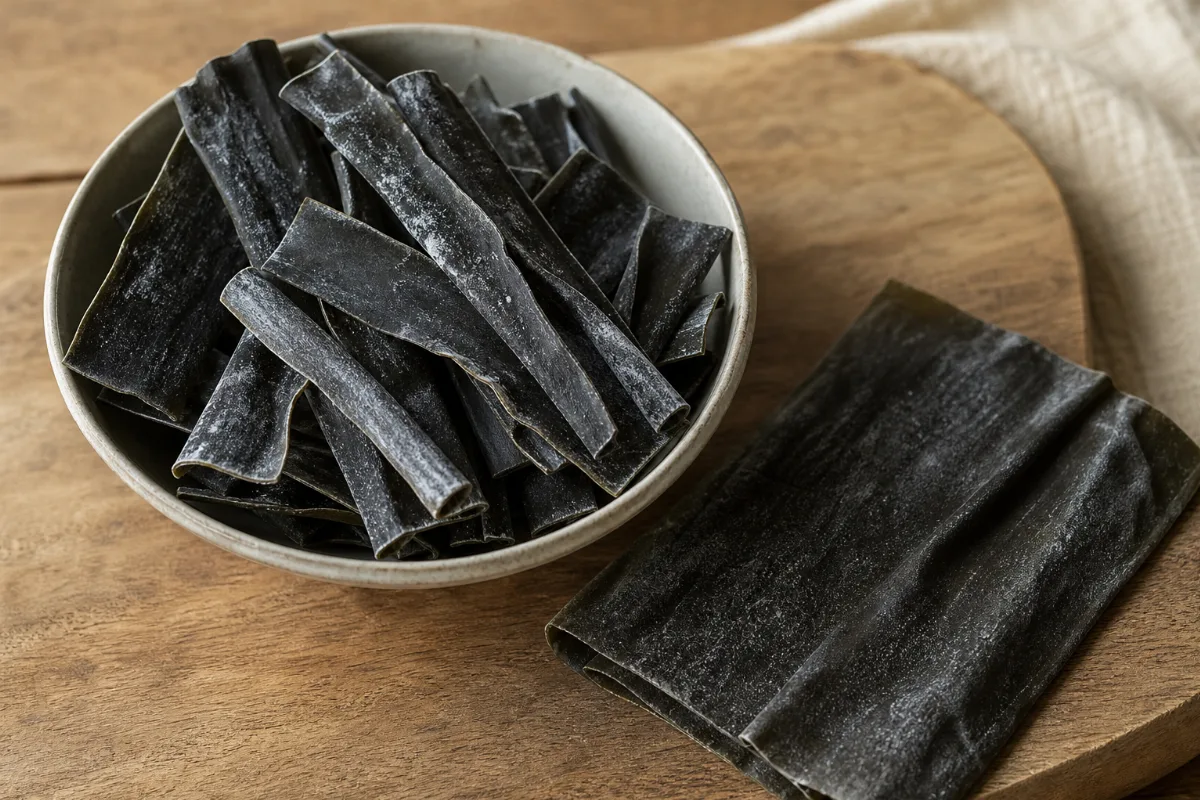
Kombu is a thick, dark brown sea vegetable, mostly Laminaria japonica (also called Saccharina japonica), a kelp in the brown seaweed group. It is sold dried in strips or sheets and is used in Japanese cooking, most of all to make stock (see Dashi). People eat it for its savory taste and minerals. This page separates the food from kelp tablets and extracts, and from web hype.
Read this first
- Iodine comes first. Kombu is among the highest-iodine seaweeds. One study of Norwegian market products found kombu averaged 2,276 micrograms (mcg) of iodine per gram. [3] A US survey found kelp products from under 600 to over 8,000 mcg per gram, against 16 mcg per gram in nori. [2] The adult upper limit is 1,100 mcg a day (Health Canada table, ATA). [12] [13] By our arithmetic, one gram of dried kombu at the Norwegian average is already about twice that. Real kombu varies a lot, so you cannot tell from looking.
- Who needs extra care: people with thyroid disease, people who are pregnant or breastfeeding, and young children. Ask a clinician or pharmacist before eating kombu often. This page does not tell anyone to eat or avoid it for a thyroid problem.
- Metals: a 2026 study found that nearly all commercial seaweed samples, including kombu, were above a French seaweed-institute guide limit for cadmium and total arsenic. [4]
- Evidence in one line: kombu is a food with a very high iodine load. One small trial found changes in body fat and blood pressure, and the evidence for "detox", weight loss or thyroid "support" claims is missing.
- If you have a reaction such as trouble breathing or swelling of the face or throat, call 911 or your local emergency number. We did not find a source we read on seaweed allergy, so we say nothing about how common it is.
What is in it (USDA values)
The USDA item is "Seaweed, kelp, raw" (FoodData Central 168457, SR Legacy). [1] This is raw, wet kelp, not the dried kombu sold in packets, which is much more concentrated. The serving column is the USDA household portion of 2 tablespoons (10 g). [1] USDA lists no iodine value for this item.
| Nutrient | Per 100 g | Per 2 tbsp (10 g) | % Daily Value per serving |
|---|---|---|---|
| Energy | 43 kcal | 4.3 kcal | not set |
| Protein | 1.68 g | 0.17 g | less than 1% |
| Fiber | 1.3 g | 0.13 g | less than 1% |
| Sodium | 233 mg | 23 mg | 1% |
| Calcium | 168 mg | 17 mg | 1% |
| Iron | 2.85 mg | 0.29 mg | 2% |
| Magnesium | 121 mg | 12 mg | 3% |
| Folate (DFE) | 180 mcg | 18 mcg | 5% |
| Vitamin K | 66 mcg | 6.6 mcg | 6% |
| Potassium | 89 mg | 8.9 mg | less than 1% |
% Daily Value uses the FDA 2016 Daily Values; values vary with species, harvest place and processing. The serving figures are the 100 g values divided by 10. [1] USDA lists vitamin B-12 as 0 for this item; we do not use that to say kelp has or lacks B12 (see Seaweed and vitamin B12).
Iodine is the nutrient that matters most, and it comes from other sources, not USDA:
| Source | Item and unit | Iodine found |
|---|---|---|
| Teas 2004 (US market samples, 12 species) [2] | Nori; processed Laminaria digitata kelp granules sold as a salt substitute | 16 mcg/g; over 8,165 mcg/g |
| Teas 2004 [2] | Two Namibian kelps, bleached vs fresh juvenile blades | 514 mcg/g; 6,571 mcg/g |
| Aakre 2021 (96 Norwegian products) [3] | Kombu, mean | 2,276 mcg/g (the abstract does not state dry or wet) |
| Nava 2026 (commercial seaweeds) [4] | Kombu | above 2,000 mg/kg, the upper limit of a French seaweed-institute guide |
Plant compounds: a 2025 trial describes kombu powder as high in alginate, a fiber from the cell wall. [9] That trial is the only item here that links a compound to an effect in people, and it did not test alginate alone.
What research says
| Health goal | What the sources found | Strength of evidence | What was studied |
|---|---|---|---|
| Iodine supply | Kombu is a very concentrated iodine food, and levels differ by species, harvest and processing. [2] [3] [4] | Established (measured content) | Market product surveys |
| Thyroid in regular seaweed eaters | Norwegian seaweed eaters had a median urinary iodine of 1,200 mcg/L, which the authors called excessive iodine status; TSH was within reference values but higher than in comparison groups. [8] After 6 weeks off seaweed, 49 habitual eaters cut estimated intake from 658 to 189 mcg/day and median TSH fell. [7] A Japanese survey of 2,845 adults found higher iodine intake went with higher TSH, with values still in the reference range. [6] | Mixed (observational and small before-after studies; they show changes in blood tests, not disease rates) | Seaweed in general, mostly kelp, not only kombu |
| Thyroid hormones on a measured kombu intake | In healthy Japanese adults eating boiled kombu powder in cookies for 12 weeks, blood thyroid hormones did not rise at about 420 mcg iodine a day. [9] | Promising but limited (one trial) | Boiled kombu powder, healthy adults |
| Body fat and blood pressure | In the same trial, body fat fell in men and systolic blood pressure was lower in men and women than with a cellulose placebo. [9] | Promising but limited (one 12-week trial, not repeated) | Boiled kombu powder in cookies, healthy Japanese adults |
| Gut bacteria | The trial saw shifts in several bacterial groups. [9] | Promising but limited (changes in bacteria counts, not health outcomes) | Same trial |
| How much iodine the body takes up | In 18 adults, iodine from a kombu meal was absorbed less than from potassium iodide (about 24 to 30% vs 64 to 84%). [10] | Promising but limited (small crossover-type study) | Kombu supplement vs potassium iodide |
| Weight loss, "detox", cancer, thyroid "support" | Proper evidence not found in the sources we read. | No good evidence of benefit | Not applicable |
Eaten as food vs taken as tablets or extract. Everything above is about kombu as food or food powder. Kelp tablets and kelp-based iodine pills are different products. The ATA advises against iodine and kelp supplements of more than 500 mcg iodine a day, and says many contain far more than the upper limit. [12] See kelp and seaweed supplements and the herb guide to kelp.
How much is a normal serving
There is no official serving of dried kombu in the sources we read. The USDA household portion for raw kelp is 2 tablespoons (10 g), which gives about 4 kcal. [1] That portion is information, not a prescription. Because iodine in dried kombu is so concentrated and so variable, we cannot give a "safe amount." The Health Canada reference table lists an adult upper limit of 1,100 mcg a day, and 200 to 300 mcg for children aged 1 to 8; the adult recommended intake is 150 mcg. [13] Japan's own regular intake is reported very differently: a 2011 literature analysis estimated 1,000 to 3,000 mcg a day, largely from seaweed, [5] while a 2016 to 2023 nationwide survey estimated about 400 mcg a day. [6] Estimates depend on the method.
Safety, allergy and medicines
- Iodine and the thyroid. Too much iodine can lead to thyroid problems. The ATA says more than 1,100 mcg of iodine a day is not recommended and may cause thyroid dysfunction. [12] A 2026 UK review describes people presenting with iodine-related thyroid problems linked to kelp supplements. [15] NHS says high doses over a long time could change how the thyroid works. [14]
- Thyroid disease and thyroid medicines. We did not read a source on kombu with levothyroxine or antithyroid drugs, so we make no claim. If you have thyroid disease or take thyroid medicine, ask your clinician before adding kombu.
- Pregnancy and breastfeeding. Health Canada lists a 1,100 mcg upper limit for pregnancy and lactation and recommended intakes of 220 and 290 mcg. [13] See Seaweed in pregnancy.
- Children. Health Canada lists 200 mcg (ages 1 to 3) and 300 mcg (ages 4 to 8) as upper limits for iodine. [13] A Japanese dietitian column notes Japan's limits for young children are 250 to 400 mcg and says a small amount of strong kombu stock could exceed a child's limit. [16]
- Arsenic and cadmium. Nearly all commercial seaweeds in a 2026 study, including kombu, were above the guide limits of 0.5 mg/kg cadmium and 3 mg/kg total arsenic; lead and mercury stayed below limits. [4] A 2024 lab study found boiling S. japonica for 10 minutes cut iodine by 94.4% and arsenic by 74.7%, and the authors concluded risk after cooking is low. [11] That is a lab result on one species, and it tested the kelp itself, not a stock. Contaminants overall: heavy metals in foods.
- Vitamin K. USDA lists 66 mcg of vitamin K per 100 g raw kelp. [1] We did not read a kombu-specific warfarin source. If you take a blood thinner, keep intake steady and ask your pharmacist. See food and medicine interactions.
- Allergy. Seaweed is not fish or shellfish. We did not find a source we read on seaweed allergy. Dried kombu is usually plain, but seasoned or flavored versions may contain other allergens: read the label. Food allergy basics.
- Symptoms to act on. Fast heartbeat, a swelling in the neck or new tiredness after heavy seaweed use: see a clinician. Chest pain or trouble breathing: call 911.
Choosing, storing and food safety
- Iodine often is not on the label. In the Norwegian survey, labeling of iodine was lacking for a large share of products. [8] Look for products that state iodine, or ask the seller.
- Iodine dissolves in cooking water and may be lost during humid storage, so the iodine in a prepared dish is hard to estimate. [2]
- We did not read food-safety rules for storing dried kombu, so we give none. Check the package.
Related pages
Health connections for Kombu
What research links to eating or drinking this food, and how strong the evidence is. Many studies are observational or use juice, powder, oil or extracts rather than the food as eaten; each card says which.
Kombu iodine and thyroid function in seaweed eaters
Preliminary or mixedIn regular seaweed eaters, urinary iodine was very high and TSH fell when seaweed was stopped. These are blood-test changes in small studies, not disease rates.
Supplements: Not a supplement question; the studies are of seaweed foods in general, mostly kelp.
Kombu and thyroid hormones in a 12-week trial
Preliminary or mixedIn healthy Japanese adults, thyroid hormones did not rise at about 420 mcg iodine a day from boiled kombu powder.
Supplements: One trial in healthy adults; it does not cover people with thyroid disease.
Cooking and how much kombu iodine reaches the body
Preliminary or mixedBoiling kelp cut its iodine by 94.4% in a lab model, and iodine from a kombu meal was absorbed less than from potassium iodide in 18 adults.
Supplements: Lab and small human studies; they do not remove the need for caution.
Kombu and body fat or blood pressure
Preliminary or mixedIn one 12-week trial, body fat fell in men and systolic blood pressure was lower in men and women who ate boiled kombu powder cookies, compared with placebo.
Supplements: One trial of food powder; it is not evidence for kelp pills.
Kombu and gut bacteria
Preliminary or mixedThe same trial saw shifts in several gut bacterial groups.
Supplements: Changes in bacteria counts, not health outcomes.
Nutrients in raw kelp (USDA)
Established roleRaw kelp gives small amounts of magnesium, folate, vitamin K, calcium and iron per 100 g. A 10 g portion gives under 6% of any Daily Value.
Supplements: Food source only.
Connected topics
Open a group to see how each topic connects and how strong the evidence is.
Health goals (4)
- Thyroid SupportDocumented risk
No source we read shows kombu supports the thyroid. Too much iodine can disturb it.
- Blood Pressure SupportPreliminary or mixed
Systolic blood pressure was lower with kombu powder in one 12-week trial. Not repeated.
- Microbiome BalancePreliminary or mixed
The kombu trial saw shifts in gut bacteria. The health meaning is unknown.
- Weight ManagementPreliminary or mixed
One 12-week trial of boiled kombu powder found lower body fat in men only. One trial is not enough.
Body systems (3)
- Endocrine SystemDocumented risk
Excess iodine from kombu can affect the thyroid, part of the hormone system.
- Gut HealthPreliminary or mixed
Changes in gut bacteria in one trial.
- Metabolism & WeightPreliminary or mixed
One small trial on body fat; no repeat.
Body parts (1)
- ThyroidDocumented risk
Kombu has so much iodine that it can push intake past the upper limit, which can disturb the thyroid. Ask a clinician if you have a thyroid condition.
Root causes (1)
- Heavy Metal ExposureDocumented risk
Kombu and other seaweeds took up cadmium and arsenic in a 2026 study; cooking cut arsenic in a lab test.
Biomarkers (1)
- TSHPreliminary or mixed
In a small before-after study of habitual seaweed eaters, TSH fell after they stopped seaweed. Changes were within normal ranges in other studies.
Conditions & symptoms (2)
- HyperthyroidismDocumented risk
Excess iodine from kelp can lead to thyroid dysfunction; the ATA advises against iodine and kelp supplements above 500 mcg a day.
- HypothyroidismDocumented risk
High iodine over time can change how the thyroid works; NHS and ATA say so. People with thyroid disease should ask their clinician.
Documented risks and interactions (3)
- Kombu and iodine intake. Kombu is one of the highest-iodine foods. Product surveys found averages of thousands of micrograms per gram, so a small piece can pass the adult upper limit.
- Kombu, arsenic and cadmium. Nearly all commercial seaweed samples, including kombu, were above French seaweed-institute guide limits for cadmium and total arsenic. Boiling cut arsenic in kelp in a lab study.
- Kombu in pregnancy, breastfeeding and childhood. Upper limits for iodine are lower in young children, and pregnancy and breastfeeding raise needs while the adult upper limit still applies.
Frequently asked questions
Is kombu high in iodine?
Yes. A Norwegian product survey found kombu averaged 2,276 mcg per gram, [3] and a 2026 study found kombu above a 2,000 mg/kg guide limit. [4] Iodine varies by species and harvest. [2]
Is kombu good for the thyroid?
We did not find evidence that it helps. Iodine is needed for the thyroid, but too much can cause problems. [12] In one 12-week trial, thyroid hormones did not rise at about 420 mcg iodine a day. [9] Ask your clinician if you have a thyroid condition.
Does boiling kombu remove iodine?
In a lab study, boiling S. japonica for 10 minutes cut iodine by 94.4%. [11] Iodine is also water-soluble in cooking, [2] so it moves into the cooking water. See Dashi.
Can kombu help with weight loss or blood pressure?
One 12-week trial in healthy Japanese adults found lower body fat in men and lower systolic blood pressure with boiled kombu powder cookies versus placebo. [9] One trial is not enough to recommend kombu for either.
Is kombu safe in pregnancy?
Iodine needs rise in pregnancy, but the upper limit is still 1,100 mcg a day. [13] Kombu iodine varies hugely, so ask your clinician before using it.
References
- U.S. Department of Agriculture. FoodData Central: Seaweed, kelp, raw (SR Legacy, FDC 168457). April 2018 release. Read 2026-10-24.
- Teas J, Pino S, Critchley A, Braverman LE. Variability of iodine content in common commercially available edible seaweeds. Thyroid 2004 (abstract read via Europe PMC). Read 2026-10-24.
- Aakre I et al. Commercially available kelp and seaweed products: valuable iodine source or risk of excess intake?. Food Nutr Res 2021 (abstract read). Read 2026-10-24.
- Nava V et al. Commercial edible seaweeds: characterization by mineral content and fatty acid composition. 2026 (abstract read via Europe PMC). Read 2026-10-24.
- Zava TT, Zava DT. Assessment of Japanese iodine intake based on seaweed consumption in Japan: a literature-based analysis. Thyroid Res 2011 (abstract read via Europe PMC). Read 2026-10-24.
- Fuse Y et al. Nationwide survey on iodine nutritional status and thyroid function in Japanese adults. 2026 (abstract read via Europe PMC). Read 2026-10-24.
- Aakre I et al. Impact of habitual seaweed consumption on iodine nutrition and thyroid function: a non-randomized pre-post clinical study. 2026 (abstract read via Europe PMC). Read 2026-10-24.
- Aakre I et al. Iodine status and thyroid function in a group of seaweed consumers in Norway. 2020 (abstract read via Europe PMC). Read 2026-10-24.
- Aoe S, Ohtoshi H, Nakamura F. Effects of daily kombu (Laminaria japonica) intake on body composition, blood pressure, and fecal microbiota in healthy adult Japanese: a randomized, double-blind study. Food Sci Nutr 2025 (abstract read via Europe PMC). Read 2026-10-24.
- Liu X et al. The iodine bioavailability and its metabolic response for kombu and potassium iodide intake in Chinese adults. Food Sci Nutr 2025 (abstract read via Europe PMC). Read 2026-10-24.
- Li N et al. Evaluation of the bioavailability of iodine and arsenic in raw and cooked Saccharina japonica based on simulated digestion/Caco-2 cell model. Foods 2024 (abstract read via Europe PMC). Read 2026-10-24.
- American Thyroid Association. ATA statement on the potential risks of excess iodine ingestion and exposure. 5 June 2013. Read 2026-10-24.
- Health Canada. Dietary reference intakes tables: reference values for elements. Page dated 2025-11-19. Read 2026-10-24.
- NHS. Vitamins and minerals: iodine. Last reviewed 3 August 2020. Read 2026-10-24.
- Taylor PN et al. What endocrinologists should know about iodine: population deficiency, individual excess and misinformation in the United Kingdom. 2026 (abstract read via Europe PMC). Read 2026-10-24.
- Eatreat editorial team (registered dietitian byline). Iodine and kombu dashi in childcare meals (Japanese). Published 2016, revised 2020. Read 2026-10-24.