Kelp (Saccharina japonica): Uses, Evidence and Safety
Kelp (Saccharina japonica, also Ascophyllum nodosum), a brown seaweed: why its iodine can upset the thyroid, the arsenic concern, and how little human evidence supports health claims.
Content last updated . This page has not been medically reviewed.
Safety first. Natural products can cause side effects and interact with medicines. Read herb safety and interactions before you use anything on this page.
What is Kelp good for?
What the body uses it for, and how strong the evidence is. A normal job in the body is not proof that extra supplements add benefit; each card says which.
Source of dietary iodine
Preliminary or mixedBrown kelps are among the richest seaweed sources of iodine, which the thyroid needs to make its hormones. The amount varies enormously between products and species.
Supplements: Reliable iodine content cannot be assumed; the authors called these products unreliable iodine sources.
General health benefits in people
Preliminary or mixedReviews say more human studies are needed before health benefits of seaweeds can be judged; no good human evidence of benefit for kelp supplements was found in the sources read.
Supplements: No good evidence of benefit from kelp supplements in the sources read.
Antioxidant and anti-inflammatory compounds (lab findings)
Lab or animal research onlyBrown seaweeds contain compounds such as fucoidan, fucoxanthin and phlorotannins that show antioxidant, anti-inflammatory and other effects in lab and animal models. How the body absorbs them is poorly understood.
Supplements: Not shown to help in people.
Connected topics
Open a group to see how each topic connects and how strong the evidence is.
Body systems (1)
- Endocrine SystemDocumented risk
Excess iodine from kelp can disturb thyroid hormone balance; the ATA advises against kelp supplements above 500 micrograms of iodine a day.
Body parts (1)
- ThyroidDocumented risk
Kelp can supply very large amounts of iodine, and too much iodine can make the thyroid underactive or overactive. A case report describes a temporary overactive thyroid after kelp tablets.
Root causes (1)
- Heavy Metal ExposureDocumented risk
Seaweed takes up arsenic; all 31 retail seaweed samples in a UK survey contained some, though the more harmful inorganic form was found only in hijiki. A kelp supplement poisoning case report is disputed. Other metals were not covered.
Conditions & symptoms (2)
- HyperthyroidismDocumented risk
A case report describes temporary hyperthyroidism after kelp tablets in a woman without earlier thyroid disease.
- HypothyroidismDocumented risk
Excess iodine is linked to an underactive thyroid in the Norwegian study; people with existing thyroid disease may be more susceptible.
Documented risks and interactions (5)
- Thyroid disturbance from excess iodine. Too much iodine from kelp can cause an underactive or an overactive thyroid. A case report describes a temporary overactive thyroid after kelp tablets in a woman with no earlier thyroid disease.
- Iodine limits and who is more vulnerable. The American Thyroid Association advises against kelp or iodine supplements above 500 micrograms of iodine a day, and names infants, older adults, pregnant or breastfeeding women and people with thyroid disease as more vulnerable.
- Pregnancy and breastfeeding. The ATA advises pregnant and breastfeeding women not to take kelp or iodine supplements above 500 micrograms of iodine a day.
- Arsenic and contamination. Seaweed takes up arsenic: every one of 31 retail dried seaweed samples in a UK survey contained some. The more harmful inorganic form was found only in hijiki, not in the other types tested. A kelp-supplement arsenic poisoning case report exists but its interpretation is disputed by a trade group.
- Unreliable product labelling. Labels often did not name the seaweed or gave iodine values that differed from lab results by more than 50%.
Safety first: iodine, the thyroid and arsenic
Kelp is a brown seaweed, and the main problem is iodine. Iodine is needed to make thyroid hormones, but kelp products can hold far too much of it, and the amount is often not reliable on the label. In a laboratory study of 96 seaweed products from Norway, the iodine in one portion of whole seaweed ranged from 128 to 62,400 micrograms, and in a daily supplement dose from 5 to 5,600 micrograms. For 54 products a single portion or dose was above the upper limit the authors used (600 micrograms a day). [1] Regular excess iodine is linked to an underactive thyroid, an overactive thyroid, goitre and autoimmune thyroid disease. [1] A case report describes a 70-year-old woman with no earlier thyroid disease who developed a temporary overactive thyroid about 3 months after starting kelp tablets; it cleared after she stopped them and took anti-thyroid treatment. [2] The American Thyroid Association (ATA) advises people of all ages, including pregnant and breastfeeding women, not to take iodine or kelp supplements providing more than 500 micrograms of iodine a day, and names infants, older adults, pregnant or breastfeeding women and people with thyroid disease as more vulnerable. [3]The second problem is contamination. Seaweed takes up arsenic from sea water; a UK survey of 31 dried retail seaweed samples found arsenic in every one. [4] A case report of long-term arsenic poisoning has been linked to an Icelandic kelp supplement, and trade-group authors dispute that interpretation, so this is debated, not settled. [5] Ask a doctor or pharmacist before using kelp if you have a thyroid condition, take thyroid medicine or lithium, are pregnant or breastfeeding, or have kidney disease. See thyroid conditions and iodine or herbal products and seaweed, iodine and the thyroid. This page is information, not a recommendation to use kelp.
Overview
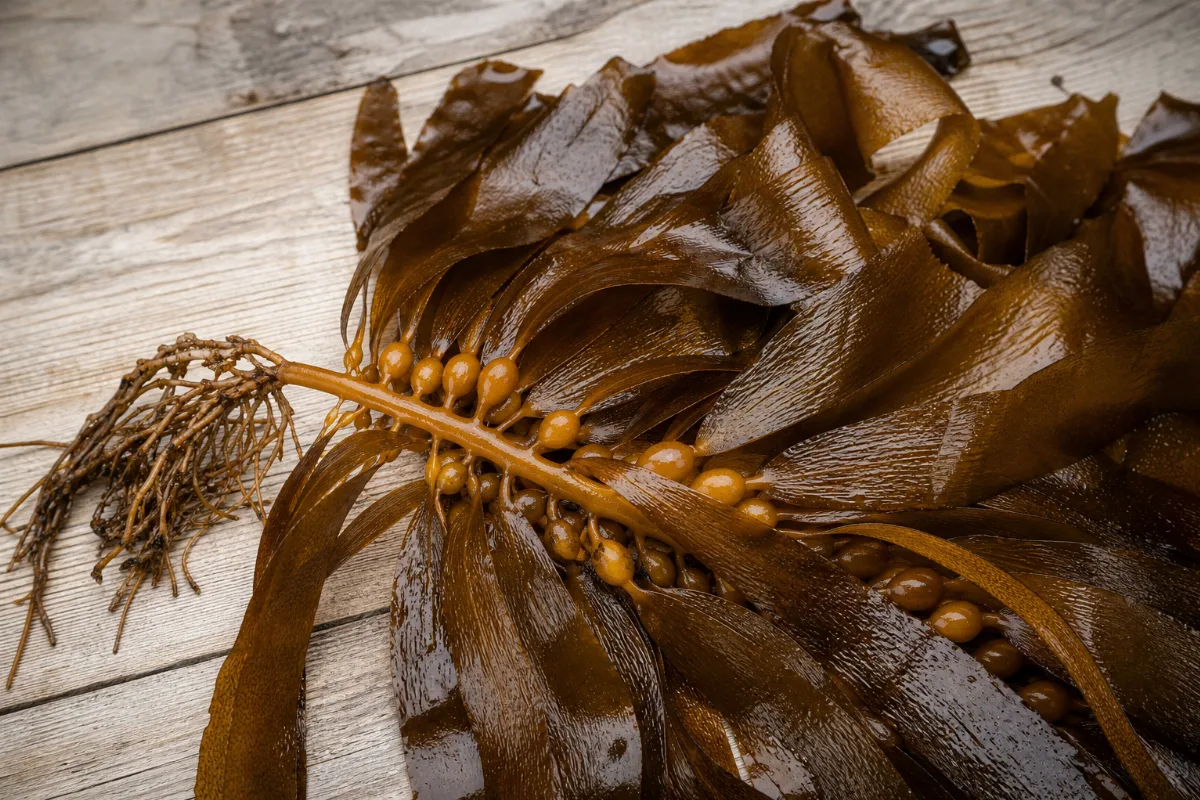
"Kelp" is a loose name for large brown seaweeds, so products differ. This page covers two that are sold under the name. Saccharina japonica (formerly Laminaria japonica; sold as kombu or kunbu) is in the family Laminariaceae. [6] Ascophyllum nodosum (knotted wrack, rockweed) is a different seaweed in the family Fucaceae, which GBIF lists as an accepted name. [6] Native range: not found in the sources we read. The part used is the whole seaweed body (thallus). It is eaten as a food and sold as powder, tablets, capsules and extracts, often in slimming or "thyroid" products. Product labels do not always name the species: in the Norwegian study, 12 products gave no information on the seaweed type. [1] Related but different: bladderwrack, which is Fucus vesiculosus and is sometimes sold as "brown kelp". Seaweed as a food and sea moss are covered in seaweed, sea moss and kelp.Traditional use (not proof of benefit)
Brown seaweeds are a long-standing part of the diet in many coastal and Asian food cultures, and narrative reviews describe their medicinal use in several traditions. [7] The sources we read did not give a clear list of traditional medical uses of kelp, so we do not list them. A long history of eating or using a seaweed is not proof that it treats anything.What research shows
| Use | What the sources found | Strength of evidence | Form and population |
|---|---|---|---|
| Source of iodine | Brown kelps had the highest iodine in the Norwegian study (averages roughly 2,270 micrograms per gram for kombu, 4,400 for sugar kelp, 7,800 for oarweed), with wide variation even within a species. [1] The authors called such products unreliable iodine sources. [1] | Strong on content, but unreliable as a dose | Foods and supplements |
| Health benefits in people (weight, cholesterol, diabetes, others) | A 2019 review said more human intervention studies are needed to judge benefit and that mechanism evidence is needed to support health claims. [8] A 2026 review of brown seaweeds said clinical studies are needed and that effects in humans are unclear. [7] | Insufficient evidence | Seaweed foods and extracts |
| Antioxidant, anti-inflammatory, antidiabetic, anticancer effects of compounds such as fucoidan and fucoxanthin | Described in lab and animal models, with human bioavailability poorly understood. [7] | Lab and animal findings only | Isolated compounds |
| Weight loss, thyroid "support", hair | Proper evidence not found in the sources we read. | No good evidence found | Supplements |
Because the first row is about iodine content and not a treatment, none of these rows shows that kelp supplements help a health condition.
Forms and why the form matters
Whole dried kelp, kelp tablets, capsules and extracts are not interchangeable. In the Norwegian study, whole-food seaweeds averaged much more iodine per portion than supplements, and iodine in 18 of 24 products with a declared value differed from the label by more than 50%. [1] Preparation changes iodine too: typical cooking or processing cut iodine by about 11 to 89% in dry weight, though a few products rose. [1] A result or limit for one product cannot be assumed for another. How much to use is a decision for a clinician or pharmacist, not this page.Safety in more detail
- Thyroid: excess iodine can cause both an underactive and an overactive thyroid. [1] Case report: temporary overactive thyroid after kelp tablets, in a person without earlier thyroid disease. [2] The authors of that report advise supervision and thyroid monitoring for people using kelp supplements. [2]
- Iodine limits quoted by the sources: the ATA says the upper limit for most people is 1,100 micrograms a day, with lower limits of 500 to 1,100 in pregnancy and breastfeeding, and advises against kelp or iodine supplements above 500 micrograms a day. [3] The Norwegian authors used 600 micrograms a day and cite a lowest-adverse-effect level of 1,800. [1] These are reference figures, not advice for any person.
- Arsenic and metals: arsenic was found in all 31 seaweed samples in the UK survey (18 to 124 mg/kg total). The more harmful inorganic form was found only in hijiki, a different seaweed, and was below the detection limit in the other types tested. [4] A letter from a herbal-industry trade group argues that most arsenic in food seaweed is the less toxic organic form and that the iodine in the supplement in the poisoning case could explain the symptoms. [5] The 2019 review lists arsenic among the risks of eating seaweed. [8] Lead, cadmium and mercury in kelp supplements: Proper evidence not found in the sources we read.
- Medicines: NIH Office of Dietary Supplements statements on iodine and anti-thyroid medicines were not read directly for this page. For thyroid medicines and lithium, see supplements and thyroid medicines and how herb and medicine interactions work.
- Pregnancy and breastfeeding: the ATA advises against kelp or iodine supplements above 500 micrograms of iodine a day in pregnancy and breastfeeding. [3] See pregnancy and breastfeeding safety.
- Children and older adults: the ATA names infants and older adults as more vulnerable to excess iodine. [3]
- Liver and kidney: the sources we read do not describe a kelp-specific liver or kidney warning. We could not read NIH's LiverTox entry, so we make no claim either way.
- Allergy and surgery: not covered by the sources we read. See supplements before surgery.
- Quality: labels are often incomplete or inaccurate on species and iodine. [1] See heavy metals in supplements and herbal products.
Official statements
- American Thyroid Association (US), first published June 2013, last updated March 2024: advises against iodine or kelp supplements above 500 micrograms of iodine a day. [3]
- UK Food Standards Agency: advised consumers to avoid hijiki seaweed because of inorganic arsenic (as reported in a 2007 survey). This is about hijiki, not kelp. [4]
- Not found in the sources we read: a current NCCIH, Memorial Sloan Kettering, EMA or FDA statement specific to kelp.
Related pages
Frequently asked questions
Can kelp supplements harm the thyroid?
They can in some people. Kelp can hold very large and unpredictable amounts of iodine, and a case report describes a temporary overactive thyroid after kelp tablets. [1][2] The ATA advises against kelp supplements above 500 micrograms of iodine a day. [3]
Is kelp the same as bladderwrack?
No. Bladderwrack is Fucus vesiculosus, while this page covers Saccharina japonica and Ascophyllum nodosum, though products are sometimes labelled loosely. See bladderwrack. [6]
Does kelp help with weight loss or other conditions?
Proper evidence not found in the sources we read. Reviews say more human studies are needed. [7][8]
Does kelp contain arsenic?
Seaweed takes up arsenic; every sample in a UK survey contained some, and the more harmful inorganic form was found only in hijiki. [4] The significance for kelp supplements is debated. [5]
Is kelp safe in pregnancy?
The ATA advises against kelp or iodine supplements above 500 micrograms of iodine a day in pregnancy and breastfeeding. [3] Ask a midwife or doctor first.
References
- Aakre I, et al. Commercially available kelp and seaweed products: valuable iodine source or risk of excess intake? Food & Nutrition Research, 2021. PMC8035890. Read 2026-10-23.
- Gherbon A, et al. Transient hyperthyroidism following the ingestion of complementary medications containing kelp seaweed: a case report. Medicine (Baltimore), 2019. PMID 31517826 (abstract read through Europe PMC). Read 2026-10-23.
- American Thyroid Association. ATA statement on the potential risks of excess iodine ingestion and exposure. Published June 2013, updated March 2024. Read 2026-10-23.
- Rose M, et al. Arsenic in seaweed: forms, concentration and dietary exposure. Food and Chemical Toxicology, 2007. PMID 17336439 (abstract read through Europe PMC). Read 2026-10-23.
- McGuffin M, Dentali S (American Herbal Products Association). Safe use of herbal kelp supplements. Environmental Health Perspectives, 2007. PMC2137109. A letter by an industry trade group responding to a case report. Read 2026-10-23.
- GBIF Secretariat. GBIF Backbone Taxonomy species match. Names checked through the species match service. Read 2026-10-23.
- Secret heroes of the sea: brown macroalgae and their bioactive powers, a narrative review. Frontiers in Nutrition, 2026. PMID 41809107 (abstract read through Europe PMC). Read 2026-10-23.
- Cherry P, et al. Risks and benefits of consuming edible seaweeds. Nutrition Reviews, 2019. PMID 30840077 (abstract read through Europe PMC). Read 2026-10-23.