Deadly Webcap
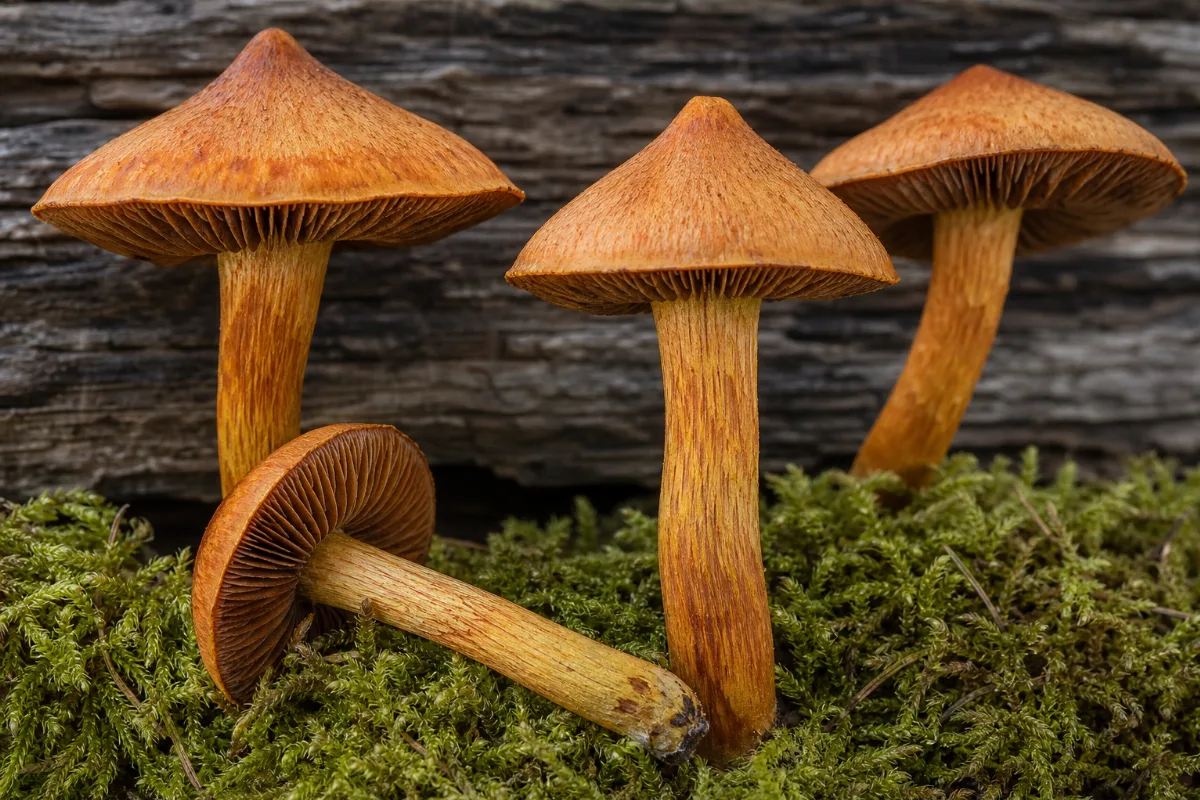
The deadly webcap (Cortinarius rubellus) and the fool's webcap (C. orellanus) contain orellanine, a kidney poison whose symptoms can start days to two weeks after a meal; this page explains the danger and what to do, and gives no identification help.
Content last updated . This page has not been medically reviewed.
Safety first. Supplements can cause side effects and interact with medicines. Read mushroom safety and interactions before you use any mushroom product.
Documented analytical data
Each group below is one study's measurement of the stated specimen or preparation. It is not a typical value for the species or product, varies between specimens, and says nothing about effects or safety. 2 values from 2 sources.
Gouvinhas I, Silva J, Alves MJ, Garcia J. The most dreadful mushroom toxins: a review of their toxicological mechanis... (1 value)
Source: Gouvinhas I, Silva J, Alves MJ, Garcia J. The most dreadful mushroom toxins: a review of their toxicological mechanisms, chemical structural characteristics, and treatment. EXCLI J. 2024. https://pmc.ncbi.nlm.nih.gov/articles/PMC11333700/ (open access; the figures are quoted there from Karlson-St... Laboratory: not stated in the review. Method: not stated in the review. Date: quoted by a 2024 review from a 2003 paper.
| Specimen or preparation | Analyte | Value | What it is | Sample size and scope |
|---|---|---|---|---|
| Cortinarius orellanus | Orellanine | 14 mg per g dry weight (dried mushroom, fruiting body) | figure quoted by the review for this species (reported) | not stated. reported range figure for the species |
Gouvinhas I, Silva J, Alves MJ, Garcia J. The most dreadful mushroom toxins: a review of their toxicological mechanis... (1 value)
Source: Gouvinhas I, Silva J, Alves MJ, Garcia J. The most dreadful mushroom toxins: a review of their toxicological mechanisms, chemical structural characteristics, and treatment. EXCLI J. 2024. https://pmc.ncbi.nlm.nih.gov/articles/PMC11333700/ (open access; the figures are quoted there from Karlson-St... Laboratory: not stated in the review. Method: not stated in the review. Date: quoted by a 2024 review from a 2003 paper.
| Specimen or preparation | Analyte | Value | What it is | Sample size and scope |
|---|---|---|---|---|
| Cortinarius speciosissimus (synonym of C. rubellus) | Orellanine | 9 mg per g dry weight (dried mushroom, fruiting body) | figure quoted by the review for this species (reported) | not stated. reported range figure for the species |
What is Deadly webcap good for?
What the body uses it for, and how strong the evidence is. A normal job in the body is not proof that extra supplements add benefit; each card says which.
Orellanine and related compounds (lab chemistry)
Lab or animal research onlyOrellanine is mostly present as sugar-bound forms in the mushroom; light turns it into orellinine (toxic) and then orelline (not toxic). Dried mushroom content is quoted as about 9 mg/g (C. rubellus, listed as C. speciosissimus) and 14 mg/g (C. orellanus) in one review.
Supplements: Not a food or supplement; there is no benefit to describe.
Laboratory cancer research on purified orellanine
Lab or animal research onlyBecause orellanine acts on kidney cells, it has been studied in the laboratory as a possible treatment for kidney cancer; a review mentions early human trials announced for 2022.
Supplements: Not applicable: research on purified orellanine, not on the mushroom.
Health claims or use as food or supplement
Not enough evidenceThe mushroom is not a food or supplement. We found no medicinal use.
Supplements: Not a food or supplement; there is no benefit to describe.
Connected topics
Open a group to see how each topic connects and how strong the evidence is.
Body systems (3)
- Kidney & UrinaryDocumented risk
The poison acts on the kidneys, with reduced or excess urine, flank pain and thirst in the kidney phase.
- Urinary SystemDocumented risk
Kidney failure from orellanine is the main outcome described in poisoning reports.
- Digestive SystemDocumented risk
Stomach symptoms are the first sign, usually about day 3, and are not the main lasting harm.
Body parts (2)
- KidneysDocumented risk
Orellanine harms the proximal tubule cells of the kidney. Kidney failure may need dialysis or a transplant. Damage can be permanent.
- GutDocumented risk
Nausea, vomiting, diarrhoea and stomach pain usually start around day 3; a review of long-term outcome found no lasting damage to the gut.
Root causes (1)
- Environmental ToxinsDocumented risk
A natural toxin from a wild mushroom; poisoning is almost always accidental.
Conditions & symptoms (4)
- Acute Kidney Tubular NecrosisDocumented risk
Kidney biopsies in poisoned patients show death of the tubule cells (tubular necrosis) and swelling of the tissue between the tubes.
- Kidney Failure, AcuteDocumented risk
The hallmark of orellanine poisoning is acute kidney failure, appearing days to about two weeks after the meal.
- Kidney FailureDocumented risk
General kidney failure label for the same outcome; matched to the exact acute and chronic topics above.
- Kidney Failure, ChronicDocumented risk
Acute kidney failure became long-term in about half of cases in one review and led to dialysis or transplant in many.
Documented risks and interactions (7)
- Orellanine kidney poisoning (delayed). Orellanine damages the cells of the kidney's proximal tubule. Stomach symptoms usually start around day 3 and kidney failure can follow up to about two weeks after the meal, so feeling well at first is not a sign of safety.
- Cooking, freezing and drying do not make it safe. Reviews say orellanine is not destroyed by cooking, freezing or drying. In a test, a stew with one webcap added still held measurable orellanine.
- No antidote; treatment is supportive. There is no antidote. Care is supportive, with dialysis for kidney failure and a transplant for some people. Antioxidants, steroids and N-acetylcysteine have been tried without consistent results.
- Long-term kidney damage and deaths. About 5.5% of strongly documented cases were fatal in one review. In a follow-up of 28 patients, 22 needed dialysis and 15 were transplanted; long-term survival was similar to other kidney-failure patients. Another review says kidney failure became long-term in about half of cases.
- Mistaken for edible wild mushrooms. Published reports name the yellow foot and golden chanterelle as edible mushrooms for which webcaps were mistaken; in Sweden people are treated every year for this mistake.
- Poison Help and emergency steps. Poison centres say to call at once, not to wait for symptoms, and to call 911 for collapse, seizure, trouble breathing or inability to wake.
- Delayed diagnosis. People often arrive only when the kidneys have failed. By then the toxin can no longer be found in blood or urine, and a kidney biopsy is often the only way to confirm.
Safety first. The deadly webcap and the fool's webcap are poisonous wild mushrooms. They contain orellanine, a toxin that damages the kidneys. Stomach symptoms usually start only a few days after eating, and kidney failure can follow up to about two weeks after the meal, so a person can feel well for days after a dangerous meal. [3][6] If anyone may have eaten a wild or unknown mushroom, call Poison Help now at 1-800-222-1222 (US), even if there are no symptoms. Poison centers say not to wait for symptoms, because they may not appear for several days. [1] Call 911 if the person collapses, has a seizure, has trouble breathing or cannot be woken. [2] Outside the US, call your local poison centre or emergency number; see poison help by country. This page gives no identification help and no way to tell safe from unsafe mushrooms. See mushroom poisoning: warning signs and urgent help and the mushroom safety quick reference.
The short version. These are not food, not a medicine and not a supplement. Orellanine is not destroyed by cooking, freezing or drying. [4][5] There is no antidote; care is supportive and, when the kidneys fail, centres on dialysis. [3][5][6] A published review puts deaths at about 5.5% of well-documented cases, and many survivors are left with long-term kidney damage. [3][6] Most poisonings happen when a foraged basket is mistaken for an edible mushroom. [3][9]
What they are
Cortinarius rubellus is called the deadly webcap, and C. orellanus the fool's webcap. [3] Wikidata lists Cortinarius speciosissimus, a name that appears in many older medical reports, as a synonym of C. rubellus. [14] They belong to the large webcap genus Cortinarius; they are woodland mushrooms of Europe and North America. [3][5] Not every webcap is poisonous, and we give no way to tell them apart. Orellanine has not been found outside this genus, and only in some of its members. [3]Do not identify wild mushrooms from text, photos or apps
Even very experienced gatherers can find it hard to know whether a mushroom is safe, according to a poison control centre. [1] In a 2026 study that tested 12 phone applications on mushroom photos, several species were misidentified or missed, especially when the mushroom was partly hidden or immature. [12] The mushroom safety quick reference says the same. Only buy mushrooms from a shop, or have a trained local expert check every mushroom, one by one, before eating. A mushroom that animals have eaten is not proof it is safe for people. [1]The toxin and how it acts
- Orellanine. The toxin is called orellanine. It was first linked to poisoning after a mass poisoning in Poland in the 1950s, and isolated in 1962. [3] Sources give different counts for that event (135 people in one review; 144 patients and 25 deaths in another), so we give no single figure. [3][5]
- Where it acts. In animals and in kidney samples from poisoned people, it harms the cells of the proximal tubule, the part of the kidney that reclaims useful substances from filtered blood. [3] The exact way it does this is still debated; oxidative damage is the main idea. [3][4]
- Its breakdown products. Light turns orellanine into orellinine, which is also toxic, and then into orelline, which is not. [3][5]
- Cooking. Orellanine does not break down below about 150 degrees C. Cooking, freezing and drying do not remove the toxicity. [3][4][5]
- In a meal. In a chemistry test, a mushroom stew made from edible mushrooms with a single webcap added still contained measurable orellanine. [8] One wrong mushroom can spoil the whole dish.
Symptom timeline
Timing varies a great deal from person to person. [3]- First hours to day 3: often nothing noticeable. Stomach symptoms (nausea, vomiting, diarrhoea, stomach pain) usually begin around day 3 (median 3 days in a review of 90 detailed cases). [3][6] Thirst, headache, chills, tiredness and muscle aches can come with them. [4] Reviews give a quiet period of about 2 to 6 days before the illness, and one case report gives kidney failure 2 to 20 days afterwards. [4][10]
- Kidney phase: back or flank pain, intense thirst, passing very little urine (or sometimes too much), then kidney failure; reviews give a median of about 8 to 8.5 days and a range up to about 2 weeks or more. [3][4][6] Some patients have mild symptoms that fade, which can leave the poisoning unnoticed. [4]
- Why it is missed: people often arrive only when the kidneys have failed, when mushrooms are no longer an obvious cause. By then the toxin can no longer be found in blood or urine, and a kidney biopsy is often the only way to confirm. [3] People sometimes eat the same mushrooms again in the days before symptoms appear. [5]
Because "feeling fine" does not mean safe, call the poison centre as soon as a wild mushroom may have been eaten. [1]
Treatment as described by medical sources
- There is no antidote. Treatment is supportive. [3][5][6]
- Dialysis. Standard care is dialysis to relieve the kidneys while they try to recover. [3] Some people need a kidney transplant. [5][6][7]
- Other ideas. Antioxidants, steroids or N-acetylcysteine have been tried, but results have not been consistent enough to call them standard. [3][5] Do not try them yourself.
- No home remedies. Do not try home treatments. Follow whatever the poison centre or a clinician tells you. See what to do first for any poisoning and what to tell Poison Help when you call.
- Tell the doctors. Say what was eaten, when, and how many people shared the meal. Keep the leftovers or a sample only if the poison centre asks you to.
How serious is it? What studies report
| Source | What it reports |
|---|---|
| Literature review of Cortinarius poisoning (2001): 245 cases collected, 90 analysed in detail | Stomach symptoms around day 3; kidney phase around day 8.5; kidney failure became long-term in about half; among those, dialysis or a transplant was needed in 70%. [6] |
| Review (2023) | About 5.5% of strongly documented cases died; fatalities have fallen since dialysis became routine. [3] |
| Follow-up of cases from 1979 to 2012: 28 of 39 patients studied | 22 of 28 needed dialysis; 15 were transplanted; at follow-up (average 17 years) 23 were alive and 5 had died; long-term outcome was similar to other patients on kidney-failure care. [7] |
| Review of forensic case reports (2020) | 27 deaths and 17 kidney transplants among the cases it listed. [5] |
| Review (2025) | Kidney failure may appear after 3 to 20 days; end-stage kidney failure may develop in 11%. [11] |
These figures come from different case collections and are not directly comparable. Reports tend to include the severe cases, so the real range of outcomes is not known. Reviews also describe individual differences, including age, pre-existing kidney disease and the amount eaten. [4]
Which edible mushrooms are named in poisoning reports
This is the history of mistakes, not a way to avoid them. A review says people most often eat these mushrooms believing them to be an edible kind, and names two: the yellow foot (Craterellus tubaeformis) and the golden chanterelle (Cantharellus cibarius). [3] A 2025 paper says foragers have confused the yellow foot with the deadly webcap and that people are treated in Sweden every year for this mistake; the webcap can grow in the same places, sometimes among yellow foot. [9] A 2012 chemistry study used yellow foot for the same reason. [8] In Norway, mushroom checkers have discarded whole baskets of yellow foot because a webcap was found among them. [9] This site's yellow foot, chanterelle and blewit pages cover the safety of those edible mushrooms; the blewit page names webcaps among possible mix-ups. These pages do not teach identification either.Reports also describe people eating the mushroom for the second time before the first symptoms arrive. [5]
Epidemiology
- Cases are reported mainly in Europe and North America, with some in Australia. [5]
- The first Scottish cases were reported in 1979; the authors called for warnings about the genus in books on wild foods. [15]
- Most poisonings are unintentional. [5]
- We found no recent count of cases for any single country that we could open. Treat all counts as partial.
Lab data and chemistry
Wikidata (the open knowledge base behind the LOTUS natural-products project) lists 6 compounds for Cortinarius rubellus and 2 for C. orellanus; none of the statements has a paper attached in the file we received. [13] A listing means "reported in at least one study of this species". This section describes a poison. It shows nothing about health benefits.A. What the laboratory literature reports in these mushrooms
| Compound or group | Class | Where in the mushroom / form | Identity | Source |
|---|---|---|---|---|
| Orellanine | Bipyridine N-oxide, the kidney toxin | Both species; mainly present as sugar-bound (glucoside) forms in the mushroom | Wikidata Q420527; ChEBI 190273 | [13][3][8] |
| Orellanine-4,4'-diglucopyranoside | Sugar-bound form of the toxin | C. orellanus (Wikidata); also shown in C. rubellus | Wikidata Q77566689; ChEBI 218621 | [13][8] |
| Orellinine | Light breakdown product of orellanine; toxic | C. rubellus | Wikidata Q82883641 | [13][3] |
| Orelline | Further breakdown product; not toxic | C. rubellus | Wikidata Q27271188 | [13][3] |
| 3-Hydroxypyridin-4(1H)-one | Small pyridine compound | C. rubellus | Wikidata Q27891533; ChEBI 28630 | [13] |
| 3-Hydroxy-4-oxo-1H-pyridine-2-carboxylic acid | Small pyridine acid | C. rubellus | Wikidata Q104667698 | [13] |
| Ergosterol | Fungal sterol | C. rubellus | Wikidata Q143263; ChEBI 16933 | [13] |
The toxin sits in the mushroom mainly as its sugar-bound forms, and these turn back into orellanine in acid or in water extracts, which makes measuring hard. [3][8]
B. Measured values
| Measure | Value | Basis | Sample | Source |
|---|---|---|---|---|
| Orellanine content | about 9 mg/g | dried mushroom | Cortinarius speciosissimus (a synonym of C. rubellus) | [4] |
| Orellanine content | about 14 mg/g | dried mushroom | Cortinarius orellanus | [4] |
| Orellanine in a cooked stew | measurable, not given as a number in the abstract | stew of edible mushrooms plus one specimen of the deadly webcap | one stew; lowest level the method detected: 4.9 ng/mL in extracts | [8] |
| Peak serum creatinine in poisoned patients | about 1,329 micromoles per litre (average) | blood test, patients needing care | 28 patients | [7] |
The two content values are quoted by a 2024 review from an earlier paper (Karlson-Stiber and Persson, 2003); we did not open the original. No USDA entry exists, as this is not a food. We found no open measured value for heavy metals, triterpenes or beta-glucan, and we did not look for any, as they are not relevant here.
C. What the numbers do and do not mean
- A content figure is an average from one set of dried samples. Toxin levels differ between samples, places and years, so no size or amount of a poisonous mushroom can be called safe. [4]
- Heating does not destroy orellanine, so a "cooked" mushroom is not safer. [3][4][5]
- The tests used in clinics have trouble finding orellanine once symptoms start, because the toxin leaves the blood while the kidneys hold it. [3][5]
- Orellanine has been studied in the laboratory as a possible cancer treatment, because it acts on kidney cells; a review says early human trials were announced for 2022. This is research on a purified molecule, not on the mushroom, and it gives no reason to eat the mushroom. [3]
Related pages
Frequently asked questions
What should I do if someone ate a wild mushroom?
Call Poison Help at 1-800-222-1222 (US) now, even without symptoms. Call 911 for collapse, a seizure, trouble breathing or if the person cannot be woken. [1][2]
How long until symptoms of deadly webcap poisoning show?
Stomach symptoms usually begin around day 3, and kidney failure can follow days later, up to about two weeks or more after the meal. Feeling fine at first is not a sign of safety. [3][6]
Does cooking, freezing or drying make it safe?
No. Orellanine is not destroyed by cooking, freezing or drying. [3][4]
Is there an antidote?
No. Care is supportive; dialysis is the standard when the kidneys fail, and some people need a transplant. [3][5][6]
Can I tell it from an edible mushroom with a photo or an app?
No. Do not identify wild mushrooms from text, photos or apps. [1][12]
Does it have any medicinal use?
No. It is a poison. A purified form of orellanine is being studied in the laboratory for kidney cancer, which is not a reason to eat it. [3]
References
- The University of Kansas Health System Poison Control Center. Poisonous Mushrooms. Read 2026-10-24.
- Poison Control (America's Poison Centers). Need immediate assistance?. Read 2026-10-24.
- Lyons MJ, Ehrhardt C, Walsh JJ. Orellanine: From Fungal Origin to a Potential Future Cancer Treatment. J Nat Prod. 2023;86(6):1620-1631. PMC10294258. Read 2026-10-24 (open access; full text).
- Gouvinhas I, Silva J, Alves MJ, Garcia J. The most dreadful mushroom toxins: a review of their toxicological mechanisms, chemical structural characteristics, and treatment. EXCLI J. 2024. PMC11333700. Read 2026-10-24 (open access; orellanine section; the dried-weight figures are quoted there from Karlson-Stiber and Persson 2003, which we did not open).
- Flament E, Guitton J, Gaulier JM, Gaillard Y. Human Poisoning from Poisonous Higher Fungi: Focus on Analytical Toxicology and Case Reports in Forensic Toxicology. Pharmaceuticals. 2020;13(12):454. PMC7764321. Read 2026-10-24 (open access; orellanine section).
- Danel VC, Saviuc PF, Garon D. Main features of Cortinarius spp. poisoning: a literature review. Toxicon. 2001;39:1053-1060. PubMed 11223095. Abstract read 2026-10-24 (via Europe PMC).
- Hedman H, Holmdahl J, Molne J, et al. Long-term clinical outcome for patients poisoned by the fungal nephrotoxin orellanine. BMC Nephrol. 2017;18:121. PMC5379567. Abstract read 2026-10-24 (via Europe PMC).
- Analysis of the mushroom nephrotoxin orellanine and its glucosides. J Nat Prod. 2012;75(11). PubMed 23046414. Abstract read 2026-10-24 (via Europe PMC).
- How funnel chanterelle (Craterellus tubaeformis) became an urban forager favorite in Scandinavia. J Ethnobiol Ethnomed. 2025. PMC12107856. Read 2026-10-24 (open access; passages on the webcap).
- Beaumier M, Rioult JP, Georges M, et al. Mushroom Poisoning Presenting With Acute Kidney Injury and Elevated Transaminases. Kidney Int Rep. 2019. PMC6551513. Read 2026-10-24 (open access; discussion of orellanine syndrome).
- Tugcan MO, Akpinar AA. Mushroom poisoning: An updated review. Turk J Emerg Med. 2025. PMC11774429. Read 2026-10-24 (open access; passage on orellanine).
- AI-mediated risks and real-life challenges in mushroom foraging. npj Science of Food. 2026. PMC13065802. Read 2026-10-24 (open access; results on app accuracy).
- Wikidata (CC0), compound-in-taxon statements (P703) for Cortinarius rubellus, Q944328 and Cortinarius orellanus, Q1367003, via the LOTUS project; read from the file
docs/research/mushroom-lab-sources/lotus-deadly-webcap.json, retrieved 2026-10-23. Compound pages were not opened. - Wikidata (CC0), item Q944328 (Cortinarius rubellus), "taxon synonym" statement naming Cortinarius speciosissimus (Q81010299). Read 2026-10-24.
- Short AI, Watling R, MacDonald MK, Robson JS. Poisoning by Cortinarius speciosissimus. Lancet. 1980;2:942-944. PubMed 6107589. Abstract read 2026-10-24 (via Europe PMC).