Yellowfoot
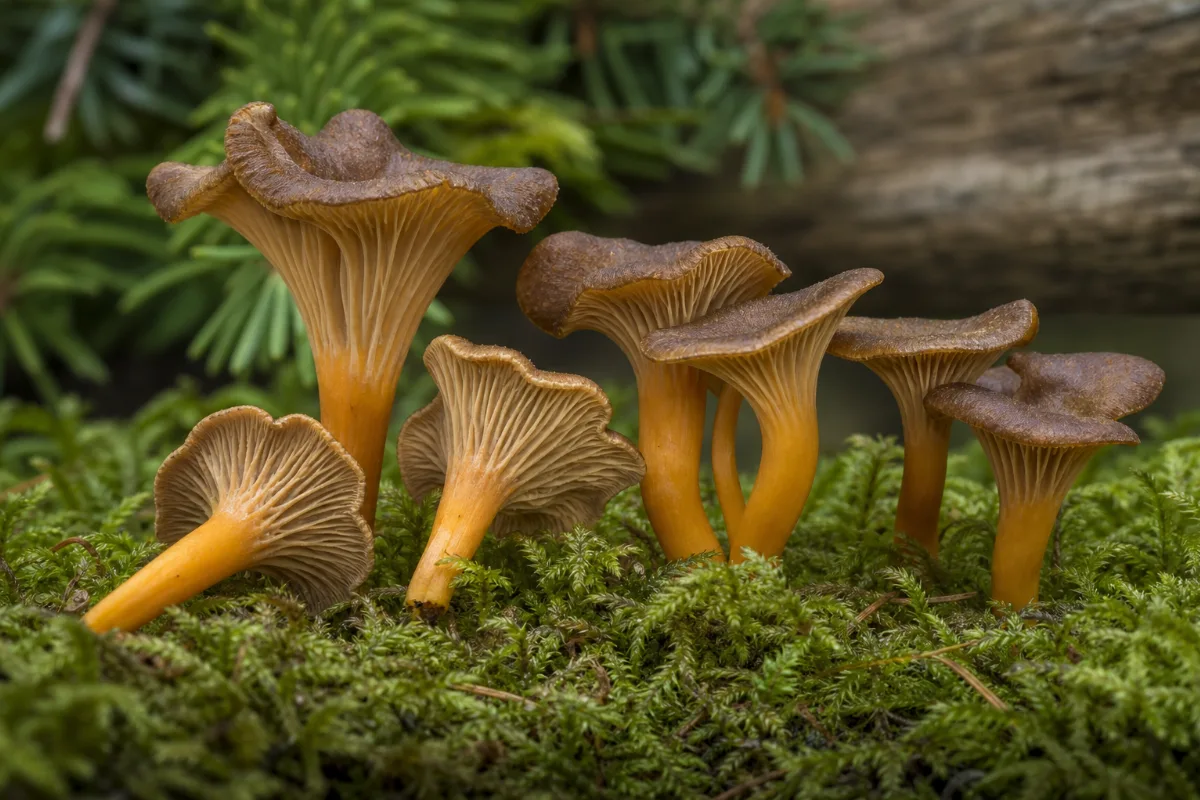
Yellow foot or funnel chanterelle (Craterellus tubaeformis) is an autumn forest food mushroom with one small vitamin D absorption trial, almost no nutrient data, and a deadly kidney-poisoning look-alike.
Content last updated . This page has not been medically reviewed.
Safety first. Supplements can cause side effects and interact with medicines. Read mushroom safety and interactions before you use any mushroom product.
Documented analytical data
Each group below is one study's measurement of the stated specimen or preparation. It is not a typical value for the species or product, varies between specimens, and says nothing about effects or safety. 3 values from 2 sources.
How funnel chanterelle (Craterellus tubaeformis) became an urban forager favorite in Scandinavia. J Ethnobiol Ethnome... (1 value)
Source: How funnel chanterelle (Craterellus tubaeformis) became an urban forager favorite in Scandinavia. J Ethnobiol Ethnomed 2025, quoting the 1999 Am J Clin Nutr bioavailability study. https://pmc.ncbi.nlm.nih.gov/articles/PMC12107856/ Laboratory: not stated in the source we read. Method: not stated in the source we read. Date: see source.
| Specimen or preparation | Analyte | Value | What it is | Sample size and scope |
|---|---|---|---|---|
| Craterellus tubaeformis, wild | Vitamin D2 (ergocalciferol), value quoted from the 1999 trial | 15.4 ug per 100 g (basis not stated in the text read) | single value (reported) | not stated. reported range or value quoted second-hand |
Content of vitamin D2 in alternative biological and nutritional sources (review). Metabolites 2026;16(7):485, quoting... (2 values)
Source: Content of vitamin D2 in alternative biological and nutritional sources (review). Metabolites 2026;16(7):485, quoting Mattila et al. 1994. https://pmc.ncbi.nlm.nih.gov/articles/PMC13414236/ (open access). Laboratory: not stated in the source we read. Method: not stated in the source we read. Date: see source.
| Specimen or preparation | Analyte | Value | What it is | Sample size and scope |
|---|---|---|---|---|
| Cantharellus tubaeformis, Finland, late summer to early autumn | Vitamin D2 (ergocalciferol), lower end of reported range | 3 ug per 100 g (fresh, wild, natural sunlight) | minimum of range (reported) | not stated. reported range or value quoted second-hand |
| Cantharellus tubaeformis, Finland, late summer to early autumn | Vitamin D2 (ergocalciferol), upper end of reported range | 30 ug per 100 g (fresh, wild, natural sunlight) | maximum of range (reported) | not stated. reported range or value quoted second-hand |
What is Yellow foot (funnel chanterelle) good for?
What the body uses it for, and how strong the evidence is. A normal job in the body is not proof that extra supplements add benefit; each card says which.
As a food (nutrition)
Preliminary or mixedYellow foot is eaten as a flavoursome wild food in Scandinavia, fresh, dried or frozen. We found no USDA entry and no open full nutrient table for it. A Finnish study reported its flavour compounds and a Spanish study classed it as a potassium-rich bioindicator.
Supplements: No supplement use found; this is about eating the mushroom. No full nutrient table was read.
Vitamin D2 source (when grown in sun)
Preliminary or mixedWild fruiting bodies contain vitamin D2 made by sunlight from ergosterol. A 1999 trial of 27 volunteers with low blood vitamin D found freeze-dried yellow foot (14 micrograms of D2 a day for 3 weeks, weekdays) raised blood 25-hydroxyvitamin D about as well as a D2 supplement of the same size.
Supplements: Small trial (n=27, 9 per group) using freeze-dried, homogenised mushroom; it shows absorption, not a clinical benefit.
Cell-wall polysaccharides (lab findings)
Lab or animal research onlyThe fruiting body holds alpha-mannan/galactan and beta-glucan type chains; hot-pressurised-water extraction was tested for glucans and antioxidant activity in the laboratory.
Supplements: No human data; no supplement product was found in what we read.
Taste and cooking quality
Preliminary or mixedPrized for aroma and flavour; free amino acids and nucleotides (umami compounds) were measured in Finnish samples and sensory work exists.
Supplements: Not applicable to supplements.
Potassium-accumulating mushroom (bioindicator)
Preliminary or mixedIn a Spanish study, yellow foot was among species that concentrate potassium (and its natural radioactive isotope 40K); the authors judged the radiation dose from eating mushrooms to be very low and said they could be a potassium source.
Supplements: Food only.
Immune, anticancer and other health claims
Not enough evidenceWe found no human study of yellow foot for any health outcome beyond the vitamin D absorption trial.
Supplements: No evidence found either way.
Connected topics
Open a group to see how each topic connects and how strong the evidence is.
Body systems (2)
- Kidney & UrinaryDocumented risk
Kidney damage comes from the deadly webcap, a look-alike that is mistaken for yellow foot, not from yellow foot itself. Delayed (about 3 to 14 days) kidney failure; no antidote.
- Urinary SystemDocumented risk
Kidney damage comes from the deadly webcap, a look-alike that is mistaken for yellow foot, not from yellow foot itself. Delayed (about 3 to 14 days) kidney failure; no antidote.
Body parts (1)
- KidneysDocumented risk
Kidney damage comes from the deadly webcap, a look-alike that is mistaken for yellow foot, not from yellow foot itself. Delayed (about 3 to 14 days) kidney failure; no antidote.
Biomarkers (1)
- Vitamin DPreliminary or mixed
A 1999 trial in 27 people with low blood vitamin D found sun-grown dried yellow foot raised 25-hydroxyvitamin D about as well as a D2 supplement. Small and short; vitamin D2 in wild mushrooms varies with sunlight.
Conditions & symptoms (2)
- Acute Kidney Tubular NecrosisDocumented risk
Caused by orellanine in the deadly webcap, a look-alike mistaken for yellow foot; not by yellow foot itself.
- Kidney Failure, AcuteDocumented risk
Orellanine poisoning from the look-alike can progress to complete kidney failure; dialysis is the standard care and there is no antidote.
Documented risks and interactions (4)
- Deadly look-alike: orellanine kidney poisoning. The deadly webcap (Cortinarius rubellus) is repeatedly named as being mistaken for yellow foot. Its toxin orellanine damages the kidney tubules; stomach symptoms usually begin around day 3 and kidney symptoms up to 2 weeks after eating. There is no antidote; dialysis is the standard care. Swedish clinics treat this mistake every year.
- Cooking does not make a poisonous look-alike safe. A mushroom stew made from yellow foot with a single webcap added still contained measurable orellanine, showing one wrong mushroom contaminates a whole dish.
- Radiocaesium after Chernobyl. Interest in the mushroom fell after the 1986 Chernobyl accident because of caesium-137 contamination, then recovered. Levels depend on the forest of origin.
- Allergy and general food cautions. Edible-mushroom allergy exists in general. We found no yellow-foot-specific allergy, pregnancy or drug-interaction source.
Safety first. Wild mushrooms can be poisonous. If anyone has eaten a wild mushroom and you are worried, call Poison Help at 1-800-222-1222 (US) right away and do not wait for symptoms. See Plant and Mushroom Poisoning and mushroom poisoning and urgent help. This page gives no identification or foraging help.
The short version. Yellow foot is a thin, funnel-shaped, brown-capped mushroom that is picked in autumn and eaten fresh, dried or frozen, mostly in Scandinavia. It is a food, not a supplement. The only human study we found measured how well the body absorbs its vitamin D. No open full nutrient table exists for it, and we found no evidence for health claims such as immune or anticancer effects.
What it is
Yellow foot is Craterellus tubaeformis, also written Cantharellus tubaeformis in older sources. It is a funnel chanterelle, a relative of the golden chanterelle but in a different genus. [1] Names overlap: Swedish trattkantarell, English "winter chanterelle", "trumpet chanterelle" and "funnel chanterelle" are used for it, and a 2025 paper uses "yellow foot" for a different species, C. lutescens. [1] So check the Latin name in anything you read. It grows in moss under conifers and beech, forms a partnership with tree roots (mainly spruce and pine), and fruits from August to November, sometimes later. [1] The fruiting body is the part eaten. See also chanterelle and black trumpet.As a food
- Use. In Scandinavia it is used fresh or dried, or frozen, in sauces, soups, sandwiches and with game. Dried mushrooms are soaked about 30 minutes in water, wine or milk. One described freezing method is to heat the mushrooms in a pan until they release liquid, then freeze them in it. [1]
- Nutrition. We found no USDA FoodData Central entry for it (the USDA chanterelle record is for Cantharellus cibarius, a different mushroom) and no open full nutrient table, so we give no calories or protein figures. [2] A Spanish study found it concentrates potassium and its natural radioactive form (40K), judged the radiation dose from eating mushrooms very low, and said such mushrooms could be a potassium source in the diet; we did not read a per-portion figure for this species. [3]
- Flavour. Free amino acids and flavour nucleotides were measured in Finnish samples for the first time in 2018; umami amino acids were among the main free amino acids. [4]
- Cooking and storage. Use the general advice in cooking edible mushrooms safely and storing mushrooms. We found no yellow-foot-specific source on raw eating.
Traditional use
It is a popular wild food in Sweden and Norway; roughly 40% of Swedes aged 18 to 74 pick fungi and this is among the favourite species. [1] We found no source for a traditional medicinal use, so we do not claim one. Proper evidence not found.What research shows
| Question | What the source found | Strength of evidence | Form studied |
|---|---|---|---|
| Does mushroom vitamin D get absorbed? | Twenty-seven volunteers with low blood vitamin D (below 60 nmol/L) were split into 3 groups of 9. For 3 weeks (weekdays only) one group ate freeze-dried yellow foot giving 14 micrograms of vitamin D2 a day, one took a 14 microgram D2 supplement, one took nothing. Blood 25-hydroxyvitamin D rose in both treated groups compared with no treatment, and the mushroom and supplement groups did not differ. [5] | Small, short trial; shows absorption, not a health benefit | Freeze-dried, homogenised wild fruiting body |
| Cell-wall sugars and antioxidant activity | Laboratory work described the structure of its mannan/galactan and beta-glucan chains and tested hot-water extraction of glucans. [6][7] | Laboratory only | Extracts |
| Immune, anticancer, blood sugar, brain or other effects | Proper evidence not found. We found no human or animal study of these for yellow foot. | None | Not applicable |
Fruiting body, mycelium and grain products
We found no mycelium-on-grain or extract product for this mushroom, so the usual fruiting-body versus mycelium problem (see fruiting body vs mycelium) does not arise. Everything above is about the wild fruiting body.Lab data and chemistry
Very little is published and openly readable. Wikidata (the open knowledge base behind the LOTUS natural-products project) lists only 3 compounds reported in Craterellus tubaeformis, with no paper attached to any statement in the file we received. [10] A listing means "reported in at least one study of this species", not "present in every product". This section does not show that eating yellow foot improves any health condition.A. What the laboratory literature reports in this mushroom
| Compound or group | Class | Where in the mushroom / form | Identity | Source |
|---|---|---|---|---|
| (E)-10-hydroxydec-8-enoic acid (and the same compound without the double-bond shape given) | Hydroxy fatty acid | Part not given | Wikidata Q76303310; ChEBI 138752; unspecified form Q105234053 | [10] |
| Cibaric acid | Fatty acid derivative (also listed for the golden chanterelle) | Part not given | Wikidata Q77513850; ChEBI 177569 | [10] |
| Mannan/galactan-type polysaccharide | Hot-water-soluble cell-wall sugar chains bound to protein | Fruiting body | no single ID | [6] |
| Beta-glucan (beta-1,6 glucose chains with short 1,3 branches) | Fibre-like polysaccharide, alkali-extracted | Fruiting body | no single ID | [6][7] |
| Free amino acids (including umami amino acids) and 5'-nucleotides | Flavour compounds | Fruiting body | not checked | [4] |
| Ergosterol and vitamin D2 | Sterol and its sunlight product | Fruiting body; D2 shown by the absorption trial | not looked up | [5][12] |
| Potassium (and 40K) | Mineral | Fruiting body | not applicable | [3] |
B. Measured values. No USDA entry for this species. The values below are second-hand: we read the abstracts or reviews, not the original measurement papers.
| Measure | Value | Basis | Sample | Source |
|---|---|---|---|---|
| Vitamin D2 | 3 to 30 micrograms per 100 g | fresh, wild, natural sunlight | Finnish samples collected late summer and early autumn (Mattila 1994, quoted by a review; original not opened) | [12] |
| Vitamin D2 | about 15.4 micrograms per 100 g | not stated in the text we read | quoted from the 1999 trial by a 2025 paper; the trial abstract itself gives only the daily amount of 14 micrograms | [1][5] |
| Vitamin D2 given in the trial | 14 micrograms per day | freeze-dried mushroom, weekdays for 3 weeks | 9 volunteers in the mushroom group | [5] |
| Potassium, ergothioneine, beta-glucan, triterpenes, heavy metals | no open measured value found |
C. What the numbers do and do not mean
- Vitamin D2 in wild mushrooms depends on sunlight, season and storage, so the 3 to 30 range shows how much it can vary. Farmed, UV-treated mushrooms are different; see mushrooms and vitamin D. [12]
- The trial shows the vitamin D2 was absorbed from the mushroom as well as from a supplement of the same size. It did not test whether anyone became healthier. [5]
- A compound found in the lab is not shown to do anything in people who eat the mushroom. [6][7]
- Metal and radioactivity levels depend on where the mushroom grew; no measured value for this species was read.
- Eating a mushroom portion gives small amounts compared with extracts; see food portions vs supplement amounts.
Related pages
Frequently asked questions
Is yellow foot the same as the funnel chanterelle?
Usually yes: Craterellus tubaeformis. But one 2025 paper uses "yellow foot" for a related species, C. lutescens, so check the Latin name. [1]
Does yellow foot have vitamin D?
Wild fruiting bodies contain vitamin D2, and in a small 1999 trial it was absorbed as well as a supplement of the same size. The amount varies with sunlight (3 to 30 micrograms per 100 g fresh in one older report). [5][12]
Is it good for immunity or cancer?
Proper evidence not found. We found no study of these for yellow foot.
What is the main danger?
Mistaking the deadly webcap, which causes delayed kidney failure, for yellow foot. Never identify wild fungi from text or an app. [1][8]
Does cooking make a poisonous mushroom safe?
No. In a chemistry study a stew with just one webcap added still held the toxin. [9]
More details: evidence, limits and cautions
The details behind this page: cautions, limits of the evidence and where sources disagree. Open any note to read it.
Safety and limits of the evidence
- The real danger is a look-alike. The deadly webcap (Cortinarius rubellus) grows in similar places, sometimes among funnel chanterelles, and Swedish clinics treat poisonings every year from this mistake. [1] Its toxin orellanine is a kidney poison. A review says stomach symptoms usually begin around day 3, kidney symptoms can start up to 2 weeks after eating, damage to the kidney tubes is irreversible, there is no antidote, and dialysis is the standard care; about 5.5% of well-documented cases were fatal. [8] The review names yellow foot as one of the edible species this toxic mushroom is mistaken for. [8]
- Do not identify wild fungi from text or an app. A 2026 study of AI identification tools found they misidentified or failed to recognise common species, including the funnel chanterelle. [11]
- One wrong mushroom spoils the dish. In a chemistry study, a stew made from yellow foot with a single webcap added still contained measurable orellanine. [9] Cooking does not remove toxins from poisonous species; see chanterelle.
- Radiocaesium and metals. Interest in the mushroom fell after the 1986 Chernobyl accident because of caesium-137 contamination, then recovered within a few years. [1] We did not read a measured value for this species. See heavy metals and contamination.
- Medicines, pregnancy, breastfeeding, allergy, surgery. Not described for yellow foot in the sources we read. Lack of a report is not proof of safety. Mushroom allergy exists in general: see mushroom allergy and medicine interactions.
- Conservation. The 2025 authors see room to pick more and no risk of over-harvesting in Scandinavia; this is their opinion, not a formal assessment. [1] See wild harvest and conservation.
References
- How funnel chanterelle (Craterellus tubaeformis) became an urban forager favorite in Scandinavia. J Ethnobiol Ethnomed. 2025. PMC12107856. Read 2026-10-24 (open access; main text).
- U.S. Department of Agriculture. FoodData Central. Public domain. The local copy of the mushroom records was checked on 2026-10-24: no Craterellus or Cantharellus tubaeformis entry.
- Natural radioactivity and total K content in wild-growing or cultivated edible mushrooms and soils from Galicia (NW Spain). Environ Sci Pollut Res. 2021. PubMed 34018117. Abstract read 2026-10-24.
- Free amino acids and 5'-nucleotides in Finnish forest mushrooms. Food Chem. 2018. PubMed 29277224. Abstract read 2026-10-24.
- Bioavailability of vitamin D from wild edible mushrooms (Cantharellus tubaeformis) as measured with a human bioassay. Am J Clin Nutr. 1999. PubMed 9925129. Abstract read 2026-10-24 (via Europe PMC).
- Structural investigation of cell wall polysaccharides extracted from wild Finnish mushroom Craterellus tubaeformis (Funnel Chanterelle). Food Chem. 2019. PubMed 31377617. Abstract read 2026-10-24.
- Pressurized hot water extraction of beta-glucans from Cantharellus tubaeformis. Electrophoresis. 2018. PubMed 29460953. Abstract read 2026-10-24.
- Orellanine: from fungal origin to a potential future cancer treatment. 2023. PMC10294258. Read 2026-10-24 (open access; about the first 100,000 characters).
- Analysis of the mushroom nephrotoxin orellanine and its glucosides. J Nat Prod. 2012. PubMed 23046414. Abstract read 2026-10-24.
- Wikidata (CC0), compound-in-taxon statements (P703) for Craterellus tubaeformis, Q371126, via the LOTUS project; read from the file
docs/research/mushroom-lab-sources/lotus-yellow-foot.json, retrieved 2026-10-23. Compound pages were not opened. - AI-mediated risks and real-life challenges in mushroom foraging. npj Science of Food. 2026. PMC13065802. Cited as read on the chanterelle page of this site; not re-opened for this page.
- Content of vitamin D2 in alternative biological and nutritional sources and its effectiveness as compared to other sources (review). Metabolites. 2026;16(7):485. PMC13414236. Read 2026-10-24 (open access; first 100,000 characters; Mattila 1994 value quoted from it).