Alfalfa & Clover Sprouts: Nutrients, What Research Shows and Safety
Alfalfa and clover sprouts as food: the outbreak history and who should avoid them raw, USDA values, lupus and canavanine cautions, warfarin, and what the lab shows.
Content last updated . This page has not been medically reviewed.
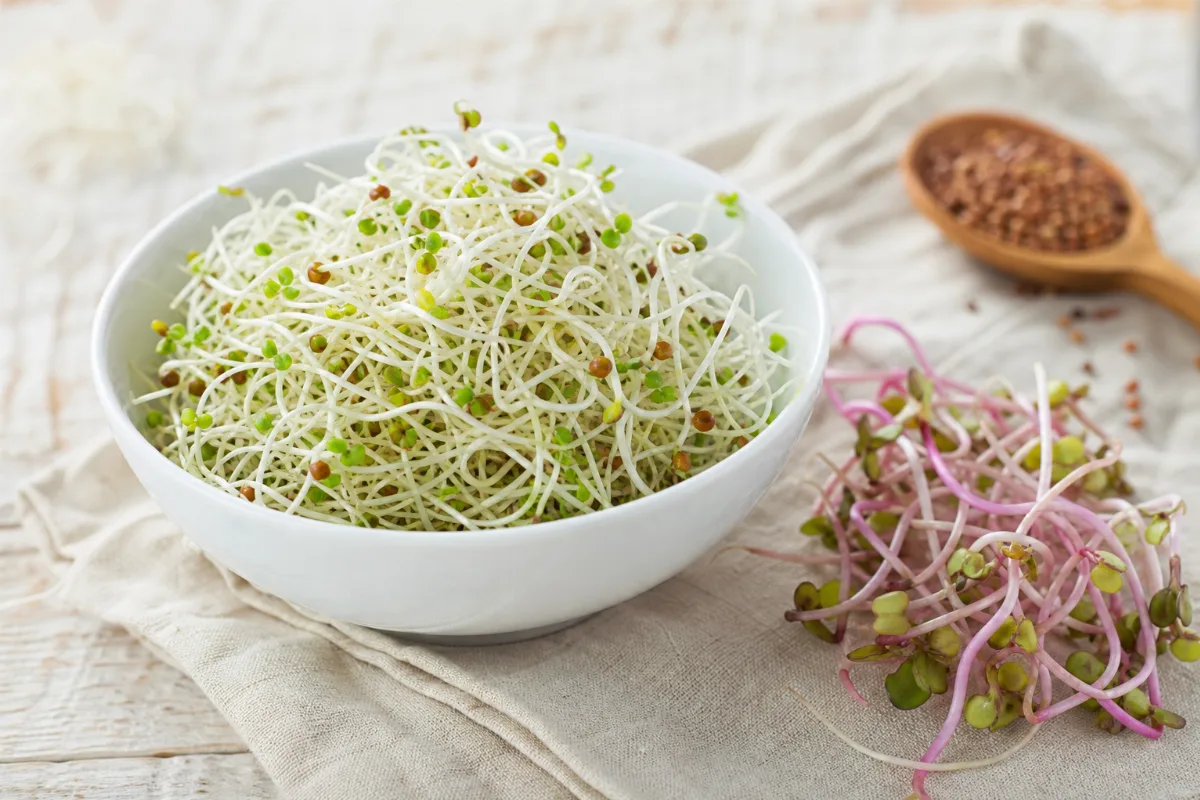
Alfalfa sprouts and clover sprouts are the young seedlings of alfalfa (Medicago sativa) and red clover (Trifolium pratense), both legumes in the pea family. They are thin, pale shoots eaten raw in sandwiches and salads, often sold as a mix. This page keeps them apart from alfalfa tablets and clover extracts, and from the more general sprout advice on the bean sprouts page. It covers what is special about these two: a long record of food poisoning outbreaks, and cautions for lupus and warfarin. Safety comes first.
Read this first
- Who should avoid raw sprouts: the FDA says children, older adults, pregnant women and people with weakened immune systems should avoid eating raw or lightly cooked sprouts of any kind, and names alfalfa and clover. [2] The FDA's higher-risk list also includes people with cancer, diabetes, HIV/AIDS, autoimmune diseases and organ transplants. [3]
- A current outbreak (as of 1 October 2026): the CDC reports 76 illnesses, 6 hospitalizations and no deaths in 16 states from E. coli and Salmonella linked to alfalfa sprouts; 35 of 50 people interviewed (70%) reported eating alfalfa sprouts. [4] [5] Recalled products and a recalled alfalfa sprouting seed lot are listed on the FDA page. [5] Check those pages for updates.
- Cooking: the CDC advises cooking sprouts thoroughly, which kills harmful bacteria. [6] We did not read a sprout-specific cooking time, so this page gives none.
- Lupus: Memorial Sloan Kettering says people with systemic lupus should avoid alfalfa tablets because they may cause a relapse. Those cautions are about tablets and seeds, not proven for sprouts. [9]
- Warfarin: a cup has about 8% of the vitamin K Daily Value (USDA), so steady intake matters. [1] [13]
- Evidence in one line: we found no human trial of eating alfalfa or clover sprouts for any health outcome. Lab findings are not health results. [12]
- Allergy emergency: for trouble breathing or swelling of the face or throat, call 911 (or your local emergency number). [14]
What is in it (USDA values)
The values are for alfalfa seeds, sprouted, raw (USDA FoodData Central item 168384, SR Legacy). [1] The USDA household portion is 1 cup, 33 g. There is no USDA item for clover sprouts in the data we used.
| Nutrient | Per 100 g | Per 1 cup (33 g) | % Daily Value per cup |
|---|---|---|---|
| Energy | 23 kcal | 7.59 kcal | no DV |
| Water | 92.82 g | 30.6 g | no DV |
| Protein | 3.99 g | 1.32 g | 3% |
| Total fat | 0.69 g | 0.228 g | 0% |
| Carbohydrate | 2.1 g | 0.693 g | 0% |
| Fiber | 1.9 g | 0.627 g | 2% |
| Vitamin K | 30.5 mcg | 10.1 mcg | 8% |
| Vitamin C | 8.2 mg | 2.71 mg | 3% |
| Folate (DFE) | 36 mcg | 11.9 mcg | 3% |
| Copper | 0.157 mg | 0.0518 mg | 6% |
| Manganese | 0.188 mg | 0.062 mg | 3% |
| Potassium | 79 mg | 26.1 mg | 1% |
| Sodium | 6 mg | 1.98 mg | 0% |
% Daily Value uses the FDA 2016 Daily Values. The cup column is the per-100 g value multiplied by 0.33. Sprouts are mostly water (92.82 g per 100 g), so they are light on calories and a cup does not reach 10% of the Daily Value for any listed nutrient. Values vary with seed, growing time and storage.
Plant compounds: alfalfa seeds contain L-canavanine, an amino acid that is toxic in lab and animal studies; levels vary between crops and decline as the plant matures, according to Memorial Sloan Kettering. [9] That source does not give a figure for sprouts eaten as food. A 2022 laboratory study found red clover sprouts had up to 426.2 mg of isoflavones per 100 g dry weight, more than white, Persian or crimson clover sprouts; it measured no human health outcome, and the authors advise caution for people at risk of hormone-dependent cancers. [12] Alfalfa extracts have estrogen-like effects in lab studies. [9] This is lab chemistry, not a health benefit.
What research says
| Health goal | What the sources found | Strength of evidence | What was studied |
|---|---|---|---|
| Food poisoning risk (alfalfa and clover) | Alfalfa sprouts caused repeated Salmonella and E. coli outbreaks in Europe and North America in the 1990s (for example 282 cases in Sweden and 210 in Finland in 1994, and more than 450 confirmed Salmonella infections in California in 1996). [8] A 2009 Salmonella outbreak linked to alfalfa sprouts caused 228 cases in 13 states. [7] A 2014 CDC advisory covered an E. coli outbreak tied to raw clover sprouts. [6] The 2026 outbreak is above. [4] [5] | Established (documented risk) | Outbreak reports and reviews |
| Why sprouts are risky | Seeds can carry germs from the field; warm, moist sprouting multiplies them to more than 10 million per gram without changing how the sprouts look. [8] The FDA says even home sprouting under sanitary conditions does not remove the risk. [2] | Established | Reviews of outbreaks and lab work |
| Cleaning the seeds or sprouts | A 1999 review found no single chemical treatment reliably cut germs by more than about 1,000-fold, and washing sprouts reduced E. coli and Salmonella by no more than about 10-fold. [8] The review is old; we did not read a newer one. | Established, but dated | Lab studies |
| Lupus-like illness | Alfalfa sprouts caused a lupus-like illness in monkeys, attributed to L-canavanine. [10] [11] In test tubes L-canavanine changed the activity of human immune cells. [10] A 1991 review described one person who developed autoimmune hemolytic anemia during a study that required eating alfalfa seeds. [11] | Lab or animal only, with a few human reports | Monkeys, human cells, one case; mostly seeds and tablets |
| Cholesterol, blood sugar, menopause, cancer | Proper evidence not found in the sources we read for sprouts. Memorial Sloan Kettering says there is no evidence that alfalfa treats cancer. [9] | Insufficient evidence | Not applicable |
| Isoflavones in red clover sprouts | Measured in the lab (see above); no human outcome. [12] | Lab or animal only | Cell lines and chemistry |
Sprouts versus tablets and extracts. The lupus and hormone cautions come mostly from studies and warnings about alfalfa seeds and tablets. We found no source showing that eating normal amounts of sprouts causes lupus flares. We found no source saying sprouts are safe for people with lupus either, so people with lupus should ask their clinician. Observational and lab findings do not prove cause.
How much is a normal serving
The USDA household portion is 1 cup (33 g), about 7.6 kcal. [1] We found no official daily amount for sprouts. This is information, not a prescription.
Safety, allergy and medicines
- Food poisoning (main point). The FDA says warm, humid sprouting conditions suit Salmonella, Listeria and E. coli, and that a few germs on a seed can grow to high levels even in clean home sprouting. [2] CDC and FDA have advised high-risk groups since 1999 to avoid raw sprouts, and in 2009, during an outbreak, FDA and CDC recommended that consumers not eat raw alfalfa sprouts, including blends containing them. [7] The CDC says young children, older adults, pregnant people and anyone with a weakened immune system should not eat raw sprouts of any type, including alfalfa, clover, radish and mung bean. [6]
- Symptoms and when to get help. For the current outbreak the CDC lists severe stomach cramps, often bloody diarrhea and vomiting for E. coli (starting 3 to 4 days after exposure) and diarrhea, fever and cramps for Salmonella (starting 6 hours to 6 days after). It advises prompt medical care for diarrhea with fever above 102 degrees Fahrenheit, diarrhea lasting more than 2 days, bloody diarrhea, vomiting that stops you keeping liquids down, or signs of dehydration. [4] [5] See poisoning: what to do first.
- Recalls. If a sprout product is recalled, the CDC says do not eat it, throw it away or return it, and wash items it touched with hot soapy water or in a dishwasher. [4]
- Pregnancy and breastfeeding. The FDA lists pregnant women among those who should avoid raw or lightly cooked sprouts. [2] Memorial Sloan Kettering says alfalfa should be avoided in pregnancy and nursing because of its hormonal effects. [9] See foods in pregnancy: what official bodies advise.
- Lupus and autoimmune disease. See the table. Alfalfa tablets are the clearest warning. [9] [10] See also alfalfa (herb page).
- Hormone-sensitive conditions. In lab studies alfalfa extracts made estrogen-dependent breast cancer cells grow more than estradiol did, and the red clover sprout study's authors advise caution in people at risk of hormone-dependent cancers. [9] [12] Neither tested sprouts eaten as food in people. See red clover.
- Warfarin. USDA lists 30.5 mcg of vitamin K per 100 g of alfalfa sprouts (25% of the Daily Value) and 10.1 mcg in a cup. [1] MedlinePlus advises consistent amounts of vitamin K-containing foods from week to week and checking diet changes with your doctor. [13] See foods and medicine interactions.
- Allergy. Alfalfa and clover are legumes, but we read no source on allergy to these sprouts. MedlinePlus says to call 911 or your local emergency number for a serious or whole-body reaction. [14] See food allergy basics and emergency signs.
- Kidney disease, children, older adults: the FDA names children and older adults as higher risk for food poisoning. [3] We did not read kidney-specific advice for sprouts.
Choosing, storing and food safety
- The FDA's general produce advice is to wash under running water without soap, noting that washing reduces but does not eliminate bacteria, and to buy refrigerated packaged produce. [2] The CDC advises cooking sprouts thoroughly. [6]
- Look at recall notices and buy from sources that follow the FDA guidance on sprouted seeds (the CDC's advice to restaurants and retailers). [6]
- You cannot tell contaminated sprouts by looks or smell; germs can reach very high numbers without visible change. [8]
- A cooked, hot sprout dish (stir-fry or soup) is not the same as raw sprouts in a sandwich, but we did not read a time or temperature rule for sprouts. Follow the FDA and CDC advice above.
- For the broader risks of raw sprouts and other foods, see raw sprouts, raw milk and undercooked foods: risks. For mung bean and lentil sprouts, see bean sprouts.
Related pages
Health connections for Alfalfa & Clover Sprouts
What research links to eating or drinking this food, and how strong the evidence is. Many studies are observational or use juice, powder, oil or extracts rather than the food as eaten; each card says which.
Estrogen-like compounds in alfalfa and clover
Lab or animal research onlyAlfalfa extracts made estrogen-dependent breast cancer cells grow more than estradiol did in lab studies; a 2022 lab study found up to 426.2 mg isoflavones per 100 g dry weight in red clover sprouts, measured no human outcome, and advised caution for people at risk of hormone-dependent cancers. MSK says alfalfa should be avoided in pregnancy and nursing because of hormonal effects.
Supplements: Lab studies; sprouts eaten as food not tested for this.
Nutrients in alfalfa sprouts
Established roleUSDA lists 23 kcal per 100 g, 92.82 g water, 30.5 mcg vitamin K, 8.2 mg vitamin C and 36 mcg folate per 100 g; a cup (33 g) reaches 10% of no listed Daily Value.
Supplements: Nutrient content of the food.
Sprouts for health outcomes
Not enough evidenceWe found no human trial of eating alfalfa or clover sprouts for cholesterol, blood sugar, menopause or cancer; MSK says there is no evidence that alfalfa treats cancer.
Supplements: Proper evidence not found in the sources we read.
Connected topics
Open a group to see how each topic connects and how strong the evidence is.
Body systems (1)
- Digestive SystemDocumented risk
Raw alfalfa and clover sprouts have caused repeated Salmonella and E. coli outbreaks with diarrhea, cramps and sometimes kidney complications.
Root causes (2)
- Autoimmune DysfunctionDocumented risk
MSK warns people with lupus to avoid alfalfa tablets; evidence is for tablets and seeds, not proven for sprouts.
- Medication Side EffectsDocumented risk
The vitamin K in alfalfa sprouts is relevant to warfarin; keep intake steady.
Conditions & symptoms (4)
- Escherichia Coli InfectionsDocumented risk
E. coli (STEC) outbreaks have been linked to alfalfa and clover sprouts, including 2026; some people develop kidney problems (HUS).
- Food PoisoningDocumented risk
Raw alfalfa and clover sprouts are a documented source of food poisoning; the FDA and CDC advise high-risk groups to avoid them raw and to cook sprouts thoroughly.
- Salmonella InfectionsDocumented risk
Large Salmonella outbreaks have been linked to alfalfa sprouts (for example 228 cases in 13 states in 2009).
- Lupus Erythematosus, SystemicDocumented risk
MSK says people with systemic lupus should avoid alfalfa tablets because they may cause a relapse; evidence is for tablets and seeds, not shown for sprouts.
Documented risks and interactions (5)
- Food poisoning from raw alfalfa and clover sprouts. Alfalfa sprouts caused many Salmonella and E. coli outbreaks (for example 282 cases in Sweden and 210 in Finland in 1994; 228 cases in 13 US states in 2009; 76 illnesses in 16 states in 2026 per CDC/FDA as of 1 Oct 2026). A 2014 CDC advisory covered an E. coli outbreak linked to raw clover sprouts.
- Who should avoid raw sprouts. The FDA says children, older adults, pregnant women and people with weakened immune systems should avoid raw or lightly cooked sprouts of any kind, naming alfalfa and clover; its higher-risk list includes people with cancer, diabetes, HIV/AIDS, autoimmune disease and organ transplants.
- Why washing and home sprouting do not fix it. The FDA says germs on a seed can grow to high levels even in clean home sprouting. A 1999 review found no chemical seed treatment reliably cut germs by more than about 1,000-fold and washing sprouts cut E. coli and Salmonella by no more than about 10-fold; the review is old.
- Alfalfa, L-canavanine and lupus. Memorial Sloan Kettering says people with systemic lupus should avoid alfalfa tablets because they may cause a relapse; L-canavanine in the seeds caused a lupus-like illness in monkeys and changed human immune cells in test tubes; a 1991 review described one human with autoimmune hemolytic anemia during a study that required eating alfalfa seeds. Evidence is for tablets and seeds, not proven for sprouts.
- Alfalfa sprouts and warfarin (vitamin K). USDA lists 30.5 mcg vitamin K per 100 g (25% DV); a cup has 10.1 mcg (8%). MedlinePlus advises consistent vitamin K intake week to week and checking diet changes with your doctor.
Frequently asked questions
Are alfalfa sprouts safe to eat raw?
The FDA says children, older adults, pregnant women and people with weakened immune systems should avoid raw or lightly cooked sprouts of any kind, including alfalfa and clover. [2] Alfalfa sprouts have been tied to many outbreaks, including one the CDC was tracking in 2026. [4] [8]
Does washing or growing sprouts at home make them safe?
No. The FDA says germs on a seed can grow to high levels even when sprouts are grown at home under clean conditions. [2] A 1999 review found washing cut E. coli and Salmonella by no more than about 10-fold. [8]
Can I eat alfalfa sprouts if I have lupus?
Memorial Sloan Kettering warns people with systemic lupus to avoid alfalfa tablets, which may cause a relapse; the link is mainly with seeds and tablets and an amino acid called L-canavanine. [9] We found no study of sprouts in people with lupus, so ask your clinician.
Are alfalfa sprouts OK with warfarin?
A cup has about 10 mcg of vitamin K (8% of the Daily Value) in USDA data. [1] MedlinePlus advises keeping vitamin K intake steady week to week and asking your doctor before diet changes. [13]
How are clover sprouts different from alfalfa sprouts?
Both are raw sprouts with the same germ risk; a 2014 CDC advisory covered an outbreak linked to clover sprouts. [6] Red clover sprouts are richer in isoflavones in lab tests, but no human health outcome was measured. [12]
References
- U.S. Department of Agriculture. FoodData Central: Alfalfa seeds, sprouted, raw (SR Legacy, FDC 168384). April 2018 release. Read 2026-10-24.
- U.S. Food and Drug Administration. Selecting and Serving Produce Safely. Content current as of 5 March 2024. Read 2026-10-24.
- U.S. Food and Drug Administration. People at Risk of Foodborne Illness. Content current as of 16 January 2025. Read 2026-10-24.
- CDC. E. coli and Salmonella outbreak linked to alfalfa sprouts. Published 21 August 2026; updated 1 October 2026. Read 2026-10-24.
- U.S. Food and Drug Administration. Outbreak Investigation of Shiga Toxin-producing E. coli and Salmonella: Sprouts (August 2026). Updated 1 October 2026. Read 2026-10-24.
- CDC. 2014 E. coli outbreak linked to raw clover sprouts: advice to consumers. Posted 1 August 2014. Read 2026-10-24.
- CDC. Outbreak of Salmonella serotype Saintpaul infections associated with eating alfalfa sprouts, United States, 2009. MMWR, 7 May 2009. Read 2026-10-24.
- Taormina PJ, Beuchat LR, Slutsker L. Infections associated with eating seed sprouts: an international concern. Emerging Infectious Diseases (CDC) 1999;5(5). Read 2026-10-24.
- Memorial Sloan Kettering Cancer Center. Alfalfa. Last updated 5 April 2023. Read 2026-10-24.
- Alcocer-Varela J, Iglesias A, Llorente L, Alarcon-Segovia D. Effects of L-canavanine on T cells may explain the induction of systemic lupus erythematosus by alfalfa. Arthritis Rheum 1985 (abstract read via Europe PMC). Read 2026-10-24.
- Montanaro A, Bardana EJ. Dietary amino acid-induced systemic lupus erythematosus. Rheum Dis Clin North Am 1991 (abstract read via Europe PMC). Read 2026-10-24.
- In the Search for Novel, Isoflavone-Rich Functional Foods: Comparative Studies of Four Clover Species Sprouts and Their Chemopreventive Potential for Breast and Prostate Cancer. Pharmaceuticals (Basel) 2022. Read 2026-10-24.
- MedlinePlus. Warfarin: drug information. Last revised 15 March 2026. Read 2026-10-24.
- MedlinePlus. Food allergy. Reviewed 29 October 2024. Read 2026-10-24.