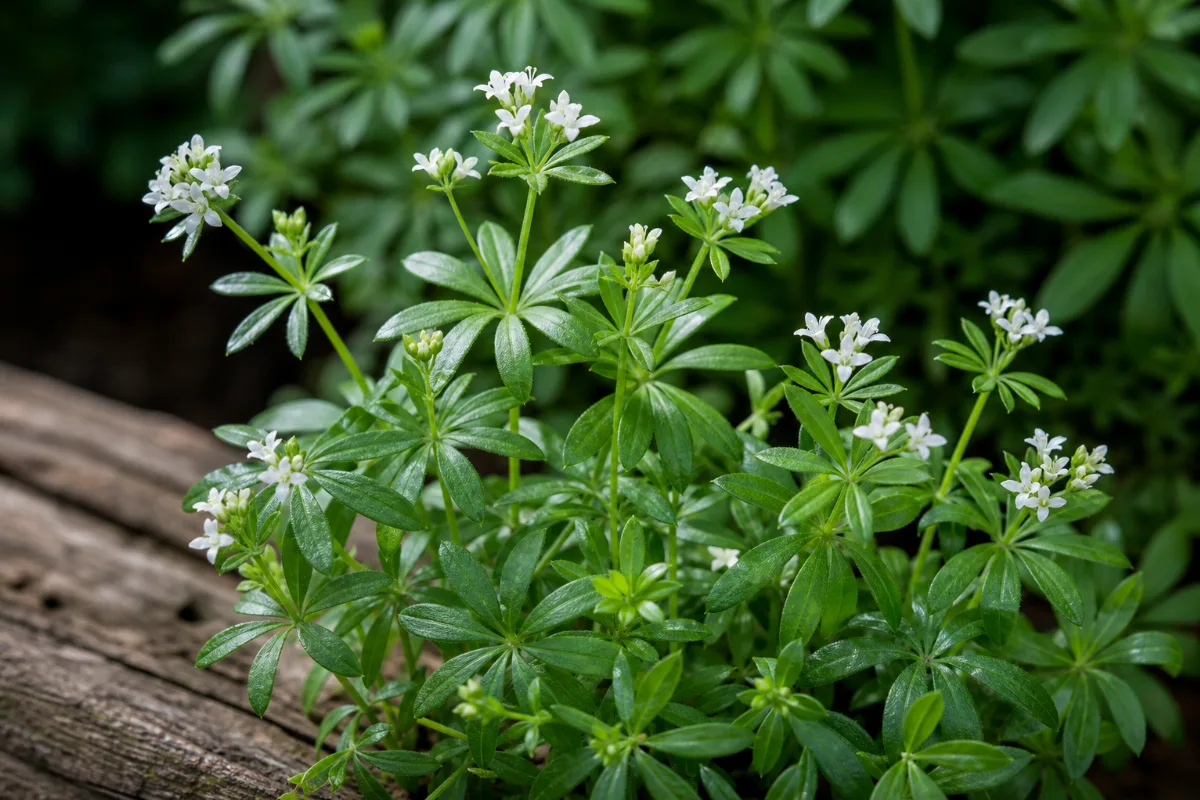
Herbs & Botanicals · European May wine herb
Woodruff
Galium odoratum · also called Sweet woodruff, Waldmeister, master of the wood
Woodruff is a small European woodland herb best known for flavouring May wine and syrups. It was also used in folk medicine for nerves, veins and the liver. No human trial of woodruff has tested any of these uses, so the evidence is very thin. The main caution is coumarin, which gives it its hay smell and can harm the liver at high intakes.
General information, not medical advice. Last substantive update · Not medically reviewed. A named clinician has not signed off on this page. How this page is made
About Woodruff
Sweet woodruff (Galium odoratum) is a European woodland herb with a sweet, hay-like smell. It is best known as the flavour in May wine and woodruff syrup. It was also used in folk medicine, but no human trial of woodruff exists. Its coumarin is the main safety question.
What it is
Woodruff is a small perennial plant of European beech and conifer forests, with whorled leaves and small white flowers in spring. The aerial parts are used.
Fresh woodruff smells of little. As the leaves wilt, sugar-bound precursors release coumarin, which gives the hay-like smell and the flavour. Its old name was Asperula odorata.
How it differs from other coumarin plants
Cassia cinnamon, tonka bean and sweet clover also hold coumarin. Limits count every source together, so heavy cinnamon users should count woodruff too.
The coumarin in woodruff is not the same as the blood-thinning drugs warfarin and phenprocoumon, which are also called coumarins (AGES). A consumer reference still advises caution with blood thinners, and the true risk is unknown.
Traditional and food uses
May wine has been made with woodruff since at least 854 AD (as cited in a 2026 review). Folk medicine used it for wounds, digestion, coughs and anxiety, and later for nerves, veins and the liver. Today it is mostly a flavouring.
What the research shows
No convincing clinical evidence exists for woodruff preparations. The findings that do exist are lab and animal: extracts calmed inflammatory immune cells in mouse cells and improved burn healing in rats.
A 2025 study found coumarin first forms as the herb wilts and then falls with long drying, because it evaporates.
At a glance
Traditional uses history, not proof
- Flavouring for May wine, syrups, soft drinks and Berliner Weisse (traditional food use)
- Tea or drink for nerves, anxiety and sleeplessness (folk use)
- Folk use for digestion, the liver, circulation and wounds
Studied for research
- Nerves, sleep and headache: insufficient (traditional use only, no human trial)
- Veins, liver, digestion and urine flow: insufficient (traditional use only)
- Burn healing: very-low (one rat study); anti-inflammatory effects in cells: lab only
Main compounds
- Coumarin (released from sugar-bound melilotosides as the herb wilts)
- Asperuloside and other iridoid glycosides
- Chlorogenic acids
- Flavonoids such as rutin
Common forms
- Fresh or wilted leaves in May wine (Maibowle)
- Syrup
- Dried leaves or tea
- Tincture
- Capsules and skin or perfume products
Research links: Sweet woodruff review, Molecules (2026) · Coumarin formation during drying (2025) · Toxicology and risk assessment of coumarin (BfR authors, 2010) · AGES coumarin page · Rat burn-healing study (2013) · Coumarin liver toxicity review (2022) · French pharmacovigilance survey of coumarin liver reactions (1998) · Research Library · Genes & Biomarkers Library
The plant and its history
- Accepted scientific name
- Galium odoratum (L.) Scop.
- Naming authority
- (L.) Scop.
- Synonyms
- Asperula odorata L.
- Common names
- Sweet woodruff (English); Woodruff (English); Waldmeister (German); Master of the wood (English); Reine des bois (French)
- Botanical family
- Rubiaceae (madder family)
- Classification
- Plantae > Gentianales > Rubiaceae > Galium > Galium odoratum
- Native range
- A European woodland herb (2026 review); wider range not stated in the sources read.
- Habitat
- Woodland, in conifer and beech forest, flowering from late April to June (test.de, 2003).
- What the plant looks like
- Roots: Not described.; Stems: Not described.; Leaves: Whorled leaves (leaves in rings around the stem); a perennial herb.; Flowers: Small white flowers in spring and early summer (2026 review).; Fruit: Not described.
- Cultivation
- Cultivated and wild plants have been compared in a 2024 study. Species-specific harvest volumes are poorly documented; use of wild plants is listed in Poland (2026 review).
- Harvest and processing
- Shoots are traditionally wilted for 2 to 24 hours before use in May wine; a 2025 study found drying done by 48 hours and coumarin falling later through evaporation.
- Look-alikes and adulterants
- Name: Other Galium species (bedstraws); Note: Close relatives. Not verified here as to coumarin content.; Name: Sweet clover (Melilotus); Note: A different plant, also coumarin-rich with a hay smell. See the sweet clover page.
- Sustainability and conservation
- Not protected in Poland since 2015 (2026 review); wider status not assessed.
Traditional use and history history, not clinical proof
| Tradition or era | Documented use | Source |
|---|---|---|
| Medieval Central Europe | Used in May wine (Maiwein); a source cited by the 2026 review traces this to 854 AD. | p42654000 |
| European folk medicine | Externally for wounds; internally for digestive disorders, coughs and anxiety. | p42654000 |
| Modern Germany and Austria | Flavouring for syrups, soft drinks, Berliner Weisse (the green shot) and May wine. | s-ages-coumarin |
Traditional use shows how a plant was used. It does not show that a supplement works or is safe today.
What is inside, and how it may work
What the plant contains and how those compounds act in cells and animals. Laboratory and animal mechanisms are not proven effects in people.
Main compounds
| Compound | Family | Where it is concentrated | Activity studied | Level of evidence |
|---|---|---|---|---|
| Coumarin (1,2-benzopyrone) PubChem 323 | coumarin (benzopyrone) | Aerial parts after wilting or drying | Gives the sweet hay smell; formed from cis- and trans-melilotoside on wilting. Main safety compound. 10 9 1 | Human data |
| Asperuloside (an iridoid) PubChem 84298 | iridoid glycoside | Aerial parts | Isolated from woodruff in 2025. Anti-inflammatory activity is reported for related iridoids, mostly isolated compounds from other plants. 9 10 | Lab |
| Chlorogenic acid PubChem 1794427 | caffeoylquinic acid | Aerial parts | Contributes to antioxidant activity in extracts. 13 9 | Lab |
| Rutin and other flavonoid glycosides (quercetin and kaempferol types) PubChem 5280805 | flavonoid | Aerial parts | Contributes to antioxidant activity. CID is for rutin only. 13 10 | Lab |
Mechanisms, receptors and pathways
| Target or pathway | Gene or receptor | What was found | Level |
|---|---|---|---|
| Release of coumarin on wilting | plant enzymes | Sugar-bound coumarin precursors (melilotosides) are converted to free coumarin when plant tissue is damaged or wilted. 9 1 | Lab |
| Macrophage type (inflammation) | not specified | Woodruff extracts reduced the inflammatory M1 macrophage population in mouse cells. 13 | Lab |
| Liver toxicity route of coumarin | CYP2A6, CYP3A4 | Low CYP2A6 activity may shunt coumarin toward a toxic metabolite in a small subset of people. 5 | Theory |
| Burn healing | not specified | Extracts improved wound contraction in rats; actives not identified. 11 | Animal research |
Absorption, metabolism and elimination
- Absorption
- Coumarin is absorbed relatively easily through the skin (AGES). No woodruff absorption study was found.
- Distribution
- Not studied for woodruff.
- Metabolism
- Mainly CYP2A6 7-hydroxylation in the liver; alternative routes may matter in sensitive people.
- Elimination
- Not described in the sources read.
- Bioavailability
- Not established for woodruff preparations.
Isolated compounds versus whole extracts
Most safety data come from isolated coumarin used as a drug. Most activity data come from isolated compounds or non-standard extracts. The 2026 review says findings from isolated compounds should not be applied to woodruff preparations, whose coumarin amount depends on how the herb was handled.
Nutritional composition
Woodruff is a flavouring, not a source of nutrients. It is not a significant source of vitamins or minerals.
1 very low certainty8 not enough evidence
What is Woodruff good for?
What woodruff has been used for and how strong the evidence is. Every use rests on tradition or on lab and animal work.
Benefits, one by one
Each card is a research question, not a promise. Tap a goal to filter. Open a card to see the studies, doses and limits.
Nervousness, restlessness and anxiety (traditional)
Not enough evidenceWoodruff was used in European folk medicine for nerves and anxiety. No trial in people has tested it.
2 studiesTraditional use is as a tea or a wine-based drink from the aerial par…
Studies, doses and limits
What the trials found
No human trial of woodruff was found. The 2026 review says there is no convincing clinical evidence for defined woodruff preparations.
Results
No outcome has been measured.
Effect sizes as reported
No effect sizes exist; no human study was found.
Why this rating
Only traditional use is documented; there are no human or relevant animal studies in the sources read.
Form and dose studied
Traditional use is as a tea or a wine-based drink from the aerial parts. No standard product has been tested.
Who was studied
None studied.
Limits
Traditional claims only. Higher coumarin intake itself is linked to headache and dizziness, so more is not safer.
Why researchers looked
Folk use for anxiety and restlessness. The compounds responsible, if any, are unknown.
Traditional use
The 2026 review notes folk use of the aerial parts for anxiety, and a consumer drug reference lists nervousness and restlessness.
Proposed mechanism Pharmacological theory
Not established. Coumarin and other plant compounds have not been shown to calm the nervous system in people.
A proposed mechanism does not show that the effect happens in people.
See the Safety tab: coumarin and the liver, pregnancy, blood-thinning drugs.
Sleeplessness (traditional)
Not enough evidenceListed as a traditional use for sleep problems. There is no human evidence.
2 studiesTraditional use is as a tea or a wine-based drink from the aerial par…
Studies, doses and limits
What the trials found
No human trial of woodruff was found. The 2026 review says there is no convincing clinical evidence for defined woodruff preparations.
Results
No outcome has been measured.
Effect sizes as reported
No effect sizes exist; no human study was found.
Why this rating
Traditional claims only.
Form and dose studied
Traditional use is as a tea or a wine-based drink from the aerial parts. No standard product has been tested.
Who was studied
None studied.
Limits
No trial. The May wine form contains alcohol, which itself disturbs sleep.
Why researchers looked
Traditional evening use as a calming tea or drink.
Traditional use
A consumer drug reference lists sleeplessness; a 2003 consumer article says folk medicine values woodruff for sleeplessness.
Proposed mechanism Pharmacological theory
Not established.
A proposed mechanism does not show that the effect happens in people.
Alcohol-based preparations (May wine, tincture) are not suitable for everyone.
Headache, migraine and nerve pain (traditional)
Not enough evidenceWoodruff has been used for migraine and nerve pain, yet too much woodruff is itself linked to headache.
2 studiesTraditional use is as a tea or a wine-based drink from the aerial par…
Studies, doses and limits
What the trials found
No human trial of woodruff was found. The 2026 review says there is no convincing clinical evidence for defined woodruff preparations.
Results
No outcome has been measured.
Effect sizes as reported
No effect sizes exist; no human study was found.
Why this rating
Traditional claims only, and the same sources link excess intake with headache, so direction of effect is unclear.
Form and dose studied
Traditional use is as a tea or a wine-based drink from the aerial parts. No standard product has been tested.
Who was studied
None studied.
Limits
Sources disagree in spirit: folk use for headache versus headache from excess coumarin (consumer article).
Why researchers looked
Traditional use for migraine and nerve pain (neuralgia).
Traditional use
RxList lists migraine and nerve pain among traditional uses; a 2003 article says folk medicine used it for headache, cramps and sleeplessness.
Proposed mechanism Pharmacological theory
Not established.
A proposed mechanism does not show that the effect happens in people.
If headaches follow woodruff drinks, stop and tell a clinician if they persist.
Weak veins and circulation (traditional)
Not enough evidenceWoodruff has been listed for "weak veins" and circulation. No study tested this.
1 studiesTraditional use is as a tea or a wine-based drink from the aerial par…
Studies, doses and limits
What the trials found
No human trial of woodruff was found. The 2026 review says there is no convincing clinical evidence for defined woodruff preparations.
Results
No outcome measured.
Effect sizes as reported
No effect sizes exist; no human study was found.
Why this rating
Traditional claim only.
Form and dose studied
Traditional use is as a tea or a wine-based drink from the aerial parts. No standard product has been tested.
Who was studied
None studied.
Limits
Do not assume woodruff works like sweet clover; they are different plants.
Why researchers looked
Traditional use for veins and circulation, sometimes called blood purification.
Traditional use
RxList lists "weak veins", circulation problems and heart problems as traditional uses.
Proposed mechanism Pharmacological theory
Not established. Another coumarin plant, sweet clover, has European approval for leg-vein heaviness as a traditional use, but that does not show woodruff works.
A proposed mechanism does not show that the effect happens in people.
Coumarin and bleeding: see Safety tab.
Liver and gallbladder complaints (traditional)
Not enough evidenceTraditionally used for the liver and gallbladder, yet the main compound, coumarin, can harm the liver at high intake.
2 studiesTraditional use is as a tea or a wine-based drink from the aerial par…
Studies, doses and limits
What the trials found
No human trial of woodruff was found. The 2026 review says there is no convincing clinical evidence for defined woodruff preparations. Coumarin liver injury is documented for the isolated drug at far higher intakes than food.
Results
No benefit demonstrated.
Effect sizes as reported
No effect sizes exist; no human study was found.
Why this rating
Traditional claim only, set against a documented liver risk at high coumarin intake.
Form and dose studied
Traditional use is as a tea or a wine-based drink from the aerial parts. No standard product has been tested.
Who was studied
None studied.
Limits
Not a liver remedy. See the Safety tab before any liver-related use.
Why researchers looked
Folk use for liver and gallbladder ailments.
Traditional use
RxList lists liver and gallbladder ailments as insufficient evidence to rate.
Proposed mechanism Pharmacological theory
None shown. Toxicology points the other way (liver is the critical endpoint for coumarin).
A proposed mechanism does not show that the effect happens in people.
People with liver disease should avoid medicinal use.
Stomach and digestive complaints (traditional)
Not enough evidenceA traditional use. No study was found.
2 studiesTraditional use is as a tea or a wine-based drink from the aerial par…
Studies, doses and limits
What the trials found
No human trial of woodruff was found. The 2026 review says there is no convincing clinical evidence for defined woodruff preparations.
Results
No outcome measured.
Effect sizes as reported
No effect sizes exist; no human study was found.
Why this rating
Traditional claim only.
Form and dose studied
Traditional use is as a tea or a wine-based drink from the aerial parts. No standard product has been tested.
Who was studied
None studied.
Limits
None to add.
Why researchers looked
Folk use for digestive disorders.
Traditional use
The 2026 review and RxList list digestive disorders as traditional uses.
Proposed mechanism Pharmacological theory
Not established.
A proposed mechanism does not show that the effect happens in people.
None specific.
Urinary complaints and water retention (traditional)
Not enough evidenceUsed traditionally to increase urine flow. No study was found.
1 studiesTraditional use is as a tea or a wine-based drink from the aerial par…
Studies, doses and limits
What the trials found
No human trial of woodruff was found. The 2026 review says there is no convincing clinical evidence for defined woodruff preparations.
Results
No outcome measured.
Effect sizes as reported
No effect sizes exist; no human study was found.
Why this rating
Traditional claim only.
Form and dose studied
Traditional use is as a tea or a wine-based drink from the aerial parts. No standard product has been tested.
Who was studied
None studied.
Limits
None to add.
Why researchers looked
Folk use as a diuretic and for urinary disorders.
Traditional use
RxList lists urinary disorders and water retention as insufficient evidence to rate.
Proposed mechanism Pharmacological theory
Not established.
A proposed mechanism does not show that the effect happens in people.
Swelling that is new, one-sided or painful needs medical review, not a herb.
Wounds, burns and skin use (animal and traditional)
Very low certaintyIn one rat study, woodruff extract cream helped burn wounds heal. It has not been tested in people.
3 studiesTopical creams of 15% and 30% extract in rats. No human product has b…
Studies, doses and limits
What the trials found
No human trial. One rat study (36 rats) tested water and methanol extracts of Galium odoratum in cream on second-degree burns for 14 days.
Results
Wound contraction was better than the cream base (p<0.001); water extract 90.68% and 97.18% (15% and 30%) versus methanol extract 79.29% and 91.94%.
Effect sizes as reported
Water extract 30%: 97.18% contraction in rats. Control values are not given in the abstract.
Why this rating
One small rat study; no human data; actives unknown.
Form and dose studied
Topical creams of 15% and 30% extract in rats. No human product has been tested.
Who was studied
Rats only.
Limits
Small animal study; skin safety in people is not well studied (RxList). Coumarin is absorbed fairly easily through skin (AGES).
Why researchers looked
Folk external use for wounds, skin disease, piles and swelling.
Traditional use
The 2026 review says it was used externally for wounds; RxList lists skin problems and haemorrhoids.
Proposed mechanism Animal research
Extracts showed antioxidant activity in a test tube, and fewer inflammatory cells in healed rat wounds. The active compounds are unknown.
A proposed mechanism does not show that the effect happens in people.
Skin contact allergy to coumarin is a known issue for fragrances (AGES). Do not put on burns or open wounds without medical advice.
Anti-inflammatory and antioxidant effects (lab only)
Not enough evidenceWoodruff extracts calm inflammatory immune cells in a dish and act as antioxidants in test tubes. This does not show a benefit in people.
2 studiesExtracts in a dish. Not a human-use form.
Studies, doses and limits
What the trials found
No human study. A 2024 mouse-cell study and the 2026 review describe lab and animal findings only.
Results
Reduced M1 macrophage population in mouse bone-marrow cells; antioxidant activity higher in sun-grown plants.
Effect sizes as reported
No effect sizes exist; no human study was found.
Why this rating
Lab and animal findings only; the 2026 review warns against extrapolating from isolated compounds.
Form and dose studied
Extracts in a dish. Not a human-use form.
Who was studied
Mouse cells.
Limits
Cell work cannot show benefit or safe use.
Why researchers looked
Researchers wanted to know what the plant's phenols and iridoids do.
Traditional use
Not a traditional claim.
Proposed mechanism Laboratory research
Chlorogenic acid and rutin appear to drive the antioxidant effect, and extracts reduced inflammatory (M1) macrophages in mouse cells. Iridoids such as asperuloside have been studied as isolated compounds, mostly from other plants.
A proposed mechanism does not show that the effect happens in people.
None specific.
Connections to the rest of health
How Woodruff connects to the rest of our health knowledge graph. Every link says what kind of connection it is. A safety link (for example to the liver) is a warning, not a benefit. A study that merely mentions a topic never creates a benefit link.
Explore every connection: goals, body systems, organs, symptoms, genes
A. Wellness goals
| Connected to | Kind of connection | Evidence status | Context | Studies |
|---|---|---|---|---|
| Anxiety Support | Traditional use | Not enough evidence | Nervousness, restlessness and anxiety (traditional): Woodruff was used in European folk medicine for nerves and anxiety. No trial in people has tested it. | 10 14 |
| Calm Relaxation | Traditional use | Not enough evidence | Nervousness, restlessness and anxiety (traditional): Woodruff was used in European folk medicine for nerves and anxiety. No trial in people has tested it. | 10 14 |
| Better Sleep | Traditional use | Not enough evidence | Sleeplessness (traditional): Listed as a traditional use for sleep problems. There is no human evidence. | 14 15 |
| Sleep Quality | Traditional use | Not enough evidence | Sleeplessness (traditional): Listed as a traditional use for sleep problems. There is no human evidence. | 14 15 |
| Inflammation Balance | Traditional use | Not enough evidence | Headache, migraine and nerve pain (traditional): Woodruff has been used for migraine and nerve pain, yet too much woodruff is itself linked to headache. | 14 15 |
| Healthy Circulation | Traditional use | Not enough evidence | Weak veins and circulation (traditional): Woodruff has been listed for "weak veins" and circulation. No study tested this. | 14 |
| Heart Health | Traditional use | Not enough evidence | Weak veins and circulation (traditional): Woodruff has been listed for "weak veins" and circulation. No study tested this. | 14 |
| Liver Support | Traditional use | Not enough evidence | Liver and gallbladder complaints (traditional): Traditionally used for the liver and gallbladder, yet the main compound, coumarin, can harm the liver at high intake. | 14 2 |
| Digestive Support | Traditional use | Not enough evidence | Liver and gallbladder complaints (traditional): Traditionally used for the liver and gallbladder, yet the main compound, coumarin, can harm the liver at high intake. Stomach and digestive complaints (traditional): A traditional use. No study was found. | 14 2 10 |
| Gut Health | Traditional use | Not enough evidence | Stomach and digestive complaints (traditional): A traditional use. No study was found. | 10 14 |
| Detoxification Support | Traditional use | Not enough evidence | Urinary complaints and water retention (traditional): Used traditionally to increase urine flow. No study was found. | 14 |
| Healthy Skin | Preliminary mechanism | Very low certainty | Wounds, burns and skin use (animal and traditional): In one rat study, woodruff extract cream helped burn wounds heal. It has not been tested in people. | 11 10 1 |
| Inflammation Balance | Preliminary mechanism | Not enough evidence | Anti-inflammatory and antioxidant effects (lab only): Woodruff extracts calm inflammatory immune cells in a dish and act as antioxidants in test tubes. This does not show a benefit in people. | 13 10 |
| Cellular Protection | Preliminary mechanism | Not enough evidence | Anti-inflammatory and antioxidant effects (lab only): Woodruff extracts calm inflammatory immune cells in a dish and act as antioxidants in test tubes. This does not show a benefit in people. | 13 10 |
B. Body systems
| Connected to | Kind of connection | Evidence status | Context | Studies |
|---|---|---|---|---|
| Nervous System | Biological association | Not enough evidence | Studied for: Nervousness, restlessness and anxiety (traditional) Studied for: Sleeplessness (traditional) | 10 14 15 |
| Cardiovascular System | Biological association | Not enough evidence | Studied for: Weak veins and circulation (traditional) | 14 |
| Hepatic System | Biological association | Not enough evidence | Studied for: Liver and gallbladder complaints (traditional) | 14 2 |
| Digestive System | Biological association | Not enough evidence | Studied for: Liver and gallbladder complaints (traditional) Studied for: Stomach and digestive complaints (traditional) | 14 2 10 |
| Urinary System | Biological association | Not enough evidence | Studied for: Urinary complaints and water retention (traditional) | 14 |
| Integumentary System | Biological association | Very low certainty | Studied for: Wounds, burns and skin use (animal and traditional) | 11 10 1 |
| Immune System | Biological association | Not enough evidence | Studied for: Anti-inflammatory and antioxidant effects (lab only) | 13 10 |
J. Genes, receptors and enzymes
| Connected to | Kind of connection | Evidence status | Context | Studies |
|---|---|---|---|---|
| CYP2A6 (liver enzyme) | Biological association | Low certainty | Low CYP2A6 activity may push coumarin into a toxic route. Preparation or compound: coumarin |
5 |
| CYP2A6 (liver enzyme that clears coumarin) | Preliminary mechanism | Human | Genetic differences may change coumarin handling and risk of liver injury. | 5 |
L. Active compounds
| Connected to | Kind of connection | Evidence status | Context | Studies |
|---|---|---|---|---|
| Coumarin | Contraindication | Moderate certainty | Main safety compound; liver-toxic in a sensitive subset when given as a drug. Liver raised enzymes in a small subset taking a coumarin drug; tolerable daily intake 0.1 mg per kg. Preparation or compound: coumarin |
2 3 1 |
| Coumarin (1,2-benzopyrone) | Biological association | Human | Gives the sweet hay smell; formed from cis- and trans-melilotoside on wilting. Main safety compound. Preparation or compound: Aerial parts after wilting or drying |
10 9 1 |
| Asperuloside (an iridoid) | Biological association | Lab | Isolated from woodruff in 2025. Anti-inflammatory activity is reported for related iridoids, mostly isolated compounds from other plants. Preparation or compound: Aerial parts |
9 10 |
| Chlorogenic acid | Biological association | Lab | Contributes to antioxidant activity in extracts. Preparation or compound: Aerial parts |
13 9 |
| Rutin and other flavonoid glycosides (quercetin and kaempferol types) | Biological association | Lab | Contributes to antioxidant activity. CID is for rutin only. Preparation or compound: Aerial parts |
13 10 |
Each connection is stored with the ingredient, the connected record, the kind of connection, the evidence status, the supporting studies, the preparation or compound involved, and a review date (last reviewed October 25, 2026).
The evidence
The research centre for Woodruff. Every record here was checked against PubMed or the publisher's page; we never list a study we have not verified.
Evidence by outcome
Bars show how many studies we found for each outcome, not how well it works. People are added up across trials only (reviews are not added, to avoid double counting).
How we rate evidence
High certainty
Several well-run trials or reviews agree; further research is unlikely to change the picture much.
Moderate certainty
Good trials point the same way, but some doubt remains.
Low certainty
Small, short or inconsistent trials. The finding could change with better research.
Very low certainty
Very little or very weak human data. Treat as a possibility only.
Mixed findings
Trials or reviews disagree with each other.
Not enough evidence
Not enough human research to say either way.
Evidence against
Good research found no benefit, or found harm.
We take the reviewers' own risk-of-bias and GRADE statements where they exist, and otherwise judge from study size, design, consistency, directness and whether a product matches what is sold. Many publications do not make evidence high. Method note: We built on our existing summary, read a 2026 open-access review in full, read the AGES, RxList and Stiftung Warentest pages, and read PubMed abstracts. The BfR opinion was not re-opened. Identity was checked in GBIF and PubChem.
Study library: every study we checked 15
| Study | Design | People | Product, dose, length | Result |
|---|---|---|---|---|
| AGES (Austrian Agency for Health and Food Safety) 2025 Coumarin (AGES, Austrian food safety agency) AGES web page · Source |
Authoritative guidance |
General public; woodruff, cassia cinnamon, tonka bean and cosmetics as coumarin sources | Coumarin from woodruff leaves, cassia cinnamon, tonka bean leaves, bark, seed Amounts are not given here. |
Says coumarin is bound to sugar in fresh woodruff and released as the herb wilts or dries. Says large amounts over a long time can raise liver values up to jaundice in sensitive people, seen only with a coumarin drug taken for several weeks at intakes several times higher than food, and reversible on stopping. Says natural coumarin differs from the blood-thinning drugs warfarin and phenprocoumon. Gives a tolerable daily intake of 0.1 mg per kg body weight, counted across all sources. Gives practical limits for woodruff (not repeated here). Regulator-style guidance; no new data. Methods, limits and fundingOutcomes: Where coumarin comes from, health risk, limits Limitations: Austrian authority, general text on coumarin. It does not address pregnancy or drug interactions for woodruff. Funding and conflicts: Not applicable (public agency). Read: full-text |
| Abraham 2010 Toxicology and risk assessment of coumarin: focus on human data Mol Nutr Food Res · PMID 20024932 · DOI |
Systematic review |
Humans given coumarin as a drug; German adults surveyed on cinnamon intake | Coumarin (isolated), cassia cinnamon as food source bark (cinnamon) Amounts are not given here. |
BfR authors report coumarin is liver-toxic and carcinogenic in animals, a gene-damage mechanism was discounted by EFSA in 2004, and human drug data show a more susceptible subgroup of people. Using human data they derived the same tolerable daily intake, 0.1 mg per kg body weight. Heavy cassia cinnamon eaters may reach that intake. TDI 0.1 mg/kg body weight. Methods, limits and fundingOutcomes: Liver toxicity, tolerable daily intake, dietary exposure Limitations: Narrative risk assessment by the German regulator. About cinnamon exposure, not woodruff. Funding and conflicts: Public agency authors. Read: abstract |
| Andrejak 1998 French pharmacovigilance survey evaluating the hepatic toxicity of coumarin Pharmacoepidemiol Drug Saf · PMID 15073959 |
Case series |
34 34 reported liver reactions to coumarin (benzopyrone) given for arm lymphoedema after breast cancer treatment |
Coumarin drug, average 90 mg/day isolated compound Average 90 mg/day (drug, not woodruff) |
Cause judged likely or probable in 15 cases, 2 positive rechallenges; mostly 2 to 6 months into treatment; jaundice in 14; one liver transplant and two probable deaths from liver failure with encephalopathy; most others recovered. Authors call it a strong signal and suggest a reactive metabolite in people with deficient coumarin 7-hydroxylation. Signal, no rate. Methods, limits and fundingOutcomes: Liver reactions Limitations: Spontaneous reports (no denominator). A pure coumarin drug at 90 mg/day, not woodruff. Disagrees on frequency with the 1989 series, so both are given. Funding and conflicts: Includes cases reported to the manufacturer. Read: abstract |
| Cox 1989 The rarity of liver toxicity in patients treated with coumarin (1,2-benzopyrone) Hum Toxicol · PMID 2591993 · DOI |
Case series |
2173 2,173 people with cancer or chronic infections treated with coumarin in a clinical trial |
Coumarin (isolated drug) isolated compound Drug doses; not woodruff |
0.37% developed raised liver enzymes. The authors thought it probably an idiosyncratic (unpredictable) reaction and possibly immune in origin. 0.37% (8 of 2,173) Methods, limits and fundingOutcomes: Raised liver enzymes Limitations: Isolated coumarin drug, not woodruff. Older, uncontrolled report. Funding and conflicts: Not stated in the abstract. Read: abstract |
| Farinola 2007 CYP2A6 polymorphisms: is there a role for pharmacogenomics in preventing coumarin-induced hepatotoxicity in lymphedema patients? Pharmacogenomics · PMID 17286538 · DOI |
Systematic review |
Review of coumarin liver toxicity | Coumarin (isolated) isolated compound Amounts are not given here. |
Reports that people with low CYP2A6 activity may shunt coumarin into a toxic metabolic route, which may explain rare liver injury. Authors say testing could identify risk but more mechanism data are needed. Proposed mechanism. Methods, limits and fundingOutcomes: Mechanism of liver toxicity Limitations: Hypothesis-level review; no woodruff data. Funding and conflicts: Not stated. Read: abstract |
| GBIF 2026 GBIF species match: Galium odoratum (L.) Scop. GBIF API · Source |
Authoritative guidance |
Plant name check | Name check whole plant |
Galium odoratum (L.) Scop. is ACCEPTED (key 2914642), family Rubiaceae, order Gentianales. Asperula odorata L. (key 2914643) is a SYNONYM of it. Name verified 2026-10-25. Methods, limits and fundingOutcomes: Accepted name and family Limitations: NCBI Taxonomy not checked. Funding and conflicts: Not applicable. Read: full-text |
| German Federal Institute for Risk Assessment (BfR) 2007 BfR proposes maximum levels for coumarin in food (Opinion 048/2007) BfR opinion · Source |
Authoritative guidance |
General population | Coumarin in food various Amounts are not given here. |
Summary only (PDF could not be opened as text in this session): through our earlier summary, BfR uses a tolerable daily intake of 0.1 mg coumarin per kg body weight, says coumarin can harm the liver, and reports that EFSA concluded in 2004 the animal tumour effect is not caused by gene damage. Risk limits. Methods, limits and fundingOutcomes: Risk assessment and proposed maximum levels Limitations: NOT re-opened in this build. Details are from our earlier summary and from the BfR-authored paper p20024932. Funding and conflicts: Not applicable (public agency). Read: summary-only |
| Heghes 2022 Safety Profile of Nutraceuticals Rich in Coumarins: An Update Front Pharmacol · PMID 35140615 · DOI |
Systematic review |
Review of natural coumarin-rich products | Coumarin-rich herbs and spices various Amounts are not given here. |
Reviews preclinical and clinical safety of natural coumarins in herbs and spices, and the rules in several world regions. Warns that accidental exposure to high doses in some people could be harmful. Safety overview. Methods, limits and fundingOutcomes: General and specific toxicity, regulation Limitations: Abstract read only; does not address woodruff by name in the abstract. Funding and conflicts: No conflicts declared. Read: abstract |
| Herre 2025 Comprehensive analysis of natural products of Galium odoratum (Rubiaceae), focusing on the formation of coumarin during the drying process Phytochemistry · PMID 40122276 · DOI |
Laboratory research in-vitro |
Freshly harvested Galium odoratum shoots | Galium odoratum shoots monitored for 72 h after harvest shoots 72 hours |
Drying was finished after 48 h. Coumarin fell during drying because it evaporates (sublimation), which supports using fresh or lightly wilted material in May wine recipes. The team isolated iridoids including asperuloside, and caffeoylquinic acids and flavonoid glycosides. Chemistry, not health effect. Methods, limits and fundingOutcomes: Coumarin and precursors during drying Limitations: Plant chemistry only; no people or animals. Funding and conflicts: No competing interests declared. Read: abstract |
| Herre 2026 Sweet Woodruff (Galium odoratum L.)-More than Just Coumarin: From Fundamental to Biomass Valorization Molecules · PMID 42654000 · DOI |
Systematic review |
Review of sweet woodruff chemistry, traditional use and toxicology | Galium odoratum aerial parts and extracts aerial parts Amounts are not given here. |
Narrative review. Reports use since at least 854 AD in May wine, folk use for wounds, digestion, coughs and anxiety, and constituents (coumarin released from melilotosides on wilting, iridoids, flavonoids, chlorogenic acids). Says reported activities come from isolated compounds, lab work, animals or non-standard extracts and that no convincing clinical evidence exists for defined woodruff preparations. Says the EFSA tolerable daily intake is 0.1 mg per kg per day and distinguishes coumarin from anticoagulant 4-hydroxycoumarins. No clinical effect shown. Methods, limits and fundingOutcomes: Traditional use, constituents, activity, toxicology Limitations: Narrative (not systematic) review despite broad scope. Full text read. Funding and conflicts: No conflicts declared. Read: full-text |
| Kahkeshani 2013 Antioxidant and burn healing potential of Galium odoratum extracts Res Pharm Sci · PMID 24019829 |
Animal research animal |
36 Rats with second-degree burns, 6 groups of 6 |
Methanol and water extracts of Galium odoratum in eucerin cream, 15% and 30% w/w aerial parts 14 days daily · vs Eucerin base; silver sulfadiazine |
Extracts improved wound contraction versus the cream base (p<0.001). Water extract was better: 90.68% and 97.18% contraction (15% and 30%) against 79.29% and 91.94% for methanol extract. Extracts showed antioxidant activity in a test-tube assay. Positive in rats; not tested in people. Methods, limits and fundingOutcomes: Wound contraction, healing under the microscope, antioxidant activity in a test tube Limitations: Small rat study. Active compounds not identified. Funding and conflicts: Not stated in the abstract. Read: abstract |
| Pitaro 2022 Coumarin-Induced Hepatotoxicity: A Narrative Review Molecules · PMID 36558195 · DOI |
Systematic review |
Review of coumarin liver safety in lymphoedema treatment | Coumarin (isolated drug) isolated compound Amounts are not given here. |
Says hepatotoxicity is mainly mild to moderate transaminase elevation in a small subset of patients, with only a few severe cases and no reported cases of liver failure. Suggests different CYP450 routes in susceptible people. Mostly mild liver-enzyme rises. Methods, limits and fundingOutcomes: Liver toxicity Limitations: Narrative review. Its "no liver failure" statement conflicts with the French survey (p15073959), which reported a transplant and probable deaths. Funding and conflicts: No conflicts declared. Read: abstract |
| Razzivina 2024 Phenolic Content and Anti-Inflammatory Activity of Cultivated and Wild-Type Galium odoratum Extracts in Murine Bone Marrow-Derived Macrophages Antioxidants (Basel) · PMID 39765776 · DOI |
Laboratory research in-vitro |
Mouse immune cells in a dish | Galium odoratum extracts from cultivated and wild plants aerial parts |
Coumarin levels stayed stable across growing conditions; phenols and antioxidant activity rose in sun-grown plants. The extracts reduced the inflammatory (M1) macrophage population in mouse cells. Lab effect only. Methods, limits and fundingOutcomes: Phenolic content, antioxidant activity, effect on macrophage type Limitations: Mouse cells, not people. One author is employed by a farming company that supplied plants; the company had no role in the study. Funding and conflicts: One author affiliated with SIA Field and Forest (plant supplier); stated no role in design or analysis. Read: abstract |
| RxList / Natural Medicines content 2026 Sweet Woodruff (RxList, consumer drug reference) RxList web page · Source |
Authoritative guidance |
General readers | Sweet woodruff, aerial parts aerial parts No dose range given (it says there is not enough information). |
Rates every listed use (lungs, stomach, liver and gallbladder, urinary, heart, nervousness, sleeplessness, migraine, water retention, skin) as "insufficient evidence to rate". Says food amounts are likely safe, medicinal amounts possibly safe short-term, and long-term use may cause headaches, blackouts and liver damage. Advises avoiding in pregnancy and breastfeeding for lack of information, and says woodruff "might slow blood clotting", rating the interaction with blood thinners as moderate and advising stopping 2 weeks before surgery. Consumer reference summary. Methods, limits and fundingOutcomes: Uses, safety, interactions Limitations: No references are shown on the page. The blood-clotting claim is not backed by any study we found and AGES and a 2026 review describe natural coumarin as different from blood-thinning drugs. Funding and conflicts: Commercial consumer site; no study funding to declare. Read: full-text |
| Stiftung Warentest 2003 Maibowle: Entwarnung fuer Waldmeister (Stiftung Warentest) test.de (consumer magazine, German) · Source |
Other |
Consumers of May wine | Woodruff in May wine aerial parts Amounts are not given here. |
The 2003 article says coumarin was long suspected, that it can cause headache, dizziness and vomiting, and that long-term studies show these effects only with constant, excessive intake. It also says it "inhibits blood clotting", which AGES and a 2026 review do not support for natural coumarin. It notes folk medicine values woodruff for headache, cramps and sleeplessness. Reassurance, not a measurement. Methods, limits and fundingOutcomes: Consumer-magazine reassurance article Limitations: Consumer article, 22 years old, no numbers or references shown in the text read. The blood-clotting statement conflicts with AGES and the 2026 review. Funding and conflicts: Not applicable. Read: full-text |
What we do not know yet
- No human trial of woodruff for any use.
- No study of woodruff with blood thinners.
- No pregnancy or breastfeeding data.
- No measurements of coumarin in typical May wine or syrup.
How new research is added
New studies are found by a saved PubMed search and are placed in a review queue. A person reads each one before it changes any evidence rating or safety wording.
Lab markers
What changed in blood or saliva tests during trials. A changed number is not the same as feeling or being healthier, and we give no "normal ranges".
Safety
What studies and official sources say about side effects, medicines and who should check first. Each point shows what kind of evidence it comes from.
Main points to know 4
- The main safety question is coumarin and the liver. Woodruff gets its sweet hay smell from coumarin, released as the herb wilts.. Fresh woodruff holds coumarin bound to sugar. Wilting or drying frees it. European risk assessors (EFSA, BfR) set a tolerable daily intake of 0.1 mg per kg body weight, counted across all sources (woodruff, cassia cinnamon, tonka bean, cosmetics). The liver effect was seen in people taking a coumarin drug for weeks at intakes several times above food levels, and it reversed on stopping. Strong home-made syrups and drinks made with a lot of woodruff are the main way to overshoot. Authoritative guidance 1 2 10
- Coumarin from woodruff is not the same as the blood-thinning drugs called coumarins.. Warfarin and phenprocoumon are 4-hydroxycoumarin drugs. AGES and a 2026 review say natural coumarin is a different substance. Still, a consumer drug reference rates woodruff with blood thinners as a moderate interaction, and a 2003 consumer article says coumarin inhibits clotting. These claims have no study behind them in the sources we read, so the true risk is unknown. Anyone on a blood thinner should ask their prescriber. Authoritative guidance 1 10 14 15
- May wine adds alcohol to the picture.. Traditional May wine (Maibowle) is woodruff steeped in white and sparkling wine. Alcohol has its own risks, including for the liver, pregnancy, driving and medicines. Pre-wilting for a short time is the traditional method; a 2025 study found coumarin falls with long drying because it evaporates. Authoritative guidance 9 10
- There is very little human safety research on woodruff itself.. No trial, case report or regulator monograph on woodruff was found. Most safety statements are borrowed from studies of isolated coumarin (the drug) and cassia cinnamon. Authoritative guidance 10 8
Side effects 3
| Effect | How often | Severity and recovery | Evidence |
|---|---|---|---|
| Headache, dizziness and vomiting with excessive intake Stated by a 2003 consumer article and a consumer drug reference, linked to constant excessive intake. No agency source gives an amount or a rate. | Not established | mild to moderate Expected to settle on stopping (not measured) | Authoritative guidance 15 14 |
| Raised liver enzymes up to jaundice in sensitive people (isolated coumarin drug) These are from a coumarin drug, not woodruff, taken for weeks at intakes several times above food levels (AGES). | 0.37% in a 2,173-person series; 34 reported cases in a French survey (no denominator) | mild to severe Reversible in most cases on stopping | Case series 4 3 12 1 |
| Skin contact allergy to coumarin AGES says coumarin is a contact allergen regulated in cosmetics. Woodruff skin use is not well studied (RxList). | Not established | mild Settles after exposure stops | Authoritative guidance 1 |
Liver
LiverTox was not read (blocked in the earlier summary, not retried). Coumarin is established as a liver toxicant in rats and mice, and in a small subset of people given the isolated drug. A 1989 series of 2,173 patients found raised liver enzymes in 0.37%; a French survey reported 34 cases at the recommended drug dose (90 mg/day) including jaundice, a transplant and probable deaths; a 2022 review says severe cases are few and reports no liver failure. These do not agree, so we state both. All are about isolated coumarin, not woodruff. No liver case report naming woodruff was found. 4 3 12 5 1
How often. Rare in the 1989 series (0.37%); the French survey gives no rate.
Monitoring. Ask a doctor about liver blood tests if you have liver disease, drink alcohol regularly or take medicines that affect the liver and plan regular or medicinal woodruff use.
- .
This is a safety connection. It is not evidence that Woodruff supports liver health.
Medicines and supplements 4
| With | Why it matters | Importance | Evidence | What to do |
|---|---|---|---|---|
| Warfarin and other blood thinners (anticoagulants), aspirin-type antiplatelet drugs prescription | Unproven. A consumer drug reference says woodruff might slow clotting. AGES and a 2026 review say natural coumarin differs from warfarin-type drugs. No study tested woodruff with these drugs. | Possibly important if real; frequency unknown. | Pharmacological theory Very low certainty 14 1 10 15 | Ask the prescriber or pharmacist before regular or medicinal use. |
| Medicines that can harm the liver, and alcohol prescription | Added liver load is a theory based on coumarin toxicology. No woodruff study. | Unknown. | Pharmacological theory Very low certainty 2 5 | Ask a pharmacist if you take such medicines. May wine adds alcohol. |
| Other coumarin sources (cassia cinnamon, tonka bean, coumarin in cosmetics, sweet clover) food and herb | Intake from all sources adds up toward the tolerable daily intake of 0.1 mg per kg body weight. | Matters mainly for heavy cassia cinnamon or strong woodruff syrup users. | Authoritative guidance Moderate certainty 1 2 | Count all sources together. See the cinnamon and sweet clover pages. |
| Planned surgery procedure | RxList advises stopping at least 2 weeks before surgery over possible effects on clotting. No study supports or tests this. | Precaution only. | Authoritative guidance Very low certainty 14 | Tell your surgeon or dentist about any woodruff use. |
Who should check first 5
| Situation | Advice | Evidence |
|---|---|---|
| Pregnancy and breastfeeding (medicinal use) | Avoid medicinal use. Reliable safety information is lacking (RxList). AGES does not address pregnancy. May wine also contains alcohol. | Authoritative guidance 14 1 |
| Liver disease, heavy alcohol use, or a past reaction to coumarin | Avoid medicinal use; ask a clinician. | Pharmacological theory 2 3 |
| Taking blood thinners, a bleeding disorder, or surgery coming up | Ask the prescriber or surgeon first; the evidence is unclear. | Authoritative guidance 14 1 |
| Children | No safety data. Children's body weight makes coumarin limits easier to exceed. Avoid medicinal use. | Pharmacological theory 1 |
| Regular headaches or migraine | Excess woodruff is linked to headache (consumer sources); do not use it as a migraine remedy. | Authoritative guidance 15 14 |
Overdose, product quality and regulators
Summary. Coumarin, woodruff's key compound, is liver-toxic in rats and mice and at very high intakes over long periods caused tumours in rodents. EFSA concluded in 2004 the tumour effect is not by gene damage, which allowed the tolerable daily intake. AGES states no evidence of coumarin-caused tumours in humans. No toxicity study of woodruff itself was found.
Animal. Rodent liver and tumour findings are for isolated coumarin at very high amounts.
Human doses studied. Not given here.
High dose or long term signals. Raised liver enzymes up to jaundice with a coumarin drug taken for weeks; consumer sources report headache, dizziness and vomiting with excessive intake, and RxList mentions blackouts.
Overdose response. Consumer article: headache, dizziness, vomiting; worst case respiratory depression is claimed without a source. No woodruff overdose case report was found.
Genotoxicity. EFSA 2004 discounted a gene-damage mechanism for the rodent tumours, as reported by BfR authors.
Toxic plant parts. No toxic plant part other than the coumarin-rich aerial parts is described. Coumarin is released as the herb wilts.
Coumarin content varies with harvest time, plant part, wilting, storage and extraction, so two woodruff products can differ widely.
Variable coumarin. The 2026 review says coumarin exposure cannot be judged without harvest time, organ, drying, storage and preparation. A 2025 study found coumarin first rises on wilting, then falls with long drying because it evaporates. 10 9
Food limits and checks. EU Regulation 1334/2008 Annex III sets coumarin limits for some foods. AGES tests herbal syrups and baked goods; in a 2025 Austrian campaign of 151 samples, four exceeded limits (three cinnamon baked goods and one cereal; none were herbal syrups). 1
Look-alikes and sweet clover. No woodruff adulteration reports were found. Spoiled sweet clover (a different plant) can form a blood-thinning poison; this has not been described for woodruff in the sources read. 10
| Body | Action | Date |
|---|---|---|
| EFSA / BfR (EU / Germany) | Tolerable daily intake for coumarin 0.1 mg per kg body weight per day (all sources). source | 2004 / 2007 |
When to get medical help
- Yellow skin or eyes, dark urine, pale stools, or severe tiredness (possible liver problem): stop and get medical care.
- Severe or sudden headache with confusion, vomiting that will not stop, or fainting: get urgent care.
- Black or bloody stools, vomiting blood, blood in urine, nosebleeds that will not stop, or large unexplained bruises, especially on blood thinners: urgent care.
- Facial swelling, hives or trouble breathing (allergy): call emergency services.
Stop the supplement and contact a clinician or emergency service. In the US, Poison Control is 1-800-222-1222.
General information only, not medical advice. Ask a clinician or pharmacist before use, especially with medicines, in pregnancy or with a health condition. See the Natural Remedy Safety guide.
Frequently asked questions
What is woodruff?
Does woodruff help with nerves or sleep?
Is woodruff good for the liver?
Is woodruff the same as the blood thinner warfarin?
Can woodruff harm the liver?
Why does woodruff smell only after it wilts?
Is May wine safe?
What is the coumarin limit?
Can I use woodruff in pregnancy or while breastfeeding?
Does woodruff help with veins or leg swelling?
It was traditionally listed for weak veins, but no study tested it. Sweet clover has a different record and is not interchangeable.
Does it heal burns or wounds?
Should I stop before surgery?
A consumer reference advises stopping at least 2 weeks before surgery, though no study tests this. Tell your surgeon about any woodruff use.
Explore by health goal
Inflammation BalanceDigestive SupportAnxiety SupportCalm RelaxationBetter SleepSleep QualityHealthy CirculationHeart HealthLiver SupportGut HealthDetoxification SupportHealthy SkinCellular Protection
Editorial transparency
- Written by
- AlternativeMed editorial team. Research compiled with AI assistance, then checked against PubMed records and agency pages.
- Medical review
- None. This page has not been reviewed by a physician or pharmacist.
- First published
- 2026-10-25
- Last substantive update
- 2026-10-25
- How we research
- We built on our existing summary, read a 2026 open-access review in full, read the AGES, RxList and Stiftung Warentest pages, and read PubMed abstracts. The BfR opinion was not re-opened. Identity was checked in GBIF and PubChem.
- How we rate evidence
- See "How we rate evidence" in the Evidence tab.
- Independence
- No product is promoted on this page. No affiliate links are shown. If one is added later it will be labelled and kept apart from the evidence.
Sources 15
Each source was opened and checked. Where we read only the abstract, it says so. The small numbers in the text point here.
- AGES (Austrian Agency for Health and Food Safety). Coumarin (AGES, Austrian food safety agency). AGES web page. 2025. (full-text)
- Abraham K, Wohrlin F, Lindtner O, et al.. Toxicology and risk assessment of coumarin: focus on human data. Mol Nutr Food Res. 2010. PMID 20024932. DOI 10.1002/mnfr.200900281. (abstract)
- Andrejak M, Gersberg M, Sgro C, et al.. French pharmacovigilance survey evaluating the hepatic toxicity of coumarin. Pharmacoepidemiol Drug Saf. 1998. PMID 15073959. (abstract)
- Cox D, O'Kennedy R, Thornes RD. The rarity of liver toxicity in patients treated with coumarin (1,2-benzopyrone). Hum Toxicol. 1989. PMID 2591993. DOI 10.1177/096032718900800612. (abstract)
- Farinola N, Piller NB. CYP2A6 polymorphisms: is there a role for pharmacogenomics in preventing coumarin-induced hepatotoxicity in lymphedema patients?. Pharmacogenomics. 2007. PMID 17286538. DOI 10.2217/14622416.8.2.151. (abstract)
- GBIF. GBIF species match: Galium odoratum (L.) Scop.. GBIF API. 2026. (full-text)
- German Federal Institute for Risk Assessment (BfR). BfR proposes maximum levels for coumarin in food (Opinion 048/2007). BfR opinion. 2007. (summary-only)
- Heghes SC, Vostinaru O, Mogosan C, et al.. Safety Profile of Nutraceuticals Rich in Coumarins: An Update. Front Pharmacol. 2022. PMID 35140615. DOI 10.3389/fphar.2022.803338. (abstract)
- Herre I, Stegemann T, Zidorn C. Comprehensive analysis of natural products of Galium odoratum (Rubiaceae), focusing on the formation of coumarin during the drying process. Phytochemistry. 2025. PMID 40122276. DOI 10.1016/j.phytochem.2025.114485. (abstract)
- Herre I, Stegemann T. Sweet Woodruff (Galium odoratum L.)-More than Just Coumarin: From Fundamental to Biomass Valorization. Molecules. 2026. PMID 42654000. DOI 10.3390/molecules31162920. (full-text)
- Kahkeshani N, Farahanikia B, Mahdaviani P, et al.. Antioxidant and burn healing potential of Galium odoratum extracts. Res Pharm Sci. 2013. PMID 24019829. (abstract)
- Pitaro M, Croce N, Gallo V, et al.. Coumarin-Induced Hepatotoxicity: A Narrative Review. Molecules. 2022. PMID 36558195. DOI 10.3390/molecules27249063. (abstract)
- Razzivina V, Vasiljeva A, Kronberga A, et al.. Phenolic Content and Anti-Inflammatory Activity of Cultivated and Wild-Type Galium odoratum Extracts in Murine Bone Marrow-Derived Macrophages. Antioxidants (Basel). 2024. PMID 39765776. DOI 10.3390/antiox13121447. (abstract)
- RxList / Natural Medicines content. Sweet Woodruff (RxList, consumer drug reference). RxList web page. 2026. (full-text)
- Stiftung Warentest. Maibowle: Entwarnung fuer Waldmeister (Stiftung Warentest). test.de (consumer magazine, German). 2003. (full-text)