Herbs & Botanicals · Traditional leg-vein herb
Sweet clover
Melilotus officinalis · also called Yellow sweet clover, melilot, Meliloti herba
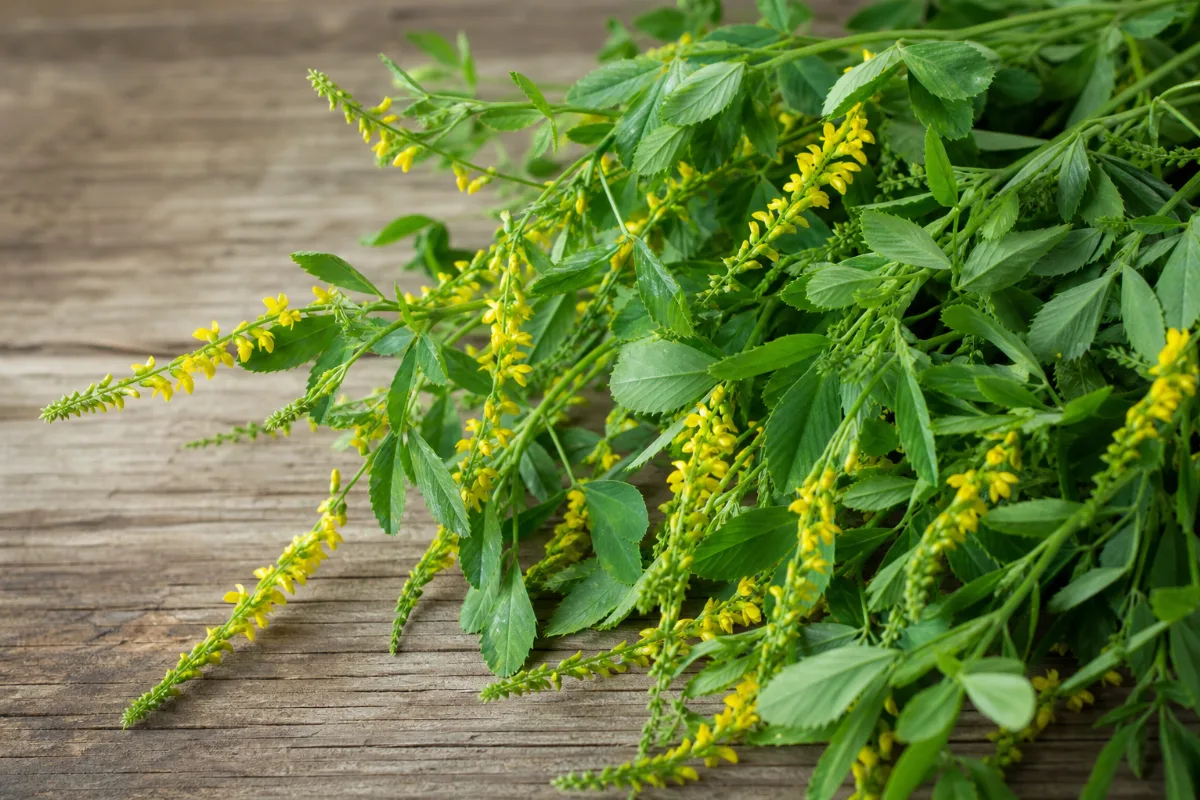
Sweet clover (melilot) is a yellow-flowered plant whose dried tops are used in Europe as a traditional herb for heavy, swollen legs from minor vein problems. Studies are small and mostly uncontrolled, so we cannot say it works. It contains coumarin, which can irritate the liver in a few people, and spoiled hay made a blood-thinning poison that led to warfarin-type drugs. Check with a doctor or pharmacist first if you take blood thinners.
General information, not medical advice. Last substantive update · Not medically reviewed. A named clinician has not signed off on this page. How this page is made
About Sweet clover
Sweet clover (Melilotus officinalis, also called yellow sweet clover or melilot) is a European herb used for heavy, swollen legs. The EU allows it only as a traditional medicine. Studies are small and mostly open, and the best-known coumarin trials disagree. The main compound, coumarin, can irritate the liver in a few people, and spoiled sweet clover hay is where the first blood-thinning drug of its family was found.
What it is
Sweet clover is a legume (family Fabaceae) with yellow flowers. The medicinal herb, called Meliloti herba in Europe, is the dried aerial parts. It smells of new-mown hay because of coumarin, which makes up about 0.3 to 0.9 percent of the dry herb.
It is a different plant from red clover (Trifolium pratense), which is used for other reasons. See the red clover page.
Coumarin, dicoumarol and the cattle disease
Cattle fed spoiled sweet clover hay developed a bleeding disease. In 1939 the chemist Link identified dicoumarol (dicumarol) in the spoiled hay as the cause. Dicoumarol blocks vitamin K and so thins the blood. It is part of the story of the coumarin blood-thinner drugs such as warfarin.
Coumarin, the main compound in the plant, is a different molecule and is not itself a blood thinner. Dicoumarol is not expected in clean, dry herb, but the EMA notes it can form when the herb is infected by mould and spoils. This is why storage and quality matter.
The lineage from dicoumarol to warfarin is general history. The abstracts we read confirm the dicumarol discovery and that coumarin-type drugs became mainstay anticoagulants; we did not verify every step.
What it is used for
The EU accepts two traditional uses: relief of heaviness and discomfort in the legs from minor vein problems, and minor skin inflammation. "Traditional" means accepted on long use, not on proof from trials.
Tea, powder, liquid extract and skin patches are all described. Vein products often combine melilot with rutin, diosmin, Ruscus, Centella or horse chestnut. Horse chestnut has its own page.
What the research shows
For leg heaviness there is no placebo-controlled trial of melilot alone. The EMA reviewed three open studies and found the data not strong enough for a well-established use.
For lymphoedema, a 1993 trial of pure coumarin found less swelling. A 1999 trial in 140 women with arm swelling after breast cancer found no difference from placebo and liver blood-test changes in 6%. A Cochrane review of benzo-pyrones could not reach a conclusion because the trials were too poor. Melilot extract studies are small, open or mixed with other ingredients.
One 2026 study of a combination product was written partly by employees of the maker. Other uses (injury swelling, diabetic foot ulcers by injection, breast pain) rest on single small studies.
At a glance
Traditional uses history, not proof
- Tea or powder for heavy, tired legs and ankle swelling (EU traditional use)
- Skin patch or poultice for minor skin inflammation (EU traditional use)
- Folk use for bruises and swellings
Studied for research
- Leg heaviness and swelling in chronic venous disease: very-low certainty (open studies, combination products)
- Lymphoedema (limb swelling): mixed; pure coumarin trials disagree, melilot extract studies are uncontrolled
- Swelling after injury, diabetic foot ulcers (injected), breast pain: very-low or insufficient
Main compounds
- Coumarin (the main compound; 0.3-0.9% of the dried herb)
- Melilotoside (a coumarin-related sugar compound)
- Flavonoids such as robinin
- Dicoumarol (only in mouldy or spoiled herb)
Common forms
- Dried herb tea
- Powdered herb or capsule
- Liquid or standardised extract
- Skin patch or ointment
- Combination vein products (with rutin, diosmin, Ruscus and others)
Research links: EMA assessment report on melilot (2017) · EMA herbal monograph on melilot (2017) · Coumarin trial in arm lymphoedema, no effect (1999) · Coumarin trial in lymphoedema, benefit (1993) · Cochrane review: benzo-pyrones for lymphoedema (2004) · Coumarin liver toxicity review (2022) · Melilot supplement and interferon liver case (2012) · History of anticoagulant discovery (2012) · Research Library · Genes & Biomarkers Library
The plant and its history
- Accepted scientific name
- Melilotus officinalis (L.) Lam.
- Naming authority
- (L.) Lam.
- Common names
- Sweet clover (English); Yellow sweet clover (English); Melilot (English); Meliloto (Spanish); Steinklee / Steinkleekraut (German); Mélilot (French)
- Botanical family
- Fabaceae (legume family)
- Classification
- Plantae > Fabaceae > Melilotus > Melilotus officinalis
- Native range
- Not stated in the sources we read (EMA describes the herb used in Europe). Not claimed here.
- Habitat
- Not described in the sources read.
- What the plant looks like
- Roots: Not described.; Stems: Not described.; Leaves: Not described.; Flowers: Yellow flowers (from the common name "yellow sweet clover"); not described in sources read.; Fruit: Not described.
- Cultivation
- Not described in the sources read. Grown as a forage and hay crop (general knowledge, not verified here).
- Harvest and processing
- The medicinal herb (Meliloti herba) is the cut, dried aerial parts (Ph. Eur. as quoted by EMA). Damp storage lets moulds form dicoumarol.
- Look-alikes and adulterants
- Name: White sweet clover (Melilotus albus); Note: Close relative, also coumarin-rich. Not verified here; used in lab work only (not read).; Name: Red clover (Trifolium pratense); Note: Different genus and compounds (isoflavones). A different plant; see its own page.; Name: Tonka bean and sweet woodruff; Note: Different plants that are also coumarin-rich; EMA cites a tea combining them with melilot.
- Sustainability and conservation
- Not assessed here.
Traditional use and history history, not clinical proof
| Tradition or era | Documented use | Source |
|---|---|---|
| European traditional medicine | Melilot herb used as tea, powder, extract and skin plaster for heavy legs, swelling and minor skin inflammation. The EMA accepts these as traditional uses. | s-ema-mono |
| Early 20th century veterinary science | Cattle fed spoiled sweet clover hay developed a bleeding disease. In 1939 Link identified dicumarol from the spoiled hay as the cause. This is part of the history of the coumarin blood-thinner drugs. | p21838662 |
| Late 20th century clinical research | Coumarin tested for lymphoedema (positive 1993 trial, negative 1999 trial). | p15106192 |
Traditional use shows how a plant was used. It does not show that a supplement works or is safe today.
What is inside, and how it may work
What the plant contains and how those compounds act in cells and animals. Laboratory and animal mechanisms are not proven effects in people.
Main compounds
| Compound | Family | Where it is concentrated | Activity studied | Level of evidence |
|---|---|---|---|---|
| Coumarin (1,2-benzopyrone) PubChem 323 | coumarin (benzopyrone) | Aerial parts (dried herb) 0.3-0.9% of the dried herb (EMA); Ph. Eur. minimum 0.3%. | Main studied compound. Thought to promote protein clearance from swelling; liver effects in some people. Not itself a blood thinner. 7 4 13 | Human data |
| Melilotoside PubChem 5280759 | coumarinic acid glycoside | Aerial parts Main coumarin derivative in the dried herb (EMA). | Releases coumarin as the plant dries. One lab study found activity against a parasite (Giardia). No human data. 7 | Laboratory research |
| Scopoletin PubChem 5280460 | coumarin | Aerial parts Not given. | Minor coumarin; no human data. 7 | Laboratory research |
| Robinin (kaempferol glycoside) and other flavonoids PubChem 5281693 | flavonoid | Aerial parts Not given. | Flavonoids (robinin, a quercetin glycoside called clovin and others) are listed in the EMA report. No human data on these compounds from melilot. 7 | Laboratory research |
| Dicoumarol (dicumarol) PubChem 54676038 | hydroxycoumarin | Only in mouldy or spoiled herb or hay Not present in sound herb (EMA says it can form with fungal spoilage). | Vitamin K blocker; anticoagulant (bleeding). 20 10 7 | Human data |
Mechanisms, receptors and pathways
| Target or pathway | Gene or receptor | What was found | Level |
|---|---|---|---|
| Protein breakdown by macrophages and lymph vessel movement (proposed for coumarin) | not specified | Authors of the lymphoedema papers propose coumarin stimulates macrophages to digest protein and improves lymph vessel contractions. Not confirmed; the large placebo-controlled trial found no benefit. 4 15 13 | Theory |
| Vitamin K epoxide reductase (dicoumarol) | VKORC1 (enzyme) | Dicoumarol resembles vitamin K and blocks the recycling enzyme, producing an anticoagulant effect. This applies to dicoumarol, not to coumarin itself. 20 | Human data |
| Liver metabolism of coumarin by CYP2A6 | CYP2A6 | Humans clear coumarin mainly through 7-hydroxylation by CYP2A6, which varies genetically. The role of CYP2A6 poor metabolisers in coumarin liver injury is only conjecture according to the EMA. 7 18 | Human data |
| Anti-inflammatory effects of extracts | not specified | Lab and animal studies report anti-inflammatory effects. Lab/animal only; no human mechanism work found. 7 | Animal research |
Absorption, metabolism and elimination
- Absorption
- Coumarin is absorbed quickly through human skin and metabolised mainly to 7-hydroxycoumarin (EMA). Oral absorption of melilot compounds other than coumarin is not studied.
- Distribution
- Radiolabelled coumarin in rats reached many organs; in skin it stays unmetabolised (EMA). Human data limited.
- Metabolism
- Mainly CYP2A6 7-hydroxylation in the liver; other pathways (3-hydroxylation, ring opening) exist and may matter in people with low CYP2A6 activity.
- Elimination
- Mainly as glucuronides in urine (EMA).
- Bioavailability
- Not established for melilot preparations.
Isolated compounds versus whole extracts
The two positive-looking and negative controlled lymphoedema trials used isolated coumarin, not the whole herb. Whole melilot also holds melilotoside, scopoletin, flavonoids and a small amount of other compounds, and can hold dicoumarol if spoiled. Melilot studies of the whole extract are uncontrolled or mixed with other herbs, so what is due to coumarin or to other ingredients is unknown. Results from isolated coumarin should not be assumed for the herb, or vice versa.
Nutritional composition
Sweet clover is not a food or a nutrient source. It is sometimes used as a flavouring in some regions (general knowledge, not verified here).
1 mixed findings5 very low certainty2 not enough evidence
What is Sweet clover good for?
What sweet clover has been studied for and how strong the evidence is. Most uses rest on small, uncontrolled studies or on traditional use.
Benefits, one by one
Each card is a research question, not a promise. Tap a goal to filter. Open a card to see the studies, doses and limits.
Heavy, tired legs from minor vein problems
Very low certaintyThis is the use the European Medicines Agency accepts, but only as a traditional herbal medicine. The studies were open (no placebo group) and small, or did not measure results well. They hint at less heaviness, cramps and ankle swelling, but they cannot prove it.
5 studiesTea, powder, liquid extract, skin patch and combination products were…
Studies, doses and limits
What the trials found
EMA found three open studies of melilot alone: a 1996 comparison with ozone therapy (55 people), a 1999 series of 4,536 people, and a 1997 lymphoedema study. All lacked a proper control group. A small trial of a combination product with other herbs (Cataldi 2001, 30 people) also reported less swelling.
Results
Reported less ankle swelling, night cramps and heaviness. In the large series the authors reported good results in about 70% using an unvalidated score; stomach side effects in 1.2% and allergic reactions in 0.25%.
Effect sizes as reported
Not reported in the EMA summaries or abstracts read.
Why this rating
No placebo-controlled trial of melilot alone was found; open designs, unvalidated scores, combination products.
Form and dose studied
Tea, powder, liquid extract, skin patch and combination products were studied; amounts differ and are not given here.
Who was studied
Adults with chronic venous insufficiency (vein valve weakness) or leg swelling.
Limits
EMA said the clinical relevance of the 1996 study is doubtful and that the data support traditional use only. Combination trials cannot separate melilot from other ingredients.
Why researchers looked
Melilot herb has long been used in Europe for leg heaviness and swelling.
Traditional use
Used as tea, powder, extract or skin patch in European folk medicine. Long use is not proof of benefit.
Proposed mechanism Pharmacological theory
Not established in people. Coumarin and related compounds are thought to reduce leak of fluid from small vessels and help clear protein-rich fluid, but this comes from lab and older theory, not from proof in people.
A proposed mechanism does not show that the effect happens in people.
Leg swelling can also come from a blood clot, heart or kidney problems. See the Safety tab.
Leg swelling (oedema) in chronic venous disease
Very low certaintySmall studies of products that combine melilot with other plants report a little less leg swelling. Because several ingredients are mixed together, they do not show what melilot itself does. One 2026 study was written partly by employees of the product maker.
2 studiesTea, powder, liquid extract, skin patch and combination products were…
Studies, doses and limits
What the trials found
A 2026 retrospective study of 51 people used a product with diosmin, Ruscus, melilot and grape extracts plus compression for 30 days, and reported smaller ankle and calf size and better quality of life. A 2001 randomised study of 30 people tested vitamin E, rutin, melilot and Centella.
Results
Median ankle circumference fell 0.4 cm and calf 0.5 cm in the 2026 study. Improvements are small and come with compression.
Effect sizes as reported
Small median drops in ankle and calf size; symptom scores improved (details in the paper).
Why this rating
Combination products, no control group (2026) or tiny trial (2001), industry-linked 2026 study.
Form and dose studied
Tea, powder, liquid extract, skin patch and combination products were studied; amounts differ and are not given here.
Who was studied
Adults with chronic venous or lymphatic disease; mostly women.
Limits
Cannot isolate melilot. Short follow-up. Industry employees among the authors of the 2026 study.
Why researchers looked
Swollen ankles are a main sign of weak leg veins.
Traditional use
Melilot often appears in European vein-support products.
Proposed mechanism Pharmacological theory
Not established. Combination products mix plant compounds with different proposed actions (vein tone, fluid leak, inflammation).
A proposed mechanism does not show that the effect happens in people.
Sudden one-sided leg swelling needs urgent medical review.
Lymphoedema (swelling from poor lymph drainage): melilot extract
Very low certaintySmall open studies of melilot extract, alone or in combination, report a modest drop in limb size. There is no placebo-controlled trial of melilot extract. The largest arm-swelling trial, which used pure coumarin, found no benefit.
5 studiesTea, powder, liquid extract, skin patch and combination products were…
Studies, doses and limits
What the trials found
Pastura 1999 (open, 24 enrolled, 14 treated per protocol): melilot extract for 6 months, about 5% smaller arm size in 11 of 14. Michelini 2019 (52 people, no control): melilot with rutin and bromelain, pitting gone in 72% and limbs 4.2 cm smaller on average. Vettorello 1996 (76 people, open): coumarin with Ginkgo and melilot reported improvement. Martignani 1997 (20 people): melilot plus compression improved, cause unclear.
Results
All melilot lymphoedema studies were uncontrolled or combination products and reported benefit. See the next entry for the controlled coumarin trials.
Effect sizes as reported
Arm size about 5% smaller (Pastura); 4.2 cm average drop in circumference (Michelini).
Why this rating
Uncontrolled studies, combination products, small numbers.
Form and dose studied
Tea, powder, liquid extract, skin patch and combination products were studied; amounts differ and are not given here.
Who was studied
Adults with arm lymphoedema after breast cancer surgery, or leg lymphoedema, stage I-II.
Limits
No placebo group. Many dropped out in Pastura. Michelini and Vettorello used combination products.
Why researchers looked
Coumarin was proposed to help the body clear protein-rich swelling fluid.
Traditional use
Used in some European clinics alongside compression and lymph drainage massage.
Proposed mechanism Preliminary mechanism
Proposed: coumarin activates immune cells (macrophages) to break down protein and may improve lymph vessel movement. Not shown in people.
A proposed mechanism does not show that the effect happens in people.
Lymphoedema needs proper care (compression, skin care, infection watch). Liver enzymes were checked in Michelini and did not change. See Safety tab.
Lymphoedema: trials of isolated coumarin (the main compound)
Mixed findingsThese trials tested pure coumarin, not the whole plant. One 1993 trial found less swelling. A larger 1999 trial of breast-cancer arm swelling found no difference from placebo and a liver signal in 6%. The Cochrane review could not reach a conclusion.
3 studiesPure coumarin, not melilot herb. Amounts not given here.
Studies, doses and limits
What the trials found
Casley-Smith 1993 (crossover, placebo-controlled, 52 people): arm swelling fell from 46% to 26% above normal, leg swelling from 25% to 17% above normal, P<0.001. Loprinzi 1999 (crossover, placebo-controlled, 140 women): arm volumes were similar on coumarin and placebo (P=0.80). Badger 2004 Cochrane review: meta-analysis not possible; no conclusion could be drawn.
Results
One positive trial, one clearly negative and larger trial. Results do not agree.
Effect sizes as reported
Casley-Smith: arms 46% to 26% above normal. Loprinzi: arm volume rose 58 mL on coumarin and 21 mL on placebo (P=0.80).
Why this rating
Two placebo-controlled trials point in opposite directions; Cochrane found most others too poor to judge.
Form and dose studied
Pure coumarin, not melilot herb. Amounts not given here.
Who was studied
People with arm lymphoedema after breast cancer treatment and leg lymphoedema from various causes.
Limits
Isolated compound, so results may not apply to the herb. The positive trial came from the group that developed the theory.
Why researchers looked
Coumarin is the main active-looking compound in melilot.
Traditional use
Not a traditional use; a drug-development line from the 1970s onward.
Proposed mechanism Preliminary mechanism
Same proposal as above (protein breakdown by macrophages). Not confirmed.
A proposed mechanism does not show that the effect happens in people.
6% of women in the larger trial had liver blood-test changes. See Safety tab.
Minor skin inflammation (skin patch or ointment)
Not enough evidenceThe EU lists melilot skin products as a traditional use for minor skin irritation. No human trial was found; only lab work.
2 studiesSkin patch or ointment.
Studies, doses and limits
What the trials found
None found. EMA accepted this use on long use alone.
Results
No trial results.
Effect sizes as reported
None.
Why this rating
Traditional use and lab studies only.
Form and dose studied
Skin patch or ointment.
Who was studied
Adults (not recommended under 18).
Limits
No clinical studies found.
Why researchers looked
Long folk use as a poultice or plaster.
Traditional use
A skin patch with melilot oil extract is sold in some European countries.
Proposed mechanism Laboratory research
Lab studies show some anti-inflammatory effects of extracts. Not shown in people.
A proposed mechanism does not show that the effect happens in people.
Allergic skin reactions are reported. The patch glue colophony (rosin) can also cause allergy. Coumarin is absorbed through the skin and one case report links a melilot cream to a clotting change (see Safety).
Swelling after sprains and bruises
Very low certaintyOne trial of 80 people (known only from an abstract) reported less swelling and pain when melilot tablets were added to usual care. The EMA called this preliminary.
2 studiesSugar-coated tablets of melilot extract (low coumarin per tablet).
Studies, doses and limits
What the trials found
Yang 2010: 80 people with swelling after injury, melilot tablets added to usual care for 7 days versus usual care alone. Reported less inflammation, pain and swelling.
Results
Reported benefit; no data given in the EMA summary.
Effect sizes as reported
Not given.
Why this rating
One unreplicated trial known only from an abstract; no European data.
Form and dose studied
Sugar-coated tablets of melilot extract (low coumarin per tablet).
Who was studied
Adults after injury.
Limits
Read through the EMA report only. Not placebo-controlled as described.
Why researchers looked
Melilot is thought to calm swelling fluid and inflammation.
Traditional use
Used for bruises and swellings in folk medicine.
Proposed mechanism Pharmacological theory
Not established.
A proposed mechanism does not show that the effect happens in people.
Do not use instead of medical care for a bad sprain or suspected fracture.
Diabetic foot ulcers (given by injection in one trial)
Very low certaintyOne tiny trial of 25 people reported faster healing with an injected melilot extract. This is not a home or supplement use, and the evidence is very weak.
2 studiesInjection; not a home use.
Studies, doses and limits
What the trials found
Larijani 2008: 16 treated and 9 control patients, intravenous melilot extract for 28 days; ulcer area shrank 64% versus 25%.
Results
Faster ulcer shrinkage in the treated group.
Effect sizes as reported
64% versus 25% ulcer area reduction.
Why this rating
25 people, unbalanced groups, unstandardised injection.
Form and dose studied
Injection; not a home use.
Who was studied
Adults with diabetic foot ulcers.
Limits
EMA said further larger studies are needed.
Why researchers looked
Melilot was tried as a wound-healing aid.
Traditional use
None for this use.
Proposed mechanism Pharmacological theory
Not established.
A proposed mechanism does not show that the effect happens in people.
Diabetic foot ulcers need medical care.
Breast pain (mastalgia)
Not enough evidenceOne open study of 50 women reported benefit in 23 of 31 assessed, but the outcome measure was unclear and many were not assessed.
2 studiesOral extract (not specified).
Studies, doses and limits
What the trials found
Open study of 50 patients; 23 of 31 assessed improved, 8 did not.
Results
Reported benefit, unclear measure.
Effect sizes as reported
Not given.
Why this rating
Open design, 19 of 50 not assessed for benefit, no placebo.
Form and dose studied
Oral extract (not specified).
Who was studied
Women with breast pain.
Limits
EMA said the efficacy measure could not be assessed.
Why researchers looked
Melilot was tried for cyclic and non-cyclic breast pain.
Traditional use
Not a traditional use.
Proposed mechanism Pharmacological theory
Not established.
A proposed mechanism does not show that the effect happens in people.
New breast pain or lumps need medical review.
Connections to the rest of health
How Sweet clover connects to the rest of our health knowledge graph. Every link says what kind of connection it is. A safety link (for example to the liver) is a warning, not a benefit. A study that merely mentions a topic never creates a benefit link.
Explore every connection: goals, body systems, organs, symptoms, genes
A. Wellness goals
| Connected to | Kind of connection | Evidence status | Context | Studies |
|---|---|---|---|---|
| Healthy Circulation | Traditional use | Very low certainty | Heavy, tired legs from minor vein problems: This is the use the European Medicines Agency accepts, but only as a traditional herbal medicine. The studies were open (no placebo group) and small, or did not measure results well. They hint at less heaviness, cramps and ankle swelling, but they cannot prove it. | 19 1 5 7 8 |
| Healthy Circulation | Very low certainty | Leg swelling (oedema) in chronic venous disease: Small studies of products that combine melilot with other plants report a little less leg swelling. Because several ingredients are mixed together, they do not show what melilot itself does. One 2026 study was written partly by employees of the product maker. Lymphoedema (swelling from poor lymph drainage): melilot extract: Small open studies of melilot extract, alone or in combination, report a modest drop in limb size. There is no placebo-controlled trial of melilot extract. The largest arm-swelling trial, which used pure coumarin, found no benefit. | 2 5 17 15 22 14 7 | |
| Healthy Circulation | Mixed findings | Lymphoedema: trials of isolated coumarin (the main compound): These trials tested pure coumarin, not the whole plant. One 1993 trial found less swelling. A larger 1999 trial of breast-cancer arm swelling found no difference from placebo and a liver signal in 6%. The Cochrane review could not reach a conclusion. | 4 13 3 | |
| Healthy Skin | Traditional use | Not enough evidence | Minor skin inflammation (skin patch or ointment): The EU lists melilot skin products as a traditional use for minor skin irritation. No human trial was found; only lab work. | 7 8 |
| Inflammation Balance | Traditional use | Not enough evidence | Minor skin inflammation (skin patch or ointment): The EU lists melilot skin products as a traditional use for minor skin irritation. No human trial was found; only lab work. | 7 8 |
| Inflammation Balance | Very low certainty | Swelling after sprains and bruises: One trial of 80 people (known only from an abstract) reported less swelling and pain when melilot tablets were added to usual care. The EMA called this preliminary. | 23 7 | |
| Healthy Skin | Very low certainty | Diabetic foot ulcers (given by injection in one trial): One tiny trial of 25 people reported faster healing with an injected melilot extract. This is not a home or supplement use, and the evidence is very weak. | 12 7 | |
| Womens Wellness | Not enough evidence | Breast pain (mastalgia): One open study of 50 women reported benefit in 23 of 31 assessed, but the outcome measure was unclear and many were not assessed. | 16 7 |
B. Body systems
| Connected to | Kind of connection | Evidence status | Context | Studies |
|---|---|---|---|---|
| Cardiovascular System | Biological association | Very low certainty | Studied for: Heavy, tired legs from minor vein problems Studied for: Leg swelling (oedema) in chronic venous disease | 19 1 5 7 8 2 17 15 22 14 4 13 3 23 |
| Integumentary System | Biological association | Not enough evidence | Studied for: Minor skin inflammation (skin patch or ointment) Studied for: Diabetic foot ulcers (given by injection in one trial) | 7 8 12 |
| Reproductive System | Biological association | Not enough evidence | Studied for: Breast pain (mastalgia) | 16 7 |
I. Biomarkers
| Connected to | Kind of connection | Evidence status | Context | Studies |
|---|---|---|---|---|
| Limb size (circumference or volume) | Biological association | Mixed findings | Measured in trials: decrease. A lab change is not the same as a health benefit. | 17 15 4 13 |
| Ankle and calf circumference | Biological association | Very low certainty | Measured in trials: decrease. A lab change is not the same as a health benefit. | 2 |
| Leg heaviness, cramps and swelling symptom scores | Biological association | Very low certainty | Measured in trials: decrease. A lab change is not the same as a health benefit. | 1 5 |
| Liver enzymes (ALT, AST) | Biological association | Low certainty | Measured in trials: monitor. A lab change is not the same as a health benefit. | 13 15 21 |
| INR (blood clotting test) | Biological association | Very low certainty | Measured in trials: monitor. A lab change is not the same as a health benefit. | 6 |
| Diabetic foot ulcer area | Biological association | Very low certainty | Measured in trials: decrease. A lab change is not the same as a health benefit. | 12 |
J. Genes, receptors and enzymes
K. Biological pathways
| Connected to | Kind of connection | Evidence status | Context | Studies |
|---|---|---|---|---|
| Vitamin K cycle (VKORC1) | Preliminary mechanism | Human | Target of dicoumarol and warfarin-type drugs. | 20 |
L. Active compounds
| Connected to | Kind of connection | Evidence status | Context | Studies |
|---|---|---|---|---|
| Coumarin | Contraindication | Moderate certainty | Main melilot compound; liver signal in 6% in a placebo-controlled trial (isolated coumarin). Liver signal in 6% of women in a placebo-controlled trial of isolated coumarin. Preparation or compound: coumarin |
13 18 |
| Dicoumarol | Contraindication | Moderate certainty | Vitamin K blocker formed when sweet clover spoils; origin of coumarin-type anticoagulants. Preparation or compound: dicoumarol |
10 20 |
| Coumarin (1,2-benzopyrone) | Biological association | Human | Main studied compound. Thought to promote protein clearance from swelling; liver effects in some people. Not itself a blood thinner. Preparation or compound: Aerial parts (dried herb) |
7 4 13 |
| Melilotoside | Biological association | In vitro | Releases coumarin as the plant dries. One lab study found activity against a parasite (Giardia). No human data. Preparation or compound: Aerial parts |
7 |
| Scopoletin | Biological association | In vitro | Minor coumarin; no human data. Preparation or compound: Aerial parts |
7 |
| Robinin (kaempferol glycoside) and other flavonoids | Biological association | In vitro | Flavonoids (robinin, a quercetin glycoside called clovin and others) are listed in the EMA report. No human data on these compounds from melilot. Preparation or compound: Aerial parts |
7 |
| Dicoumarol (dicumarol) | Biological association | Human | Vitamin K blocker; anticoagulant (bleeding). Preparation or compound: Only in mouldy or spoiled herb or hay |
20 10 7 |
Each connection is stored with the ingredient, the connected record, the kind of connection, the evidence status, the supporting studies, the preparation or compound involved, and a review date (last reviewed October 25, 2026).
The evidence
The research centre for Sweet clover. Every record here was checked against PubMed or the publisher's page; we never list a study we have not verified.
Evidence by outcome
Bars show how many studies we found for each outcome, not how well it works. People are added up across trials only (reviews are not added, to avoid double counting).
How we rate evidence
High certainty
Several well-run trials or reviews agree; further research is unlikely to change the picture much.
Moderate certainty
Good trials point the same way, but some doubt remains.
Low certainty
Small, short or inconsistent trials. The finding could change with better research.
Very low certainty
Very little or very weak human data. Treat as a possibility only.
Mixed findings
Trials or reviews disagree with each other.
Not enough evidence
Not enough human research to say either way.
Evidence against
Good research found no benefit, or found harm.
We take the reviewers' own risk-of-bias and GRADE statements where they exist, and otherwise judge from study size, design, consistency, directness and whether a product matches what is sold. Many publications do not make evidence high. Method note: We built on our existing summary, read the EMA herbal monograph and assessment report in full, and read PubMed abstracts. Studies that the EMA describes but we did not open are labelled as read through the EMA report. Identity was checked in GBIF and PubChem.
Study library: every study we checked 23
| Study | Design | People | Product, dose, length | Result |
|---|---|---|---|---|
| Aloisi and Scondotto 1999 Observational series of melilot extract in chronic venous insufficiency (as described by EMA) Cited in EMA assessment report · Source |
Observational |
4536 4,536 people with chronic venous insufficiency treated for 3-8 months |
Melilot extract standardised for coumarin Melilot herb Amounts differ between studies and are not given here. |
Authors reported good results in 70%. Stomach side effects in 1.2% and allergic reactions in 0.25%. EMA noted the score was not validated and no objective measure was used. Reported good results; weak design. Methods, limits and fundingOutcomes: Unvalidated 3-level symptom score Limitations: No control group; unvalidated score. Read through EMA assessment report only. Funding and conflicts: Not stated. Read: secondary |
| Avruscio 2026 Real-world effectiveness of a phlebotonic formulation combining diosmin, Ruscus, Melilotus and Vitis vinifera (VIVEMA Stasis) Drugs Context · PMID 41716640 · DOI |
Observational retrospective |
51 51 adults with leg venous and/or lymphatic oedema (84% women) |
Combination: diosmin, Ruscus aculeatus, Melilotus officinalis and Vitis vinifera extracts, plus compression Mixed ingredients Not given here. 30 days |
Quality-of-life score, symptoms and ankle/calf size improved (median 0.4 cm ankle, 0.5 cm calf; p<0.001). No adverse events reported. Small improvements with compression in a combination product. Methods, limits and fundingOutcomes: CIVIQ-14 quality of life; symptoms; ankle and calf circumference Limitations: No control group, retrospective, 30 days, combination product plus compression so melilot cannot be separated. Funding and conflicts: Industry-linked: three authors are employees of the maker (Italfarmaco S.p.A.). Read: abstract |
| Badger 2004 Benzo-pyrones for reducing and controlling lymphoedema of the limbs Cochrane Database Syst Rev · PMID 15106192 · DOI |
Systematic review |
15 trials of benzo-pyrones (coumarin, oxerutin and others) in limb lymphoedema | Benzo-pyrones including coumarin Isolated compounds Amounts differ between studies and are not given here. |
Meta-analysis not possible because of poor trial quality and missing data. Eight coumarin trials were hard to interpret (some duplicate reports, most reporting unclear). Loprinzi 1999 found no difference from placebo and reported a liver toxicity case. The reviewers could not draw conclusions about effectiveness. No conclusion possible (very-low certainty). Methods, limits and fundingOutcomes: Limb volume, pain, discomfort, quality of life, adverse effects Limitations: Old review (2004 update). Covers isolated coumarin and related drugs, not melilot extract. Funding and conflicts: None known (per record). Read: abstract |
| Casley-Smith 1993 Treatment of lymphedema of the arms and legs with 5,6-benzo-[alpha]-pyrone N Engl J Med · PMID 8377779 · DOI |
Controlled trial |
52 31 people with arm lymphoedema after mastectomy and 21 with leg lymphoedema of various causes |
Pure coumarin (5,6-benzo-alpha-pyrone), a single compound - not a melilot extract Synthetic or isolated compound Not given here. Six months on drug and six months on placebo (crossover) · vs Placebo |
Limb swelling fell more on coumarin than on placebo (arms: 46% to 26% above normal; legs: 25% to 17%; P<0.001). Fewer attacks of acute inflammation. 93% preferred the drug. Mild nausea or diarrhoea in 7 people. Positive for isolated coumarin in lymphoedema. Methods, limits and fundingOutcomes: Limb volume and circumference, tissue softness, skin temperature, infections, symptoms Limitations: Isolated coumarin, not whole melilot. Small. Later larger trial (Loprinzi 1999) did not replicate it. Authors are from the group that proposed the benzopyrone theory. Funding and conflicts: Not stated in the abstract. Read: abstract |
| Cataldi 2001 Effectiveness of the combination of alpha tocopherol, rutin, melilotus, and centella asiatica in the treatment of patients with chronic venous insufficiency Minerva Cardioangiol (Italian) · PMID 11292962 |
Controlled trial |
30 30 people with chronic venous insufficiency, randomised to 15 treatment and 15 control |
Combination: vitamin E (alpha tocopherol), rutin, Melilotus officinalis and Centella asiatica Mixed ingredients Amounts differ between studies and are not given here. |
Symptoms improved with less swelling above the fascia (superficial oedema). Reported improvement in a small combination-product trial. Methods, limits and fundingOutcomes: Symptom score 0-4 (function, cramps, oedema) at 15 and 30 days Limitations: Combination product; melilot cannot be separated. Very small. Abstract gives no numbers and does not name the control treatment. Funding and conflicts: Not stated in the abstract. Read: abstract |
| Chiffoleau et al. 2000 Possible interaction: acenocoumarol and a topical cream containing Ruscus and melilot extracts (as described by EMA) Cited in EMA assessment report · Source |
Case report |
1 A 66-year-old woman with heart rhythm disorder on acenocoumarol for years |
Cream containing Ruscus and melilot extracts, applied to legs three times daily Melilot herb extract (topical) Not given here. 10 days to INR rise |
INR rose from 2 to 5.82 about 10 days after starting the cream and returned to usual when either was stopped. A rechallenge seven months later raised INR from 2.56 to 4.06. She massaged more often than advised. Possible interaction; two episodes. Methods, limits and fundingOutcomes: INR (blood clotting test) Limitations: One person. Cream had two plant extracts. Read through EMA assessment report only; original paper not opened. Funding and conflicts: Not stated. Read: secondary |
| European Medicines Agency 2017 Assessment report on Melilotus officinalis (L.) Lam., herba (EMA/HMPC/44165/2016) EMA · Source |
Authoritative guidance |
Regulator review of all available melilot (aerial parts) data | Melilot herb (Meliloti herba) preparations Dried aerial parts Amounts differ between studies and are not given here. |
Concluded the clinical data are not enough for a well-established use but support traditional use for heavy legs from minor vein problems and minor skin inflammation. Notes no interaction data for single-ingredient melilot products, case reports of liver and clotting effects, and that pregnancy and breastfeeding use is not recommended. Traditional use accepted; well-established use not accepted. Methods, limits and fundingOutcomes: Clinical data, safety, toxicology, interactions, pregnancy Limitations: Full text read. Studies it describes (Stefanini 1996, Aloisi 1999, Martignani 1997, Yang 2010, Larijani 2008, Chiffoleau 2000, Hogan 1983) were not re-opened here and are listed as read through this report. Funding and conflicts: Not applicable (regulator document). Read: full-text |
| European Medicines Agency 2017 European Union herbal monograph on Melilotus officinalis (L.) Lam., herba (EMA/HMPC/44166/2016) EMA · Source |
Authoritative guidance |
Regulator monograph | Melilot herb preparations (tea, powder, liquid extract, skin patch) Dried aerial parts Amounts differ between studies and are not given here. |
Two traditional uses only: discomfort and heaviness of the legs from minor vein problems, and minor skin inflammation. Not for under 18 years. Not recommended in pregnancy or breastfeeding. Contraindication: hypersensitivity. Interactions: none reported. Gastrointestinal complaints (oral) and allergic reactions (skin) reported, frequency not known. See a doctor if leg symptoms last more than 2 weeks, or if thrombophlebitis, hard lumps under the skin, sudden swelling of one or both legs, or heart or kidney failure signs appear. Traditional use registration only. Methods, limits and fundingOutcomes: Allowed indications, warnings, interactions, pregnancy Limitations: Full text read. A 2024-25 periodic review noted in our earlier summary was not read. Funding and conflicts: Not applicable (regulator document). Read: full-text |
| GBIF Secretariat 2026 GBIF Backbone Taxonomy: Melilotus officinalis (L.) Lam. GBIF species match API (queried 2026-10-25) · Source |
Database record plant |
Taxonomic record | Name check Whole plant Amounts differ between studies and are not given here. |
Exact match, status ACCEPTED, family Fabaceae, usage key 8193111. Name confirmed. Methods, limits and fundingOutcomes: Accepted name, family Limitations: Database record only. NCBI Taxonomy not checked. Funding and conflicts: Not applicable Read: database |
| Gomez-Outes 2012 Discovery of anticoagulant drugs: a historical perspective Curr Drug Discov Technol · PMID 21838662 · DOI |
Narrative review |
Historical review of anticoagulants | History review Not applicable Amounts differ between studies and are not given here. |
States Link identified dicumarol from spoiled sweet clover hay in 1939 as the cause of sweet clover disease, a bleeding disorder in cattle. Coumarin drugs (warfarin, phenprocoumon, acenocoumarol) have been a mainstay of anticoagulant treatment for over 60 years. Historical account. Methods, limits and fundingOutcomes: History Limitations: History only. The abstract does not describe the step from dicumarol to warfarin in detail. Funding and conflicts: Not stated. Read: abstract |
| Hogan 1983 Bleeding tendency after large amounts of a herbal tonic tea containing tonka bean, melilot and sweet woodruff (as described by EMA) Cited in EMA assessment report · Source |
Case report |
1 A young woman who drank large amounts of a "seasonal tonic" tea for about 2 months |
Tea of tonka beans, melilot and sweet woodruff (all naturally contain coumarin; tonka highest) Mixed coumarin-rich plants Large amounts (EMA). About 2 months |
Abnormal clotting function and mild heavy periods. She was also taking other products that might strengthen anticoagulants (propoxyphene, vitamin A, bromelain). Single confounded case. Methods, limits and fundingOutcomes: Clotting tests; bleeding Limitations: Mostly tonka bean coumarin; melilot only one ingredient; other products may have contributed. Read through EMA assessment report only. Funding and conflicts: Not stated. Read: secondary |
| Larijani et al. 2008 Intravenous melilot extract for diabetic foot ulcers (as described by EMA) Cited in EMA assessment report · Source |
Controlled trial |
25 25 people with diabetic foot ulcers (16 treated, 9 control) |
Intravenous melilot extract (not specified) plus usual care Melilot herb Amounts differ between studies and are not given here. |
Ulcer area shrank 64% in the treated group versus 25% in the control group at 28 days. EMA noted groups were unbalanced and the product was not described. This is an injection and not a home-use form. Possible benefit; very small. Methods, limits and fundingOutcomes: Ulcer area Limitations: Tiny, unbalanced, injected, product unstandardised. Read through EMA assessment report only. Funding and conflicts: Not stated. Read: secondary |
| Loprinzi 1999 Lack of effect of coumarin in women with lymphedema after treatment for breast cancer N Engl J Med · PMID 9929524 · DOI |
Controlled trial |
140 140 women with chronic arm lymphoedema after breast cancer treatment |
Pure coumarin, a single compound - not a melilot extract Isolated compound Not given here. Six months on coumarin and six months on placebo (crossover) · vs Placebo |
Arm volumes were nearly identical on coumarin and placebo (P=0.80). Symptom questionnaires were similar. Coumarin was generally well tolerated, but blood tests suggested liver toxicity in 6% of the women. Null for lymphoedema. Liver signal in 6%. Methods, limits and fundingOutcomes: Arm volume; symptom questionnaire Limitations: Isolated coumarin, not whole melilot. Women with breast-cancer arm lymphoedema only. Funding and conflicts: Not stated in the abstract. Read: abstract |
| Martignani et al. 1997 Open study of melilot extract plus compression in leg lymphoedema (as described by EMA) Cited in EMA assessment report · Source |
Open label |
20 20 people with stage I-II leg lymphoedema |
Melilot extract (not specified) plus compression Melilot herb Amounts differ between studies and are not given here. |
All measures improved, but EMA said melilot is not separable from compression. Improvement; cause unclear. Methods, limits and fundingOutcomes: Pain, tension, leg circumference, ultrasound Limitations: No control group. Read through EMA assessment report only. Funding and conflicts: Not stated. Read: secondary |
| Michelini 2019 Melilotus, Rutin and Bromelain in primary and secondary lymphedema Lymphology · PMID 32171184 |
Uncontrolled trial |
52 52 people with stage I-II primary or secondary lymphoedema (31 leg, 21 arm) |
Combination product: Melilotus extract plus rutin plus bromelain Melilot herb plus other ingredients Amounts differ between studies and are not given here. |
Pitting disappeared in 72%; Stemmer sign unchanged; limb circumference fell by 4.2 cm on average; tissue thickness fell 29%. Liver tests (ALT, AST, GGT, bilirubin) did not change. No side effects reported. Improvement in an uncontrolled study; liver tests unchanged. Methods, limits and fundingOutcomes: Pitting, Stemmer sign, limb circumference, ultrasound tissue thickness, liver blood tests Limitations: No control group. Combination product, so melilot cannot be separated from rutin and bromelain. Six-month follow-up only. Funding and conflicts: Authors report no relevant financial relationships. Read: abstract |
| Not named in our source Open study of melilot extract for breast pain (as described by EMA) Cited in EMA assessment report · Source |
Open label |
50 50 people with cyclic or non-cyclic breast pain; 31 assessed for efficacy |
Melilot extract, high concentration (not specified) Melilot herb Amounts differ between studies and are not given here. |
Melilot helped 23 of 31 assessed, 8 had no benefit. EMA said the efficacy measure was unclear and 19 people were not assessed. Unclear. Methods, limits and fundingOutcomes: Clinical exam and unnamed questionnaire Limitations: Open, unclear outcome, many missing. Read through EMA assessment report only. Funding and conflicts: Not stated. Read: secondary |
| Pastura 1999 Lymphedema of the upper extremity in patients operated for carcinoma of the breast: clinical experience with coumarinic extract from Melilotus officinalis Clin Ter (Italian) · PMID 10756659 |
Open label |
24 24 women enrolled with chronic arm lymphoedema after axillary surgery for breast cancer; 21 eligible, 14 treated per protocol |
Coumarinic extract of Melilotus officinalis (CEMO), a melilot extract Melilot herb Not given here. 6 months · vs Four untreated patients followed as controls |
Of 14 treated per protocol, 11 had about a 5% smaller arm circumference (median reduction modest, p=0.048). Symptoms improved in 12 of 21. Three people had transient stomach side effects. Lymphoedema and symptoms worsened in 4 untreated patients. Small, modest arm-size reduction. Methods, limits and fundingOutcomes: Upper-arm circumference; symptoms; tolerability Limitations: Open, tiny, mostly uncontrolled; many dropped out of the analysis. Abstract only (Italian paper). Funding and conflicts: Not stated in the abstract. Read: abstract |
| Pitaro 2022 Coumarin-Induced Hepatotoxicity: A Narrative Review Molecules · PMID 36558195 · DOI |
Narrative review |
Review of lab and clinical data on coumarin liver effects | Coumarin (isolated compound) Isolated compound Amounts differ between studies and are not given here. |
Coumarin use is limited in several countries because of possible liver toxicity, mostly mild to moderate transaminase rises. Only a few severe cases are described and no liver failure. Liver injury seems restricted to a small subset of people, possibly because of alternative CYP450 metabolism. Real but uncommon liver signal. Methods, limits and fundingOutcomes: Liver safety Limitations: Narrative review; about isolated coumarin rather than melilot. Funding and conflicts: No conflicts declared. Read: abstract |
| Stefanini et al. 1996 Open study of melilot extract versus ozone therapy in chronic venous insufficiency (as described by EMA) Cited in EMA assessment report · Source |
Open label |
55 20 on melilot, 15 on ozone therapy, 20 on both; chronic venous insufficiency |
Melilot dry extract (not specified) Melilot herb Amounts differ between studies and are not given here. |
Melilot reduced ankle oedema, night cramps and heaviness and did better than ozone therapy, but effect sizes were not reported. EMA called the clinical relevance doubtful. Reported benefit, doubtful relevance. Methods, limits and fundingOutcomes: Ankle oedema, night cramps, heaviness Limitations: Open, no placebo group, ozone is not a standard treatment. Not opened by us; read through EMA assessment report. Funding and conflicts: Not stated. Read: secondary |
| Sun 2020 A pharmacological review of dicoumarol: An old natural anticoagulant agent Pharmacol Res · PMID 32911072 · DOI |
Narrative review |
Review of dicoumarol pharmacology | Dicoumarol (isolated compound) Spoilage product of melilot Amounts differ between studies and are not given here. |
Dicoumarol is a natural hydroxycoumarin discovered from the spoilage of Melilotus officinalis. It resembles vitamin K and blocks vitamin K epoxide reductase, acting as a vitamin K antagonist (an anticoagulant). Its side effects raise safety concerns. Mechanism described. Methods, limits and fundingOutcomes: Pharmacology Limitations: Review; no melilot herb data. Funding and conflicts: Not stated. Read: abstract |
| Tamura 2012 Severe liver dysfunction possibly caused by the combination of interferon beta-1b therapy and melilot (sweet clover) supplement J Clin Pharm Ther · PMID 22642738 · DOI |
Case report |
1 One 23-year-old woman with multiple sclerosis in Japan |
Melilot supplement (stated as containing coumarin) with interferon beta-1b Melilot herb supplement Not given here. Supplement for about 3 years; liver rise 14 days after interferon started |
AST and ALT rose sharply (235 and 681 IU/L) 14 days after interferon beta-1b was started. Both returned to normal after stopping the interferon and the supplement. A later switch to a different interferon without the supplement was tolerated. Single case; possible interaction. Methods, limits and fundingOutcomes: Liver enzymes Limitations: One case. The EMA assessment notes lutein supplements may also have contributed, and interferon alone can raise liver enzymes. Cannot say which caused it. Funding and conflicts: Not stated. Read: abstract |
| Vettorello 1996 Contribution of a combination of alpha and beta benzopyrones, flavonoids and natural terpenes in the treatment of lymphedema of the lower limbs at the 2d stage Minerva Cardioangiol (Italian) · PMID 8999369 |
Open label |
76 76 people with stage 2 leg lymphoedema |
Combination: coumarin (tonka bean source), Ginkgo biloba and Melilotus officinalis Mixed ingredients Not given here. 6-8 months |
Authors report very significant improvement in limb size, symptoms and infections from the third month, with good long-term tolerance. Reported improvement in an open study. Methods, limits and fundingOutcomes: Limb circumference, pain, heaviness, oedema, infections Limitations: Open label, no control group, combination product, abstract has no numbers. Funding and conflicts: Not stated in the abstract. Read: abstract |
| Yang et al. 2010 Melilot tablets for swelling after injury (as described by EMA) Cited in EMA assessment report (abstract) · Source |
Controlled trial |
80 80 people with swelling after sprains or bruises |
Melilot extract tablets added to usual care for 7 days Melilot herb Amounts differ between studies and are not given here. |
Authors reported clearly less inflammation, pain and swelling than usual care alone. EMA called the data preliminary; no European data. Preliminary benefit. Methods, limits and fundingOutcomes: Inflammation, pain, swelling Limitations: Only an abstract was available to EMA. Read through EMA assessment report only. Funding and conflicts: Not stated. Read: secondary |
What we do not know yet
- No placebo-controlled trial of melilot alone for leg heaviness or swelling.
- No safety data for melilot with warfarin beyond one case report.
- No testing of commercial products for dicoumarol or coumarin content.
- No pregnancy or breastfeeding data.
How new research is added
New studies are found by a saved PubMed search and are placed in a review queue. A person reads each one before it changes any evidence rating or safety wording.
Lab markers
What changed in blood or saliva tests during trials. A changed number is not the same as feeling or being healthier, and we give no "normal ranges".
Other 6
Limb size (circumference or volume)
Decrease in trials
Tape measurements or volume of the swollen arm or leg.
Mixed findingsResults and what it means
Why it was measured
It shows how much fluid is trapped.
Statistical vs. clinical meaning
A smaller limb is a real measure, but benefit differed between the controlled trials.
Safety implication
None directly.
| Study | Result | People | Product |
|---|---|---|---|
| 17 | About 5% smaller upper-arm circumference in 11 of 14 treated (melilot extract, open). | Arm lymphoedema after breast surgery | Melilot extract |
| 15 | Average circumference down 4.2 cm; tissue thickness down 29% (combination, no control). | Stage I-II lymphoedema | Melilot, rutin, bromelain |
| 4 | Arm swelling 46% to 26% above normal; leg 25% to 17% (isolated coumarin, placebo-controlled). | Arm and leg lymphoedema | Isolated coumarin |
| 13 | No difference from placebo in arm volume (P=0.80). | Arm lymphoedema after breast cancer | Isolated coumarin |
Ankle and calf circumference
Decrease in trials
Tape measure around the ankle and calf in people with swollen legs.
Very low certaintyResults and what it means
Why it was measured
A simple sign of venous swelling.
Statistical vs. clinical meaning
Tiny changes without a control group.
Safety implication
None.
| Study | Result | People | Product |
|---|---|---|---|
| 2 | Median ankle down 0.4 cm and calf down 0.5 cm in 30 days (combination plus compression, no control). | 51 adults with venous or lymphatic oedema | Diosmin, Ruscus, melilot, grape extract |
Leg heaviness, cramps and swelling symptom scores
Decrease in trials
Scores of how heavy, crampy or swollen legs feel.
Very low certaintyResults and what it means
Why it was measured
These are the complaints that make people seek treatment.
Statistical vs. clinical meaning
Scores are subjective and open to expectation effects.
Safety implication
None.
Liver enzymes (ALT, AST)
Monitor in trials
Blood tests that rise when liver cells are irritated or injured.
Low certaintyResults and what it means
Why it was measured
Coumarin can raise liver enzymes in some people.
Statistical vs. clinical meaning
Liver effects look uncommon but real. One report involves pure coumarin, one a combination product with normal tests, and one another liver-active drug.
Safety implication
Anyone with liver disease or on liver-active drugs should ask a doctor first.
| Study | Result | People | Product |
|---|---|---|---|
| 13 | Blood tests suggested liver toxicity in 6% of women taking pure coumarin versus placebo. | 140 women with breast-cancer arm lymphoedema | Isolated coumarin |
| 15 | No change in ALT, AST, GGT or bilirubin over 6 months. | 52 people with lymphoedema | Melilot, rutin, bromelain |
| 21 | AST 235 and ALT 681 IU/L after interferon beta-1b added in a woman taking a melilot supplement; normal after stopping both. | One woman with multiple sclerosis | Melilot supplement plus interferon |
INR (blood clotting test)
Monitor in trials
A test of how long blood takes to clot. People on warfarin-type drugs are kept in a target range.
Very low certaintyResults and what it means
Why it was measured
Coumarin-containing products might alter blood-thinner effect.
Statistical vs. clinical meaning
One reported case, not a trial. It shows the possibility, not how common it is.
Safety implication
Anyone on a blood thinner should ask a doctor or pharmacist before any melilot product, including creams.
| Study | Result | People | Product |
|---|---|---|---|
| 6 | INR rose from 2 to 5.82, then again from 2.56 to 4.06 on rechallenge, with a melilot-and-Ruscus cream on acenocoumarol (one person). | One woman on acenocoumarol | Topical cream with melilot and Ruscus extracts |
Diabetic foot ulcer area
Decrease in trials
Measured surface area of the sore.
Very low certaintyResults and what it means
Safety
What studies and official sources say about side effects, medicines and who should check first. Each point shows what kind of evidence it comes from.
Main points to know 5
- Spoiled sweet clover hay made a blood-thinning poison. Properly dried, clean herb is not the same thing.. Cattle fed spoiled sweet clover hay developed a bleeding disease known as sweet clover disease. In 1939 Link identified dicumarol (dicoumarol) in the spoiled hay as the cause. Dicoumarol is a vitamin K blocker, and it is part of the history of the coumarin blood-thinner drugs such as warfarin and acenocoumarol (the exact lineage is not detailed in the abstracts we read). The EMA says dicoumarol can form in melilot through fungal spoilage. Plain coumarin in the herb is a different molecule and is not itself a blood thinner, but mould, damp storage or poor quality is the concern. No human case of bleeding from correctly stored melilot was found. Authoritative guidance 10 20 7
- Blood thinners (warfarin, acenocoumarol): ask a doctor or pharmacist first, even for creams.. One person on acenocoumarol had her INR (clotting test) rise from 2 to 5.82 about 10 days after starting a leg cream with melilot and Ruscus, and again on a rechallenge. This is a single case report, but it involved a cream. The EMA monograph says no interactions are reported and the assessment says there are no data for single-ingredient melilot products. Case report 6 7 8
- Coumarin can irritate the liver in a small number of people.. In a 140-woman placebo-controlled trial of isolated coumarin, blood tests suggested liver toxicity in 6%. A review says severe cases are few and no liver failure was reported. One woman on a melilot supplement and interferon had a sharp liver rise that settled when both were stopped. Controlled trial 13 18 21
- Not recommended in pregnancy or breastfeeding, or under 18.. The EMA says safety in pregnancy and breastfeeding is not established and use is not recommended. Use under 18 has not been established. Authoritative guidance 8 7
- Tell your surgeon and dentist about any melilot product before procedures.. Because of the clotting-test case and the dicoumarol history, tell the surgical team about any melilot or other coumarin-rich product before an operation. No study tested melilot around surgery. Pharmacological theory 6
Side effects 4
| Effect | How often | Severity and recovery | Evidence |
|---|---|---|---|
| Stomach upset, nausea, vomiting (oral use) 3 of 21 had transient stomach effects in Pastura 1999. EMA lists gastrointestinal complaints, frequency not known. | 1.2% of 4,536 people in one series | mild Expected to settle | Authoritative guidance 1 8 17 |
| Allergic reactions (skin, rash, itching, hives); contact eczema and rhinitis in reports The rosin (colophony) in some melilot plasters is itself a known skin allergen. | 0.25% in the 4,536-person series | mild to moderate Usually settles after stopping | Authoritative guidance 1 7 8 |
| Bruising (ecchymosis) EMA listed ecchymosis among 32 WHO VigiLyze reports (1994-2014), most from South Korea and many after injections. Causality not assessed. | Not established | not graded Unknown | Other observational 7 |
| Raised liver enzymes See Liver. | 6% on isolated coumarin in one trial | mild to moderate; rare severe cases Returned to normal after stopping in the case report | Controlled trial 13 18 21 |
Liver
LiverTox was not searched for this page. Evidence comes from coumarin trials and one melilot case. In the 140-woman placebo-controlled trial of isolated coumarin, 6% showed blood-test signs of liver toxicity. A 2022 review says coumarin liver injury is mostly mild to moderate enzyme rises, restricted to a small group, possibly because of differences in how the CYP2A6 liver enzyme handles coumarin; only a few severe cases and no liver failure were reported. EMA notes melilot herb contains only a small amount of coumarin, but that case reports mostly involve higher daily intakes, a few at lower intakes. In a 52-person uncontrolled study of melilot with rutin and bromelain, liver tests did not change over 6 months. 13 18 21 15 7
How often. Uncommon. Higher-intake and genetic (CYP2A6) differences are suspected but unproven.
Monitoring. Ask a doctor about liver blood tests if you have liver disease, drink alcohol heavily, or take other liver-affecting medicines. Report dark urine, yellow skin or eyes, or severe tiredness.
- .
This is a safety connection. It is not evidence that Sweet clover supports liver health.
Medicines and supplements 6
| With | Why it matters | Importance | Evidence | What to do |
|---|---|---|---|---|
| Warfarin, acenocoumarol and other vitamin K antagonist blood thinners prescription | Unproven. Case report of INR rise with a melilot-and-Ruscus cream; melilot herb also naturally contains coumarins and can contain dicoumarol if spoiled. | Possibly serious (bleeding) if real. Frequency unknown. | Case report Very low certainty 6 7 | Do not start any melilot product, including a cream, without asking the prescriber or pharmacist. Tell them if you already use one. |
| Large amounts of other coumarin-rich plants (tonka bean, sweet woodruff, cassia cinnamon) herb | Additive coumarin intake. | A young woman drinking large amounts of a tea of tonka bean, melilot and sweet woodruff for about 2 months developed abnormal clotting and mild heavy periods. Tonka bean has the most coumarin, and she also took other products that could strengthen anticoagulants. | Case report Very low certainty 11 7 | Avoid stacking several coumarin-rich products. |
| Interferon beta and other medicines that can affect the liver prescription | Possible added liver strain; unproven. | Severe enzyme rise in one reported case. | Case report Very low certainty 21 7 | Tell your neurologist or doctor about the supplement before starting interferon. |
| Aspirin, clopidogrel, other antiplatelets, NSAIDs, fish oil, ginkgo and other bleeding-risk products prescription and supplement | Theoretical added bleeding tendency. | No study found. | Not studied Not enough evidence | Ask a pharmacist. |
| Medicines that speed or slow the liver enzyme CYP2A6 prescription | EMA notes coumarin removal depends on CYP2A6 and is affected by inducers, inhibitors and genetics. | Unknown whether it matters in practice. | Pharmacological theory Not enough evidence 7 | Ask a pharmacist if you take many medicines. |
| Intravenous melilot with rutoside prescription | None found. | Two older clinical studies (1961, 1963) reported no effect on clotting tests for this injected combination (details not given). | Other observational Very low certainty 7 | Not a home use. |
Who should check first 6
| Situation | Advice | Evidence |
|---|---|---|
| Allergy to melilot or coumarin | Do not use (EMA contraindication). | Authoritative guidance 8 7 |
| Taking warfarin, acenocoumarol or other blood thinners, or bleeding disorders, or surgery coming up | Ask the prescriber or surgeon first. No study defines a safe approach. | Case report 6 11 |
| Liver disease, heavy alcohol use, or taking liver-affecting medicines | Ask a doctor first (reasoned from coumarin liver data). | Controlled trial 13 18 21 |
| Pregnancy or breastfeeding | Not recommended (EMA). Animal studies of coumarin showed embryo toxicity. | Authoritative guidance 8 7 |
| Under 18 | Not recommended; use not established. | Authoritative guidance 8 |
| Sudden swelling of one or both legs, thrombophlebitis or hard lumps under the skin, heart or kidney failure | See a doctor; do not self-treat with melilot (EMA warning). | Authoritative guidance 8 7 |
Overdose, product quality and regulators
Summary. In rats and mice, coumarin harms the liver (and lungs in mice) at high doses; humans handle it mainly by a different route, so animal findings do not map directly. Human case reports are listed under Liver and Interactions. The EMA found no genotoxicity or cancer studies of melilot preparations.
Animal. Coumarin: liver (rats, mice) and lung (mice) are target organs; hamsters and gerbils are resistant. Doses were much higher than herb amounts. From EMA assessment (animal data, not re-opened).
Human doses studied. Not given here.
High dose or long term signals. Liver enzyme rises reported at higher coumarin intakes. EFSA set a tolerable daily intake for coumarin from all sources (EMA report).
Overdose response. EMA: no overdose case reported. A handbook cites nausea, vomiting, headache and weakness from a large extract amount, unconfirmed.
Genotoxicity. No studies of melilot preparations. Coumarin itself is not a clear genotoxic agent per EMA (mixed lab results).
Toxic plant parts. No toxic plant part identified in the herb; the hazard is mouldy or spoiled hay forming dicoumarol.
Melilot is a field crop and wild plant. Spoilage by moulds can create dicoumarol. Coumarin content varies between products.
Mould and dicoumarol. EMA: dicoumarol and the antifungal medicarpin can form in melilot through fungal infection and spoilage. This is the cattle disease mechanism. 7 10
Variable coumarin. The European Pharmacopoeia requires at least 0.3% coumarin in the herb, which in practice ranges 0.3-0.9%. Extracts can be concentrated and vary. 7
Plaster additives. A European patch uses colophony (rosin), a known contact allergen. 7
Wrong plant. Do not mix with red clover (Trifolium pratense), a different plant with different compounds. White sweet clover (Melilotus albus) is a close relative; its use is not verified here. 9
| Body | Action | Date |
|---|---|---|
| EMA/HMPC (EU) | Community herbal monograph (Meliloti herba): traditional use for leg heaviness from minor vein problems and for minor skin inflammation. Well-established use not accepted. Not for under 18, not recommended in pregnancy or breastfeeding. source | 2017-11-21 |
When to get medical help
- One swollen, painful, warm or red leg, or sudden calf pain (possible blood clot): get urgent care.
- Chest pain or sudden breathlessness: call emergency services.
- Black or bloody stools, vomiting blood, blood in urine, nosebleeds that will not stop, large unexplained bruises, very heavy periods: stop the product and get urgent care, especially on blood thinners.
- Yellow skin or eyes, dark urine, pale stools or severe tiredness (possible liver problem).
- Facial swelling, hives or trouble breathing (allergy).
Stop the supplement and contact a clinician or emergency service. In the US, Poison Control is 1-800-222-1222.
General information only, not medical advice. Ask a clinician or pharmacist before use, especially with medicines, in pregnancy or with a health condition. See the Natural Remedy Safety guide.
Frequently asked questions
What is sweet clover?
Is sweet clover the same as red clover?
No. Red clover is Trifolium pratense, a different plant with different compounds. Sweet clover is Melilotus officinalis.
Does sweet clover help heavy or swollen legs?
Does it help lymphoedema?
What is the dicoumarol and bleeding story?
Can sweet clover affect blood thinners like warfarin?
Can it harm the liver?
Is it safe in pregnancy or while breastfeeding?
What about surgery?
Tell your surgeon, dentist and anaesthetist about any melilot product. No study tested it around surgery.
What side effects have been reported?
When should I see a doctor instead?
Sudden swelling of one leg, a painful red or warm leg, chest pain, breathlessness, or signs of bleeding need urgent care. Heart or kidney problems with swollen legs also need medical review.
How do I find the right amount or product?
Ask a doctor or pharmacist. Products differ in coumarin content and we do not give amounts.
Explore by health goal
Healthy CirculationHealthy SkinInflammation BalanceWomens Wellness
Editorial transparency
- Written by
- AlternativeMed editorial team. Research compiled with AI assistance, then checked against PubMed records and the EMA documents.
- Medical review
- None. This page has not been reviewed by a physician or pharmacist.
- First published
- 2026-10-25
- Last substantive update
- 2026-10-25
- How we research
- We built on our existing summary, read the EMA herbal monograph and assessment report in full, and read PubMed abstracts. Studies that the EMA describes but we did not open are labelled as read through the EMA report. Identity was checked in GBIF and PubChem.
- How we rate evidence
- See "How we rate evidence" in the Evidence tab.
- Independence
- No product is promoted on this page. No affiliate links are shown. If one is added later it will be labelled and kept apart from the evidence.
Sources 23
Each source was opened and checked. Where we read only the abstract, it says so. The small numbers in the text point here.
- Aloisi and Scondotto. Observational series of melilot extract in chronic venous insufficiency (as described by EMA). Cited in EMA assessment report. 1999. (secondary)
- Avruscio G, Tirrito C, Ragazzo S, et al.. Real-world effectiveness of a phlebotonic formulation combining diosmin, Ruscus, Melilotus and Vitis vinifera (VIVEMA Stasis). Drugs Context. 2026. PMID 41716640. DOI 10.7573/dic.2025-10-1. (abstract)
- Badger C, Preston N, Seers K, Mortimer P. Benzo-pyrones for reducing and controlling lymphoedema of the limbs. Cochrane Database Syst Rev. 2004. PMID 15106192. DOI 10.1002/14651858.CD003140.pub2. (abstract)
- Casley-Smith JR, Morgan RG, Piller NB. Treatment of lymphedema of the arms and legs with 5,6-benzo-[alpha]-pyrone. N Engl J Med. 1993. PMID 8377779. DOI 10.1056/NEJM199310143291604. (abstract)
- Cataldi A, Gasbarro V, Viaggi R, et al.. Effectiveness of the combination of alpha tocopherol, rutin, melilotus, and centella asiatica in the treatment of patients with chronic venous insufficiency. Minerva Cardioangiol (Italian). 2001. PMID 11292962. (abstract)
- Chiffoleau et al.. Possible interaction: acenocoumarol and a topical cream containing Ruscus and melilot extracts (as described by EMA). Cited in EMA assessment report. 2000. (secondary)
- European Medicines Agency, HMPC. Assessment report on Melilotus officinalis (L.) Lam., herba (EMA/HMPC/44165/2016). EMA. 2017. (full-text)
- European Medicines Agency, HMPC. European Union herbal monograph on Melilotus officinalis (L.) Lam., herba (EMA/HMPC/44166/2016). EMA. 2017. (full-text)
- GBIF Secretariat. GBIF Backbone Taxonomy: Melilotus officinalis (L.) Lam.. GBIF species match API (queried 2026-10-25). 2026. (database)
- Gomez-Outes A, Suarez-Gea ML, Calvo-Rojas G, et al.. Discovery of anticoagulant drugs: a historical perspective. Curr Drug Discov Technol. 2012. PMID 21838662. DOI 10.2174/1570163811209020083. (abstract)
- Hogan. Bleeding tendency after large amounts of a herbal tonic tea containing tonka bean, melilot and sweet woodruff (as described by EMA). Cited in EMA assessment report. 1983. (secondary)
- Larijani et al.. Intravenous melilot extract for diabetic foot ulcers (as described by EMA). Cited in EMA assessment report. 2008. (secondary)
- Loprinzi CL, Kugler JW, Sloan JA, et al.. Lack of effect of coumarin in women with lymphedema after treatment for breast cancer. N Engl J Med. 1999. PMID 9929524. DOI 10.1056/NEJM199902043400503. (abstract)
- Martignani et al.. Open study of melilot extract plus compression in leg lymphoedema (as described by EMA). Cited in EMA assessment report. 1997. (secondary)
- Michelini S, Fiorentino A, Cardone M. Melilotus, Rutin and Bromelain in primary and secondary lymphedema. Lymphology. 2019. PMID 32171184. (abstract)
- Not named in our source. Open study of melilot extract for breast pain (as described by EMA). Cited in EMA assessment report. . (secondary)
- Pastura G, Mesiti M, Saitta M, et al.. Lymphedema of the upper extremity in patients operated for carcinoma of the breast: clinical experience with coumarinic extract from Melilotus officinalis. Clin Ter (Italian). 1999. PMID 10756659. (abstract)
- Pitaro M, Croce N, Gallo V, et al.. Coumarin-Induced Hepatotoxicity: A Narrative Review. Molecules. 2022. PMID 36558195. DOI 10.3390/molecules27249063. (abstract)
- Stefanini et al.. Open study of melilot extract versus ozone therapy in chronic venous insufficiency (as described by EMA). Cited in EMA assessment report. 1996. (secondary)
- Sun C, Zhao W, Wang X, et al.. A pharmacological review of dicoumarol: An old natural anticoagulant agent. Pharmacol Res. 2020. PMID 32911072. DOI 10.1016/j.phrs.2020.105193. (abstract)
- Tamura S, Warabi Y, Matsubara S. Severe liver dysfunction possibly caused by the combination of interferon beta-1b therapy and melilot (sweet clover) supplement. J Clin Pharm Ther. 2012. PMID 22642738. DOI 10.1111/j.1365-2710.2012.01350.x. (abstract)
- Vettorello G, Cerreta G, Derwish A, et al.. Contribution of a combination of alpha and beta benzopyrones, flavonoids and natural terpenes in the treatment of lymphedema of the lower limbs at the 2d stage. Minerva Cardioangiol (Italian). 1996. PMID 8999369. (abstract)
- Yang et al.. Melilot tablets for swelling after injury (as described by EMA). Cited in EMA assessment report (abstract). 2010. (secondary)