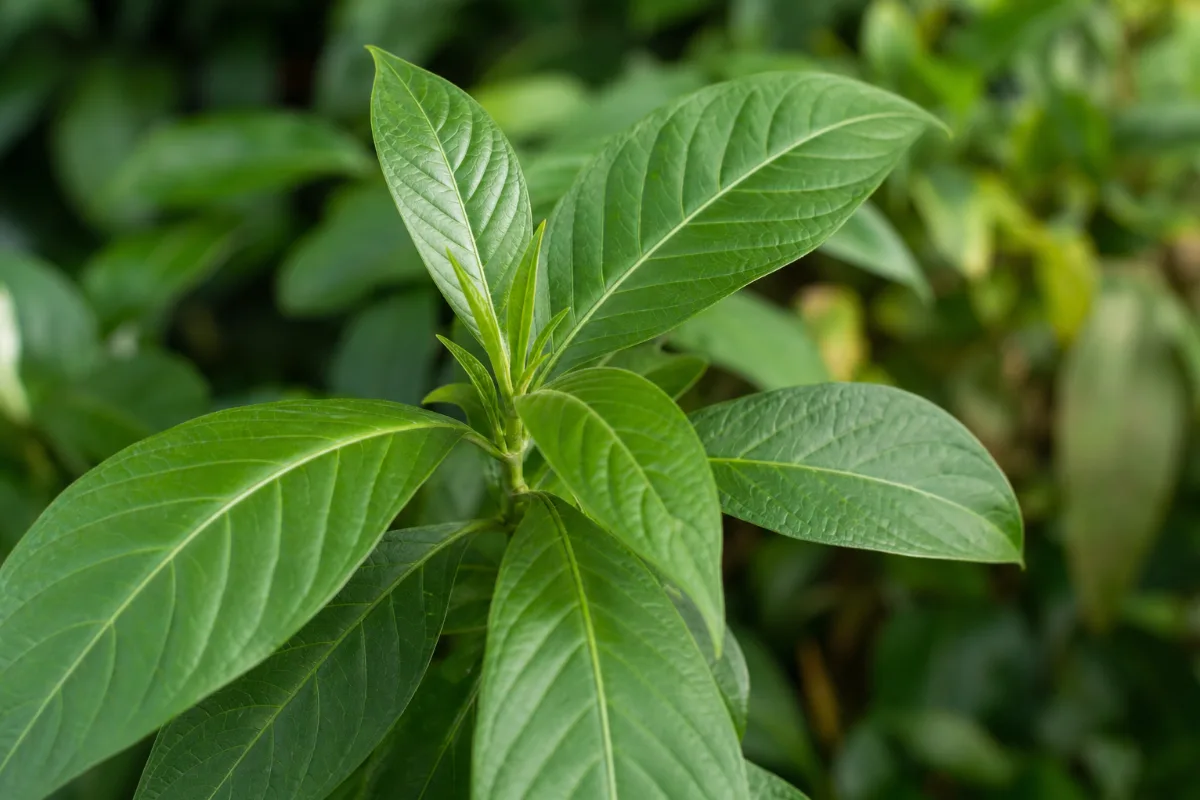
Herbs & Botanicals · Ayurvedic cough herb
Vasaka
Justicia adhatoda · also called Malabar nut, Adosa, adhatoda
Vasaka is a leafy shrub from South Asia that Ayurvedic and Unani medicine have long used for cough, phlegm and bronchitis. Human research is very thin: two trials of a three-herb mix that contains it eased colds, but the plain herb has no controlled cough trial. The cough drug bromhexine was developed from its main compound, but that drug is not the herb. Avoid it in pregnancy, because reviews report womb-stimulating and pregnancy-ending effects.
General information, not medical advice. Last substantive update · Not medically reviewed. A named clinician has not signed off on this page. How this page is made
About Vasaka
Vasaka is a shrub used in Ayurveda and Unani medicine for cough and chest problems. Human evidence is weak, and the plant is not safe in pregnancy.
What it is
Vasaka (Justicia adhatoda, also called Malabar nut) is a shrub in the acanthus family, found across South and Southeast Asia. Older papers call it Adhatoda vasica; it is the same plant.
The leaf is the main part used. Keep four things apart: the herb itself, the Kan Jang combination, pure vasicine in the lab, and the drugs bromhexine and ambroxol.
What is in it
The main active compounds are quinazoline alkaloids, led by vasicine and vasicinone. Reviews also list flavonoids such as quercetin.
Bromhexine, a mucus-thinning cough medicine sold since 1963, was developed from vasicine. How much vasicine a product holds varies a lot.
What the research shows
For cough, the only controlled trials test Kan Jang, a mix of vasaka, Echinacea and eleuthero. They found some cough relief in adults with colds, but the blinded comparison did not show that vasaka added anything. One open-label trial in mild COVID-19 had no placebo group.
Most other findings come from cells, rats and mice. A review of 2022 and others rely on tradition. We rate the evidence for the plain herb as insufficient.
At a glance
Traditional uses history, not proof
- Cough, phlegm, bronchitis and asthma in Ayurveda and Unani medicine
- Tuberculosis, indigestion and skin problems in traditional lists
- Leaf extract also used in some places to speed childbirth (a reason it is not safe in pregnancy)
Studied for research
- Colds and cough: two trials of a three-herb combination
- Mild COVID-19: one open-label trial, no placebo
- Everything else: lab and animal work only
Main compounds
- Vasicine (PubChem CID 667496)
- Vasicinone (CID 442935)
- Deoxyvasicine (CID 442894)
Common forms
- Dried leaf, powder, tea and decoction (traditional)
- Leaf juice and syrup (traditional)
- Three-herb liquid with Echinacea and eleuthero (Kan Jang)
Research links: Claeson 2000: critical review of ethnopharmacological and toxicological data (PubMed) · Khandelwal 2024: pyrrolo-quinazoline derivatives in Adhatoda vasica (PubMed) · Barth 2015: cough trial of a combination with vasaka (PubMed) · Verma 2023: vasaka and Tinospora in mild COVID-19 (PubMed) · Zanasi 2017: bromhexine reappraisal (PubMed) · Research Library · Genes & Biomarkers Library
The plant and its history
- Accepted scientific name
- Justicia adhatoda L.
- Naming authority
- L.
- Synonyms
- Adhatoda vasica Nees; Adhatoda zeylanica Medik.; Adhatoda adhatoda (L.) Huth; Adhatoda arborea Raf.; Adhatoda pubescens Moench; Adeloda serrata Raf.; Dianthera latifolia Salisb.; Ecbolium adhatoda (L.) Druce; Ecbolium adhatoda (L.) Kuntze; Gendarussa adhadota (L.) Steud.; Gendarussa adhatoda (L.) Steud.
- Common names
- Malabar nut (English); Vasaka (English (trade and Ayurvedic name)); Adosa (English (spelling used in one review))
- Botanical family
- Acanthaceae (acanthus family)
- Classification
- Plantae > Tracheophyta > Magnoliopsida > Lamiales > Acanthaceae > Justicia > Justicia adhatoda
- Native range
- A 2026 review says it is widely distributed across South and Southeast Asia; a 2022 review calls it a native plant of the Indian subcontinent. Fine range not verified.
- Habitat
- Not found in the sources read.
- What the plant looks like
- Roots: Roots are used in some folk remedies; no description found.; Stems: Not described.; Leaves: The leaf is the main medicinal part; no description found.; Flowers: Not described.; Fruit: Not described.; Note: A 2022 review describes it as a shrub with opposite ascending branches.
- Cultivation
- Not found.
- Harvest and processing
- Not found. A review describes the traditional 'swarasa' leaf juice, made by heating crushed fresh leaves and squeezing out the juice.
- Look-alikes and adulterants
- Name: Bromhexine and ambroxol (drugs); Note: Factory-made drugs derived from vasicine. They are not the herb and have their own safety information.; Name: Kan Jang / KanJang; Note: A three-herb combination containing vasaka leaf extract, Echinacea root and eleuthero root; trial results belong to the mix.
- Sustainability and conservation
- A 2026 review says it has been over-harvested and placed in the threatened category in India. Not checked in IUCN.
Traditional use and history history, not clinical proof
| Tradition or era | Documented use | Source |
|---|---|---|
| Ayurveda and Unani medicine (about 2,500 years, per one review) | Cough, bronchitis, asthma, phlegm and other breathing complaints; also acidity, bleeding piles, skin problems and, in some places, to speed childbirth or end pregnancy. | p35809281 |
| Modern drug development (1963) | Bromhexine, a mucus-thinning cough drug, was derived from the plant's vasicine and has been sold since 1963. | p28331610 |
| 1980 Indian paper on vasicine as an oxytocic and abortifacient | Cited in the 2024 review as the source for vasicine's womb-stimulating action; we saw only the reference. | p38379997 |
| Scandinavian herbal medicine (Kan Jang) | A fixed combination with Echinacea and eleuthero is approved in Scandinavia for respiratory infections, per a trial paper (not verified against the regulator). | p26598919 |
Traditional use shows how a plant was used. It does not show that a supplement works or is safe today.
What is inside, and how it may work
What the plant contains and how those compounds act in cells and animals. Laboratory and animal mechanisms are not proven effects in people.
Main compounds
| Compound | Family | Where it is concentrated | Activity studied | Level of evidence |
|---|---|---|---|---|
| Vasicine (peganine) PubChem 667496 | Quinazoline alkaloid | Leaf 0.85% in one thick leaf extract; varies widely by product | Main marker compound. Womb-stimulating (animals and tissue), cholinesterase-blocking (lab), and the source compound for the cough drug bromhexine. 3 8 22 14 | Animal research |
| Vasicinone PubChem 442935 | Quinazoline alkaloid | Leaf | A related alkaloid; a minor conversion product of vasicine in rat blood. 20 18 14 | Animal research |
| Deoxyvasicine (deoxypeganine) PubChem 442894 | Quinazoline alkaloid | Leaf | Listed among the active constituents in reviews. 17 14 | Laboratory research |
| Other alkaloids (vasicinol, adhatodine, anisotine and others) | Quinazoline alkaloids | Leaf, root | Reviews list them; CIDs not verified. 8 | Laboratory research |
| Flavonoids (quercetin, kaempferol, apigenin) | Flavonoids | Leaf | Antioxidant and anti-inflammatory activity in lab tests. 18 | Laboratory research |
| Bromhexine (drug, derived from vasicine) PubChem 2442 | Synthetic mucolytic | Not a plant compound | Mucus-thinning cough medicine; not the herb. 21 14 | Human data |
| Ambroxol (drug, relative of bromhexine) PubChem 2132 | Synthetic mucolytic | Not a plant compound | Related cough medicine; not reviewed here. 14 21 | Human data |
Mechanisms, receptors and pathways
| Target or pathway | Gene or receptor | What was found | Level |
|---|---|---|---|
| Womb muscle contraction (prostaglandin synthesis and release) | Prostaglandin pathway | Vasicine started rhythmic contractions of human womb-muscle strips from pregnant and non-pregnant uteri and had womb-stimulating and abortifacient effects in four animal species, probably by raising prostaglandin synthesis and release. 8 | Animal research |
| Mucus secretion and clearance | Not specified | Bromhexine, derived from vasicine, increases secretion of mucus components, changes mucus properties and raises mucociliary clearance. 21 | Human data |
| Cholinesterase enzymes | ACHE, BCHE | Both forms of pure vasicine blocked acetylcholinesterase and butyrylcholinesterase in lab tests. 22 | Laboratory research |
| Oxidative stress and cell death in cancer cells | Apoptosis genes | An ethanol leaf extract raised ROS and triggered intrinsic apoptosis in colon cancer cells. 13 | Laboratory research |
| Drug-handling liver enzymes | CYP2E1, NAT, UGT1A1 | Leaf extract changed expression of these genes in rats given TB drugs. 16 | Animal research |
| Hypoxia marker | HIF-1A | HIF-1alpha fell in the vasaka-alone group of an open-label COVID-19 trial. 19 | Human data |
| Vasicine glucuronidation | UGT1A9, UGT2B15 | UGT1A9 and UGT2B15 were the main human liver enzymes for l-vasicine and UGT1A9 for d-vasicine (human liver microsomes). 22 | Laboratory research |
Absorption, metabolism and elimination
- Absorption
- No human absorption data found (a 1987 volunteer study exists but has no abstract). In rats, vasicine was more orally bioavailable from a freeze-dried leaf-juice capsule than from other forms.
- Distribution
- Not found.
- Metabolism
- Vasicine is attached to glucuronic acid by UGT1A9 and UGT2B15 in human liver preparations; l-vasicine is broken down faster than d-vasicine. A minor conversion to vasicinone is reported in rats.
- Elimination
- Not found for people.
- Bioavailability
- In rats, blood exposure to d-vasicine was 1.3-fold (injection) and 1.6-fold (by mouth) that of l-vasicine. Formulation changed bioavailability in rats.
Isolated compounds versus whole extracts
The herb, the combination Kan Jang, pure vasicine, and the drugs bromhexine and ambroxol are different products. Trials of Kan Jang cannot be credited to vasaka alone, and the modest evidence for bromhexine does not carry over to the leaf. Safety signals (womb stimulation) come from the leaf and vasicine.
Nutritional composition
Vasaka is not a food and no nutrient data were found.
1 low certainty2 very low certainty9 not enough evidence
What was looked at
The 12 benefits and uses checked for Vasaka, each with how strong the evidence is. Tap one to open it.
- Cough and common cold (Kan Jang, a three-herb combination that contains vasaka)Low certainty
- Cough, phlegm and bronchitis (vasaka on its own, traditional use)Not enough evidence
- Asthma and breathing (traditional use)Not enough evidence
- Mild COVID-19 (one open-label trial)Very low certainty
- Bromhexine and ambroxol: cough drugs derived from vasicine (the drugs, not the herb)Not enough evidence
- Tuberculosis (traditional and lab only)Not enough evidence
- Indigestion and acidity (a 1983 syrup study)Very low certainty
- Blood sugar (mouse study)Not enough evidence
- Liver protection (rat studies only)Not enough evidence
- Antioxidant and anti-inflammatory activity (lab and animal)Not enough evidence
- Colon cancer cells in a dish (lab only)Not enough evidence
- Gum inflammation (a traditional report)Not enough evidence
Lab markers tracked in the studies
Cough frequency (cough index)Time to a negative COVID-19 PCR testHIF-1alpha and ferritin (low-oxygen and inflammation markers)PT/INR (clotting time) and eosinophilsStomach acid (total and free hydrochloric acid)Blood glucose in diabetic miceLiver oxidative-stress markers in rats
What is Vasaka good for?
The studied uses and how strong the human evidence is. For vasaka it is weak: the human results are for a three-herb combination, one open-label trial and a very old report. The rest is lab and animal work.
Benefits, one by one
Each card is a research question, not a promise. Tap a goal to filter. Open a card to see the studies, doses and limits.
Cough and common cold (Kan Jang, a three-herb combination that contains vasaka)
Low certaintyIn two randomized trials in Armenia, a liquid made of vasaka leaf, Echinacea root and eleuthero root eased cough in adults with colds. The result belongs to the three-herb mix, not to vasaka alone. Both trials have limits and may be linked to the maker.
2 studiesFixed-dose liquid combination. Nothing here applies to plain leaf, te…
Studies, doses and limits
What the trials found
A 2015 double-blind trial in 177 adults with a cold compared Kan Jang with placebo and with bromhexine for 5 days and found both active treatments relieved cough more than placebo, with a slightly faster recovery with Kan Jang on days 3 and 4. A 2005 trial compared the same combination with an Echinacea-plus-eleuthero mix (double-blind, no significant difference) and with bromhexine (open-label, better symptom scores and 2 days shorter recovery for Kan Jang). No adverse reactions were reported by those finishing the 2005 study, and the 2015 trial reports good tolerability.
Results
More cough relief than placebo; slightly faster recovery than bromhexine in one trial. The blinded comparison of the combination with and without vasaka showed no significant difference.
Effect sizes as reported
The abstracts give no effect sizes (numbers).
Why this rating
Two randomized trials with a consistent direction, but both test a three-herb combination, one comparison was open-label, numbers are missing from the abstracts, colds clear on their own, and a manufacturer link is possible. The 2005 blinded comparison did not show that vasaka added anything.
Form and dose studied
Fixed-dose liquid combination. Nothing here applies to plain leaf, tea, powder or capsules.
Who was studied
Adults 18 to 65 with an uncomplicated cold or acute upper respiratory infection.
Limits
Cannot separate vasaka from Echinacea and eleuthero. Short trials. No children, no pregnancy data. Abstract-only reading.
Why researchers looked
Vasaka is a traditional cough herb, and the Kan Jang combination is approved in Scandinavia for respiratory infections.
Traditional use
Used in Ayurveda and Unani medicine for cough, bronchitis and phlegm.
Proposed mechanism Pharmacological theory
Not shown in these trials. Vasicine, the main alkaloid, is the source of the cough drug bromhexine, but whether vasicine in the herb acts the same way in people has not been shown.
A proposed mechanism does not show that the effect happens in people.
No serious problems reported in these short trials. Pregnancy and breastfeeding were not studied (see the safety file).
Cough, phlegm and bronchitis (vasaka on its own, traditional use)
Not enough evidenceVasaka leaf has been used for cough, phlegm and bronchitis in Ayurveda and Unani medicine for centuries. We found no controlled human trial of the plain herb for cough.
3 studiesDried leaf, juice, decoction, syrup and mixed formulas are described …
Studies, doses and limits
What the trials found
Three reviews (2022, 2024, 2026) describe traditional use and lab findings. None of the abstracts we read report a controlled human trial of the herb alone for cough or bronchitis. The only controlled cough trials found test a combination product.
Results
Traditional use only; no trial results for the plain herb.
Effect sizes as reported
Not applicable.
Why this rating
No controlled trial of the herb alone was found. Reviews restate traditional use and lab findings.
Form and dose studied
Dried leaf, juice, decoction, syrup and mixed formulas are described in reviews; no trial tested them for cough.
Who was studied
Not applicable.
Limits
Our search (PubMed, 2026-10-25) may have missed older Indian trials. Reviews mix many species names and preparations.
Why researchers looked
It is one of the best-known traditional cough herbs of the Indian subcontinent.
Traditional use
Described as a drug for respiratory ailments in Ayurveda and Unani medicine for about 2,500 years (per a 2022 review).
Proposed mechanism Preliminary mechanism
Vasicine and related alkaloids are described in reviews as having mucus-loosening and bronchial effects, mostly from lab and animal work.
A proposed mechanism does not show that the effect happens in people.
See the pregnancy warning in the safety file.
Asthma and breathing (traditional use)
Not enough evidenceVasaka is listed in traditional medicine for asthma and breathlessness. We found no human trial of it for asthma, and it should not replace asthma medicines.
3 studiesNo form tested.
Studies, doses and limits
What the trials found
Reviews list asthma as a traditional use. A 2026 review looked at how eight herbs, including vasaka, might interact with asthma medicines; the abstract gives no vasaka finding. No asthma trial of the herb was found.
Results
None in people.
Effect sizes as reported
Not applicable.
Why this rating
Traditional use plus a review of interactions; no human trial.
Form and dose studied
No form tested.
Who was studied
Not applicable.
Limits
Abstract-only for the interaction review.
Why researchers looked
Asthma is one of the older traditional uses (the leaves were also smoked in a pipe to ease breathing, according to a review).
Traditional use
Ayurvedic and Unani use for asthma and 'dyspnea'.
Proposed mechanism Preliminary mechanism
No mechanism has been shown in people for the herb.
A proposed mechanism does not show that the effect happens in people.
Do not stop or replace prescribed asthma medicines. Possible interactions are unknown (see the safety file).
Mild COVID-19 (one open-label trial)
Very low certaintyOne Indian trial gave vasaka extract, Tinospora extract or both to people with mild COVID-19 for 14 days. Everyone recovered, but there was no placebo group, so it does not show the herb helped.
1 studiesVasaka extract 500 mg arm; other arms 250 mg each. 14 days.
Studies, doses and limits
What the trials found
A 2023 randomized open-label three-arm trial enrolled 150 adults with no or mild symptoms (136 finished). Mean time to a negative PCR test was 13.92 days with vasaka alone, 13.44 with Tinospora alone and 11.86 with both. In the vasaka group, HIF-1alpha, ferritin and SGOT (AST) fell, while eosinophils and PT/INR rose. The authors report no adverse effects.
Results
Viral clearance 13.92 days (95% CI 12.85 to 14.99) with vasaka alone; the combination was 11.86 days (10.62 to 13.11).
Effect sizes as reported
See results; the confidence intervals overlap.
Why this rating
Open-label, no placebo arm, a mild illness that clears by itself, and small groups. The abstract is inconsistent about whether PT/INR rose or fell.
Form and dose studied
Vasaka extract 500 mg arm; other arms 250 mg each. 14 days.
Who was studied
Adults 19 to 65 with no or mild COVID-19 in India.
Limits
Cannot tell if the herb changed the course of illness. No placebo. Funding not stated.
Why researchers looked
Early in the pandemic, traditional respiratory herbs were tested for mild infection and for markers of inflammation and low oxygen.
Traditional use
Traditional use for respiratory infection.
Proposed mechanism Preliminary mechanism
The authors suggest vasaka lowers HIF-1alpha, a marker of low oxygen, but this is a lab-value change in an open-label trial, not proven cause and effect.
A proposed mechanism does not show that the effect happens in people.
No adverse effects reported by the authors, but PT/INR (a clotting test) and eosinophils changed. This is a reason for caution with blood thinners (see the safety file).
Bromhexine and ambroxol: cough drugs derived from vasicine (the drugs, not the herb)
Not enough evidenceBromhexine, a mucus-thinning cough medicine, was developed from the plant's vasicine. Studies of the drug show modest, mostly older evidence in chronic bronchitis. This evidence does not apply to the herb.
2 studiesFactory-made tablets and syrups; not the herb.
Studies, doses and limits
What the trials found
A 2017 review says bromhexine has been sold over the counter since 1963 and describes its clinical evidence as modest but positive, mostly from older studies in chronic bronchitis, with a call for larger, better trials. Ambroxol is a related drug; we did not review its evidence.
Results
Modest but positive (the reviewers' words) for the drug.
Effect sizes as reported
Not applicable.
Why this rating
Rated insufficient for the herb. Whatever the drug does cannot be assumed for vasaka leaf, which has different and variable contents.
Form and dose studied
Factory-made tablets and syrups; not the herb.
Who was studied
People with chronic bronchitis and other chest conditions (drug).
Limits
Different product; dose, purity and effects of the herb are not the same.
Why researchers looked
It explains why the plant matters to modern respiratory medicine.
Traditional use
Not applicable (a modern drug).
Proposed mechanism Preliminary mechanism
The drug increases secretion of mucus components, changes mucus properties and improves mucus clearance, reducing cough.
A proposed mechanism does not show that the effect happens in people.
Bromhexine and ambroxol have their own safety information from a pharmacist.
Tuberculosis (traditional and lab only)
Not enough evidenceVasaka is listed in traditional medicine for tuberculosis. Only lab work backs this and it is not a treatment. Nobody should use it in place of TB medicines.
3 studiesNo form tested in people.
Studies, doses and limits
What the trials found
Reviews list anti-tuberculosis activity from lab and animal tests. No human trial was found. One rat study used the extract alongside TB drugs and found it protected the liver from damage, while changing drug-handling liver enzymes.
Results
None in people.
Effect sizes as reported
Not applicable.
Why this rating
Lab and animal only.
Form and dose studied
No form tested in people.
Who was studied
Not applicable.
Limits
Lab and animal only; do not delay TB treatment.
Why researchers looked
TB is among the old uses; leaf extracts were tested against the TB germ in dishes and mice.
Traditional use
Ayurvedic use for 'phthisis' and TB.
Proposed mechanism Laboratory research
Lab activity against Mycobacterium tuberculosis is reported in reviews.
A proposed mechanism does not show that the effect happens in people.
TB needs prescribed medicines. Any herb added to them can change how they are handled by the liver (see the safety file).
Indigestion and acidity (a 1983 syrup study)
Very low certaintyA very old Indian clinical report says vasaka syrup eased non-ulcer indigestion and lowered stomach acid. It is a short report with few details, so it cannot be relied on.
1 studiesSyrup (Vasa).
Studies, doses and limits
What the trials found
One 1983 clinical trial of Adhatoda vasica syrup in people with non-ulcer dyspepsia. The authors call the results hopeful and report lower total and free stomach acid. The abstract does not state patient numbers, controls, dose or side effects.
Results
Lower stomach acid; no numbers.
Effect sizes as reported
Not given.
Why this rating
Tiny report with no design details and no later confirmation.
Form and dose studied
Syrup (Vasa).
Who was studied
People with non-ulcer dyspepsia.
Limits
No details; 1983; no replication.
Why researchers looked
In Ayurveda the plant is also used for 'amlapitta' (acidity).
Traditional use
Ayurvedic use for acid indigestion.
Proposed mechanism Preliminary mechanism
Lower stomach acid reported; mechanism not studied.
A proposed mechanism does not show that the effect happens in people.
Side effects were not stated in the abstract. Whether it irritates the stomach is unknown.
Blood sugar (mouse study)
Not enough evidenceIn diabetic mice a vasaka-type leaf extract lowered blood sugar nearly as much as metformin. No human trial was found, so it should not be used for diabetes.
2 studiesMethanol leaf extract in mice.
Studies, doses and limits
What the trials found
No human trial found. A 2025 study in diabetic mice (leaf extract of Adhatoda zeylanica, a synonym) reported a drop in blood glucose of 78.95% at 400 mg/kg compared with 85.84% for metformin.
Results
78.95% fall in glucose in diabetic mice versus 85.84% with metformin.
Effect sizes as reported
Not applicable (mouse study).
Why this rating
Animal evidence in one chemically-induced model; no human data.
Form and dose studied
Methanol leaf extract in mice.
Who was studied
Mice.
Limits
Not applicable to people; extreme drop in a drug-induced diabetes model.
Why researchers looked
Reviews list blood-sugar lowering among the plant's activities.
Traditional use
Not a main traditional use in the sources we read.
Proposed mechanism Preliminary mechanism
Vasicine is described as having antidiabetic properties in the mouse paper; the mechanism is not shown in people.
A proposed mechanism does not show that the effect happens in people.
Possible low blood sugar if combined with diabetes medicines is a theory (see the safety file).
Liver protection (rat studies only)
Not enough evidenceIn rats, vasaka leaf extract protected the liver from chemical injury and from TB-drug injury. There is no human liver data, and the extract also changed drug-handling enzymes.
2 studiesEthanol leaf extract in rats.
Studies, doses and limits
What the trials found
A 2021 rat study gave an ethanol leaf extract with isoniazid, rifampicin and pyrazinamide for 25 days; the high dose reduced the oxidative damage and tissue changes. The 2024 review also lists protection against other chemical injuries in rats and mice. No human trial.
Results
Protection in rats; no numbers given.
Effect sizes as reported
Not applicable.
Why this rating
Animal only.
Form and dose studied
Ethanol leaf extract in rats.
Who was studied
Rats.
Limits
Rats, chemical injury models.
Why researchers looked
Traditional use for jaundice and 'liver fever' is mentioned in a review.
Traditional use
Used for jaundice in folk medicine.
Proposed mechanism Animal research
Lowered oxidative stress and changed liver enzymes in rats.
A proposed mechanism does not show that the effect happens in people.
The same study shows the extract changes liver drug-handling enzymes, so it could change how some medicines work. Human liver safety is unknown.
Antioxidant and anti-inflammatory activity (lab and animal)
Not enough evidencePlant compounds in vasaka show antioxidant and anti-inflammatory activity in lab tests and animals. This has not been shown to help people.
2 studiesExtracts and compounds in dishes and animals.
Studies, doses and limits
What the trials found
A 2026 review and a 2024 review report antioxidant, anti-inflammatory and immune-modulating activity in lab and animal studies. No human trial measures this.
Results
None in people.
Effect sizes as reported
Not applicable.
Why this rating
Mechanistic only.
Form and dose studied
Extracts and compounds in dishes and animals.
Who was studied
Not applicable.
Limits
Lab activity often does not carry over to people.
Why researchers looked
Reviews describe quercetin, kaempferol, apigenin and the alkaloids as active.
Traditional use
Leaf paste is applied to painful joints (rheumatism) in folk medicine, per a review.
Proposed mechanism Laboratory research
Antioxidant and anti-inflammatory activity in tests; not proven in people.
A proposed mechanism does not show that the effect happens in people.
None known.
Colon cancer cells in a dish (lab only)
Not enough evidenceA leaf extract killed colon cancer cells in a dish. This does not show that it treats or prevents cancer.
1 studiesEthanol leaf extract.
Studies, doses and limits
What the trials found
A 2026 study (HT-29 colon cancer cells and computer docking). No animal or human data in the abstract.
Results
None in people.
Effect sizes as reported
Not applicable.
Why this rating
Cell-culture and computer work only.
Form and dose studied
Ethanol leaf extract.
Who was studied
Cells.
Limits
Not shown on normal cells in the abstract.
Why researchers looked
Researchers look for natural compounds that kill cancer cells.
Traditional use
Not a traditional use.
Proposed mechanism Laboratory research
The extract raised reactive oxygen species and triggered programmed cell death in the cells.
A proposed mechanism does not show that the effect happens in people.
It is not a cancer treatment; do not use it instead of care.
Gum inflammation (a traditional report)
Not enough evidenceA review mentions leaf extract rubbed on inflamed gums for three weeks. No trial details were found.
1 studiesLeaf extract applied to gums.
Studies, doses and limits
What the trials found
The 2024 review lists the report in a table without trial detail. Toothpaste trials that came up in a search were not used because we could not confirm what they contained.
Results
None given.
Effect sizes as reported
Not applicable.
Why this rating
One line in a review.
Form and dose studied
Leaf extract applied to gums.
Who was studied
Patients with pyorrhoea.
Limits
No design details.
Why researchers looked
Traditional use for gum disease (pyorrhoea).
Traditional use
Leaf extract massaged on gums twice daily.
Proposed mechanism Pharmacological theory
Not studied.
A proposed mechanism does not show that the effect happens in people.
None known.
Connections to the rest of health
How Vasaka connects to the rest of our health knowledge graph. Every link says what kind of connection it is. A safety link (for example to the liver) is a warning, not a benefit. A study that merely mentions a topic never creates a benefit link.
Explore every connection: goals, body systems, organs, symptoms, genes
A. Wellness goals
| Connected to | Kind of connection | Evidence status | Context | Studies |
|---|---|---|---|---|
| Immune Support | Potential benefit | Very low certainty | Mild COVID-19 (one open-label trial): One Indian trial gave vasaka extract, Tinospora extract or both to people with mild COVID-19 for 14 days. Everyone recovered, but there was no placebo group, so it does not show the herb helped. | 19 |
| Digestive Support | Traditional use | Very low certainty | Indigestion and acidity (a 1983 syrup study): A very old Indian clinical report says vasaka syrup eased non-ulcer indigestion and lowered stomach acid. It is a short report with few details, so it cannot be relied on. | 4 |
| Blood Sugar Balance | Preliminary mechanism | Not enough evidence | Blood sugar (mouse study): In diabetic mice a vasaka-type leaf extract lowered blood sugar nearly as much as metformin. No human trial was found, so it should not be used for diabetes. | 1 15 |
| Liver Support | Preliminary mechanism | Not enough evidence | Liver protection (rat studies only): In rats, vasaka leaf extract protected the liver from chemical injury and from TB-drug injury. There is no human liver data, and the extract also changed drug-handling enzymes. | 16 8 |
| Inflammation Balance | Preliminary mechanism | Not enough evidence | Antioxidant and anti-inflammatory activity (lab and animal): Plant compounds in vasaka show antioxidant and anti-inflammatory activity in lab tests and animals. This has not been shown to help people. | 18 8 |
B. Body systems
| Connected to | Kind of connection | Evidence status | Context | Studies |
|---|---|---|---|---|
| Respiratory System | Biological association | Low certainty | Studied for: Cough and common cold (Kan Jang, a three-herb combination that contains vasaka) Studied for: Cough, phlegm and bronchitis (vasaka on its own, traditional use) | 2 11 17 8 18 9 19 21 16 15 |
| Immune System | Biological association | Very low certainty | Studied for: Mild COVID-19 (one open-label trial) Studied for: Tuberculosis (traditional and lab only) | 19 18 16 15 8 |
| Digestive System | Biological association | Very low certainty | Studied for: Indigestion and acidity (a 1983 syrup study) Studied for: Colon cancer cells in a dish (lab only) | 4 13 8 |
| Endocrine System | Biological association | Not enough evidence | Studied for: Blood sugar (mouse study) | 1 15 |
| Metabolism Weight | Biological association | Not enough evidence | Studied for: Blood sugar (mouse study) | 1 15 |
| Hepatic System | Biological association | Not enough evidence | Studied for: Liver protection (rat studies only) | 16 8 |
E. Health conditions
| Connected to | Kind of connection | Evidence status | Context | Studies |
|---|---|---|---|---|
| Pregnancy | Contraindication | Documented risk | Womb-stimulating and abortifacient effects in animals and lab tissue; avoid. Womb-stimulating and pregnancy-ending effects in animals and lab tissue; avoid. Preparation or compound: Leaf extract and vasicine |
6 8 |
| Breastfeeding | Contraindication | Not enough evidence | No safety data; avoid unless a doctor agrees. Preparation or compound: Leaf |
8 |
| Cold / upper respiratory infection | Potential benefit | Low certainty | Two trials of a combination; not vasaka alone. Preparation or compound: Kan Jang (three-herb combination) |
2 11 |
I. Biomarkers
| Connected to | Kind of connection | Evidence status | Context | Studies |
|---|---|---|---|---|
| Cough frequency (cough index) | Biological association | Low certainty | Measured in trials: lowered. A lab change is not the same as a health benefit. | 2 11 |
| Time to a negative COVID-19 PCR test | Biological association | Very low certainty | Measured in trials: mixed. A lab change is not the same as a health benefit. | 19 |
| HIF-1alpha and ferritin (low-oxygen and inflammation markers) | Biological association | Very low certainty | Measured in trials: lowered. A lab change is not the same as a health benefit. | 19 |
| PT/INR (clotting time) and eosinophils | Biological association | Very low certainty | Measured in trials: raised. A lab change is not the same as a health benefit. | 19 |
| Stomach acid (total and free hydrochloric acid) | Biological association | Very low certainty | Measured in trials: lowered. A lab change is not the same as a health benefit. | 4 |
| Blood glucose in diabetic mice | Biological association | Not enough evidence | Measured in trials: lowered. A lab change is not the same as a health benefit. | 1 |
| Liver oxidative-stress markers in rats | Biological association | Not enough evidence | Measured in trials: lowered. A lab change is not the same as a health benefit. | 16 |
J. Genes, receptors and enzymes
| Connected to | Kind of connection | Evidence status | Context | Studies |
|---|---|---|---|---|
| HIF1A | Preliminary mechanism | Human | Lowered in the vasaka-alone group of one open-label trial. | 19 |
| CYP2E1, NAT, UGT1A1 | Preliminary mechanism | Animal | Changed by leaf extract in rats given TB drugs. | 16 |
| UGT1A9, UGT2B15 | Preliminary mechanism | In vitro | Human liver enzymes that metabolize vasicine. | 22 |
| ACHE, BCHE | Preliminary mechanism | In vitro | Cholinesterase enzymes blocked by vasicine in the lab. | 22 |
K. Biological pathways
| Connected to | Kind of connection | Evidence status | Context | Studies |
|---|---|---|---|---|
| Prostaglandin synthesis | Preliminary mechanism | Animal | Proposed route for the womb-stimulating effect of vasicine. | 8 |
L. Active compounds
| Connected to | Kind of connection | Evidence status | Context | Studies |
|---|---|---|---|---|
| Vasicine (peganine) | Biological association | Animal | Main marker compound. Womb-stimulating (animals and tissue), cholinesterase-blocking (lab), and the source compound for the cough drug bromhexine. Preparation or compound: Leaf |
3 8 22 14 |
| Vasicinone | Biological association | Animal | A related alkaloid; a minor conversion product of vasicine in rat blood. Preparation or compound: Leaf |
20 18 14 |
| Deoxyvasicine (deoxypeganine) | Biological association | In vitro | Listed among the active constituents in reviews. Preparation or compound: Leaf |
17 14 |
| Other alkaloids (vasicinol, adhatodine, anisotine and others) | Biological association | In vitro | Reviews list them; CIDs not verified. Preparation or compound: Leaf, root |
8 |
| Flavonoids (quercetin, kaempferol, apigenin) | Biological association | In vitro | Antioxidant and anti-inflammatory activity in lab tests. Preparation or compound: Leaf |
18 |
| Bromhexine (drug, derived from vasicine) | Biological association | Human | Mucus-thinning cough medicine; not the herb. Preparation or compound: Not a plant compound |
21 14 |
| Ambroxol (drug, relative of bromhexine) | Biological association | Human | Related cough medicine; not reviewed here. Preparation or compound: Not a plant compound |
14 21 |
Each connection is stored with the ingredient, the connected record, the kind of connection, the evidence status, the supporting studies, the preparation or compound involved, and a review date (last reviewed October 25, 2026).
The evidence
The research centre for Vasaka. Every record here was checked against PubMed or the publisher's page; we never list a study we have not verified.
Evidence by outcome
Bars show how many studies we found for each outcome, not how well it works. People are added up across trials only (reviews are not added, to avoid double counting).
How we rate evidence
High certainty
Several well-run trials or reviews agree; further research is unlikely to change the picture much.
Moderate certainty
Good trials point the same way, but some doubt remains.
Low certainty
Small, short or inconsistent trials. The finding could change with better research.
Very low certainty
Very little or very weak human data. Treat as a possibility only.
Mixed findings
Trials or reviews disagree with each other.
Not enough evidence
Not enough human research to say either way.
Evidence against
Good research found no benefit, or found harm.
We take the reviewers' own risk-of-bias and GRADE statements where they exist, and otherwise judge from study size, design, consistency, directness and whether a product matches what is sold. Many publications do not make evidence high. Method note: We started from our existing vasaka summary, read the abstract of every PubMed study cited, read parts of the 2024 Heliyon review in full text via Europe PMC, checked the plant name in GBIF and NCBI Taxonomy and compounds in PubChem. NCCIH, LiverTox and LactMed were checked and nothing was found; EMA could not be checked properly.
Study library: every study we checked 22
| Study | Design | People | Product, dose, length | Result |
|---|---|---|---|---|
| Ahmed 2025 Optimization of the extraction methods and evaluation of the hypoglycemic effect of Adhatoda Zeylanica extracts on artificially induced diabetic mice. Heliyon · PMID 39866458 · DOI |
Animal research animal |
Mice made diabetic with alloxan | Methanolic leaf extract of Adhatoda zeylanica (a GBIF synonym of Justicia adhatoda); metformin and two other plant extracts as comparators leaf 400 mg/kg body weight Not stated in abstract · vs Metformin; extracts of Centella asiatica and Allamanda cathartica |
At the dose tested the vasaka-type extract lowered blood glucose by 78.95%, close to metformin at 85.84% (the authors call the vasaka-type extract and metformin statistically similar, both with p < 0.001). Cell survival was above 89% at therapeutic doses in a toxicity test. Large drop in blood glucose in diabetic mice Methods, limits and fundingOutcomes: Blood glucose Limitations: Mice, one chemically induced model, one dose in the abstract. It says nothing about people. The plant was named A. zeylanica, which GBIF lists as a synonym. Funding and conflicts: COI none declared; funding not stated. Read: abstract |
| Barth 2015 Antitussive effect of a fixed combination of Justicia adhatoda, Echinacea purpurea and Eleutherococcus senticosus extracts in patients with acute upper respiratory tract infection: A comparative, randomized, double-blind, placebo-controlled study. Phytomedicine · PMID 26598919 · DOI |
Controlled trial |
177 Adults aged 18-65 with an uncomplicated upper respiratory infection (common cold) in Armenia |
Kan Jang oral solution: a fixed combination of Justicia adhatoda leaf, Echinacea purpurea root and Eleutherococcus senticosus root extracts (a combination product, not vasaka alone) leaf (plus two root extracts) 30 ml per day (contains about 0.2 mg/ml vasicine, as reported) 5 days · vs Placebo; bromhexine hydrochloride |
Both Kan Jang and bromhexine relieved cough more than placebo. On days 3 and 4 the Kan Jang group improved faster than the bromhexine and placebo groups, a slightly shorter recovery time. Good tolerability and safety were reported. The abstract gives no cough-index numbers. Cough relief greater than placebo; slightly faster than bromhexine on days 3-4 Methods, limits and fundingOutcomes: Cough frequency (cough index); adverse events and blood counts Limitations: A three-part combination, so the result cannot be credited to vasaka. Short (5 days), colds clear on their own, no effect sizes in the abstract. The product is approved in Scandinavia and the trial may be manufacturer-linked; funding is not stated in the abstract. Funding and conflicts: Funding not stated in the abstract; product maker involvement not checked. Read: abstract |
| Burgos 1997 Non-abortive effect of Adhatoda vasica spissum leaf extract by oral administration in rats. Phytomedicine · PMID 23195403 · DOI |
Animal research animal |
Pregnant female rats (5 given by stomach tube; 9 given in drinking water) | Adhatoda vasica leaf 'spissum' (thick) extract; main alkaloid vasicine 0.85% leaf 325 mg/kg/day by stomach tube, or 0.25% and 2.5% in the water Days 1 to 9 of pregnancy · vs Not stated in abstract |
No abortion was seen in any treated group. No abortion in these rats Methods, limits and fundingOutcomes: Whether abortion occurred Limitations: Very small groups. Dosing covered only days 1-9 of pregnancy, and the extract is a specific product. It conflicts with other rat work, so the animal evidence on pregnancy is mixed. It does not show the herb is safe for people. The affiliation shown is the Swedish Herbal Institute and one author (Wikman) also appears on a KanJang trial, so an industry link is possible but was not checked. Funding and conflicts: Not stated; affiliation listed is the Swedish Herbal Institute (industry link possible, not checked). Read: abstract |
| Chaturvedi 1983 Clinical trial of adhatoda vasica syrup (vasa) in the patients of non-ulcer dyspepsia (amlapitta). Anc Sci Life · PMID 22557371 |
Clinical trial |
People with non-ulcer dyspepsia (amlapitta, 'acidity') in Varanasi, India | Adhatoda vasica syrup (Vasa) not stated Not stated in abstract Not stated in abstract · vs Not stated in abstract |
The authors call the results 'hopeful'. The syrup reduced total and free hydrochloric acid in patients with hyperacidity and hyperchlorhydria. Lower stomach acid; no numbers in the abstract Methods, limits and fundingOutcomes: Dyspepsia symptoms and stomach acid Limitations: A 1983 journal report. The abstract does not state the number of patients, a control group, blinding, dose or adverse effects. Very low certainty. Funding and conflicts: Not stated. Read: abstract |
| Checked 2026-10-25 2026 Regulator checks for vasaka: NCCIH, EMA/HMPC, LiverTox, LactMed · Source |
Database record not applicable |
Not applicable | Not applicable Not applicable Not applicable Not applicable · vs Not applicable |
NCCIH: pages /health/vasaka and /health/adhatoda returned HTTP 404 (a Memorial Sloan Kettering page also returned 404 in our earlier check). EMA: site search returned HTTP 401 (blocked) and a guessed herbal-medicine page returned 404, so no EMA/HMPC monograph was found or ruled out. NCBI Books search for adhatoda or vasaka with LiverTox or LactMed returned no records. FDA, Commission E and WHO monographs were not searched. Not applicable Methods, limits and fundingOutcomes: Identity or regulator check Limitations: A database or website check, not a study. Read: website |
| Claeson 2000 Adhatoda vasica: a critical review of ethnopharmacological and toxicological data. J Ethnopharmacol · PMID 10967448 · DOI |
Review |
Not applicable (literature review) | Justicia adhatoda (Adhatoda vasica) leaf and other parts, as described in the review leaf Not applicable Not applicable · vs Not applicable |
The abstract says that over about 20 years there were several scientific reports of womb-stimulating (oxytocic) and pregnancy-ending (abortifacient) effects of vasicine and an alkaloid derived from the plant, and that this raised safety questions. The authors reviewed published and unpublished data on traditional use, pharmacology and toxicology and judged how reliable and relevant each was. The abstract gives no final verdict. Narrative review; no pooled effect Methods, limits and fundingOutcomes: Safety of the herb, with focus on womb-stimulating and abortifacient reports Limitations: Only the abstract was read, so the review's own conclusions and data tables were not seen. It is from 2000. Read: abstract |
| GBIF 2026 GBIF Backbone Taxonomy: Justicia adhatoda L. · Source |
Database record not applicable |
Not applicable | Not applicable Not applicable Not applicable Not applicable · vs Not applicable |
Exact match, status ACCEPTED, rank species, usage key 3173105, confidence 97. Family Acanthaceae, order Lamiales. 'Adhatoda vasica Nees' (key 3173106) is listed as a SYNONYM of it (exact match, confidence 98). Other listed synonyms include Adhatoda zeylanica Medik., Adhatoda adhatoda (L.) Huth and Gendarussa adhatoda (L.) Steud. Not applicable Methods, limits and fundingOutcomes: Identity or regulator check Limitations: A database or website check, not a study. Read: api |
| Khandelwal 2024 Exploring the pharmacological and chemical aspects of pyrrolo-quinazoline derivatives in Adhatoda vasica. Heliyon · PMID 38379997 · DOI |
Review |
Not applicable (literature review of lab, animal and traditional-use reports) | Justicia adhatoda (Adhatoda vasica) leaf and other parts, as described in the review leaf Not applicable Not applicable · vs Not applicable |
The review covers literature from 1888 to 2023. It lists traditional use for cough, asthma and phlegm, and reports womb-stimulating and abortifacient effects of vasicine in hamsters, rabbits, rats and guinea pigs, contractions of human womb-muscle strips from pregnant and non-pregnant women, a village survey in which 70% of pregnant women had used the leaves by mouth to end a pregnancy, a 100% abortifacient result for a leaf extract in rats, protection of rat livers from chemical injury, blood-sugar lowering in animals, and a few other lab findings. It calls for clinical studies. Narrative review; no pooled effect Methods, limits and fundingOutcomes: Traditional uses, chemistry, pharmacology and safety signals Limitations: Read the abstract and searched the first part of the full text (via Europe PMC) for specific passages. The survey, rat and human-strip findings are repeated from older papers that we did not open. Many entries in its tables lack doses or methods. Read: full-text |
| Kocyigit 2026 Pharmacokinetic and Pharmacodynamic Interactions Between Anti-Asthma Drugs and Medicinal Plants: A Comprehensive Review. Phytother Res · PMID 42702401 · DOI |
Review |
Not applicable (literature review) | Justicia adhatoda (Adhatoda vasica) leaf and other parts, as described in the review leaf Not applicable Not applicable · vs Not applicable |
The review looks at eight botanicals, including Adhatoda vasica, and how they affect liver enzymes (cytochrome P450 and phase II enzymes) and transporters such as P-glycoprotein, and where they overlap with the targets of asthma medicines (inhaled steroids, beta-agonists, leukotriene blockers, theophylline, biologics). The abstract gives examples for other herbs (St John's wort, ephedra, licorice, ginkgo, turmeric) but no specific finding about vasaka. Narrative review; no pooled effect Methods, limits and fundingOutcomes: Herb-drug interactions with asthma medicines Limitations: Only the abstract was read, so what the full text says about vasaka is unknown. It rests on mechanistic, preclinical and some clinical data. Published online September 2026. Read: abstract |
| NCBI Taxonomy via E-utilities 2026 NCBI Taxonomy: Justicia adhatoda (taxid 141317) · Source |
Database record not applicable |
Not applicable | Not applicable Not applicable Not applicable Not applicable · vs Not applicable |
Scientific name Justicia adhatoda, rank species, taxid 141317, genus Justicia, family Acanthaceae; 'Adhatoda vasica' is listed as a synonym. Not applicable Methods, limits and fundingOutcomes: Identity or regulator check Limitations: A database or website check, not a study. Read: api |
| Narimanian 2005 Randomized trial of a fixed combination (KanJang) of herbal extracts containing Adhatoda vasica, Echinacea purpurea and Eleutherococcus senticosus in patients with upper respiratory tract infections. Phytomedicine · PMID 16121513 · DOI |
Controlled trial |
People with uncomplicated acute respiratory tract infections in Armenia (group sizes not given in the abstract) | KanJang oral solution: standardised Echinacea purpurea, Adhatoda vasica and Eleutherococcus senticosus extracts (combination) not stated Not stated in abstract Not stated in abstract · vs Echinacea plus Eleutherococcus mixture without vasaka (double-blind part); bromhexine (open part) |
Compared with bromhexine, KanJang gave significantly greater improvement in cough severity, cough frequency, mucus discharge, nasal congestion and general sickness, and recovery was 2 days shorter. The Echinacea mixture without vasaka did not differ significantly from bromhexine except for cough frequency. The direct double-blind comparison of KanJang against the Echinacea mixture showed no significant difference. No patients completing the study reported adverse reactions. Better than bromhexine on several symptoms; no significant difference from the mixture without vasaka in the blinded comparison Methods, limits and fundingOutcomes: Cough severity and frequency, mucus discharge, nasal congestion, feeling of sickness, recovery time Limitations: The comparison with bromhexine was open-label, not blinded. The blinded comparison did not show that adding vasaka helped. Group sizes and numbers are missing from the abstract. The authors' explanation for the difference is a guess. Funding and conflicts: Funding not stated in the abstract; some authors have written other papers on this product, so a manufacturer link is possible but not checked. Read: abstract |
| Nath 1992 Commonly used Indian abortifacient plants with special reference to their teratologic effects in rats. J Ethnopharmacol · PMID 1608272 · DOI |
Animal research animal |
Rats dosed by mouth for 10 days after mating | Aqueous or 90% ethanol leaf extracts of several Indian plants, including Adhatoda vasica leaf Equivalent to 175 mg/kg of dry leaf material, as reported 10 days after mating · vs Not stated in abstract |
Leaf extracts of Moringa oleifera and Adhatoda vasica were 100% abortive at the tested dose. Only flowers of two other plants (Acacia arabica and Hibiscus rosa-sinensis) lacked teratologic potential at the doses tested. 100% pregnancy loss in the rats at the tested dose Methods, limits and fundingOutcomes: Abortion and effects on fetal development Limitations: Animal study; the abstract gives no group sizes and does not say which extract type was used for Adhatoda. Results differ from the 1997 rat study, so the animal evidence is mixed. It cannot give a safe or unsafe amount for people. Funding and conflicts: Not stated in abstract (government drug research institute). Read: abstract |
| Ponnusamy 2026 Mechanistic Exploration of the anticancer activity of Justicia adhatoda Plant Leaf Ethanolic Extract against Colon Cancer Cells: An in silico and in vitro Approach. Asian Pac J Cancer Prev · PMID 41793686 · DOI |
Laboratory research in-vitro |
HT-29 human colon cancer cells in a dish, plus computer docking | Ethanol extract of Justicia adhatoda leaf leaf Not stated in abstract Not stated in abstract · vs Untreated cells (not stated) |
The ethanol leaf extract was strongly toxic to the cancer cells. It raised reactive oxygen species and triggered programmed cell death through the intrinsic pathway. Computer analysis suggested drug-like properties for some plant compounds. Cell-culture result only Methods, limits and fundingOutcomes: Cell death, oxidative stress markers, gene and protein changes Limitations: Dish and computer work. It cannot show that the extract works, or is safe, in a person, and it does not show an effect on normal cells. Read: abstract |
| PubChem PUG REST 2026 PubChem compound records: vasicine, vasicinone, deoxyvasicine, bromhexine, ambroxol · Source |
Database record not applicable |
Not applicable | Not applicable Not applicable Not applicable Not applicable · vs Not applicable |
Name look-ups returned: (-)-vasicine CID 667496 (C11H12N2O); (-)-vasicinone CID 442935 (C11H10N2O2); deoxyvasicine, listed as Deoxypeganine, CID 442894 (C11H12N2); bromhexine CID 2442 (C14H20Br2N2); ambroxol CID 2132 (C13H18Br2N2O). Not applicable Methods, limits and fundingOutcomes: Identity or regulator check Limitations: A database or website check, not a study. Read: api |
| Shamsuddin 2021 Adhatoda vasica (Nees.): A Review on its Botany, Traditional uses, Phytochemistry, Pharmacological Activities and Toxicity. Mini Rev Med Chem · PMID 33634759 · DOI |
Review |
Not applicable (literature review) | Justicia adhatoda (Adhatoda vasica) leaf and other parts, as described in the review leaf Not applicable Not applicable · vs Not applicable |
The review collected 233 compounds from the plant (alkaloids, flavonoids, essential oils, terpenoids and others) and lists antibacterial, antifungal, liver-protecting, anti-ulcer, abortifacient, antiviral, anti-inflammatory, clot-dissolving, blood-sugar-lowering, anti-tuberculosis, antioxidant and cough-relieving activities. It mentions clinical assessment and toxicity in its aims but the abstract gives no details. Narrative review; no pooled effect Methods, limits and fundingOutcomes: Narrative summary of traditional use, chemistry, lab and animal findings and safety Limitations: Only the abstract was read. It lists activities without saying which were tested in people. Activity lists like this come largely from lab and animal work. Read: abstract |
| Sharma 2021 Ameliorative potential of Adhatoda vasica against anti-tubercular drugs induced hepatic impairments in female Wistar rats in relation to oxidative stress and xeno-metabolism. J Ethnopharmacol · PMID 33388427 · DOI |
Animal research animal |
Female Wistar rats given the anti-tuberculosis drugs isoniazid, rifampicin and pyrazinamide for 25 days | Ethanol leaf extract of Adhatoda vasica leaf 200 and 300 mg/kg/day 25 days · vs Rats given only the TB drugs |
The high dose lessened the oxidative damage and tissue changes caused by the TB drugs. The extract acted as a 'bi-functional inducer' of both phase I (CYP2E1) and phase II (NAT, UGT1A1) enzyme systems. The extract held 134.5 micrograms of vasicine per 10 mg. Liver protection in rats; changed activity of drug-handling enzymes Methods, limits and fundingOutcomes: Liver oxidative stress, antioxidant markers, liver tissue and liver-enzyme genes (CYP2E1, CYP7A1, NAT, NR1I2, UGT1A1) Limitations: Rats only. It shows the extract can change drug-handling enzymes, which is a reason for caution with medicines, not proof of benefit in people. Funding and conflicts: Not stated in abstract. Read: abstract |
| Shoaib 2022 A systematic ethnobotanical review of Adhatoda vasica (L.), Nees. Cell Mol Biol (Noisy-le-grand) · PMID 35809281 · DOI |
Review |
Not applicable (literature review) | Justicia adhatoda (Adhatoda vasica) leaf and other parts, as described in the review leaf Not applicable Not applicable · vs Not applicable |
The review says the plant has been used in Indian medicine for about 2,500 years, mainly for bronchial infections and cough. It names vasicine, vasicinone and deoxyvasicine among the active compounds. Its conclusion is that there is not enough scientifically strong evidence to say the extract could be harmful to people, especially pregnant women. It also says many clinical trials of vasaka herbal formulations have been done around the world, without naming them in the abstract. Narrative review; no pooled effect Methods, limits and fundingOutcomes: Traditional use, chemistry and safety Limitations: This conclusion is softer than the womb-stimulating findings in other reviews and in animals, and it does not list the trials it mentions. Only the abstract was read. Read: abstract |
| Tiwari 2026 The Multifaceted Potential of Adhatoda vasica Nees: Traditional Uses, Pharmacological Activities and Biotechnological Applications. Mini Rev Med Chem · PMID 42015366 · DOI |
Review |
Not applicable (literature review) | Justicia adhatoda (Adhatoda vasica) leaf and other parts, as described in the review leaf Not applicable Not applicable · vs Not applicable |
The review describes Malabar nut as widely distributed across South and Southeast Asia and used in Ayurveda and Unani medicine for asthma, bronchitis and tuberculosis. It names vasicine and vasicinone as the main active compounds and reports antioxidant, antimicrobial, anti-inflammatory and immune-modulating activity. It says the plant has been overharvested and placed in the threatened category in India, and that clinical trials are needed to confirm effectiveness and safety. Narrative review; no pooled effect Methods, limits and fundingOutcomes: Narrative summary of traditional use, chemistry, lab and animal findings and safety Limitations: Only the abstract was read. The activities listed come from lab and animal work, not from controlled human trials. The claim that the plant has 'little or no adverse effects' is hopeful wording, not a finding. Read: abstract |
| Verma 2023 Adhatoda vasica and Tinospora cordifolia extracts ameliorate clinical and molecular markers in mild COVID-19 patients: a randomized open-label three-armed study. Eur J Med Res · PMID 38049897 · DOI |
Controlled trial |
150 Adults aged 19-65 with COVID-19 and no or mild symptoms in India; 136 finished |
Adhatoda vasica extract (one arm); Tinospora cordifolia extract (second arm); both together (third arm) not stated in abstract 500 mg in the vasaka-alone group (n=50); 250 mg each in the combination group 14 days · vs The other two arms; no placebo group |
Mean time to a negative PCR test was 13.92 days (95% CI 12.85-14.99) with vasaka alone, 13.44 days (12.14-14.74) with Tinospora alone and 11.86 days (10.62-13.11) with both. Temperature fell over 14 days in the vasaka and Tinospora groups. In the vasaka group, eosinophils and PT/INR rose significantly, while monocytes, SGOT (AST), globulin, ferritin and HIF-1alpha fell. The authors report no adverse effects and say everyone recovered. The combination arm cleared the virus sooner than the single-herb arms in the authors' view; vasaka alone was not shown to beat anything () Methods, limits and fundingOutcomes: Symptoms, vital signs and viral clearance (primary); blood, cytokine and hypoxia markers (secondary) Limitations: Open-label, no placebo arm, mild illness that usually clears by itself, so recovery cannot be credited to the herb. The three groups' confidence intervals overlap. The abstract describes PT/INR as rising in the results but as a 'reduction' in the conclusions, so the direction is unclear in the abstract. Short, 14 days. Funding and conflicts: Conflict of interest statement says none declared. Funding source not stated in the abstract. Registration: CTRI/2020/09/028043 Read: abstract |
| Vyas 2011 Formulation and pharmacokinetic evaluation of hard gelatin capsule encapsulating lyophilized Vasa Swaras for improved stability and oral bioavailability of vasicine. Fitoterapia · PMID 21187127 · DOI |
Animal research animal |
Rats | Lyophilised Vasa Swaras (aqueous leaf extract of Adhatoda vasica) in capsules, compared with the fresh juice extract, pure vasicine and a marketed capsule leaf Not stated in abstract Not stated in abstract · vs Vasa Swaras, pure vasicine, a marketed capsule |
Vasicine was more orally bioavailable from the freeze-dried Vasa Swaras capsule than from the other forms tested, with a minor conversion to vasicinone. How the product is made changes how much vasicine reaches the blood in rats Methods, limits and fundingOutcomes: Blood levels of vasicine Limitations: Rats, and a formulation test by pharmacy researchers. It says nothing about human blood levels. Funding and conflicts: Not stated. Read: abstract |
| Zanasi 2017 A reappraisal of the mucoactive activity and clinical efficacy of bromhexine. Multidiscip Respir Med · PMID 28331610 · DOI |
Narrative review |
Not applicable (review of lab and clinical research on the drug bromhexine, mostly in chronic bronchitis) | Bromhexine, a factory-made cough medicine derived from vasicine; NOT the herb not applicable Not applicable Not applicable · vs Not applicable |
The review says bromhexine has been sold over the counter since 1963 and is a derivative of the Adhatoda vasica plant. It increases secretion of mucus components, changes mucus properties, raises mucus clearance and reduces cough. Most clinical studies were done in chronic bronchitis, in an era before modern trial standards. The authors describe the clinical evidence as modest but positive, and say larger, better-designed trials are needed. Modest but positive (authors' words); about the drug only Methods, limits and fundingOutcomes: Mucus clearance, cough and respiratory symptoms Limitations: This is about the drug, not the herb, so none of its results carry over to vasaka. Only the abstract was read. Read: abstract |
| Zhu 2018 Stereoselective glucuronidation metabolism, pharmacokinetics, anti-amnesic pharmacodynamics, and toxic properties of vasicine enantiomers in vitro and in vivo. Eur J Pharm Sci · PMID 30077712 · DOI |
Laboratory research in-vitro |
Human liver microsomes and enzymes, rats, and mice | Pure d-vasicine and l-vasicine (not the herb) not applicable Not stated in abstract Not stated in abstract · vs Between the two forms |
UGT1A9 and UGT2B15 were the main human liver enzymes that attach glucuronic acid to l-vasicine, and UGT1A9 alone for d-vasicine. In rats, blood exposure to d-vasicine was 1.3-fold (injected) and 1.6-fold (by mouth) that of l-vasicine. Both forms blocked acetylcholinesterase and butyrylcholinesterase in the lab. The LD50 (dose that killed half of the animals) was 282.51 mg/kg for d-vasicine and 319.75 mg/kg for l-vasicine. Lab and animal pharmacology Methods, limits and fundingOutcomes: How vasicine is broken down and how much reaches the blood; cholinesterase blocking; acute toxicity (LD50) Limitations: Pure compound, not the plant. The abstract does not name the animal species or route for the LD50. Cannot be turned into a safe level for people. Funding and conflicts: Not stated in abstract. Read: abstract |
What we do not know yet
- No controlled trial of plain vasaka (leaf, tea, syrup or capsule) for cough, bronchitis or asthma.
- No human study in pregnancy or breastfeeding, and no human interaction data.
- Cough trials test a three-herb mix, and the abstracts give no numbers.
- The COVID-19 trial had no placebo group.
- No EMA/HMPC, NCCIH, LiverTox or LactMed assessment was found.
How new research is added
New studies are found by a saved PubMed search and placed in a review queue. A person reads each one before it changes any rating or safety wording.
Lab markers
What changed in blood or saliva tests during trials. A changed number is not the same as feeling or being healthier, and we give no "normal ranges".
Metabolic 1
Blood glucose in diabetic mice
Lowered in trials
Sugar in the blood.
Not enough evidenceResults and what it means
Why it was measured
To test blood-sugar lowering in a disease model.
Statistical vs. clinical meaning
Animal result only.
Safety implication
Possible additive effect with diabetes drugs is a theory.
| Study | Result | People | Product |
|---|---|---|---|
| 1 | Fell 78.95% with methanol leaf extract at 400 mg/kg, versus 85.84% with metformin. | Alloxan-induced diabetic mice | Adhatoda zeylanica leaf extract |
Other 6
Cough frequency (cough index)
Lowered in trials
How often a person coughs, tracked over the treatment days.
Low certaintyResults and what it means
Why it was measured
To see whether the combination eases cough.
Statistical vs. clinical meaning
Cough is something people feel, so this is a useful outcome, but the numbers are missing and the product is a combination.
Safety implication
None reported in the abstracts.
| Study | Result | People | Product |
|---|---|---|---|
| 2 | Kan Jang and bromhexine both relieved cough more than placebo; faster improvement with Kan Jang on days 3 and 4. No numbers in the abstract. | 177 adults with a cold | Kan Jang (three-herb combination), 5 days, versus placebo or bromhexine |
| 11 | Greater improvement in cough severity and frequency than with bromhexine; the open comparison, no numbers in the abstract. | People with acute respiratory infections | KanJang versus bromhexine (open) and versus an Echinacea mixture (double-blind) |
Time to a negative COVID-19 PCR test
Mixed results in trials
Days until a swab test no longer finds the virus.
Very low certaintyResults and what it means
Why it was measured
To see if the herb speeds clearing of the virus.
Statistical vs. clinical meaning
No placebo group, so the numbers cannot be compared with doing nothing.
Safety implication
None reported by the authors.
| Study | Result | People | Product |
|---|---|---|---|
| 19 | 13.92 days (95% CI 12.85 to 14.99) with vasaka alone; 13.44 with Tinospora alone; 11.86 with both. | 136 adults with no or mild COVID-19 | Vasaka extract 500 mg, Tinospora 500 mg, or 250 mg of each, 14 days |
HIF-1alpha and ferritin (low-oxygen and inflammation markers)
Lowered in trials
Blood markers linked to low oxygen (HIF-1alpha) and inflammation (ferritin).
Very low certaintyResults and what it means
Why it was measured
To look for a body-level effect behind any symptom change.
Statistical vs. clinical meaning
A change in a lab marker is not a clinical benefit.
Safety implication
None.
| Study | Result | People | Product |
|---|---|---|---|
| 19 | HIF-1alpha and ferritin fell significantly in the vasaka-alone group; values not given in the abstract. | Vasaka-alone arm (n=50) | Vasaka extract 500 mg, 14 days |
PT/INR (clotting time) and eosinophils
Raised in trials
PT/INR measures how quickly blood clots; eosinophils are a type of white blood cell linked to allergy.
Very low certaintyResults and what it means
Why it was measured
As safety and inflammation markers in the trial.
Statistical vs. clinical meaning
A possible effect on clotting that is not confirmed. It matters for people on blood thinners.
Safety implication
Treat as a caution until clarified. Ask a doctor before combining with warfarin or similar medicines.
| Study | Result | People | Product |
|---|---|---|---|
| 19 | In the vasaka-alone group, PT/INR and eosinophils increased significantly. The abstract also describes a 'reduction' of PT/INR in its conclusions, so the direction is not clear from the abstract. | Vasaka-alone arm (n=50) | Vasaka extract 500 mg, 14 days |
Stomach acid (total and free hydrochloric acid)
Lowered in trials
The amount of acid in stomach juice.
Very low certaintyResults and what it means
Why it was measured
To see if the syrup eases acidity.
Statistical vs. clinical meaning
Lower acid is a lab measure; symptom relief is not reported with numbers.
Safety implication
Not reported.
| Study | Result | People | Product |
|---|---|---|---|
| 4 | Total and free hydrochloric acid were reduced in people with hyperacidity; no numbers in the abstract. | People with non-ulcer dyspepsia | Adhatoda vasica syrup (Vasa) |
Liver oxidative-stress markers in rats
Lowered in trials
Chemical signs that liver cells are under oxidative damage.
Not enough evidenceResults and what it means
Why it was measured
To test liver protection in a drug-injury model.
Statistical vs. clinical meaning
Rat result only; not a human liver finding.
Safety implication
The extract also changed CYP2E1, NAT and UGT1A1 gene activity.
| Study | Result | People | Product |
|---|---|---|---|
| 16 | The high dose of ethanol leaf extract reduced the damage caused by TB drugs; no numbers in the abstract. | Female Wistar rats | Ethanol leaf extract 200 and 300 mg/kg/day with TB drugs, 25 days |
Safety
What studies and official sources say about side effects, medicines and who should check first. Each point shows what kind of evidence it comes from.
Main points to know 7
- Avoid in pregnancy: reviews report womb-stimulating and pregnancy-ending effects. Several sources report that vasicine and leaf extracts stimulate womb muscle and ended pregnancies in animals. A 2024 review reports effects in hamsters, rabbits, rats and guinea pigs, contractions of strips of human womb muscle taken from pregnant and non-pregnant women, and a village survey in which 70% of pregnant women said they had used the leaves by mouth to end a pregnancy. A 1992 rat study found 100% pregnancy loss with a leaf extract at the dose tested. The 2000 critical review was written because of these reports. The evidence is mostly animal and lab, from older papers, and one 1997 rat study with a thick leaf extract found no abortion, so animal results are mixed. No controlled human pregnancy study exists. Because the possible harm is serious and the amount that is risky is unknown, treat vasaka as unsafe in pregnancy and avoid it, including in tea or home remedies. See a doctor or midwife for any pregnancy concern. Animal research 6 8 12 3 17
- Breastfeeding: no safety data found. No human data on use while breastfeeding were found, and LactMed has no entry. In the lab, vasicine increased the strength of oxytocin-driven contractions in a rat milk-gland strip, but what that means in a nursing mother is unknown. With no data, avoid it while breastfeeding unless a doctor agrees. Pharmacological theory 8 5
- Human safety data are thin. The small human trials found are short. The Kan Jang combination trials report good tolerability or no adverse reactions in the people who finished. The COVID-19 trial of vasaka extract reported no adverse effects over 14 days, though clotting time (PT/INR) and eosinophils changed. None of this covers long use, children, older adults or people with other illnesses. Controlled trial 2 11 19
- Possible effect on clotting. In the one trial of vasaka alone, PT/INR (a clotting test) and eosinophils rose significantly, although the abstract also uses the word 'reduction' for PT/INR, so the direction is unclear. This is not proof of bleeding risk. People who take warfarin or similar medicines should ask a clinician before using vasaka. Controlled trial 19
- Blood sugar and blood pressure: theory only. A mouse study found a large drop in blood glucose, and a review table lists lower blood pressure for the root alkaloid vasicinol in cats. There are no human data. If you take diabetes or blood-pressure medicines, the possibility of an added effect is a theory worth raising with a pharmacist. Animal research 1 8
- Drug-handling enzymes may change. In rats, a leaf extract changed the activity of liver enzymes (CYP2E1, NAT, UGT1A1) that handle medicines. A 2026 review looked at vasaka among eight herbs that could interact with asthma medicines through liver enzymes and transporters; the abstract gives no vasaka-specific result. Animal research 16 9
- The drugs bromhexine and ambroxol are not the herb. These cough medicines were derived from vasicine. Their safety record belongs to the drugs. Do not take them together with the herb without asking a pharmacist, because both aim at the same job and no one has studied the mix. Authoritative guidance 21
Side effects 4
| Effect | How often | Severity and recovery | Evidence |
|---|---|---|---|
| Stimulation of the womb / pregnancy loss Animal and lab evidence plus a survey; no human frequency available. Animal results conflict (one rat study found no abortion). | Not established | Serious Not applicable | Animal research 8 12 6 |
| Raised clotting time (PT/INR) and eosinophils Lab values in an open-label trial; direction unclear in the abstract. | Not established | Unknown Unknown | Controlled trial 19 |
| Stomach and bowel upset No gut side effects were reported in the abstracts of the human trials, but those were short and small. Absence of reports is not proof of safety. | Not established | Unknown Unknown | None found 2 19 |
| Low blood sugar or low blood pressure Based on animal findings only; not seen in people. | Not established | Unknown Unknown | Pharmacological theory 1 8 |
Liver
No LiverTox entry was found (an NCBI Bookshelf search returned nothing) and no human case report of liver injury from vasaka turned up in our searches. In rats, leaf extracts protected the liver from chemical injury and from anti-TB drug injury. In the one COVID-19 trial, AST (SGOT) fell in the vasaka-alone group. These are not safety proof: no long-term human liver study exists, and the extract changed drug-handling liver enzymes in rats. 16 19 5
How often. No frequency is available.
Monitoring. No monitoring advice was found. Stop and get medical help for yellow skin or eyes, dark urine, pale stools or severe tiredness.
This is a safety connection. It is not evidence that Vasaka supports liver health.
Medicines and supplements 8
| With | Why it matters | Importance | Evidence | What to do |
|---|---|---|---|---|
| Oxytocin, ergot-type labour medicines, prostaglandins and other womb-stimulating drugs prescription | In the lab, vasicine started and strengthened womb contractions and increased the effect of oxytocin and prostaglandins in animal tissue. | Possible added effect on the womb; not studied in people. | Animal research Not enough evidence 8 | Do not use around pregnancy, labour or delivery. Tell the care team if any was used. |
| Warfarin and other blood thinners prescription | One open-label trial saw a rise in PT/INR with vasaka extract; the abstract is unclear on direction. | Possible change in clotting; unproven. | Controlled trial Not enough evidence 19 | Ask the prescriber before using. Do not start or stop on your own. |
| Diabetes medicines prescription | Mouse data show a large fall in blood glucose. | Possible low blood sugar with insulin or tablets; theory. | Animal research Not enough evidence 1 | Check with a pharmacist; watch for shakiness, sweating or confusion if you use it. |
| Blood-pressure medicines prescription | A hypotensive effect of the root alkaloid vasicinol was reported in cats. | Possible added drop in blood pressure; theory. | Animal research Not enough evidence 8 | Check with a pharmacist, especially if dizzy or faint. |
| Asthma medicines (theophylline, steroids, beta-agonists, leukotriene blockers) prescription | A 2026 review covers how vasaka and seven other herbs may act on liver enzymes and transporters shared with these medicines. We read only its abstract. | Unknown for vasaka specifically. | Pharmacological theory Not enough evidence 9 | Do not replace asthma medicines. Tell your doctor or pharmacist about all herbs. |
| Anti-tuberculosis drugs (isoniazid, rifampicin, pyrazinamide) prescription | In rats, the extract changed CYP2E1, NAT and UGT1A1 gene activity while protecting the liver. | May change how the TB drugs are handled; human effect unknown. | Animal research Not enough evidence 16 | TB treatment should be supervised; tell the TB team about any herb. |
| Bromhexine and ambroxol cough medicines over-the-counter | Same job and shared plant origin; the herb contains vasicine, the plant source of bromhexine. | No study of the mix; double effect is a theory. | Pharmacological theory Not enough evidence 21 | Ask a pharmacist before using both. |
| Cholinesterase-inhibiting drugs (such as those for Alzheimer's) prescription | Pure vasicine blocked cholinesterase enzymes in the lab. | Possible added effect; very low relevance for the whole herb. | Laboratory research Not enough evidence 22 | Mention it to the prescriber. |
Who should check first 5
| Situation | Advice | Evidence |
|---|---|---|
| Pregnancy (any stage) and trying to get pregnant | Avoid. Reviews report womb-stimulating and pregnancy-ending effects; there is no known safe amount and no controlled human study. | Animal research 6 8 12 |
| Breastfeeding | Avoid unless a doctor agrees. There is no safety data. | Pharmacological theory 8 5 |
| Children | No safety data in children; the trials found enrolled adults. Ask a pediatrician. For a child's cough lasting more than a few days, see a doctor. | Authoritative guidance 2 |
| Taking blood thinners, diabetes medicines, blood-pressure medicines or TB drugs | Ask a doctor or pharmacist first (see interactions). | Pharmacological theory 19 1 16 |
| Using it in place of care for asthma, tuberculosis, a long-lasting cough or a breathing problem | Not supported; get medical care. | Authoritative guidance 9 18 |
Overdose, product quality and regulators
Summary. There is no formal human toxicity study of the plain herb. The main concern is womb stimulation in pregnancy. Pure vasicine has an animal LD50, and the plant is a mix of many compounds.
Animal. For pure vasicine, the LD50 was 282.51 mg/kg (d-vasicine) and 319.75 mg/kg (l-vasicine) in a 2018 study; the abstract does not name the species or route. In a cell test of an A. zeylanica leaf extract, survival stayed above 89% at the doses tried.
Human doses studied. Short trials of a three-herb combination (5 days) and of vasaka extract (14 days) reported no serious problems. Not enough to define a safe level.
High dose or long term signals. Not found. No long-term human data.
Overdose response. Not found.
Genotoxicity. Not found in the sources read.
Toxic plant parts. The leaf is the main part used and the part in the pregnancy reports. A review also notes root use to help expel the foetus or help delivery, probably by local application. We found no comparison of leaf versus root safety.
Supplements are not checked for contents before sale in many countries. We found no tests of vasaka products for metals, pesticides or adulteration. The amount of vasicine differs widely between extracts and methods, and a 2026 review says the plant is overharvested and threatened in India, which can encourage substitution.
Vasicine content varies. Reported vasicine content was 0.85% in one thick leaf extract, about 134.5 micrograms per 10 mg in an ethanol extract, and up to 2.44 g per kg of dried leaf in the best extraction method in another study. These are different products and methods, but they show how much content can vary. 3 16 1
Over-harvesting. A 2026 review says the plant has been over-harvested and placed in the threatened category in India. 18
When to get medical help
- If pregnant: vaginal bleeding, cramping or pain in the belly after taking it: get urgent medical help.
- Hives, swelling of the lips, face or throat, wheezing or trouble breathing: call emergency services.
- Yellow skin or eyes, dark urine, pale stools or severe tiredness: stop and get medical help.
- Unusual bruising or bleeding, especially if you take a blood thinner: get medical help.
- Shakiness, sweating or confusion while on diabetes medicine: treat low blood sugar and call your clinician.
- Breathing that is getting worse, a cough lasting more than 2 to 3 weeks, or coughing blood: see a doctor.
Stop the supplement and contact a clinician or emergency service. In the US, Poison Control is 1-800-222-1222.
General information only, not medical advice. Ask a clinician or pharmacist before use, especially with medicines, in pregnancy or with a health condition. See the Natural Remedy Safety guide.
Frequently asked questions
Is vasaka safe in pregnancy?
No. Reviews report that vasicine and leaf extracts stimulate womb muscle and ended pregnancies in animals, and a village survey describes use to end pregnancy. One rat study using a different extract found no pregnancy loss, so the animal evidence is mixed, but there is no controlled human study and no known safe amount. Avoid it in pregnancy and see a doctor or midwife for any pregnancy question.
Can I use vasaka while breastfeeding?
Does vasaka work for cough?
Is vasaka the same as bromhexine or ambroxol?
What is Kan Jang?
Did vasaka help in COVID-19?
One small open-label trial found everyone with mild COVID-19 recovered within the study, but there was no placebo group, so no benefit is shown.
Is Justicia adhatoda the same as Adhatoda vasica?
Can vasaka affect my medicines?
Possibly, but it is not proven in people. Reasons for caution are a clotting-test change in one trial, blood-sugar lowering in mice, and enzyme changes in rats. Tell your doctor or pharmacist about every herb you use, especially with warfarin, diabetes, blood-pressure, asthma or TB medicines.
Does vasaka damage the liver?
Does vasaka lower blood sugar or blood pressure?
Is vasaka approved by European or US health agencies?
We found no EMA/HMPC monograph (the EMA site could not be checked properly), and no NCCIH, LiverTox or LactMed entry. Absence from these lists means there is no official assessment, not that it is safe.
Where can I get advice on amounts or products?
Ask a doctor or pharmacist. The research on amounts is too thin to give guidance here.
Explore by health goal
Immune SupportDigestive SupportBlood Sugar BalanceLiver SupportInflammation Balance
Editorial transparency
- Written by
- AlternativeMed editorial team. Research compiled with AI assistance, then checked against PubMed records.
- Medical review
- None. This page has not been reviewed by a physician or pharmacist.
- First published
- 2026-10-25
- Last substantive update
- 2026-10-25
- How we research
- We started from our existing vasaka summary, read the abstract of every PubMed study cited, read parts of the 2024 Heliyon review in full text via Europe PMC, checked the plant name in GBIF and NCBI Taxonomy and compounds in PubChem. NCCIH, LiverTox and LactMed were checked and nothing was found; EMA could not be checked properly.
- How we rate evidence
- See "How we rate evidence" in the Evidence tab.
- Independence
- No product is promoted on this page.
Sources 22
Each source was opened and checked. Where we read only the abstract, it says so. The small numbers in the text point here.
- Ahmed MF, Raby KH, Tasnim N et al.. Optimization of the extraction methods and evaluation of the hypoglycemic effect of Adhatoda Zeylanica extracts on artificially induced diabetic mice.. Heliyon. 2025. PMID 39866458. DOI 10.1016/j.heliyon.2025.e41627. (abstract)
- Barth A, Hovhannisyan A, Jamalyan K et al.. Antitussive effect of a fixed combination of Justicia adhatoda, Echinacea purpurea and Eleutherococcus senticosus extracts in patients with acute upper respiratory tract infection: A comparative, randomized, double-blind, placebo-controlled study.. Phytomedicine. 2015. PMID 26598919. DOI 10.1016/j.phymed.2015.10.001. (abstract)
- Burgos R, Forcelledo M, Wagner H et al.. Non-abortive effect of Adhatoda vasica spissum leaf extract by oral administration in rats.. Phytomedicine. 1997. PMID 23195403. DOI 10.1016/S0944-7113(97)80061-X. (abstract)
- Chaturvedi GN, Rai NP, Dhani R et al.. Clinical trial of adhatoda vasica syrup (vasa) in the patients of non-ulcer dyspepsia (amlapitta).. Anc Sci Life. 1983. PMID 22557371. (abstract)
- Checked 2026-10-25. Regulator checks for vasaka: NCCIH, EMA/HMPC, LiverTox, LactMed. . 2026. (website)
- Claeson UP, Malmfors T, Wikman G et al.. Adhatoda vasica: a critical review of ethnopharmacological and toxicological data.. J Ethnopharmacol. 2000. PMID 10967448. DOI 10.1016/s0378-8741(00)00225-7. (abstract)
- GBIF API, read 2026-10-25. GBIF Backbone Taxonomy: Justicia adhatoda L.. . 2026. (api)
- Khandelwal P, Wadhwani BD, Rao RS et al.. Exploring the pharmacological and chemical aspects of pyrrolo-quinazoline derivatives in Adhatoda vasica.. Heliyon. 2024. PMID 38379997. DOI 10.1016/j.heliyon.2024.e25727. (full-text)
- Kocyigit E, Bülbül A, Kocaadam-Bozkurt B et al.. Pharmacokinetic and Pharmacodynamic Interactions Between Anti-Asthma Drugs and Medicinal Plants: A Comprehensive Review.. Phytother Res. 2026. PMID 42702401. DOI 10.1002/ptr.70436. (abstract)
- NCBI Taxonomy via E-utilities, read 2026-10-25. NCBI Taxonomy: Justicia adhatoda (taxid 141317). . 2026. (api)
- Narimanian M, Badalyan M, Panosyan V et al.. Randomized trial of a fixed combination (KanJang) of herbal extracts containing Adhatoda vasica, Echinacea purpurea and Eleutherococcus senticosus in patients with upper respiratory tract infections.. Phytomedicine. 2005. PMID 16121513. DOI 10.1016/j.phymed.2004.10.001. (abstract)
- Nath D, Sethi N, Singh RK et al.. Commonly used Indian abortifacient plants with special reference to their teratologic effects in rats.. J Ethnopharmacol. 1992. PMID 1608272. DOI 10.1016/0378-8741(92)90015-j. (abstract)
- Ponnusamy B, Rajagopal P, Palanisamy CP et al.. Mechanistic Exploration of the anticancer activity of Justicia adhatoda Plant Leaf Ethanolic Extract against Colon Cancer Cells: An in silico and in vitro Approach.. Asian Pac J Cancer Prev. 2026. PMID 41793686. DOI 10.31557/APJCP.2026.27.3.1069. (abstract)
- PubChem PUG REST, read 2026-10-25. PubChem compound records: vasicine, vasicinone, deoxyvasicine, bromhexine, ambroxol. . 2026. (api)
- Shamsuddin T, Alam MS, Junaid M et al.. Adhatoda vasica (Nees.): A Review on its Botany, Traditional uses, Phytochemistry, Pharmacological Activities and Toxicity.. Mini Rev Med Chem. 2021. PMID 33634759. DOI 10.2174/1389557521666210226152238. (abstract)
- Sharma V, Kaur R, Sharma VL. Ameliorative potential of Adhatoda vasica against anti-tubercular drugs induced hepatic impairments in female Wistar rats in relation to oxidative stress and xeno-metabolism.. J Ethnopharmacol. 2021. PMID 33388427. DOI 10.1016/j.jep.2020.113771. (abstract)
- Shoaib A. A systematic ethnobotanical review of Adhatoda vasica (L.), Nees.. Cell Mol Biol (Noisy-le-grand). 2022. PMID 35809281. DOI 10.14715/cmb/2021.67.4.28. (abstract)
- Tiwari S, Panchal P, Mehta H et al.. The Multifaceted Potential of Adhatoda vasica Nees: Traditional Uses, Pharmacological Activities and Biotechnological Applications.. Mini Rev Med Chem. 2026. PMID 42015366. DOI 10.2174/0113895575430554260206060149. (abstract)
- Verma M, Rawat N, Rani R et al.. Adhatoda vasica and Tinospora cordifolia extracts ameliorate clinical and molecular markers in mild COVID-19 patients: a randomized open-label three-armed study.. Eur J Med Res. 2023. PMID 38049897. DOI 10.1186/s40001-023-01507-7. (abstract)
- Vyas T, Dash RP, Anandjiwala S et al.. Formulation and pharmacokinetic evaluation of hard gelatin capsule encapsulating lyophilized Vasa Swaras for improved stability and oral bioavailability of vasicine.. Fitoterapia. 2011. PMID 21187127. DOI 10.1016/j.fitote.2010.12.005. (abstract)
- Zanasi A, Mazzolini M, Kantar A. A reappraisal of the mucoactive activity and clinical efficacy of bromhexine.. Multidiscip Respir Med. 2017. PMID 28331610. DOI 10.1186/s40248-017-0088-1. (abstract)
- Zhu Y, Liu W, Qi S et al.. Stereoselective glucuronidation metabolism, pharmacokinetics, anti-amnesic pharmacodynamics, and toxic properties of vasicine enantiomers in vitro and in vivo.. Eur J Pharm Sci. 2018. PMID 30077712. DOI 10.1016/j.ejps.2018.07.058. (abstract)