Butcher's Broom (Ruscus aculeatus): Uses, Evidence and Safety
Butcher's broom (Ruscus aculeatus): EU traditional-use status for heavy legs and hemorrhoid itching, what trials found, why combination-product results do not transfer, and cautions.
Content last updated . This page has not been medically reviewed.
Safety first. Natural products can cause side effects and interact with medicines. Read herb safety and interactions before you use anything on this page.
What is Butcher's broom good for?
What the body uses it for, and how strong the evidence is. A normal job in the body is not proof that extra supplements add benefit; each card says which.
Heavy, uncomfortable legs from minor circulation problems
Not enough evidenceAccepted in the EU as a traditional use for relieving leg discomfort and heaviness, for adults, after a doctor has ruled out serious causes.
Supplements: Traditional use only; not proof of benefit.
Leg swelling in chronic venous insufficiency
Preliminary or mixedOne 12-week trial in 166 women found less leg volume than placebo with an extract; the EU committee found the overall benefit not convincing because men were excluded and the study was short.
Supplements: Promising but limited; one trial.
Venous symptoms in Ruscus-containing combination products
Preliminary or mixedA review of 10 trials (719 patients) of Ruscus-containing products reported less leg pain, heaviness and swelling than placebo.
Supplements: Combination-product evidence does not transfer to the herb alone.
Hemorrhoid itching and burning
Not enough evidenceAccepted in the EU as a traditional use after a doctor has ruled out serious conditions.
Supplements: Traditional use only.
Connected topics
Open a group to see how each topic connects and how strong the evidence is.
Health goals (1)
- Healthy CirculationPreliminary or mixed
One 12-week trial in women with chronic venous insufficiency found less leg swelling than placebo, but the EU committee judged the overall benefit not convincing; the herb is accepted only as a traditional use for heavy legs.
Body systems (2)
- Cardiovascular SystemPreliminary or mixed
Studied for chronic venous insufficiency of the legs (the veins), not for the heart. Evidence is limited.
- Heart & CirculationPreliminary or mixed
Used for leg heaviness from minor circulation problems; trial support is limited to one short study in women.
Body parts (1)
- Blood VesselsPreliminary or mixed
Studied for leg vein problems (chronic venous insufficiency). We found no evidence on the veins themselves, only on leg swelling and symptoms.
Functional actions (1)
- Circulation SupportPreliminary or mixed
Traditionally used for leg circulation complaints; one trial and a review of mostly combination products reported less leg swelling.
Root causes (1)
- Poor CirculationPreliminary or mixed
Leg heaviness and swelling from weak vein circulation is the main use. Evidence is limited and the herb does not replace medical care for sudden swelling or ulcers.
Conditions & symptoms (1)
- Venous InsufficiencyPreliminary or mixed
One 12-week trial in women found less leg swelling than placebo; the EU committee judged the benefit not convincing.
Documented risks and interactions (3)
- Safety: see a doctor for warning signs. Sudden leg swelling, leg ulcers, skin inflammation or hardening, heart or kidney insufficiency, or rectal bleeding need a doctor, not self-treatment. Symptoms lasting over 2 weeks or worsening need medical review.
- Safety: pregnancy, breastfeeding and under 18. Safety in pregnancy, breastfeeding and under 18 has not been established, so use is not recommended; the EU use is for adults only.
- Safety: side effects, interactions and gaps. No side effects had been reported at the time of the EU assessment, and the one trial reported good tolerability with one possibly related adverse event out of 48. Reproductive toxicity, genotoxicity and carcinogenicity tests have not been done, and interactions with medicines were not tested in the sources read.
Safety first. The EU herbal committee says sudden swelling of one or both legs, leg ulcers, skin inflammation or hardening, or heart or kidney insufficiency should be seen by a doctor, not self-treated with butcher's broom. [1] Rectal bleeding should also be checked by a doctor. [1] The committee says safety in pregnancy and breastfeeding has not been established and use under 18 has not been established. [1] See Pregnancy and Breastfeeding.
Overview
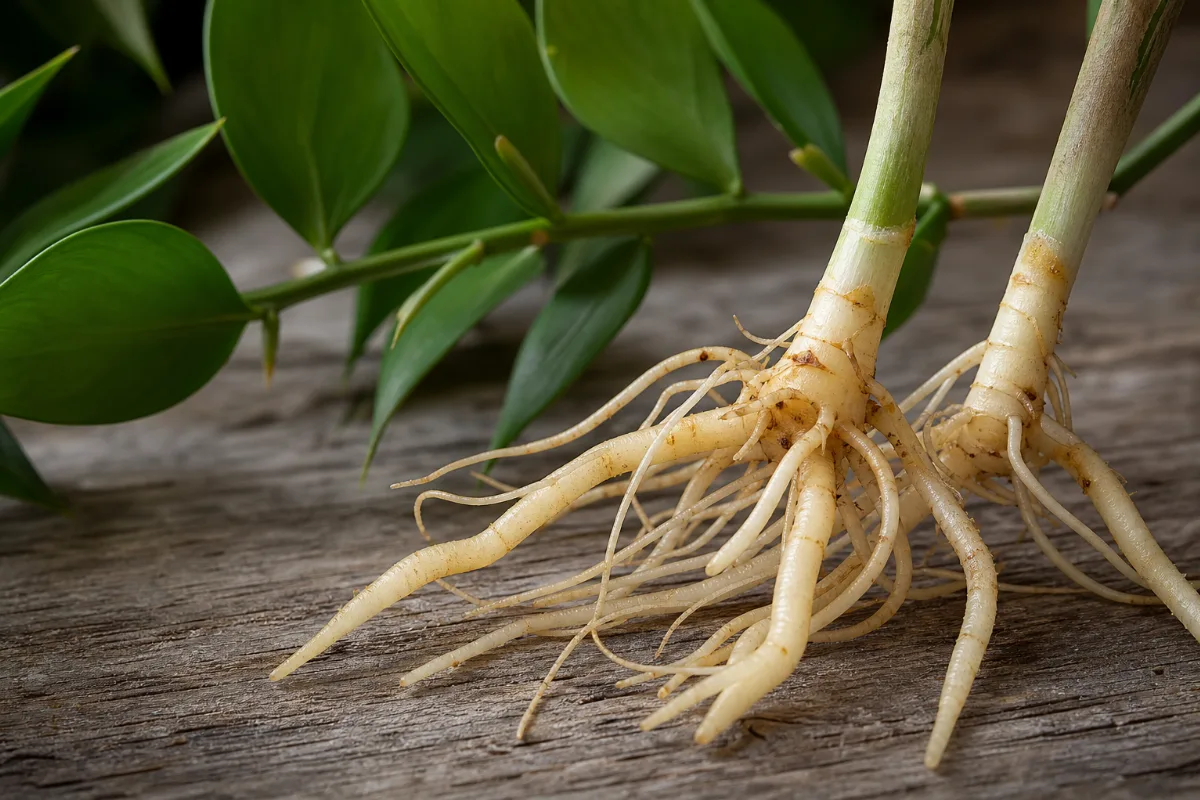
Butcher's broom (Ruscus aculeatus) is a plant whose underground part is used in capsules and extracts, mainly for heavy legs and hemorrhoid discomfort. [2] Human research is limited, and much of the stronger-looking research tests combination products, not the herb alone. See also Horse Chestnut, which is used for similar leg complaints.Scientific name and plant part
- Accepted name: Ruscus aculeatus L., family Asparagaceae, in GBIF. [3]
- Part used: the EU public summary calls it the root; the EU monograph is titled for the rhizome. [2][1] The preparations are dried powder and dry extracts. [2]
Traditional use (not proof)
The EU herbal committee (HMPC) accepted, on long-standing use of at least 30 years (at least 15 in the EU), that butcher's broom preparations can relieve discomfort and heaviness of legs from minor circulation problems and itching and burning from hemorrhoids, after a doctor has ruled out serious conditions. [2] Use is for adults only. [2] Long use is respected as history and is not proof that it works.What research shows (research, not tradition)
| Use | What the source found | Evidence label | Population and form studied |
|---|---|---|---|
| Chronic venous insufficiency (CVI), extract alone | A 12-week randomized trial of 166 women found leg volume lower than placebo, with one adverse event possibly related to treatment. [4] The EU committee judged the overall benefit not convincing and firm conclusions not possible because it excluded men and was short. [2] | Promising but limited | Women with CVI; one extract |
| CVI, Ruscus-containing products | A 2017 review of 10 trials (719 patients) of products containing Ruscus reported fewer leg symptoms and less swelling than placebo. [5] A 2025 review rated Ruscus extract combined with hesperidin methyl chalcone and ascorbic acid among the best-supported options. [6] | Promising but limited (combination, not herb alone) | CVI; mostly combination product |
| Hemorrhoid itching and burning | The EU committee says no studies in hemorrhoid patients have been done with butcher's broom. [2] | Traditional use only | None |
| Blood pressure, circulation in general, other claims | Proper evidence not found in the sources we read. We searched PubMed for butcher's broom with randomized trials, hemorrhoids and safety, and read the EU regulator's documents. | Insufficient evidence | None |
Why combinations matter: the 2017 review's title names a Ruscus, hesperidin methyl chalcone and vitamin C combination, and the abstract does not say how many trials tested Ruscus alone. [5] A 2022 symposium report on the same combination came from authors who disclose speaker fees or funding from a manufacturer. [7] The benefit of a combination cannot be credited to one ingredient.
Forms and why the form matters
The EU documents cover dried powder and dry extracts for oral use; combinations are not covered. [2] A clinician or pharmacist decides what is right for a person. See Standardized Herbal Extracts Explained.Safety and who should ask first
- Side effects: the EU monograph (2018) lists none known, and the public summary says none had been reported at the time of assessment. [1][2] The 12-week trial reported tolerability as good or very good. [4]
- Medicines: the EU monograph lists no interactions as reported. [1] The sources we read did not test combinations with blood thinners or blood pressure medicine; ask a pharmacist. See How Interactions Work.
- Allergy: the monograph's only contraindication is hypersensitivity to the active substance. [1]
- Older adults, liver, surgery: not described in the sources we read. Tell the surgical team about every herb you use. See Supplements Before Surgery.
- Cardiac or renal insufficiency: see a doctor first, per the monograph. [1]
- Missing safety tests: the EU monograph notes that tests on reproductive toxicity, genotoxicity and carcinogenicity have not been performed. [1]
- Quality: product contents can differ from the label; see Quality Testing and Certifications.
Official statements
- EU HMPC monograph, 20 November 2018, and public summary (2019): traditional use only, adults only; see a doctor if symptoms last more than 2 weeks. [1][2]
Frequently asked questions
Does butcher's broom help varicose veins?
One 12-week trial in women found less leg swelling than placebo, but the EU committee judged the benefit not convincing. [4][2] We found no evidence on the veins themselves.
Does butcher's broom work for hemorrhoids?
The EU committee accepted it only on long-standing use, and no studies in hemorrhoid patients have been done. [2] Rectal bleeding needs a doctor. [1]
Is butcher's broom the same as horse chestnut?
No. They are different plants: Ruscus aculeatus (Asparagaceae) and Aesculus hippocastanum (Sapindaceae). [3][8]
Is it safe in pregnancy or for children?
Not established, so it is not recommended. [1]
Can I use it with prescription medicine?
No interactions are reported in the EU monograph, but that is not proof of safety. [1] Ask a pharmacist.
Related: Horse Chestnut, Ginkgo, Hawthorn, Massage With Varicose Veins and Circulation Problems.
References
- European Medicines Agency, HMPC. European Union herbal monograph on Ruscus aculeatus L., rhizoma (EMA/HMPC/188804/2017, 20 November 2018). ema.europa.eu. Read 2026-10-23.
- European Medicines Agency, HMPC. Rusci rhizoma (butcher's broom): summary for the public (EMA/845547/2018, first published 22 August 2019). ema.europa.eu. Read 2026-10-23.
- GBIF Secretariat. GBIF Backbone Taxonomy: Ruscus aculeatus L. api.gbif.org species match. Read 2026-10-23.
- Vanscheidt W, et al. Efficacy and safety of a butcher's broom preparation (Ruscus aculeatus L. extract) compared to placebo in patients suffering from chronic venous insufficiency. Arzneimittelforschung. 2002. PubMed 12040966. Read 2026-10-23.
- Kakkos SK, Allaert FA. Efficacy of Ruscus extract, HMC and vitamin C on improving individual venous symptoms and edema: a systematic review and meta-analysis of randomized double-blind placebo-controlled trials. Int Angiol. 2017. PubMed 28225220. Read 2026-10-23.
- Gloviczki ML, et al. The role of venoactive compounds in the treatment of chronic venous disease. J Vasc Surg Venous Lymphat Disord. 2025. PubMed 40348378. Read 2026-10-23.
- Bihari I, et al. Clinical perspectives and management of edema in chronic venous disease: what about Ruscus? Medicines (Basel). 2022. PubMed 35893088. Read 2026-10-23.
- GBIF Secretariat. GBIF Backbone Taxonomy: Aesculus hippocastanum L. api.gbif.org species match. Read 2026-10-23.