Herbs & Botanicals · Traditional European cough herb
Speedwell
Veronica officinalis · also called Common speedwell, Veronicae herba
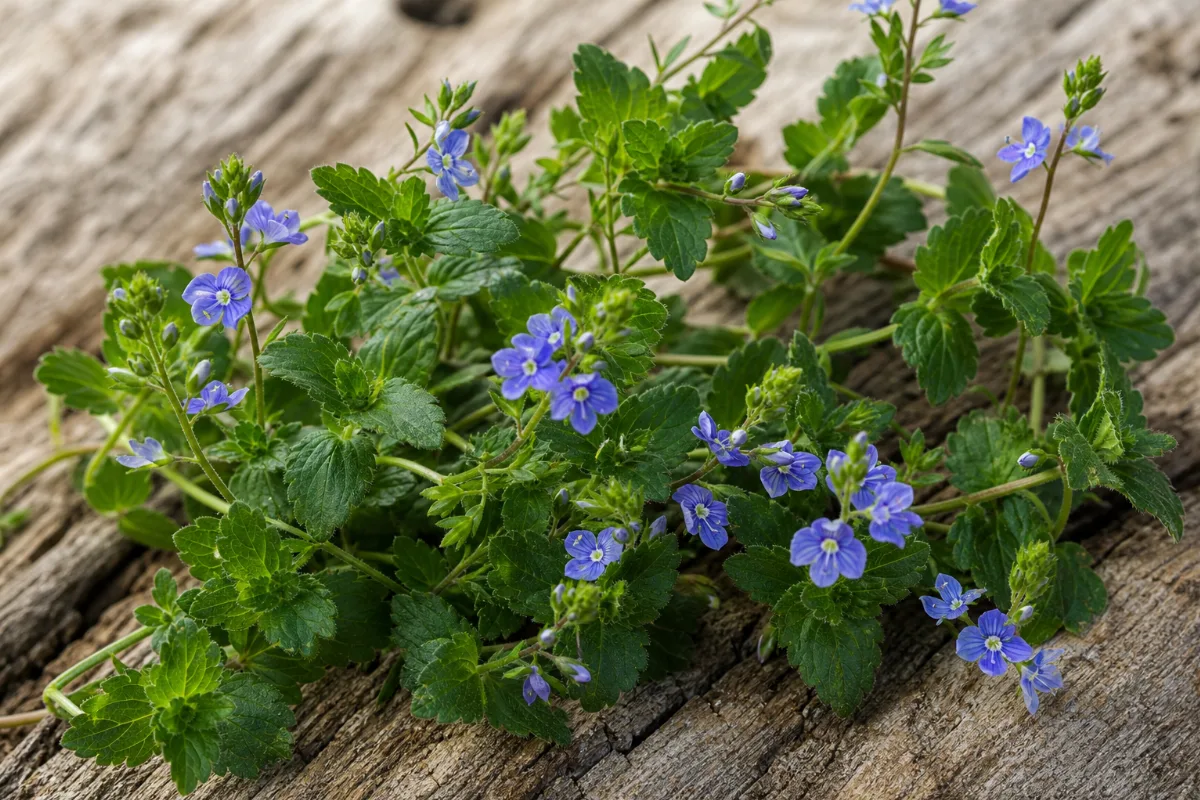
Speedwell is a small European wayside plant whose dried tops are made into tea. It has been used for coughs, skin problems and as a spring tea. We found no human trial showing it works, only lab studies. Many products sold as speedwell turned out to be a different plant, so buy carefully.
General information, not medical advice. Last substantive update · Not medically reviewed. A named clinician has not signed off on this page. How this page is made
About Speedwell
Speedwell (Veronica officinalis) is a European herb used as a tea for coughs, skin problems and as a spring tonic. No human trial supports these uses. Lab studies show anti-inflammatory signals in cells. Products are often mislabelled, and Culver's root is a different, laxative plant.
What it is
Common speedwell is a low plant of the plantain family. The dried above-ground parts are used.
The name causes mix-ups. Germander speedwell (Veronica chamaedrys) is a different species that often replaces it in products. Culver's root (Veronicastrum) is a different genus altogether.
What makes it distinctive
Its characteristic compounds are iridoids such as aucubin, catalpol and verproside, along with flavonoids and phenolic acids.
In human lung cells in a dish, a speedwell extract lowered inflammatory signals. That is a lab result, not proof of benefit.
Traditional uses
Reviews record cough and catarrh (Romania), and eczema, ulcers and wounds (Balkans). The German Commission E did not endorse it because efficacy data are missing, per a secondary source.
At a glance
Traditional uses history, not proof
- European folk medicine: cough and chest complaints
- Balkan folk medicine: eczema, ulcers, wounds
- Spring tea and mild tonic
Studied for research
- Cough and chest complaints: insufficient evidence
- Inflammation (lab only): insufficient evidence
- Anti-wrinkle cream (one trial reported second-hand): insufficient evidence
Main compounds
- Iridoids (aucubin, catalpol, verproside)
- Flavonoids
- Phenolic acids and tannins
Common forms
- Dried herb tea
- Liquid or dry extract
- Capsule
- Cosmetic cream with extract
Research links: PubMed: Veronica officinalis · Product authentication study (Front Pharmacol 2017) · Review: genus Veronica (Am J Chin Med 2019) · Review: Veronica plants (Molecules 2019) · Research Library · Genes & Biomarkers Library
The plant and its history
- Accepted scientific name
- Veronica officinalis L.
- Naming authority
- L.
- Common names
- speedwell (English); common speedwell (English); Veronicae herba (pharmacopoeial Latin)
- Botanical family
- Plantaginaceae (plantain family). Older books place Veronica in the figwort family (Scrophulariaceae).
- Classification
- Plantae > Tracheophyta > Magnoliopsida > Lamiales > Plantaginaceae > Veronica > Veronica officinalis
- Native range
- A European herb per the sources read (central-eastern Europe and the Balkans are named for traditional use); full native range not verified.
- Habitat
- Not verified.
- What the plant looks like
- Roots: Not verified.; Stems: Not verified.; Leaves: Not verified.; Flowers: Not verified.; Fruit: Not verified.
- Cultivation
- Not verified.
- Harvest and processing
- Dried aerial parts (Veronicae herba) used as tea or extract.
- Look-alikes and adulterants
- Name: Germander speedwell (Veronica chamaedrys); Note: The most common substitute; found in 62% of 16 products labelled as common speedwell (p28674497). GBIF: accepted species, same family (s-gbif-vc).; Name: Culver's root (Veronicastrum virginicum); Note: Different genus with a strongly laxative fresh root per a botanic garden page (s-cornell). Name confusion, not a visual look-alike.
- Sustainability and conservation
- Not assessed.
Traditional use and history history, not clinical proof
| Tradition or era | Documented use | Source |
|---|---|---|
| European traditional medicine | Long history of use, mainly in central-eastern Europe and the Balkans. | p28674497 |
| Balkan folk medicine | Liver, eczema, ulcers, wounds, skin lesions. | p31277407 |
| Romanian medicine | Wound healing, cough and catarrh (aerial parts). | p31277407 |
| Germany (Commission E) | Negative monograph: not endorsed for lack of efficacy data. NOT verified: secondary source only. | s-altmeyers |
Traditional use shows how a plant was used. It does not show that a supplement works or is safe today.
What is inside, and how it may work
What the plant contains and how those compounds act in cells and animals. Laboratory and animal mechanisms are not proven effects in people.
Main compounds
| Compound | Family | Where it is concentrated | Activity studied | Level of evidence |
|---|---|---|---|---|
| Aucubin PubChem 91458 | iridoid glycoside | aerial parts not reported | Characteristic of the genus Veronica; lab antioxidant and anti-inflammatory activity reported for the genus. 4 10 | Review |
| Catalpol and derivatives PubChem 91520 | iridoid glycoside | aerial parts not reported | Characteristic of the genus Veronica. 4 11 | Review |
| Verproside PubChem 12000799 | iridoid glycoside | aerial parts not reported | One of the two most abundant iridoids in a standardized extract (with verminoside); linked to anti-inflammatory effects in cells. 1 12 | Laboratory research |
| Flavonoids (luteolin, apigenin and others) | flavonoid | aerial parts not reported | Common flavone aglycones in Veronica species; lab activity only. 3 | Review |
| Phenolic acids and tannins | phenolic | aerial parts not reported | Named in the brief and in genus reviews as present; speedwell-specific amounts not read. 3 | Review |
Mechanisms, receptors and pathways
| Target or pathway | Gene or receptor | What was found | Level |
|---|---|---|---|
| NF-kB / COX-2 in lung epithelial cells | COX-2; eotaxin | Extract lowered PGE2 and eotaxin release through lower COX-2 expression (lab, human cell line). 1 | Laboratory research |
Absorption, metabolism and elimination
- Absorption
- No human data found.
- Distribution
- No human data found.
- Metabolism
- No human data found.
- Elimination
- No human data found.
- Bioavailability
- Not established.
Isolated compounds versus whole extracts
Lab findings come from standardized extracts or isolated iridoids; teas and retail products vary and may not contain speedwell at all (p28674497), so lab results cannot be assumed for a given product.
Nutritional composition
A nutrient table is not meaningful for a medicinal herb.
5 not enough evidence
What was looked at
The 5 benefits and uses checked for Speedwell, each with how strong the evidence is. Tap one to open it.
- Cough and chest complaints (traditional use)Not enough evidence
- Inflammation and antioxidant effects (laboratory only)Not enough evidence
- Skin problems and wound healing (traditional use)Not enough evidence
- Anti-wrinkle cosmetic cream (one reported trial, not read)Not enough evidence
- Digestive and urinary use (traditional use)Not enough evidence
What is Speedwell good for?
The traditional uses and how strong the human evidence is for each. For speedwell, 'insufficient' means no controlled human trial of the herb was found.
Benefits, one by one
Each card is a research question, not a promise. Tap a goal to filter. Open a card to see the studies, doses and limits.
Cough and chest complaints (traditional use)
Not enough evidenceSpeedwell tea has long been used in Europe for coughs and chest complaints. We found no human trial of speedwell for cough or any chest problem. The German Commission E did not endorse it, because data on whether it works are missing.
4 studiesDried herb as tea or extract (traditional). Amounts belong with a cli…
Studies, doses and limits
What the trials found
No human trial of speedwell for cough was found in the reviews we read (p31277407, p31488038). One cell study (p23142555) found anti-inflammatory signals in lung cells; its authors say clinical potency has first to be shown in animals and then in trials.
Results
Traditional and lab evidence only; no human result.
Effect sizes as reported
None available.
Why this rating
No human trial; cell findings do not show benefit in people.
Form and dose studied
Dried herb as tea or extract (traditional). Amounts belong with a clinician or pharmacist.
Who was studied
Not applicable (cell work).
Limits
Cell study with a standardised extract; products vary a lot and may not contain the labelled species (p28674497).
Why researchers looked
Aerial parts of common speedwell are a long-standing European folk remedy for the chest.
Traditional use
Reviews record use for cough, catarrh, influenza and sore throat in European and Chinese folk medicine (for the genus Veronica).
Proposed mechanism Laboratory research
A speedwell extract lowered inflammatory signals (eotaxin, PGE2) in human lung cells in a dish.
A proposed mechanism does not show that the effect happens in people.
A cough lasting more than a few weeks, bringing up blood, or with breathlessness or fever needs a medical check; do not delay care for a herb.
Inflammation and antioxidant effects (laboratory only)
Not enough evidenceIn the lab, speedwell extracts and their iridoid compounds (such as verproside, aucubin and catalpol) reduce inflammatory signals and act as antioxidants. This has not been tested for benefit in people.
3 studiesNot applicable.
Studies, doses and limits
What the trials found
No human study. Lab and animal findings for the genus Veronica are summarised in two reviews (p31488038, p31277407).
Results
Lab signals only.
Effect sizes as reported
None for people.
Why this rating
Cell and animal results do not show a benefit in people.
Form and dose studied
Not applicable.
Who was studied
Cells and animals.
Limits
Most work is on other Veronica species or isolated compounds.
Why researchers looked
Researchers wanted to explain the traditional use for lung inflammation.
Traditional use
Iridoid glycosides and flavonoids are the main groups of compounds in the genus.
Proposed mechanism Laboratory research
Extract reduced COX-2 and PGE2 through the NF-kB pathway in human lung cells.
A proposed mechanism does not show that the effect happens in people.
No safety conclusion can be drawn from lab work.
Skin problems and wound healing (traditional use)
Not enough evidenceIn Balkan and Romanian folk medicine speedwell was used on eczema, ulcers, wounds and skin lesions. No human trial of the herb itself for these uses was found.
1 studiesDried herb, traditionally also as washes or poultices. Not tested.
Studies, doses and limits
What the trials found
No human trial of the herb for skin conditions was found (p31277407).
Results
Traditional use only.
Effect sizes as reported
None available.
Why this rating
No human trial in the sources read.
Form and dose studied
Dried herb, traditionally also as washes or poultices. Not tested.
Who was studied
Not applicable.
Limits
Review-level source only.
Why researchers looked
Folk use for skin and wounds is recorded for the aerial parts.
Traditional use
Balkan folk medicine: eczema, ulcers, wounds, skin lesions; Romanian medicine: wound healing.
Proposed mechanism Preliminary mechanism
Not established.
A proposed mechanism does not show that the effect happens in people.
Open, infected or spreading wounds need medical care.
Anti-wrinkle cosmetic cream (one reported trial, not read)
Not enough evidenceA 2019 review says a placebo-controlled trial in women found anti-wrinkle activity from a cream containing a speedwell extract over 56 days. We could not read that trial, so we cannot give any numbers or judge its quality. A cream is not the same as a tea.
1 studiesTopical cream with extract.
Studies, doses and limits
What the trials found
The review (p31277407) reports the trial second-hand and cites a 2015 cosmetic-science journal paper that we did not open. No sample size, result size or funding is known to us; cosmetic trials are often company-run.
Results
Reported as significant anti-wrinkle activity at 56 days (second-hand, unverified).
Effect sizes as reported
Not available.
Why this rating
Only a second-hand report of one trial; primary paper not read; extract cream, not herb.
Form and dose studied
Topical cream with extract.
Who was studied
Women (details not read).
Limits
Primary study not read; possible industry link not checked.
Why researchers looked
A cosmetic company tested a speedwell-extract cream.
Traditional use
Not a traditional use as such.
Proposed mechanism Laboratory research
The same report describes antioxidant and collagen-synthesis activity in skin cells in a dish (second-hand).
A proposed mechanism does not show that the effect happens in people.
Stop a cream that causes redness, itching or swelling. Allergic reactions to plant extracts on skin can happen.
Digestive and urinary use (traditional use)
Not enough evidenceTraditional records list stomach and digestive complaints and its use as a mild diuretic and spring tea. We found no human evidence for any of these.
2 studiesTea (traditional).
Studies, doses and limits
What the trials found
No human study found (p31277407, p31488038).
Results
Traditional use only.
Effect sizes as reported
None available.
Why this rating
No human trial.
Form and dose studied
Tea (traditional).
Who was studied
Not applicable.
Limits
Genus-level, review sources only.
Why researchers looked
Folk herbals list speedwell as a general tonic.
Traditional use
Reviews list diuretic and wound-healing uses in Turkish and Balkan folk medicine (genus Veronica).
Proposed mechanism Preliminary mechanism
Not established.
A proposed mechanism does not show that the effect happens in people.
Persistent stomach pain, vomiting or blood in stool needs medical review.
Connections to the rest of health
How Speedwell connects to the rest of our health knowledge graph. Every link says what kind of connection it is. A safety link (for example to the liver) is a warning, not a benefit. A study that merely mentions a topic never creates a benefit link.
Explore every connection: goals, body systems, organs, symptoms, genes
A. Wellness goals
| Connected to | Kind of connection | Evidence status | Context | Studies |
|---|---|---|---|---|
| Lung Support | Traditional use | Not enough evidence | Cough and chest complaints (traditional use): Speedwell tea has long been used in Europe for coughs and chest complaints. We found no human trial of speedwell for cough or any chest problem. The German Commission E did not endorse it, because data on whether it works are missing. | 3 4 1 5 |
| Breathing Support | Traditional use | Not enough evidence | Cough and chest complaints (traditional use): Speedwell tea has long been used in Europe for coughs and chest complaints. We found no human trial of speedwell for cough or any chest problem. The German Commission E did not endorse it, because data on whether it works are missing. | 3 4 1 5 |
| Seasonal Wellness | Traditional use | Not enough evidence | Cough and chest complaints (traditional use): Speedwell tea has long been used in Europe for coughs and chest complaints. We found no human trial of speedwell for cough or any chest problem. The German Commission E did not endorse it, because data on whether it works are missing. | 3 4 1 5 |
| Immune Support | Traditional use | Not enough evidence | Cough and chest complaints (traditional use): Speedwell tea has long been used in Europe for coughs and chest complaints. We found no human trial of speedwell for cough or any chest problem. The German Commission E did not endorse it, because data on whether it works are missing. | 3 4 1 5 |
| Inflammation Balance | Not enough evidence | Inflammation and antioxidant effects (laboratory only): In the lab, speedwell extracts and their iridoid compounds (such as verproside, aucubin and catalpol) reduce inflammatory signals and act as antioxidants. This has not been tested for benefit in people. | 1 4 3 | |
| Cellular Protection | Not enough evidence | Inflammation and antioxidant effects (laboratory only): In the lab, speedwell extracts and their iridoid compounds (such as verproside, aucubin and catalpol) reduce inflammatory signals and act as antioxidants. This has not been tested for benefit in people. | 1 4 3 | |
| Healthy Skin | Traditional use | Not enough evidence | Skin problems and wound healing (traditional use): In Balkan and Romanian folk medicine speedwell was used on eczema, ulcers, wounds and skin lesions. No human trial of the herb itself for these uses was found. | 3 |
| Healthy Skin | Not enough evidence | Anti-wrinkle cosmetic cream (one reported trial, not read): A 2019 review says a placebo-controlled trial in women found anti-wrinkle activity from a cream containing a speedwell extract over 56 days. We could not read that trial, so we cannot give any numbers or judge its quality. A cream is not the same as a tea. | 3 | |
| Anti Aging Support | Not enough evidence | Anti-wrinkle cosmetic cream (one reported trial, not read): A 2019 review says a placebo-controlled trial in women found anti-wrinkle activity from a cream containing a speedwell extract over 56 days. We could not read that trial, so we cannot give any numbers or judge its quality. A cream is not the same as a tea. | 3 | |
| Digestive Support | Traditional use | Not enough evidence | Digestive and urinary use (traditional use): Traditional records list stomach and digestive complaints and its use as a mild diuretic and spring tea. We found no human evidence for any of these. | 3 4 |
B. Body systems
| Connected to | Kind of connection | Evidence status | Context | Studies |
|---|---|---|---|---|
| Respiratory System | Biological association | Not enough evidence | Studied for: Cough and chest complaints (traditional use) | 3 4 1 5 |
| Immune System | Biological association | Not enough evidence | Studied for: Inflammation and antioxidant effects (laboratory only) | 1 4 3 |
| Integumentary System | Biological association | Not enough evidence | Studied for: Skin problems and wound healing (traditional use) Studied for: Anti-wrinkle cosmetic cream (one reported trial, not read) | 3 |
| Digestive System | Biological association | Not enough evidence | Studied for: Digestive and urinary use (traditional use) | 3 4 |
| Urinary System | Biological association | Not enough evidence | Studied for: Digestive and urinary use (traditional use) | 3 4 |
D. Symptoms
| Connected to | Kind of connection | Evidence status | Context | Studies |
|---|---|---|---|---|
| Pregnancy | Not enough evidence | No safety data; avoid unless a doctor agrees. Preparation or compound: Speedwell tea or extract |
6 | |
| Cough | Traditional use | Not enough evidence | Traditional use; no human trial. Preparation or compound: Dried aerial parts |
3 |
K. Biological pathways
| Connected to | Kind of connection | Evidence status | Context | Studies |
|---|---|---|---|---|
| NF-kB signalling | Preliminary mechanism | In vitro | Reduced in a lung cell line by the extract. | 1 |
L. Active compounds
| Connected to | Kind of connection | Evidence status | Context | Studies |
|---|---|---|---|---|
| Aucubin | Biological association | Review | Characteristic of the genus Veronica; lab antioxidant and anti-inflammatory activity reported for the genus. Preparation or compound: aerial parts |
4 10 |
| Catalpol and derivatives | Biological association | Review | Characteristic of the genus Veronica. Preparation or compound: aerial parts |
4 11 |
| Verproside | Biological association | In vitro | One of the two most abundant iridoids in a standardized extract (with verminoside); linked to anti-inflammatory effects in cells. Preparation or compound: aerial parts |
1 12 |
| Flavonoids (luteolin, apigenin and others) | Biological association | Review | Common flavone aglycones in Veronica species; lab activity only. Preparation or compound: aerial parts |
3 |
| Phenolic acids and tannins | Biological association | Review | Named in the brief and in genus reviews as present; speedwell-specific amounts not read. Preparation or compound: aerial parts |
3 |
Each connection is stored with the ingredient, the connected record, the kind of connection, the evidence status, the supporting studies, the preparation or compound involved, and a review date (last reviewed October 25, 2026).
The evidence
The research centre for Speedwell. Every record here was checked against PubMed or the publisher's page; we never list a study we have not verified.
Evidence by outcome
Bars show how many studies we found for each outcome, not how well it works. People are added up across trials only (reviews are not added, to avoid double counting).
How we rate evidence
High certainty
Several well-run trials or reviews agree; further research is unlikely to change the picture much.
Moderate certainty
Good trials point the same way, but some doubt remains.
Low certainty
Small, short or inconsistent trials. The finding could change with better research.
Very low certainty
Very little or very weak human data. Treat as a possibility only.
Mixed findings
Trials or reviews disagree with each other.
Not enough evidence
Not enough human research to say either way.
Evidence against
Good research found no benefit, or found harm.
We take the reviewers' own risk-of-bias and GRADE statements where they exist, and otherwise judge from study size, design, consistency, directness and whether a product matches what is sold. Many publications do not make evidence high. Method note: We started from our earlier speedwell summary, then checked PubMed records and a few reference pages. Most sources were abstracts only. Details not re-opened are marked summary-only. No study is cited that we could not verify.
Study library: every study we checked 13
| Study | Design | People | Product, dose, length | Result |
|---|---|---|---|---|
| Grundemann 2013 Traditionally used Veronica officinalis inhibits proinflammatory mediators via the NF-kB signalling pathway in a human lung cell line J Ethnopharmacol · PMID 23142555 · DOI |
Laboratory research in-vitro |
Human lung epithelial cells (A549) and mast cells | Standardized Veronica officinalis extract aerial parts (extract) not extracted not extracted · vs none |
The extract had a small effect on mast-cell degranulation but reduced eotaxin and PGE2 release in activated lung cells, through lower COX-2 expression via NF-kB. Verproside and verminoside were the most abundant iridoid glycosides. The authors say clinical potency first has to be proven in animals and then in clinical trials. Cell-level anti-inflammatory signals. (not reported in abstract) Methods, limits and fundingLimitations: Cell study only; abstract read. Funding and conflicts: not read Read: abstract |
| Raclariu 2017 Veronica officinalis Product Authentication Using DNA Metabarcoding and HPLC-MS Reveals Widespread Adulteration with Veronica chamaedrys Front Pharmacol · PMID 28674497 · DOI |
Laboratory analysis laboratory |
16 16 commercial products labelled as common speedwell (Veronica officinalis) |
Retail herbal products aerial parts (dried herb products) not extracted not extracted · vs none |
DNA metabarcoding found V. officinalis in only 15% of the 16 products and germander speedwell (V. chamaedrys) in 62%. None of the products contained exactly the species on the label; all had substitutes, contaminants or fillers. HPLC-MS measured target compounds well but could not tell species apart. The authors call for authentication along the supply chain. A later erratum (p29282405) exists for this paper. Mislabelling was common (15% contained the labelled species). (not reported in abstract) Methods, limits and fundingLimitations: Small sample (16 products); abstract read. Funding and conflicts: not read Read: abstract |
| Salehi 2019 Veronica Plants-Drifting from Farm to Traditional Healing, Food Application, and Phytopharmacology Molecules · PMID 31277407 · DOI |
Narrative review mixed |
Genus Veronica: chemistry, food use and pharmacology | Genus-wide extracts mixed not extracted not extracted · vs none |
Veronica species contain iridoid glycosides and phenolic compounds. V. officinalis is used in Balkan folk medicine for liver, eczema, ulcers, wounds and skin lesions, and for cough and catarrh in Romanian medicine. The authors say human studies are scarce, with the exception of V. officinalis as an anti-wrinkle agent: the full text reports a placebo-controlled trial in women of a cream (Scoti-Speedwell) used for 56 days with anti-wrinkle activity, citing a 2015 journal paper (Lee et al., J Cosmet Dermatol Sci Appl) that we did not open. The review concludes that further studies in humans are required. Cream trial reported second-hand; no numbers read. (not reported in abstract) Methods, limits and fundingLimitations: Abstract and full text of the review read via Europe PMC; the cream trial itself was NOT read. Funding and conflicts: not read Read: full text |
| Xue 2019 Review of the Ethnopharmacology, Phytochemistry, and Pharmacology of the Genus Veronica Am J Chin Med · PMID 31488038 · DOI |
Narrative review mixed |
Genus Veronica (about 500 species): literature 1970-2018 | Genus-wide extracts and isolated compounds mixed not extracted not extracted · vs none |
Over 260 compounds isolated; iridoid glucosides including aucubin, catalpol and catalpol derivatives are characteristic of the genus. Reported actions (anti-inflammatory, antioxidant, anticancer, antibacterial and others) are from in vivo and in vitro work. Traditional uses include influenza, respiratory disease, cough, laryngopharyngitis, oedema and wounds. No effect sizes. (not reported in abstract) Methods, limits and fundingLimitations: Abstract read; genus-wide, not specific to V. officinalis; the abstract mentions clinical practice but no trial is cited in it. Funding and conflicts: not read Read: abstract |
| n/a 2026 Altmeyers Encyclopedia: Speedwell (Veronicae herba) (secondary source) Altmeyers Encyclopedia · Source |
Encyclopedia n/a |
n/a | n/a n/a not extracted not extracted · vs none |
Page read 2026-10-25. States that the German Commission E published a negative monograph due to lack of data on efficacy, as no risks are to be expected, and lists EMA/HMPC as not processed. Says nothing on side effects, pregnancy, interactions or allergy. n/a (not reported in abstract) Methods, limits and fundingLimitations: Secondary encyclopedia; the original Commission E text was NOT read. Funding and conflicts: not read Read: full text |
| n/a 2026 Regulator search (EMA/HMPC, NCCIH, LiverTox, LactMed): no speedwell monograph or entry found n/a · Source |
Search record n/a |
n/a | n/a n/a not extracted not extracted · vs none |
No speedwell entry was found in our brief checks. The only regulatory statements we hold (Commission E negative monograph, EMA/HMPC not processed) come from a secondary encyclopedia (s-altmeyers). n/a (not reported in abstract) Methods, limits and fundingLimitations: Not an exhaustive check of each regulator; NCCIH, LiverTox and LactMed pages were not opened individually. Funding and conflicts: not read Read: full text |
| n/a 2026 Cornell Botanic Gardens: Culver's Root (Veronicastrum virginicum) (secondary source) Cornell Botanic Gardens · Source |
Botanic garden page n/a |
n/a | n/a n/a not extracted not extracted · vs none |
Page read 2026-10-25. Says the plant is potentially toxic: the fresh root is a violent cathartic and possibly emetic; the dried root is milder but less predictable. n/a (not reported in abstract) Methods, limits and fundingLimitations: Botanic garden page, not a clinical source; no dose or case data. Funding and conflicts: not read Read: full text |
| n/a 2026 GBIF Backbone: Veronicastrum virginicum (L.) Farw. (usage key 3172206) n/a · Source |
Reference database n/a |
n/a | n/a n/a not extracted not extracted · vs none |
GBIF API match 2026-10-25: exact, ACCEPTED, family Plantaginaceae. A different genus from Veronica. n/a (not reported in abstract) Methods, limits and fundingLimitations: Taxonomic record only. Funding and conflicts: not read Read: full text |
| n/a 2026 GBIF Backbone: Veronica officinalis L. (usage key 3172049) n/a · Source |
Reference database n/a |
n/a | n/a n/a not extracted not extracted · vs none |
GBIF API match 2026-10-25: exact, status ACCEPTED, family Plantaginaceae, order Lamiales, class Magnoliopsida, phylum Tracheophyta. n/a (not reported in abstract) Methods, limits and fundingLimitations: Taxonomic record only. Funding and conflicts: not read Read: full text |
| n/a 2026 PubChem: Aucubin (CID 91458) n/a · Source |
Reference database n/a |
n/a | n/a n/a not extracted not extracted · vs none |
PubChem name search 2026-10-25 returned CID 91458, formula C15H22O9. n/a (not reported in abstract) Methods, limits and fundingLimitations: Compound record only. Funding and conflicts: not read Read: full text |
| n/a 2026 PubChem: Catalpol (CID 91520) n/a · Source |
Reference database n/a |
n/a | n/a n/a not extracted not extracted · vs none |
PubChem name search 2026-10-25 returned CID 91520, formula C15H22O10. n/a (not reported in abstract) Methods, limits and fundingLimitations: Compound record only. Funding and conflicts: not read Read: full text |
| n/a 2026 PubChem: Verproside (CID 12000799) n/a · Source |
Reference database n/a |
n/a | n/a n/a not extracted not extracted · vs none |
PubChem name search 2026-10-25 returned CID 12000799, formula C22H26O13. n/a (not reported in abstract) Methods, limits and fundingLimitations: Compound record only. Funding and conflicts: not read Read: full text |
| n/a 2026 GBIF Backbone: Veronica chamaedrys L. (usage key 7874883) n/a · Source |
Reference database n/a |
n/a | n/a n/a not extracted not extracted · vs none |
GBIF API match 2026-10-25: exact, ACCEPTED, family Plantaginaceae. n/a (not reported in abstract) Methods, limits and fundingLimitations: Taxonomic record only. Funding and conflicts: not read Read: full text |
What we do not know yet
- No human trial of speedwell for any use.
- The cream trial was not read.
- No pregnancy, breastfeeding, child, liver or interaction data.
- Regulatory statements come from a secondary source.
How new research is added
New studies are found by a saved PubMed search and are placed in a review queue. A person reads each one before it changes any evidence rating or safety wording.
Lab markers
What changed in blood or saliva tests during trials. A changed number is not the same as feeling or being healthier, and we give no "normal ranges".
Safety
What studies and official sources say about side effects, medicines and who should check first. Each point shows what kind of evidence it comes from.
Main points to know 3
- Evidence on safety is thin. We found no human safety trial, no case report of harm from common speedwell and no regulator safety review. 'No reports' is not the same as 'proven safe'. The German Commission E (via a secondary source) did not endorse it for lack of efficacy data, and said no risks were expected. Secondary source 5 6
- Do not confuse it with Culver's root. Culver's root (Veronicastrum virginicum, also called Leptandra) is a different plant in a different genus. A botanic garden source says its fresh root is a violent laxative and may cause vomiting. The two are easy to mix up by name, so check the Latin name on any product. Secondary source 7 8
- Products are often not what the label says. In a test of 16 products sold as common speedwell, only 15% contained it and 62% contained germander speedwell (Veronica chamaedrys). None matched the label exactly. Laboratory analysis 2
Side effects 2
| Effect | How often | Severity and recovery | Evidence |
|---|---|---|---|
| No specific adverse effect of common speedwell tea or extract is documented in the sources we read Gaps in the record, not proof of safety. Stomach upset and allergic skin or breathing reactions are possible with any plant, but we found no report for this one. | Not established | unknown unknown | Insufficient 6 |
| Possible strong laxative or vomiting effect if Culver's root is mistaken for speedwell Applies to Veronicastrum virginicum, not to speedwell. Included because of name confusion. | Not established | moderate unknown | Secondary source 7 |
Liver
No LiverTox entry for speedwell was found and no human case of liver injury was found. Iridoids such as aucubin have been studied in the lab for liver protection, but that is not human evidence. 6 4
How often. Unknown.
Monitoring. No agency advice found. Stop and seek medical advice for yellow skin or eyes, dark urine or severe tiredness.
This is a safety connection. It is not evidence that Speedwell supports liver health.
Medicines and supplements 3
| With | Why it matters | Importance | Evidence | What to do |
|---|---|---|---|---|
| Blood thinners (warfarin, apixaban, aspirin and similar) drug | Theoretical only: some plant flavonoids and phenolic acids can affect clotting in the lab. No study of speedwell was found. | Unknown; no human data. | Theoretical Not enough evidence 6 | Ask your doctor or pharmacist before using speedwell if you take a blood thinner or have a bleeding problem or surgery planned. |
| Diuretics, blood-pressure or diabetes medicines drug | Speedwell has a traditional reputation as a mild diuretic, but no human study tested this. | Unknown. | Traditional use Not enough evidence 3 | Tell your pharmacist you use it so any change in effect can be watched. |
| Other herbs or supplements herb | No interaction study found. | Unknown. | None found Not enough evidence 6 | Keep a list of everything you take and share it with your pharmacist. |
Who should check first 3
| Situation | Advice | Evidence |
|---|---|---|
| Pregnancy and breastfeeding | No safety data. Avoid unless your doctor agrees. | No data 6 |
| Children | No safety data. Ask a paediatrician first. | No data 6 |
| Known allergy to plants of the plantain family (Plantaginaceae) or to other Veronica species | Cross-reaction has not been studied; take care and stop at the first sign of a reaction. | Theoretical 9 |
Overdose, product quality and regulators
Summary. No toxicity data for common speedwell were found in people. Genus reviews call the plants relatively safe because members are eaten and used in folk medicine, which is an inference, not a safety study.
Animal. Not reviewed here.
Human doses studied. Not stated here. Amounts belong with a clinician.
High dose or long term signals. Unknown.
Overdose response. No overdose report found. Seek care for severe vomiting, diarrhoea or any allergic reaction.
Genotoxicity. Not found.
Toxic plant parts. No toxic part is documented for common speedwell. Culver's root (a different plant) has a fresh root described as a violent laxative.
Mislabelling and substitution are the main product concerns.
Substitution with germander speedwell. Of 16 products labelled as Veronica officinalis, only 15% had it by DNA testing; 62% contained Veronica chamaedrys, and all had substitutes, contaminants or fillers. 2
Lozenge with no iridoids. Our earlier summary noted one lozenge with no detectable iridoids. Summary-only; not re-opened. 2
| Body | Action | Date |
|---|
When to get medical help
- Swelling of the lips, tongue or throat, hives or trouble breathing after a herb or product.
- Severe vomiting or diarrhoea, especially if a product might be Culver's root.
- Yellow skin or eyes, or dark urine.
- Coughing up blood, or cough with breathlessness or high fever.
Stop the supplement and contact a clinician or emergency service. In the US, Poison Control is 1-800-222-1222.
General information only, not medical advice. Ask a clinician or pharmacist before use, especially with medicines, in pregnancy or with a health condition. See the Natural Remedy Safety guide.
Frequently asked questions
What is speedwell used for?
Does speedwell work for cough?
Is speedwell the same as Culver's root?
Are speedwell products reliable?
Often not. DNA tests on 16 products found the labelled species in only 15%; 62% held germander speedwell.
Is speedwell safe in pregnancy or while breastfeeding?
There are no safety data, so avoid it unless your doctor agrees.
Does speedwell interact with medicines?
No interaction studies exist. A blood-thinner interaction is only a theory. Ask your doctor or pharmacist.
Can speedwell harm the liver?
No case of liver injury and no LiverTox entry were found. That means unknown, not proven safe.
Does speedwell cream remove wrinkles?
A review mentions one placebo-controlled trial of an extract cream. We could not read it, so we cannot rate it.
What is in speedwell?
Has any agency approved speedwell?
The German Commission E gave a negative monograph for missing efficacy data, and the EU herbal committee has not processed it, per a secondary source we could not verify.
Which Veronica species is best?
There is no evidence ranking species. What matters is that a product really contains the plant on its label.
Explore by health goal
Healthy SkinLung SupportBreathing SupportSeasonal WellnessImmune SupportInflammation BalanceCellular ProtectionAnti Aging SupportDigestive Support
Editorial transparency
- Written by
- AlternativeMed editorial team. Research compiled with AI assistance, then checked against PubMed records.
- Medical review
- None. This page has not been reviewed by a physician or pharmacist.
- First published
- 2026-10-25
- Last substantive update
- 2026-10-25
- How we research
- We started from our earlier speedwell summary, then checked PubMed records and a few reference pages. Most sources were abstracts only. Details not re-opened are marked summary-only. No study is cited that we could not verify.
- How we rate evidence
- See "How we rate evidence" in the Evidence tab.
- Independence
- No product is promoted on this page. No affiliate links are shown. If one is added later it will be labelled and kept apart from the evidence.
Sources 13
Each source was opened and checked. Where we read only the abstract, it says so. The small numbers in the text point here.
- Grundemann C, Garcia-Kaufer M, Sauer B, Stangenberg E et al.. Traditionally used Veronica officinalis inhibits proinflammatory mediators via the NF-kB signalling pathway in a human lung cell line. J Ethnopharmacol. 2013. PMID 23142555. DOI 10.1016/j.jep.2012.10.039. (abstract)
- Raclariu AC, Mocan A, Popa MO, Vlase L et al.. Veronica officinalis Product Authentication Using DNA Metabarcoding and HPLC-MS Reveals Widespread Adulteration with Veronica chamaedrys. Front Pharmacol. 2017. PMID 28674497. DOI 10.3389/fphar.2017.00378. (abstract)
- Salehi B, Shivaprasad Shetty M, V Anil Kumar N, Zivkovic J et al.. Veronica Plants-Drifting from Farm to Traditional Healing, Food Application, and Phytopharmacology. Molecules. 2019. PMID 31277407. DOI 10.3390/molecules24132454. (full text)
- Xue H, Chen KX, Zhang LQ, Li YM. Review of the Ethnopharmacology, Phytochemistry, and Pharmacology of the Genus Veronica. Am J Chin Med. 2019. PMID 31488038. DOI 10.1142/S0192415X19500617. (abstract)
- n/a. Altmeyers Encyclopedia: Speedwell (Veronicae herba) (secondary source). Altmeyers Encyclopedia. 2026. (full text)
- n/a. Regulator search (EMA/HMPC, NCCIH, LiverTox, LactMed): no speedwell monograph or entry found. n/a. 2026. (full text)
- n/a. Cornell Botanic Gardens: Culver's Root (Veronicastrum virginicum) (secondary source). Cornell Botanic Gardens. 2026. (full text)
- n/a. GBIF Backbone: Veronicastrum virginicum (L.) Farw. (usage key 3172206). n/a. 2026. (full text)
- n/a. GBIF Backbone: Veronica officinalis L. (usage key 3172049). n/a. 2026. (full text)
- n/a. PubChem: Aucubin (CID 91458). n/a. 2026. (full text)
- n/a. PubChem: Catalpol (CID 91520). n/a. 2026. (full text)
- n/a. PubChem: Verproside (CID 12000799). n/a. 2026. (full text)
- n/a. GBIF Backbone: Veronica chamaedrys L. (usage key 7874883). n/a. 2026. (full text)