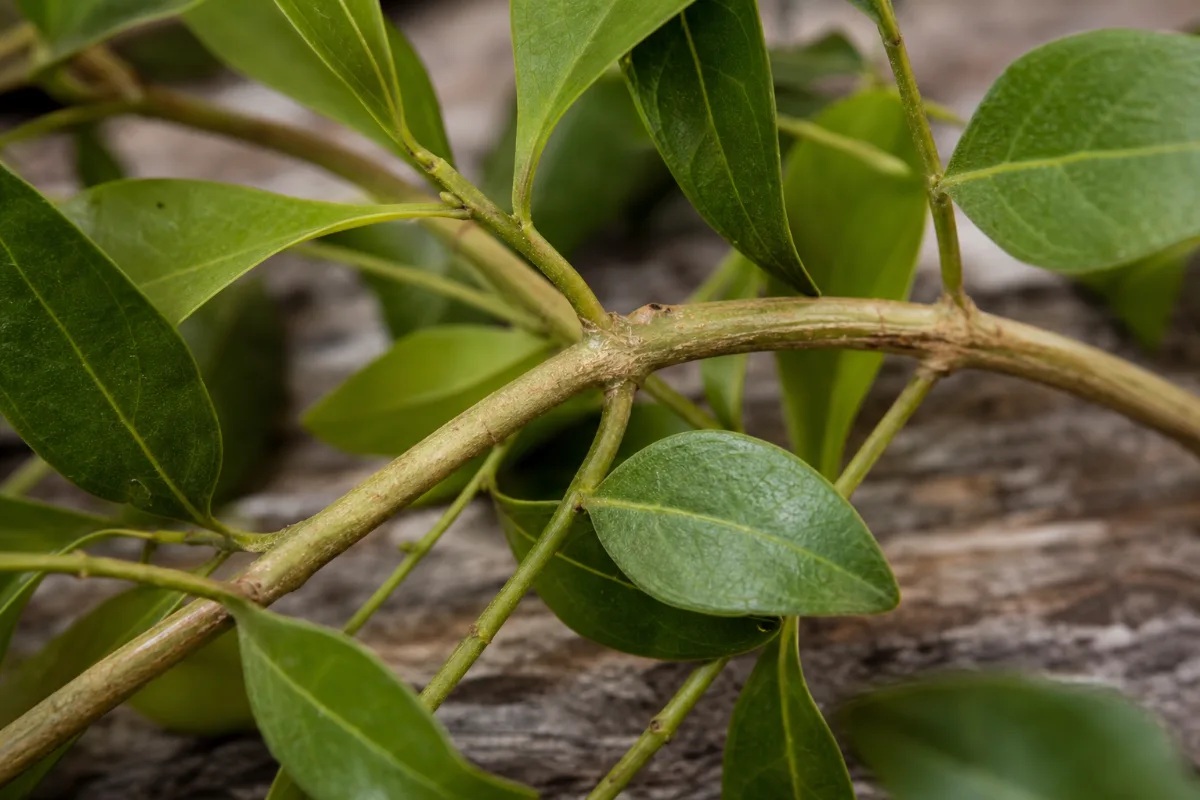
Herbs & Botanicals · Fragrant heartwood and skin oil
Sandalwood
Santalum album · also called White sandalwood; East Indian sandalwood; Indian sandalwood. Not the same as Australian sandalwood or red sandalwood.
Sandalwood is a fragrant tree. Its heartwood, and the oil distilled from it, are used in perfume, incense, skin care and traditional medicine. Studies are few and small: one on calming body signs, a pilot on anxiety, and open studies on warts and molluscum. None proves it works. Key caution: the oil can cause skin allergy, many oils sold as sandalwood are fake, and the tree is Vulnerable.
General information, not medical advice. Last substantive update · Not medically reviewed. A named clinician has not signed off on this page. How this page is made
About Sandalwood
Sandalwood (Santalum album) is a tree whose fragrant heartwood and oil are used in perfume, incense, skin care and traditional medicine. Human studies are small and none proves a benefit. The oil can cause skin allergy, many oils sold as sandalwood are not genuine, and the tree is Vulnerable.
What it is
White sandalwood is a tree in the sandalwood family. The heartwood is used as powder or paste, and the essential oil is distilled from it. Its main oil compounds are alpha- and beta-santalol.
It is sold as oil, in massage blends, incense, perfume and skin products.
Not the same as other sandalwoods
Australian sandalwood (Santalum spicatum) is another species. Red sandalwood (Pterocarpus santalinus) is a different plant in the pea family. West Indian sandalwood (Amyris balsamifera) is often used to adulterate the real oil.
This page covers white sandalwood, Santalum album. Some studies use other oils or products, and we say so where we know.
What people use it for
Traditionally it is used for calming, for the skin, and in incense and perfume. A consumer reference says Germany's Commission E approved the oil for supportive care of urinary infections.
Long use is not proof that it works.
What the research shows
One small study found calming body signs from the oil on the skin. A pilot on anxiety in palliative care was too small to judge. Two 10-person open studies reported warts and molluscum clearing, with no comparison group.
A review of skin use is positive but written by people linked to the oil's developer. We found no placebo-controlled trial of plain sandalwood oil.
At a glance
Traditional uses history, not proof
- Ayurveda and Asian traditions: cooling and calming, skin paste, incense and perfume
- Traditional Chinese medicine: sedative use reported by a consumer reference (not checked further)
- Germany: swallowed oil reported as approved for supportive care of lower urinary tract infection (consumer report; monograph not read)
Studied for research
- Calm and relaxation: one small study of body signs, insufficient evidence
- Anxiety in palliative care: a pilot that gave no usable results, insufficient evidence
- Common warts and molluscum: two 10-person open studies, insufficient evidence
- Acne: a combination product with salicylic acid, very low certainty
- Psoriasis and eczema: interim and lab data, insufficient evidence
- Radiotherapy skin reactions: a sandalwood and turmeric cream, very low certainty
Main compounds
- Alpha-santalol (main oil compound)
- Beta-santalol
Common forms
- Essential oil from the heartwood
- Heartwood powder or paste
- Diluted massage oil
- Incense, perfume and diffusers (often blends or synthetics)
Research links: PubMed: skin absorption of sandalwood oil in volunteers (Planta Med, 2004) · PubMed: sandalwood oil for common warts (Clin Pediatr, 2018) · PubMed: contact allergy to essential oils, 10,930 patients (Contact Dermatitis, 2022) · PubMed: six commercial 'sandalwood' oils tested (Molecules, 2021) · Research Library · Genes & Biomarkers Library
The plant and its history
- Accepted scientific name
- Santalum album L.
- Naming authority
- L. (Linnaeus, 1753). GBIF accepted species, usageKey 2889785 (exact match, confidence 100); NCBI Taxonomy taxid 35974, GenBank common name 'white sandalwood'.
- Common names
- Sandalwood (English); White sandalwood (English (NCBI)); East Indian sandalwood (English (trade)); Indian sandalwood (English)
- Botanical family
- Santalaceae (the sandalwood family), order Santalales.
- Classification
- Plantae > Tracheophyta > Magnoliopsida > Santalales > Santalaceae > Santalum > Santalum album
- Native range
- A 2025 review calls it a tree native to India and widely distributed across Asia and Australia; a web search listed Indonesia, the Philippines and Western Australia in its range (secondary source). Exact native range not verified.
- Habitat
- Not verified in a source read.
- What the plant looks like
- Roots: Not verified.; Stems: The fragrant heartwood of the trunk is the part used for oil and powder (2025 review).; Leaves: Not verified.; Flowers: Not verified.; Fruit: Not verified.
- Cultivation
- The 2025 review calls for structured germplasm conservation and sustainable cultivation. Harvest age figures in secondary sources differed (20 versus 40 years) and are not stated here.
- Harvest and processing
- The essential oil is distilled from the heartwood. Not verified beyond that.
- Look-alikes and adulterants
- Name: Australian sandalwood (Santalum spicatum (R.Br.) A.DC.); Note: A separate accepted species in the same genus (GBIF usageKey 3788877). Its oil differs in composition and some products and studies use it. Not covered by this page's ratings.; Name: Red sandalwood (Pterocarpus santalinus L.f.); Note: A different plant in the pea family, Fabaceae (GBIF usageKey 5708628), used for its red colour and in other traditions; not a source of sandalwood oil.; Name: West Indian sandalwood (Amyris balsamifera); Note: A different tree often used to adulterate sandalwood oil; three of six shop oils tested looked like it (Kucharska 2021).
- Sustainability and conservation
- Reported as Vulnerable on the IUCN Red List by secondary sources (the IUCN page itself returned 403 and was not read; CITES status not checked). A 2025 review says natural populations have sharply declined from overexploitation, habitat loss and disease, and that India produces over 85% of global supply.
The plant and the parts used

Traditional use and history history, not clinical proof
| Tradition or era | Documented use | Source |
|---|---|---|
| India and wider Asia (Ayurveda, incense, perfume) | The heartwood, paste and oil are used for the skin, for cooling and calming, and in perfume and incense. The 2025 review says the wood is valued by pharmaceutical, cosmetic and cultural industries. | p41313490 |
| Traditional Chinese medicine (Tan xiang) | A consumer reference mentions sedative use of Santalum album in TCM; not checked against other sources. | s-peacehealth-sandalwood |
| Germany, Commission E | Reported as approving the oil for supportive treatment of lower urinary tract infections; monograph not read. | s-peacehealth-sandalwood |
Traditional use shows how a plant was used. It does not show that a supplement works or is safe today.
What is inside, and how it may work
What the plant contains and how those compounds act in cells and animals. Laboratory and animal mechanisms are not proven effects in people.
Main compounds
| Compound | Family | Where it is concentrated | Activity studied | Level of evidence |
|---|---|---|---|---|
| Alpha-santalol PubChem 11085337 | sesquiterpene alcohol | Heartwood oil | Caused relaxing or sedative-type body changes in the 2004 skin-absorption study; lab work reports anti-inflammatory activity. 1 7 16 | Human data |
| Beta-santalol PubChem 6857681 | sesquiterpene alcohol | Heartwood oil | A marker of genuine Santalum album oil together with alpha-santalol; individual effects not read. 9 16 | Laboratory research |
Mechanisms, receptors and pathways
| Target or pathway | Gene or receptor | What was found | Level |
|---|---|---|---|
| Inflammatory signals in skin | IL-6, IL-8, IL-1 beta, MCP-1, GM-CSF, ENA-78 | East Indian sandalwood oil lowered these signals and reversed psoriasis-like changes in lab-grown human skin models. 19 | Laboratory research |
| Whole-body arousal | Not identified | Skin-absorbed alpha-santalol produced relaxing/sedative-type body changes in healthy volunteers; how was not studied. This is the only human mechanism-type finding. 7 | Human data |
| Anticancer, antimicrobial and other lab effects | Various | Reviews report lab and animal effects of alpha-santalol. Lab and animal only; they do not show effects in people. Not itemised. 12 1 | Animal research |
Absorption, metabolism and elimination
- Absorption
- The 2004 study shows that oil compounds act on the body after skin application, which suggests absorption; amounts were not measured in the abstract.
- Distribution
- Not established.
- Metabolism
- Not established.
- Elimination
- Not established.
- Bioavailability
- Not established.
Isolated compounds versus whole extracts
Whole oil and pure alpha-santalol did not act the same way in the 2004 study: alpha-santalol looked sedating, while the whole oil lowered body arousal but raised self-rated activity. So results for the oil cannot be assumed for the isolated compound, or the reverse.
Nutritional composition
Sandalwood oil is used as a food flavour at tiny intakes (0.0074 mg/kg a day in one estimate). It is not a source of nutrients.
2 very low certainty6 not enough evidence
What is Sandalwood good for?
The main proposed uses and how strong the human evidence is for each. 'Insufficient' means there is not enough good evidence to say; 'very low' is the best rating anything here reaches.
Benefits, one by one
Each card is a research question, not a promise. Tap a goal to filter. Open a card to see the studies, doses and limits.
Calm and relaxation (body measures)
Not enough evidenceIn one small study of healthy volunteers, sandalwood oil put on the skin (with masks so no scent was smelled) lowered body arousal while people rated themselves more active. Pure alpha-santalol looked more sedating. It does not show that sandalwood treats anxiety or insomnia.
2 studiesEast Indian sandalwood essential oil (Santalum album) and pure alpha-…
Studies, doses and limits
What the trials found
One randomized study (Hongratanaworakit 2004) in healthy volunteers measured eight body signs such as pulse, blood pressure and skin conductance, plus mood ratings. Breathing masks blocked the smell. Alpha-santalol changed the body signs in ways the authors call relaxing or sedative. The whole oil lowered body arousal but raised behavioural activation, which the authors describe as an uncoupling of the two.
Results
Mixed: calming body measures, but higher self-rated activity with the whole oil.
Effect sizes as reported
The abstract gives no numbers and does not state how many people took part.
Why this rating
One small study of healthy people, short-term body measures, no numbers in the abstract, no replication found.
Form and dose studied
East Indian sandalwood essential oil (Santalum album) and pure alpha-santalol on the skin. No amount can be advised from this.
Who was studied
Healthy volunteers.
Limits
Healthy people, not patients; body signs are not the same as feeling calmer in daily life.
Why researchers looked
Sandalwood is a well-known calming scent, and researchers wanted to know whether the oil itself acts through the skin, separate from smell.
Traditional use
In Ayurveda and other traditions sandalwood is used for cooling and calming, and in incense for meditation. Tradition is not proof of an effect.
Proposed mechanism Pharmacological theory
Alpha-santalol and other oil compounds may act on the body after absorption through the skin. How is not shown in the sources we read.
A proposed mechanism does not show that the effect happens in people.
Essential oil on the skin can cause irritation or allergy in some people; see the safety tab.
Anxiety in palliative care (aromatherapy massage)
Not enough evidenceA small pilot of 34 palliative-care patients compared massage with 1% sandalwood oil, massage with carrier oil alone, and sandalwood from an aroma stone. The author said the results were too weak to draw conclusions.
1 studiesMassage with a 1% dilution in sweet almond oil, or sandalwood from an…
Studies, doses and limits
What the trials found
One pilot of a larger trial (Kyle 2006). 34 people took part and 25% dropped out. The author wrote that the results were not substantial enough for coherent statistics, and that no assumptions could be drawn, while adding that the results 'seem to support' an anxiety-lowering effect.
Results
No usable statistics reported.
Effect sizes as reported
None reported.
Why this rating
A pilot with a high dropout and no analysable results. It tested logistics, not the effect.
Form and dose studied
Massage with a 1% dilution in sweet almond oil, or sandalwood from an aroma stone. Details of timing were not in the abstract.
Who was studied
Palliative-care patients.
Limits
Tiny pilot; the benefit of massage itself cannot be separated from the oil; the larger trial's results were not found.
Why researchers looked
Aromatherapy is widely offered to people with serious illness, and sandalwood is a common choice for anxiety.
Traditional use
Sandalwood oil is traditionally used in aromatherapy for calming and sleep.
Proposed mechanism Pharmacological theory
Not shown. Effects of massage, touch and attention are mixed with any effect of the scent or oil.
A proposed mechanism does not show that the effect happens in people.
Sandalwood oil on the skin is a possible allergen; avoid use on broken skin and tell staff if a rash appears.
Common warts (skin application)
Not enough evidenceIn an open study of 10 people, 8 had all treated warts clear after 12 weeks of twice-daily sandalwood oil on the skin. There was no comparison group, and warts can clear on their own.
2 studiesSandalwood oil on the skin, twice daily for 12 weeks (as studied).
Studies, doses and limits
What the trials found
One open-label study (Haque and Coury 2018) of 10 people. Oil was applied twice daily for 12 weeks. No irritation or other side effects were reported.
Results
8 of 10 (80%) complete clearing; 2 had moderate improvement (25% to over 90%).
Effect sizes as reported
80% (8/10); no confidence interval.
Why this rating
Ten people, no control group, abstract only read. Natural clearing of warts cannot be excluded.
Form and dose studied
Sandalwood oil on the skin, twice daily for 12 weeks (as studied).
Who was studied
People with common warts.
Limits
Very small, uncontrolled; full text not read.
Why researchers looked
Warts are caused by a virus and are slow to treat; sandalwood oil has shown antiviral activity in the lab.
Traditional use
Traditional skin use of sandalwood paste and oil.
Proposed mechanism Laboratory research
Lab work suggests antiviral and anti-inflammatory effects; not shown to explain the result in people.
A proposed mechanism does not show that the effect happens in people.
Even with no reactions here, sandalwood oil can cause skin allergy; see the safety tab.
Molluscum contagiosum (skin application)
Not enough evidenceIn an open pilot of 10 people aged 22 months to 29 years, 9 had all lesions clear within 12 weeks of twice-daily East Indian sandalwood oil product. There was no comparison group.
1 studiesAn East Indian sandalwood oil product, twice daily (as studied); the …
Studies, doses and limits
What the trials found
One open-label pilot (Haque and Coury 2018) of 10 people. Response did not depend on lesion number, duration, age or sex. No side effects were reported.
Results
9 of 10 (90%) complete resolution within 12 weeks.
Effect sizes as reported
90% (9/10).
Why this rating
Ten people, no control, and molluscum often resolves without treatment. Abstract only.
Form and dose studied
An East Indian sandalwood oil product, twice daily (as studied); the exact product is not described in the abstract.
Who was studied
Children and adults with molluscum.
Limits
Tiny, open label, no control.
Why researchers looked
Molluscum is a common skin virus in children that often clears by itself but can take months.
Traditional use
Not described in the sources read.
Proposed mechanism Pharmacological theory
Not shown.
A proposed mechanism does not show that the effect happens in people.
Children's skin can be more reactive; ask a clinician before use on a child.
Acne (a salicylic-acid regimen containing sandalwood oil)
Very low certaintyIn an 8-week open study of 47 people with mild to moderate acne, 89% rated improved on a regimen that contained salicylic acid plus sandalwood oil. The oil's own effect cannot be separated, and the oil was described as from Australia.
2 studiesA proprietary salicylic acid regimen containing sandalwood oil; not a…
Studies, doses and limits
What the trials found
One open-label, single-centre study (Moy 2012) of a four-part regimen (cleanser, serum, spot treatment, mask) with 0.5% salicylic acid and purified sandalwood oil, used for 8 weeks. Most side effects (itching, scaling, burning) were mild to moderate and peaked at week 2, mainly with the mask.
Results
42 of 47 (89.4%) improved, much improved or very much improved on a global rating.
Effect sizes as reported
42/47; no control.
Why this rating
Open-label, combination product with salicylic acid (a known acne ingredient), no control, product maker link, and Australian rather than Santalum album oil (as described).
Form and dose studied
A proprietary salicylic acid regimen containing sandalwood oil; not a plain sandalwood product.
Who was studied
Adolescents and adults with mild to moderate facial acne.
Limits
Cannot credit sandalwood; species not stated in the abstract.
Why researchers looked
Sandalwood oil is anti-inflammatory and antimicrobial in lab tests, so it was tried in acne products.
Traditional use
Traditional skin use only.
Proposed mechanism Laboratory research
Lab studies report anti-inflammatory and antimicrobial activity of the oil; not shown to explain the human result.
A proposed mechanism does not show that the effect happens in people.
Skin tolerance symptoms occurred early in use.
Psoriasis and eczema (skin application)
Not enough evidenceA dermatology review says sandalwood album oil has shown promise in trials for psoriasis and eczema. We found interim, uncontrolled psoriasis data and lab-skin results, but no published controlled trial result.
2 studiesTopical East Indian sandalwood oil; no amount can be advised.
Studies, doses and limits
What the trials found
A 2017 paper (Sharma) reports interim results of an ongoing phase II psoriasis trial as 'well tolerated and helpful' without numbers in the abstract; its measured data are from lab-grown skin. The 2017 review (Moy and Levenson) states the oil has 'shown promise' in trials for acne, psoriasis, eczema, warts and molluscum. Both papers involve authors linked to the oil's developer. We did not find a controlled eczema trial.
Results
Not reported in the abstracts.
Effect sizes as reported
None reported.
Why this rating
Interim uncontrolled clinical data with no figures, mostly lab results, and developer-linked authors.
Form and dose studied
Topical East Indian sandalwood oil; no amount can be advised.
Who was studied
People with mild to moderate psoriasis (interim); eczema not found in detail.
Limits
Abstracts only; the underlying trials were not read.
Why researchers looked
Both conditions involve skin inflammation, and the oil reduced inflammatory signals in lab-grown skin.
Traditional use
Traditional skin use.
Proposed mechanism Laboratory research
In lab-grown psoriasis skin the oil reversed psoriasis-like changes and lowered IL-6, IL-8, IL-1 beta and other inflammatory signals. This is lab work only.
A proposed mechanism does not show that the effect happens in people.
Reported as well tolerated by the authors; allergy remains possible.
Skin reactions during breast radiotherapy (sandalwood and turmeric cream)
Very low certaintyIn a study of women having breast radiotherapy, a cream containing sandalwood oil and turmeric delayed and reduced skin burns compared with baby oil. The cream is a combination, so sandalwood cannot be credited.
1 studiesVicco turmeric Ayurvedic cream (sandalwood oil plus turmeric), daily …
Studies, doses and limits
What the trials found
One investigator-blinded randomized study (Rao 2017): the Vicco turmeric cream was applied daily for 5 weeks. Dermatitis grade was lower with the cream at weeks 2, 3 and 4 (p between 0.003 and 0.05 across measures). The authors call for double-blind trials.
Results
Lower grade 1 at week 2 (p=0.025) and grade 2/3 at weeks 3 and 4 (p=0.003, 0.02) versus Johnson's Baby Oil.
Effect sizes as reported
p-values only in the abstract.
Why this rating
A combination cream, investigator-blind only, the comparison was baby oil rather than an inactive cream, and group sizes are not in the abstract.
Form and dose studied
Vicco turmeric Ayurvedic cream (sandalwood oil plus turmeric), daily for 5 weeks (as studied).
Who was studied
Women receiving breast radiotherapy.
Limits
Cannot separate sandalwood from turmeric.
Why researchers looked
Radiation skin burns are common, and cheap soothing creams are wanted.
Traditional use
Both sandalwood and turmeric are used in Ayurvedic skin preparations.
Proposed mechanism Pharmacological theory
Not shown; the cream has two active plants.
A proposed mechanism does not show that the effect happens in people.
Skin on radiotherapy sites is fragile; follow the cancer team's advice on creams.
Urinary tract infection (swallowed oil; traditional and Commission E)
Not enough evidenceConsumer references say Germany's Commission E approved the oil for supportive treatment of lower urinary tract infections, but that clinical trials are lacking. We could not read the monograph, and we do not recommend swallowing the oil.
1 studiesThe reference describes a supervised, time-limited oral use; no amoun…
Studies, doses and limits
What the trials found
No clinical trial was found. A consumer reference (PeaceHealth) states the Commission E approval and that clinical trial support is lacking.
Results
None.
Effect sizes as reported
None.
Why this rating
Tradition and a secondary report of a regulator opinion only.
Form and dose studied
The reference describes a supervised, time-limited oral use; no amount is advised here.
Who was studied
Not studied.
Limits
The monograph itself was not read; the kidney caution in the same reference is discussed on the safety tab.
Why researchers looked
Sandalwood oil has a long traditional use as a urinary antiseptic.
Traditional use
Traditional use, reported by consumer references.
Proposed mechanism Pharmacological theory
Not shown.
A proposed mechanism does not show that the effect happens in people.
The same reference says people with kidney disease should not use sandalwood internally.
Connections to the rest of health
How Sandalwood connects to the rest of our health knowledge graph. Every link says what kind of connection it is. A safety link (for example to the liver) is a warning, not a benefit. A study that merely mentions a topic never creates a benefit link.
Explore every connection: goals, body systems, organs, symptoms, genes
A. Wellness goals
| Connected to | Kind of connection | Evidence status | Context | Studies |
|---|---|---|---|---|
| Calm Relaxation | Preliminary mechanism | Not enough evidence | Calm and relaxation (body measures): In one small study of healthy volunteers, sandalwood oil put on the skin (with masks so no scent was smelled) lowered body arousal while people rated themselves more active. Pure alpha-santalol looked more sedating. It does not show that sandalwood treats anxiety or insomnia. | 7 12 |
| Anxiety Support | Traditional use | Not enough evidence | Anxiety in palliative care (aromatherapy massage): A small pilot of 34 palliative-care patients compared massage with 1% sandalwood oil, massage with carrier oil alone, and sandalwood from an aroma stone. The author said the results were too weak to draw conclusions. | 10 |
| Calm Relaxation | Traditional use | Not enough evidence | Anxiety in palliative care (aromatherapy massage): A small pilot of 34 palliative-care patients compared massage with 1% sandalwood oil, massage with carrier oil alone, and sandalwood from an aroma stone. The author said the results were too weak to draw conclusions. | 10 |
| Healthy Skin | Potential benefit | Not enough evidence | Common warts (skin application): In an open study of 10 people, 8 had all treated warts clear after 12 weeks of twice-daily sandalwood oil on the skin. There was no comparison group, and warts can clear on their own. Molluscum contagiosum (skin application): In an open pilot of 10 people aged 22 months to 29 years, 9 had all lesions clear within 12 weeks of twice-daily East Indian sandalwood oil product. There was no comparison group. | 5 12 6 11 18 |
| Immune Support | Potential benefit | Not enough evidence | Common warts (skin application): In an open study of 10 people, 8 had all treated warts clear after 12 weeks of twice-daily sandalwood oil on the skin. There was no comparison group, and warts can clear on their own. Molluscum contagiosum (skin application): In an open pilot of 10 people aged 22 months to 29 years, 9 had all lesions clear within 12 weeks of twice-daily East Indian sandalwood oil product. There was no comparison group. | 5 12 6 |
| Healthy Skin | Preliminary mechanism | Not enough evidence | Psoriasis and eczema (skin application): A dermatology review says sandalwood album oil has shown promise in trials for psoriasis and eczema. We found interim, uncontrolled psoriasis data and lab-skin results, but no published controlled trial result. | 19 12 |
| Inflammation Balance | Preliminary mechanism | Not enough evidence | Psoriasis and eczema (skin application): A dermatology review says sandalwood album oil has shown promise in trials for psoriasis and eczema. We found interim, uncontrolled psoriasis data and lab-skin results, but no published controlled trial result. | 19 12 |
| Immune Support | Traditional use | Not enough evidence | Urinary tract infection (swallowed oil; traditional and Commission E): Consumer references say Germany's Commission E approved the oil for supportive treatment of lower urinary tract infections, but that clinical trials are lacking. We could not read the monograph, and we do not recommend swallowing the oil. | 15 |
B. Body systems
| Connected to | Kind of connection | Evidence status | Context | Studies |
|---|---|---|---|---|
| Nervous System | Biological association | Not enough evidence | Studied for: Calm and relaxation (body measures) Studied for: Anxiety in palliative care (aromatherapy massage) | 7 12 10 |
| Integumentary System | Biological association | Not enough evidence | Studied for: Common warts (skin application) Studied for: Molluscum contagiosum (skin application) | 5 12 6 11 19 18 |
| Immune System | Biological association | Not enough evidence | Studied for: Psoriasis and eczema (skin application) | 19 12 |
| Urinary System | Biological association | Not enough evidence | Studied for: Urinary tract infection (swallowed oil; traditional and Commission E) | 15 |
C. Body parts and organs
| Connected to | Kind of connection | Evidence status | Context | Studies |
|---|---|---|---|---|
| Skin | Adverse effect or risk | Mixed findings | Contact allergy in about 1.8% of patch-tested dermatitis patients; small open studies of skin use reported no reactions. Contact allergy in 1.8% of patch-tested patients; small open studies of skin use. Preparation or compound: Essential oil |
4 5 |
| Kidneys | Contraindication | Not enough evidence | A consumer reference advises against internal use in kidney disease; no harm report found. Preparation or compound: Swallowed oil |
15 |
E. Health conditions
J. Genes, receptors and enzymes
| Connected to | Kind of connection | Evidence status | Context | Studies |
|---|---|---|---|---|
| IL-6, IL-8, IL-1 beta (inflammatory cytokines) | Preliminary mechanism | In vitro | Lowered by East Indian sandalwood oil in lab-grown psoriasis skin. | 19 |
L. Active compounds
| Connected to | Kind of connection | Evidence status | Context | Studies |
|---|---|---|---|---|
| Alpha-santalol | Biological association | Human | Caused relaxing or sedative-type body changes in the 2004 skin-absorption study; lab work reports anti-inflammatory activity. Preparation or compound: Heartwood oil |
1 7 16 |
| Beta-santalol | Biological association | In vitro | A marker of genuine Santalum album oil together with alpha-santalol; individual effects not read. Preparation or compound: Heartwood oil |
9 16 |
Each connection is stored with the ingredient, the connected record, the kind of connection, the evidence status, the supporting studies, the preparation or compound involved, and a review date (last reviewed October 25, 2026).
The evidence
The research centre for Sandalwood. Every record here was checked against PubMed or the publisher's page; we never list a study we have not verified.
Evidence by outcome
Bars show how many studies we found for each outcome, not how well it works. People are added up across trials only (reviews are not added, to avoid double counting).
How we rate evidence
High certainty
Several well-run trials or reviews agree; further research is unlikely to change the picture much.
Moderate certainty
Good trials point the same way, but some doubt remains.
Low certainty
Small, short or inconsistent trials. The finding could change with better research.
Very low certainty
Very little or very weak human data. Treat as a possibility only.
Mixed findings
Trials or reviews disagree with each other.
Not enough evidence
Not enough human research to say either way.
Evidence against
Good research found no benefit, or found harm.
We take the reviewers' own risk-of-bias and GRADE statements where they exist, and otherwise judge from study size, design, consistency, directness and whether a product matches what is sold. Many publications do not make evidence high. Method note: We started from our existing sandalwood summary, read the key abstracts in PubMed and one consumer reference in full, checked names in GBIF, NCBI and PubChem, and looked for EU, NCCIH, LiverTox and LactMed entries, which were not found. Results are recorded as reported, mostly from abstracts. Certainty ratings are the compiler's reading. No study is cited that we could not verify.
Study library: every study we checked 20
| Study | Design | People | Product, dose, length | Result |
|---|---|---|---|---|
| Burdock 2008 Safety assessment of sandalwood oil (Santalum album L.). Food Chem Toxicol · PMID 17980948 · DOI |
Narrative review |
Published toxicity data | Sandalwood oil (Santalum album) and alpha-santalol oil n/a n/a · vs n/a |
Low acute oral and skin toxicity in lab animals; not mutagenic in one bacterial test. Occasional irritation or sensitisation reactions in people are reported. Authors call the toxicity data limited but consider it safe at present food-use levels (0.0074 mg/kg a day). n/a Methods, limits and fundingOutcomes: Safety of sandalwood oil as a food flavour and cosmetic ingredient Limitations: Authors say available toxicity information is limited. Abstract read only. Relates to food-flavour levels, not high-dose or medicinal use. Funding and conflicts: Authors at Burdock Group, a consultancy; funding not stated in the abstract. Read: abstract |
| EMA 2026 EMA/HMPC herbal monograph for Santalum album: not found Regulator search · Source |
Not found n/a |
n/a | n/a n/a n/a n/a · vs n/a |
No EMA/HMPC monograph for sandalwood was located (EMA site search was blocked, HTTP 401). n/a Methods, limits and fundingOutcomes: n/a Limitations: Not found does not prove none exists. Read: summary-only |
| GBIF 2026 GBIF Backbone Taxonomy: Santalum album L. (usageKey 2889785) Database lookup · Source |
Reference database n/a |
n/a | n/a n/a n/a n/a · vs n/a |
Accepted species, family Santalaceae, order Santalales (exact match, confidence 100). Same lookup: Santalum spicatum (R.Br.) A.DC. is a separate accepted species (usageKey 3788877); Pterocarpus santalinus L.f. is a separate accepted species in family Fabaceae (usageKey 5708628). n/a Methods, limits and fundingOutcomes: n/a Limitations: Name lookup only; no range or conservation data read. Read: full-text |
| Geier 2022 Contact sensitization to essential oils: IVDK data of the years 2010-2019. Contact Dermatitis · PMID 35417610 · DOI |
Retrospective surveillance |
10930 Dermatitis patients patch-tested in German-speaking skin clinics |
Patch tests with 12 essential oils including sandalwood oil oil n/a n/a · vs n/a |
908 of 10,930 (8.3%) reacted to at least one oil. Sandalwood oil gave 1.8% positive reactions, one of six oils above 1%. Masseurs and cosmeticians were at higher risk. 1.8% positive for sandalwood oil Methods, limits and fundingOutcomes: Share of patients with a positive patch test Limitations: People already attending skin clinics, so rates are higher than in the general public. Reactions to sandalwood overlapped with fragrances. Abstract read only; which sandalwood species was tested is not stated in the abstract. Read: abstract |
| Haque 2018 Topical Sandalwood Oil for Common Warts. Clin Pediatr (Phila) · PMID 28954520 · DOI |
Open label pilot |
10 People with common skin warts (HPV) |
Sandalwood oil applied to the skin oil twice daily 12 weeks · vs None (no control group) |
8 of 10 (80%) had all treated warts clear; the other 2 had moderate improvement (25% to over 90%). No skin irritation or other side effects were reported. 80% complete clearance (8/10) Methods, limits and fundingOutcomes: Wart size and clearance; side effects Limitations: Ten people, open label, no placebo or comparison group, so natural clearing of warts cannot be ruled out. Full text not read. Read: abstract |
| Haque 2018 Treatment of molluscum contagiosum with an East Indian sandalwood oil product. J Dermatolog Treat · PMID 29103323 · DOI |
Open label pilot |
10 People aged 22 months to 29 years with molluscum contagiosum |
An East Indian sandalwood oil (EISO) product applied to lesions oil twice daily 12 weeks · vs None (no control group) |
9 of 10 (90%) had complete resolution within 12 weeks. No side effects, irritation or pain were reported. 90% complete resolution (9/10) Methods, limits and fundingOutcomes: Lesion counts; side effects Limitations: Ten people, open label, no control group. Molluscum often clears on its own, so this cannot show the oil caused the clearing. Full text not read. Read: abstract |
| Hongratanaworakit 2004 Evaluation of the effects of East Indian sandalwood oil and alpha-santalol on humans after transdermal absorption. Planta Med · PMID 14765284 · DOI |
Randomized controlled trial |
Healthy volunteers (number not stated in the abstract) | East Indian sandalwood essential oil (Santalum album) and pure alpha-santalol, applied to the skin with breathing masks so the scent was not smelled heartwood oil n/a n/a · vs n/a |
Alpha-santalol caused changes the authors read as relaxing or sedative. The whole oil lowered body arousal but raised behavioural (self-rated) activation. Direction of change only; no numbers in the abstract Methods, limits and fundingOutcomes: Eight body measures (oxygen saturation, blood pressure, breathing rate, eye-blink rate, pulse, skin conductance, skin temperature, muscle activity) and rating scales of mood Limitations: Number of people and effect sizes not given in the abstract; healthy volunteers, short-term body measures, not anxiety patients. Read: abstract |
| IUCN (via web search results) 2026 IUCN Red List status of Santalum album: Vulnerable (not verified on the IUCN site) Web search · Source |
Secondary report n/a |
n/a | n/a n/a n/a n/a · vs n/a |
A web search returned secondary pages (including Wikipedia) listing the species as Vulnerable under IUCN 3.1; one industry source gave 1998 as the year. The IUCN Red List page itself returned HTTP 403 and was not read. n/a Methods, limits and fundingOutcomes: n/a Limitations: NOT verified at the primary source. CITES status was not checked. Read: summary-only |
| Kucharska 2021 A Comparison of the Composition of Selected Commercial Sandalwood Oils with the International Standard. Molecules · PMID 33924603 · DOI |
Laboratory analysis n/a |
6 Six commercial oils sold as sandalwood oil |
Commercial oils labelled sandalwood, tested by gas chromatography with mass spectrometry oil n/a n/a · vs n/a |
None of six met the standard. Only one contained both alpha- and beta-santalol, as Santalum album does. Three looked like Amyris balsamifera oil, and two were synthetic mixtures (benzyl benzoate in one; synthetic alcohols such as javanol, polysantol and ebanol in the other). Labels were correct for three. Toxicology of the synthetic alcohols is unknown. 1 of 6 genuine Santalum album Methods, limits and fundingOutcomes: Match with ISO 3518:2002 standard (alpha- and beta-santalol) Limitations: Six oils only, from shops in one study; shows the problem exists, not how common it is. Funding and conflicts: Authors declared no conflict of interest. Read: abstract |
| Kyle 2006 Evaluating the effectiveness of aromatherapy in reducing levels of anxiety in palliative care patients: results of a pilot study. Complement Ther Clin Pract · PMID 16648093 · DOI |
Randomized controlled trial |
34 Palliative-care patients (pilot of a larger trial) |
Massage with 1% Santalum album (sandalwood) oil in sweet almond carrier oil; sandalwood via an aromastone oil 1% dilution not stated in the abstract · vs Massage with carrier oil alone |
The pilot's data were not strong enough to produce coherent statistics. The author said no conclusions could be drawn, though the results 'seem to support' an anxiety-lowering effect. No usable statistics Methods, limits and fundingOutcomes: Anxiety scores Limitations: 34 people, 25% dropped out, results not substantial enough for statistics. Pilot only. Read: abstract |
| Moy 2012 Single-center, open-label study of a proprietary topical 0.5% salicylic acid-based treatment regimen containing sandalwood oil in adolescents and adults with mild to moderate acne. J Drugs Dermatol · PMID 23377508 |
Open label trial |
47 Adolescents and adults with mild to moderate facial acne |
A proprietary regimen (cleanser, serum, spot treatment, mask) with 0.5% salicylic acid plus highly purified sandalwood oil 'from Australia' oil as directed 8 weeks · vs None (no control group) |
89.4% (42/47) rated improved, much improved or very much improved. Most intolerance events were mild to moderate, mainly with the mask. 42 of 47 improved Methods, limits and fundingOutcomes: Global Aesthetic Improvement Scale at week 8; tolerability Limitations: Combination product with salicylic acid, so the oil's own effect cannot be separated. No control group. The oil is described as from Australia, which is a different sandalwood species from Santalum album (species not stated in the abstract). Authors link to the product maker's research group. Read: abstract |
| Moy 2017 Sandalwood Album Oil as a Botanical Therapeutic in Dermatology. J Clin Aesthet Dermatol · PMID 29344319 |
Narrative review |
Published research on sandalwood album oil in skin disease | East Indian sandalwood oil (Santalum album) oil n/a n/a · vs n/a |
Says the oil has shown anti-inflammatory, antimicrobial and anti-proliferative activity, and promise in clinical trials for acne, psoriasis, eczema, warts and molluscum. Describes the safety profile as favourable. n/a Methods, limits and fundingOutcomes: Overview of anti-inflammatory, antimicrobial and clinical findings Limitations: Narrative review, abstract only read; underlying trials were not read. One author is an employee of the company developing sandalwood oil drugs, which holds investigational new drug applications. Funding and conflicts: Dr Levenson is an employee of Santalis Pharmaceuticals; Dr Moy declared no conflict. No funding. Read: abstract |
| NCBI Bookshelf 2026 LiverTox and LactMed entries for sandalwood: not found Database search · Source |
Not found n/a |
n/a | n/a n/a n/a n/a · vs n/a |
A Bookshelf search for sandalwood plus LiverTox or LactMed returned no records. n/a Methods, limits and fundingOutcomes: n/a Limitations: Not found does not prove none exists. Read: summary-only |
| NCCIH 2026 NCCIH page for sandalwood: not found Regulator search · Source |
Not found n/a |
n/a | n/a n/a n/a n/a · vs n/a |
The guessed NCCIH page www.nccih.nih.gov/health/sandalwood returned HTTP 404 on 2026-10-25. n/a Methods, limits and fundingOutcomes: n/a Limitations: Not found does not prove none exists. Read: summary-only |
| PeaceHealth 2026 Sandalwood (Santalum album) PeaceHealth medical library (consumer reference) · Source |
Consumer reference n/a |
n/a | n/a n/a n/a n/a · vs n/a |
Says people with kidney disease should not use sandalwood internally; internal use should be avoided in pregnancy and breastfeeding and is not for infants and children; no known interactions but unknown ones may exist; mild skin irritation can occur with skin use. Says Germany's Commission E approved the oil for supportive treatment of lower urinary tract infections, and that clinical trials to support this are lacking. n/a Methods, limits and fundingOutcomes: n/a Limitations: Consumer reference, not a regulator. The Commission E monograph itself was not read. Reasons for the kidney caution are not given on the page text we read. Read: full-text |
| PubChem 2026 PubChem name lookups: alpha-santalol (CID 11085337) and beta-santalol (CID 6857681) Database lookup · Source |
Reference database n/a |
n/a | n/a n/a n/a n/a · vs n/a |
Both are C15H24O. Alpha-Santalol CID 11085337; Beta-Santalol CID 6857681. n/a Methods, limits and fundingOutcomes: n/a Limitations: Name lookups only. Read: full-text |
| Rajarajan 2025 Genetic and genomic resources of Santalum album: past achievements and future prospects. Genetica · PMID 41313490 · DOI |
Narrative review n/a |
Review of the tree's genetics and supply | Santalum album tree whole tree n/a n/a · vs n/a |
Says natural populations have sharply declined from overexploitation, habitat loss and disease, and that India produces over 85% of global supply. Calls for germplasm conservation and sustainable cultivation. n/a Methods, limits and fundingOutcomes: Genetic resources and conservation Limitations: Abstract read only; a plant genetics review, not a conservation status assessment. Funding and conflicts: Authors declared no competing interests. Read: abstract |
| Rao 2017 Sandalwood Oil and Turmeric-Based Cream Prevents Ionizing Radiation-Induced Dermatitis in Breast Cancer Patients: Clinical Study. Medicines (Basel) · PMID 28930259 · DOI |
Randomized investigator blinded |
Women receiving breast radiotherapy (50 Gy in 25 daily fractions) | Vicco turmeric Ayurvedic cream (sandalwood oil plus turmeric) oil + turmeric daily 5 weeks · vs Johnson's Baby Oil |
Less dermatitis with the cream: lower grade 1 at week 2 (p=0.025), grade 2 and 3 at weeks 3 and 4 (p=0.003, p=0.02). p-values only; group sizes not given in the abstract Methods, limits and fundingOutcomes: Radiation dermatitis grade (RTOG score) Limitations: Combination cream (sandalwood plus turmeric); the effect cannot be credited to sandalwood. Investigator-blinded only; authors call for double-blind trials. Group sizes not in the abstract. Comparator was baby oil. Funding and conflicts: Authors declared no conflict of interest. Read: abstract |
| Sharma 2017 East Indian Sandalwood Oil (EISO) Alleviates Inflammatory and Proliferative Pathologies of Psoriasis. Front Pharmacol · PMID 28360856 · DOI |
Interim clinical report plus lab in-vitro |
Interim report from an ongoing phase II psoriasis trial (number not given) plus lab-grown human skin models | East Indian sandalwood oil (EISO), applied to the skin oil n/a n/a · vs n/a |
Authors say EISO was well tolerated and helpful in mild to moderate psoriasis in interim data, and reversed psoriasis-like changes in lab-grown skin and lowered inflammatory signals (IL-6, IL-8, IL-1 beta and others). Not reported in the abstract Methods, limits and fundingOutcomes: Psoriasis symptoms; skin-model markers of inflammation and cell growth Limitations: Interim, uncontrolled clinical data not shown in the abstract; the measured results are from lab-grown skin, not people. Authors include employees of the oil developer. Funding and conflicts: Some authors are employees of Santalis Pharmaceuticals, the oil developer. Read: abstract |
| de Groot 2017 Essential Oils, Part VI: Sandalwood Oil, Ylang-Ylang Oil, and Jasmine Absolute. Dermatitis · PMID 28002230 · DOI |
Narrative review |
Published reports of contact allergy to the oils | Sandalwood oil, ylang-ylang oil, jasmine absolute oil n/a n/a · vs n/a |
The abstract only says the article covers contact allergy and allergic contact dermatitis from these oils and their causative ingredients. No figures are in the abstract. n/a Methods, limits and fundingOutcomes: Botanical origin, composition, contact allergy and allergenic ingredients Limitations: Only the abstract was read, and it states topics rather than findings. Used here only to show that contact allergy is a recognised topic in dermatology reviews. Read: abstract |
What we do not know yet
- What the evidence supports: tradition, one small body-signs study, a failed pilot and small open skin studies, at insufficient or very-low certainty.
- No placebo-controlled trial of plain sandalwood oil for any use.
- No pregnancy, breastfeeding, child or medicine interaction study.
- The reason for the kidney caution and the Commission E monograph were not found.
- No EMA, NCCIH, LiverTox or LactMed entry was found, and the IUCN status was not verified at its source.
How new research is added
New studies are found by a saved PubMed search and placed in a review queue. A person reads each one before it changes any evidence rating or safety wording. New publications never change ratings automatically.
Lab markers
What changed in blood or saliva tests during trials. A changed number is not the same as feeling or being healthier, and we give no "normal ranges".
Safety
What studies and official sources say about side effects, medicines and who should check first. Each point shows what kind of evidence it comes from.
Main points to know 5
- Skin allergy and irritation from the essential oil. In a German clinic network, 1.8% of 10,930 patients with dermatitis who were patch-tested reacted to sandalwood oil. That is a group already seeing skin doctors, so it is not the rate for the public. A food-safety review also reports occasional irritation or sensitisation in people. Do a small patch test on a little diluted oil first and stop if a rash appears. Observational study 4 1 20
- Do not swallow essential oil without medical advice. The only source we read that describes swallowing sandalwood oil (a consumer reference) says it should be avoided in pregnancy, breastfeeding, infancy and childhood and in kidney disease, and that trials of oral use are lacking. We could not read a regulator document. Authoritative guidance 15
- Kidney caution is traditional and unexplained. A consumer reference tells people with kidney disease not to use sandalwood internally. We found no case report, trial or regulator statement that shows kidney harm, and the reason for the caution is not given in the text we read. Treat it as a precaution. Traditional use 15
- Many oils sold as sandalwood are not genuine. In a 2021 test of six shop oils sold as sandalwood, none met the international standard. Only one contained the santalols of Santalum album; three looked like Amyris balsamifera, and two were synthetic mixtures whose toxicology is unknown. Laboratory analysis 9
- The tree is Vulnerable, so sourcing matters. White sandalwood is reported as Vulnerable on the IUCN Red List and natural stands have declined from overharvesting. Buy only from suppliers who name the species and can show legal, sustainable sourcing. Authoritative guidance 17 8
Side effects 4
| Effect | How often | Severity and recovery | Evidence |
|---|---|---|---|
| Allergic contact dermatitis (itchy red rash) from sandalwood oil Masseurs and cosmeticians were over-represented among essential-oil allergy cases. Reactions overlapped with fragrance allergy. | Not established | mild to moderate Usually settles after stopping contact (general dermatology knowledge; not stated in the abstract) | Observational study 4 20 |
| Skin irritation or sensitisation The food-safety review calls these 'occasional' without giving a rate. | Not established | mild Not stated | Narrative review 1 |
| Itching, scaling, burning or stinging with a sandalwood and salicylic acid acne regimen Mainly with the mask component. Salicylic acid can also cause these effects, so sandalwood is not proven the cause. | Not established | mild to moderate Fell by weeks 4 and 8 | Open label trial 11 |
| No side effects reported in two 10-person open studies of skin application Too few people to rule out uncommon reactions. | Not established | none n/a | Case series 5 6 |
Liver
We found no case report of liver injury from sandalwood and no LiverTox entry. Absence of reports is not proof of safety. A consumer reference summarised in our earlier notes advised against internal use in severe liver disease, but we did not re-read that source. 13
How often. No frequency can be given.
Monitoring. No agency monitoring advice found. Anyone swallowing essential oil who develops yellow skin or eyes, dark urine or pale stools should stop and see a doctor.
This is a safety connection. It is not evidence that Sandalwood supports liver health.
Medicines and supplements 3
| With | Why it matters | Importance | Evidence | What to do |
|---|---|---|---|---|
| Sedatives, sleeping pills and other calming medicines or alcohol prescription | In one small study alpha-santalol changed body signs in a sedative-like direction. Added calming effects with other sedatives are therefore possible in theory. | Theory only. No interaction study with any medicine was found. | Pharmacological theory Very low certainty 7 | Ask a doctor or pharmacist before combining swallowed sandalwood oil with sedating medicines. Skin or scent use is unlikely to matter, but this is not studied. |
| Other skin products (retinoids, strong acids, other essential oils or fragrances) topical | More products on the skin can add irritation. Allergy to sandalwood often overlaps with fragrance allergy. | Overlapping patch-test reactions to essential oils and fragrances are reported; no product-combination trial was found. | Observational study Low certainty 4 11 | Patch test first and avoid stacking several fragranced products on the same skin. |
| Medicines in general (liver-enzyme, blood-thinner or other effects) general | None found. A consumer reference reports no known interactions and says unknown ones may exist. | No pharmacokinetic or interaction study of sandalwood oil was found. | Authoritative guidance Not enough evidence 15 | Tell your doctor or pharmacist what you use, especially before swallowing any essential oil. |
Who should check first 6
| Situation | Advice | Evidence |
|---|---|---|
| Allergy to sandalwood, fragrances or essential oils | Avoid. Patch test first if unsure. | Observational study 4 |
| Pregnancy | Avoid swallowing the oil. A consumer reference advises avoiding internal use. No study of safety in pregnancy was found, so skin or scent use is also unstudied. | Authoritative guidance 15 13 |
| Breastfeeding | Avoid swallowing the oil, per the same consumer reference. No LactMed entry was found. | Authoritative guidance 15 13 |
| Infants and children (swallowed oil) | Do not give. Two small open studies used a skin product in children as young as 22 months without reported side effects, but that does not make other uses safe; ask a doctor first. | Authoritative guidance 15 6 |
| Kidney disease | Do not swallow the oil, per a consumer reference. The reason is not given and no harm report was found. | Traditional use 15 |
| Broken or inflamed skin (essential oil) | Avoid undiluted oil; irritation is more likely and absorption higher. This is cautious general advice, not stated in a source we read. | Pharmacological theory 1 |
Overdose, product quality and regulators
Summary. The food-safety assessment found low acute oral and skin toxicity of the oil and alpha-santalol in lab animals. It was not mutagenic in one bacterial test. The authors called the data limited. They reported estimated food-flavour intake of 0.0074 mg/kg a day.
Animal. Low acute oral and skin toxicity in lab animals (abstract; details not read).
Human doses studied. Skin trials used oil twice daily for 8 to 12 weeks or a 1% massage dilution. No amount is advised here.
High dose or long term signals. None identified, but long-term and high-dose human data were not found.
Overdose response. No overdose report was found.
Genotoxicity. Not mutagenic in a spore Rec assay (one bacterial test); the review says toxicity information is limited.
Toxic plant parts. The heartwood and its oil are the parts used. Toxicity of other parts was not reviewed.
The main quality problem is adulteration and substitution. Cost and scarcity encourage fakes.
Synthetic and other-species oils sold as sandalwood. Of six commercial oils, none met ISO 3518:2002. Three matched Amyris balsamifera (West Indian sandalwood, a different tree), two were synthetic mixtures (one mainly benzyl benzoate), and only one contained both alpha- and beta-santalol. Labels were correct for three of six. 9
Other sandalwoods are different plants. Australian sandalwood (Santalum spicatum) and red sandalwood (Pterocarpus santalinus, a legume) are different species, and are not Santalum album. The acne study we read describes its oil as from Australia. 3 11
| Body | Action | Date |
|---|
When to get medical help
- Spreading rash, swelling, blisters or hives after using the oil: stop and get medical care.
- Trouble breathing or swelling of the face or throat: call emergency services.
- Yellow skin or eyes, dark urine or pale stools after swallowing essential oil: stop and see a doctor.
- Much less urine, or new swelling, in someone with kidney problems who swallowed the oil: get medical care.
Stop the supplement and contact a clinician or emergency service. In the US, Poison Control is 1-800-222-1222.
General information only, not medical advice. Ask a clinician or pharmacist before use, especially with medicines, in pregnancy or with a health condition. See the Natural Remedy Safety guide.
Frequently asked questions
What is sandalwood?
Does sandalwood reduce anxiety?
Can sandalwood oil treat warts or molluscum?
Is sandalwood good for acne, eczema or psoriasis?
Can sandalwood oil cause an allergic rash?
Is it safe to swallow sandalwood oil?
We do not advise it. The only source we read on oral use is a consumer reference that says to avoid it in pregnancy, breastfeeding, childhood and kidney disease and that trials are lacking. Ask a doctor first.
Does sandalwood harm the kidneys?
A consumer reference says people with kidney disease should not use it internally, but no harm report was found and the reason is not given. Treat it as a precaution.
Is it safe in pregnancy or while breastfeeding?
Does it interact with medicines?
How can I tell real sandalwood oil from fake?
You often cannot by smell. In one test of six shop oils none met the standard; three looked like another tree's oil and two were synthetic. Look for the Latin name Santalum album and a batch test report. Ask a doctor or pharmacist about amounts.
Is sandalwood endangered?
Explore by health goal
Healthy SkinImmune SupportCalm RelaxationAnxiety SupportInflammation Balance
Editorial transparency
- Written by
- AlternativeMed editorial team. Research compiled with AI assistance, then checked against PubMed records.
- Medical review
- None. This page has not been reviewed by a physician or pharmacist.
- First published
- 2026-10-25
- Last substantive update
- 2026-10-25
- How we research
- We started from our existing sandalwood summary, read the key abstracts in PubMed and one consumer reference in full, checked names in GBIF, NCBI and PubChem, and looked for EU, NCCIH, LiverTox and LactMed entries, which were not found. Results are recorded as reported, mostly from abstracts. Certainty ratings are the compiler's reading. No study is cited that we could not verify.
- How we rate evidence
- See "How we rate evidence" in the Evidence tab.
- Independence
- No product is promoted on this page. No affiliate links are shown. If one is added later it will be labelled and kept apart from the evidence.
Sources 20
Each source was opened and checked. Where we read only the abstract, it says so. The small numbers in the text point here.
- Burdock GA, Carabin IG. Safety assessment of sandalwood oil (Santalum album L.).. Food Chem Toxicol. 2008. PMID 17980948. DOI 10.1016/j.fct.2007.09.092. (abstract)
- EMA. EMA/HMPC herbal monograph for Santalum album: not found. Regulator search. 2026. (summary-only)
- GBIF. GBIF Backbone Taxonomy: Santalum album L. (usageKey 2889785). Database lookup. 2026. (full-text)
- Geier J, Schubert S, Reich K, et al.. Contact sensitization to essential oils: IVDK data of the years 2010-2019.. Contact Dermatitis. 2022. PMID 35417610. DOI 10.1111/cod.14126. (abstract)
- Haque M, Coury DL. Topical Sandalwood Oil for Common Warts.. Clin Pediatr (Phila). 2018. PMID 28954520. DOI 10.1177/0009922817691536. (abstract)
- Haque M, Coury DL. Treatment of molluscum contagiosum with an East Indian sandalwood oil product.. J Dermatolog Treat. 2018. PMID 29103323. DOI 10.1080/09546634.2017.1402115. (abstract)
- Hongratanaworakit T, Heuberger E, Buchbauer G. Evaluation of the effects of East Indian sandalwood oil and alpha-santalol on humans after transdermal absorption.. Planta Med. 2004. PMID 14765284. DOI 10.1055/s-2004-815446. (abstract)
- IUCN (via web search results). IUCN Red List status of Santalum album: Vulnerable (not verified on the IUCN site). Web search. 2026. (summary-only)
- Kucharska M, Frydrych B, Wesolowski W, et al.. A Comparison of the Composition of Selected Commercial Sandalwood Oils with the International Standard.. Molecules. 2021. PMID 33924603. DOI 10.3390/molecules26082249. (abstract)
- Kyle G. Evaluating the effectiveness of aromatherapy in reducing levels of anxiety in palliative care patients: results of a pilot study.. Complement Ther Clin Pract. 2006. PMID 16648093. DOI 10.1016/j.ctcp.2005.11.003. (abstract)
- Moy RL, Levenson C, So JJ, et al.. Single-center, open-label study of a proprietary topical 0.5% salicylic acid-based treatment regimen containing sandalwood oil in adolescents and adults with mild to moderate acne.. J Drugs Dermatol. 2012. PMID 23377508. (abstract)
- Moy RL, Levenson C. Sandalwood Album Oil as a Botanical Therapeutic in Dermatology.. J Clin Aesthet Dermatol. 2017. PMID 29344319. (abstract)
- NCBI Bookshelf. LiverTox and LactMed entries for sandalwood: not found. Database search. 2026. (summary-only)
- NCCIH. NCCIH page for sandalwood: not found. Regulator search. 2026. (summary-only)
- PeaceHealth. Sandalwood (Santalum album). PeaceHealth medical library (consumer reference). 2026. (full-text)
- PubChem. PubChem name lookups: alpha-santalol (CID 11085337) and beta-santalol (CID 6857681). Database lookup. 2026. (full-text)
- Rajarajan K, Jadhav M, Rajendran A, et al.. Genetic and genomic resources of Santalum album: past achievements and future prospects.. Genetica. 2025. PMID 41313490. DOI 10.1007/s10709-025-00251-6. (abstract)
- Rao S, Hegde SK, Baliga-Rao MP, et al.. Sandalwood Oil and Turmeric-Based Cream Prevents Ionizing Radiation-Induced Dermatitis in Breast Cancer Patients: Clinical Study.. Medicines (Basel). 2017. PMID 28930259. DOI 10.3390/medicines4030043. (abstract)
- Sharma M, Levenson C, Clements I, et al.. East Indian Sandalwood Oil (EISO) Alleviates Inflammatory and Proliferative Pathologies of Psoriasis.. Front Pharmacol. 2017. PMID 28360856. DOI 10.3389/fphar.2017.00125. (abstract)
- de Groot AC, Schmidt E. Essential Oils, Part VI: Sandalwood Oil, Ylang-Ylang Oil, and Jasmine Absolute.. Dermatitis. 2017. PMID 28002230. DOI 10.1097/DER.0000000000000241. (abstract)