Myrrh (Commiphora myrrha): Uses, Evidence and Safety
Myrrh resin (Commiphora myrrha): what the EU says about mouth and skin use, what small trials found, and warfarin, pregnancy, allergy and quality cautions.
Content last updated . This page has not been medically reviewed.
Safety first. Natural products can cause side effects and interact with medicines. Read herb safety and interactions before you use anything on this page.
What is Myrrh good for?
What the body uses it for, and how strong the evidence is. A normal job in the body is not proof that extra supplements add benefit; each card says which.
Minor mouth ulcers and gum inflammation (tincture)
Preliminary or mixedIn the EU, an alcohol tincture of myrrh is accepted as a traditional herbal medicine for minor mouth ulcers and gum inflammation. It is accepted on long use, not on clinical trials.
Supplements: Regulatory acceptance as traditional use; no good trial proof of benefit in the sources read.
Minor wounds and small boils (tincture)
Preliminary or mixedThe same EU tincture is accepted for minor wounds and small boils, again on traditional use only.
Supplements: Traditional use only; not shown to replace wound care.
Plaque and gum health (mouth rinses)
Preliminary or mixedA 2026 review of eight trials found a small, statistically significant drop in plaque but no significant effect on gum inflammation or healing.
Supplements: Possible small plaque reduction; not shown to replace brushing or dental treatment.
Healing after dental implant surgery (mouthwash)
Preliminary or mixedIn a 35-person trial a myrrh mouthwash and a chlorhexidine mouthwash did not differ significantly in swelling, pain, bleeding or redness.
Supplements: Insufficient evidence of added benefit.
Healing of the childbirth cut (episiotomy)
Preliminary or mixedIn a 90-woman trial, myrrh sitz baths scored better on a healing scale than frankincense or povidone-iodine baths.
Supplements: Possible help for wound healing; evidence is a single small trial.
Clearing tissue after an incomplete miscarriage
Preliminary or mixedIn an 80-patient placebo-controlled trial, myrrh capsules cleared retained tissue more often than placebo. This is a medical condition and not for self-treatment.
Supplements: Not an established treatment; one small trial.
Cough, stomach complaints, cancer, diabetes and other claims
Lab or animal research onlyMyrrh is traditionally used for many complaints. MSK says studies are very limited and mostly in animals or labs.
Supplements: No good evidence of benefit in people from the sources read.
Connected topics
Open a group to see how each topic connects and how strong the evidence is.
Body systems (2)
- Digestive SystemPreliminary or mixed
The EU accepts a myrrh tincture for minor mouth ulcers and gum inflammation on traditional use only, not clinical trials. The mouth is the start of the digestive tract; no trial evidence for the rest of the gut.
- Integumentary SystemPreliminary or mixed
The EU accepts a myrrh tincture on the skin for minor wounds and small boils on traditional use only. Skin allergy is a listed side effect.
Body parts (1)
- SkinPreliminary or mixed
Used on minor wounds and small boils under EU traditional use; a trial of sitz baths for childbirth wounds was positive but small.
Root causes (1)
- Medication Side EffectsDocumented risk
MSK advises against myrrh with warfarin based on a case report in which warfarin's effect seemed weaker.
Conditions & symptoms (5)
- Contact DermatitisDocumented risk
EMA lists allergic skin reactions and MSK lists contact dermatitis from topical myrrh.
- FurunclePreliminary or mixed
EU traditional use covers small boils; facial boils should be treated by a doctor.
- GingivitisPreliminary or mixed
A 2026 review found a small plaque reduction but no significant effect on gum inflammation or healing; EU traditional use covers gum inflammation.
- Recurrent Mouth UlcersPreliminary or mixed
EU accepts a tincture for minor mouth ulcers on traditional use only; trial proof is lacking.
- StomatitisPreliminary or mixed
EU traditional use covers inflammation of the mouth (stomatitis and gingivitis); not based on trials.
Documented risks and interactions (5)
- Warfarin interaction. MSK advises against taking myrrh with warfarin, citing a case report in which warfarin's effect appeared weaker.
- Pregnancy and breastfeeding. EMA says safety in pregnancy and breastfeeding is not established and does not recommend use. MSK reports a case of stomach pain in a pregnant woman using large amounts for two months, with womb stimulation suspected.
- Skin and allergic reactions. EMA lists allergic skin reactions and brief irritation from the alcohol in the tincture. MSK lists redness, swelling, itching and contact dermatitis, and a delayed skin reaction after oral use of a decoction containing myrrh.
- Heart rate at high amounts. MSK says high doses may affect heart rate.
- Children under 12. EMA does not recommend the tincture for children under 12 because of a lack of adequate data.
Safety first: pregnancy, warfarin and swallowed myrrh
The European Medicines Agency (EMA) committee says safety of myrrh in pregnancy and breastfeeding has not been established, and in the absence of enough data it does not recommend use in either. [2] Memorial Sloan Kettering (MSK) describes a case report of stomach pain in a pregnant woman who used large amounts for two months; the pain stopped when she stopped, and myrrh acting on the womb was suspected. [3] A small Iranian trial in women with an incomplete miscarriage found that myrrh capsules helped clear leftover tissue, which fits the idea that myrrh can stimulate the womb. [8] MSK also warns people taking warfarin (a blood thinner) not to take myrrh, based on a case report in which it seemed to weaken warfarin's effect. [3] The EU product is a mouth and skin liquid, and its approved uses are for people over 12. [1][2] See pregnancy and breastfeeding safety and how herb and medicine interactions work.Overview
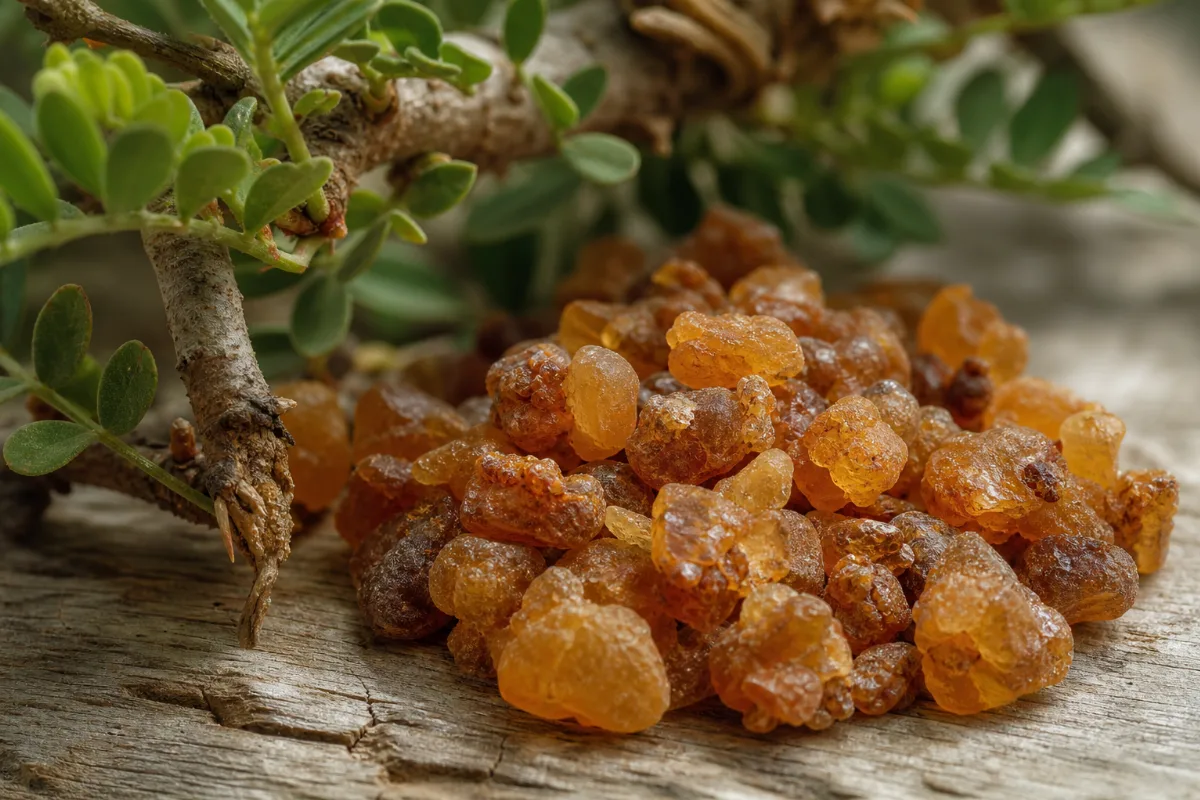
Myrrh is the dried, hardened sap (gum-resin) that seeps from trees of the genus Commiphora, in the family Burseraceae. The EMA names the source plant Commiphora molmol Engler, while research papers more often write Commiphora myrrha (Nees) Engl.; this page uses Commiphora myrrha and treats the two names as the same myrrh. We did not check an independent plant-names database for this, so treat the naming link as reported by the sources, not confirmed by us. [1][4] A review says the tree grows in southern Arabia and north-eastern Africa, including Somalia and Kenya. [4] This page covers the resin and its alcohol extract (tincture) and mouth rinses. For the scented oil see myrrh essential oil; for the related resin see frankincense oil and boswellia.Traditional use (not proof of benefit)
A 2023 review says myrrh has traditionally been used for wounds, mouth ulcers, aches, fractures, stomach disorders, infections and inflammatory diseases, and as an antiseptic and astringent. [4] MSK lists asthma, cough, indigestion and inflammation as purported uses, and says studies are very limited and mostly in animals. [3] The EMA accepted the tincture for minor mouth ulcers and gum inflammation, and for minor wounds and small boils, only as "traditional use": the decision rests on long-standing use, not on clinical trials. [1][2]What research shows
| Use | What the sources found | Strength of evidence | Form and population |
|---|---|---|---|
| Minor mouth ulcers, gum inflammation, minor wounds, small boils | The EMA accepted these on long-standing use rather than trial results. [1][2] | Traditional use only | Tincture; adults and adolescents over 12 |
| Gum disease (plaque, gum inflammation) | A 2026 review of 15 studies (8 trials in people) found a small but statistically significant drop in plaque, while effects on gum inflammation and healing were not significant. The authors call it promising and ask for better trials. [5] | Promising but limited | Mouth rinses and gels; adults |
| Healing after dental implant surgery | In a 35-person trial, a myrrh mouthwash and a chlorhexidine mouthwash did not differ significantly in swelling, pain, bleeding or redness. [6] | Insufficient evidence (small trial, compared with a medicine, no placebo) | Mouthwash; adults |
| Healing of the cut after childbirth (episiotomy) | In a 90-woman trial, sitz baths with myrrh extract scored better on a healing scale than frankincense or povidone-iodine baths. [7] | Promising but limited | Sitz-bath extract; new mothers |
| Clearing tissue after an incomplete miscarriage | In an 80-patient trial, myrrh capsules cleared retained tissue more often than placebo (82.9% vs 54.3%). The authors want more work on its womb-stimulating effect. [8] | Promising but limited (one small trial); this is a medical condition, not for self-treatment | Capsules; women with retained tissue |
| Cough, asthma, indigestion, cancer, diabetes, bowel conditions | MSK reports animal and lab findings and only preliminary data on mixed herbal products; human data are lacking or limited. [3] | Insufficient evidence | Various |
Antibacterial, anti-inflammatory and other effects seen in dishes and animals are not proof of the same effect in people. [4][5] Whether myrrh works better than ordinary mouth care or a standard wound dressing: Proper evidence not found in the sources we read.
Forms and why the form matters
The EU monograph covers only a tincture made with strong alcohol (1 part resin to 5 parts 90% ethanol), used in the mouth or on the skin. [2] The EMA says its conclusions apply to liquid extracts made with solvents such as ethanol, not to other products. [1] Studies on mouthwashes, sitz baths, capsules and essential oil are separate evidence and do not carry over to each other. [5][7][8] Many shop products mix myrrh with other herbs. We give no amounts; ask a pharmacist or clinician.Safety in more detail
- Side effects: the EMA lists allergic skin reactions (frequency unknown), and the alcohol in the tincture may cause brief pain or irritation on skin or mouth lining. [1][2] MSK lists skin redness, swelling, itching and contact dermatitis from topical products, and a delayed skin reaction after swallowing a Chinese medicine decoction containing myrrh. [3]
- Medicines: MSK describes warfarin antagonism from a case report and says myrrh might speed warfarin breakdown in the liver (a suggestion, not proven). [3] A single case report is weak evidence, but anyone on warfarin should ask a pharmacist.
- Heart: MSK says high doses may affect heart rate. [3]
- Pregnancy: see the top of this page. [2][3][8]
- Breastfeeding: the EMA does not recommend use. [2]
- Children: the EMA does not recommend use under 12 because data are lacking. [2]
- Eyes: the EMA advises avoiding eye contact with the tincture. [2]
- Liver and kidney: the sources we read do not report liver or kidney harm from myrrh. NIH's LiverTox page could not be read (the site blocked automated access), so we make no claim either way.
- Quality and contamination: the sources we read do not discuss myrrh adulteration or contamination. For label checks see quality testing and certifications and adulteration and substitution of herbs.
Official statements
- EMA (EU), monograph 2011, summary for the public 2019: traditional herbal medicine for minor mouth ulcers and inflammation and for minor wounds and small boils; ages over 12; see a doctor if symptoms last more than one week or worsen. [1][2]
- EMA (EU), 2024: a call for new scientific data for a periodic review of the myrrh monograph was open; no updated conclusion was found in the sources we read. [1]
- Memorial Sloan Kettering (US), page updated 7 December 2021: advises people on warfarin not to take myrrh and notes limited evidence. [3]
Related pages
Frequently asked questions
What is myrrh used for?
Traditionally for mouth ulcers, wounds and stomach complaints. The EU accepts a tincture for minor mouth ulcers, gum inflammation, minor wounds and small boils on the basis of long use, not trials. [1][2]
Is myrrh safe in pregnancy?
The EMA does not recommend it, since safety has not been established. [2] MSK describes a case of stomach pain in a pregnant woman using large amounts. [3] Ask a midwife or doctor.
Does myrrh interact with warfarin?
MSK advises against taking myrrh with warfarin, citing one case report where warfarin's effect seemed weaker. [3] Tell your pharmacist or prescriber.
Does myrrh mouthwash work for gums?
A 2026 review found a small reduction in plaque but no significant effect on gum inflammation or healing, and called for better trials. [5] It is not shown to replace brushing or dental care.
Can myrrh cause allergic reactions?
Yes. The EMA lists allergic skin reactions, and MSK lists contact dermatitis. [1][3]
References
- European Medicines Agency. Myrrha - herbal medicinal product (summary for the public and HMPC documents). Read 2026-10-23.
- European Medicines Agency, HMPC. Community herbal monograph on Commiphora molmol Engler, gummi-resina (EMA/HMPC/96911/2010), final 12 July 2011. Read 2026-10-23 (text extracted from the PDF; the interactions line was only partly legible, so it is not cited).
- Memorial Sloan Kettering Cancer Center. Myrrh (Commiphora molmol). Page last updated 7 December 2021. Read 2026-10-23.
- Commiphora myrrh: a phytochemical and pharmacological update. 2023. PMID 36399185 (abstract read via Europe PMC). Read 2026-10-23.
- Myrrh in the Management of Periodontal Disease and Gingival Healing: A Systematic Review and Meta-Analysis. J Int Soc Prev Community Dent, 2026. PMID 42004991 (abstract read via Europe PMC). Read 2026-10-23.
- Evaluating Soft Tissue Healing after Implant Placement Using Two Different Mouthwashes (Myrrh and Chlorhexidine Gluconate): A Randomized Control Trial. Medicina, 2022. PMID 36295512 (abstract). Read 2026-10-23.
- Episiotomy wound healing by Commiphora myrrha and Boswellia carteri in primiparous women: A randomized controlled trial. J Ethnopharmacol, 2021. PMID 32971163 (abstract). Read 2026-10-23.
- Efficacy and safety of myrrh in patients with incomplete abortion: a randomized, double-blind, placebo-controlled clinical study. BMC Complement Med Ther, 2020. PMID 32397980 (abstract). Read 2026-10-23.