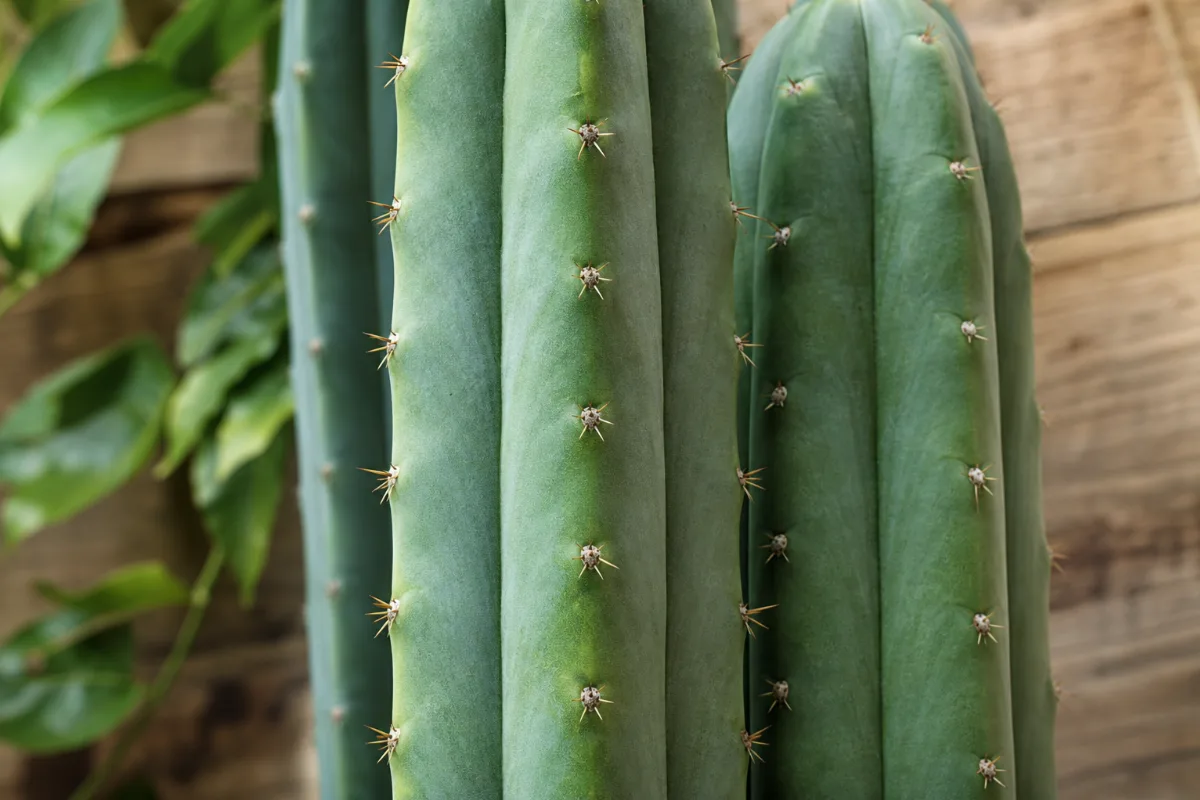
Natural Psychedelics · Cactus
San Pedro Cactus
Echinopsis pachanoi (also written Trichocereus pachanoi) · also called San Pedro, wachuma, huachuma; not the same cactus as peyote
San Pedro is a tall columnar cactus of the Andes. It contains mescaline, a psychedelic that can cause strong hallucinations and psychosis-like states. It has a long place in healing traditions in northern Peru and southern Ecuador. There is no controlled trial of the cactus and no approved medical use. The main cautions are unpredictable strength, mental-health risk and effects on heart rate and blood pressure.
General information, not medical advice. Last substantive update · Not medically reviewed. A named clinician has not signed off on this page. How this page is made
About San Pedro Cactus
San Pedro (Echinopsis pachanoi) is a psychedelic cactus. Its main active compound is mescaline. Research on the cactus is limited to chemical analysis, ethnography and a few reports. Human studies of mescaline used the pure compound, and surveys rely on self-reports. The main risks are unpredictable strength, psychosis-like states and mania in vulnerable people, nausea, and higher blood pressure and heart rate.
What it is
San Pedro is a tall columnar cactus from the Andes. Databases disagree on its accepted name: GBIF lists Trichocereus macrogonus var. pachanoi, while many papers use Echinopsis pachanoi. A catalogue citing Kew gives its native range as southern Ecuador to Peru.
Mescaline is the main active compound. The cactus also contains minor compounds that have not been studied for their effects. San Pedro is not the same as peyote (Lophophora williamsii), which is a different cactus.
Mescaline is covered on its own page. This page is about the plant.
Traditions and respect
In northern Peru, healers (curanderos) have long used San Pedro in healing rites. A review reports archaeological evidence from the Cupisnique, Chavin, Moche and Lambayeque cultures, and present-day 'mesa' healing rites. In southern Ecuador, ten recognised Saraguro healers described it as one of their sacred plants.
In 2022 Peru's Ministry of Culture declared these traditional uses a Cultural Heritage of the Nation. The declaration separates ritual use from recreational use and what it calls 'mystical tourism'.
These practices belong to the peoples who hold them. This page describes them from published sources and does not describe ceremonies. Tradition is not clinical evidence.
What the research shows
No controlled trial of San Pedro in any condition was found. A 2026 systematic review found only 10 usable studies on mescaline and mescaline-containing plants and called the evidence limited and of highly variable quality.
Two online surveys of 452 self-selected users reported that most with depression, anxiety or other conditions said they improved. Two authors are board members of a foundation that supports psychedelic research. A review that was positive about mescaline's safety and benefits was written by authors tied to a company developing mescaline medicines. Treat these as hypotheses.
Controlled trials in healthy volunteers tested pure mescaline in a clinic, not the cactus. They show how mescaline behaves in the body but not that it treats any illness.
Legal and regulatory status
Laws differ by country and change. This is not legal advice.
In the US federal schedule text we read, mescaline is listed in Schedule I and peyote is defined as Lophophora williamsii. The text does not name San Pedro, Echinopsis or Trichocereus. That does not tell you how the cactus is treated, and state laws differ. We did not find a regulator source on whether the living plant may be sold or kept as an ornamental in any particular place. The Native American Church exemption covers peyote only.
In Peru the cactus's traditional use in curanderismo is recognised as cultural heritage. That declaration does not state the legal status of consuming it. We did not read the UN 1971 Convention schedule or INCB text, and did not check other countries.
At a glance
Traditional uses history, not proof
- Used by healers in northern Peru in ritual healing rites (curanderismo); archaeological evidence runs back about 3,500 years (review).
- Listed by Saraguro healers in southern Ecuador among sacred and psychoactive plants (interview study).
- Declared Cultural Heritage of the Nation by Peru's Ministry of Culture in 2022 for its traditional use in curanderismo in northern Peru.
Studied for research
- Mood and well-being (self-reports about mescaline cacti), very low
- Alcohol and drug use problems (self-reports), insufficient
- Spiritual and meaningful experiences (self-reports), very low
- Traditional healing (tradition, not trials), insufficient
- Gut bacteria (one case), insufficient
Main compounds
- Mescaline, the main psychedelic compound
- Minor phenethylamines (lophophine, homopiperonylamine, lobivine), effects untested
Common forms
- Not described on this page by design
Research links: Mescaline safety trial in healthy volunteers (abstract) · Mescaline pharmacokinetics trial (abstract) · Systematic review of mescaline use (abstract) · Mescaline content of San Pedro taxa (abstract) · US Schedule I text (eCFR) · Peru heritage declaration (El Peruano) · Research Library · Genes & Biomarkers Library
The plant and its history
- Accepted scientific name
- Trichocereus macrogonus var. pachanoi (GBIF); often written Echinopsis pachanoi
- Naming authority
- (Britton & Rose) Albesiano & R.Kiesling (GBIF); (Britton & Rose) H.Friedrich & G.D.Rowley for Echinopsis pachanoi
- Synonyms
- Echinopsis pachanoi (Britton & Rose) H.Friedrich & G.D.Rowley; Trichocereus pachanoi Britton & Rose
- Common names
- San Pedro cactus (English); Wachuma / huachuma (Andean (as written in the sources read))
- Botanical family
- Cactaceae (the cactus family)
- Classification
- Plantae > Tracheophyta > Magnoliopsida > Caryophyllales > Cactaceae > Trichocereus (GBIF) or Echinopsis (older and many papers) > Trichocereus macrogonus / Echinopsis pachanoi
- Native range
- South Ecuador to Peru (as given by a catalogue citing Kew/WCVP; sources read describe use in northern Peru and southern Ecuador). Primary Kew/POWO page not read.
- Habitat
- A tall, columnar cactus of the Andes (sources read describe its use in Andean communities). Further habitat detail was not checked.
- What the plant looks like
- Roots: Not checked.; Stems: Tall columnar stem; outer tissue studied for mescaline.; Leaves: Cactus: no true leaves in the sources read.; Flowers: Not checked.; Fruit: Not checked.
- Cultivation
- Not covered on purpose. San Pedro is also grown as an ornamental; this page gives no growing advice.
- Harvest and processing
- Not covered on purpose.
- Look-alikes and adulterants
- Name: Other mescaline-containing columnar cacti (for example Trichocereus peruvianus, T. bridgesii) and peyote; Note: A chemistry review lists wachuma cacti together with peyote as the cacti with high mescaline; peyote is a different cactus (Lophophora williamsii). Identification should not be attempted from this page.
- Sustainability and conservation
- A catalogue citing the IUCN Red List (a 2013 assessment) lists the species as Least Concern. Secondary reports mention concern in Peru; neither was checked in a primary source. CITES status not verified. Conservation of the wild plant and of its cultural use is a concern raised by Andean healers (secondary report; not verified).
Traditional use and history history, not clinical proof
| Tradition or era | Documented use | Source |
|---|---|---|
| Pre-Columbian northern Peru | A review reports archaeological evidence of ritual use of San Pedro in the Cupisnique (about 1500 BC), Chavin (about 1000 BC), Moche (100 to 750 AD) and Lambayeque (750 to 1350 AD) cultures, and describes present-day healing 'mesa' rites in northern Peru. | p16625512 |
| Cacti and mescaline, long history | Archaeological studies in the United States, Mexico and Peru suggest mescaline-containing cacti have been used for more than 6,000 years. Spanish 16th-century chroniclers considered these cacti diabolic, leading to prohibition, but use persisted. | p29847089 |
| Ecuador, Saraguro people | In 2010 to 2011, ten recognised Saraguro healers (yachakkuna) described San Pedro among the sacred and psychoactive plants of their healing system. | p24565054 |
| Modern recognition, Peru | In 2022 Peru's Ministry of Culture declared the traditional knowledge and uses of San Pedro in curanderismo in northern Peru a Cultural Heritage of the Nation. | s-peru-rvm-252 |
| Science of mescaline | Mescaline was isolated from peyote in the late 1800s and its structure was confirmed by synthesis in 1929. | p29847089 |
Traditional use shows how a plant was used. It does not show that a supplement works or is safe today.
What is inside, and how it may work
What the plant contains and how those compounds act in cells and animals. Laboratory and animal mechanisms are not proven effects in people.
Main compounds
| Compound | Family | Where it is concentrated | Activity studied | Level of evidence |
|---|---|---|---|---|
| Mescaline (3,4,5-trimethoxyphenethylamine) PubChem 4076 | phenethylamine | Stem tissue (outer stem) Across 14 San Pedro-type taxa/cultivars in one laboratory: 0.053% to 4.7% of dry weight | Serotonin 5-HT2A receptor agonist; also binds 5-HT1A and alpha-2A receptors. Main psychedelic compound. 22 14 6 17 | Human data |
| Lophophine, homopiperonylamine, lobivine | phenethylamines | Cactus tissue Minor constituents | Reported as new minor constituents of peyote and Trichocereus pachanoi; their effects were not tested. 4 | Lab |
Mechanisms, receptors and pathways
| Target or pathway | Gene or receptor | What was found | Level |
|---|---|---|---|
| Serotonin 5-HT2A receptor | HTR2A | Mescaline's main psychedelic effects are mediated by 5-HT2A receptor agonism, as with psilocybin and LSD. Also acts at 5-HT2C, and at alpha-1A/2A noradrenaline and D1/2/3 dopamine receptors in preclinical work. 17 6 7 | Human data |
| Sympathetic (stimulant-like) effects | n/a | A review describes a sympathomimetic pattern. In isolated mouse and human atrial tissue mescaline alone did not increase force of contraction. 7 13 | Lab |
| Brain activity | n/a | In 12 healthy men mescaline produced an acute psychotic state with a higher frontal blood-flow pattern on SPECT. 9 | Human data |
Absorption, metabolism and elimination
- Absorption
- Pure mescaline taken by mouth reached peak blood levels within about 2 hours; effects began at about 1 hour. Oral bioavailability is at least 53%. No study of the cactus itself was found.
- Distribution
- Not given in the abstracts read.
- Metabolism
- Mainly oxidative deamination to 3,4,5-trimethoxyphenylacetic acid (TMPAA).
- Elimination
- Half-life about 3.5 hours; 53% excreted unchanged in urine and 31% as TMPAA over 24 to 30 hours. Effect duration grew with amount absorbed, from about 3 to about 15 hours.
- Bioavailability
- At least 53% (trial of pure mescaline hydrochloride in healthy volunteers).
Isolated compounds versus whole extracts
Controlled human studies used pure mescaline given in a clinic, not San Pedro. The whole cactus has variable mescaline content, other minor compounds, and no controlled human studies, so what is known about pure mescaline cannot be applied directly to the plant.
Nutritional composition
San Pedro is not a food or a nutrient and has no nutritional claim in the sources read.
2 very low certainty4 not enough evidence
What is San Pedro Cactus good for?
What people ask about, and how strong the human evidence is for each. None of it is proven for San Pedro itself, and every row must be read with the safety section.
Benefits, one by one
Each card is a research question, not a promise. Tap a goal to filter. Open a card to see the studies, doses and limits.
Mood, anxiety and well-being
Very low certaintySurveys of people who used mescaline-containing cacti (peyote and San Pedro) found that most of those with depression or anxiety said they felt better afterwards. These are self-reports, not trials. No controlled trial of San Pedro exists.
5 studiesNot applicable. No study tested a San Pedro cactus preparation agains…
Studies, doses and limits
What the trials found
Two online surveys of the same 452 adults found that people with depression, anxiety or PTSD mostly (68 to 86%) said they improved after their most memorable mescaline experience. A systematic review found only 10 usable studies, with reported improvements in depression scales and well-being but highly variable quality. A single-person case report described a large fall in a depression score after a San Pedro ceremony.
Results
Survey: 68 to 86% of respondents with a given condition said they improved. Improvement went with stronger mystical-type and insight experiences (Cohen d 0.7 to 1.5). Case report (one woman): depression score 12 to 2 after a huachuma ceremony.
Effect sizes as reported
Self-reported improvement, no control group.
Why this rating
Self-selected online surveys, one case report, no placebo, no blinding, strong expectancy effects, and no check of what was actually taken. A systematic review of the field calls the literature limited and of highly variable quality.
Form and dose studied
Not applicable. No study tested a San Pedro cactus preparation against a placebo, and amounts are not given here.
Who was studied
English-speaking adults who had used mescaline (mostly cactus or peyote) on their own; one adult in a ceremony.
Limits
People with good experiences are more likely to answer a survey. Cannot show that mescaline caused the change. Not a trial of San Pedro.
Why researchers looked
Interest in mescaline for mental health grew after psilocybin trials. Because San Pedro is one natural source of mescaline, researchers have asked users what they experienced.
Traditional use
In Andean healing, San Pedro is used within curanderismo to diagnose and cleanse illness, which includes spiritual and emotional distress (Peru Ministry of Culture; Saraguro healers study). This is a tradition, not clinical evidence.
Proposed mechanism Pharmacological theory
Mescaline, the main active compound in San Pedro, switches on the 5-HT2A serotonin receptor, which is how classic psychedelics produce their effects (reviews; the cactus itself was not the studied product).
A proposed mechanism does not show that the effect happens in people.
Mescaline can cause intense hallucinations, anxiety, nausea and vomiting, higher blood pressure and heart rate, and psychosis-like states. It is not a treatment. See the Safety tab first.
Alcohol and drug use problems
Not enough evidenceSome surveys report that people with alcohol or drug problems said they improved after mescaline. A review that says mescaline may help with alcoholism comes from authors tied to a company developing mescaline medicines. No trial has tested San Pedro for addiction.
3 studiesNot applicable. No study tested a San Pedro cactus preparation agains…
Studies, doses and limits
What the trials found
In the 452-person survey, most respondents with alcohol or drug use problems said these improved after their most memorable experience. A systematic review lists nicotine dependence and alcohol use among reported improvements. A review by authors linked to Neural Therapeutics says mescaline may help overcome alcoholism.
Results
Survey: most (68 to 86%) of those with a past alcohol or drug use problem reported improvement. No trial numbers.
Effect sizes as reported
Self-report only.
Why this rating
Self-selected surveys and a review by authors with financial ties to a mescaline company. No controlled human trial.
Form and dose studied
Not applicable. No study tested a San Pedro cactus preparation against a placebo, and amounts are not given here.
Who was studied
Adults who used mescaline in naturalistic settings.
Limits
Cannot separate mescaline from setting, ritual, expectancy and other changes in life. Not a trial of San Pedro.
Why researchers looked
Older work with peyote and mescaline in alcohol problems, and the revival of research on psychedelics in addiction, led to this question.
Traditional use
Not described in the sources read.
Proposed mechanism Pharmacological theory
Mescaline, the main active compound in San Pedro, switches on the 5-HT2A serotonin receptor, which is how classic psychedelics produce their effects (reviews; the cactus itself was not the studied product).
A proposed mechanism does not show that the effect happens in people.
Mescaline can cause intense hallucinations, anxiety, nausea and vomiting, higher blood pressure and heart rate, and psychosis-like states. It is not a treatment. See the Safety tab first.
Spiritual and meaningful experiences
Very low certaintyMany people say a mescaline experience was among the most meaningful of their lives. This is a description of experience, not a health benefit, and it can come with distress.
4 studiesNot applicable. No study tested a San Pedro cactus preparation agains…
Studies, doses and limits
What the trials found
In the epidemiology survey of 452 people, 74% used it mainly for spiritual exploration or to connect with nature. In the other survey 35 to 50% rated it among their five most spiritually meaningful experiences. Challenging effects were rated very slight on average.
Results
35 to 50% put it in their top five most meaningful experiences.
Effect sizes as reported
Survey ratings.
Why this rating
Self-selected surveys; ratings of meaning are subjective and are not health outcomes.
Form and dose studied
Not applicable. No study tested a San Pedro cactus preparation against a placebo, and amounts are not given here.
Who was studied
English-speaking adults who had used mescaline.
Limits
People who had difficult experiences may not have taken part. Not a measure of benefit or safety.
Why researchers looked
Spiritual exploration and connection with nature are the main reasons users give.
Traditional use
San Pedro (wachuma, huachuma) has a long ritual role in northern Peru and southern Ecuador. Archaeological evidence cited by a review runs from the Cupisnique (about 1500 BC) through the Chavin, Moche and Lambayeque cultures, and healing rites continue today. See the Identity tab and the cultural notes.
Proposed mechanism Pharmacological theory
Mescaline, the main active compound in San Pedro, switches on the 5-HT2A serotonin receptor, which is how classic psychedelics produce their effects (reviews; the cactus itself was not the studied product).
A proposed mechanism does not show that the effect happens in people.
Mescaline can cause intense hallucinations, anxiety, nausea and vomiting, higher blood pressure and heart rate, and psychosis-like states. It is not a treatment. See the Safety tab first.
Traditional healing in the Andes
Not enough evidenceIn northern Peru and southern Ecuador, healers have used San Pedro for diagnosis and cleansing in ritual. This is living tradition. It has not been tested as a medicine.
3 studiesNot applicable. No study tested a San Pedro cactus preparation agains…
Studies, doses and limits
What the trials found
No clinical study of San Pedro as a treatment was found. The ethnographic and archaeological papers describe practice, not outcomes.
Results
None measured.
Effect sizes as reported
None.
Why this rating
Tradition and ethnography, not clinical trials. The practices belong to the peoples who hold them.
Form and dose studied
Not applicable. No study tested a San Pedro cactus preparation against a placebo, and amounts are not given here.
Who was studied
Healers and communities in northern Peru and southern Ecuador.
Limits
The tradition should not be read as proof that it works as a medicine. Practices differ among peoples and places.
Why researchers looked
Researchers document the practice, and Peru has recognised it as cultural heritage.
Traditional use
Peruvian healers (curanderos) use San Pedro on a ritual table (mesa) to find and treat illness believed to be caused by enchantment or bad luck (review). Saraguro healers (yachakkuna) in Ecuador list it among sacred and psychoactive plants (interview study). In 2022 Peru's Ministry of Culture declared the traditional knowledge and uses of San Pedro in curanderismo in northern Peru a Cultural Heritage of the Nation.
Proposed mechanism Pharmacological theory
Not tested. The tradition's own frame is cultural and spiritual healing, not a drug effect.
A proposed mechanism does not show that the effect happens in people.
Mescaline can cause intense hallucinations, anxiety, nausea and vomiting, higher blood pressure and heart rate, and psychosis-like states. It is not a treatment. See the Safety tab first.
Gut bacteria
Not enough evidenceOne woman's stool samples changed after a San Pedro ceremony, including more of some bacteria that make butyrate. One case cannot show a link.
1 studiesNot applicable. No study tested a San Pedro cactus preparation agains…
Studies, doses and limits
What the trials found
A single-patient case study of separate ayahuasca and huachuma (San Pedro) ceremonies reported shifts in stool bacteria, with more butyrate-producing species, alongside lower depression scores.
Results
Qualitative shifts in bacterial composition in one person.
Effect sizes as reported
None.
Why this rating
One person, no control, no repeat samples to show normal variation.
Form and dose studied
Not applicable. No study tested a San Pedro cactus preparation against a placebo, and amounts are not given here.
Who was studied
One adult.
Limits
Hypothesis-generating only.
Why researchers looked
A hypothesis that psychedelic effects on mood may run partly through gut bacteria.
Traditional use
Not described.
Proposed mechanism Pharmacological theory
The authors suggest a gut-brain route; this is a hypothesis from one case.
A proposed mechanism does not show that the effect happens in people.
Mescaline can cause intense hallucinations, anxiety, nausea and vomiting, higher blood pressure and heart rate, and psychosis-like states. It is not a treatment. See the Safety tab first.
A research model of psychosis (historical)
Not enough evidenceIn 1992 researchers gave pure mescaline to 12 healthy men to study psychosis-like states. This is research, not a benefit for the person taking it.
1 studiesNot applicable. No study tested a San Pedro cactus preparation agains…
Studies, doses and limits
What the trials found
Mescaline caused an acute psychotic state about 3.5 to 4 hours after intake, mainly visual, with lower right-hemisphere function on a face test and a pattern of higher frontal blood flow on SPECT scans.
Results
Psychotic symptoms on standard rating scales in all-male volunteers.
Effect sizes as reported
None.
Why this rating
Small, men only, 1992, pure mescaline and not San Pedro. It shows an effect, not a benefit.
Form and dose studied
Not applicable. No study tested a San Pedro cactus preparation against a placebo, and amounts are not given here.
Who was studied
12 healthy men.
Limits
Not a use for ordinary people.
Why researchers looked
Psychedelics have been used in labs to study how perception and thinking change.
Traditional use
Not applicable.
Proposed mechanism Human experimental theory
Mescaline activates 5-HT2A receptors; the study linked brain-blood-flow changes to psychotic symptoms.
A proposed mechanism does not show that the effect happens in people.
Mescaline can cause intense hallucinations, anxiety, nausea and vomiting, higher blood pressure and heart rate, and psychosis-like states. It is not a treatment. See the Safety tab first.
Connections to the rest of health
How San Pedro Cactus connects to the rest of our health knowledge graph. Every link says what kind of connection it is. A safety link (for example to the liver) is a warning, not a benefit. A study that merely mentions a topic never creates a benefit link.
Explore every connection: goals, body systems, organs, symptoms, genes
A. Wellness goals
| Connected to | Kind of connection | Evidence status | Context | Studies |
|---|---|---|---|---|
| Stress Relaxation | Preliminary mechanism | Very low certainty | Mood, anxiety and well-being: Surveys of people who used mescaline-containing cacti (peyote and San Pedro) found that most of those with depression or anxiety said they felt better afterwards. These are self-reports, not trials. No controlled trial of San Pedro exists. Alcohol and drug use problems: Some surveys report that people with alcohol or drug problems said they improved after mescaline. A review that says mescaline may help with alcoholism comes from authors tied to a company developing mescaline medicines. No trial has tested San Pedro for addiction. | 1 16 15 8 17 |
B. Body systems
| Connected to | Kind of connection | Evidence status | Context | Studies |
|---|---|---|---|---|
| Nervous System | Biological association | Very low certainty | Studied for: Mood, anxiety and well-being Studied for: Alcohol and drug use problems | 1 16 15 8 17 6 5 2 19 9 |
| Digestive System | Biological association | Not enough evidence | Studied for: Gut bacteria | 8 |
C. Body parts and organs
| Connected to | Kind of connection | Evidence status | Context | Studies |
|---|---|---|---|---|
| Heart | Adverse effect or risk | Low certainty | Raised blood pressure and heart rate; no data in heart disease. Preparation or compound: Mescaline (pure, in trials) |
10 18 |
| Brain | Adverse effect or risk | Moderate certainty | Hallucinations and psychosis-like states; may trigger psychosis in vulnerable people. Preparation or compound: Mescaline (pure) |
9 3 |
I. Biomarkers
| Connected to | Kind of connection | Evidence status | Context | Studies |
|---|---|---|---|---|
| Hamilton depression score (HAM-D) | Biological association | Not enough evidence | Measured in trials: lowered. A lab change is not the same as a health benefit. | 8 |
| Self-reported improvement in a psychiatric condition | Biological association | Very low certainty | Measured in trials: raised. A lab change is not the same as a health benefit. | 1 16 |
| Brain blood flow (SPECT) | Biological association | Not enough evidence | Measured in trials: raised. A lab change is not the same as a health benefit. | 9 |
| Butyrate-producing gut bacteria | Biological association | Not enough evidence | Measured in trials: raised. A lab change is not the same as a health benefit. | 8 |
J. Genes, receptors and enzymes
L. Active compounds
| Connected to | Kind of connection | Evidence status | Context | Studies |
|---|---|---|---|---|
| Mescaline (3,4,5-trimethoxyphenethylamine) | Biological association | Human | Serotonin 5-HT2A receptor agonist; also binds 5-HT1A and alpha-2A receptors. Main psychedelic compound. Preparation or compound: Stem tissue (outer stem) |
22 14 6 17 |
| Lophophine, homopiperonylamine, lobivine | Biological association | Lab | Reported as new minor constituents of peyote and Trichocereus pachanoi; their effects were not tested. Preparation or compound: Cactus tissue |
4 |
Each connection is stored with the ingredient, the connected record, the kind of connection, the evidence status, the supporting studies, the preparation or compound involved, and a review date (last reviewed October 25, 2026).
Evidence at a glance: what changed in 4 lab markers
Tap a number to show only those markers. Counts are markers, not people.
The evidence
The research centre for San Pedro Cactus. Every record here was checked against PubMed or the publisher's page; we never list a study we have not verified.
Evidence by outcome
Bars show how many studies we found for each outcome, not how well it works. People are added up across trials only (reviews are not added, to avoid double counting).
How we rate evidence
High certainty
Several well-run trials or reviews agree; further research is unlikely to change the picture much.
Moderate certainty
Good trials point the same way, but some doubt remains.
Low certainty
Small, short or inconsistent trials. The finding could change with better research.
Very low certainty
Very little or very weak human data. Treat as a possibility only.
Mixed findings
Trials or reviews disagree with each other.
Not enough evidence
Not enough human research to say either way.
Evidence against
Good research found no benefit, or found harm.
We take the reviewers' own risk-of-bias and GRADE statements where they exist, and otherwise judge from study size, design, consistency, directness and whether a product matches what is sold. Many publications do not make evidence high. Method note: We searched PubMed and read the abstracts of 16 papers, read the US eCFR schedule and Native American Church text, the Peru Ministry of Culture resolution and the US Poison Help page, and checked the plant name in the GBIF API and mescaline in PubChem. Only abstracts were read for papers. Certainty ratings are the compiler's own reading.
Study library: every study we checked 25
| Study | Design | People | Product, dose, length | Result |
|---|---|---|---|---|
| Agin-Liebes 2021 Naturalistic Use of Mescaline Is Associated with Self-Reported Psychiatric Improvements and Enduring Positive Life Changes. ACS Pharmacology & Translational Science · PMID 33860184 · DOI |
Survey |
452 452 English-speaking adults who had used mescaline-containing cacti or peyote in non-clinical settings; online anonymous questionnaire |
Mescaline in naturalistic settings (cactus or peyote; product not verified) n/a Not reported here n/a · vs n/a |
Of respondents who reported each condition, 68 to 86% said they improved after their most memorable mescaline experience. Improvement was linked to higher ratings of mystical-type, insight and ego-dissolution effects (Cohen d 0.7 to 1.5). 35 to 50% rated it among their most meaningful life experiences. The authors say controlled longitudinal trials are needed. Methods, limits and fundingOutcomes: Self-reported change in depression, anxiety, PTSD, alcohol and drug use problems after the most memorable experience Limitations: Self-selected online sample, recall of a past experience, no control group, no diagnosis check, people who had good experiences are more likely to respond. Cannot show mescaline caused the change. Funding and conflicts: Two authors are board members of the Source Research Foundation, which the authors say was not involved in the study. Read: abstract |
| Armijos 2014 Traditional medicine applied by the Saraguro yachakkuna: a preliminary approach to the use of sacred and psychoactive plant species in the southern region of Ecuador. Journal of Ethnobiology and Ethnomedicine · PMID 24565054 · DOI |
Ethnography |
10 Ten recognised healers (yachakkuna) of the Saraguro people, Ecuador, interviewed 2010-2011 under an agreement with the Saraguro Healers Council |
San Pedro cactus (Echinopsis pachanoi) as used by the healers n/a Not reported here n/a · vs n/a |
Reports the San Pedro cactus among the sacred and medicinal psychoactive plants used by the Saraguro healers, alongside wandug (Brugmansia) and tobacco, within limpia and other rituals. The authors describe the system as a cultural expression of an Andean people and their ability to survive as a community. Methods, limits and fundingOutcomes: Documentation of traditional healing practice Limitations: Documents one community through ten interviews; it describes tradition, it is not clinical evidence, and it does not speak for other Andean peoples. Funding and conflicts: Not stated in the abstract. Read: abstract |
| Brar 2026 The intersection between psychedelics and schizophrenia spectrum disorders: Reevaluating risk and therapeutic potential. Journal of Psychopharmacology · PMID 42345450 · DOI |
Review |
Narrative review of psychedelics (classic psychedelics in general) and psychosis | Classic psychedelics in general (not mescaline-specific) n/a Not reported here n/a · vs n/a |
Clinical evidence shows psychedelics can worsen pre-existing psychotic illness and may trigger psychosis in vulnerable people, though the size of the risk is not well measured. Trials exclude people at risk. Methods, limits and fundingOutcomes: Psychosis risk Limitations: Narrative review on psychedelics as a group; not specific to mescaline or cacti. Funding and conflicts: No conflict declared. Read: abstract |
| Bruhn 2008 Ecstasy analogues found in cacti. Journal of Psychoactive Drugs · PMID 18720674 · DOI |
Lab lab |
Chemical analysis of Lophophora williamsii and Trichocereus pachanoi | Plant material n/a Not reported here n/a · vs n/a |
Lophophine, homopiperonylamine and lobivine were reported as new minor constituents of peyote and Trichocereus pachanoi (San Pedro), the first report of putatively psychoactive phenethylamines besides mescaline in these cacti. Methods, limits and fundingOutcomes: Minor phenethylamine constituents Limitations: Chemical identification only; effects of these minor compounds were not tested here ("putatively"). Funding and conflicts: Not stated in the abstract. Read: abstract |
| Carod-Artal 2006 [Mescaline and the San Pedro cactus ritual: archaeological and ethnographic evidence in northern Peru]. Revista de Neurologia (in Spanish) · PMID 16625512 · DOI |
Review |
Review of ethno-archaeological and ethno-historical evidence from northern Peru | San Pedro cactus in ritual n/a Not reported here n/a · vs n/a |
Reports archaeological evidence of San Pedro use in the Cupisnique (about 1500 BC), Chavin (about 1000 BC), Moche (100 to 750 AD) and Lambayeque (750 to 1350 AD) cultures, and continuity into present-day healing "mesa" rites in northern Peru. Methods, limits and fundingOutcomes: History of ritual use Limitations: Spanish-language review, abstract read only; authors are outside the traditions described. Funding and conflicts: Not stated in the abstract. Read: abstract |
| Cassels 2018 Dark Classics in Chemical Neuroscience: Mescaline. ACS Chemical Neuroscience · PMID 29847089 · DOI |
Review |
Historical and pharmacology review of mescaline | Mescaline as a cactus constituent n/a Not reported here n/a · vs n/a |
Archaeological studies in the United States, Mexico and Peru suggest use of mescaline-containing cacti for more than 6,000 years. High mescaline concentrations are found in few cactus species, notably peyote and the South American wachuma (Trichocereus pachanoi, T. peruvianus, T. bridgesii). Spanish 16th-century chroniclers considered the cacti diabolic, leading to prohibition. Effects are mainly through the 5-HT2A receptor; it also binds 5-HT1A and alpha-2A receptors; it is mostly excreted unchanged in urine. Methods, limits and fundingOutcomes: History, chemistry, receptor pharmacology Limitations: Review; the archaeological dating is summarised, not re-examined here. Funding and conflicts: Not stated in the abstract. Read: abstract |
| Dinis-Oliveira 2019 Pharmacokinetic and Pharmacodynamic Aspects of Peyote and Mescaline: Clinical and Forensic Repercussions. Current Molecular Pharmacology · PMID 30318013 · DOI |
Review |
Narrative review of the pharmacology of mescaline | Mescaline (mainly peyote cactus) n/a Not reported here n/a · vs n/a |
Acts mainly through 5-HT2A-C receptors; effects include euphoria, hallucinations, depersonalisation and psychoses; a sympathomimetic (stimulant-like) pattern is described. Main metabolite is trimethoxyphenylacetic acid by oxidative deamination. Most reports lacked confirmation of exposure. Addiction and dependence are practically absent and most intoxications appear mild. Methods, limits and fundingOutcomes: Pharmacokinetics, pharmacodynamics, intoxication Limitations: Narrative review; most underlying reports had no toxicology confirmation; about peyote rather than San Pedro. Funding and conflicts: Not stated in the abstract. Read: abstract |
| Follestad 2025 Gut-Mind Interactions in Psychedelic Healing: A Case Study Assessing the Effects of Huachuma and Ayahuasca on the Mind and Microbiome. Journal of Restorative Medicine · PMID 41647444 · DOI |
Case report |
1 One 35-year-old woman with prior psychedelic experience, separate ayahuasca and huachuma (San Pedro) ceremonies |
San Pedro (huachuma) ceremony and a separate ayahuasca ceremony; product and amount not described in the abstract n/a Not reported here n/a · vs n/a |
After the huachuma ceremony the HAM-D score fell from 12 to 2 and the connectedness score rose from 58.32% to 84.65%; stool tests showed shifts in bacteria, including more butyrate-producing species. The authors call it hypothesis-generating. Methods, limits and fundingOutcomes: Hamilton depression score, connectedness scale, stool microbiome Limitations: One person, no control, no blinding, expectancy likely, short follow-up. Cannot show cause. Funding and conflicts: Not stated in the abstract. Read: abstract |
| Hermle 1992 Mescaline-induced psychopathological, neuropsychological, and neurometabolic effects in normal subjects: experimental psychosis as a tool for psychiatric research. Biological Psychiatry · PMID 1467389 · DOI |
Experimental |
12 12 healthy male volunteers |
Mescaline (pure compound) n/a Not reported here n/a · vs n/a |
Mescaline produced an acute psychotic state about 3.5 to 4 hours after intake on psychiatric rating scales, mainly visual effects, reduced right-hemisphere function on a face task and a "hyperfrontal" brain blood-flow pattern linked to the psychotic symptoms. Methods, limits and fundingOutcomes: Psychotic symptoms, neuropsychological tests, brain blood flow (SPECT) Limitations: Small, men only, 1992; used as a research model, not a treatment. Funding and conflicts: Not stated in the abstract. Read: abstract |
| Klaiber 2024 Safety pharmacology of acute mescaline administration in healthy participants. British Journal of Clinical Pharmacology · PMID 39587436 · DOI |
Controlled trial |
48 48 healthy participants, 96 administrations, in two double-blind placebo-controlled studies at University Hospital Basel |
Pure mescaline taken by mouth in a clinical research unit (not a cactus) n/a Not reported here n/a · vs n/a |
Positive subjective effects rose with the amount taken and exceeded negative effects. Systolic blood pressure stayed below 180 mmHg; diastolic above 100 mmHg occurred in 6% of administrations, heart rate above 100 in 3%, temperature above 38 C in 5%. Nausea was the limiting side effect. Liver, kidney and blood counts stayed normal. "Flashbacks" were reported after 2% of administrations. The authors conclude single doses were safe in a controlled clinical setting in healthy participants. Methods, limits and fundingOutcomes: Subjective and autonomic effects, adverse effects, liver, kidney, blood counts, flashbacks Limitations: Healthy, screened volunteers in a supervised setting; single doses; short follow-up; not a cactus; says nothing about people with heart or mental illness, or unsupervised use. COI not in the abstract. Funding and conflicts: Not stated in the abstract (the sister pharmacokinetic paper reports support from Mind Medicine, Inc.). Read: abstract |
| Lin 2023 Natural or artificial: An example of topographic spatial distribution analysis of mescaline in cactus plants by MALDI mass spectrometry imaging. Frontiers in Plant Science · PMID 36844095 · DOI |
Lab lab |
Trichocereus pachanoi and Lophophora williamsii plants and flowers | Plant tissue imaging stem and flower Not reported here n/a · vs n/a |
Mescaline was concentrated in the growing tips (meristems), outer tissue (epidermis) and protruding parts in natural plants; the pattern differed from artificially spiked material. Methods, limits and fundingOutcomes: Where mescaline sits in the plant Limitations: Forensic method study; shows distribution in the plant, not effects. Funding and conflicts: No commercial or financial relationships declared. Read: abstract |
| Mueller 2025 Pharmacokinetics, Pharmacodynamics, and Urinary Recovery of Oral Mescaline Hydrochloride in Healthy Participants. Clinical Pharmacokinetics · PMID 40658345 · DOI |
Controlled trial |
49 49 healthy participants, 105 administrations, from two phase I trials |
Oral mescaline hydrochloride (pure compound) n/a Not reported here n/a · vs n/a |
Peak blood level within about 2 hours, half-life 3.5 hours, onset of any effect about 1 hour, effect duration from about 2.8 hours at the lowest group to 15 hours at the highest. 53% was excreted unchanged in urine and 31% as the main metabolite over 24 to 30 hours. Oral bioavailability at least 53%. Methods, limits and fundingOutcomes: Blood levels, onset and duration of effects, urine recovery Limitations: Healthy volunteers, pure compound, not a cactus; plant content and absorption could differ. Funding and conflicts: Supported by the Swiss National Science Foundation, University Hospital Basel and Mind Medicine, Inc., which licensed the data; the senior author consults for Mind Medicine. Registration: NCT04227756; NCT04849013 Read: abstract |
| Neumann 2023 Cardiac effects of ephedrine, norephedrine, mescaline, and 3,4-methylenedioxymethamphetamine (MDMA) in mouse and human atrial preparations. Naunyn-Schmiedeberg's Archives of Pharmacology · PMID 36319858 · DOI |
Lab lab |
Isolated mouse and human right-atrial tissue from heart surgery | Mescaline applied to isolated tissue n/a Not reported here n/a · vs n/a |
Ephedrine, norephedrine and MDMA raised force of contraction; mescaline alone did not in mouse or human atrial tissue. Methods, limits and fundingOutcomes: Force of contraction and beating rate Limitations: Isolated tissue in a dish; does not show what happens in a living person. Funding and conflicts: No competing interests declared. Read: abstract |
| Ogunbodede 2010 New mescaline concentrations from 14 taxa/cultivars of Echinopsis spp. (Cactaceae) ("San Pedro") and their relevance to shamanic practice. Journal of Ethnopharmacology · PMID 20637277 · DOI |
Lab lab |
14 Vegetative clones of 14 San Pedro-type taxa/cultivars of known origin |
Cactus stem tissue (cortical chlorenchyma) stem Not reported here n/a · vs n/a |
Every taxon had mescaline. Concentrations spanned two orders of magnitude, from 0.053% to 4.7% of dry weight. The highest, particularly E. pachanoi from Peru, matched the plants most associated with documented shamanic use. Methods, limits and fundingOutcomes: Mescaline concentration by HPLC Limitations: Cloned plants in one laboratory, one sample per taxon; not a typical strength for any wild or garden plant. Funding and conflicts: Not stated in the abstract. Read: abstract |
| Shaw 2026 The Ethnopharmacological Use of Mescaline for Psychiatric Disorders: A Systematic Review. International Journal of Molecular Sciences · PMID 41977267 · DOI |
Systematic review |
Of 2,770 references found, 66 met inclusion and only 10 were suitable for analysis (studies on mescaline and mescaline-containing plants such as Peyote and San Pedro) | Mescaline and mescaline-containing ethnobotanicals n/a Not reported here n/a · vs n/a |
Studies reported improvements in depression scales, well-being, nicotine dependence, alcohol use and obsessions. Reported adverse effects included hypertension, headache, nausea and vomiting. The authors call the literature limited and of highly variable quality and say no definite conclusions can be drawn. Methods, limits and fundingOutcomes: Reported therapeutic effects and adverse effects Limitations: Only 10 studies analysed, mixed designs and quality, includes older and uncontrolled reports. Funding and conflicts: The authors declare no conflicts of interest. Read: abstract |
| Uthaug 2022 The epidemiology of mescaline use: Pattern of use, motivations for consumption, and perceived consequences, benefits, and acute and enduring subjective effects. Journal of Psychopharmacology · PMID 33949246 · DOI |
Survey |
452 452 English-speaking adults reporting past mescaline use (web survey) |
Mescaline from cacti including Peyote and San Pedro (types self-reported) n/a Not reported here n/a · vs n/a |
Most used infrequently (once a year or less), mainly for spiritual exploration or connection with nature (74%). 9% reported craving or desire; 1% reported legal and 1% psychological problems; none reported seeking medical attention. About half reported a psychiatric condition and over 67% of those reported improvement after their most memorable experience. Most said Peyote and San Pedro were their most memorable source. Intensity of effects did not differ between mescaline types. Methods, limits and fundingOutcomes: Patterns of use, motivations, effects, problems reported Limitations: Self-selected online sample that reflects people who had positive experiences; people with bad outcomes may not respond; cannot show cause; the actual content of what was consumed is unknown. Funding and conflicts: Three authors are board members of the Source Research Foundation, which the authors say was not involved in the study. Read: abstract |
| Vamvakopoulou 2023 Mescaline: The forgotten psychedelic. Neuropharmacology · PMID 36252614 · DOI |
Review human+animal |
Narrative review of preclinical and clinical mescaline research | Mescaline (mainly from peyote and Echinopsis cacti) n/a Not reported here n/a · vs n/a |
Mescaline is a 5-HT2A/2C serotonin receptor agonist; it also acts at some noradrenaline and dopamine receptors. Animals: anxiolytic-like effects. Humans: euphoria, hallucinations, reported improved well-being and psychotomimetic effects in naturalistic or religious settings. The authors say it appears safe with mostly mild, treatable intoxications and may be useful for alcoholism. Methods, limits and fundingOutcomes: Pharmacology and behavioural effects Limitations: Narrative review, not systematic. Authors are linked to Neural Therapeutics, a company developing mescaline-based treatments, so the optimistic safety and benefit wording should be read with caution. Funding and conflicts: Authors report ties to Neural Therapeutics Inc. (paid intern with shares, consultant paid with shares, employee, board members). Read: abstract |
| Wsol 2023 Cardiovascular safety of psychedelic medicine: current status and future directions. Pharmacological Reports · PMID 37874530 · DOI |
Review human+animal |
Review of experimental and clinical data on psilocybin, LSD, DMT, ayahuasca and mescaline | Several psychedelics including mescaline n/a Not reported here n/a · vs n/a |
Data from trials suggest relative cardiovascular safety in healthy volunteers, but psychedelics show significant sympathomimetic effects, and there is a lack of data in people with cardiovascular disease and for long-term use. Methods, limits and fundingOutcomes: Cardiovascular safety Limitations: Review mixing several substances; mescaline-specific data are limited. Funding and conflicts: No conflict declared. Read: abstract |
| n/a 2022 Peru Ministry of Culture, Resolucion Viceministerial N. 000252-2022-VMPCIC/MC (El Peruano, 17 Nov 2022) n/a · Source |
Regulation n/a |
n/a | n/a n/a n/a n/a · vs n/a |
Declares the knowledge, practices and traditional uses of the San Pedro cactus in curanderismo in northern Peru a Cultural Heritage of the Nation. It excludes use to cause harm, and distinguishes ritual use from recreational use, drug misuse and "mystical tourism". It does not address the legal status of consuming the cactus. Read 2026-10-25. Methods, limits and fundingOutcomes: Declares the knowledge, practices and traditional uses of the San Pedro cactus in curanderismo in northern Peru a Cultural Heritage of the Nation. It excludes use to cause harm, and distinguishes ritual use from recreational use, drug misuse and "mystical tourism". It does not address the legal status of consuming the cactus. Read 2026-10-25. Limitations: A cultural-heritage declaration, not a drug-law ruling. Read: full-text |
| n/a 2026 US eCFR, 21 CFR 1308.11 Schedule I (text version of 2026-10-20) n/a · Source |
Regulation n/a |
n/a | n/a n/a n/a n/a · vs n/a |
Lists mescaline at (d)(24) and peyote at (d)(26). Peyote is defined as all parts of the plant presently classified botanically as Lophophora williamsii Lemaire, and its seeds, extracts and preparations. The text read does not name San Pedro, Echinopsis or Trichocereus. Read 2026-10-25. Methods, limits and fundingOutcomes: Lists mescaline at (d)(24) and peyote at (d)(26). Peyote is defined as all parts of the plant presently classified botanically as Lophophora williamsii Lemaire, and its seeds, extracts and preparations. The text read does not name San Pedro, Echinopsis or Trichocereus. Read 2026-10-25. Limitations: A list of named substances; it does not itself say how the cactus is treated. Read: full-text |
| n/a 2026 US eCFR, 21 CFR 1307.31 Native American Church n/a · Source |
Regulation n/a |
n/a | n/a n/a n/a n/a · vs n/a |
The Schedule I listing does not apply to the nondrug use of peyote in bona fide religious ceremonies of the Native American Church; members are exempt from registration; suppliers must register. Read 2026-10-25. Methods, limits and fundingOutcomes: The Schedule I listing does not apply to the nondrug use of peyote in bona fide religious ceremonies of the Native American Church; members are exempt from registration; suppliers must register. Read 2026-10-25. Limitations: Peyote only. It does not mention San Pedro. Read: full-text |
| n/a 2026 PubChem REST API: Mescaline (CID 4076) n/a · Source |
Database n/a |
n/a | n/a n/a n/a n/a · vs n/a |
PubChem CID 4076; 2-(3,4,5-trimethoxyphenyl)ethanamine; molecular formula C11H17NO3; molecular weight 211.26. Retrieved 2026-10-25. Methods, limits and fundingOutcomes: PubChem CID 4076; 2-(3,4,5-trimethoxyphenyl)ethanamine; molecular formula C11H17NO3; molecular weight 211.26. Retrieved 2026-10-25. Limitations: Identity only. Read: full-text |
| n/a 2026 National Capital Poison Center (poison.org): Poison Help line and webPOISONCONTROL n/a · Source |
Authoritative guidance n/a |
n/a | n/a n/a n/a n/a · vs n/a |
US Poison Help number 1-800-222-1222, free and confidential; online tool at triage.webpoisoncontrol.org; the page says to call 911 for collapse, seizure, trouble breathing or if the person cannot be woken. It also says the centre moved to fully digital service in March 2025. Read 2026-10-25. Methods, limits and fundingOutcomes: US Poison Help number 1-800-222-1222, free and confidential; online tool at triage.webpoisoncontrol.org; the page says to call 911 for collapse, seizure, trouble breathing or if the person cannot be woken. It also says the centre moved to fully digital service in March 2025. Read 2026-10-25. Limitations: US-only. Hours of the phone line were not stated on the page. Read: full-text |
| n/a 2026 GBIF Backbone Taxonomy API: Echinopsis pachanoi and Trichocereus pachanoi (synonyms) -> Trichocereus macrogonus var. pachanoi (key 11093098) n/a · Source |
Database n/a |
n/a | n/a n/a n/a n/a · vs n/a |
GBIF treats Echinopsis pachanoi (key 5622352) and Trichocereus pachanoi (key 7282455) as synonyms of the accepted Trichocereus macrogonus var. pachanoi (Britton & Rose) Albesiano & R.Kiesling, family Cactaceae. Retrieved 2026-10-25. Methods, limits and fundingOutcomes: GBIF treats Echinopsis pachanoi (key 5622352) and Trichocereus pachanoi (key 7282455) as synonyms of the accepted Trichocereus macrogonus var. pachanoi (Britton & Rose) Albesiano & R.Kiesling, family Cactaceae. Retrieved 2026-10-25. Limitations: Another database (Plants of the World Online / WCVP) may treat Echinopsis pachanoi as accepted; POWO could not be read directly (blocked). Read: full-text |
| n/a 2026 Catalogo de Plantas de Colombia (colplanta.org): Echinopsis pachanoi, citing Kew/WCVP and the IUCN Red List n/a · Source |
Database n/a |
n/a | n/a n/a n/a n/a · vs n/a |
Page says the species is accepted as Echinopsis pachanoi, native range South Ecuador to Peru (Kew Science / WCVP) and Least Concern on the IUCN Red List. Read 2026-10-25. Methods, limits and fundingOutcomes: Page says the species is accepted as Echinopsis pachanoi, native range South Ecuador to Peru (Kew Science / WCVP) and Least Concern on the IUCN Red List. Read 2026-10-25. Limitations: Secondary catalogue repeating Kew and IUCN; the IUCN assessment it cites is from 2013 and the primary IUCN and Kew pages were not read. The two databases (GBIF and WCVP) disagree on the accepted name. Read: full-text |
What we do not know yet
- No controlled trial of San Pedro cactus for any condition.
- Mescaline research is small, old or survey-based; surveys are self-selected and some authors have industry ties.
- Strength varies widely and cannot be known without a lab.
- No data on heart disease, pregnancy, breastfeeding, children or drug interactions.
- Legal status for the living plant, other countries and US states was not checked; UN and INCB text was not read.
How new research is added
New studies are found by a saved PubMed search and placed in a review queue. A person reads each one before it is added.
Lab markers
What changed in blood or saliva tests during trials. A changed number is not the same as feeling or being healthier, and we give no "normal ranges".
Other 4
Hamilton depression score (HAM-D)
Lowered in trials
A clinician-rated checklist of depression symptoms. Lower scores mean fewer symptoms.
Not enough evidenceResults and what it means
Why it was measured
To track change in depression after a San Pedro ceremony in one case report.
Statistical vs. clinical meaning
One person, no control, no blinding; cannot show cause.
Safety implication
Not applicable to a single case.
| Study | Result | People | Product |
|---|---|---|---|
| 8 | Fell from 12 to 2 after the huachuma (San Pedro) ceremony in one woman. | One 35-year-old woman | One San Pedro ceremony (product and amount not given in the abstract) |
Self-reported improvement in a psychiatric condition
Raised in trials
Whether a respondent says their depression, anxiety, PTSD or alcohol or drug problem got better after their most memorable mescaline experience.
Very low certaintyResults and what it means
Why it was measured
To learn what users believe happened.
Statistical vs. clinical meaning
Subjective, remembered, unverified.
Safety implication
Does not show safety.
| Study | Result | People | Product |
|---|---|---|---|
| 1 | 68 to 86% of respondents with each condition reported improvement. | 452 adults, anonymous online survey | Naturalistic mescaline use (cacti or peyote) |
Brain blood flow (SPECT)
Raised in trials
A scan that shows which brain areas get more blood.
Not enough evidenceResults and what it means
Why it was measured
To see how mescaline changes brain activity.
Statistical vs. clinical meaning
Small 1992 study; a research finding.
Safety implication
Shows a strong effect on the brain.
| Study | Result | People | Product |
|---|---|---|---|
| 9 | A 'hyperfrontal' pattern, stronger on the right, matched psychotic symptoms. | 12 healthy men | Pure mescaline in a lab |
Butyrate-producing gut bacteria
Raised in trials
Gut bacteria that make butyrate, a fatty acid linked to gut health.
Not enough evidenceSafety
What studies and official sources say about side effects, medicines and who should check first. Each point shows what kind of evidence it comes from.
Main points to know 8
- A powerful psychedelic: intense and unpredictable effects. San Pedro contains mescaline. In people it can cause euphoria, hallucinations, loss of the normal sense of self, and psychosis-like states (reviews; a 1992 lab study of pure mescaline produced an acute psychotic state in 12 healthy men). Effects can last many hours: in one trial of pure mescaline, effects lasted from under 3 hours to about 15 hours depending on the amount absorbed. Review 7 9 12 17
- Psychosis and mania risk. Psychedelics can worsen existing psychotic illness and may trigger psychosis in vulnerable people. How big the risk is has not been well measured. Modern psychedelic trials exclude people at risk. This review covers classic psychedelics as a group, not mescaline or cacti alone. Review 3
- Nausea, vomiting, blood pressure and heart rate. In a supervised trial of pure mescaline in healthy volunteers nausea was the side effect that limited use. Diastolic blood pressure above 100 mmHg occurred in 6% of administrations and heart rate above 100 in 3%. A systematic review lists hypertension, headache, nausea and vomiting as frequently reported. Reviews describe a stimulant-like (sympathomimetic) pattern. Controlled trial 10 15 7
- Heart disease: unknown. Reviews say there are no safety data for psychedelics in people with heart disease, and long-term cardiovascular safety is unknown. In isolated heart tissue mescaline itself did not raise force of contraction, but that is a dish experiment and does not show what happens in a person. Review 18 13
- Strength varies widely from plant to plant. Mescaline content in San Pedro-type cacti ranged about ninety-fold across 14 lab-grown taxa and cultivars (0.053% to 4.7% of dry weight in one laboratory), and within a single plant it is unevenly spread. Nobody can tell the strength of a plant by looking at it, and the lab figures say nothing about effects. This is one reason cactus experiences are unpredictable. Lab 14 11
- Not a medicine and not proven to treat anything. No regulator has approved San Pedro for any condition, and no controlled trial of the cactus was found. Survey reports of benefit are self-reported and uncontrolled. Review 15
- Other, little-studied compounds. San Pedro also contains minor phenethylamines (lophophine, homopiperonylamine, lobivine) whose effects were not tested. A full safety profile of the whole plant does not exist. Lab 4
- Dependence appears low. Reviews and a survey report little craving or addiction with mescaline: practically absent in one review, and 9% of survey respondents reported craving or desire. This does not make it safe. Review 7 16
Side effects 7
| Effect | How often | Severity and recovery | Evidence |
|---|---|---|---|
| Nausea and vomiting Also listed by a systematic review of mescaline and mescaline-containing plants. | Dose-limiting in the Basel trial; no rate given in the abstract | moderate Reversible | Controlled trial 10 15 |
| Raised blood pressure and heart rate People with heart disease were not studied. | Diastolic BP above 100 mmHg in 6% and heart rate above 100 in 3% of administrations in healthy volunteers | moderate Reversible in the trial | Controlled trial 10 |
| Hallucinations and psychosis-like states Visual effects mainly. | Common as the main effect; psychotic state in all 12 volunteers in a 1992 study | severe Usually resolves as effects wear off; lasting problems are reported for psychedelics in vulnerable people | Experimental 9 3 |
| Headache | Listed among frequent effects in a systematic review | mild Reversible | Systematic review 15 |
| Raised body temperature | 5% of administrations above 38 C in the Basel trial | mild Reversible | Controlled trial 10 |
| 'Flashbacks' Follow-up was short. | About 2% of administrations in the Basel trial | mild to moderate Not fully described in the abstract | Controlled trial 10 |
| Anxiety and challenging experiences A survey of people who chose to respond; people with bad outcomes may be missing. | Rated very slight on average in a survey of self-selected users; none sought medical help | variable Not described | Survey 16 |
Liver
In the Basel trial of pure mescaline in 48 healthy participants, liver and kidney function and blood counts stayed normal after single doses. No case reports of liver injury from San Pedro were found in the sources read. Long-term and repeated use were not studied. 10
How often. No rate can be given.
Monitoring. No monitoring advice from a regulator was read.
This is a safety connection. It is not evidence that San Pedro Cactus supports liver health.
Medicines and supplements 5
| With | Why it matters | Importance | Evidence | What to do |
|---|---|---|---|---|
| Other stimulants (amphetamines, cocaine, caffeine in large amounts, decongestants) pharmacodynamic | Mescaline has a stimulant-like (sympathomimetic) pattern, so effects on heart rate and blood pressure may add up. | Plausible but not studied together in the sources read. | Pharmacological theory Very low certainty 7 | Ask a pharmacist or doctor before combining anything with a psychedelic. |
| Medicines that act on serotonin (antidepressants, lithium, triptans and others) pharmacodynamic | Mescaline acts on serotonin receptors. Interactions with SSRIs and other medicines have not been specifically established for mescaline in the sources read; see the guide on serotonergic medicines and substance-specific evidence. | Not established for mescaline or San Pedro; not read. | Not studied Not enough evidence | Never stop a prescribed medicine on your own. Ask the prescriber. |
| Antipsychotics and medicines for bipolar disorder clinical | People with psychosis or bipolar disorder are excluded from modern psychedelic trials, and the review says psychedelics can trigger or worsen psychosis. | Risk is in the underlying condition, not in a studied drug pair. | Review Low certainty 3 | Ask a doctor; this is a reason many people with these conditions are advised to avoid psychedelics. |
| Alcohol and other sedatives or drugs clinical | Combined effects of mescaline with alcohol or other drugs were not found in the sources read. | Unknown. | Not studied Not enough evidence | Mixing intoxicating substances adds unpredictable risk. |
| Blood-pressure and heart medicines clinical | Mescaline raised blood pressure and heart rate in healthy volunteers; effects in people on heart medicines were not studied. | Unknown. | Not studied Not enough evidence 10 18 | Ask a doctor or pharmacist. |
Who should check first 5
| Situation | Advice | Evidence |
|---|---|---|
| Psychosis, schizophrenia, bipolar disorder, or a close family history | Psychedelics can trigger or worsen psychosis and mania in vulnerable people; trials exclude these people. Talk to a doctor. | Review 3 |
| Heart disease or high blood pressure | Mescaline raises blood pressure and heart rate and there are no safety data in people with heart disease. Talk to a doctor. | Controlled trial 10 18 |
| Pregnancy and breastfeeding | No human safety data were found in the sources read. This is not evidence of safety. Talk to a doctor. | Not studied |
| Driving, machinery, work | Effects last many hours (up to about 15 in a trial of pure mescaline), so thinking and perception can be affected for a long time. No driving study was read. | Controlled trial 12 |
| Children and teenagers | A review notes illicit mescaline use has been described in adolescents and young adults; no safety data for young people were found. | Review 7 |
Overdose, product quality and regulators
Summary. Most mescaline intoxications described in a review were mild and unlikely to be life-threatening, but most reports had no lab confirmation of what was taken. The whole San Pedro plant (with its other alkaloids) has not been studied for toxicity in people.
Animal. Not reviewed in depth for this profile.
Human doses studied. Not given here. Controlled trials used pure mescaline hydrochloride in healthy volunteers, not cactus.
High dose or long term signals. Not established. A systematic review calls the safety literature limited.
Overdose response. No source read gives treatment steps for a cactus poisoning. Seek emergency care.
Genotoxicity. Not read.
Toxic plant parts. Mescaline is found in the stem tissue; it is concentrated in growing tips and outer tissue. Other parts were not compared for safety in the sources read.
No study of contamination or label accuracy in San Pedro products was found. Mescaline content differs widely between plants, and unregulated plant material has no quality control.
Variable mescaline content. 0.053% to 4.7% of dry weight across 14 taxa/cultivars in one laboratory; uneven distribution within a plant. 14 11
| Body | Action | Date |
|---|---|---|
| US Drug Enforcement Administration / eCFR (21 CFR 1308.11) (United States) | Lists mescaline in Schedule I (d)(24). Peyote is defined as Lophophora williamsii only. The text read does not name San Pedro, Echinopsis or Trichocereus. The schedule text alone does not tell you how the whole cactus is treated by federal or state law; laws differ by state and change. source | 2026-10-20 |
| US eCFR (21 CFR 1307.31) (United States) | The Native American Church exemption applies to the nondrug use of peyote in bona fide religious ceremonies. The text read does not mention San Pedro. source | 2026-10-20 |
| Peru, Ministry of Culture (Peru) | Declared the traditional knowledge, practices and uses of the San Pedro cactus in curanderismo in northern Peru a Cultural Heritage of the Nation (Resolucion Viceministerial 000252-2022-VMPCIC/MC). It excludes use to cause harm and separates ritual use from recreational use and 'mystical tourism'. It does not state the legal status of consuming the cactus. source | 2022-11-17 |
When to get medical help
- Trouble breathing, chest pain, seizure, collapse, or cannot be woken: call emergency services now (911 in the US).
- Severe confusion, agitation, hallucinations that do not settle, or thoughts of harming yourself or others: call emergency services or a crisis line.
- Poisoning question in the US: Poison Help 1-800-222-1222 (free, confidential) or triage.webpoisoncontrol.org (poison.org). Outside the US use your local emergency number or poison centre.
- Never leave a very intoxicated person alone.
If someone may be poisoned or in a crisis, contact a clinician or emergency service straight away. In the US, Poison Control is 1-800-222-1222.
General information only, not medical advice. Ask a clinician or pharmacist before use, especially with medicines, in pregnancy or with a health condition. See the Natural Remedy Safety guide.
Frequently asked questions
What is San Pedro cactus?
Is San Pedro the same as peyote?
What does the research show?
Does San Pedro treat depression, anxiety or addiction?
No treatment claim can be made. A 2026 systematic review found only 10 usable studies and said no firm conclusions can be drawn. Talk to a doctor about any mental-health concern.
What are the main risks?
Is it addictive?
Why is the strength so unpredictable?
How long do the effects last?
In a trial of pure mescaline in healthy volunteers, effects began after about 1 hour and lasted from under 3 to about 15 hours depending on how much was absorbed. The cactus itself was not studied.
Is it legal?
It depends on where you live and laws change. The US federal schedule text names mescaline and peyote but not San Pedro; that does not mean it is permitted. We did not find a regulator source on selling or keeping the living plant as an ornamental. Check your own local law.
What is the Peru heritage declaration?
In 2022 Peru's Ministry of Culture declared the traditional knowledge and uses of San Pedro in curanderismo in northern Peru a Cultural Heritage of the Nation. It separates ritual use from recreational use and does not address legality of consumption.
Can it interact with medicines?
What should I do if someone feels very unwell?
Call emergency services for chest pain, trouble breathing, seizures, extreme agitation or if the person cannot be woken. In the US, Poison Help is 1-800-222-1222.
Explore by health goal
Editorial transparency
- Written by
- AlternativeMed editorial team. Research compiled with AI assistance, then checked against PubMed records.
- Medical review
- None. This page has not been reviewed by a physician or pharmacist.
- First published
- 2026-10-25
- Last substantive update
- 2026-10-25
- How we research
- We searched PubMed and read the abstracts of 16 papers, read the US eCFR schedule and Native American Church text, the Peru Ministry of Culture resolution and the US Poison Help page, and checked the plant name in the GBIF API and mescaline in PubChem. Only abstracts were read for papers. Certainty ratings are the compiler's own reading.
- How we rate evidence
- See "How we rate evidence" in the Evidence tab.
- Independence
- No product is promoted on this page. No affiliate links are shown, and none will be added. This page gives no preparation, growing, sourcing or identification advice.
Sources 25
Each source was opened and checked. Where we read only the abstract, it says so. The small numbers in the text point here.
- Agin-Liebes G, Haas TF, Lancelotta R, et al. Naturalistic Use of Mescaline Is Associated with Self-Reported Psychiatric Improvements and Enduring Positive Life Changes.. ACS Pharmacology & Translational Science. 2021. PMID 33860184. DOI 10.1021/acsptsci.1c00018. (abstract)
- Armijos C, Cota I, Gonzalez S. Traditional medicine applied by the Saraguro yachakkuna: a preliminary approach to the use of sacred and psychoactive plant species in the southern region of Ecuador.. Journal of Ethnobiology and Ethnomedicine. 2014. PMID 24565054. DOI 10.1186/1746-4269-10-26. (abstract)
- Brar PS, Price RB, Ross S, Tofighi B, Sarpal DK. The intersection between psychedelics and schizophrenia spectrum disorders: Reevaluating risk and therapeutic potential.. Journal of Psychopharmacology. 2026. PMID 42345450. DOI 10.1177/02698811261456191. (abstract)
- Bruhn JG, El-Seedi HR, Stephanson N, Beck O, Shulgin AT. Ecstasy analogues found in cacti.. Journal of Psychoactive Drugs. 2008. PMID 18720674. DOI 10.1080/02791072.2008.10400635. (abstract)
- Carod-Artal FJ, Vazquez-Cabrera CB. [Mescaline and the San Pedro cactus ritual: archaeological and ethnographic evidence in northern Peru].. Revista de Neurologia (in Spanish). 2006. PMID 16625512. DOI n/a. (abstract)
- Cassels BK, Saez-Briones P. Dark Classics in Chemical Neuroscience: Mescaline.. ACS Chemical Neuroscience. 2018. PMID 29847089. DOI 10.1021/acschemneuro.8b00215. (abstract)
- Dinis-Oliveira RJ, Pereira CL, da Silva DD. Pharmacokinetic and Pharmacodynamic Aspects of Peyote and Mescaline: Clinical and Forensic Repercussions.. Current Molecular Pharmacology. 2019. PMID 30318013. DOI 10.2174/1874467211666181010154139. (abstract)
- Follestad P, Filbin P, Thompson B, et al. Gut-Mind Interactions in Psychedelic Healing: A Case Study Assessing the Effects of Huachuma and Ayahuasca on the Mind and Microbiome.. Journal of Restorative Medicine. 2025. PMID 41647444. DOI 10.14200/jrm.2025.0006. (abstract)
- Hermle L, Funfgeld M, Oepen G, et al. Mescaline-induced psychopathological, neuropsychological, and neurometabolic effects in normal subjects: experimental psychosis as a tool for psychiatric research.. Biological Psychiatry. 1992. PMID 1467389. DOI 10.1016/0006-3223(92)90059-9. (abstract)
- Klaiber A, Humbert-Droz M, Ley L, Schmid Y, Liechti ME. Safety pharmacology of acute mescaline administration in healthy participants.. British Journal of Clinical Pharmacology. 2024. PMID 39587436. DOI 10.1111/bcp.16349. (abstract)
- Lin J, Yang S, Ji J, Xiang P, Wu L, Chen H. Natural or artificial: An example of topographic spatial distribution analysis of mescaline in cactus plants by MALDI mass spectrometry imaging.. Frontiers in Plant Science. 2023. PMID 36844095. DOI 10.3389/fpls.2023.1066595. (abstract)
- Mueller L, Klaiber A, Ley L, et al. Pharmacokinetics, Pharmacodynamics, and Urinary Recovery of Oral Mescaline Hydrochloride in Healthy Participants.. Clinical Pharmacokinetics. 2025. PMID 40658345. DOI 10.1007/s40262-025-01544-x. (abstract)
- Neumann J, Azatsian K, Hohm C, et al. Cardiac effects of ephedrine, norephedrine, mescaline, and 3,4-methylenedioxymethamphetamine (MDMA) in mouse and human atrial preparations.. Naunyn-Schmiedeberg's Archives of Pharmacology. 2023. PMID 36319858. DOI 10.1007/s00210-022-02315-2. (abstract)
- Ogunbodede O, McCombs D, Trout K, Daley P, Terry M. New mescaline concentrations from 14 taxa/cultivars of Echinopsis spp. (Cactaceae) ("San Pedro") and their relevance to shamanic practice.. Journal of Ethnopharmacology. 2010. PMID 20637277. DOI 10.1016/j.jep.2010.07.021. (abstract)
- Shaw J, Yong A, Lee J, et al. The Ethnopharmacological Use of Mescaline for Psychiatric Disorders: A Systematic Review.. International Journal of Molecular Sciences. 2026. PMID 41977267. DOI 10.3390/ijms27073081. (abstract)
- Uthaug MV, Davis AK, Haas TF, et al. The epidemiology of mescaline use: Pattern of use, motivations for consumption, and perceived consequences, benefits, and acute and enduring subjective effects.. Journal of Psychopharmacology. 2022. PMID 33949246. DOI 10.1177/02698811211013583. (abstract)
- Vamvakopoulou IA, Narine KAD, Campbell I, Dyck JRB, Nutt DJ. Mescaline: The forgotten psychedelic.. Neuropharmacology. 2023. PMID 36252614. DOI 10.1016/j.neuropharm.2022.109294. (abstract)
- Wsol A. Cardiovascular safety of psychedelic medicine: current status and future directions.. Pharmacological Reports. 2023. PMID 37874530. DOI 10.1007/s43440-023-00539-4. (abstract)
- n/a. Peru Ministry of Culture, Resolucion Viceministerial N. 000252-2022-VMPCIC/MC (El Peruano, 17 Nov 2022). n/a. 2022. (full-text)
- n/a. US eCFR, 21 CFR 1308.11 Schedule I (text version of 2026-10-20). n/a. 2026. (full-text)
- n/a. US eCFR, 21 CFR 1307.31 Native American Church. n/a. 2026. (full-text)
- n/a. PubChem REST API: Mescaline (CID 4076). n/a. 2026. (full-text)
- n/a. National Capital Poison Center (poison.org): Poison Help line and webPOISONCONTROL. n/a. 2026. (full-text)
- n/a. GBIF Backbone Taxonomy API: Echinopsis pachanoi and Trichocereus pachanoi (synonyms) -> Trichocereus macrogonus var. pachanoi (key 11093098). n/a. 2026. (full-text)
- n/a. Catalogo de Plantas de Colombia (colplanta.org): Echinopsis pachanoi, citing Kew/WCVP and the IUCN Red List. n/a. 2026. (full-text)