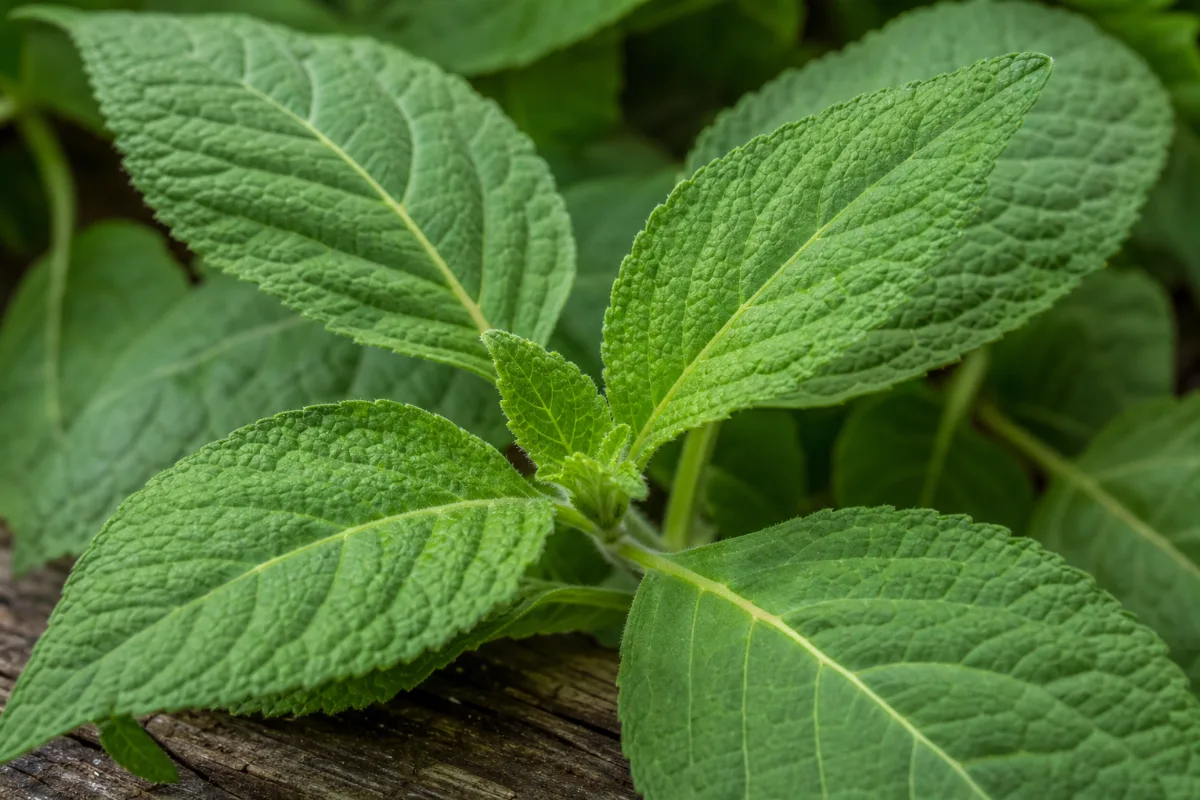
Natural Psychedelics · Mexican sage with intense, short-lived effects
Salvia divinorum
Salvia divinorum · also called Diviner's sage, salvia
Salvia divinorum is a sage from a small region of Mexico, used for centuries by the Mazatec people for divination and spiritual healing. Its main compound, salvinorin A, acts on kappa-opioid receptors and causes very intense effects that fade within minutes. Human research is small and almost all of it used the pure compound in a lab, not the leaf. No health benefit has been shown, and reviews warn of anxiety, psychiatric risks and unpredictable product strength.
General information, not medical advice. Last substantive update · Not medically reviewed. A named clinician has not signed off on this page. The Mazatec context awaits cultural review. How this page is made
About Salvia divinorum
Salvia divinorum is a sage in the mint family from a very small region of Mexico. Its main active compound, salvinorin A, is unusual: it acts on kappa-opioid receptors rather than on serotonin receptors like psilocybin or LSD. In small lab studies it caused very intense, brief changes in perception. There is no approved medical use, and the research we found does not show that it helps any condition.
What it is
Salvia divinorum Epling & Játiva is an accepted species in the mint family (Lamiaceae). A review of fifty years of research says traditional use is confined to a very small region of Mexico and that the first flowering specimen was collected in 1962 by Hofmann and Wasson in Oaxaca.
Its main active compound, salvinorin A, is a diterpene, not an alkaloid. It is the first reported psychoactive diterpene.
The plant is not the same as the compound
Almost every human study used pure salvinorin A, inhaled in a lab. No trial tested the leaf or any product sold to the public. Reviews also say animal work dominates the research.
Salvinorin A is not a classic psychedelic. It acts on kappa-opioid receptors, and its effects only partly overlap with those of serotonin psychedelics.
Mazatec tradition
The Mazatec people of Oaxaca, Mexico, have used the plant for divination and spiritual healing for centuries. This is a living cultural and spiritual tradition that belongs to the Mazatec. It is different from recreational use and from clinical research, and this page does not describe it as medicine.
See also our page on traditional contexts.
What the research shows
In small controlled lab studies with healthy volunteers who had used hallucinogens before, inhaled salvinorin A caused intense effects that peaked within about two minutes and faded within about 30 minutes. Some people described losing contact with their surroundings and body. A 2026 systematic review of 12 trials with 174 people found no serious adverse events but reported disorientation, anxiety and distress in subsets of participants.
One lab study found memory impaired during the effects and no lasting problems at one month in 8 people. A brain-scan study found less default mode network activity at peak effects.
These volunteers were supervised, healthy and experienced. That does not describe taking an unregulated plant product alone.
Product strength varies
Laboratory tests found much more salvinorin A in so-called enhanced extracts than in raw leaf, roughly 8 to 35 times more in one study. One internet-bought product contained salvinorin A, but eight other Salvia species did not. A product can be far stronger or weaker than it looks.
Legal status
Laws differ by country and by US state and change often. This is not legal advice. In the US, Salvia divinorum and salvinorin A are not named in the federal schedules I to V as of 22 October 2026, but states and other laws differ. We could not confirm other countries' laws from official sources. See our page on how we verify legal information.
At a glance
Traditional uses history, not proof
- The Mazatec people of Oaxaca, Mexico, have used the plant for divination and spiritual healing for centuries. This tradition belongs to the Mazatec.
- Today it is also used recreationally, mostly by adolescents and young adults. That is a different context.
Studied for research
- Intense dissociative effects in lab studies (an effect, not a benefit), moderate certainty it occurs
- Body awareness changes, low
- Mood after use (self-report), very low
- Pain, addiction, stroke, inflammation: animal research only, insufficient
- Depression: no human trials, animal results mixed
Main compounds
- Salvinorin A, a diterpene that is not an alkaloid; kappa-opioid receptor agonist
- Other related diterpenoids (not well studied)
Common forms
Research links: Salvinorin A: compound guide · Salvia divinorum: traditional contexts · PubMed: 2026 systematic review of salvinorin A in humans · PubMed: 2025 animal meta-analysis · Research Library · Genes & Biomarkers Library
The plant and its history
- Accepted scientific name
- Salvia divinorum
- Naming authority
- Epling & Játiva
- Common names
- Diviner's sage (English); Salvia (English (short name))
- Botanical family
- Lamiaceae (the mint family)
- Classification
- Plantae > Tracheophyta > Magnoliopsida > Lamiales > Lamiaceae > Salvia > Salvia divinorum
- Native range
- A very small region of Mexico (Oaxaca), home of the Mazatec people (Casselman 2014; Zawilska 2013; Maqueda 2015).
- Habitat
- Not checked in the sources read. A review says more botanical information is needed, including germination, pollination and the plant's native environment.
- What the plant looks like
- Roots: Not checked.; Stems: Not checked.; Leaves: The leaf is the part used and the part analysed in the studies we read.; Flowers: A flowering specimen was first collected in 1962 by Hofmann and Wasson in Oaxaca (Casselman 2014).; Fruit: Not checked.
- Cultivation
- Not covered on this page.
- Harvest and processing
- Not covered on this page.
- Look-alikes and adulterants
- Name: Other Salvia species; Note: A Taiwan study found salvinorin A in S. divinorum but not in eight native Salvia species, so other sages should not be assumed to share its effects.
- Sustainability and conservation
- Not checked: no IUCN or CITES entry was read for this species.
Traditional use and history history, not clinical proof
| Tradition or era | Documented use | Source |
|---|---|---|
| Mazatec people, Oaxaca, Mexico | Used for centuries for divination and spiritual healing (Johnson 2011; Zawilska 2013). Traditional use is confined to a very small region of Mexico (Casselman 2014). This is a living spiritual tradition of the Mazatec people, not a recreational practice. | p24315983 |
| 1962 | Hofmann and Wasson collected the first flowering specimen on an expedition to Oaxaca, which allowed the species to be identified (Casselman 2014). | p24315983 |
| Late 20th and 21st century | Became known worldwide and used mainly by adolescents and young adults as a recreational drug, an alternative to cannabis or LSD (Zawilska 2013). Modern use is a different context from Mazatec practice. | p23794315 |
| Research | Salvinorin A was identified as the first known naturally occurring non-nitrogenous full kappa-opioid agonist (Chavkin 2004, citing earlier work). | p14718611 |
Traditional use shows how a plant was used. It does not show that a supplement works or is safe today.
What is inside, and how it may work
What the plant contains and how those compounds act in cells and animals. Laboratory and animal mechanisms are not proven effects in people.
Main compounds
| Compound | Family | Where it is concentrated | Activity studied | Level of evidence |
|---|---|---|---|---|
| Salvinorin A PubChem 128563 | Diterpene (not an alkaloid) | Leaf Varies hugely by product; raw leaf versus enhanced extracts differed by roughly 8 to 35 times in one lab study. | Full agonist at kappa-opioid receptors in cell studies; produces short, intense dissociative effects in people when inhaled. 6 13 5 27 4 | Human data |
| Other diterpenoids related to salvinorin A | Diterpenoids | Leaf Not quantified in the sources read. | Not well studied in the sources read; a review says other classes of constituents need more investigation. 4 | Authoritative guidance |
Mechanisms, receptors and pathways
| Target or pathway | Gene or receptor | What was found | Level |
|---|---|---|---|
| Kappa-opioid receptor | kappa-opioid receptor (OPRK1) | Salvinorin A is a potent, full agonist, similar in efficacy to the natural peptide dynorphin A, in cloned human receptors. LABORATORY. 6 | Laboratory research |
| Nucleus accumbens dopamine | dopamine system | In rats, salvinorin A lowered extracellular dopamine in the reward centre and caused depressive-like behaviour. ANIMAL. 3 | Animal research |
| Default mode network | brain network | In healthy adults, salvinorin A attenuated default mode network connectivity at peak effects, similar to other hallucinogens. HUMAN. 7 | Human data |
| Sensory gating and body awareness | kappa-opioid receptor | The authors suggest kappa-opioid receptors help regulate sensory perception, body awareness and body ownership in humans. HUMAN, interpretation. 15 | Human data |
Absorption, metabolism and elimination
- Absorption
- Inhaled: onset within seconds, peak effects at 1 to 2 minutes, resolution within about 30 minutes. Sublingual: slower onset and longer duration in two studies. Oral: inactive in one study (2026 review of 12 trials).
- Distribution
- Not read for humans. Animal half-life about one hour in a 2025 meta-analysis.
- Metabolism
- Not read.
- Elimination
- Not read for humans. Animal half-life about one hour.
- Bioavailability
- Not established in the sources read.
Isolated compounds versus whole extracts
Almost all human research used pure salvinorin A, inhaled in a lab. The plant leaf and sold products were not tested in trials. Leaf products differ hugely in strength.
Nutritional composition
Salvia divinorum is not a food or nutrient and has no nutritional use.
1 moderate certainty1 mixed findings2 low certainty1 very low certainty5 not enough evidence
What is Salvia divinorum good for?
These are the things people ask about, and how strong the evidence is for each. None is an approved use, and several are only animal research. Read with the safety section.
Benefits, one by one
Each card is a research question, not a promise. Tap a goal to filter. Open a card to see the studies, doses and limits.
Intense, short-lived dissociative and hallucination-like effects
Moderate certaintyIn small supervised lab studies, inhaled salvinorin A caused very intense changes in perception that faded within minutes. This is an effect, not a benefit.
6 studiesHuman studies used pure salvinorin A given by inhalation under superv…
Studies, doses and limits
What the trials found
Five small controlled lab studies (4 to 30 healthy, hallucinogen-experienced adults) and a 2026 systematic review of 12 trials (174 people) describe the same pattern: very fast onset, peak at 1 to 2 minutes and resolution within about 30 minutes.
Results
Hallucinogen-scale scores rose in all studies. One study reported effects no longer definite at about 20 minutes. Another found the effects were transient and not dose-related in 10 people. The reviewers report disorientation, anxiety and distress in subsets of participants.
Effect sizes as reported
Consistent effect across small studies; no effect size pooled.
Why this rating
Several placebo-controlled studies agree on what the effect is, but all are small, short, and used experienced volunteers in supportive lab settings.
Form and dose studied
Human studies used pure salvinorin A given by inhalation under supervision in a lab. They did not test the plant leaf or any product people buy. No amounts are given here.
Who was studied
Healthy adults who had used hallucinogens before.
Limits
Small samples, experienced volunteers, lab settings; pure compound inhaled, not the plant. Says nothing about benefit.
Why researchers looked
Researchers study it to understand the kappa-opioid system and how consciousness can be altered without serotonin psychedelics.
Traditional use
The Mazatec people of Oaxaca, Mexico, have long used the plant for divination and spiritual healing. That use belongs to the Mazatec and is a spiritual and cultural practice, not a clinical treatment.
Proposed mechanism Laboratory research
Salvinorin A switches on kappa-opioid receptors, a different brain system from the serotonin receptors targeted by classic psychedelics such as psilocybin. In cell studies it is a full activator of these receptors.
A proposed mechanism does not show that the effect happens in people.
Effects can include loss of contact with surroundings and body, disorientation, anxiety and distress. See the Safety tab.
Changes in body awareness and sense of body ownership
Low certaintyAt higher amounts, volunteers described losing contact with the outside world and sometimes with their own body.
2 studiesHuman studies used pure salvinorin A given by inhalation under superv…
Studies, doses and limits
What the trials found
One placebo-controlled study of 8 volunteers in Barcelona used a body-awareness questionnaire.
Results
Salvinorin A led to a disconnection from external reality, elaborate visions and sounds, and changed body awareness. Lower amounts increased body sensations; the highest gave a sense of complete loss of contact with the body.
Effect sizes as reported
Inverted-U pattern: more body sensation at lower amounts, less at the highest.
Why this rating
One study of 8 people.
Form and dose studied
Human studies used pure salvinorin A given by inhalation under supervision in a lab. They did not test the plant leaf or any product people buy. No amounts are given here.
Who was studied
8 healthy volunteers with psychedelic experience.
Limits
Tiny sample; questionnaire data.
Why researchers looked
The effect is unusual and helps scientists study how the brain senses the body.
Traditional use
The Mazatec people of Oaxaca, Mexico, have long used the plant for divination and spiritual healing. That use belongs to the Mazatec and is a spiritual and cultural practice, not a clinical treatment.
Proposed mechanism Pharmacological theory
Researchers suggest kappa-opioid receptors play a role in sensory gating and body awareness. This is an interpretation, not proof.
A proposed mechanism does not show that the effect happens in people.
Effects can include loss of contact with surroundings and body, disorientation, anxiety and distress. See the Safety tab.
Memory and thinking during the effects
Mixed findingsMemory and recall were impaired while the effects lasted in one study; another found no thinking problems. Neither found lasting problems at follow-up.
3 studiesHuman studies used pure salvinorin A given by inhalation under superv…
Studies, doses and limits
What the trials found
Two small studies disagree on thinking, and one followed 8 people for a month.
Results
MacLean 2013: dose-related impairment of recall and recognition memory, no persisting adverse effects at 1 month. Ranganathan 2012: no cognitive deficits in 10 people. A review of misuse says salvinorin A may negatively affect cognition.
Effect sizes as reported
Mixed.
Why this rating
The two small human studies point in different directions, and only one tracked people for a month.
Form and dose studied
Human studies used pure salvinorin A given by inhalation under supervision in a lab. They did not test the plant leaf or any product people buy. No amounts are given here.
Who was studied
Healthy volunteers.
Limits
Small studies, short follow-up; long-term heavy use has not been tested.
Why researchers looked
Safety question: does it harm thinking?
Traditional use
The Mazatec people of Oaxaca, Mexico, have long used the plant for divination and spiritual healing. That use belongs to the Mazatec and is a spiritual and cultural practice, not a clinical treatment.
Proposed mechanism Pharmacological theory
Memory effects during intoxication are common with strongly mind-altering substances. The mechanism for salvinorin A is not established.
A proposed mechanism does not show that the effect happens in people.
Memory impairment during effects makes unsupervised activity unsafe.
Changes in brain network activity (brain scans)
Low certaintyA brain-scan study found that salvinorin A reduced activity of the default mode network during the peak of the effects, a pattern similar to other hallucinogens.
1 studiesHuman studies used pure salvinorin A given by inhalation under superv…
Studies, doses and limits
What the trials found
One placebo-controlled fMRI study; participant number not read.
Results
Less within-network connectivity, more between-network connectivity, and less default mode network activity at peak effects. The authors say direct comparisons with other hallucinogens are needed.
Effect sizes as reported
Pattern described; no clinical meaning.
Why this rating
One imaging study; a scan change is not a health outcome.
Form and dose studied
Human studies used pure salvinorin A given by inhalation under supervision in a lab. They did not test the plant leaf or any product people buy. No amounts are given here.
Who was studied
Healthy adults.
Limits
Imaging changes do not show benefit.
Why researchers looked
Brain scans show what the compound does inside the brain.
Traditional use
The Mazatec people of Oaxaca, Mexico, have long used the plant for divination and spiritual healing. That use belongs to the Mazatec and is a spiritual and cultural practice, not a clinical treatment.
Proposed mechanism Preliminary mechanism
Scan patterns are consistent with kappa-opioid and other hallucinogen effects on network activity.
A proposed mechanism does not show that the effect happens in people.
None specific.
Mood and well-being after use (self-report)
Very low certaintyIn a large online survey, about a quarter of users said they felt better for a day or more after some sessions, and about 1 in 20 reported lasting anxiety or other negative effects.
2 studiesHuman studies used pure salvinorin A given by inhalation under superv…
Studies, doses and limits
What the trials found
One internet survey of 500 users and a small lab follow-up at 8 weeks.
Results
25.8% reported positive effects lasting 24 hours or longer on at least one occasion; 4.4% reported persisting negative effects, most often anxiety. In a 30-person lab study no significant adverse events were reported.
Effect sizes as reported
Self-report only.
Why this rating
Self-selected survey of mostly young men; no control group.
Form and dose studied
Human studies used pure salvinorin A given by inhalation under supervision in a lab. They did not test the plant leaf or any product people buy. No amounts are given here.
Who was studied
Mostly young men who chose to use it.
Limits
Convenience sample from a drug-information website, remembering past experiences.
Why researchers looked
People ask whether it lifts mood. The best data are self-reports, not trials.
Traditional use
The Mazatec people of Oaxaca, Mexico, have long used the plant for divination and spiritual healing. That use belongs to the Mazatec and is a spiritual and cultural practice, not a clinical treatment.
Proposed mechanism Pharmacological theory
Not established.
A proposed mechanism does not show that the effect happens in people.
Same survey: some users reported lasting anxiety.
Depression or low mood
Not enough evidenceThere are no human trials of salvinorin A for depression. Animal results are mixed and, in rats, point toward depressive-like effects.
2 studiesHuman studies used pure salvinorin A given by inhalation under superv…
Studies, doses and limits
What the trials found
No human trial for any mood disorder.
Results
A 2025 meta-analysis of animal studies found findings on depression inconsistent, with both antidepressant and depressive-like results. One rat study found depressive-like effects.
Effect sizes as reported
Animal results mixed.
Why this rating
No human trials; animal findings pull both ways.
Form and dose studied
Human studies used pure salvinorin A given by inhalation under supervision in a lab. They did not test the plant leaf or any product people buy. No amounts are given here.
Who was studied
Animals only.
Limits
Animal models of depression do not predict results in people.
Why researchers looked
Kappa-opioid receptors are linked to mood, so the question comes up.
Traditional use
The Mazatec people of Oaxaca, Mexico, have long used the plant for divination and spiritual healing. That use belongs to the Mazatec and is a spiritual and cultural practice, not a clinical treatment.
Proposed mechanism Animal research
In rats, salvinorin A lowered dopamine in the reward centre and produced depressive-like behaviour.
A proposed mechanism does not show that the effect happens in people.
If anything, animal work warns of depressive-like effects.
Pain
Not enough evidenceAnimal studies suggest salvinorin A can reduce pain responses. No human trial has tested it for pain.
2 studiesHuman studies used pure salvinorin A given by inhalation under superv…
Studies, doses and limits
What the trials found
No human trial for pain.
Results
A 2025 systematic review and meta-analysis found anti-nociceptive and anti-inflammatory effects in animal models.
Effect sizes as reported
Animal results only.
Why this rating
Findings come from animal models; no human trial exists.
Form and dose studied
Human studies used pure salvinorin A given by inhalation under supervision in a lab. They did not test the plant leaf or any product people buy. No amounts are given here.
Who was studied
Animals.
Limits
Animal results often fail to carry over to people.
Why researchers looked
Opioid-like systems control pain.
Traditional use
The Mazatec people of Oaxaca, Mexico, have long used the plant for divination and spiritual healing. That use belongs to the Mazatec and is a spiritual and cultural practice, not a clinical treatment.
Proposed mechanism Animal research
Animal findings suggest kappa-opioid receptor effects; not shown in people.
A proposed mechanism does not show that the effect happens in people.
Side effects (anxiety, motor and cognitive impairment in animals; intense mind effects in people) may limit use.
Addiction
Not enough evidenceIn animal models salvinorin A showed anti-addictive effects. No human trial exists.
2 studiesHuman studies used pure salvinorin A given by inhalation under superv…
Studies, doses and limits
What the trials found
No human trial for addiction. Some case reports describe a persistent pattern of Salvia use.
Results
Anti-addictive effects in animal models (2025 meta-analysis).
Effect sizes as reported
Animal results only.
Why this rating
Findings come from animal models; no human trial exists.
Form and dose studied
Human studies used pure salvinorin A given by inhalation under supervision in a lab. They did not test the plant leaf or any product people buy. No amounts are given here.
Who was studied
Animals.
Limits
Animal results often fail to carry over to people.
Why researchers looked
Kappa-opioid receptors are involved in drug craving and reward.
Traditional use
The Mazatec people of Oaxaca, Mexico, have long used the plant for divination and spiritual healing. That use belongs to the Mazatec and is a spiritual and cultural practice, not a clinical treatment.
Proposed mechanism Animal research
Animal findings suggest kappa-opioid receptor effects; not shown in people.
A proposed mechanism does not show that the effect happens in people.
Salvia itself has been linked to persistent use in a small case series.
Stroke and brain injury
Not enough evidenceAnimal models suggest a protective effect after stroke-like injury. Not tested in people.
2 studiesHuman studies used pure salvinorin A given by inhalation under superv…
Studies, doses and limits
What the trials found
No human trial.
Results
Neuroprotective effects in animal models of cerebrovascular insults.
Effect sizes as reported
Animal results only.
Why this rating
Findings come from animal models; no human trial exists.
Form and dose studied
Human studies used pure salvinorin A given by inhalation under supervision in a lab. They did not test the plant leaf or any product people buy. No amounts are given here.
Who was studied
Animals.
Limits
Animal results often fail to carry over to people.
Why researchers looked
Researchers look for neuroprotective compounds.
Traditional use
The Mazatec people of Oaxaca, Mexico, have long used the plant for divination and spiritual healing. That use belongs to the Mazatec and is a spiritual and cultural practice, not a clinical treatment.
Proposed mechanism Animal research
Animal findings suggest kappa-opioid receptor effects; not shown in people.
A proposed mechanism does not show that the effect happens in people.
No safety data in stroke.
Inflammation
Not enough evidenceAnimal research suggests anti-inflammatory effects. Not tested in people.
2 studiesHuman studies used pure salvinorin A given by inhalation under superv…
Studies, doses and limits
What the trials found
No human trial.
Results
Anti-inflammatory effects in animal models.
Effect sizes as reported
Animal results only.
Why this rating
Findings come from animal models; no human trial exists.
Form and dose studied
Human studies used pure salvinorin A given by inhalation under supervision in a lab. They did not test the plant leaf or any product people buy. No amounts are given here.
Who was studied
Animals.
Limits
Animal results often fail to carry over to people.
Why researchers looked
Related to the pain findings.
Traditional use
The Mazatec people of Oaxaca, Mexico, have long used the plant for divination and spiritual healing. That use belongs to the Mazatec and is a spiritual and cultural practice, not a clinical treatment.
Proposed mechanism Animal research
Animal findings suggest kappa-opioid receptor effects; not shown in people.
A proposed mechanism does not show that the effect happens in people.
No safety data for this use.
Connections to the rest of health
How Salvia divinorum connects to the rest of our health knowledge graph. Every link says what kind of connection it is. A safety link (for example to the liver) is a warning, not a benefit. A study that merely mentions a topic never creates a benefit link.
Explore every connection: goals, body systems, organs, symptoms, genes
B. Body systems
| Connected to | Kind of connection | Evidence status | Context | Studies |
|---|---|---|---|---|
| Nervous system | Biological association | Moderate certainty | Kappa-opioid receptor activation causes short, intense mind effects. Studied for: Intense, short-lived dissociative and hallucination-like effects Preparation or compound: Salvinorin A |
6 13 11 20 1 23 4 15 14 7 2 22 3 9 8 |
D. Symptoms
| Connected to | Kind of connection | Evidence status | Context | Studies |
|---|---|---|---|---|
| Psychosis | Adverse effect or risk | Very low certainty | Case report and review warnings; cause not shown. Preparation or compound: Plant or salvinorin A |
19 21 |
| Anxiety | Adverse effect or risk | Low certainty | Reported during and after use in trials and a survey. Preparation or compound: Plant or salvinorin A |
23 2 |
I. Biomarkers
| Connected to | Kind of connection | Evidence status | Context | Studies |
|---|---|---|---|---|
| Default mode network activity (fMRI) | Biological association | Low certainty | Measured in trials: lowered at peak effects. A lab change is not the same as a health benefit. | 7 |
| Cortisol (stress hormone) | Biological association | Low certainty | Measured in trials: raised. A lab change is not the same as a health benefit. | 20 |
| Prolactin | Biological association | Low certainty | Measured in trials: raised. A lab change is not the same as a health benefit. | 20 |
| Blood pressure and heart rate | Biological association | Low certainty | Measured in trials: little change. A lab change is not the same as a health benefit. | 11 23 20 |
J. Genes, receptors and enzymes
| Connected to | Kind of connection | Evidence status | Context | Studies |
|---|---|---|---|---|
| Kappa-opioid receptor (OPRK1) | Preliminary mechanism | In vitro | Main target of salvinorin A. | 6 |
L. Active compounds
| Connected to | Kind of connection | Evidence status | Context | Studies |
|---|---|---|---|---|
| Salvinorin A | Biological association | Human | Full agonist at kappa-opioid receptors in cell studies; produces short, intense dissociative effects in people when inhaled. Preparation or compound: Leaf |
6 13 5 27 4 |
| Other diterpenoids related to salvinorin A | Biological association | Authoritative guidance | Not well studied in the sources read; a review says other classes of constituents need more investigation. Preparation or compound: Leaf |
4 |
Each connection is stored with the ingredient, the connected record, the kind of connection, the evidence status, the supporting studies, the preparation or compound involved, and a review date (last reviewed October 25, 2026).
Evidence at a glance: what changed in 2 lab markers
Tap a number to show only those markers. Counts are markers, not people.
The evidence
The research centre for Salvia divinorum. Every record here was checked against PubMed or the publisher's page; we never list a study we have not verified.
Evidence by outcome
Bars show how many studies we found for each outcome, not how well it works. People are added up across trials only (reviews are not added, to avoid double counting).
How we rate evidence
High certainty
Several well-run trials or reviews agree; further research is unlikely to change the picture much.
Moderate certainty
Good trials point the same way, but some doubt remains.
Low certainty
Small, short or inconsistent trials. The finding could change with better research.
Very low certainty
Very little or very weak human data. Treat as a possibility only.
Mixed findings
Trials or reviews disagree with each other.
Not enough evidence
Not enough human research to say either way.
Evidence against
Good research found no benefit, or found harm.
We take the reviewers' own risk-of-bias and GRADE statements where they exist, and otherwise judge from study size, design, consistency, directness and whether a product matches what is sold. Many publications do not make evidence high. Method note: We searched PubMed and read the abstracts of about 20 papers, checked the plant name in GBIF and the compound in PubChem, and searched the US federal drug schedules in the eCFR. Some legal pages refused automated access and are marked as not verified. Only abstracts were read. Certainty ratings are the compiler's own reading.
Study library: every study we checked 27
| Study | Design | People | Product, dose, length | Result |
|---|---|---|---|---|
| Addy 2012 Acute and post-acute behavioral and psychological effects of salvinorin A in humans. Psychopharmacology · PMID 21901316 |
Controlled trial |
30 30 middle-aged, well-educated adults with hallucinogen experience |
Smoked pure salvinorin A (two amounts) none (isolated compound) A higher and a lower amount, 2 weeks apart (not repeated here) Two sessions; interview after 8 weeks · vs Lower amount used as control, in counterbalanced order |
Participants talked, laughed and moved more on the active amount. All six hallucinogen-scale clusters rose. No significant adverse events were observed or reported. Hallucinogen-like effects, no significant adverse events Methods, limits and fundingOutcomes: Behaviour, hallucinogen rating scale, reported consequences at 8 weeks Limitations: Selected, experienced participants; 8 weeks of follow-up only. Funding and conflicts: Not stated in the abstract. Read: abstract |
| Baggott 2010 Use patterns and self-reported effects of Salvia divinorum: an internet-based survey. Drug and Alcohol Dependence · PMID 20627425 |
Cohort study |
500 500 people who had used Salvia, recruited from a drug-information website (92.6% male, mean age 23.4) |
Salvia divinorum product, typically smoked or vaporized n/a n/a Self-report · vs None |
Most (92.6%) smoked or vaporized it. Main effects lasted about 14 minutes on average. 25.8% reported positive effects lasting 24 hours or longer on at least one occasion; 4.4% reported persisting negative effects, most often anxiety. 80.6% would probably or definitely use it again. Brief effects; persisting negative effects uncommon in this sample Methods, limits and fundingOutcomes: Reasons, methods and reported consequences of use Limitations: Convenience sample from a drug-information website, self-reported, not random. Funding and conflicts: The website operators are among the authors; the abstract states no funding conflict. Read: abstract |
| Carlezon WA Jr 2006 Depressive-like effects of the kappa-opioid receptor agonist salvinorin A on behavior and neurochemistry in rats. Journal of Pharmacology and Experimental Therapeutics · PMID 16223871 |
Animal research animal |
Rats | Salvinorin A purified from Salvia divinorum leaves, injected leaf (source of compound) Not repeated here Acute · vs Vehicle |
Salvinorin A increased immobility in the forced swim test (opposite to antidepressants), raised brain-reward thresholds, and lowered dopamine in the nucleus accumbens at a dose that caused these effects. Depressive-like signs in rats Methods, limits and fundingOutcomes: Forced swim and brain-reward tests; nucleus accumbens dopamine Limitations: Rats; behavioural models of depression, not depression in people. Funding and conflicts: Not stated in the abstract. Read: abstract |
| Casselman 2014 From local to global-fifty years of research on Salvia divinorum. Journal of Ethnopharmacology · PMID 24315983 |
Review review |
Review of 50 years of research | Salvia divinorum and salvinorin A n/a n/a n/a · vs n/a |
Traditional use is confined to a very small region of Mexico. The first flowering specimen was collected in 1962 by Hofmann and Wasson in Oaxaca. Salvinorin A is a kappa-opioid agonist and the first reported psychoactive diterpene. Its effects have mainly been studied in animals. Published human studies reported no harmful effects within the amounts studied, but more toxicology and safety data are needed before larger therapeutic trials. Methods, limits and fundingOutcomes: Ethnobotany, taxonomy, chemistry, pharmacology Limitations: Narrative review; search ended in 2013. Funding and conflicts: Not stated in the abstract. Read: abstract |
| Chambers 2023 Rapid Detection and Quantification of Hallucinogenic Salvinorin A in Commercial Salvia divinorum Products by DART-HRMS. ACS Omega · PMID 36643502 |
Laboratory research in-vitro |
Commercial Salvia divinorum leaf products (raw leaves and "enhanced" extracts) | Commercial Salvia divinorum products analysed in a laboratory leaf n/a n/a · vs n/a |
The enhanced leaf extracts tested held roughly 8 to 35 times more salvinorin A than the raw leaves, so strength differs greatly between product types. Content varies widely by product type Methods, limits and fundingOutcomes: Salvinorin A content by mass spectrometry Limitations: Few products tested; this describes content, not effects or safety. Funding and conflicts: Authors declare no competing financial interest. Read: abstract |
| Chavkin 2004 Salvinorin A, an active component of the hallucinogenic sage salvia divinorum is a highly efficacious kappa-opioid receptor agonist: structural and functional considerations. Journal of Pharmacology and Experimental Therapeutics · PMID 14718611 |
Laboratory research in-vitro |
Cloned human kappa-opioid receptors in cells and frog egg cells | Salvinorin A and derivatives in cells n/a n/a n/a · vs n/a |
Salvinorin A was a potent, full agonist at kappa-opioid receptors, similar in efficacy to the body's own dynorphin A, and the first known naturally occurring non-nitrogenous full agonist at these receptors. Methods, limits and fundingOutcomes: Receptor activation Limitations: Laboratory cells only. Funding and conflicts: Not stated in the abstract. Read: abstract |
| Doss 2020 The Acute Effects of the Atypical Dissociative Hallucinogen Salvinorin A on Functional Connectivity in the Human Brain. Scientific Reports · PMID 33009457 |
Clinical trial |
Healthy adults (number not given in the abstract) | Inhaled pure salvinorin A none (isolated compound) Not stated in abstract One 20-minute scan · vs Placebo, within-subject |
Salvinorin A tended to weaken connectivity inside brain networks and strengthen it between networks, with the clearest effect being less activity in the default mode network during peak effects. The pattern looked strikingly like other hallucinogens, and direct comparisons are needed. Default mode network attenuated Methods, limits and fundingOutcomes: Functional MRI connectivity Limitations: Brain-scan patterns are not clinical outcomes; sample size not read. Funding and conflicts: Authors disclose consulting for psychedelic drug development firms and a research institute board seat (as stated in the paper). Read: abstract |
| El-Khoury 2018 Case series: Salvia divinorum as a potential addictive hallucinogen. American Journal on Addictions · PMID 29596726 |
Case series |
2 2 patients with an enduring, pervasive pattern of Salvia use |
Salvia divinorum use n/a n/a n/a · vs n/a |
Two patients presented with an enduring and pervasive pattern of use. The authors urge clinicians to ask about Salvia, especially in young people who use several substances, and note the potential for a use disorder. Two cases of a persistent use pattern Methods, limits and fundingOutcomes: Pattern of use and clinical presentation Limitations: Two patients; no rates of dependence. Funding and conflicts: Not stated in the abstract. Read: abstract |
| Grundmann 2007 Salvia divinorum and salvinorin A: an update on pharmacology and analytical methodology. Planta Medica · PMID 17628834 |
Review review |
Review | Salvia divinorum and salvinorin A n/a n/a n/a · vs n/a |
Animal studies show rapid onset, short half-lives and no evidence of short- or long-term toxicity. The authors see salvinorin A as promising for CNS illnesses but say many further investigations are needed. Methods, limits and fundingOutcomes: Pharmacology, toxicology, pharmacokinetics, analytical methods Limitations: 2007 review, mostly animal data; later human work has since appeared. Funding and conflicts: Not stated in the abstract. Read: abstract |
| Hutton 2016 "Quite a Profoundly Strange Experience": An Analysis of the Experiences of Salvia divinorum Users. Journal of Psychoactive Drugs · PMID 27176133 |
Cohort study |
393 393 respondents in New Zealand, 167 of whom had used Salvia (2010 to 2011) |
Salvia divinorum use (self-reported) n/a n/a n/a · vs n/a |
Three themes: the effects of Salvia, the importance of set and setting, and pleasure versus not-pleasure. Use looked intermittent and novel. The paper notes Salvia became illegal in New Zealand under a 2014 Act. Qualitative themes Methods, limits and fundingOutcomes: Themes in user experiences Limitations: Qualitative; recruited by flyer; a small group of users. Funding and conflicts: Not stated in the abstract. Read: abstract |
| Johnson 2011 Human psychopharmacology and dose-effects of salvinorin A, a kappa opioid agonist hallucinogen present in the plant Salvia divinorum. Drug and Alcohol Dependence · PMID 21131142 |
Clinical trial |
4 4 healthy adults who had used hallucinogens before |
Inhaled (vaporized or smoked) pure salvinorin A, not the whole plant none (isolated compound) Ascending lab-controlled inhaled amounts (amounts not repeated here) Single sessions; effects tracked for 60 minutes · vs Placebo inhalations mixed in |
Effects were orderly and linked to the amount inhaled, peaked at the first check (2 minutes) and were no longer definite at about 20 minutes. Mystical-type and hallucinogen-scale scores rose. Heart rate and blood pressure did not rise significantly. Narratives described changes in spatial orientation, pressure on the body, childhood memories, cartoon-like imagery and contact with entities. Short, intense, dose-related effects Methods, limits and fundingOutcomes: Subject-rated drug strength, mystical-type experience and classic-hallucinogen rating scales, heart rate and blood pressure Limitations: Only 4 people, all experienced with hallucinogens, in a supportive lab setting. Not the whole plant. Funding and conflicts: Not stated in the abstract. Read: abstract |
| Lin 2014 Quantitative determination of salvinorin A, a natural hallucinogen with abuse liability, in Internet-available Salvia divinorum and endemic species of Salvia in Taiwan. Journal of Food and Drug Analysis · PMID 28911428 |
Laboratory research in-vitro |
Internet-bought S. divinorum and 8 Salvia species native to Taiwan | Dry leaves analysed by HPLC leaf n/a n/a · vs n/a |
Salvinorin A was found in S. divinorum but not in the eight native Taiwan Salvia species tested. Methods, limits and fundingOutcomes: Salvinorin A content Limitations: Laboratory content study only. Funding and conflicts: Authors declare no conflicts. Read: abstract |
| MacLean 2013 Dose-related effects of salvinorin A in humans: dissociative, hallucinogenic, and memory effects. Psychopharmacology · PMID 23135605 |
Clinical trial |
8 8 healthy adults with histories of hallucinogen use |
Inhaled (vaporized or smoked) pure salvinorin A, not the whole plant none (isolated compound) Ascending lab-controlled inhaled amounts (not repeated here) Single sessions plus 1-month follow-up · vs Placebo |
Effects were intense, rose with amount and faded within minutes. Maximal ratings or unresponsiveness were common at high amounts. Dissociative effects and impaired recall and recognition memory were dose-related. No persisting adverse effects were seen at 1 month. Participants said the effects differed from other drugs. Dissociation and memory impairment during effects; none at 1 month Methods, limits and fundingOutcomes: Dissociative, hallucinogen-scale and memory measures; persisting effects at 1 month Limitations: 8 people, experienced with hallucinogens, lab setting. Funding and conflicts: Not stated in the abstract. Read: abstract |
| Mahendran 2016 Salvia divinorum: An overview of the usage, misuse, and addiction processes. Asia-Pacific Psychiatry · PMID 26617400 |
Review review |
Review | Salvia divinorum and salvinorin A n/a n/a n/a · vs n/a |
Widely believed to have low addictive potential and low toxicity, but recent findings suggest salvinorin A can precipitate psychiatric symptoms and negatively affect cognition. The authors say clinicians need to know its effects. Methods, limits and fundingOutcomes: Use, misuse and addiction Limitations: Narrative review; the abstract calls religious use "South America" while other sources place traditional use in Mexico. Funding and conflicts: Not stated in the abstract. Read: abstract |
| Maqueda 2015 Salvinorin-A Induces Intense Dissociative Effects, Blocking External Sensory Perception and Modulating Interoception and Sense of Body Ownership in Humans. International Journal of Neuropsychopharmacology · PMID 26047623 |
Controlled trial |
8 8 healthy volunteers with previous psychedelic experience (Barcelona) |
Vaporized pure salvinorin A none (isolated compound) Three increasing amounts plus placebo (not repeated here) Single sessions · vs Placebo |
Salvinorin A led to a disconnection from external reality, elaborate visions and sounds, and changed body awareness. Lower amounts increased body sensations; the highest led to a sense of complete loss of contact with the body. Loss of contact with surroundings and body at the highest amount Methods, limits and fundingOutcomes: Hallucinogen Rating Scale, Altered States of Consciousness scale, interoceptive awareness questionnaire Limitations: 8 people; effects shown only with questionnaires in a lab. Funding and conflicts: Not stated in the abstract. Read: abstract |
| Margalho 2016 Salvia divinorum: toxicological aspects and analysis in human biological specimens. Bioanalysis · PMID 27277872 |
Review review |
Review | Salvia divinorum and salvinorin A n/a n/a n/a · vs n/a |
The authors say uncontrolled abuse has risen quickly, exposing users to serious risks in the short and long term, and summarise legal aspects and testing methods. Methods, limits and fundingOutcomes: Toxicology, legal aspects, detection methods Limitations: Brief overview; the abstract gives no risk figures. Funding and conflicts: Not stated in the abstract. Read: abstract |
| Perron 2012 Use of Salvia divinorum in a nationally representative sample. American Journal of Drug and Alcohol Abuse · PMID 21834614 |
Cohort study |
55623 US National Survey on Drug Use and Health 2008 |
Salvia divinorum use (self-reported) n/a n/a n/a · vs n/a |
Use was most common at ages 18 to 25 and in people with risk-taking behaviour or other illicit drug use, especially other hallucinogens or ecstasy. Self-reported depression and anxiety were also associated with use. Association only Methods, limits and fundingOutcomes: Who uses Salvia and what goes with use Limitations: An association in a survey; it cannot show that Salvia caused anything. Funding and conflicts: Authors report no conflicts. Read: abstract |
| Pichini 2005 Quantification of the plant-derived hallucinogen Salvinorin A in conventional and non-conventional biological fluids by gas chromatography/mass spectrometry after Salvia divinorum smoking. Rapid Communications in Mass Spectrometry · PMID 15915477 |
Case series |
2 2 consumers who smoked plant leaves |
Smoked Salvia divinorum leaves leaf Not repeated here Single session · vs None |
Salvinorin A was found in urine (2.4 and 10.9 ng/mL) and saliva (11.1 and 25.0 ng/mL) of the two consumers, but not in sweat patches. Detectable in urine and saliva Methods, limits and fundingOutcomes: Salvinorin A in urine, saliva and sweat Limitations: Mainly a testing-method paper; only two people. Funding and conflicts: Not stated in the abstract. Read: abstract |
| Przekop 2009 Persistent psychosis associated with salvia divinorum use. American Journal of Psychiatry · PMID 19570943 |
Case report |
Case report (details not available to us) | Salvia divinorum use n/a n/a n/a · vs n/a |
Only the title and citation were read. The title reports a case of persistent psychosis associated with Salvia use. We did not read details. Case report, details not read Methods, limits and fundingOutcomes: Psychosis after Salvia use Limitations: No abstract available on PubMed; a single case report cannot show cause. Funding and conflicts: Not known. Read: citation-only |
| Ranganathan 2012 Dose-related behavioral, subjective, endocrine, and psychophysiological effects of the kappa opioid agonist Salvinorin A in humans. Biological Psychiatry · PMID 22817868 |
Controlled trial |
10 10 healthy people who had used Salvia before |
Inhaled (vaporized or smoked) pure salvinorin A, not the whole plant none (isolated compound) Two active inhaled amounts and placebo (amounts not repeated here) 3 days, crossover · vs Placebo |
Salvinorin A produced psychotomimetic and perceptual effects, including dissociative and body-sensation effects, raised plasma cortisol and prolactin and lowered resting EEG power. It did not produce euphoria, cognitive deficits or changes in vital signs. Effects were transient and not dose-related; no acute or delayed adverse effects were reported. Transient dissociative effects; hormone rise; no vital-sign change Methods, limits and fundingOutcomes: Psychotomimetic and perceptual effects, cognition, vital signs, cortisol, prolactin, EEG Limitations: 10 people, previous Salvia users, lab setting. Funding and conflicts: Authors report no biomedical financial interests or conflicts for most authors; full statement not copied. Read: abstract |
| Zawilska 2013 Salvia divinorum: from Mazatec medicinal and hallucinogenic plant to emerging recreational drug. Human Psychopharmacology · PMID 23794315 |
Review review |
Review | Salvia divinorum and salvinorin A n/a n/a n/a · vs n/a |
Salvia is a sage endemic to a small region of Mexico, traditionally used by the Mazatec for divination and spiritual healing. It causes intense but short-lived changes in mood and perception, with hallucinations and disorientation. The authors warn that websites misread limited research as proof of safety and that health risks exist especially for teenagers, users of other substances and people with underlying psychotic disturbances. Methods, limits and fundingOutcomes: Neurochemistry, pharmacokinetics, trends and health problems Limitations: Narrative review from 2013. Funding and conflicts: Not stated in the abstract. Read: abstract |
| Zürrer 2025 The translational potential of salvinorin A: systematic review and meta-analysis of preclinical studies. Translational Psychiatry · PMID 41073402 |
Meta-analysis animal |
82 animal studies in the review, 10 in the meta-analysis | Salvinorin A in animals n/a n/a n/a · vs n/a |
Salvinorin A was anti-nociceptive, anti-inflammatory, neuroprotective and anti-addictive in animal models of pain, cerebrovascular insults and addiction. Depression findings were inconsistent, with both antidepressant and depressogenic results. Toxicity data showed anxiogenic effects and motor and cognitive impairment, with minimal effect on vital parameters. Half-life was about one hour. The authors say side effects may limit clinical use. Methods, limits and fundingOutcomes: Therapeutic potential, toxic effects and pharmacokinetics in animal models Limitations: Animal research only; it does not show effects in people. Funding and conflicts: Authors report no competing interests. Read: abstract |
| Zürrer 2026 Salvinorin A in humans: A systematic review of pharmacokinetics, pharmacodynamics, and safety. Journal of Psychopharmacology · PMID 42638533 |
Systematic review |
174 12 clinical trials, 174 participants, mostly healthy hallucinogen-experienced volunteers |
Mostly inhaled pure salvinorin A; some sublingual; oral in one study none (isolated compound) Not repeated here Mostly single sessions · vs Placebo in most |
Onset was within seconds, peak at 1 to 2 minutes and resolution within 30 minutes. Sublingual dosing was slower and longer; oral dosing was inactive in one study. No serious adverse events were reported. Blood pressure and heart rate were largely stable. Disorientation, anxiety and distress occurred in subsets of participants. Long-term adverse effects were rare and abuse potential appeared low. No serious adverse events in 12 small trials Methods, limits and fundingOutcomes: Pharmacokinetics, pharmacodynamics, safety, longer-term effects Limitations: Human studies were heterogeneous and fragmented; mostly small studies in experienced volunteers. Funding and conflicts: Not stated in the abstract. Read: abstract |
| n/a 2016 Canada: Food and Drug Regulations (schedule listing Salvia divinorum) n/a · Source |
Authoritative guidance n/a |
n/a | n/a n/a n/a n/a · vs n/a |
Not read. A web-search result listed the Food and Drug Regulations schedule page as including Salvia divinorum and salvinorin A. Methods, limits and fundingOutcomes: Legal status in Canada Limitations: Only a search listing was seen; current wording not read. Not verified. Read: not-read |
| n/a 2026 US eCFR: 21 CFR 1308.11 to 1308.15 (Schedules I to V), current to 22 Oct 2026 n/a · Source |
Authoritative guidance n/a |
n/a | n/a n/a n/a n/a · vs n/a |
Text of sections 1308.11, 1308.12, 1308.13, 1308.14 and 1308.15 was searched on 2026-10-25 for "salvia" and "salvinorin": no match in any of the five. Methods, limits and fundingOutcomes: Whether Salvia divinorum or salvinorin A is named in the US federal schedules Limitations: A search of the federal schedules only; says nothing about state laws, other laws or other countries. Read: full-text |
| n/a 2026 EUDA (European Union Drugs Agency) drug profile: Salvia divinorum n/a · Source |
Authoritative guidance n/a |
n/a | n/a n/a n/a n/a · vs n/a |
Not opened (the page refused automated access). A web-search summary of the page said neither the plant nor salvinorin A is in the schedules of the UN drug conventions, and listed several European countries that control the plant and/or salvinorin A. Methods, limits and fundingOutcomes: Legal status in Europe and under UN conventions Limitations: Second-hand summary only. Not verified. Read: not-read |
| n/a 2026 PubChem: salvinorin A (CID 128563) n/a · Source |
Registry or database n/a |
n/a | n/a n/a n/a n/a · vs n/a |
PubChem REST on 2026-10-25: CID 128563, formula C23H28O8, molecular weight 432.5. Methods, limits and fundingOutcomes: Chemical identity Limitations: Database entry. Read: full-text |
What we do not know yet
- No controlled trial of Salvia divinorum plant leaf or any product people buy; all human trials used pure salvinorin A given by inhalation.
- No human trial for depression, pain, addiction or any illness.
- Only small studies in experienced volunteers; none in people with mental illness, older adults, or teenagers.
- Long-term follow-up beyond about 8 weeks is missing.
- No human trial for pain, addiction, stroke or inflammation.
- Hormone and heart readings come from small volunteer studies; people with heart or hormone conditions were not studied.
- Pregnancy, breastfeeding, liver, kidney and heart effects have not been studied in people.
- No drug-interaction studies.
- No data on driving or injuries after use.
- Real-world poisoning, emergency-visit and long-term heavy-use data not found in the sources read.
- Current legal status for most countries was not read from official sources.
How new research is added
New studies are found by a saved PubMed search and are placed in a review queue. A person reads each one before it changes any evidence rating or safety wording.
Lab markers
What changed in blood or saliva tests during trials. A changed number is not the same as feeling or being healthier, and we give no "normal ranges".
Hormonal 2
Cortisol (stress hormone)
Raised in trials
A hormone released by the adrenal glands during stress.
Low certaintyResults and what it means
Why it was measured
Checked to see whether the compound activates the body stress response.
Statistical vs. clinical meaning
A short-lived hormone rise in one small study.
Safety implication
Reflects a stress-like response; no harm shown in the study.
| Study | Result | People | Product |
|---|---|---|---|
| 20 | Plasma cortisol increased after inhaled salvinorin A. | 10 healthy people who had used Salvia | Inhaled pure salvinorin A versus placebo |
Prolactin
Raised in trials
A pituitary hormone.
Low certaintyResults and what it means
Why it was measured
Kappa-opioid activation can change hormone release.
Statistical vs. clinical meaning
A transient rise in one small study.
Safety implication
None established.
| Study | Result | People | Product |
|---|---|---|---|
| 20 | Plasma prolactin increased after inhaled salvinorin A. | 10 healthy people who had used Salvia | Inhaled pure salvinorin A versus placebo |
Other 2
Default mode network activity (fMRI)
Lowered at peak effects in trials
A brain-scan measure of how much a set of brain regions linked to self-focused thought work together.
Low certaintyResults and what it means
Why it was measured
Used in studies of hallucinogens to see how they change brain networks.
Statistical vs. clinical meaning
A scan pattern that looks like other hallucinogens; not a health outcome.
Safety implication
None established.
| Study | Result | People | Product |
|---|---|---|---|
| 7 | Attenuation of the default mode network during the first half of a 20-minute scan, at peak effects. | Healthy adults, placebo-controlled | Inhaled pure salvinorin A versus placebo |
Blood pressure and heart rate
Little change in trials
Basic measures of heart and circulation.
Low certaintyResults and what it means
Why it was measured
Safety check in volunteer studies.
Statistical vs. clinical meaning
No major circulation changes in small volunteer studies.
Safety implication
Not studied in people with heart disease.
| Study | Result | People | Product |
|---|---|---|---|
| 11 | Salvinorin A did not significantly increase heart rate or blood pressure. | 4 hallucinogen-using adults | Inhaled pure salvinorin A |
| 23 | Largely stable, with occasional mild increases in blood pressure or heart rate across 12 trials. | 174 participants in 12 trials | Mostly inhaled pure salvinorin A |
Safety
What studies and official sources say about side effects, medicines and who should check first. Each point shows what kind of evidence it comes from.
Main points to know 8
- Intense loss of contact with surroundings and body. In lab studies, inhaled salvinorin A caused a disconnection from external reality, strong visions and sounds, and at the highest amounts a complete loss of contact with the body. Reviews report disorientation, anxiety and distress in some people. Effects are brief but can be overwhelming. Because contact with surroundings can be lost, falls and accidents are a reasonable concern when someone is alone or not supervised, though no injury rates were found. Controlled trial 15 23 21
- Possible psychiatric harm, especially in the vulnerable. Reviews warn of risks for teenagers, people who use other substances and people with underlying psychotic disturbances, and say salvinorin A can precipitate psychiatric symptoms. A case report is titled "Persistent psychosis associated with salvia divinorum use" (details not read). A national survey links use to depression and anxiety, which cannot show cause. Case report 21 14 19 17
- Not an approved medicine. We found no regulator approval for any use of the plant or of salvinorin A in the sources we read. Human research is small and mostly done in healthy volunteers by inhalation. Pharmacological theory 23 4
- Memory is impaired while the effects last. One lab study found dose-related impairment of recall and recognition memory during the effects, and no persisting problems at 1 month in 8 people. Another found no cognitive deficits. Controlled trial 13 20
- Dependence: probably low, but not zero. Reviews describe a low addictive potential, and a 2026 review judged abuse potential low. A case series of two patients described an enduring, pervasive pattern of use, and the authors suggest asking about Salvia in young people who use several substances. Case series 23 14 8
- Safe in volunteers is not safe for everyone. Twelve small trials (174 people) report no serious adverse events, but the volunteers were healthy, experienced with hallucinogens, supervised and given pure compound. That does not describe someone alone with a plant product. Systematic review 23 4
- Product strength is not predictable. Lab measurements of commercial products found much higher salvinorin A in so-called enhanced extracts than in raw leaf (roughly 8 to 35 times in one study), so a product can be much stronger than it looks. Another study found one internet-bought sample contained it while eight other Salvia species did not. Laboratory research 5 12
- Not a classic psychedelic. Salvinorin A acts on kappa-opioid receptors, not serotonin receptors, and its effects only partly overlap with classic psychedelics. Findings about psilocybin or LSD should not be assumed to apply. Laboratory research 6 13
Side effects 6
| Effect | How often | Severity and recovery | Evidence |
|---|---|---|---|
| Disorientation, anxiety, distress From supervised lab trials. | Occurred in subsets of participants across 12 trials; no rate given in the abstract | moderate Resolved within about 30 minutes in trials | Systematic review 23 |
| Loss of contact with surroundings and body Maximal ratings or unresponsiveness were frequent at high amounts in one study. | Common at higher amounts in lab studies | moderate to severe Brief | Controlled trial 15 13 |
| Memory impairment during the effects Not seen in another study of 10 people. | Dose-related in one study of 8 people | mild to moderate No persisting effects at 1 month in that study | Controlled trial 13 |
| Persisting anxiety after use Self-selected survey. | 4.4% of 500 survey respondents reported persisting negative effects, most often anxiety | mild to moderate Not known | Cohort study 2 |
| Psychosis (reported) A single case report cannot show cause. | Not quantified; case report only | severe Reported as persistent in the case title; details not read | Case report 19 21 |
| Mild blood pressure or heart rate rise Largely stable physiology otherwise. | Occasional | mild Brief | Systematic review 23 |
Liver
No source we read reports on liver effects of Salvia divinorum or salvinorin A in people.
How often. Not studied.
Monitoring. None.
This is a safety connection. It is not evidence that Salvia divinorum supports liver health.
Medicines and supplements 3
| With | Why it matters | Importance | Evidence | What to do |
|---|---|---|---|---|
| Alcohol, cannabis, classic psychedelics, stimulants and other mind-altering substances other | Not studied. Combining substances can make effects less predictable. | Reviews warn that users of other substances are at higher risk of problems; the national survey links Salvia use to other drug use. | Review Very low certainty 21 17 | Avoid combining; ask a doctor or pharmacist. |
| Antipsychotics, antidepressants, MAOIs and other prescription medicines prescription | No interaction studies were found. Salvinorin A acts on kappa-opioid rather than serotonin receptors, so classic serotonergic interaction rules cannot be assumed to apply either way. | Unknown. | Pharmacological theory Not enough evidence 6 | Tell your prescriber if you use Salvia. Do not assume it is safe with any medicine. |
| Opioid medicines and opioid blockers (for example naloxone or naltrexone) prescription | Both act on opioid receptor systems, but no human interaction study was found. | Unknown. | Pharmacological theory Not enough evidence 6 | Ask a clinician or pharmacist. |
Who should check first 5
| Situation | Advice | Evidence |
|---|---|---|
| A personal or family history of psychosis, or current serious mental illness | Reviews warn of higher risk in people with underlying psychotic disturbances. Avoid, and talk to a clinician. | Review 21 14 |
| Teenagers and young people | Reviews and surveys flag young people as a risk group. Online claims that it is safe are misleading. | Review 21 17 |
| Pregnancy and breastfeeding | No human data were found. Avoid; there is no evidence of safety. | Pharmacological theory |
| Driving, operating machinery, swimming, or being alone | The effects remove contact with the surroundings and impair memory. No driving study was found; avoid all risky activities. This is a precaution, not a measured risk. | Pharmacological theory 15 13 |
| Heart disease or high blood pressure | Volunteer studies saw mostly stable vital signs but excluded people with illness. Not studied; ask a clinician. | Systematic review 23 |
Overdose, product quality and regulators
Summary. Human lab studies of pure salvinorin A reported no serious adverse events. Animal reviews describe a lack of evidence for short- or long-term toxicity, but also anxiety-like effects and motor and cognitive impairment. Real-world poisoning data, deaths and long-term heavy use have not been studied well.
Animal. A 2025 meta-analysis of animal studies reported anxiogenic effects, motor and cognitive impairment and minimal effect on vital signs, with a half-life of about one hour. A 2007 review found no evidence of short- or long-term toxicity.
Human doses studied. Not repeated here.
High dose or long term signals. Long-term effects are unstudied. A case series and case report suggest persistent use patterns and persistent psychosis in a few people.
Overdose response. No source we read describes a treatment for overdose. Most reported harm is behavioural and psychological.
Genotoxicity. Not read.
Toxic plant parts. The leaf is the part used traditionally and recreationally. Other plant parts were not reviewed.
Salvia divinorum products are not made to medicine standards. Lab studies show product strength varies greatly.
Strength varies. Enhanced leaf extracts contained roughly 8 to 35 times more salvinorin A than raw leaf in one lab study. 5
Look-alike Salvia species. In Taiwan, salvinorin A was found in S. divinorum but not in eight native Salvia species, so other Salvia plants should not be assumed to act the same. 12
| Body | Action | Date |
|---|---|---|
| US Code of Federal Regulations (DEA schedules) (United States) | Salvia divinorum and salvinorin A are not named in the federal controlled substance schedules I to V (21 CFR 1308.11 to 1308.15). This is not the same as legal everywhere: states and other laws differ and change. source | 2026-10-25 |
When to get medical help
- Someone very agitated, confused, violent, unable to be roused, having a seizure, or hurt: call your local emergency number now (911 in the US).
- Chest pain, trouble breathing or fainting: call emergency services.
- Thoughts of harming yourself or others, or psychosis that does not clear after the effects should have faded: seek urgent care. Use a local crisis line or emergency number.
- Poison control (US): 1-800-222-1222. Elsewhere, use your local poison centre or emergency number.
If someone may be poisoned or in a crisis, contact a clinician or emergency service straight away. In the US, Poison Control is 1-800-222-1222.
General information only, not medical advice. Ask a clinician or pharmacist before use, especially with medicines, in pregnancy or with a health condition. See the Natural Remedy Safety guide.
Frequently asked questions
What is Salvia divinorum?
What does salvinorin A do in the brain?
How long do the effects last?
Is Salvia divinorum a classic psychedelic?
Is it approved as a medicine?
Does it help with depression, pain or addiction?
Is it safe?
Can it cause psychosis or lasting problems?
Is it addictive?
Who uses it?
In a US national survey, use was most common at ages 18 to 25 and in people with other drug use or risk-taking. That is an association, not proof of cause.
Is it the same as the Mazatec tradition?
Is it legal?
It depends on the country and, in the US, the state, and laws change. In the US the federal schedules do not name it. This is not legal advice; check current local law.
Explore by health goal
Editorial transparency
- Written by
- AlternativeMed editorial team. Research compiled with AI assistance, then checked against PubMed records.
- Medical review
- None. This page has not been reviewed by a physician or pharmacist.
- First published
- 2026-10-25
- Last substantive update
- 2026-10-25
- How we research
- We searched PubMed and read the abstracts of about 20 papers, checked the plant name in GBIF and the compound in PubChem, and searched the US federal drug schedules in the eCFR. Some legal pages refused automated access and are marked as not verified. Only abstracts were read. Certainty ratings are the compiler's own reading.
- How we rate evidence
- See "How we rate evidence" in the Evidence tab.
- Independence
- No product is promoted on this page. No affiliate links are shown, and none will be added.
Sources 27
Each source was opened and checked. Where we read only the abstract, it says so. The small numbers in the text point here.
- Addy PH. Acute and post-acute behavioral and psychological effects of salvinorin A in humans.. Psychopharmacology. 2012. PMID 21901316. (abstract)
- Baggott MJ, Erowid E, Erowid F, Galloway GP, Mendelson J. Use patterns and self-reported effects of Salvia divinorum: an internet-based survey.. Drug and Alcohol Dependence. 2010. PMID 20627425. (abstract)
- Carlezon WA Jr, Béguin C, DiNieri JA, Baumann MH, Richards MR, Todtenkopf MS, et al. Depressive-like effects of the kappa-opioid receptor agonist salvinorin A on behavior and neurochemistry in rats.. Journal of Pharmacology and Experimental Therapeutics. 2006. PMID 16223871. (abstract)
- Casselman I, Nock CJ, Wohlmuth H, Weatherby RP, Heinrich M. From local to global-fifty years of research on Salvia divinorum.. Journal of Ethnopharmacology. 2014. PMID 24315983. (abstract)
- Chambers MI, Giffen-Lemieux JE, Musah RA. Rapid Detection and Quantification of Hallucinogenic Salvinorin A in Commercial Salvia divinorum Products by DART-HRMS.. ACS Omega. 2023. PMID 36643502. (abstract)
- Chavkin C, Sud S, Jin W, Stewart J, Zjawiony JK, Siebert DJ, Toth BA, Hufeisen SJ, Roth BL. Salvinorin A, an active component of the hallucinogenic sage salvia divinorum is a highly efficacious kappa-opioid receptor agonist: structural and functional considerations.. Journal of Pharmacology and Experimental Therapeutics. 2004. PMID 14718611. (abstract)
- Doss MK, May DG, Johnson MW, Clifton JM, Hedrick SL, Prisinzano TE, Griffiths RR, Barrett FS. The Acute Effects of the Atypical Dissociative Hallucinogen Salvinorin A on Functional Connectivity in the Human Brain.. Scientific Reports. 2020. PMID 33009457. (abstract)
- El-Khoury J, Baroud E. Case series: Salvia divinorum as a potential addictive hallucinogen.. American Journal on Addictions. 2018. PMID 29596726. (abstract)
- Grundmann O, Phipps SM, Zadezensky I, Butterweck V. Salvia divinorum and salvinorin A: an update on pharmacology and analytical methodology.. Planta Medica. 2007. PMID 17628834. (abstract)
- Hutton F, Kivell B, Boyle O. "Quite a Profoundly Strange Experience": An Analysis of the Experiences of Salvia divinorum Users.. Journal of Psychoactive Drugs. 2016. PMID 27176133. (abstract)
- Johnson MW, MacLean KA, Reissig CJ, Prisinzano TE, Griffiths RR. Human psychopharmacology and dose-effects of salvinorin A, a kappa opioid agonist hallucinogen present in the plant Salvia divinorum.. Drug and Alcohol Dependence. 2011. PMID 21131142. (abstract)
- Lin PX, Li JH, Chen SH, Chang HC, McKetin R. Quantitative determination of salvinorin A, a natural hallucinogen with abuse liability, in Internet-available Salvia divinorum and endemic species of Salvia in Taiwan.. Journal of Food and Drug Analysis. 2014. PMID 28911428. (abstract)
- MacLean KA, Johnson MW, Reissig CJ, Prisinzano TE, Griffiths RR. Dose-related effects of salvinorin A in humans: dissociative, hallucinogenic, and memory effects.. Psychopharmacology. 2013. PMID 23135605. (abstract)
- Mahendran R, Lim HA, Tan JY, Chua SM, Winslow M. Salvia divinorum: An overview of the usage, misuse, and addiction processes.. Asia-Pacific Psychiatry. 2016. PMID 26617400. (abstract)
- Maqueda AE, Valle M, Addy PH, Antonijoan RM, Puntes M, Coimbra J, et al. Salvinorin-A Induces Intense Dissociative Effects, Blocking External Sensory Perception and Modulating Interoception and Sense of Body Ownership in Humans.. International Journal of Neuropsychopharmacology. 2015. PMID 26047623. (abstract)
- Margalho C, Corte-Real F, López-Rivadulla M, Gallardo E. Salvia divinorum: toxicological aspects and analysis in human biological specimens.. Bioanalysis. 2016. PMID 27277872. (abstract)
- Perron BE, Ahmedani BK, Vaughn MG, Glass JE, Abdon A, Wu LT. Use of Salvia divinorum in a nationally representative sample.. American Journal of Drug and Alcohol Abuse. 2012. PMID 21834614. (abstract)
- Pichini S, Abanades S, Farré M, Pellegrini M, Marchei E, Pacifici R, Torre Rde L, Zuccaro P. Quantification of the plant-derived hallucinogen Salvinorin A in conventional and non-conventional biological fluids by gas chromatography/mass spectrometry after Salvia divinorum smoking.. Rapid Communications in Mass Spectrometry. 2005. PMID 15915477. (abstract)
- Przekop P, Lee T. Persistent psychosis associated with salvia divinorum use.. American Journal of Psychiatry. 2009. PMID 19570943. (citation-only)
- Ranganathan M, Schnakenberg A, Skosnik PD, Cohen BM, Pittman B, Sewell RA, D'Souza DC. Dose-related behavioral, subjective, endocrine, and psychophysiological effects of the kappa opioid agonist Salvinorin A in humans.. Biological Psychiatry. 2012. PMID 22817868. (abstract)
- Zawilska JB, Wojcieszak J. Salvia divinorum: from Mazatec medicinal and hallucinogenic plant to emerging recreational drug.. Human Psychopharmacology. 2013. PMID 23794315. (abstract)
- Zürrer WE, Wettstein L, Aicher HD, Scheidegger M, Ineichen BV. The translational potential of salvinorin A: systematic review and meta-analysis of preclinical studies.. Translational Psychiatry. 2025. PMID 41073402. (abstract)
- Zürrer WE, Liesner J, Brüschweiler D, Aicher HD, Scheidegger M, Ineichen BV. Salvinorin A in humans: A systematic review of pharmacokinetics, pharmacodynamics, and safety.. Journal of Psychopharmacology. 2026. PMID 42638533. (abstract)
- n/a. Canada: Food and Drug Regulations (schedule listing Salvia divinorum). n/a. 2016. (not-read)
- n/a. US eCFR: 21 CFR 1308.11 to 1308.15 (Schedules I to V), current to 22 Oct 2026. n/a. 2026. (full-text)
- n/a. EUDA (European Union Drugs Agency) drug profile: Salvia divinorum. n/a. 2026. (not-read)
- n/a. PubChem: salvinorin A (CID 128563). n/a. 2026. (full-text)