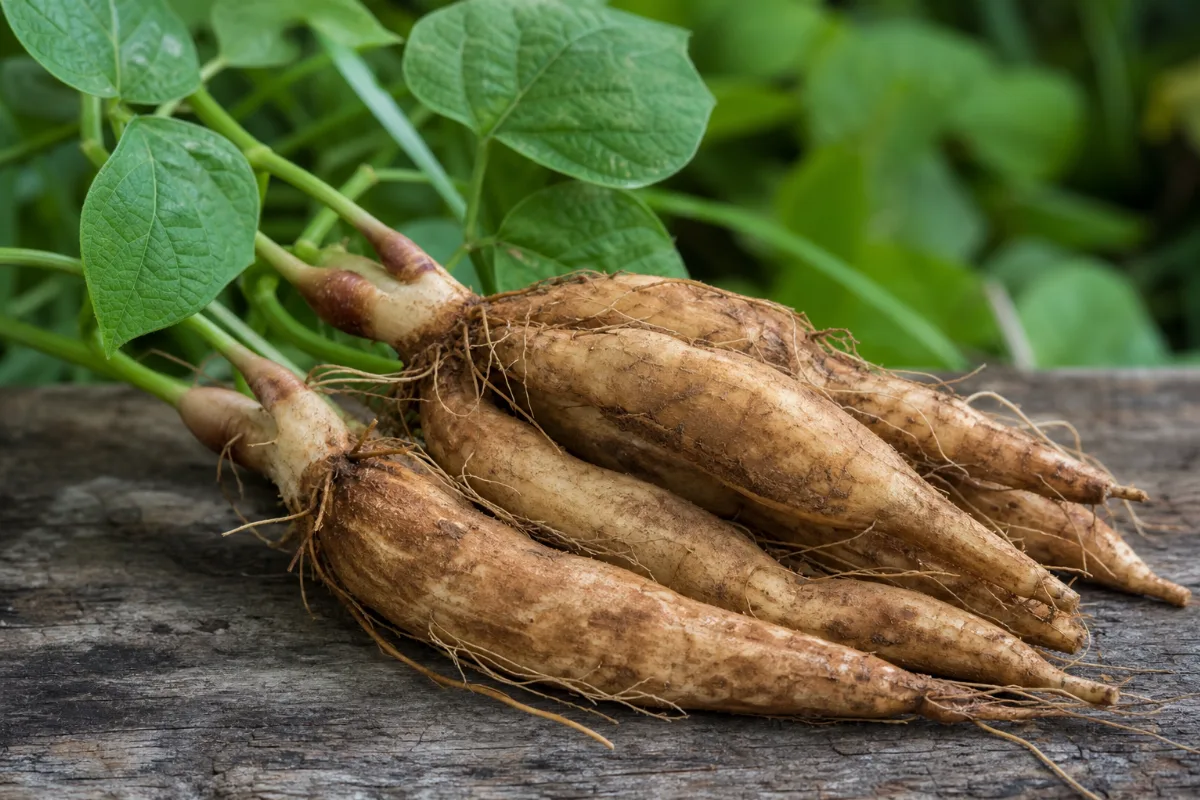
Herbs & Botanicals · Thai root, potent plant estrogen
Pueraria mirifica
Pueraria mirifica (also written Pueraria candollei var. mirifica) · also called White Kwao Krua, Kwao Krua Khao, white kudzu
White Kwao Krua is a Thai tuberous root used for generations as a rejuvenating herb for women, and today for menopause symptoms, vaginal dryness, and (in unproven marketing) breast enlargement and skin. The research is small and mostly short: many Thai studies had no placebo group, and reviewers call the evidence inconclusive. It contains miroestrol, one of the strongest plant estrogens known, so the main caution is serious: it can cause bleeding and period problems and is not safe to assume with breast, womb or ovarian cancer, pregnancy, or hormone medicines.
General information, not medical advice. Last substantive update · Not medically reviewed. A named clinician has not signed off on this page. How this page is made
About Pueraria mirifica
White Kwao Krua is a Thai tuberous root used for generations as a rejuvenating herb for women, and today for menopause symptoms, vaginal dryness, and (in unproven marketing) breast enlargement and skin. The research is small and mostly short: many Thai studies had no placebo group, and reviewers call the evidence inconclusive. It contains miroestrol, one of the strongest plant estrogens known, so the main caution is serious: it can cause bleeding and period problems and is not safe to assume with breast, womb or ovarian cancer, pregnancy, or hormone medicines. Cooking is not the issue here: this profile is about the root as a supplement. For amounts, ask a doctor or pharmacist.
What it is
Pueraria mirifica, called white Kwao Krua in Thailand, is a climbing legume of the pea family (Fabaceae) native to Southeast Asia, mainly Thailand and Myanmar. The part used is the tuberous root. It is related to kudzu, but it is a different plant, and it is also different from red and black Kwao Krua, which have different botanical origins and effects. Papers use two scientific names, Pueraria mirifica and Pueraria candollei var. mirifica; databases list both as accepted.
Traditional and current uses
In Thailand the root has long been used as a rejuvenating herb, especially for women past mid-life. Today it is mostly taken for menopause symptoms and, in some countries, sold for breast enlargement, body shaping and skin. A Japanese survey found younger women used estrogen-like supplements for beauty, while women in their 40s and 50s mainly used them for menopause. Traditional use is not proof it works, and the beauty uses have no clinical trials.
What is in it and how it works
The root contains miroestrol and deoxymiroestrol, plant estrogens strong enough to cause side effects in small amounts, plus weaker isoflavones such as daidzein and genistein. In cells, miroestrol and coumestrol switched on both types of estrogen receptor. This is why it can ease menopause-type changes, and also why it carries the same cautions as an estrogen. Miroestrol is present in low amounts and is hard to measure, so strength varies between products.
What the research shows
A 2018 systematic review covered eight small studies in 309 women and called the evidence for menopause symptoms inconclusive: scores about halved from baseline in five studies, but most had no placebo, the products were not defined, and the risk of bias was high. The Thai trials were mostly open-label (everyone knew what they took). One small trial found it similar to prescription estrogen, without a placebo. A placebo-controlled 24-week trial of 71 women found less vaginal dryness and a lower bone turnover marker, with no thickening of the womb lining. Two small vaginal-gel trials found better vaginal measures, but one found no symptom gain over placebo. Cholesterol results are tiny and mixed. We found no human trial of breast enlargement or skin. The abstracts did not state funding, so we could not check industry links.
A 2026 review calls it a high-potency candidate for menopause but says the move from tradition to standard use is held back by missing pharmacokinetic data and inconsistent quality control.
At a glance
Traditional uses history, not proof
- Thai traditional medicine: a rejuvenating root, described as a postmenopausal rejuvenant in upland Thailand. Traditional use is not proof it works.
- Menopause: the main modern use; the roots are used to relieve menopausal symptoms.
- Beauty and body shaping: sold for breast enlargement, weight loss and skin care in the modern supplement market. Not tested in clinical trials.
- Age-related decline: a general tonic use for older men and women in the tradition. Not tested directly.
Studied for research
- Hot flushes and menopause symptoms, very low certainty (small, mostly no placebo)
- Vaginal dryness and thinning, low certainty (oral and gel)
- Vaginal infection signs, very low certainty (one gel trial)
- Cholesterol and blood fats, very low certainty
- Bone turnover marker, very low certainty (no fracture data)
- Breast enlargement, skin and rejuvenation, insufficient (no trials)
Main compounds
- Miroestrol and deoxymiroestrol, very strong plant estrogens
- Isoflavones: daidzein and genistein, weaker estrogen-like compounds
- Puerarin, an isoflavone also in kudzu (amount not verified)
- Coumestrol, another plant estrogen
Common forms
- Capsules or tablets of dried root powder (used in the Thai studies)
- Vaginal gel, 5-6% (two placebo-controlled trials)
- Health-food blends, mostly in Japan, sold for breast and body shaping
- Creams sold for breasts and skin (not trial-tested)
Research links: PubMed record of the 2018 systematic review · PubMed record of the 24-week placebo-controlled vaginal health trial · PubMed record of the rat mammary cancer study · PubMed record of the Japanese designated-ingredient survey · Research Library · Genes & Biomarkers Library
The plant and its history
- Accepted scientific name
- Pueraria mirifica Airy Shaw & Suvat.
- Naming authority
- Airy Shaw & Suvat. (GBIF key 2977697, status ACCEPTED, Fabaceae). GBIF also lists Pueraria candollei Wall. ex Benth. (key 2977693) as accepted; the papers use Pueraria candollei var. mirifica. We did not resolve this and the NCBI taxon id was not checked.
- Synonyms
- Pueraria candollei var. mirifica (Airy Shaw & Suvat.) Niyomdham (name used in papers)
- Common names
- White Kwao Krua (English); Kwao Krua Khao (Thai); White kudzu (English)
- Botanical family
- Fabaceae (pea and bean family, which also holds kudzu).
- Classification
- Plantae > Fabales > Fabaceae > Pueraria > Pueraria mirifica
- Native range
- Southeast Asia, particularly Thailand and Myanmar (2026 review abstract).
- Habitat
- Upland Thailand (2018 review abstract).
- What the plant looks like
- Roots: Tuberous roots are the medicinal part (2020 Thai products paper).; Stems: Not verified from a primary source.; Leaves: Not verified.; Flowers: Not verified.; Fruit: Not verified.
- Cultivation
- Not verified from a primary source.
- Harvest and processing
- Not verified.
- Look-alikes and adulterants
- Name: Red and black Kwao Krua; Note: Different plants with different botanical origins and activity; not interchangeable (2020 Thai products paper).; Name: Kudzu (Pueraria montana var. lobata); Note: A different species with a separate evidence base; see our kudzu page.; Name: Vidari kanda (Pueraria tuberosa); Note: An Indian species used in Ayurveda; a different plant. See our vidari kanda page.
- Sustainability and conservation
- Not verified.
Traditional use and history history, not clinical proof
| Tradition or era | Documented use | Source |
|---|---|---|
| Thai traditional medicine | White Kwao Krua is a long-used rejuvenating herb, described as a postmenopausal rejuvenant in upland Thailand (2018 review); the roots are used to relieve menopausal symptoms (2020 Thai products paper). | p29409850 |
| Modern Thai clinical studies (2004 onward) | Phase-labelled open-label studies at a Thai regional hospital, then placebo-controlled studies of capsules and vaginal gels. | p14971532 |
| Japan, 2012 to 2017 | Many bleeding and menstrual disorder complaints about health foods sold for breast or body-shaping effects, leading to the 'designated ingredient' label. | p35264518 |
| Modern supplement market | Sold for menopause, breast enlargement and skin care; the younger users in surveys are using it for beauty. | p36364772 |
Traditional use shows how a plant was used. It does not show that a supplement works or is safe today.
What is inside, and how it may work
What the plant contains and how those compounds act in cells and animals. Laboratory and animal mechanisms are not proven effects in people.
Main compounds
| Compound | Family | Where it is concentrated | Activity studied | Level of evidence |
|---|---|---|---|---|
| Miroestrol PubChem 165001 | chromene (benzopyran) phytoestrogen | Root Low; hard to measure. | Very strong estrogenic activity; switched on both estrogen receptor types in cells. 15 16 26 | Laboratory research |
| Deoxymiroestrol PubChem 9927999 | chromene (benzopyran) phytoestrogen | Root Not given in the abstracts read. | Reported as another potent estrogenic compound (named in the Japanese survey). 4 26 | Laboratory research |
| Daidzein PubChem 5281708 | isoflavone | Root Not given in the abstracts read. | Weaker estrogen-receptor activity, favouring the beta receptor in cells. 16 26 | Laboratory research |
| Genistein PubChem 5280961 | isoflavone | Root Not given in the abstracts read. | Weaker estrogen-receptor activity, favouring the beta receptor in cells. 16 26 | Laboratory research |
| Puerarin PubChem 5281807 | isoflavone glycoside | Root Not given in the abstracts read. | Isoflavone best known from kudzu. Its presence and amount in this plant were named in the request but not verified in the abstracts read. 26 | Laboratory research |
| Coumestrol | coumestan phytoestrogen | Root Not given. | Switched on both estrogen receptor types in cells, with miroestrol. 16 | Laboratory research |
Mechanisms, receptors and pathways
| Target or pathway | Gene or receptor | What was found | Level |
|---|---|---|---|
| Estrogen receptors alpha and beta | ESR1, ESR2 | Miroestrol and coumestrol activated both receptor types in cells; daidzein and genistein favoured beta. This is the core of both the effects and the cautions. 16 | Laboratory research |
| Pituitary-ovary axis | FSH, LH | In rats and mice, high amounts lowered gonadotropins, prolonged cycles and reduced growing follicles. 17 7 | Animal research |
| Mammary and uterine tissue growth | not specified | Raised mammary cell growth and, after a chemical starter, mammary tumours and atypical womb-lining overgrowth in rats. 8 | Animal research |
| Bone turnover | not specified | Lower bone-specific alkaline phosphatase in women; lower cortical bone loss in monkeys. 14 10 | Human data |
| Vaginal tissue maturation and blood flow | not specified | Higher maturation index and lower pulsatility index with oral and gel forms in women. 13 22 | Human data |
Absorption, metabolism and elimination
- Absorption
- No human data. The 2026 review names a lack of rigorous pharmacokinetic data as a barrier.
- Distribution
- Unknown.
- Metabolism
- Unknown in people.
- Elimination
- Unknown.
- Bioavailability
- Unknown.
Isolated compounds versus whole extracts
The estrogen-like effects depend on a few potent compounds (miroestrol, deoxymiroestrol) plus weaker isoflavones. Their ratio varies by product, so 'whole root' and 'extract' products are not interchangeable, and effects found with a Thai root powder should not be assumed for a Japanese health-food blend.
Nutritional composition
It is not a nutritional food; it is a hormone-active root.
2 low certainty4 very low certainty3 not enough evidence
What is Pueraria mirifica good for?
The uses of Pueraria mirifica and how strong the evidence is for each. "Very low" means the studies are tiny or have no placebo; "insufficient" means no usable human trial. A potent plant estrogen is also a safety question, so read the safety tab as well.
Benefits, one by one
Each card is a research question, not a promise. Tap a goal to filter. Open a card to see the studies, doses and limits.
Hot flushes and general menopause symptoms (oral root)
Very low certaintyIn Thai studies of women with menopause symptoms, symptom scores fell by about half over six months. Most had no placebo group, so we cannot tell how much was the herb. Reviewers called the evidence inconclusive.
6 studiesCapsules of raw root powder or tablets were used in the trials; stren…
Studies, doses and limits
What the trials found
Eight small studies (309 women in total) were reviewed in 2018; five used a symptom score. Three Thai open-label studies (no placebo) and one two-strengths comparison are the main sources. One Thai trial compared the herb with prescription estrogen without a placebo. Funding was not stated in the abstracts, so industry ties could not be checked.
Results
Open-label Thai studies: the modified Greene climacteric score fell from about 36 to 15 (n=37) and from 44 to 11 (n=8) over 6 months. A randomised comparison (n=60) found similar falls with the herb and with conjugated equine estrogen (not statistically different). A double-blind comparison of two strengths in 52 women who had had a hysterectomy found both improved, with no difference between them.
Effect sizes as reported
Score about 50% below baseline in 5 studies (2018 review); no placebo-corrected effect available.
Why this rating
The 2018 reviewers rated the trials as at high risk of bias with low quality scores and said efficacy is inconclusive. Most trials had no placebo, tiny samples, undefined products and hormone levels that varied. Symptom scores also fall over time without treatment.
Form and dose studied
Capsules of raw root powder or tablets were used in the trials; strength and content differ between products and were not defined. For amounts, ask a doctor or pharmacist.
Who was studied
Perimenopausal and postmenopausal Thai women, some after hysterectomy.
Limits
No placebo in the hot-flush studies, many dropouts, short follow-up, same research groups, undefined products. 'No difference from estrogen' in a small study is not proof they work equally.
Why researchers looked
White Kwao Krua is the Thai traditional rejuvenation herb for women past mid-life, and the modern Thai trials started from that use.
Traditional use
Used in Thai folk medicine as a rejuvenating root for women and older people (2018 systematic review and 2026 review).
Proposed mechanism Lab
The root holds plant estrogens, mainly miroestrol and deoxymiroestrol (very strong) and isoflavones such as daidzein, genistein and puerarin (weaker). They bind estrogen receptors, so effects resemble weak to strong estrogen, depending on the product.
A proposed mechanism does not show that the effect happens in people.
Safety is covered in the safety section. This is a strong plant estrogen: avoid with hormone-sensitive cancers or conditions, pregnancy and breastfeeding, and ask a doctor first.
Vaginal dryness and thinning (oral capsules)
Low certaintyOne placebo-controlled trial of 71 healthy postmenopausal women found less vaginal dryness and healthier vaginal cells after 24 weeks. It is small and has not been repeated by an independent group that we found.
2 studiesCapsules; three strengths were tested. For amounts, ask a doctor or p…
Studies, doses and limits
What the trials found
One randomised, double-blind, placebo-controlled trial (51 on the herb in three strengths, 20 on placebo) from a Thai university hospital; its abstract states no funding.
Results
Vaginal dryness decreased after 12 weeks. The vaginal maturation index (share of mature cells) moved from 46:43:11 to 11:65:24 (parabasal:intermediate:superficial) after 24 weeks. Adverse effects did not differ from placebo.
Effect sizes as reported
Cell maturation shifted toward mature cells; dryness lower from week 12.
Why this rating
Placebo-controlled and double-blind but small (71 women), one trial, one centre. Counted as low, not moderate.
Form and dose studied
Capsules; three strengths were tested. For amounts, ask a doctor or pharmacist.
Who was studied
Healthy postmenopausal women aged 45 to 60.
Limits
Single small trial, 24 weeks. Funding and conflicts not stated in the abstract. Same participants as the lipid and bone report.
Why researchers looked
A strong plant estrogen should act on estrogen-starved vaginal tissue, so this was a natural early test.
Traditional use
Part of the traditional rejuvenation use; not described as a specific traditional use.
Proposed mechanism Lab
The root holds plant estrogens, mainly miroestrol and deoxymiroestrol (very strong) and isoflavones such as daidzein, genistein and puerarin (weaker). They bind estrogen receptors, so effects resemble weak to strong estrogen, depending on the product.
A proposed mechanism does not show that the effect happens in people.
Safety is covered in the safety section. This is a strong plant estrogen: avoid with hormone-sensitive cancers or conditions, pregnancy and breastfeeding, and ask a doctor first.
Vaginal atrophy and blood flow (vaginal gel)
Low certaintyTwo small placebo-controlled trials and one comparison with an estrogen cream found better vaginal tissue measures with the gel. The estrogen cream worked better on vaginal cells.
3 studiesGel; 5-6% strengths were tested. For amounts, ask a doctor or pharmac…
Studies, doses and limits
What the trials found
A 12-week placebo-controlled trial of a 6% gel in 72 women (63 finished) and a 12-week comparison of a gel with a conjugated estrogen cream in 82 women. A 2021 systematic review of 33 phytoestrogen trials also lists the herb, with better results for vaginal use than other forms.
Results
Blood-flow indices fell (pulsatility index 3.03 vs 6.88 on placebo) and the vaginal maturation index was higher (55.2 vs 20.3) at week 12. Compared with estrogen cream, the gel improved symptom scores similarly (about 4.4 to 1.0) but raised the maturation index less (about 22 to 48 vs 27 to 67). Endometrial thickness was measured in the placebo-controlled trial.
Effect sizes as reported
VMI 55.2 vs 20.3 (placebo-controlled); gel less effective than estrogen cream on VMI.
Why this rating
Randomised and placebo-controlled in one trial, with consistent direction in a second, but small samples, short follow-up, mostly lab-type measures, and no symptom benefit shown over placebo in the other gel trial (below).
Form and dose studied
Gel; 5-6% strengths were tested. For amounts, ask a doctor or pharmacist.
Who was studied
Postmenopausal women with genitourinary syndrome of menopause or vulvovaginal symptoms.
Limits
Short, small, no long-term safety on the womb lining or breast. The class review mixes many products and does not give a separate result for this herb.
Why researchers looked
Putting the herb in a vaginal gel aims to act locally on the tissue with less effect on the rest of the body.
Traditional use
No traditional gel use; a modern product.
Proposed mechanism Lab
The root holds plant estrogens, mainly miroestrol and deoxymiroestrol (very strong) and isoflavones such as daidzein, genistein and puerarin (weaker). They bind estrogen receptors, so effects resemble weak to strong estrogen, depending on the product.
A proposed mechanism does not show that the effect happens in people.
Safety is covered in the safety section. This is a strong plant estrogen: avoid with hormone-sensitive cancers or conditions, pregnancy and breastfeeding, and ask a doctor first.
Vaginal infection signs and symptoms (vaginal gel)
Very low certaintyA 5% gel lowered the share of women with abnormal bacterial vaginosis scores, but genital symptoms did not improve more than with placebo.
1 studiesGel; 5% strength. For amounts, ask a doctor or pharmacist.
Studies, doses and limits
What the trials found
One randomised, double-blind, placebo-controlled trial in 60 postmenopausal women with genitourinary syndrome of menopause (12 weeks).
Results
Abnormal Nugent scores in 6.7% (2 of 30) on the gel against 23.3% (7 of 30) on placebo; the vaginal health index improved more. No significant difference in symptoms between groups.
Effect sizes as reported
Abnormal Nugent 6.7% vs 23.3%; symptoms no difference.
Why this rating
One small trial where the main gain was a lab score and symptoms did not improve over placebo.
Form and dose studied
Gel; 5% strength. For amounts, ask a doctor or pharmacist.
Who was studied
Postmenopausal women with genitourinary syndrome of menopause.
Limits
Only 30 per group, 12 weeks, one centre, a surrogate score.
Why researchers looked
Estrogen-like effects on vaginal tissue can shift vaginal bacteria toward a healthier balance.
Traditional use
None.
Proposed mechanism Pharmacological theory
Estrogen-like effects on the vaginal lining may favour protective bacteria (theory).
A proposed mechanism does not show that the effect happens in people.
Safety is covered in the safety section. This is a strong plant estrogen: avoid with hormone-sensitive cancers or conditions, pregnancy and breastfeeding, and ask a doctor first.
Cholesterol and blood fats
Very low certaintyOne small trial of 19 women found higher HDL and lower LDL after two months, but a larger placebo-controlled trial found triglycerides rose about 15% in both herb and placebo groups.
3 studiesOral powder or capsules; strengths vary. For amounts, ask a doctor or…
Studies, doses and limits
What the trials found
A randomised placebo-controlled trial of 19 postmenopausal women in Japan with oral powder, and the 71-woman Thai trial that measured lipids as one outcome. The 2026 review also reports favourable lipid effects.
Results
HDL cholesterol rose about 34% and LDL fell about 17% on the herb compared with baseline over 2 months (n=19). In the Thai trial triglycerides rose by about 15% on herb and on placebo, so the herb did not stand out from placebo.
Effect sizes as reported
HDL +34%, LDL -17% vs baseline (n=19); triglycerides +15% in both arms (n=71).
Why this rating
Tiny trial, baseline comparison, two months, and a second trial that did not separate herb from placebo. No heart-attack or stroke outcome was studied.
Form and dose studied
Oral powder or capsules; strengths vary. For amounts, ask a doctor or pharmacist.
Who was studied
Postmenopausal women in Japan and Thailand.
Limits
Very small, short, surrogate measures only, funding not stated.
Why researchers looked
Estrogen loss after menopause worsens blood fats, so a plant estrogen was tested.
Traditional use
None specific.
Proposed mechanism Lab
The root holds plant estrogens, mainly miroestrol and deoxymiroestrol (very strong) and isoflavones such as daidzein, genistein and puerarin (weaker). They bind estrogen receptors, so effects resemble weak to strong estrogen, depending on the product.
A proposed mechanism does not show that the effect happens in people.
Safety is covered in the safety section. This is a strong plant estrogen: avoid with hormone-sensitive cancers or conditions, pregnancy and breastfeeding, and ask a doctor first.
Bone health (bone turnover marker)
Very low certaintyA blood marker of bone turnover fell with the herb versus placebo, and monkeys lost less cortical bone. No trial in women measured fractures or bone density.
3 studiesCapsules in the trial; powder in the diet in monkeys.
Studies, doses and limits
What the trials found
One randomised placebo-controlled trial of 24 weeks (71 women) measured bone-specific alkaline phosphatase. A 16-month study in ten monkeys measured bone density. The 2018 review noted bone alkaline phosphatase about halved across the studies.
Results
Bone-specific alkaline phosphatase fell from about 0.22 to 0.13 U/L with the herb and stayed at 0.20 on placebo. In monkeys the treated group lost less cortical bone than untreated animals.
Effect sizes as reported
Bone ALP 0.22 to 0.13 U/L (herb) vs 0.20 to 0.20 (placebo); monkey cortical bone loss reduced.
Why this rating
A turnover marker is not bone strength or fractures. The only bone-density data are in ten monkeys. The 2026 review's claim of favourable bone density effects was not checked against full trials.
Form and dose studied
Capsules in the trial; powder in the diet in monkeys.
Who was studied
Healthy postmenopausal women (marker); postmenopausal monkeys (bone density).
Limits
No fractures or bone density in women; short follow-up; animals are not people.
Why researchers looked
Estrogen slows bone loss after menopause, so a plant estrogen might too.
Traditional use
None specific.
Proposed mechanism Animal research
The root holds plant estrogens, mainly miroestrol and deoxymiroestrol (very strong) and isoflavones such as daidzein, genistein and puerarin (weaker). They bind estrogen receptors, so effects resemble weak to strong estrogen, depending on the product.
A proposed mechanism does not show that the effect happens in people.
Safety is covered in the safety section. This is a strong plant estrogen: avoid with hormone-sensitive cancers or conditions, pregnancy and breastfeeding, and ask a doctor first.
Breast enlargement
Not enough evidenceNo clinical trial of breast enlargement was found. The herb is widely sold for it, and the Japanese reports of breast swelling and pain, bleeding and menstrual problems come from this use.
3 studiesPills, capsules and creams sold as supplements; no tested strengths.
Studies, doses and limits
What the trials found
No human trial. Japanese consumer reports and surveys describe use for breast enlargement and body shaping, with adverse events. Rat studies show the root stimulates mammary tissue.
Results
No result in people. Japanese reports from 2012 to 2017 describe irregular vaginal bleeding and menstrual disorders with health foods sold for breast-enlarging or body-shaping effects. A survey reported breast swelling and pain among users.
Effect sizes as reported
None measurable.
Why this rating
No controlled human study. Reports of harm are self-reported or complaint-system data, so they show a signal, not a rate.
Form and dose studied
Pills, capsules and creams sold as supplements; no tested strengths.
Who was studied
Young women in surveys (teens to 20s used it for beauty purposes).
Limits
Marketing use outpaces research. Strong estrogen-like action in young women is a particular concern.
Why researchers looked
Breast tissue responds to estrogen, so the herb is marketed for breast enlargement and firming.
Traditional use
Marketing claim in modern products; not a documented traditional use in the sources we read.
Proposed mechanism Animal research
Estrogen-like action on breast tissue. In rats the root caused mammary cell growth and, after a chemical cancer starter, more mammary cancer.
A proposed mechanism does not show that the effect happens in people.
Breast growth effects are the same estrogen-like action behind the cancer and bleeding cautions. See the safety section.
Skin and anti-ageing
Not enough evidenceNo human trial of skin effects was found. A Japanese survey notes some younger women use estrogen-like supplements including this herb for skin care.
1 studiesCreams and pills are sold; no tested strengths.
Studies, doses and limits
What the trials found
No human trial found. Evidence is limited to a survey of use and marketing claims.
Results
No result in people.
Effect sizes as reported
None measurable.
Why this rating
There is no controlled evidence on skin. Our lean search did not look for lab-only skin papers.
Form and dose studied
Creams and pills are sold; no tested strengths.
Who was studied
Women who use estrogen-like supplements for beauty purposes in a Japanese survey.
Limits
No controlled data; self-reported use only.
Why researchers looked
Estrogen affects skin thickness, so the herb is promoted for skin and youthfulness.
Traditional use
Thai 'rejuvenation' use.
Proposed mechanism Pharmacological theory
Estrogen-like action on skin cells (theory).
A proposed mechanism does not show that the effect happens in people.
Safety is covered in the safety section. This is a strong plant estrogen: avoid with hormone-sensitive cancers or conditions, pregnancy and breastfeeding, and ask a doctor first.
Traditional rejuvenation and healthy ageing
Not enough evidenceUsed in Thailand for centuries as a rejuvenating root. Modern reviewers say the traditional use has not been tested properly and call for studies of current users.
2 studiesNot applicable.
Studies, doses and limits
What the trials found
The 2018 systematic review says the traditional rejuvenation use needs cohort studies of current users and pharmacovigilance. A 2026 review calls the plant a high-potency phytoestrogenic candidate but wants standardised products.
Results
No human trial of 'rejuvenation' as such. Only the menopause and vaginal measures above were studied.
Effect sizes as reported
None.
Why this rating
Tradition and indirect measures only.
Form and dose studied
Not applicable.
Who was studied
Traditional users in Thailand.
Limits
Tradition is not proof of benefit or safety.
Why researchers looked
The Thai tradition treats white Kwao Krua as a rejuvenating tonic for older men and women.
Traditional use
Long history as a postmenopausal rejuvenant therapy in upland Thailand (2018 review).
Proposed mechanism Lab
The root holds plant estrogens, mainly miroestrol and deoxymiroestrol (very strong) and isoflavones such as daidzein, genistein and puerarin (weaker). They bind estrogen receptors, so effects resemble weak to strong estrogen, depending on the product.
A proposed mechanism does not show that the effect happens in people.
Safety is covered in the safety section. This is a strong plant estrogen: avoid with hormone-sensitive cancers or conditions, pregnancy and breastfeeding, and ask a doctor first.
Connections to the rest of health
How Pueraria mirifica connects to the rest of our health knowledge graph. Every link says what kind of connection it is. A safety link (for example to the liver) is a warning, not a benefit. A study that merely mentions a topic never creates a benefit link.
Explore every connection: goals, body systems, organs, symptoms, genes
A. Wellness goals
| Connected to | Kind of connection | Evidence status | Context | Studies |
|---|---|---|---|---|
| Menopause Support | Potential benefit | Very low certainty | Hot flushes and general menopause symptoms (oral root): In Thai studies of women with menopause symptoms, symptom scores fell by about half over six months. Most had no placebo group, so we cannot tell how much was the herb. Reviewers called the evidence inconclusive. Vaginal dryness and thinning (oral capsules): One placebo-controlled trial of 71 healthy postmenopausal women found less vaginal dryness and healthier vaginal cells after 24 weeks. It is small and has not been repeated by an independent group that we found. | 11 12 2 3 21 23 13 22 19 1 |
| Hormone Balance | Potential benefit | Very low certainty | Hot flushes and general menopause symptoms (oral root): In Thai studies of women with menopause symptoms, symptom scores fell by about half over six months. Most had no placebo group, so we cannot tell how much was the herb. Reviewers called the evidence inconclusive. | 11 12 2 3 21 23 |
| Womens Wellness | Potential benefit | Low certainty | Vaginal dryness and thinning (oral capsules): One placebo-controlled trial of 71 healthy postmenopausal women found less vaginal dryness and healthier vaginal cells after 24 weeks. It is small and has not been repeated by an independent group that we found. Vaginal atrophy and blood flow (vaginal gel): Two small placebo-controlled trials and one comparison with an estrogen cream found better vaginal tissue measures with the gel. The estrogen cream worked better on vaginal cells. | 13 11 22 19 1 18 4 5 8 |
| Cholesterol Balance | Potential benefit | Very low certainty | Cholesterol and blood fats: One small trial of 19 women found higher HDL and lower LDL after two months, but a larger placebo-controlled trial found triglycerides rose about 15% in both herb and placebo groups. | 16 14 23 |
| Heart Health | Potential benefit | Very low certainty | Cholesterol and blood fats: One small trial of 19 women found higher HDL and lower LDL after two months, but a larger placebo-controlled trial found triglycerides rose about 15% in both herb and placebo groups. | 16 14 23 |
| Bone Health | Potential benefit | Very low certainty | Bone health (bone turnover marker): A blood marker of bone turnover fell with the herb versus placebo, and monkeys lost less cortical bone. No trial in women measured fractures or bone density. | 14 10 11 |
| Healthy Skin | Potential benefit | Not enough evidence | Skin and anti-ageing: No human trial of skin effects was found. A Japanese survey notes some younger women use estrogen-like supplements including this herb for skin care. | 4 |
| Healthy Aging | Potential benefit | Not enough evidence | Skin and anti-ageing: No human trial of skin effects was found. A Japanese survey notes some younger women use estrogen-like supplements including this herb for skin care. Traditional rejuvenation and healthy ageing: Used in Thailand for centuries as a rejuvenating root. Modern reviewers say the traditional use has not been tested properly and call for studies of current users. | 4 11 23 |
B. Body systems
| Connected to | Kind of connection | Evidence status | Context | Studies |
|---|---|---|---|---|
| Hormone Health | Biological association | Very low certainty | Studied for: Hot flushes and general menopause symptoms (oral root) Studied for: Traditional rejuvenation and healthy ageing | 11 12 2 3 21 23 |
| Reproductive Health | Biological association | Low certainty | Studied for: Vaginal dryness and thinning (oral capsules) Studied for: Vaginal atrophy and blood flow (vaginal gel) | 13 11 22 19 1 18 4 5 8 |
| Heart Circulation | Biological association | Very low certainty | Studied for: Cholesterol and blood fats | 16 14 23 |
| Bones Joints Muscles | Biological association | Very low certainty | Studied for: Bone health (bone turnover marker) | 14 10 11 |
| Skin Hair Beauty | Biological association | Not enough evidence | Studied for: Skin and anti-ageing | 4 |
C. Body parts and organs
| Connected to | Kind of connection | Evidence status | Context | Studies |
|---|---|---|---|---|
| Breast | Adverse effect or risk | Low certainty | Breast swelling and pain reported; rat root feeding promoted mammary cancer in one model. Preparation or compound: Miroestrol and isoflavones |
4 8 |
| Uterus | Adverse effect or risk | Low certainty | Irregular bleeding reported; womb-lining thickening in rodents; no change at 24 weeks in women. Preparation or compound: Miroestrol and isoflavones |
5 14 17 |
| Heart | Adverse effect or risk | Very low certainty | One long-QT case report. Preparation or compound: Estrogen-type supplement |
9 |
| Liver | Adverse effect or risk | Very low certainty | Short-lived abnormal tests in open-label studies; mild fat change in rat liver cells. Preparation or compound: Root powder |
12 17 |
I. Biomarkers
| Connected to | Kind of connection | Evidence status | Context | Studies |
|---|---|---|---|---|
| Modified Greene climacteric score | Biological association | Very low certainty | Measured in trials: lowered. A lab change is not the same as a health benefit. | 12 3 21 11 |
| Vaginal maturation index | Biological association | Low certainty | Measured in trials: raised. A lab change is not the same as a health benefit. | 13 22 19 |
| Vaginal artery pulsatility index | Biological association | Low certainty | Measured in trials: lowered. A lab change is not the same as a health benefit. | 22 |
| Nugent score (bacterial vaginosis) | Biological association | Very low certainty | Measured in trials: lowered. A lab change is not the same as a health benefit. | 18 |
| Bone-specific alkaline phosphatase | Biological association | Very low certainty | Measured in trials: lowered. A lab change is not the same as a health benefit. | 14 11 |
| HDL and LDL cholesterol | Biological association | Very low certainty | Measured in trials: mixed. A lab change is not the same as a health benefit. | 16 |
| Triglycerides | Biological association | Low certainty | Measured in trials: raised. A lab change is not the same as a health benefit. | 14 |
| Endometrial thickness | Biological association | Low certainty | Measured in trials: no change. A lab change is not the same as a health benefit. | 14 17 7 |
| Estradiol, FSH and LH | Biological association | Very low certainty | Measured in trials: mixed. A lab change is not the same as a health benefit. | 12 3 11 17 |
J. Genes, receptors and enzymes
| Connected to | Kind of connection | Evidence status | Context | Studies |
|---|---|---|---|---|
| ESR1 and ESR2 (estrogen receptors alpha and beta) | Preliminary mechanism | In vitro | Activated by miroestrol and coumestrol in cells. | 16 |
| KCNQ1 (inherited long-QT gene) | Preliminary mechanism | Human case | One case report: heart rhythm trouble in a woman carrying a KCNQ1 variant after an estrogen supplement from this herb. | 9 |
L. Active compounds
| Connected to | Kind of connection | Evidence status | Context | Studies |
|---|---|---|---|---|
| Miroestrol | Biological association | In vitro | Very strong estrogenic activity; switched on both estrogen receptor types in cells. Preparation or compound: Root |
15 16 26 |
| Deoxymiroestrol | Biological association | In vitro | Reported as another potent estrogenic compound (named in the Japanese survey). Preparation or compound: Root |
4 26 |
| Daidzein | Biological association | In vitro | Weaker estrogen-receptor activity, favouring the beta receptor in cells. Preparation or compound: Root |
16 26 |
| Genistein | Biological association | In vitro | Weaker estrogen-receptor activity, favouring the beta receptor in cells. Preparation or compound: Root |
16 26 |
| Puerarin | Biological association | In vitro | Isoflavone best known from kudzu. Its presence and amount in this plant were named in the request but not verified in the abstracts read. Preparation or compound: Root |
26 |
| Coumestrol | Biological association | In vitro | Switched on both estrogen receptor types in cells, with miroestrol. Preparation or compound: Root |
16 |
Each connection is stored with the ingredient, the connected record, the kind of connection, the evidence status, the supporting studies, the preparation or compound involved, and a review date (last reviewed October 25, 2026).
The evidence
The research centre for Pueraria mirifica. Every record here was checked against PubMed or the publisher's page; we never list a study we have not verified.
Evidence by outcome
Bars show how many studies we found for each outcome, not how well it works. People are added up across trials only (reviews are not added, to avoid double counting).
How we rate evidence
High certainty
Several well-run trials or reviews agree; further research is unlikely to change the picture much.
Moderate certainty
Good trials point the same way, but some doubt remains.
Low certainty
Small, short or inconsistent trials. The finding could change with better research.
Very low certainty
Very little or very weak human data. Treat as a possibility only.
Mixed findings
Trials or reviews disagree with each other.
Not enough evidence
Not enough human research to say either way.
Evidence against
Good research found no benefit, or found harm.
We take the reviewers' own risk-of-bias and GRADE statements where they exist, and otherwise judge from study size, design, consistency, directness and whether a product matches what is sold. Many publications do not make evidence high. Method note: We started from an earlier summary of this herb, searched PubMed for trials, reviews and safety reports, and read the abstracts of every study cited. Plant names were checked in GBIF and compounds in PubChem. Not verified: LiverTox, EMA, FDA, NCCIH, LactMed and Thai regulator documents were not read; the Japanese designation is described in two abstracts but the official notice was not read; full texts were not read. Funding was not stated in the abstracts, so industry ties could not be checked. Certainty ratings are our own reading. No study is cited that we could not verify.
Study library: every study we checked 28
| Study | Design | People | Product, dose, length | Result |
|---|---|---|---|---|
| Abdi 2021 Impact of phytoestrogens on treatment of urogenital menopause symptoms: A systematic review of randomized clinical trials. Eur J Obstet Gynecol Reprod Biol · PMID 33962824 · DOI |
Systematic review |
33 randomised trials of phytoestrogens (including P. mirifica among many) in menopausal women | Various phytoestrogens: soy, red clover, black cohosh, hops, fennel, P. mirifica and others various not extracted for this file not extracted for this file · vs not applicable |
The reviewers reported that various phytoestrogens, including P. mirifica, improved urogenital symptoms, with a greater recovery rate for vaginal use than other forms, and that they were a safe, low-risk option compared with hormone therapy. Methods, limits and fundingOutcomes: Urogenital symptoms, atrophy indices, sexual function Limitations: A mixed class review: P. mirifica is one of many products and the abstract gives no separate result for it. The claim of safety compared with hormone therapy is the reviewers' own and is weaker than the cancer and bleeding signals reported elsewhere. Funding and conflicts: Not stated in the abstract. Read: abstract |
| Chandeying 2007 Challenges in the conduct of Thai herbal scientific study: efficacy and safety of phytoestrogen, pueraria mirifica (Kwao Keur Kao), phase I, in the alleviation of climacteric symptoms in perimenopausal women. J Med Assoc Thai · PMID 17710964 |
Open label trial |
8 Perimenopausal women at a Thai menopause clinic; 10 enrolled, 8 evaluated |
P. mirifica capsules (raw material) tuberous root not extracted for this file not extracted for this file · vs two strengths; no placebo |
The average score fell from 44.1 to 11.1 over 6 months. One woman had a short rise in creatinine and one a rise in blood urea nitrogen. Estradiol rose slightly; FSH and LH were nearly stable. The authors say the data are insufficient for firm conclusions about the estrogenic effect. Greene score 44.1 to 11.1 over 6 months; no placebo Methods, limits and fundingOutcomes: Modified Greene climacteric scale, blood tests, estradiol, FSH, LH Limitations: Only 8 women analysed, open-label, no placebo. The title itself describes challenges in running the study. Funding and conflicts: Funding and conflicts not stated in the abstract; industry ties could not be checked. Read: abstract |
| Chandeying 2007 Efficacy comparison of Pueraria mirifica (PM) against conjugated equine estrogen (CEE) with/without medroxyprogesterone acetate (MPA) in the treatment of climacteric symptoms in perimenopausal women: phase III study. J Med Assoc Thai · PMID 17957910 |
Randomised comparison |
60 Perimenopausal women at a Thai menopause clinic; 71 enrolled, 60 evaluated (30 per group) |
P. mirifica raw material capsules tuberous root not extracted for this file not extracted for this file · vs conjugated equine estrogen (with or without medroxyprogesterone) |
Scores fell similarly: about 29 to 9.9 with the herb and 32 to 8.2 with the estrogen drug over 6 months; the difference was not statistically significant. The three hormone markers did not differ between groups. No significant difference between herb and estrogen drug (p > 0.05); no placebo Methods, limits and fundingOutcomes: Modified Greene climacteric scale, estradiol, FSH, LH Limitations: No placebo group; blinding is not stated in the abstract; 11 of 71 dropped out before analysis; the authors call for optimal strengths to be assessed. 'No difference' in a small study is not proof of equal effect. Funding and conflicts: Funding and conflicts not stated in the abstract; industry ties could not be checked. Read: abstract |
| Chiba 2022 The Prevalence of Dietary Supplements That Claim Estrogen-like Effects in Japanese Women. Nutrients · PMID 36364772 · DOI |
Survey |
Japanese women aged 15 to 69 in an online survey | Estrogen-like supplements, including products with P. mirifica tuberous root not extracted for this file not extracted for this file · vs not applicable |
About 5% were using such supplements. Older women used them for menopausal symptoms; younger women for beauty purposes such as weight loss, breast enlargement and skin care. Among P. mirifica users, some reported irregular vaginal bleeding, breast swelling and pain, and heavy menstruation. Survey: self-reported events; not a controlled study Methods, limits and fundingOutcomes: Use of estrogen-like supplements and self-reported adverse events Limitations: Self-report, no control group, cannot prove cause. The percentage reported for adverse events has an unclear denominator and is not used here. Funding and conflicts: Not stated in the abstract. Read: abstract |
| Chiba 2022 Recognition and Prevalence of "Designated Ingredient, etc." in Health Foods. Shokuhin Eiseigaku Zasshi · PMID 35264518 · DOI |
Survey |
Japanese consumers and healthcare professionals in a survey; plus a summary of national reports | Health foods containing P. mirifica, black cohosh, Coleus forskohlii, greater celandine tuberous root not extracted for this file not extracted for this file · vs not applicable |
From 2012 to 2017 many adverse events (irregular vaginal bleeding, menstrual disorders) linked to P. mirifica health foods were reported to the Japanese consumer complaints system (PIO-NET). The government then labelled P. mirifica, Coleus forskohlii, black cohosh and greater celandine 'designated ingredients'. In the survey, 1.2% used a P. mirifica food and almost half of those users reported adverse events such as irregular bleeding and menstrual disorder. About 1.2% used; almost half of users reported events (self-reported) Methods, limits and fundingOutcomes: Recognition of the 'designated ingredient' label; use; self-reported adverse events Limitations: Self-reported survey, small user group, no control group. Complaint-system reports show a signal, not a rate. Funding and conflicts: Not stated in the abstract. Read: abstract |
| Intharuksa 2020 Evaluation of white Kwao Krua (Pueraria candollei Grah. ex Benth.) products sold in Thailand by molecular, chemical, and microscopic analyses. J Nat Med · PMID 31377923 · DOI |
Analytical study not applicable |
Products from Thai herbal markets labelled white Kwao Krua | White Kwao Krua tuberous roots and products tuberous root not extracted for this file not extracted for this file · vs not applicable |
White, red and black Kwao Krua are different plants with different activity, and adulteration was suspected because supply is limited. By DNA, chemical and microscopic methods, all Thai products examined contained authentic white Kwao Krua as labelled. Methods, limits and fundingOutcomes: DNA, chemical (isoflavone) and microscopic identification Limitations: A limited set of Thai market products; does not show that products sold online or abroad are authentic, and says nothing about strength. Funding and conflicts: Not stated in the abstract. Read: abstract |
| Jaroenporn 2007 Assessment of fertility and reproductive toxicity in adult female mice after long-term exposure to Pueraria mirifica herb. J Reprod Dev · PMID 17585183 · DOI |
Animal study mouse |
144 Adult female mice (36 per group) |
P. mirifica herb powder, oral tuberous root not extracted for this file not extracted for this file · vs untreated and diethylstilbestrol groups |
The higher level (not the lower) lengthened estrous cycles, thickened the uterine lining, reduced growing ovarian follicles and lowered LH and FSH, which cut mating efficiency (like diethylstilbestrol). Once mating occurred, pregnancy and offspring looked normal. Higher level reduced mating efficiency; lower level did not change the axis Methods, limits and fundingOutcomes: Estrous cycle, ovary and uterus tissue, LH/FSH, mating and pregnancy (8 weeks treatment plus 8 weeks after) Limitations: Mouse study; shows an effect on fertility at higher amounts, not a measured human risk. Funding and conflicts: Not stated in the abstract. Read: abstract |
| Kakehashi 2016 Pueraria mirifica Exerts Estrogenic Effects in the Mammary Gland and Uterus and Promotes Mammary Carcinogenesis in Donryu Rats. Toxins (Basel) · PMID 27827907 · DOI |
Animal study rat |
Female Donryu rats given a chemical cancer starter | Dried powdered P. mirifica tuberous root in the diet tuberous root not extracted for this file not extracted for this file · vs untreated animals |
The root increased uterus weight and mammary cell growth. In a 36-week experiment after a chemical cancer starter, it significantly raised the rate of mammary cancer and of atypical womb-lining overgrowth, and at higher levels caused swelling, bleeding and inflammation of the uterine wall. The authors concluded long-term use promoted mammary carcinogenesis in this model. Mammary adenocarcinoma incidence significantly increased (rat) Methods, limits and fundingOutcomes: Uterus weight, mammary cell growth, mammary and womb cancer, uterine wall changes Limitations: Rat model with a chemical carcinogen; not proof of cancer risk in women, but directly relevant to the caution for hormone-sensitive cancers. Funding and conflicts: Not stated in the abstract. Read: abstract |
| Kashiwa 2021 Pueraria mirifica, an estrogenic tropical herb, unveiled the severity of Type 1 LQTS caused by KCNQ1-T587M. J Arrhythmia · PMID 34386142 · DOI |
Case report |
1 A 24-year-old woman |
Estrogen-containing supplement derived from P. mirifica not stated not extracted for this file not extracted for this file · vs not applicable |
After taking the supplement she had marked QT prolongation and repeated torsade de pointes (a dangerous heart rhythm). She carried a heterozygous KCNQ1-T587M gene variant. The authors call it the first report of P. mirifica-related acquired long QT syndrome. Methods, limits and fundingOutcomes: QT interval and heart rhythm Limitations: One case in a woman with an inherited risk; cannot show frequency or that the herb alone caused it. Funding and conflicts: Not stated in the abstract. Read: abstract |
| Kittivanichkul 2016 Pueraria mirifica alleviates cortical bone loss in naturally menopausal monkeys. J Endocrinol · PMID 27601445 · DOI |
Animal study monkey |
10 Ten postmenopausal osteoporotic monkeys (five per group) |
P. mirifica powder mixed into the diet tuberous root not extracted for this file not extracted for this file · vs standard diet |
Untreated monkeys kept losing cortical bone. The treated group lost less, mainly in the shaft of long bones, with lower bone-specific alkaline phosphatase and osteocalcin (lower bone turnover). Cortical bone loss reduced vs control (monkey) Methods, limits and fundingOutcomes: Bone mineral density, content and geometry, bone markers (16 months) Limitations: Ten monkeys; not people. Fracture benefit in women is not shown. Funding and conflicts: Not stated in the abstract. Read: abstract |
| Kongkaew 2018 Efficacy and safety of Pueraria candollei var. mirifica (Airy Shaw & Suvat.) Niyomdham for menopausal women: A systematic review of clinical trials and the way forward. J Ethnopharmacol · PMID 29409850 · DOI |
Systematic review |
309 Eight studies (nine articles), 309 menopausal or postmenopausal women |
P. mirifica products of undefined content (review of trials) tuberous root not extracted for this file not extracted for this file · vs placebo, conjugated equine estrogen or none, depending on the trial |
Five studies showed climacteric scores about 50% lower than at baseline. A few studies with small placebo groups suggested better vaginal and urogenital measures. Bone alkaline phosphatase halved. Hormone levels varied between studies. Adverse event rates (breast pain, vaginal spotting, dizziness) were similar across groups, but C-reactive protein doubled. Scores about 50% below baseline in 5 studies (not placebo-corrected); bone ALP halved; CRP doubled Methods, limits and fundingOutcomes: Menopausal symptom scores, reproductive hormones, urogenital function, bone markers, adverse events Limitations: Reviewers rated the trials as having design and reporting faults, high risk of bias and low quality scores. Active ingredients and sources were not defined. Their conclusion: efficacy for menopausal symptoms remains inconclusive. Funding and conflicts: Not stated in the abstract. Read: abstract |
| Lamlertkittikul 2004 Efficacy and safety of Pueraria mirifica (Kwao Kruea Khao) for the treatment of vasomotor symptoms in perimenopausal women: Phase II Study. J Med Assoc Thai · PMID 14971532 |
Open label trial |
37 Women with hot flushes and night sweats at a Thai regional hospital; 48 enrolled, 37 evaluated |
P. mirifica capsules (raw material) tuberous root not extracted for this file not extracted for this file · vs two strengths compared; no placebo |
The climacteric score fell in both groups (for example from about 36 to 15 at 6 months in one group). Estradiol fluctuated; FSH and LH were stable. A small number of women had short-lived anaemia or abnormal liver tests. Greene score about 36 to 15 (low-strength group) and 33 to 14 (higher-strength group) over 6 months; no placebo Methods, limits and fundingOutcomes: Modified Greene climacteric scale, estradiol, FSH/LH, blood tests Limitations: Open-label, no placebo, 11 of 48 dropped out before analysis; symptom scores fall over time even without treatment. Raw root material of undefined content. Funding and conflicts: Funding and conflicts not stated in the abstract; industry ties could not be checked. Read: abstract |
| Manonai 2007 Effect of Pueraria mirifica on vaginal health. Menopause · PMID 17415017 · DOI |
Randomised placebo controlled |
71 Healthy postmenopausal women aged 45 to 60; 71 evaluated (51 herb, 20 placebo) |
P. mirifica capsules, three strengths tuberous root not extracted for this file not extracted for this file · vs identical placebo |
Vaginal dryness decreased after 12 weeks. The vaginal maturation index shifted from 46:43:11 to 11:65:24 (parabasal:intermediate:superficial cells). No significant difference in adverse effects versus placebo. Maturation 46:43:11 to 11:65:24 at 24 weeks Methods, limits and fundingOutcomes: Vaginal dryness symptoms, vaginal health index, pH, vaginal cell maturation (24 weeks) Limitations: Small, 24 weeks; same participant group as the lipid and bone report, so these are not two independent trials. Funding and conflicts: Funding and conflicts not stated in the abstract; industry ties could not be checked. Read: abstract |
| Manonai 2008 Effects and safety of Pueraria mirifica on lipid profiles and biochemical markers of bone turnover rates in healthy postmenopausal women. Menopause · PMID 18202589 · DOI |
Randomised placebo controlled |
71 Healthy postmenopausal women aged 45 to 60; 71 evaluated (51 herb, 20 placebo) |
P. mirifica capsules, three strengths tuberous root not extracted for this file not extracted for this file · vs identical placebo |
Triglycerides rose about 15% in both herb and placebo groups. Bone-specific alkaline phosphatase fell with the herb (about 0.22 to 0.13 U/L) and not with placebo. Endometrial thickness did not change and no hyperplasia was found. No significant differences in breast, blood, liver or kidney results versus placebo. Mild adverse effects occurred in both groups. Bone ALP 0.22 to 0.13 U/L (herb) vs 0.20 to 0.20 (placebo); endometrial thickness unchanged Methods, limits and fundingOutcomes: Lipids, bone-specific alkaline phosphatase, endometrial thickness and biopsy, breast ultrasound, blood, liver and kidney tests (24 weeks) Limitations: Small (20 on placebo), only 24 weeks, a surrogate bone marker rather than fractures or bone density. Too short and small to rule out rare harms. Funding and conflicts: Funding and conflicts not stated in the abstract; industry ties could not be checked. Read: abstract |
| Masada 2021 Miroestrol Quantification in Pueraria mirifica Crude Drugs and Products by Single-Reference UPLC/PDA/MS Using Relative Molar Sensitivities to Kwakhurin. Chem Pharm Bull · PMID 33790074 · DOI |
Analytical study not applicable |
Commercial P. mirifica crude drugs and products | P. mirifica crude drugs and products tuberous root not extracted for this file not extracted for this file · vs not applicable |
Miroestrol is a very strongly estrogenic compound that can cause side effects in small amounts. Its content is low and a standard is rarely available, so routine testing is hard. The Japanese government has designated P. mirifica an 'ingredient calling for special attention'. The authors developed a standard-free test and applied it to commercial products. Methods, limits and fundingOutcomes: Miroestrol content measured by a new method Limitations: Method paper; the abstract does not give the product contents, so variation between products is not quantified here. Funding and conflicts: Not stated in the abstract. Read: abstract |
| Okamura 2008 Pueraria mirifica phytoestrogens improve dyslipidemia in postmenopausal women probably by activating estrogen receptor subtypes. Tohoku J Exp Med · PMID 19060449 · DOI |
Randomised placebo controlled |
19 19 postmenopausal women |
P. mirifica powder, oral tuberous root not extracted for this file not extracted for this file · vs placebo |
After 2 months HDL cholesterol rose about 34% and LDL fell about 17% on the herb compared with baseline. In cells, miroestrol and coumestrol switched on both estrogen receptor types, and daidzein and genistein favoured the beta type. HDL +34%, LDL -17% versus baseline (herb group) Methods, limits and fundingOutcomes: Blood lipids and apolipoproteins; lab receptor assays (2 months) Limitations: Only 19 women; changes were compared with baseline in the herb group; two months only; the abstract does not give a clear placebo-corrected figure. Funding and conflicts: Funding and conflicts not stated in the abstract; industry ties could not be checked. Read: abstract |
| Srasri 2022 Assessment of 28-day oral exposure to Pueraria candollei var. mirifica (Fabaceae) roots on pituitary-ovarian axis function and selected metabolic parameters in ovary-intact rats. Toxicol Rep · PMID 36518446 · DOI |
Animal study rat |
Ovary-intact adult female rats | P. candollei var. mirifica root powder tuberous root not extracted for this file not extracted for this file · vs vehicle and 17-beta-estradiol groups |
The root acted like estradiol on the pituitary-ovary axis: lower gonadotropins, abnormal estrous cycles, fewer ovarian follicles, thicker uterine and vaginal lining, mammary alveolar hyperplasia, and lower serum lipids, without changing thyroid parameters. Very small numbers of fatty (microvesicular) changes in liver cells appeared at high amounts. Estrogen-like effects at high amounts; mild liver cell fat change Methods, limits and fundingOutcomes: Hormones, estrous cycle, ovary, uterus, vagina, breast and liver tissue (28 days) Limitations: Rat study at high amounts; shows direction of effects, not human risk. Funding and conflicts: Not stated in the abstract. Read: abstract |
| Sritonchai 2020 Comparison of the effects of Pueraria mirifica gel and of placebo gel on the vaginal microenvironment of postmenopausal women with Genitourinary Syndrome of Menopause (GSM). Maturitas · PMID 32972635 · DOI |
Randomised placebo controlled |
60 60 postmenopausal women with genitourinary syndrome of menopause |
5% P. mirifica vaginal gel tuberous root not extracted for this file not extracted for this file · vs identical placebo gel |
Abnormal Nugent scores were found in 6.7% (2 of 30) on the gel versus 23.3% (7 of 30) on placebo (p = 0.006), and vaginal health index improved more. There was no significant difference between groups in genital symptoms. Abnormal Nugent 6.7% vs 23.3%; symptoms no difference Methods, limits and fundingOutcomes: Bacterial vaginosis score (Nugent), fungal culture, pH, vaginal health index, symptoms (12 weeks) Limitations: Small, 12 weeks, only 30 per group; the main finding is a lab score, and symptoms did not improve more than with placebo. Funding and conflicts: Not stated in the abstract. Registration: TCTR20160517002 Read: abstract |
| Suwanvesh 2017 Comparison of Pueraria mirifica gel and conjugated equine estrogen cream effects on vaginal health in postmenopausal women. Menopause · PMID 27749740 · DOI |
Randomised noninferiority |
82 82 postmenopausal women with at least one vulvovaginal symptom |
P. mirifica vaginal gel tuberous root not extracted for this file not extracted for this file · vs conjugated estrogen vaginal cream |
Both treatments improved vaginal cells and symptom scores. The estrogen cream raised the maturation index more (about 27 to 67 vs 22 to 48, p < 0.05) and improved signs of atrophy more. Symptom scores fell similarly (about 4.4 to 1.0 with the gel). Maturation index 22.4 to 47.6 (gel) vs 27.1 to 66.9 (estrogen cream); symptom scores similar Methods, limits and fundingOutcomes: Vaginal maturation index, symptom score, health score, vaginal flora (12 weeks) Limitations: No placebo group; the gel was less effective than the estrogen cream on vaginal cells. Blinding not stated in the abstract. Funding and conflicts: Funding and conflicts not stated in the abstract; industry ties could not be checked. Read: abstract |
| Tjeerdsma 2023 Analysis of Safety Concerns on Herbal Products with Assumed Phytoestrogenic Activity. Pharmaceuticals (Basel) · PMID 37631050 · DOI |
Pharmacovigilance review |
Adverse reaction reports to the Dutch centre Lareb and WHO VigiBase plus a scoping review of 73 articles | Herbal products with assumed phytoestrogenic activity (mostly black cohosh, hops, soy; P. mirifica is not named in the abstract) various not extracted for this file not extracted for this file · vs not applicable |
Reactions were most often reported in gastrointestinal, skin, reproductive and breast, and general disorders. The scoping review linked such products with postmenopausal bleeding. The authors call for more investigation and careful monitoring. Methods, limits and fundingOutcomes: Types of adverse reactions reported Limitations: Class-level evidence for phytoestrogen herbs, not specific to P. mirifica; spontaneous reports cannot give rates. Funding and conflicts: Not stated in the abstract. Read: abstract |
| Virojchaiwong 2011 Comparison of Pueraria mirifica 25 and 50 mg for menopausal symptoms. Arch Gynecol Obstet · PMID 20872225 · DOI |
Randomised double blind comparison |
52 52 women who had had a hysterectomy and had menopausal symptoms |
P. mirifica tablets, two strengths tuberous root not extracted for this file not extracted for this file · vs the two strengths against each other; no placebo |
Scores fell in both arms (to about 14 and 12 at 6 months, p = 0.5 between arms). No significant side effects were observed. Greene score about 24 to 14 and 23 to 12; no difference between strengths Methods, limits and fundingOutcomes: Modified Greene climacteric scale, side effects, lab tests Limitations: No placebo group, so it cannot show the herb beats placebo. Women without a uterus cannot show any effect on the womb lining. Funding and conflicts: Funding and conflicts not stated in the abstract; industry ties could not be checked. Read: abstract |
| Warinsiriruk 2022 Effects of Pueraria mirifica on vaginal artery vascularization in postmenopausal women with genitourinary syndrome of menopause. Maturitas · PMID 35550707 · DOI |
Randomised placebo controlled |
72 72 postmenopausal women with genitourinary syndrome of menopause; 63 completed |
6% P. mirifica vaginal gel tuberous root not extracted for this file not extracted for this file · vs placebo gel |
Blood-flow indices were lower with the gel than placebo at 4 and 12 weeks (pulsatility index 3.03 vs 6.88 at week 12). Vaginal maturation index was higher (55.2 vs 20.3) and physical vaginal health signs were better. The abstract excerpt did not report symptom relief. PI 3.03 vs 6.88 (p = 0.002); VMI 55.2 vs 20.3 (p = 0.012) Methods, limits and fundingOutcomes: Vaginal artery blood-flow indices on Doppler ultrasound, vaginal maturation index, vaginal health index, endometrial thickness, symptoms (12 weeks) Limitations: Small, 12 weeks, 9 dropouts; findings are measurements rather than how women felt. Only the abstract was read. Funding and conflicts: Not stated in the abstract. Registration: TCTR20200624007 Read: abstract |
| Zeng 2026 Pueraria mirifica: a critical review of the ethnobotany, phytochemistry, pharmacology and challenges in standardization and safety. Front Pharmacol · PMID 42328653 · DOI |
Narrative review review |
Literature review up to 2025 (ethnobotany, chemistry, lab, animal and clinical data) | P. mirifica rhizome/root (various products) tuberous root not extracted for this file not extracted for this file · vs not applicable |
The review reports 106 secondary metabolites, potent estrogenic, anti-osteoporotic and antioxidant activity in the lab and animals, and says clinical data show benefit for menopausal symptoms and urogenital syndromes and favourable effects on lipids and bone density. It calls the plant a high-potency phytoestrogenic candidate, but says translation to clinical use is held back by missing pharmacokinetic data and inconsistent quality control, and asks for long-term safety margins. Methods, limits and fundingOutcomes: Botany, 106 secondary metabolites, pharmacology, toxicology, clinical findings Limitations: A narrative review, not a graded systematic review; only the abstract was read, so its clinical claims were not independently checked. Funding and conflicts: Not stated in the abstract. Read: abstract |
| n/a 2026 LiverTox (NIH) search for Pueraria mirifica www.ncbi.nlm.nih.gov · Source |
Regulator not read not applicable |
not applicable | not applicable not applicable |
Not read: the NCBI Bookshelf page returned a reCAPTCHA check to automated access. NOT verified whether an entry exists. Methods, limits and fundingOutcomes: not applicable Limitations: Not a study. Not read. Funding and conflicts: not applicable Read: not read |
| n/a 2026 EMA/HMPC herbal monograph list www.ema.europa.eu · Source |
Regulator not read not applicable |
not applicable | not applicable not applicable |
Not checked. No EMA monograph for P. mirifica is known to us; NOT verified. Methods, limits and fundingOutcomes: not applicable Limitations: Not a study. Not read. Funding and conflicts: not applicable Read: not read |
| n/a 2026 PubChem compound records for miroestrol, deoxymiroestrol, daidzein, genistein and puerarin pubchem.ncbi.nlm.nih.gov · Source |
Reference database not applicable |
not applicable | not applicable not applicable |
CIDs 165001, 9927999, 5281708, 5280961, 5281807 checked via the PubChem API 2026-10-25 Methods, limits and fundingOutcomes: not applicable Limitations: Not a study. Database record. Funding and conflicts: not applicable Read: checked |
| n/a 2026 GBIF species match: Pueraria mirifica Airy Shaw & Suvat. api.gbif.org · Source |
Reference database not applicable |
not applicable | not applicable not applicable |
Accepted species, Fabaceae, GBIF key 2977697 (checked 2026-10-25 via GBIF API) Methods, limits and fundingOutcomes: not applicable Limitations: Not a study. Database record. Funding and conflicts: not applicable Read: checked |
| n/a 2026 GBIF species match: Pueraria candollei Wall. ex Benth. api.gbif.org · Source |
Reference database not applicable |
not applicable | not applicable not applicable |
Accepted species, Fabaceae, GBIF key 2977693 (checked 2026-10-25 via GBIF API) Methods, limits and fundingOutcomes: not applicable Limitations: Not a study. Database record. Funding and conflicts: not applicable Read: checked |
What we do not know yet
- What the evidence supports: only low-certainty benefit for vaginal dryness and tissue measures; very low for menopause symptoms and blood fats. Breast enlargement, skin and rejuvenation are unproven.
- What is uncertain: the Thai trials were small and mostly open-label, funding was not stated, products were not defined, and long-term safety on the breast, womb and in cancer is unknown. Thai regulator reports were not found.
- What is missing: a large independent placebo-controlled trial, long-term safety follow-up, interaction studies, human pharmacokinetics, and tested product strength.
How new research is added
New studies are found by a saved PubMed search and are placed in a review queue. A person reads each one before it changes any evidence rating or safety wording. New publications never change ratings automatically.
Lab markers
What changed in blood or saliva tests during trials. A changed number is not the same as feeling or being healthier, and we give no "normal ranges".
Metabolic 1
Triglycerides
Raised in trials
A blood fat linked to heart risk.
Low certaintyResults and what it means
Why it was measured
Part of the lipid profile.
Statistical vs. clinical meaning
Same rise on placebo, so not clearly caused by the herb, but not lowered either.
Safety implication
None identified.
| Study | Result | People | Product |
|---|---|---|---|
| 14 | Rose about 15% from baseline in both the herb and placebo groups. | 71 healthy postmenopausal women | P. mirifica capsules vs placebo |
Other 8
Modified Greene climacteric score
Lowered in trials
A questionnaire score of menopausal symptoms (hot flushes, mood, sleep, vaginal and other complaints); higher is worse.
Very low certaintyResults and what it means
Why it was measured
Shows how bothersome overall menopause symptoms are.
Statistical vs. clinical meaning
Scores fall in all Thai studies but none had a placebo, so the herb's own effect is unknown.
Safety implication
None identified from this measure.
| Study | Result | People | Product |
|---|---|---|---|
| 12 | Mean score fell from 35.6 to 15.1 (50 mg group) and 32.6 to 13.6 (100 mg group) over 6 months; no placebo. | 37 perimenopausal Thai women | P. mirifica capsules, two strengths |
| 3 | Score fell from about 29 to 9.9 with the herb and 32 to 8.2 with conjugated estrogen; no significant difference. | 60 women (30 per group) | P. mirifica vs conjugated equine estrogen |
| 21 | Both strengths fell to about 14 and 12 at 6 months; no difference between strengths; no placebo. | 52 women after hysterectomy | P. mirifica, two tablet strengths |
Vaginal maturation index
Raised in trials
The share of immature versus mature cells in a vaginal smear; more mature cells mean healthier, estrogenised tissue.
Low certaintyResults and what it means
Why it was measured
A lab measure of estrogen-like action on vaginal tissue.
Statistical vs. clinical meaning
Consistent estrogen-like action on vaginal cells; it shows the herb behaves like an estrogen, which is also the reason for the safety cautions.
Safety implication
The same estrogen-like action explains the cautions about the womb lining, breast and hormone-sensitive cancers.
| Study | Result | People | Product |
|---|---|---|---|
| 13 | Shifted from 46:43:11 to 11:65:24 (parabasal:intermediate:superficial) at 24 weeks; placebo-controlled. | 71 healthy postmenopausal women | P. mirifica capsules |
| 22 | Week-12 index 55.2 vs 20.3 on placebo gel. | 72 randomised, 63 finished | 6% P. mirifica vaginal gel |
| 19 | Gel 22.4 to 47.6; estrogen cream 27.1 to 66.9; cream significantly higher. | 82 women | P. mirifica gel vs estrogen cream |
Vaginal artery pulsatility index
Lowered in trials
A Doppler ultrasound measure of resistance to blood flow in the vaginal arteries; lower means better blood flow.
Low certaintyResults and what it means
Why it was measured
Shows vaginal blood supply, which falls after menopause.
Statistical vs. clinical meaning
One trial; an ultrasound measure, not a symptom.
Safety implication
None identified.
| Study | Result | People | Product |
|---|---|---|---|
| 22 | Week-12 pulsatility index 3.03 on the gel vs 6.88 on placebo (p = 0.002). | 72 randomised, 63 finished | 6% P. mirifica vaginal gel |
Nugent score (bacterial vaginosis)
Lowered in trials
A lab score from a vaginal smear that grades the balance of bacteria; abnormal scores mean bacterial vaginosis.
Very low certaintyResults and what it means
Why it was measured
Shows whether vaginal bacteria look healthy.
Statistical vs. clinical meaning
One small trial, and symptoms did not improve over placebo.
Safety implication
None identified.
| Study | Result | People | Product |
|---|---|---|---|
| 18 | Abnormal Nugent score in 6.7% (2/30) on the gel vs 23.3% (7/30) on placebo (p = 0.006). | 60 postmenopausal women | 5% P. mirifica vaginal gel |
Bone-specific alkaline phosphatase
Lowered in trials
A blood marker made by bone-building cells; it rises when bone turnover is fast.
Very low certaintyResults and what it means
Why it was measured
Used to track bone turnover after menopause.
Statistical vs. clinical meaning
Lower turnover is an estrogen-like effect; it does not prove stronger bones.
Safety implication
None identified from this measure.
| Study | Result | People | Product |
|---|---|---|---|
| 14 | Fell from 0.22 to 0.13 U/L with the herb; unchanged (0.20) on placebo. | 71 healthy postmenopausal women, 24 weeks | P. mirifica capsules, three strengths |
HDL and LDL cholesterol
Mixed results in trials
HDL is the 'protective' cholesterol; LDL the 'harmful' one.
Very low certaintyResults and what it means
Why it was measured
Blood fat risk after menopause.
Statistical vs. clinical meaning
Tiny trial; no clear placebo-corrected figure in the abstract.
Safety implication
None identified.
| Study | Result | People | Product |
|---|---|---|---|
| 16 | HDL +34% and LDL -17% versus baseline after 2 months on the herb. | 19 postmenopausal women | P. mirifica powder, placebo-controlled |
Endometrial thickness
No change in trials
The thickness of the womb lining on ultrasound; thickening is a warning sign for estrogen-type products.
Low certaintyResults and what it means
Why it was measured
Safety check for unopposed estrogen-like action.
Statistical vs. clinical meaning
Reassuring but only 24 weeks. Rat and mouse studies show uterine lining thickening at higher amounts.
Safety implication
This is the main short-term safety check for womb lining effects; long-term effects are unknown.
| Study | Result | People | Product |
|---|---|---|---|
| 14 | Did not change after 24 weeks; no hyperplasia on biopsy. | 71 healthy postmenopausal women | P. mirifica capsules vs placebo |
Estradiol, FSH and LH
Mixed results in trials
Blood hormones; FSH and LH rise after menopause and fall when estrogen-like action is felt by the brain.
Very low certaintyResults and what it means
Why it was measured
Shows whether the herb changes the body's hormone feedback.
Statistical vs. clinical meaning
No consistent change was seen; the 2018 review says hormone levels varied between studies. Rats given high amounts had lower FSH and LH.
Safety implication
Rodent studies show the herb can suppress the pituitary-ovary axis at high amounts.
Safety
What studies and official sources say about side effects, medicines and who should check first. Each point shows what kind of evidence it comes from.
Main points to know 6
- A very strong plant estrogen: keep away if you have, or have had, a hormone-sensitive cancer or condition. Miroestrol is a plant estrogen strong enough to cause side effects in small amounts. In rats, long-term feeding of the root raised mammary cancer after a chemical starter, and caused womb-lining overgrowth. No human study has tested it in women with breast, uterine or ovarian cancer, endometriosis or fibroids, so avoid it unless your specialist agrees. Animal research 8 15 17
- Bleeding, period changes and breast pain are the best-documented harms. Japan received many reports of irregular vaginal bleeding and menstrual disorders from health foods containing it between 2012 and 2017, and the government listed it as an ingredient calling for special attention. In surveys, users reported breast swelling and pain and heavy periods. These are reports and surveys, not controlled trials, so they show a signal but not how often it happens. Survey 5 4 15
- One case of a dangerous heart rhythm. A 24-year-old woman with an inherited gene variant developed marked QT prolongation and torsade de pointes after taking an estrogen-containing supplement made from it. A single case; it does not show how common this is. Case report 9
- Products differ widely and the strong compound is hard to measure. Miroestrol content is low and difficult to test, and a 2026 review names inconsistent quality control as a barrier. Thai market products tested were authentic white Kwao Krua, but a small sample says nothing about strength or products sold elsewhere. Other 15 23 6
- The human trials were short and small, so long-term harm is unknown. Trials ran 24 weeks or less. In the 24-week placebo-controlled trial the womb lining did not thicken and blood, liver and kidney tests did not differ from placebo, but it had only 71 women. A 2018 review found adverse event rates similar to placebo and estrogen, but a doubling of C-reactive protein, and rated the trials as high risk of bias. Human trial 14 11 12
- Clot, thyroid and liver concerns are unproven but possible. Oral estrogens carry a clot risk, and plant estrogens act on the same receptors. No clot, thyroid or confirmed liver injury case with this herb was found in our searches. A few women in an open-label Thai study had short-lived abnormal liver profiles. Treat these as theory, not measured harm. Pharmacological theory 12 17
Side effects 7
| Effect | How often | Severity and recovery | Evidence |
|---|---|---|---|
| Irregular vaginal bleeding or spotting Also reported in the trials at rates similar to placebo and estrogen in the 2018 review. Bleeding after menopause needs a doctor. | not known; self-reported in surveys | mild to moderate expected to settle on stopping (not confirmed) | Survey 5 4 11 |
| Heavy or disordered periods Japan's complaint reports and surveys. | not known; self-reported | mild to moderate not known | Survey 5 4 |
| Breast swelling and pain Called mastodynia in the 2018 review's trial data. | not known; self-reported | mild to moderate not known | Survey 4 11 |
| Dizziness From the pooled trial report. | similar across herb, estrogen and placebo groups in the review | mild not known | Human trial 11 |
| Short-lived abnormal blood, liver or kidney tests Open-label, no placebo: cause not established. | a small number of women in open-label studies | mild transient | Human trial 12 2 |
| Heart rhythm disturbance (long QT, torsade de pointes) In a woman with an inherited risk gene. | one case report | serious not known | Case report 9 |
| Abnormal cycles and lowered fertility at high amounts Animal results; human effect unknown. | not applicable (animal) | not applicable mouse mating recovered after treatment ended in the study | Animal research 7 17 |
Liver
We found no confirmed human case of liver injury linked to this herb. A few women in an open-label Thai study had short-lived abnormal liver tests, with no placebo to compare. In the 24-week placebo-controlled trial liver tests did not differ from placebo. In rats given high amounts, very small areas of fat change appeared in liver cells. No LiverTox entry was read, so that source is unverified. The brief for this page mentioned liver case reports; we did not find a specific published case in our searches. 12 14 17 24
How often. No frequency of human liver injury found.
Monitoring. No agency monitoring advice was found. Anyone with liver disease, or who has yellow skin or eyes or dark urine, should see a doctor.
This is a safety connection. It is not evidence that Pueraria mirifica supports liver health.
Medicines and supplements 6
| With | Why it matters | Importance | Evidence | What to do |
|---|---|---|---|---|
| Hormone therapy, estrogen or the contraceptive pill prescription | Adds estrogen-like action to the same receptors; might also upset cycle control (theory). | Unknown; no interaction study was found. | Pharmacological theory Very low certainty 3 15 | Do not combine without asking the prescriber. A trial compared the herb with estrogen but did not combine them. |
| Tamoxifen, aromatase inhibitors, raloxifene and other cancer or bone hormone medicines prescription | A strong plant estrogen could oppose or confuse anti-estrogen treatment (theory). | Potentially serious; not studied. | Pharmacological theory Very low certainty 8 15 | Avoid unless your cancer team says otherwise. |
| Blood thinners (warfarin, DOACs) and antiplatelet drugs prescription | Estrogen-type products raise clot risk and may alter blood clotting control (theory). No report with this herb was found. | Unknown. | Pharmacological theory Very low certainty 11 | Ask your doctor or pharmacist; tell them before any change. |
| Thyroid medicines prescription | Plant estrogens can interfere with thyroid hormone balance (theory). One rat study found no change in thyroid parameters. | Unknown in people. | Animal research Very low certainty 17 | Mention it to the doctor who checks your thyroid. |
| Other plant-estrogen products (soy isoflavones, red clover, kudzu, black cohosh) supplement | Adds more estrogen-like activity (theory); black cohosh is also on Japan's attention list. | Unknown. | Pharmacological theory Very low certainty 5 20 | Avoid stacking several phytoestrogens. |
| Medicines that lengthen the QT interval prescription | The one heart case suggests extra care in people with QT risk (case report). | Unknown. | Case report Very low certainty 9 | Ask a pharmacist, especially if you have a heart rhythm condition. |
Who should check first 7
| Situation | Advice | Evidence |
|---|---|---|
| Hormone-sensitive cancers (breast, uterine, ovarian) or a past history of them | Avoid unless a specialist agrees. No human safety data; rat data show cancer promotion. | Animal research 8 |
| Endometriosis, fibroids, or unexplained vaginal bleeding | Avoid and see a doctor; estrogen-like action may worsen these (theory). | Pharmacological theory 5 |
| Pregnancy | Avoid. A strong estrogen-like herb; at high amounts it disrupted mating and cycles in mice. No human data. | Animal research 7 |
| Breastfeeding | Avoid; no safety data (LactMed not read). | Pharmacological theory |
| Children and teenagers | Avoid; hormone-active products can affect development, and teens and women in their twenties used it for beauty in surveys. | Survey 4 |
| History of blood clots, stroke or heart disease; inherited long QT | Avoid unless a doctor agrees (theory and one case). | Case report 9 |
| Liver disease | Ask a doctor first; liver effects are unclear. | Other 12 |
Overdose, product quality and regulators
Summary. No formal human toxicity data beyond short trials. Rats and mice show estrogen-like effects on ovary, uterus and breast, and cycle and fertility changes at higher amounts.
Animal. Rats (28 days, oral root powder): lower gonadotropins, abnormal cycles, fewer ovarian follicles, thicker uterine and vaginal lining, mammary hyperplasia, a few liver cells with fat droplets at high amounts. Rats (36 weeks, after a chemical cancer starter): more mammary cancer. Mice: prolonged cycles and lower mating at the higher amount.
Human doses studied. Trials up to 24 weeks; no long-term data.
High dose or long term signals. Long-term animal feeding raised mammary cancer in one model. Human long-term safety is unknown.
Overdose response. Not described. Seek medical help for heavy bleeding, chest pain, fainting or palpitations.
Genotoxicity. No data read.
Toxic plant parts. The tuberous root is the part used. Red and black Kwao Krua are different plants with different activity and must not be assumed equivalent.
Strength and identity vary. The main strong compound is hard to measure; adulteration was suspected but a small Thai market sample was authentic.
Miroestrol content is low and difficult to test. A Japanese lab paper says miroestrol is low in content and a commercial standard is rarely available, which is why it built a standard-free test. Products cannot be assumed to have consistent strength. 15
Mix-ups with other 'Kwao Krua' plants. White, red and black Kwao Krua are different plants. Authors suspected adulteration, but DNA, chemical and microscope tests found all Thai products examined contained authentic white Kwao Krua. The sample was small. 6
Quality control. A 2026 review names inconsistent quality control of metabolites as a barrier to reliable use. 23
| Body | Action | Date |
|---|
When to get medical help
- Chest pain, a racing or irregular heartbeat, fainting, or sudden shortness of breath: get emergency care at once.
- A swollen, painful or red leg, or sudden weakness, trouble speaking or a severe headache (possible clot or stroke): emergency care.
- Vaginal bleeding after menopause, very heavy periods, or bleeding between periods: see a doctor promptly.
- A new breast lump, nipple discharge or skin change: see a doctor.
- Yellow skin or eyes, dark urine or severe tiredness: stop and see a doctor.
Stop the supplement and contact a clinician or emergency service. In the US, Poison Control is 1-800-222-1222.
General information only, not medical advice. Ask a clinician or pharmacist before use, especially with medicines, in pregnancy or with a health condition. See the Natural Remedy Safety guide.
Frequently asked questions
What is Pueraria mirifica used for?
Does it work for hot flushes?
Does it help vaginal dryness?
Does it enlarge breasts?
Can it cause cancer or make hormone-sensitive cancer worse?
No human study answers this. In rats, long-term feeding raised mammary cancer after a chemical starter. Women with a history of breast, uterine or ovarian cancer should avoid it unless their specialist agrees.
Is it safe for the liver?
Does it affect periods or cause bleeding?
Can I take it with tamoxifen, hormone therapy or blood thinners?
Is it safe in pregnancy or breastfeeding?
Avoid it. There are no human safety data, and at high amounts it disrupted cycles and mating in mice.
Is it the same as kudzu?
Are the products consistent?
How much should I take?
We do not give amounts here: trial products differed and were not standardised. Ask a doctor or pharmacist, ideally one who knows your hormone history.
Explore by health goal
Womens WellnessMenopause SupportHealthy AgingHormone BalanceCholesterol BalanceHeart HealthBone HealthHealthy Skin
Editorial transparency
- Written by
- AlternativeMed editorial team. Research compiled with AI assistance, then checked against PubMed records.
- Medical review
- None. This page has not been reviewed by a physician or pharmacist.
- First published
- 2026-10-25
- Last substantive update
- 2026-10-25
- How we research
- We started from an earlier summary of this herb, searched PubMed for trials, reviews and safety reports, and read the abstracts of every study cited. Plant names were checked in GBIF and compounds in PubChem. Not verified: LiverTox, EMA, FDA, NCCIH, LactMed and Thai regulator documents were not read; the Japanese designation is described in two abstracts but the official notice was not read; full texts were not read. Funding was not stated in the abstracts, so industry ties could not be checked. Certainty ratings are our own reading. No study is cited that we could not verify.
- How we rate evidence
- See "How we rate evidence" in the Evidence tab.
- Independence
- No product is promoted on this page. No affiliate links are shown. If one is added later it will be labelled and kept apart from the evidence.
Sources 28
Each source was opened and checked. Where we read only the abstract, it says so. The small numbers in the text point here.
- Abdi F, Rahnemaei FA, Roozbeh N, Pakzad R.. Impact of phytoestrogens on treatment of urogenital menopause symptoms: A systematic review of randomized clinical trials.. Eur J Obstet Gynecol Reprod Biol. 2021. PMID 33962824. DOI 10.1016/j.ejogrb.2021.03.039. (abstract)
- Chandeying V, Lamlertkittikul S.. Challenges in the conduct of Thai herbal scientific study: efficacy and safety of phytoestrogen, pueraria mirifica (Kwao Keur Kao), phase I, in the alleviation of climacteric symptoms in perimenopausal women.. J Med Assoc Thai. 2007. PMID 17710964. (abstract)
- Chandeying V, Sangthawan M.. Efficacy comparison of Pueraria mirifica (PM) against conjugated equine estrogen (CEE) with/without medroxyprogesterone acetate (MPA) in the treatment of climacteric symptoms in perimenopausal women: phase III study.. J Med Assoc Thai. 2007. PMID 17957910. (abstract)
- Chiba T, Tousen Y, Nishijima C, et al.. The Prevalence of Dietary Supplements That Claim Estrogen-like Effects in Japanese Women.. Nutrients. 2022. PMID 36364772. DOI 10.3390/nu14214509. (abstract)
- Chiba T, Tanemura N, Nishijima C, et al.. Recognition and Prevalence of "Designated Ingredient, etc." in Health Foods.. Shokuhin Eiseigaku Zasshi. 2022. PMID 35264518. DOI 10.3358/shokueishi.63.20. (abstract)
- Intharuksa A, Kitamura M, Peerakam N, et al.. Evaluation of white Kwao Krua (Pueraria candollei Grah. ex Benth.) products sold in Thailand by molecular, chemical, and microscopic analyses.. J Nat Med. 2020. PMID 31377923. DOI 10.1007/s11418-019-01351-2. (abstract)
- Jaroenporn S, Malaivijitnond S, Wattanasirmkit K.. Assessment of fertility and reproductive toxicity in adult female mice after long-term exposure to Pueraria mirifica herb.. J Reprod Dev. 2007. PMID 17585183. DOI 10.1262/jrd.18151. (abstract)
- Kakehashi A, Yoshida M, Tago Y, et al.. Pueraria mirifica Exerts Estrogenic Effects in the Mammary Gland and Uterus and Promotes Mammary Carcinogenesis in Donryu Rats.. Toxins (Basel). 2016. PMID 27827907. DOI 10.3390/toxins8110275. (abstract)
- Kashiwa A, Hosaka Y, Takahashi K, et al.. Pueraria mirifica, an estrogenic tropical herb, unveiled the severity of Type 1 LQTS caused by KCNQ1-T587M.. J Arrhythmia. 2021. PMID 34386142. DOI 10.1002/joa3.12576. (abstract)
- Kittivanichkul D, Charoenphandhu N, Khemawoot P.. Pueraria mirifica alleviates cortical bone loss in naturally menopausal monkeys.. J Endocrinol. 2016. PMID 27601445. DOI 10.1530/JOE-16-0277. (abstract)
- Kongkaew C, Scholfield NC, Dhippayom T, et al.. Efficacy and safety of Pueraria candollei var. mirifica (Airy Shaw & Suvat.) Niyomdham for menopausal women: A systematic review of clinical trials and the way forward.. J Ethnopharmacol. 2018. PMID 29409850. DOI 10.1016/j.jep.2018.01.028. (abstract)
- Lamlertkittikul S, Chandeying V.. Efficacy and safety of Pueraria mirifica (Kwao Kruea Khao) for the treatment of vasomotor symptoms in perimenopausal women: Phase II Study.. J Med Assoc Thai. 2004. PMID 14971532. (abstract)
- Manonai J, Chittacharoen A, Theppisai U, et al.. Effect of Pueraria mirifica on vaginal health.. Menopause. 2007. PMID 17415017. DOI 10.1097/gme.0b013e3180399486. (abstract)
- Manonai J, Chittacharoen A, Udomsubpayakul U, et al.. Effects and safety of Pueraria mirifica on lipid profiles and biochemical markers of bone turnover rates in healthy postmenopausal women.. Menopause. 2008. PMID 18202589. DOI 10.1097/gme.0b013e31815c5fd8. (abstract)
- Masada S, Hosoe J, Arai R, et al.. Miroestrol Quantification in Pueraria mirifica Crude Drugs and Products by Single-Reference UPLC/PDA/MS Using Relative Molar Sensitivities to Kwakhurin.. Chem Pharm Bull. 2021. PMID 33790074. DOI 10.1248/cpb.c21-00160. (abstract)
- Okamura S, Sawada Y, Satoh T, et al.. Pueraria mirifica phytoestrogens improve dyslipidemia in postmenopausal women probably by activating estrogen receptor subtypes.. Tohoku J Exp Med. 2008. PMID 19060449. DOI 10.1620/tjem.216.341. (abstract)
- Srasri M, Srivilai P, Loutchanwoot P.. Assessment of 28-day oral exposure to Pueraria candollei var. mirifica (Fabaceae) roots on pituitary-ovarian axis function and selected metabolic parameters in ovary-intact rats.. Toxicol Rep. 2022. PMID 36518446. DOI 10.1016/j.toxrep.2022.09.013. (abstract)
- Sritonchai C, Manonai J, Sophonsritsuk A, et al.. Comparison of the effects of Pueraria mirifica gel and of placebo gel on the vaginal microenvironment of postmenopausal women with Genitourinary Syndrome of Menopause (GSM).. Maturitas. 2020. PMID 32972635. DOI 10.1016/j.maturitas.2020.06.005. (abstract)
- Suwanvesh N, Manonai J, Sophonsritsuk A, et al.. Comparison of Pueraria mirifica gel and conjugated equine estrogen cream effects on vaginal health in postmenopausal women.. Menopause. 2017. PMID 27749740. DOI 10.1097/GME.0000000000000742. (abstract)
- Tjeerdsma AM, van Hunsel FPAM, van de Koppel S, et al.. Analysis of Safety Concerns on Herbal Products with Assumed Phytoestrogenic Activity.. Pharmaceuticals (Basel). 2023. PMID 37631050. DOI 10.3390/ph16081137. (abstract)
- Virojchaiwong P, Suvithayasiri V, Itharat A.. Comparison of Pueraria mirifica 25 and 50 mg for menopausal symptoms.. Arch Gynecol Obstet. 2011. PMID 20872225. DOI 10.1007/s00404-010-1689-5. (abstract)
- Warinsiriruk P, Tantitham C, Cherdshewasart W, et al.. Effects of Pueraria mirifica on vaginal artery vascularization in postmenopausal women with genitourinary syndrome of menopause.. Maturitas. 2022. PMID 35550707. DOI 10.1016/j.maturitas.2022.01.005. (abstract)
- Zeng H, Wen J, Chen M, et al.. Pueraria mirifica: a critical review of the ethnobotany, phytochemistry, pharmacology and challenges in standardization and safety.. Front Pharmacol. 2026. PMID 42328653. DOI 10.3389/fphar.2026.1820644. (abstract)
- n/a. LiverTox (NIH) search for Pueraria mirifica. www.ncbi.nlm.nih.gov. 2026. (not read)
- n/a. EMA/HMPC herbal monograph list. www.ema.europa.eu. 2026. (not read)
- n/a. PubChem compound records for miroestrol, deoxymiroestrol, daidzein, genistein and puerarin. pubchem.ncbi.nlm.nih.gov. 2026. (checked)
- n/a. GBIF species match: Pueraria mirifica Airy Shaw & Suvat.. api.gbif.org. 2026. (checked)
- n/a. GBIF species match: Pueraria candollei Wall. ex Benth.. api.gbif.org. 2026. (checked)