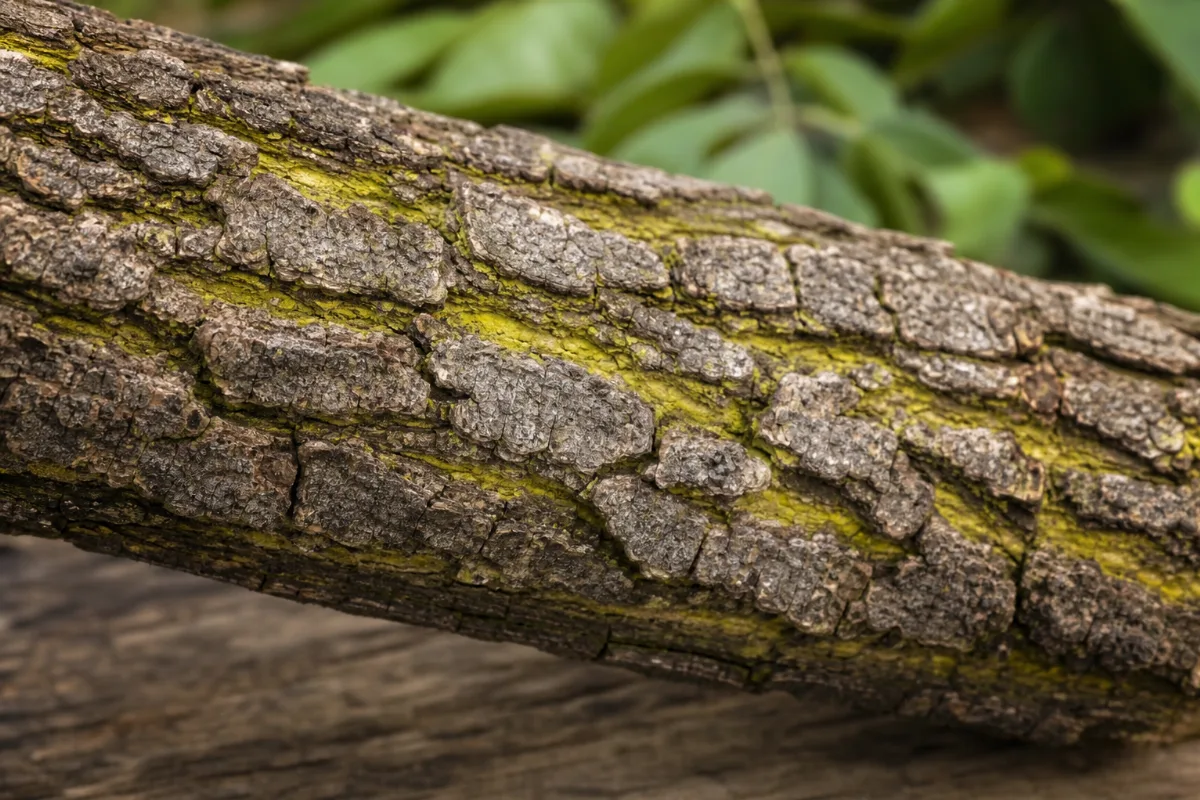
Herbs & Botanicals · Chinese bark with berberine
Phellodendron
Phellodendron amurense (bark) · also called Amur cork tree, cork tree bark, huang bai, obaku
Phellodendron is the bark of the Amur cork tree, used in Chinese medicine for diarrhea, infections and skin problems. Today it is sold mostly in a blend with magnolia bark for stress. Human research is small and mostly tests blends, not the bark alone. The bark contains berberine, so avoid it in pregnancy, breastfeeding and for babies, and check with a pharmacist about medicines.
General information, not medical advice. Last substantive update · Not medically reviewed. A named clinician has not signed off on this page. How this page is made
About Phellodendron
Phellodendron is a Chinese bark medicine with small blend trials for stress and a few other uses. The bark alone has not been tested in people. Because it holds berberine, it has clear cautions for pregnancy, newborns and some medicines.
What it is
Phellodendron is the inner bark of the Amur cork tree (Phellodendron amurense), a tree in the citrus family. A close relative, Phellodendron chinense, also supplies huang bai in Chinese medicine. A 2019 review reports that the two species differ in berberine content.
It is not the same as magnolia bark, cork oak or a berberine pill, although it shares berberine with goldenseal and barberry.
Traditional and current uses
In Chinese, Korean and Japanese medicine the bark is used to clear heat and dry dampness: diarrhea, jaundice, urinary infection, eczema and sores. Today it is sold as bark powder, capsules, extracts, and in the Relora blend with magnolia bark for stress.
What is in it and how it works
About 170 compounds have been isolated, mostly alkaloids such as berberine and palmatine. Lab and animal work suggests anti-inflammatory and antimicrobial effects, but how any of this works in people is unproven.
Berberine is poorly absorbed but can affect liver enzymes and transporters, which explains the interaction warnings.
What the research shows
The Relora trials gave mixed results: 56 stressed adults had lower cortisol and better mood than placebo, while a 40-woman pilot did not show a cortisol change. A 28-woman pilot found less weight gain than placebo. A two-herb blend with citrus peel helped knee scores in a pilot of 45 finishers, and a multi-herb tablet helped prostate storage symptoms in 105 men taking standard drugs.
All of these tested blends, and several authors worked for the maker. No trial tested the bark alone. Lab findings (anti-inflammatory, antibacterial, anticancer) are not shown in people.
At a glance
Traditional uses history, not proof
- Bark decoction for diarrhea and dysentery.
- Used for jaundice, urinary infection and vaginal discharge.
- Skin sores, eczema and swellings.
- Night sweats and fever in Chinese tradition.
Studied for research
- Stress and mood (blend with magnolia), low
- Short-term anxiety (blend), very-low
- Stress-related weight gain (blend), very-low
- Knee osteoarthritis (blend with citrus peel), very-low
- Prostate urinary symptoms (multi-herb tablet), very-low
- Blood fats, blood pressure and glucose (blends), very-low
- Lab anti-inflammatory and antimicrobial effects, insufficient
Main compounds
- Berberine
- Palmatine
- Phellodendrine
- Jatrorrhizine
- Obacunone and limonin
Common forms
- Dried bark (raw or processed)
- Powder or capsule
- Standardised bark extract
- Magnolia plus phellodendron blend
- Multi-herb patent tablet
Research links: Talbott 2013: Relora, cortisol and mood · Kalman 2008: Relora pilot in women · Sun 2019: Phellodendri cortex review · Singapore HSA: berberine herbs notice · Research Library · Genes & Biomarkers Library
The plant and its history
- Accepted scientific name
- Phellodendron amurense Rupr.
- Naming authority
- Rupr.
- Common names
- Amur cork tree (English); Cork tree bark (English); Huang bai (Chinese) (English); Obaku (Japanese) (English); Phellodendri cortex (English)
- Botanical family
- Rutaceae (citrus family)
- Classification
- Plantae > Sapindales > Rutaceae > Phellodendron > Phellodendron amurense Rupr.
- Native range
- Not verified in the sources read (the 2026 review covers geographic distribution but only its abstract was read).
- Habitat
- Not verified.
- What the plant looks like
- Roots: Not verified; Stems: The part used is the dried trunk bark (2019 review).; Leaves: Not verified; Flowers: Not verified; Fruit: Not verified
- Cultivation
- Not verified.
- Harvest and processing
- Bark is used raw or processed (salt-fried, wine-fried, charcoal) in Chinese practice (2019 review).
- Look-alikes and adulterants
- Name: Phellodendron chinense (chuan huang bai); Note: The second pharmacopoeia source of huang bai; the review gives different minimum berberine levels for the two species. Whether the two are interchangeable in clinical use was not verified.; Name: Magnolia bark and other berberine herbs; Note: Different plants. The Relora blend combines magnolia bark with phellodendron bark; goldenseal, barberry, Oregon grape and coptis also contain berberine.
- Sustainability and conservation
- Not assessed here.
Traditional use and history history, not clinical proof
| Tradition or era | Documented use | Source |
|---|---|---|
| Traditional Chinese, Korean and Japanese medicine | The bark is used to clear heat and dry dampness: diarrhea, jaundice, urinary infection, vaginal discharge, eczema, sores. Sources: 2026 review abstract. | p42075995 |
| Singapore, 1978 to 2016 | Berberine herbs, including Cortex Phellodendri, were restricted from 1978 over newborn jaundice concerns and allowed again from April 2016 with warnings. | s-hsa-berberine-2016 |
| Modern supplements (2000s) | Blends with magnolia bark (Relora) were studied for stress and weight in the 2000s; recorded in the trial papers. | p16454147 |
Traditional use shows how a plant was used. It does not show that a supplement works or is safe today.
What is inside, and how it may work
What the plant contains and how those compounds act in cells and animals. Laboratory and animal mechanisms are not proven effects in people.
Main compounds
| Compound | Family | Where it is concentrated | Activity studied | Level of evidence |
|---|---|---|---|---|
| Berberine PubChem 2353 | alkaloid | Bark Minimum 0.60% (P. amurense) to 3.0% (P. chinense) berberine hydrochloride, per the 2019 review | Safety-relevant alkaloid (newborn jaundice, interactions); lab antimicrobial and blood-sugar effects 16 20 | Laboratory research |
| Palmatine PubChem 19009 | alkaloid | Bark Minimum 0.30% in P. amurense per the review | Lab anti-inflammatory and antimicrobial activity reported 16 20 | Laboratory research |
| Phellodendrine PubChem 3081405 | alkaloid | Bark | Marker alkaloid; lab data only 16 20 | Laboratory research |
| Jatrorrhizine PubChem 72323 | alkaloid | Bark | Alkaloid found in the bark; lab data only 16 20 | Laboratory research |
| Obacunone PubChem 119041 | limonoid | Bark | Suspected anti-atopic-dermatitis compound in lab work 16 20 | Laboratory research |
| Limonin PubChem 179651 | limonoid | Bark | Bitter limonoid; lab data only 16 20 | Laboratory research |
Mechanisms, receptors and pathways
| Target or pathway | Gene or receptor | What was found | Level |
|---|---|---|---|
| Cortisol and stress response (blend) | Not specified | Proposed by the trial authors; one trial found lower cortisol, another did not. 21 10 | Human data |
| Liver enzymes CYP3A4, CYP2D6, CYP2C9 and transporters (berberine) | CYP3A4, CYP2D6, CYP2C9, P-glycoprotein, OCT1/OCT2, MATE1 | Berberine inhibits these and can induce CYP3A4; documented in people for few drug pairs. Processed bark changes CYP1A2 and CYP3A4 in lab work. 3 20 | Human data |
| Anti-inflammatory and antimicrobial actions | Not specified | Reported for bark extracts and alkaloids in cells and animals. 12 20 | Laboratory research |
| Skin inflammation (atopic dermatitis model) | Not specified | Obacunone and obaculactone suspected as the active compounds in lab work. 20 | Laboratory research |
Absorption, metabolism and elimination
- Absorption
- Berberine has very low oral bioavailability (0.68% in rats; low ng/mL blood levels in people), per a 2026 review. Bark-specific human data were not found.
- Distribution
- In animals the bark constituents spread to plasma, liver, spleen, kidney and brain (2019 review).
- Metabolism
- Berberine is processed by and affects CYP enzymes (see mechanisms).
- Elimination
- Not found for the bark in people.
- Bioavailability
- Low for berberine; magnoflorine and berberine alter each other's absorption in the bark decoction (rat work, 2019 review).
Isolated compounds versus whole extracts
Most safety and blood-sugar data are for pure berberine, which is only one of about 170 compounds in the bark and is present at different levels in the two species. Most human trials used blends. Effects of the whole bark cannot be inferred from berberine alone.
Nutritional composition
Phellodendron bark is a medicinal herb, not a nutrient source. No nutrient content was assessed.
1 low certainty5 very low certainty2 not enough evidence
What is Phellodendron good for?
The studied uses and how strong the human evidence is. Nearly everything rests on small trials of blends or on lab work. Ask a doctor or pharmacist about amounts and suitability for you.
Benefits, one by one
Each card is a research question, not a promise. Tap a goal to filter. Open a card to see the studies, doses and limits.
Stress and mood (magnolia plus phellodendron blend)
Low certaintyIn one trial of 56 stressed adults, the blend was linked to lower saliva cortisol and better self-rated mood than placebo after 4 weeks. This is for the two-bark blend, not phellodendron alone.
2 studiesBranded blend (Relora); doses not given on this page. Ask a doctor or…
Studies, doses and limits
What the trials found
One 4-week placebo-controlled trial (56 adults, moderate stress) found about 18% lower saliva cortisol and better scores on tension, anger, fatigue, vigor and overall mood versus placebo. A smaller earlier pilot did not find a cortisol change. Both trials used the same branded blend.
Results
Lower cortisol and better self-rated mood versus placebo in one trial; no cortisol change in the pilot.
Effect sizes as reported
Cortisol -18% (p<0.05); overall stress -11%, tension -13%, depression -20%, anger -42%, fatigue -31%, confusion -27%, vigor +18% (p<0.05) versus placebo. No confidence intervals in the abstract.
Why this rating
Two small trials, one positive on cortisol and mood, one not; both of one branded blend whose maker was linked to the pilot; mood scores are self-reported.
Form and dose studied
Branded blend (Relora); doses not given on this page. Ask a doctor or pharmacist about amounts.
Who was studied
Adults with moderate stress or stress-related eating; mostly women in the pilot.
Limits
Short trials (4 to 6 weeks). Blend, not the bark. Industry-linked. Not shown for diagnosed anxiety or depression.
Why researchers looked
The blend is sold for stress and stress-related eating. Both barks are used in Chinese and Korean traditional medicine.
Traditional use
Phellodendron bark is traditionally used to clear heat; stress use is a modern supplement idea, not a traditional one.
Proposed mechanism Pharmacological theory
Not established. The makers propose a cortisol-lowering effect; the trials do not prove how it works.
A proposed mechanism does not show that the effect happens in people.
See the safety tab: berberine cautions, medicine interactions, pregnancy and newborns.
Short-term anxiety (blend)
Very low certaintyIn a 40-woman pilot, the blend reduced short-term anxiety but not long-standing anxiety or depression. Cortisol and sleep did not change.
1 studiesBlend only.
Studies, doses and limits
What the trials found
26 of 40 women finished a 6-week placebo-controlled pilot. The Spielberger STATE (short-term) anxiety score was lower than placebo; the TRAIT (long-standing) score, saliva cortisol, amylase, appetite and sleep were not significantly changed.
Results
Less short-term anxiety only.
Effect sizes as reported
STATE anxiety improved versus placebo; numbers not given in the abstract.
Why this rating
Pilot with 35% dropout, one blend, and a mixed picture across outcomes.
Form and dose studied
Blend only.
Who was studied
Overweight premenopausal women who eat more when stressed.
Limits
Cannot be generalised to men, other ages or people with an anxiety disorder.
Why researchers looked
The pilot tested anxiety, stress hormones and sleep in overweight women who eat when stressed.
Traditional use
No traditional use for anxiety found in the sources read.
Proposed mechanism Pharmacological theory
Not established.
A proposed mechanism does not show that the effect happens in people.
See the safety tab: berberine cautions, medicine interactions, pregnancy and newborns.
Weight gain linked to stress eating (blend)
Very low certaintyA 6-week pilot found no weight gain on the blend, while the placebo group gained about 1.5 kg. It is not a weight-loss result.
1 studiesBlend only.
Studies, doses and limits
What the trials found
28 women finished. Placebo gained about 1.5 kg; the treated group had no significant change. Weight gainers (at least 1 kg): 75% of controls vs 37% treated. Evening cortisol showed a trend only.
Results
Less weight gain over 6 weeks versus placebo.
Effect sizes as reported
Placebo +1.5 kg; treated no significant change (p=0.89 within group); gainers 75% vs 37% (p<0.04).
Why this rating
Very small, authors worked for the maker, more dropouts in the control group, no long-term follow-up.
Form and dose studied
Blend only.
Who was studied
Overweight premenopausal women who eat under stress.
Limits
Tiny sample. Do not use in place of diet and medical advice.
Why researchers looked
The blend is marketed for stress-related weight gain.
Traditional use
No traditional use for weight control found in the sources read.
Proposed mechanism Pharmacological theory
Not established; the authors suggest lower cortisol but the cortisol change was not significant.
A proposed mechanism does not show that the effect happens in people.
See the safety tab: berberine cautions, medicine interactions, pregnancy and newborns.
Knee osteoarthritis symptoms (phellodendron plus citrus peel blend)
Very low certaintyAn 8-week pilot of a two-herb blend reported better knee scores and lower CRP in overweight adults. Weight loss may explain part of it.
1 studiesBlend of two plants.
Studies, doses and limits
What the trials found
80 adults with knee osteoarthritis enrolled, 45 finished. The blend (phellodendron bark plus orange peel) improved the Lequesne pain and movement score versus placebo in overweight and normal-weight groups and lowered CRP in the overweight group. The treated overweight group also lost about 5% body weight.
Results
Lower symptom score and CRP versus placebo in a pilot.
Effect sizes as reported
Lequesne 6.3 vs 11.8 (overweight) and 7.7 vs 9.9 (normal weight), p<0.0001; CRP -49% in overweight group vs placebo. ESR unchanged.
Why this rating
Pilot with 44% dropout, two-herb blend, weight loss confounds, makers linked to authors.
Form and dose studied
Blend of two plants.
Who was studied
Adults with knee osteoarthritis.
Limits
Do not replace prescribed arthritis care.
Why researchers looked
Phellodendron is used traditionally for swelling and inflammation.
Traditional use
Traditional anti-inflammatory use in Chinese medicine.
Proposed mechanism Laboratory research
Lab studies suggest anti-inflammatory compounds, not shown to explain the trial.
A proposed mechanism does not show that the effect happens in people.
See the safety tab: berberine cautions, medicine interactions, pregnancy and newborns.
Prostate enlargement (BPH) urinary symptoms (multi-herb tablet)
Very low certaintyA 6-month trial of a Chinese patent tablet taken with standard prostate drugs found better urine-storage symptoms and sleep than placebo. The bark alone was not tested.
1 studiesMulti-herb patent tablet taken with two prostate medicines.
Studies, doses and limits
What the trials found
120 men randomised, 105 finished. Added to tamsulosin plus finasteride, the tablet improved the storage-symptom subscore and sleep score more than placebo. The abstract reports a better adherence score too, but no clear gain on other measures.
Results
Modest improvement in storage symptoms and sleep as an add-on.
Effect sizes as reported
Storage subscore p=0.027; sleep score p<0.001; adherence score lower p=0.003.
Why this rating
One centre, multi-herb tablet of unlisted ingredients in the abstract, add-on design. Registered (ChiCTR2100046463).
Form and dose studied
Multi-herb patent tablet taken with two prostate medicines.
Who was studied
Men 45 to 75 with moderate-to-severe BPH symptoms.
Limits
Does not show the bark alone works; do not stop prescribed prostate drugs.
Why researchers looked
The tablet is used in China for anti-inflammatory and anti-infective purposes in the prostate.
Traditional use
Bark is traditionally used for painful urination and genital-area heat-damp complaints.
Proposed mechanism Pharmacological theory
Not established.
A proposed mechanism does not show that the effect happens in people.
See the safety tab: berberine cautions, medicine interactions, pregnancy and newborns.
Blood fats, blood pressure and blood sugar (blends)
Very low certaintySmall trials of blends reported better blood fats, blood pressure and glucose, but they also lost weight. The bark alone has not been tested for these.
3 studiesBlends only.
Studies, doses and limits
What the trials found
In the 45-person osteoarthritis pilot the blend was reported to lower triglycerides, LDL and blood pressure and raise HDL versus placebo, with lower fasting glucose in the overweight group and about 5% weight loss. In 10 exercise-trained men, a phellodendron plus crape myrtle blend lowered the blood glucose response to a glucose drink in one test.
Results
Direction of change in markers; no numbers in the abstract for the pilot.
Effect sizes as reported
Glucose curve lower with the blend p=0.01; insulin trend p=0.06 (10 men, one dose).
Why this rating
Secondary outcomes of a small trial; blends; weight loss; a one-dose, 10-man crossover test.
Form and dose studied
Blends only.
Who was studied
Adults with knee osteoarthritis; healthy trained men.
Limits
Do not use to replace blood sugar, cholesterol or blood pressure medicines; see interactions on the safety tab.
Why researchers looked
Researchers looked at metabolic markers in the same small osteoarthritis trial and in a one-day glucose test.
Traditional use
Not a traditional use in the sources read.
Proposed mechanism Pharmacological theory
Not established. Berberine, found in the bark, lowers blood sugar in trials of the pure compound (not the bark).
A proposed mechanism does not show that the effect happens in people.
See the safety tab: berberine cautions, medicine interactions, pregnancy and newborns.
Traditional use for heat-damp complaints
Not enough evidenceIn Chinese medicine the bark is used for diarrhea, jaundice, urinary infection, leukorrhea, eczema and skin sores. No controlled human trial of the bark for these was found.
2 studiesDried bark decoctions and processed bark in tradition.
Studies, doses and limits
What the trials found
The reviews describe traditional uses and lab effects; no human trial of the bark for diarrhea, infection or eczema was found in the sources read.
Results
Traditional only.
Effect sizes as reported
Not applicable.
Why this rating
Tradition is not trial evidence.
Form and dose studied
Dried bark decoctions and processed bark in tradition.
Who was studied
Adults in Chinese tradition.
Limits
No human trial found.
Why researchers looked
A long record of use in China and Korea.
Traditional use
Phellodendri cortex is listed for clearing heat, drying dampness and detoxifying, per a 2026 review.
Proposed mechanism Traditional use
Not tested in people.
A proposed mechanism does not show that the effect happens in people.
See the safety tab: berberine cautions, medicine interactions, pregnancy and newborns.
Anti-inflammatory, antibacterial and anticancer effects (lab and animal only)
Not enough evidenceCell and animal studies report these effects for bark extracts and compounds. None of this has been shown in people.
2 studiesNot applicable.
Studies, doses and limits
What the trials found
Reviews list antioxidant, antibacterial, antiviral, anti-inflammatory and antitumor effects in cells and animals, and suspect obacunone and obaculactone for skin-inflammation effects. No matching human trials were found.
Results
Lab and animal findings only.
Effect sizes as reported
Not applicable.
Why this rating
No human data.
Form and dose studied
Not applicable.
Who was studied
Not applicable.
Limits
Findings in dishes often fail in people.
Why researchers looked
Researchers study the many alkaloids in the bark.
Traditional use
Related to the traditional anti-heat and anti-sore uses.
Proposed mechanism Laboratory research
Compounds such as berberine, palmatine and obacunone show activity in dishes and animals.
A proposed mechanism does not show that the effect happens in people.
See the safety tab: berberine cautions, medicine interactions, pregnancy and newborns.
Connections to the rest of health
How Phellodendron connects to the rest of our health knowledge graph. Every link says what kind of connection it is. A safety link (for example to the liver) is a warning, not a benefit. A study that merely mentions a topic never creates a benefit link.
Explore every connection: goals, body systems, organs, symptoms, genes
A. Wellness goals
| Connected to | Kind of connection | Evidence status | Context | Studies |
|---|---|---|---|---|
| Stress reduction | Potential benefit | Low certainty | Two small trials of a blend. Stress and mood (magnolia plus phellodendron blend): In one trial of 56 stressed adults, the blend was linked to lower saliva cortisol and better self-rated mood than placebo after 4 weeks. This is for the two-bark blend, not phellodendron alone. Preparation or compound: Magnolia plus phellodendron blend |
21 10 6 |
| Mood Balance | Potential benefit | Low certainty | Stress and mood (magnolia plus phellodendron blend): In one trial of 56 stressed adults, the blend was linked to lower saliva cortisol and better self-rated mood than placebo after 4 weeks. This is for the two-bark blend, not phellodendron alone. | 21 10 |
| Anxiety Support | Potential benefit | Very low certainty | Short-term anxiety (blend): In a 40-woman pilot, the blend reduced short-term anxiety but not long-standing anxiety or depression. Cortisol and sleep did not change. | 10 |
| Calm Relaxation | Potential benefit | Very low certainty | Short-term anxiety (blend): In a 40-woman pilot, the blend reduced short-term anxiety but not long-standing anxiety or depression. Cortisol and sleep did not change. | 10 |
| Weight Management | Potential benefit | Very low certainty | Weight gain linked to stress eating (blend): A 6-week pilot found no weight gain on the blend, while the placebo group gained about 1.5 kg. It is not a weight-loss result. | 6 |
| Joint Support | Potential benefit | Very low certainty | Knee osteoarthritis symptoms (phellodendron plus citrus peel blend): An 8-week pilot of a two-herb blend reported better knee scores and lower CRP in overweight adults. Weight loss may explain part of it. | 18 |
| Inflammation Balance | Potential benefit | Very low certainty | Knee osteoarthritis symptoms (phellodendron plus citrus peel blend): An 8-week pilot of a two-herb blend reported better knee scores and lower CRP in overweight adults. Weight loss may explain part of it. Prostate enlargement (BPH) urinary symptoms (multi-herb tablet): A 6-month trial of a Chinese patent tablet taken with standard prostate drugs found better urine-storage symptoms and sleep than placebo. The bark alone was not tested. | 18 7 |
| Cholesterol Balance | Potential benefit | Very low certainty | Blood fats, blood pressure and blood sugar (blends): Small trials of blends reported better blood fats, blood pressure and glucose, but they also lost weight. The bark alone has not been tested for these. | 17 2 11 |
| Blood Pressure Support | Potential benefit | Very low certainty | Blood fats, blood pressure and blood sugar (blends): Small trials of blends reported better blood fats, blood pressure and glucose, but they also lost weight. The bark alone has not been tested for these. | 17 2 11 |
| Blood Sugar Balance | Potential benefit | Very low certainty | Blood fats, blood pressure and blood sugar (blends): Small trials of blends reported better blood fats, blood pressure and glucose, but they also lost weight. The bark alone has not been tested for these. | 17 2 11 |
| Digestive Support | Traditional use | Not enough evidence | Traditional use for heat-damp complaints: In Chinese medicine the bark is used for diarrhea, jaundice, urinary infection, leukorrhea, eczema and skin sores. No controlled human trial of the bark for these was found. | 12 20 |
| Healthy Skin | Traditional use | Not enough evidence | Traditional use for heat-damp complaints: In Chinese medicine the bark is used for diarrhea, jaundice, urinary infection, leukorrhea, eczema and skin sores. No controlled human trial of the bark for these was found. | 12 20 |
| Immune Support | Traditional use | Not enough evidence | Traditional use for heat-damp complaints: In Chinese medicine the bark is used for diarrhea, jaundice, urinary infection, leukorrhea, eczema and skin sores. No controlled human trial of the bark for these was found. | 12 20 |
| Inflammation Balance | Preliminary mechanism | Not enough evidence | Anti-inflammatory, antibacterial and anticancer effects (lab and animal only): Cell and animal studies report these effects for bark extracts and compounds. None of this has been shown in people. | 12 20 |
B. Body systems
| Connected to | Kind of connection | Evidence status | Context | Studies |
|---|---|---|---|---|
| Cardiovascular system | Drug or supplement interaction | Low certainty | May add to blood pressure medicines. Preparation or compound: Berberine |
11 |
| Stress Mood | Biological association | Low certainty | Studied for: Stress and mood (magnolia plus phellodendron blend) Studied for: Short-term anxiety (blend) | 21 10 6 |
| Metabolism Weight | Biological association | Very low certainty | Studied for: Weight gain linked to stress eating (blend) Studied for: Blood fats, blood pressure and blood sugar (blends) | 6 17 2 11 |
| Musculoskeletal System | Biological association | Very low certainty | Studied for: Knee osteoarthritis symptoms (phellodendron plus citrus peel blend) | 18 |
| Urinary System | Biological association | Very low certainty | Studied for: Prostate enlargement (BPH) urinary symptoms (multi-herb tablet) Studied for: Traditional use for heat-damp complaints | 7 12 20 |
| Reproductive System | Biological association | Very low certainty | Studied for: Prostate enlargement (BPH) urinary symptoms (multi-herb tablet) | 7 |
| Cardiovascular System | Biological association | Very low certainty | Studied for: Blood fats, blood pressure and blood sugar (blends) | 17 2 11 |
| Digestive System | Biological association | Not enough evidence | Studied for: Traditional use for heat-damp complaints | 12 20 |
| Integumentary System | Biological association | Not enough evidence | Studied for: Traditional use for heat-damp complaints | 12 20 |
| Immune System | Biological association | Not enough evidence | Studied for: Anti-inflammatory, antibacterial and anticancer effects (lab and animal only) | 12 20 |
C. Body parts and organs
I. Biomarkers
| Connected to | Kind of connection | Evidence status | Context | Studies |
|---|---|---|---|---|
| Cortisol | Potential benefit | Low certainty | Lower in one trial, unchanged in another. Lower in one trial only. Preparation or compound: Magnolia plus phellodendron blend |
21 10 |
| Saliva cortisol | Biological association | Low certainty | Measured in trials: mixed. A lab change is not the same as a health benefit. | 21 10 6 |
| Self-rated mood and anxiety scores | Biological association | Low certainty | Measured in trials: lowered. A lab change is not the same as a health benefit. | 21 10 |
| Body weight change | Biological association | Very low certainty | Measured in trials: mixed. A lab change is not the same as a health benefit. | 6 |
| C-reactive protein (CRP) | Biological association | Very low certainty | Measured in trials: lowered. A lab change is not the same as a health benefit. | 18 |
| Lequesne knee index | Biological association | Very low certainty | Measured in trials: lowered. A lab change is not the same as a health benefit. | 18 |
| Urine-storage symptom score (IPSS-S) | Biological association | Very low certainty | Measured in trials: lowered. A lab change is not the same as a health benefit. | 7 |
| Blood glucose | Biological association | Very low certainty | Measured in trials: lowered. A lab change is not the same as a health benefit. | 2 17 |
| Blood fats (triglycerides, LDL and HDL cholesterol) | Biological association | Very low certainty | Measured in trials: mixed. A lab change is not the same as a health benefit. | 17 |
L. Active compounds
| Connected to | Kind of connection | Evidence status | Context | Studies |
|---|---|---|---|---|
| Berberine | Biological association | In vitro | Safety-relevant alkaloid (newborn jaundice, interactions); lab antimicrobial and blood-sugar effects Preparation or compound: Bark |
16 20 |
| Palmatine | Biological association | In vitro | Lab anti-inflammatory and antimicrobial activity reported Preparation or compound: Bark |
16 20 |
| Phellodendrine | Biological association | In vitro | Marker alkaloid; lab data only Preparation or compound: Bark |
16 20 |
| Jatrorrhizine | Biological association | In vitro | Alkaloid found in the bark; lab data only Preparation or compound: Bark |
16 20 |
| Obacunone | Biological association | In vitro | Suspected anti-atopic-dermatitis compound in lab work Preparation or compound: Bark |
16 20 |
| Limonin | Biological association | In vitro | Bitter limonoid; lab data only Preparation or compound: Bark |
16 20 |
Each connection is stored with the ingredient, the connected record, the kind of connection, the evidence status, the supporting studies, the preparation or compound involved, and a review date (last reviewed October 25, 2026).
Evidence at a glance: what changed in 8 lab markers
Tap a number to show only those markers. Counts are markers, not people.
The evidence
The research centre for Phellodendron. Every record here was checked against PubMed or the publisher's page; we never list a study we have not verified.
Evidence by outcome
Bars show how many studies we found for each outcome, not how well it works. People are added up across trials only (reviews are not added, to avoid double counting).
How we rate evidence
High certainty
Several well-run trials or reviews agree; further research is unlikely to change the picture much.
Moderate certainty
Good trials point the same way, but some doubt remains.
Low certainty
Small, short or inconsistent trials. The finding could change with better research.
Very low certainty
Very little or very weak human data. Treat as a possibility only.
Mixed findings
Trials or reviews disagree with each other.
Not enough evidence
Not enough human research to say either way.
Evidence against
Good research found no benefit, or found harm.
We take the reviewers' own risk-of-bias and GRADE statements where they exist, and otherwise judge from study size, design, consistency, directness and whether a product matches what is sold. Many publications do not make evidence high. Method note: We started from our existing phellodendron summary, re-read the PubMed abstract of every PubMed study cited, read the Singapore HSA notice, the Memorial Sloan Kettering berberine page and a consumer reference, and checked plant names and compounds in GBIF, NCBI and PubChem. Not found or not read: an EMA monograph, an NCCIH page, LiverTox and LactMed. Certainty ratings are the compiler's reading, not formal grades. No study is cited that we could not verify.
Study library: every study we checked 21
| Study | Design | People | Product, dose, length | Result |
|---|---|---|---|---|
| Alam 2021 Safety studies of Nexrutine, bark extract of Phellodendron amurense through repeated oral exposure to rats for 28 days Heliyon · PMID 34386623 · DOI |
Animal research animal |
Rats | Nexrutine, a branded bark extract of Phellodendron amurense bark Single 2000 mg/kg; 250, 500 and 750 mg/kg daily 28 days · vs untreated |
No signs of toxicity after the single dose. After 28 days no toxicity signs; a marginal drop in triglycerides, cholesterol and glucose and mild kidney tubule degeneration at the highest dose. Authors judged safe up to 500 mg/kg. Animal safety only Methods, limits and fundingOutcomes: Toxicity signs, blood tests, tissue slides Limitations: Rats; says little about people Funding and conflicts: No conflict declared Read: abstract |
| Canale 2011 A blend of phellodendron and crape myrtle improves glucose tolerance in exercise-trained men Nutr Metab Insights · PMID 23946660 · DOI |
Controlled trial |
10 Healthy exercise-trained men, single test day each (crossover) |
Proprietary blend of Phellodendron and crape myrtle (Lagerstroemia) not stated single dose 15 minutes before a 75 g glucose drink one test day per condition · vs placebo |
Blood glucose lower with the blend than placebo (p=0.01); insulin a non-significant trend lower (p=0.06). Short-term effect on one glucose test in 10 men Methods, limits and fundingOutcomes: Blood glucose and insulin over 75 minutes Limitations: 10 people, one dose, healthy men, blend of two plants Funding and conflicts: Not stated in the abstract Read: abstract |
| Dumitru 2026 Berberine-Drug Interactions: Mechanisms, Clinical Relevance and Risk Stratification-A Narrative Review Pharmaceuticals (Basel) · PMID 42653808 · DOI |
Narrative review mixed |
Narrative review of berberine as a cause of supplement-drug interactions | Berberine (isolated compound; not phellodendron bark) not applicable not applicable not applicable · vs not applicable |
Interactions via CYP3A4 (inhibition and induction), CYP2D6 and CYP2C9 inhibition, transporters (P-glycoprotein, OCT1/OCT2, MATE1), and added effects (low blood sugar, low blood pressure, QT prolongation). Documented in people for only a few pairs; mostly mechanistic. The anchor human finding: cyclosporine exposure up 34.5% (AUC) in kidney-transplant recipients. Advises managing berberine as an active drug in people on several medicines. Interaction liability for berberine Methods, limits and fundingOutcomes: Mechanisms and clinical relevance of berberine interactions Limitations: Narrative review; applies to berberine, bark content varies; abstract only Funding and conflicts: No conflict declared Read: abstract |
| GBIF Secretariat 2026 GBIF Backbone Taxonomy: Phellodendron amurense Rupr. (usage key 3190154) GBIF species match API · Source |
Database record not applicable |
Plant name check | Phellodendron amurense whole plant not applicable not applicable · vs not applicable |
Status ACCEPTED, exact match, confidence 99. Family Rutaceae, order Sapindales. Name record Methods, limits and fundingOutcomes: Accepted name and family Limitations: API checked 2026-10-25 Funding and conflicts: None Read: full-text |
| GBIF Secretariat 2026 GBIF Backbone Taxonomy: Phellodendron chinense C.K.Schneid. (usage key 3831897) GBIF species match API · Source |
Database record not applicable |
Plant name check | Phellodendron chinense whole plant not applicable not applicable · vs not applicable |
Status ACCEPTED, exact match, confidence 99. Family Rutaceae. Name record Methods, limits and fundingOutcomes: Accepted name Limitations: API checked 2026-10-25 Funding and conflicts: None Read: full-text |
| Garrison 2006 Effect of a proprietary Magnolia and Phellodendron extract on weight management: a pilot, double-blind, placebo-controlled clinical trial Altern Ther Health Med · PMID 16454147 |
Controlled trial |
28 Overweight premenopausal women who eat more under stress and score above average on anxiety (28 completers) |
Relora, a branded blend of Magnolia officinalis bark and Phellodendron amurense bark extracts (Next Pharmaceuticals); not phellodendron alone bark (both species) 250 mg capsules three times a day 6 weeks · vs placebo |
Placebo group gained on average 1.5 kg; the treated group had no significant change. 75% of controls vs 37% of the treated group gained at least 1 kg (p<0.04). Average cortisol difference not significant; a trend to lower evening cortisol (p=0.06). Both groups improved on psychological scores. Less weight gain over 6 weeks, not weight loss Methods, limits and fundingOutcomes: Weight change, saliva cortisol, stress and anxiety scales Limitations: Very small; more dropouts in the placebo group; blend Funding and conflicts: Both authors at Next Pharmaceuticals (product maker) Read: abstract |
| Gong 2021 A randomized placebo-controlled study: Phellodendron Bawei tablets combined with standard management can improve storage symptoms, sleep quality, and medication compliance in patients with benign prostatic hyperplasia Transl Androl Urol · PMID 34532267 · DOI |
Controlled trial |
120 Men 45 to 75 with moderate-to-severe BPH symptoms; 105 completed |
Phellodendron Bawei tablets (Chinese patent medicine; ingredients not listed in the abstract) added to tamsulosin plus finasteride not stated not stated here 6 months · vs placebo plus tamsulosin and finasteride |
Storage-symptom subscore (p=0.027) and sleep score (p<0.001) improved more with the tablets; medication-adherence score lower (p=0.003). The abstract reports no clear gain on the other measures. Modest gains on storage symptoms and sleep as add-on Methods, limits and fundingOutcomes: Urinary symptom score (IPSS) and subscores, sleep (Athens Insomnia Scale), adherence Limitations: Single centre; multi-herb product; add-on to drugs Funding and conflicts: Authors declared no conflicts; Chinese Clinical Trial Registry ChiCTR2100046463 Read: abstract |
| Health Sciences Authority (Singapore) 2016 HSA allows sale and import of Chinese herbs containing berberine from 1 April 2016 HSA announcement · Source |
Authoritative guidance authoritative-guidance |
Chinese herbs containing berberine, including Cortex Phellodendri (huang bai) | Cortex Phellodendri and Rhizoma Coptidis bark not applicable not applicable · vs not applicable |
Singapore lifted its ban on berberine herbs from 1 April 2016 (restricted since 1978). Advises that G6PD-deficient people of all ages, pregnant and breastfeeding women, and infants avoid these herbs. Regulator advice Methods, limits and fundingOutcomes: Regulatory status and advice Limitations: Single country Funding and conflicts: Regulator document Read: full-text |
| Ho 2014 From prejudice to evidence: the case of rhizoma coptidis in Singapore Evid Based Complement Alternat Med · PMID 25610485 · DOI |
Narrative review mixed |
Literature review on Rhizoma coptidis (huang lian) and berberine | Rhizoma coptidis and berberine (not phellodendron specifically) rhizome not applicable not applicable · vs not applicable |
Rhizoma coptidis was linked in 1978 to newborn jaundice and kernicterus in G6PD-deficient babies, leading to a ban; later evidence led the regulator to lift it. Context for the newborn-jaundice caution Methods, limits and fundingOutcomes: History of the 1978 Singapore ban on berberine herbs Limitations: About a related herb; abstract only Funding and conflicts: Not stated Read: abstract |
| Kalman 2008 Effect of a proprietary Magnolia and Phellodendron extract on stress levels in healthy women: a pilot, double-blind, placebo-controlled clinical trial Nutr J · PMID 18426577 · DOI |
Controlled trial |
40 Healthy overweight premenopausal women (BMI 25 to 34.9), age 20 to 50, who eat more when stressed; 26 completed |
Relora, a branded blend of Magnolia officinalis bark and Phellodendron amurense bark extracts (Next Pharmaceuticals); not phellodendron alone bark (both species) 250 mg capsules three times a day 6 weeks · vs placebo |
Less short-term (STATE) anxiety than placebo. No benefit on long-standing (TRAIT) anxiety or depression. Cortisol, amylase, appetite, body shape and sleep not significantly changed. No significant adverse events. Mild, short-term anxiety only Methods, limits and fundingOutcomes: Spielberger anxiety scales, saliva cortisol and amylase, sleep, appetite, safety markers Limitations: Pilot; 14 of 40 did not finish; blend Funding and conflicts: One author works for the product maker (Garrison, Next Pharmaceuticals) Read: abstract |
| Lan 2015 Meta-analysis of the effect and safety of berberine in the treatment of type 2 diabetes mellitus, hyperlipemia and hypertension J Ethnopharmacol · PMID 25498346 · DOI |
Meta-analysis |
2569 27 randomised trials of berberine (the purified alkaloid) in type 2 diabetes, high blood fats and high blood pressure |
Berberine (isolated compound; not phellodendron bark) not applicable not stated in abstract varied · vs placebo, lifestyle alone, or drugs |
Berberine added to lifestyle changes or to glucose, fat or blood-pressure drugs tended to lower the markers more than those alone. No serious adverse reactions were reported in the 27 trials. Authors say the quality of the trials was limited. Berberine lowers these markers in trials of limited quality Methods, limits and fundingOutcomes: Blood sugar, blood fats, blood pressure, adverse events Limitations: Isolated berberine, not the bark; low quality trials Funding and conflicts: Not stated Read: abstract |
| Li 2026 An Updated and Comprehensive Review of Phellodendri amurensis Cortex: Ethnobotany, Geographical Distribution, Phytochemistry, Quality Control, and Pharmacology Molecules · PMID 42075995 · DOI |
Narrative review mixed |
Literature review | Phellodendri amurensis cortex (P. amurense bark) bark not applicable not applicable · vs not applicable |
About 170 compounds isolated, mainly alkaloids, also phenolics, terpenoids, sterols, lignans and flavonoids. Lab effects reported: antioxidant, antibacterial, anti-inflammatory, immunosuppressive, anticancer. Authors say mechanisms and quality control need more work. Review; mostly lab findings Methods, limits and fundingOutcomes: Traditional use, chemistry, quality control, lab pharmacology Limitations: Narrative review, not a systematic one; abstract only read Funding and conflicts: No conflict declared Read: abstract |
| Linn 2012 Berberine-induced haemolysis revisited: safety of Rhizoma coptidis and Cortex phellodendri in chronic haematological diseases Phytother Res · PMID 22002596 · DOI |
Case series |
20 20 patients with chronic low blood-count diseases who took Chinese herb mixtures containing Rhizoma coptidis, Cortex phellodendri or both |
Chinese herbal concoctions including Cortex phellodendri (1,252 patient-days) and Rhizoma coptidis (1,055 patient-days) bark traditional dosage (not stated in abstract) not stated per patient · vs none (single-arm) |
No organ toxicity or electrolyte imbalance. Three people with thalassemia intermedia had a temporary rise in bilirubin without worse anaemia or liver problems. Authors concluded use at traditional dose is safe; they found conflicting literature on newborn jaundice. Safety signal absent in 20 patients Methods, limits and fundingOutcomes: Organ toxicity, electrolytes, bilirubin, anaemia Limitations: Single arm, 20 people, mixed herbs, not newborns; authors Singapore hospital Funding and conflicts: Not stated in the abstract Read: abstract |
| Memorial Sloan Kettering Cancer Center 2023 Berberine (patient and healthcare professional herb monograph) MSK About Herbs · Source |
Authoritative guidance authoritative-guidance |
Berberine monograph; does not name phellodendron | Berberine and berberine-containing plants not applicable not applicable not applicable · vs not applicable |
Advises avoiding berberine in pregnancy and breastfeeding. May worsen jaundice in infants and lead to kernicterus. Berberine raised cyclosporine levels in kidney-transplant adults; a child on tacrolimus had raised levels and kidney toxicity; repeated intake reduced CYP2D6, 2C9 and 3A4 activity; bosutinib and sulfonylureas also listed. Mild side effects: appetite loss, upset stomach, diarrhea, constipation, rash. May lower blood sugar. Cautions for berberine, applied to the bark by inference Methods, limits and fundingOutcomes: Safety, interactions, side effects Limitations: Not about phellodendron by name Funding and conflicts: Cancer-centre information page Read: full-text |
| NCBI 2026 NCBI Taxonomy: Phellodendron amurense (taxonomy ID 68554) NCBI Taxonomy esearch · Source |
Database record not applicable |
Plant name check | Phellodendron amurense whole plant not applicable not applicable · vs not applicable |
One matching entry, taxonomy ID 68554, found by name search. Name record Methods, limits and fundingOutcomes: Name record Limitations: Only the search hit was checked, not the full record Funding and conflicts: None Read: summary-only |
| NCBI PubChem 2026 PubChem compound records: berberine, palmatine, phellodendrine, jatrorrhizine, limonin, obacunone PubChem PUG REST · Source |
Database record not applicable |
Compound name check | Named bark compounds not applicable not applicable not applicable · vs not applicable |
CIDs found by name: berberine 2353, palmatine 19009, phellodendrine 3081405, jatrorrhizine 72323, limonin 179651, obacunone 119041. Identifier check only Methods, limits and fundingOutcomes: Compound identifiers Limitations: Name match only Funding and conflicts: None Read: full-text |
| Oben 2008 Phellodendron and Citrus extracts benefit cardiovascular health in osteoarthritis patients: a double-blind, placebo-controlled pilot study Nutr J · PMID 18492265 · DOI |
Controlled trial |
80 Same trial population as the knee study: 80 enrolled, 45 finished |
NP 06-1: Phellodendron amurense bark plus Citrus sinensis peel extracts bark + fruit peel two 370 mg capsules twice a day 8 weeks · vs placebo |
Reported lower triglycerides and LDL cholesterol, higher HDL, lower blood pressure, and lower fasting glucose in the overweight treated group vs placebo; both treated groups lost weight vs placebo. The abstract gives no numbers for these changes. Direction of change only (no numbers in the abstract) Methods, limits and fundingOutcomes: Blood fats, weight, BMI, blood pressure, fasting glucose Limitations: Secondary look at the same small pilot; blend; weight loss confounds Funding and conflicts: Two authors at Next Pharmaceuticals (product maker) Read: abstract |
| Oben 2009 Phellodendron and Citrus extracts benefit joint health in osteoarthritis patients: a pilot, double-blind, placebo-controlled study Nutr J · PMID 19682376 · DOI |
Controlled trial |
80 Overweight and normal-weight adults with knee osteoarthritis; 80 enrolled, 45 finished |
NP 06-1: Phellodendron amurense bark plus Citrus sinensis peel extracts (two-herb blend) bark + fruit peel two 370 mg capsules twice a day 8 weeks · vs placebo |
Lequesne score better than placebo in overweight (6.3 +/- 2.3 vs 11.8 +/- 1.5) and normal-weight (7.7 +/- 1.4 vs 9.9 +/- 0.9) groups (p<0.0001). CRP fell 49% in the overweight treated group vs placebo; normal-weight group not different from placebo. ESR unchanged. Overweight treated group lost about 5% body weight. Symptom score improvement, with weight loss as a possible contributor Methods, limits and fundingOutcomes: Lequesne index (pain and movement), CRP, ESR Limitations: Pilot; 35 of 80 did not finish; two-herb blend; weight loss confounds Funding and conflicts: Two authors at Next Pharmaceuticals (product maker) Read: abstract |
| RxList (consumer drug reference) 2026 Phellodendron (supplement monograph) RxList · Source |
Consumer reference consumer-reference |
Consumer reference page | Phellodendron (Phellodendron amurense bark) bark not applicable not applicable · vs not applicable |
Rated likely safe short-term; safety beyond 6 weeks unknown. Rates pregnancy, breastfeeding and newborn use unsafe (berberine can cross the placenta and enter milk; brain damage risk in newborns, mainly premature babies with jaundice). Moderate interaction ratings for cyclosporine and CYP3A4-processed medicines. Reports of heartburn, hand tremor, sexual dysfunction and thyroid dysfunction in one study participant, cause unclear. Secondary consumer source; used for the points above only Methods, limits and fundingOutcomes: Safety, pregnancy, interactions Limitations: Not a primary source; underlying references not checked Funding and conflicts: Commercial site Read: full-text |
| Sun 2019 Phellodendri Cortex: A Phytochemical, Pharmacological, and Pharmacokinetic Review Evid Based Complement Alternat Med · PMID 31057654 · DOI |
Narrative review mixed |
Literature review | Phellodendri cortex from P. amurense (Guan huang bai) and P. chinense (Chuan huang bai) bark not applicable not applicable · vs not applicable |
140 compounds listed. Lab effects reported include anti-inflammatory, antibacterial, antiviral, antitumor and anti-atopic-dermatitis (obacunone and obaculactone suspected). Toxicity results are called controversial; the main allegation is neonatal jaundice and kernicterus; the review advises bilirubin and haemoglobin monitoring in haemolytic disease and restricting use around birth. Reports minimum berberine hydrochloride of 3.0% for P. chinense and 0.60% for P. amurense. Processing changes liver-enzyme effects in lab work. Review; no human efficacy conclusions Methods, limits and fundingOutcomes: Compounds, lab pharmacology, pharmacokinetics, toxicity Limitations: Narrative review; read as abstract and searched passages of the open full text, not every line Funding and conflicts: Not stated Read: full-text |
| Talbott 2013 Effect of Magnolia officinalis and Phellodendron amurense (Relora) on cortisol and psychological mood state in moderately stressed subjects J Int Soc Sports Nutr · PMID 23924268 · DOI |
Controlled trial |
56 35 men and 21 women screened for moderate stress |
Relora, a branded blend of Magnolia officinalis bark and Phellodendron amurense bark extracts (Next Pharmaceuticals); not phellodendron alone bark (both species) not stated here 4 weeks · vs placebo |
Saliva cortisol 18% lower than placebo (p<0.05). Better mood scores than placebo (p<0.05): overall stress -11%, tension -13%, depression -20%, anger -42%, fatigue -31%, confusion -27%; global mood +11%, vigor +18%. Small to moderate changes in self-rated scores and one hormone measure Methods, limits and fundingOutcomes: Saliva cortisol; self-rated mood state Limitations: Small, short, one centre; mood scores are self-reported; blend, not the bark alone; no clinical outcome Funding and conflicts: Product made by Next Pharmaceuticals; author funding not stated in the abstract Read: abstract |
What we do not know yet
- What the evidence supports: small trials of blends only; the bark alone is untested.
- No independent replication of the stress or weight findings.
- No interaction or pregnancy study of the bark; cautions come from berberine.
- No EMA monograph, NCCIH page, LiverTox or LactMed entry was read.
- No survey of product quality or mix-ups.
How new research is added
New studies are found by a saved PubMed search and placed in a review queue. A person reads each one before it changes any evidence rating or safety wording. New publications never change ratings automatically.
Lab markers
What changed in blood or saliva tests during trials. A changed number is not the same as feeling or being healthier, and we give no "normal ranges".
Hormonal 1
Saliva cortisol
Mixed results in trials
A stress hormone measured in saliva.
Low certaintyResults and what it means
Why it was measured
Used as a marker of how the body is handling stress.
Statistical vs. clinical meaning
A lower cortisol number does not prove a person feels or functions better.
Safety implication
None reported.
| Study | Result | People | Product |
|---|---|---|---|
| 21 | 18% lower than placebo after 4 weeks (p<0.05) | 56 moderately stressed adults | Relora blend, 4 weeks |
| 10 | No significant difference from placebo | 40 overweight women (26 finished) | Relora blend, 6 weeks |
| 6 | No significant average change; a trend to lower evening cortisol (p=0.06) | 28 overweight women who eat under stress | Relora blend, 6 weeks |
Metabolic 3
Body weight change
Mixed results in trials
Change in body weight over the trial.
Very low certaintyResults and what it means
Blood glucose
Lowered in trials
Sugar level in the blood.
Very low certaintyResults and what it means
Why it was measured
Tests how the body handles sugar.
Statistical vs. clinical meaning
Tiny studies of blends.
Safety implication
Could add to blood-sugar medicines; see safety tab.
Blood fats (triglycerides, LDL and HDL cholesterol)
Mixed results in trials
Fats in the blood linked to heart risk.
Very low certaintyResults and what it means
Why it was measured
Used to look at heart risk factors.
Statistical vs. clinical meaning
Direction only.
Safety implication
None reported.
| Study | Result | People | Product |
|---|---|---|---|
| 17 | Reported lower triglycerides and LDL and higher HDL versus placebo; no numbers in the abstract | 45 finishers | Phellodendron plus citrus peel blend, 8 weeks |
Inflammatory 1
C-reactive protein (CRP)
Lowered in trials
A blood marker of inflammation.
Very low certaintyResults and what it means
Why it was measured
Used as a sign of body inflammation in the knee pilot.
Statistical vs. clinical meaning
A lower CRP is not the same as less pain; the group also lost weight.
Safety implication
None reported.
| Study | Result | People | Product |
|---|---|---|---|
| 18 | Overweight treated group: -0.62 +/- 0.2 (49%) versus baseline and placebo; normal-weight group not different from placebo | 45 finishers with knee osteoarthritis | Phellodendron bark plus citrus peel blend, 8 weeks |
Other 3
Self-rated mood and anxiety scores
Lowered in trials
Questionnaire scores for tension, mood and anxiety.
Low certaintyResults and what it means
Why it was measured
These are what people feel, so they matter more than a lab number, but they can be swayed by expectation.
Statistical vs. clinical meaning
Self-reported, small trials, blend.
Safety implication
None reported.
Lequesne knee index
Lowered in trials
A questionnaire on knee pain and movement.
Very low certaintyResults and what it means
Why it was measured
Shows how knee symptoms feel to the patient.
Statistical vs. clinical meaning
Lower is better; pilot with high dropout.
Safety implication
None reported.
| Study | Result | People | Product |
|---|---|---|---|
| 18 | 6.3 vs 11.8 (overweight) and 7.7 vs 9.9 (normal weight) versus placebo (p<0.0001) | 45 finishers | Same blend, 8 weeks |
Urine-storage symptom score (IPSS-S)
Lowered in trials
Part of a questionnaire on bladder symptoms such as urgency and frequency.
Very low certaintyResults and what it means
Why it was measured
Shows how bothersome storage symptoms are.
Statistical vs. clinical meaning
Statistically better; the size of the change is not given in the abstract.
Safety implication
None reported.
| Study | Result | People | Product |
|---|---|---|---|
| 7 | Improved more than with placebo (p=0.027) | 105 men finishing | Phellodendron Bawei tablets plus tamsulosin and finasteride, 6 months |
Safety
What studies and official sources say about side effects, medicines and who should check first. Each point shows what kind of evidence it comes from.
Main points to know 6
- Berberine cautions are carried over from the berberine in the bark. The bark contains berberine. Safety sources on berberine advise avoiding it in pregnancy and breastfeeding and in newborns, because of newborn jaundice and kernicterus. No safety study of the bark in these groups was found. Authoritative guidance 14 8 20
- G6PD deficiency. Singapore's regulator advises people with G6PD deficiency of any age to avoid berberine herbs, and it names Cortex Phellodendri. A small hospital series in 20 patients with blood diseases found no organ damage and only a temporary bilirubin rise in three. Authoritative guidance 8 13
- Medicine interactions. Berberine can raise levels of some medicines (cyclosporine, tacrolimus) and slow their breakdown by liver enzymes. A consumer reference rates the bark as a moderate interaction with cyclosporine and CYP3A4 medicines. No interaction study of the bark itself was found. Case report 14 3 19
- Blood sugar and blood pressure medicines. Berberine may lower blood sugar and blood pressure, so it could add to the effect of medicines for these. This is shown for pure berberine and from two small blend trials, not for the bark alone. Meta-analysis 11 3 14
- Stomach upset. For berberine, appetite loss, upset stomach, diarrhea, constipation and rash are listed. The Relora trials reported no significant adverse events, and the osteoarthritis pilot reported no serious ones. Authoritative guidance 14 10 18
- Long-term safety unknown. A consumer reference says safety beyond 6 weeks is unknown. The longest human trial found was 6 months, of a multi-herb tablet. Authoritative guidance 19 7
Side effects 4
| Effect | How often | Severity and recovery | Evidence |
|---|---|---|---|
| No significant adverse events in the Relora pilot and trial; no serious adverse events in the 80-person osteoarthritis pilot Small, short trials; a lack of reports is not proof of safety. | Not established | not reported not applicable | Controlled trial 10 18 |
| Appetite loss, upset stomach, diarrhea, constipation, rash (berberine) Listed for berberine, not specifically for the bark. | Not established | mild not stated | Authoritative guidance 14 |
| Heartburn, hand tremor, sexual dysfunction, thyroid dysfunction in one study participant; fatigue and headache in another The source says it is unclear whether the bark caused them. | Not established | not stated not stated | Authoritative guidance 19 |
| Temporary bilirubin rise in 3 of 20 patients with thalassemia intermedia taking herb mixtures with phellodendron or coptis Mixtures, not the bark alone. | 3 of 20 | mild, no worse anaemia temporary | Case series 13 |
Liver
No NIH LiverTox entry for phellodendron was read (the NCBI page was blocked by a browser check and not retried). In the 20-patient hospital series, no liver dysfunction was reported with phellodendron-containing herb mixtures. We found no case report of liver injury from the bark. This is a gap, not a clean bill of health. 13
How often. No frequency data.
Monitoring. No agency advice found. People with liver disease or on liver-affecting medicines should ask a doctor or pharmacist.
This is a safety connection. It is not evidence that Phellodendron supports liver health.
Medicines and supplements 5
| With | Why it matters | Importance | Evidence | What to do |
|---|---|---|---|---|
| Cyclosporine and tacrolimus (transplant medicines) prescription | Berberine raised cyclosporine levels in kidney-transplant adults (AUC about +34.5%, per a 2026 review) and was linked to raised tacrolimus in a child. | Narrow-margin medicines; a consumer reference rates the bark moderate for cyclosporine. | Case report Low certainty 14 3 19 | Do not combine without the transplant team. |
| Medicines broken down by CYP3A4, CYP2D6 or CYP2C9, and P-glycoprotein or OCT transporter substrates prescription | Berberine inhibits (and for CYP3A4 can also induce) these enzymes and transporters; lab work on processed bark shows enzyme changes too. | Documented in people for only a few pairs; mostly mechanistic. Not tested for the bark itself. | Pharmacological theory Not enough evidence 3 14 20 | Ask a pharmacist before combining with regular medicines. |
| Blood sugar medicines (such as sulfonylureas, insulin) prescription | Berberine may lower blood sugar; trials show added effect with glucose-lowering drugs. | Possible low blood sugar; evidence is for pure berberine. | Meta-analysis Low certainty 11 14 3 | Tell your doctor; watch for low sugar signs. |
| Blood pressure medicines prescription | Berberine trials show added blood pressure lowering with these drugs; two small blend trials also saw lower pressure. | Possible low blood pressure; evidence is for pure berberine. | Meta-analysis Low certainty 11 3 17 | Tell your doctor. |
| Other berberine herbs (goldenseal, barberry, Oregon grape, coptis) herb | Same alkaloid, so effects and cautions add up. | Not studied together. | Pharmacological theory Not enough evidence 14 | Avoid stacking berberine sources. |
Who should check first 6
| Situation | Advice | Evidence |
|---|---|---|
| Pregnancy | Avoid (regulator and cancer-centre advice on berberine; consumer reference rates unsafe). | Authoritative guidance 8 14 19 |
| Breastfeeding | Avoid. | Authoritative guidance 8 14 19 |
| Newborns and infants | Avoid, especially with jaundice. | Authoritative guidance 8 14 20 |
| G6PD deficiency (any age) | Avoid (Singapore regulator). | Authoritative guidance 8 |
| Blood diseases with red-cell breakdown (haemolytic disease) | A review advises monitoring bilirubin and haemoglobin; see a specialist. | Authoritative guidance 20 13 |
| Taking transplant, blood sugar or blood pressure medicines | Ask your doctor or pharmacist first. | Pharmacological theory 3 14 |
Overdose, product quality and regulators
Summary. Rat data only for a branded bark extract. No human overdose reports were found.
Animal. Nexrutine (bark extract) caused no deaths at a single 2000 mg/kg dose in rats. Over 28 days there were no toxic signs, but at the highest daily level there was a small drop in triglycerides, cholesterol and glucose and mild kidney tubule degeneration. The authors judged it safe up to 500 mg/kg in rats.
Human doses studied. Human trials lasted 4 weeks to 6 months, mostly of blends.
High dose or long term signals. Mild kidney tubule changes at the top dose in rats. No human long-term data.
Overdose response. No case found.
Genotoxicity. Not found.
Toxic plant parts. The bark is the part used; other parts were not assessed here.
No analysis of supplement quality (heavy metals, mix-ups) was found. The main quality issue is that berberine content differs between species and products.
Two bark species. Chinese pharmacopoeia lists P. amurense (guan huang bai) and P. chinense (chuan huang bai). The 2019 review gives minimum berberine hydrochloride of 3.0% for P. chinense and 0.60% for P. amurense, so labels need the species. 20
Processing. Salt-fried, wine-fried and charcoal processing changes the bark chemistry and its effect on liver enzymes in lab work. 20
Adulteration with other bark. No source read documents substitution or adulteration of phellodendron supplements with other trees called cork trees. NOT verified; it was not searched beyond one query. 12
| Body | Action | Date |
|---|---|---|
| Singapore Health Sciences Authority (Singapore) | Lifted the ban on berberine-containing herbs (including Cortex Phellodendri) from 1 April 2016; advises G6PD-deficient people, pregnant and breastfeeding women and infants to avoid them. source | 2016-04-01 |
| Memorial Sloan Kettering Cancer Center (berberine page) (United States) | Advises avoiding berberine in pregnancy and breastfeeding; lists interactions. The page does not name phellodendron. source | 2023 |
When to get medical help
- Yellow skin or eyes, dark urine or pale stools in anyone, and especially a newborn who was exposed through breastfeeding.
- Dark urine, sudden tiredness or pallor in someone with G6PD deficiency.
- Signs of low blood sugar (shakiness, sweating, confusion) when also on diabetes medicines.
- Fainting or very low blood pressure when also on blood pressure medicines.
- Unexpected side effects in a transplant patient on cyclosporine or tacrolimus.
Stop the supplement and contact a clinician or emergency service. In the US, Poison Control is 1-800-222-1222.
General information only, not medical advice. Ask a clinician or pharmacist before use, especially with medicines, in pregnancy or with a health condition. See the Natural Remedy Safety guide.
Frequently asked questions
What is phellodendron?
What is phellodendron used for?
Does phellodendron help with stress?
Can it help with weight loss?
Does phellodendron help knee arthritis?
One small 8-week pilot of a phellodendron plus orange-peel blend reported better knee scores and lower CRP, with weight loss as a possible factor. It is very low-certainty evidence, so do not replace prescribed arthritis care.
Does it help with an enlarged prostate?
One 6-month trial found that a multi-herb Chinese tablet added to standard drugs improved urine-storage symptoms and sleep. It cannot show that phellodendron bark alone works, and the tablet was taken with, not instead of, prostate medicines.
Is phellodendron the same as berberine?
What are the side effects?
Trials of the blends reported no significant or serious adverse events. For berberine, mild stomach upset, diarrhea, constipation and rash are listed. Safety beyond 6 weeks is unknown, and one consumer source mentions heartburn, tremor and thyroid problems in a study participant with unclear cause.
Is it safe in pregnancy, breastfeeding or for babies?
Does it interact with medicines?
Is it bad for the liver?
No liver injury report from the bark was found, and no hospital abnormality in 20 patients taking herb mixtures with it. But the NIH LiverTox page was not read, so this is a gap rather than proof of safety.
How do I know I am buying the right bark?
Labels should name the species (amurense or chinense) and the plant part. The two species differ in berberine content, and many products are blends with magnolia or other herbs. No survey of mix-ups was found. Ask a doctor or pharmacist about amounts.
Explore by health goal
Inflammation BalanceStress ReductionMood BalanceAnxiety SupportCalm RelaxationWeight ManagementJoint SupportCholesterol BalanceBlood Pressure SupportBlood Sugar BalanceDigestive SupportHealthy SkinImmune Support
Editorial transparency
- Written by
- AlternativeMed editorial team. Research compiled with AI assistance, then checked against PubMed records.
- Medical review
- None. This page has not been reviewed by a physician or pharmacist.
- First published
- 2026-10-25
- Last substantive update
- 2026-10-25
- How we research
- We started from our existing phellodendron summary, re-read the PubMed abstract of every PubMed study cited, read the Singapore HSA notice, the Memorial Sloan Kettering berberine page and a consumer reference, and checked plant names and compounds in GBIF, NCBI and PubChem. Not found or not read: an EMA monograph, an NCCIH page, LiverTox and LactMed. Certainty ratings are the compiler's reading, not formal grades. No study is cited that we could not verify.
- How we rate evidence
- See "How we rate evidence" in the Evidence tab.
- Independence
- No product is promoted on this page. No affiliate links are shown. If one is added later it will be labelled and kept apart from the evidence.
Sources 21
Each source was opened and checked. Where we read only the abstract, it says so. The small numbers in the text point here.
- Alam S, Mandal P, Jagdale PR, et al.. Safety studies of Nexrutine, bark extract of Phellodendron amurense through repeated oral exposure to rats for 28 days. Heliyon. 2021. PMID 34386623. DOI 10.1016/j.heliyon.2021.e07654. (abstract)
- Canale RE, Farney TM, McCarthy CG, et al.. A blend of phellodendron and crape myrtle improves glucose tolerance in exercise-trained men. Nutr Metab Insights. 2011. PMID 23946660. DOI 10.4137/NMI.S7837. (abstract)
- Dumitru CN, Marcu T, Dumitru AO, et al.. Berberine-Drug Interactions: Mechanisms, Clinical Relevance and Risk Stratification-A Narrative Review. Pharmaceuticals (Basel). 2026. PMID 42653808. DOI 10.3390/ph19081313. (abstract)
- GBIF Secretariat. GBIF Backbone Taxonomy: Phellodendron amurense Rupr. (usage key 3190154). GBIF species match API. 2026. (full-text)
- GBIF Secretariat. GBIF Backbone Taxonomy: Phellodendron chinense C.K.Schneid. (usage key 3831897). GBIF species match API. 2026. (full-text)
- Garrison R, Chambliss WG. Effect of a proprietary Magnolia and Phellodendron extract on weight management: a pilot, double-blind, placebo-controlled clinical trial. Altern Ther Health Med. 2006. PMID 16454147. (abstract)
- Gong YC, Chen X, Song QT, et al.. A randomized placebo-controlled study: Phellodendron Bawei tablets combined with standard management can improve storage symptoms, sleep quality, and medication compliance in patients with benign prostatic hyperplasia. Transl Androl Urol. 2021. PMID 34532267. DOI 10.21037/tau-21-588. (abstract)
- Health Sciences Authority (Singapore). HSA allows sale and import of Chinese herbs containing berberine from 1 April 2016. HSA announcement. 2016. (full-text)
- Ho CE, Goh YL, Zhang C. From prejudice to evidence: the case of rhizoma coptidis in Singapore. Evid Based Complement Alternat Med. 2014. PMID 25610485. DOI 10.1155/2014/871720. (abstract)
- Kalman DS, Feldman S, Feldman R, et al.. Effect of a proprietary Magnolia and Phellodendron extract on stress levels in healthy women: a pilot, double-blind, placebo-controlled clinical trial. Nutr J. 2008. PMID 18426577. DOI 10.1186/1475-2891-7-11. (abstract)
- Lan J, Zhao Y, Dong F, et al.. Meta-analysis of the effect and safety of berberine in the treatment of type 2 diabetes mellitus, hyperlipemia and hypertension. J Ethnopharmacol. 2015. PMID 25498346. DOI 10.1016/j.jep.2014.09.049. (abstract)
- Li K, Song C, Tan X, et al.. An Updated and Comprehensive Review of Phellodendri amurensis Cortex: Ethnobotany, Geographical Distribution, Phytochemistry, Quality Control, and Pharmacology. Molecules. 2026. PMID 42075995. DOI 10.3390/molecules31081318. (abstract)
- Linn YC, Lu J, Lim LC, et al.. Berberine-induced haemolysis revisited: safety of Rhizoma coptidis and Cortex phellodendri in chronic haematological diseases. Phytother Res. 2012. PMID 22002596. DOI 10.1002/ptr.3617. (abstract)
- Memorial Sloan Kettering Cancer Center. Berberine (patient and healthcare professional herb monograph). MSK About Herbs. 2023. (full-text)
- NCBI. NCBI Taxonomy: Phellodendron amurense (taxonomy ID 68554). NCBI Taxonomy esearch. 2026. (summary-only)
- NCBI PubChem. PubChem compound records: berberine, palmatine, phellodendrine, jatrorrhizine, limonin, obacunone. PubChem PUG REST. 2026. (full-text)
- Oben J, Enonchong E, Kothari S, et al.. Phellodendron and Citrus extracts benefit cardiovascular health in osteoarthritis patients: a double-blind, placebo-controlled pilot study. Nutr J. 2008. PMID 18492265. DOI 10.1186/1475-2891-7-16. (abstract)
- Oben J, Enonchong E, Kothari S, et al.. Phellodendron and Citrus extracts benefit joint health in osteoarthritis patients: a pilot, double-blind, placebo-controlled study. Nutr J. 2009. PMID 19682376. DOI 10.1186/1475-2891-8-38. (abstract)
- RxList (consumer drug reference). Phellodendron (supplement monograph). RxList. 2026. (full-text)
- Sun Y, Lenon GB, Yang AWH. Phellodendri Cortex: A Phytochemical, Pharmacological, and Pharmacokinetic Review. Evid Based Complement Alternat Med. 2019. PMID 31057654. DOI 10.1155/2019/7621929. (full-text)
- Talbott SM, Talbott JA, Pugh M. Effect of Magnolia officinalis and Phellodendron amurense (Relora) on cortisol and psychological mood state in moderately stressed subjects. J Int Soc Sports Nutr. 2013. PMID 23924268. DOI 10.1186/1550-2783-10-37. (abstract)