Herbs & Botanicals · Folk remedy for low platelets
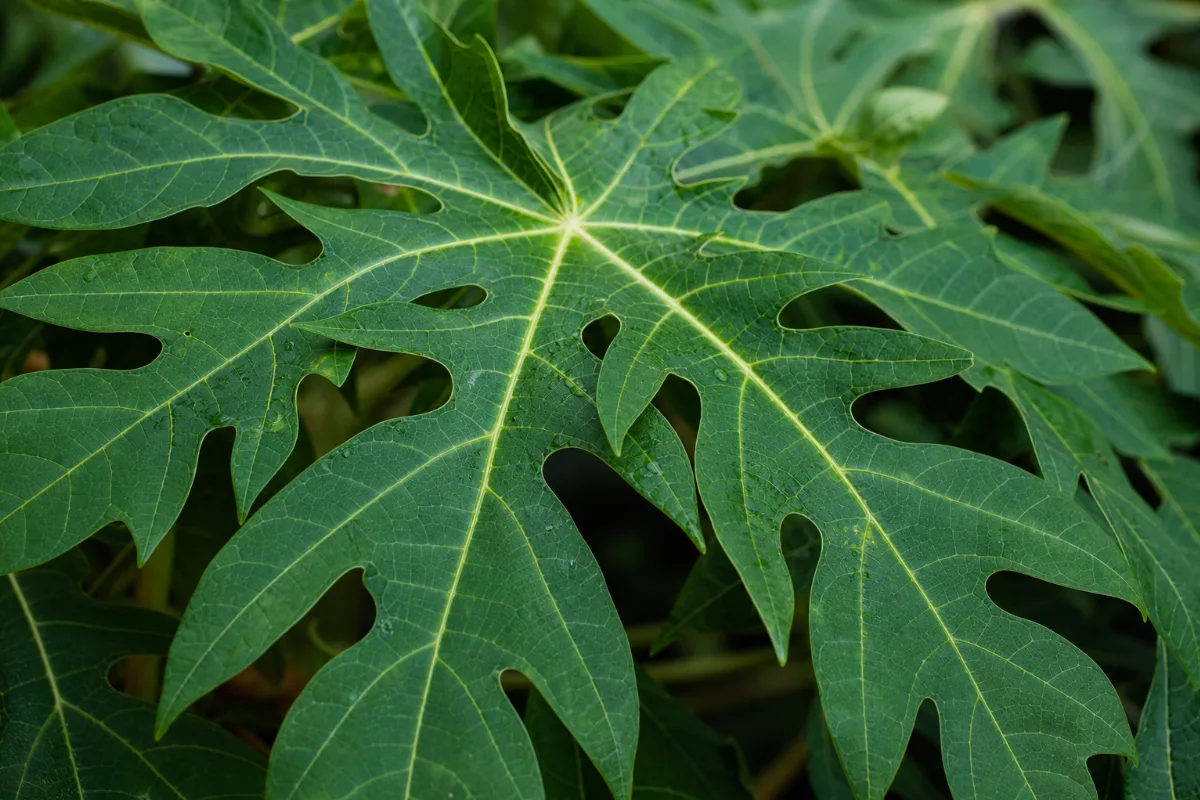
Papaya leaf
Carica papaya · also called Pawpaw leaf, papaya leaf juice, papaya leaf extract
Papaya leaf comes from the same tree as the papaya fruit. In parts of Asia the juice or an extract is used for dengue, mainly to raise low platelet counts. Several small trials found a faster platelet rise, but reviewers rate the evidence low quality and no trial tested deaths or severe illness. Dengue needs medical care, so never use it in place of a doctor, and avoid it in pregnancy.
General information, not medical advice. Last substantive update · Not medically reviewed. A named clinician has not signed off on this page. How this page is made
About Papaya leaf
Papaya leaf (Carica papaya) is used as a folk remedy for dengue, mainly to raise low platelets. Small trials report a faster platelet rise, but the evidence is low quality, short and often linked to the makers. Dengue needs medical care, and the leaf is cautioned in pregnancy, liver disease and with some medicines.
What it is
Papaya leaf is the leaf of the papaya tree, a tropical plant in the family Caricaceae. It is not the same as the ripe fruit, or as papain, an enzyme from the milky latex of unripe fruit.
In the trials the leaf was given as fresh juice, as a standardised water extract in tablets, or as a syrup. Home-made juice or tea is not the same product.
What makes it distinctive
The leaf contains an alkaloid called carpaine and flavonoids such as quercetin, according to a review. Ideas about how it might raise platelets come from rat and lab studies, for example a higher level of the thrombopoietin receptor on platelet-making cells in rats. These ideas are not proven in people.
Carpaine lowered blood pressure and cardiac output in rats, which is one reason the heart is mentioned in the safety notes.
Historical and current uses
Papaya leaf juice or a leaf decoction is used in Sri Lanka, Malaysia and parts of India for dengue, and Ayurveda and Siddha sources describe it as raising blood counts. A 2025 review says Indian government guidance recommends the extract for dengue; we have not checked that guidance ourselves.
What the research shows
A 2019 meta-analysis of 9 controlled trials found that 7 showed higher platelets, 1 showed no significant difference and 1 could not be compared. Its authors concluded the evidence is insufficient to judge the role of papaya extract in dengue. A 2016 meta-analysis of 4 randomised trials (439 people) found higher platelets overall, but not significantly after 48 hours.
A small placebo-controlled pilot in adults with very low platelets found a larger platelet rise by day 3 but no significant change in hospital stay. An open-label children's trial and a Malaysian juice trial also reported higher platelets. Several trials were open label or linked to the product's maker.
No trial measured deaths, plasma leakage or shock. A large chemotherapy platelet trial exists, but its journal published an Expression of Concern; we do not rely on it.
At a glance
Traditional uses history, not proof
- Leaf juice or boiled leaf drink for dengue in Sri Lanka, Malaysia and parts of India
- Siddha and Ayurveda use for raising blood counts
Studied for research
- Platelet count in dengue: low-certainty, small trials
- Hospital stay in dengue: mixed
- Deaths, plasma leakage and shock in dengue: not tested
- Low platelets during chemotherapy: one trial, under an Expression of Concern
Main compounds
- Carpaine (alkaloid)
- Quercetin and other flavonoids
Common forms
- Fresh leaf juice
- Standardised aqueous extract in tablets
- Syrup used in a children's trial
Research links: WHO dengue fact sheet · Meta-analysis in dengue (Rajapakse 2019) · Safety scoping review (Lim 2021) · Research Library · Genes & Biomarkers Library
The plant and its history
- Accepted scientific name
- Carica papaya L.
- Naming authority
- L. (Linnaeus)
- Common names
- Papaya leaf (English); Pawpaw leaf (English)
- Botanical family
- Caricaceae (the papaya family), order Brassicales, the same order as cabbage and mustard.
- Classification
- Plantae > Brassicales > Caricaceae > Carica > Carica papaya
- Native range
- Not verified from a source read.
- Habitat
- Not verified.
- What the plant looks like
- Roots: Not part of the use here.; Stems: Not verified.; Leaves: The leaf is the part studied in the dengue and platelet trials.; Flowers: Not verified.; Fruit: The ripe fruit is a common food (a separate page covers it); unripe fruit latex is the source of the enzyme papain.
- Cultivation
- Not verified.
- Harvest and processing
- Not verified. Trial products were fresh juice, a standardised aqueous extract, tablets and syrup.
- Look-alikes and adulterants
- Name: Papaya fruit, papain and papaya latex; Note: Different products with different evidence and different safety issues; papain comes from latex of unripe fruit and is not the same as leaf juice.; Name: Papaya leaf tea; Note: A home tea is not the studied extract or juice; no trial of tea was found.
- Sustainability and conservation
- Not verified.
Traditional use and history history, not clinical proof
| Tradition or era | Documented use | Source |
|---|---|---|
| Folk medicine in Sri Lanka, Malaysia and parts of India; Siddha and Ayurveda | Leaf juice or decoction used to raise platelet counts in dengue; described in Ayurvedic texts as increasing blood volume, as stated in a rat-study paper's introduction. | p33831466 |
| Modern India | A 2025 review says Indian government (AYUSH) guidance recommends the extract for dengue. Not checked at the source. | p39842450 |
Traditional use shows how a plant was used. It does not show that a supplement works or is safe today.
What is inside, and how it may work
What the plant contains and how those compounds act in cells and animals. Laboratory and animal mechanisms are not proven effects in people.
Main compounds
| Compound | Family | Where it is concentrated | Activity studied | Level of evidence |
|---|---|---|---|---|
| Carpaine PubChem 442630 | piperidine alkaloid | Leaf | Called a major leaf alkaloid. In anaesthetised rats it lowered blood pressure and cardiac output; a review proposes a role in platelet production. 4 8 21 | Animal research |
| Quercetin PubChem 5280343 | flavonoid | Leaf (named in a review) | A review says quercetin may help maintain the platelet membrane and block viral proteases; this is a proposal, not shown in people. 8 22 | Laboratory research |
| Flavonoids, alkaloids, phenols, tannins, terpenes, saponins and cardiac glycosides (classes) | mixed | Leaf | Listed as classes in a review; individual amounts were not read. 8 | Laboratory research |
| Papain | protein-digesting enzyme | Latex of unripe fruit; leaf content not verified | A different product from leaf extract. A consumer reference warns of risks of unprocessed papain in pregnancy and allergy. 23 | Authoritative guidance |
Mechanisms, receptors and pathways
| Target or pathway | Gene or receptor | What was found | Level |
|---|---|---|---|
| Platelet production (thrombopoietin receptor CD110/c-Mpl on megakaryocytes) | CD110 (c-Mpl) | In rats given cyclophosphamide, leaf juice raised platelet counts and the receptor level on bone-marrow megakaryocytes. 9 | Animal research |
| Platelet clumping | Not specified | The extract reduced platelet aggregation in lab samples from dengue patients and healthy people. 2 | Laboratory research |
| Platelet and inflammation genes in people given leaf juice | ALOX12, PTAFR | These genes were more highly expressed in people given juice in the 2013 trial; the meaning for health is unclear. 15 | Human data |
| Immune signals and viral antigen in dengue | IL-6, TNF-alpha, IFN-gamma, NS1 | In the 2020 pilot IL-6 fell and NS1 cleared faster with the extract; other cytokine differences were not significant. 13 | Human data |
Absorption, metabolism and elimination
- Absorption
- No human blood-level data for carpaine or other leaf compounds were found in the sources read.
- Distribution
- Not established.
- Metabolism
- Not established.
- Elimination
- Not established.
- Bioavailability
- Not established in people.
Isolated compounds versus whole extracts
No single compound has been shown to account for any effect in people. Carpaine is the best-known alkaloid, but it lowered blood pressure and cardiac output in rats, so isolating it is not obviously safe.
Nutritional composition
A nutrient table is not meaningful here; the leaf is studied as a medicinal extract, not a nutrient source.
1 mixed findings3 low certainty1 very low certainty4 not enough evidence
What is Papaya leaf good for?
The main proposed uses and how strong the human evidence is for each. 'Low' means small or flawed studies; 'insufficient' means too little to judge.
Benefits, one by one
Each card is a research question, not a promise. Tap a goal to filter. Open a card to see the studies, doses and limits.
Dengue: platelet counts
Low certaintySeveral small trials found higher platelet counts in people with dengue who were given papaya leaf juice or extract. Two meta-analyses call the evidence low quality and say bigger, better trials are needed. Platelets are a lab number, not proof that people get better or avoid severe dengue.
9 studiesProducts tested include fresh leaf juice, a standardised aqueous leaf…
Studies, doses and limits
What the trials found
Rajapakse 2019 (9 controlled trials): 7 showed higher platelets with papaya extract, 1 showed no significant difference, 1 could not be compared; the authors say the evidence is insufficient. Charan 2016 (4 randomised trials, 439 enrolled): platelets higher overall and after day 4, but not after 48 hours. Single trials: Subenthiran 2013 (228 people, fresh leaf juice, open label, platelets higher at 40 and 48 hours); Kasture 2016 (300 people, double-blind placebo, platelets rose faster, no numbers in abstract); Sathyapalan 2020 pilot (adults with very low platelets, see separate entry). Several trials were open label or industry-linked.
Results
Faster platelet rise in most small trials, with the difference often small and shown over only a few days.
Effect sizes as reported
Rajapakse: platelet change day 1 to 5 mean difference 35.45 (95% CI 23.74 to 47.15; 3 studies, 129 people; 'low quality evidence'). Charan: overall mean difference 20.27 (6.21 to 34.73); after day 4 28.25 (14.14 to 42.37); after 48 h 13.38 (-7.71 to 34.51, not significant). Units are not stated in the abstracts.
Why this rating
Pooled results are rated low quality by the reviewers themselves, the trials are small, many are open label, several are industry-linked, and the follow-up is only days. The Rajapakse authors conclude the evidence is insufficient.
Form and dose studied
Products tested include fresh leaf juice, a standardised aqueous leaf extract in tablets and a syrup. Strength and content vary between products, and the trial products are not interchangeable with home-made leaf juice. No amount is recommended here.
Who was studied
Mostly adults and children in India, Malaysia, Pakistan and Indonesia with dengue fever or dengue haemorrhagic fever.
Limits
Platelet count is a lab marker. Reviews note it correlates only loosely with serious dengue complications. Nothing was shown for deaths, plasma leakage or shock. Dengue needs medical care. WHO says there is no specific treatment and that early access to proper medical care greatly lowers deaths from severe dengue. Do not use papaya leaf in place of a doctor or hospital.
Why researchers looked
Dengue often lowers platelets, and there is no specific drug for it. Papaya leaf became a popular folk remedy and a branded product in India.
Traditional use
Papaya leaf juice or a boiled leaf drink is used as a folk remedy for dengue in parts of South and Southeast Asia (Sri Lanka, Malaysia, India), and in Siddha and Ayurveda papaya leaf has been said to raise blood volume or platelets (as described in a rat-study paper, p33831466).
Proposed mechanism Animal research
Lab and animal work proposes that leaf compounds may help platelet production (for example higher thrombopoietin-receptor levels on platelet-making cells in rats) or protect platelets. These ideas are not proven in people.
A proposed mechanism does not show that the effect happens in people.
Short-term use was generally well tolerated in the trials reviewed, with mild stomach upset the commonest complaint. Not safe to assume for pregnancy, liver disease or people on some medicines (see safety).
Dengue with very low platelets (pilot trial)
Low certaintyOne small placebo-controlled pilot in adults with dengue and platelets of 30,000 or lower found a bigger platelet rise by day 3 with papaya leaf extract than with placebo. Hospital stay did not differ significantly. It was funded by the product's maker and is only a pilot.
2 studiesPapaya leaf extract (CPLE), a standardised product; exact strength no…
Studies, doses and limits
What the trials found
Sathyapalan 2020: 51 adults randomised (groups reported as 26 and 24). By day 3 platelets rose 482% (SD 284) with the extract versus 331% (SD 370) with placebo (p = 0.007). Transfusions 1 of 26 versus 2 of 24. Median time to reach 50,000: 2 days versus 3 days. No significant difference in hospital days.
Results
Larger day-3 platelet rise; no clear difference in hospital stay; transfusion numbers too small to compare.
Effect sizes as reported
482% vs 331% (p = 0.007); median days to 50,000: 2 vs 3.
Why this rating
A single small pilot with industry funding (Micro Labs Ltd) and a group-size mismatch in the report. The authors themselves ask for larger trials.
Form and dose studied
Papaya leaf extract (CPLE), a standardised product; exact strength not discussed here.
Who was studied
Adults with laboratory-confirmed dengue and platelets of 30,000 per microlitre or lower, one hospital in Kerala, India.
Limits
Small, one centre, industry-funded. Cytokine and virus-antigen results are exploratory. Dengue needs medical care. WHO says there is no specific treatment and that early access to proper medical care greatly lowers deaths from severe dengue. Do not use papaya leaf in place of a doctor or hospital.
Why researchers looked
Very low platelets in dengue often lead doctors to consider transfusions, which can be scarce.
Traditional use
Papaya leaf juice or a boiled leaf drink is used as a folk remedy for dengue in parts of South and Southeast Asia (Sri Lanka, Malaysia, India), and in Siddha and Ayurveda papaya leaf has been said to raise blood volume or platelets (as described in a rat-study paper, p33831466).
Proposed mechanism Preliminary mechanism
The authors suggest an immune-calming and antiviral effect, based on lower IL-6 and faster fall in viral NS1 antigen in the treated group. These are small lab findings.
A proposed mechanism does not show that the effect happens in people.
Described as well tolerated in this pilot; not enough people to judge rare harms.
Dengue in children: platelet counts
Low certaintyOne open-label trial in children aged 1 to 12 with dengue found higher platelet counts from day 3 with a papaya leaf syrup added to standard care. It had no placebo and was linked to the maker.
3 studiesBranded papaya leaf extract syrup (Caripill) plus standard therapy.
Studies, doses and limits
What the trials found
Srikanth 2019: 294 children randomised (147 per group), 285 analysed for efficacy. The syrup group had higher platelets than the standard-care-only group from day 3 (p < 0.05 at day 3, 4 and 5). Two children had nausea in the syrup group.
Results
Higher platelets on days 3 to 5 compared with standard care alone; no data on illness severity or hospital stay in the abstract.
Effect sizes as reported
Syrup group mean platelets about 89,700 (day 3), 120,800 (day 4), 168,900 (day 5). Control means are not given in the abstract.
Why this rating
Open-label design (no placebo), industry authors, a short 5-day follow-up and no clinical outcomes in the abstract. One trial only.
Form and dose studied
Branded papaya leaf extract syrup (Caripill) plus standard therapy.
Who was studied
Children aged 1 to 12 with dengue or dengue haemorrhagic fever grades I and II, India.
Limits
A single open-label company-linked trial. A parent should not give a child papaya leaf in place of medical care. Dengue needs medical care. WHO says there is no specific treatment and that early access to proper medical care greatly lowers deaths from severe dengue. Do not use papaya leaf in place of a doctor or hospital.
Why researchers looked
Dengue is common in children in endemic areas, and parents look for options when platelets fall.
Traditional use
Papaya leaf juice or a boiled leaf drink is used as a folk remedy for dengue in parts of South and Southeast Asia (Sri Lanka, Malaysia, India), and in Siddha and Ayurveda papaya leaf has been said to raise blood volume or platelets (as described in a rat-study paper, p33831466).
Proposed mechanism Preliminary mechanism
Not studied in this trial.
A proposed mechanism does not show that the effect happens in people.
Nausea in 2 children was the only complaint named in the abstract.
Dengue: length of hospital stay
Mixed findingsThe two meta-analyses pooled a shorter hospital stay of about 2 days with papaya leaf extract, but the reviewers rated this low quality, the numbers in one review look inconsistent, and the placebo-controlled pilot found no significant difference.
3 studiesJuice, tablets and syrup mixed across trials.
Studies, doses and limits
What the trials found
Rajapakse 2019 pooled 3 studies and reported a mean difference of -1.98 days; Charan 2016 reported a decrease of 1.90 days. The 2020 pilot (Sathyapalan) found no significant difference. Open-label trials can affect when doctors decide to discharge.
Results
About 2 fewer days in pooled low-quality data; none in the one placebo-controlled pilot.
Effect sizes as reported
Rajapakse: mean difference -1.98 days (CI -1.83 to -2.12; 3 studies, '580 participants' as stated). Charan: mean difference 1.90 days (CI 1.62 to 2.18).
Why this rating
The reviewers rate it low quality. The reported participant count and the very narrow interval in one abstract look inconsistent, and the best-controlled trial did not confirm it.
Form and dose studied
Juice, tablets and syrup mixed across trials.
Who was studied
Adults and children with dengue in hospital settings.
Limits
Discharge timing depends on doctors' decisions and can be influenced when staff know who got the extract.
Why researchers looked
Hospital stay is a more meaningful outcome than a lab number, so reviewers looked for it.
Traditional use
Not a traditional claim.
Proposed mechanism Pharmacological theory
Not applicable; this is an outcome, not a mechanism.
A proposed mechanism does not show that the effect happens in people.
Not applicable beyond the general safety section.
Dengue: deaths, plasma leakage and shock
Not enough evidenceNo trial measured whether papaya leaf lowers deaths, plasma leakage or shock in dengue. Nobody knows if it helps with the outcomes that matter most.
4 studiesNot applicable.
Studies, doses and limits
What the trials found
Rajapakse 2019 searched for plasma leakage, life-threatening complications and death and found no evidence available. Charan 2016 planned mortality as its main end point but could not pool it because the trials did not report it. WHO and CDC say care is supportive and warn about signs of severe dengue.
Results
Not measured.
Effect sizes as reported
None.
Why this rating
No usable data. Platelets are not a reliable stand-in for these outcomes, in the reviewers' view.
Form and dose studied
Not applicable.
Who was studied
People with dengue.
Limits
This is the central gap. Until it is filled, papaya leaf should not be treated as protection against severe dengue. Dengue needs medical care. WHO says there is no specific treatment and that early access to proper medical care greatly lowers deaths from severe dengue. Do not use papaya leaf in place of a doctor or hospital.
Why researchers looked
These are the dangerous parts of dengue, which is why reviews look for them.
Traditional use
Not applicable.
Proposed mechanism Pharmacological theory
Not applicable.
A proposed mechanism does not show that the effect happens in people.
Delaying medical care is the biggest risk of using a folk remedy for dengue.
Low platelets during chemotherapy
Not enough evidenceA large Indian trial reported that more people on chemotherapy reached a safe platelet level sooner with papaya leaf extract than with placebo. A journal Expression of Concern was later published about that paper, so this result should be treated as unconfirmed.
3 studiesPapaya leaf extract in the trial; product details not in the abstract.
Studies, doses and limits
What the trials found
Ostwal 2026 (phase III, placebo-controlled): 219 randomised, 198 analysed (129 extract, 69 placebo). By day 4, 59% versus 44% reached platelets of 75,000 or more (p = .042). No grade 3 or 4 treatment-related adverse events. The journal later issued an Expression of Concern (PMID 42485600); the indexed record gives no reason.
Results
More people reached the platelet target by day 4 (59% v 44%).
Effect sizes as reported
59% vs 44% (p = .042) in the modified intention-to-treat analysis; 64% vs 48% per protocol (p = .034).
Why this rating
A single trial whose reliability is under an Expression of Concern. We rate it insufficient until the concern is resolved, even though the abstract reports a positive result.
Form and dose studied
Papaya leaf extract in the trial; product details not in the abstract.
Who was studied
Adults receiving chemotherapy with low platelets, India.
Limits
Cancer patients must not add herbal products without telling their oncology team; platelet count is a safety measure for chemotherapy. Funding and full methods were not read.
Why researchers looked
Chemotherapy can lower platelets and force delays in cancer treatment, so any way to raise them is of interest.
Traditional use
Not a traditional use.
Proposed mechanism Animal research
A rat study proposes that leaf compounds raise a thrombopoietin receptor (CD110) on platelet-making cells; this is not shown in people.
A proposed mechanism does not show that the effect happens in people.
No grade 3 or 4 related adverse events were reported in the abstract. Interaction with chemotherapy drugs is not studied.
Chronic immune thrombocytopenia (ITP)
Not enough evidenceA case series of four people suggested papaya leaf extract may help raise platelets in long-term ITP. Four people with no comparison group cannot show that it works.
1 studiesLiquid papaya leaf extract added to standard care.
Studies, doses and limits
What the trials found
Hampilos 2019: four people on standard care for chronic ITP were given a liquid leaf extract; the authors say it may be beneficial and call for a larger trial. No numbers in the abstract.
Results
Author-reported possible benefit; no numbers.
Effect sizes as reported
None in abstract.
Why this rating
Four cases, no control group, no data in the abstract.
Form and dose studied
Liquid papaya leaf extract added to standard care.
Who was studied
Four adults with chronic ITP.
Limits
ITP needs specialist follow-up. Any change in platelets could be due to the condition's natural ups and downs or to other treatment.
Why researchers looked
ITP is an autoimmune condition with low platelets; papaya leaf is used because of the dengue story.
Traditional use
Borrowed from the dengue folk use.
Proposed mechanism Pharmacological theory
Not studied.
A proposed mechanism does not show that the effect happens in people.
Not described in the abstract.
Effect on how platelets clump (lab test)
Very low certaintyIn test-tube blood samples, papaya leaf extract reduced platelet clumping. This is not a health benefit; it raises a theoretical question about bleeding risk, covered in the safety section.
1 studiesLeaf extract added to blood samples.
Studies, doses and limits
What the trials found
Chinnappan 2016: the extract reduced platelet aggregation in samples from both dengue patients and healthy people. No people took the extract in this study.
Results
Less platelet clumping in the test tube.
Effect sizes as reported
Not given in abstract.
Why this rating
Test-tube study only; no human dosing.
Form and dose studied
Leaf extract added to blood samples.
Who was studied
Blood samples from 60 dengue patients and 60 healthy people.
Limits
Cannot be applied to people taking the extract by mouth.
Why researchers looked
The authors wanted to learn how the extract might act on platelets in dengue.
Traditional use
Not traditional.
Proposed mechanism Laboratory research
Direct effect of the extract on platelets in samples from 60 people with dengue and 60 healthy people.
A proposed mechanism does not show that the effect happens in people.
Raises a theoretical caution for anyone taking blood thinners or antiplatelet medicines or facing surgery.
Other claimed uses (blood sugar, cancer, infections)
Not enough evidenceReviews list antidiabetic, anticancer, antimalarial and antioxidant activities for papaya leaf, but these come from lab and animal work. We found no human trials for them. They are listed here only so readers know they are not supported.
1 studiesNot applicable.
Studies, doses and limits
What the trials found
Munir 2022 lists immunomodulatory, antiviral, antidiabetic, anticancer, antimalarial, antiangiogenic, antibacterial and antioxidant activities; the review is narrative and the activities are lab or animal findings. We did not find human trials for these uses.
Results
No human evidence.
Effect sizes as reported
None.
Why this rating
No human trials found for these claims.
Form and dose studied
Not applicable.
Who was studied
Not applicable.
Limits
A lab effect on glucose could matter for people on diabetes drugs; see safety.
Why researchers looked
Reviews of the leaf's chemistry list many lab activities.
Traditional use
Papaya leaf is used in various folk traditions; none was verified here.
Proposed mechanism Laboratory research
Lab and animal studies only.
A proposed mechanism does not show that the effect happens in people.
See interactions in the safety section.
Connections to the rest of health
How Papaya leaf connects to the rest of our health knowledge graph. Every link says what kind of connection it is. A safety link (for example to the liver) is a warning, not a benefit. A study that merely mentions a topic never creates a benefit link.
Explore every connection: goals, body systems, organs, symptoms, genes
A. Wellness goals
| Connected to | Kind of connection | Evidence status | Context | Studies |
|---|---|---|---|---|
| Immune Support | Demonstrated clinical effect | Low certainty | Dengue: platelet counts: Several small trials found higher platelet counts in people with dengue who were given papaya leaf juice or extract. Two meta-analyses call the evidence low quality and say bigger, better trials are needed. Platelets are a lab number, not proof that people get better or avoid severe dengue. | 12 1 15 5 16 7 8 9 24 |
| Healthy Circulation | Demonstrated clinical effect | Low certainty | Dengue: platelet counts: Several small trials found higher platelet counts in people with dengue who were given papaya leaf juice or extract. Two meta-analyses call the evidence low quality and say bigger, better trials are needed. Platelets are a lab number, not proof that people get better or avoid severe dengue. | 12 1 15 5 16 7 8 9 24 |
| Immune Support | Potential benefit | Low certainty | Dengue with very low platelets (pilot trial): One small placebo-controlled pilot in adults with dengue and platelets of 30,000 or lower found a bigger platelet rise by day 3 with papaya leaf extract than with placebo. Hospital stay did not differ significantly. It was funded by the product's maker and is only a pilot. Dengue in children: platelet counts: One open-label trial in children aged 1 to 12 with dengue found higher platelet counts from day 3 with a papaya leaf syrup added to standard care. It had no placebo and was linked to the maker. | 13 24 14 6 12 1 17 10 11 9 3 |
| Healthy Circulation | Preliminary mechanism | Very low certainty | Effect on how platelets clump (lab test): In test-tube blood samples, papaya leaf extract reduced platelet clumping. This is not a health benefit; it raises a theoretical question about bleeding risk, covered in the safety section. | 2 |
| Blood Sugar Balance | Biological association | Not enough evidence | Other claimed uses (blood sugar, cancer, infections): Reviews list antidiabetic, anticancer, antimalarial and antioxidant activities for papaya leaf, but these come from lab and animal work. We found no human trials for them. They are listed here only so readers know they are not supported. | 8 |
B. Body systems
| Connected to | Kind of connection | Evidence status | Context | Studies |
|---|---|---|---|---|
| Immune System | Biological association | Low certainty | Studied for: Dengue: platelet counts Studied for: Dengue with very low platelets (pilot trial) | 12 1 15 5 16 7 8 9 24 13 14 6 17 10 11 3 |
| Cardiovascular System | Biological association | Very low certainty | Studied for: Effect on how platelets clump (lab test) | 2 |
| Endocrine System | Biological association | Not enough evidence | Studied for: Other claimed uses (blood sugar, cancer, infections) | 8 |
C. Body parts and organs
E. Health conditions
| Connected to | Kind of connection | Evidence status | Context | Studies |
|---|---|---|---|---|
| Dengue | Traditional use | Low certainty | Platelet counts higher in several small trials; no data on deaths or severe illness. Needs medical care. Higher platelet counts in small trials; no data on deaths or severe illness. Preparation or compound: Leaf juice, extract tablets and syrup in trials |
12 1 24 |
| Pregnancy | Contraindication | Documented risk | Avoid; animal harm signals and no human data. Avoid; animal signals and no human safety data. Preparation or compound: Leaf |
6 23 |
| Latex allergy | Adverse effect or risk | Documented risk | Possible cross-reaction. Preparation or compound: Papaya products |
23 |
I. Biomarkers
| Connected to | Kind of connection | Evidence status | Context | Studies |
|---|---|---|---|---|
| Platelet count (dengue) | Biological association | Low certainty | Measured in trials: raised. A lab change is not the same as a health benefit. | 1 12 13 14 15 |
| Days in hospital | Biological association | Mixed findings | Measured in trials: mixed. A lab change is not the same as a health benefit. | 12 1 13 |
| Interleukin-6 (IL-6) | Biological association | Low certainty | Measured in trials: lowered. A lab change is not the same as a health benefit. | 13 |
| Dengue NS1 antigen level | Biological association | Low certainty | Measured in trials: lowered. A lab change is not the same as a health benefit. | 13 |
| Platelets at or above 75,000 (chemotherapy) | Biological association | Not enough evidence | Measured in trials: raised. A lab change is not the same as a health benefit. | 10 11 |
| Chemotherapy dose reductions or delays | Biological association | Not enough evidence | Measured in trials: lowered. A lab change is not the same as a health benefit. | 10 11 |
| Platelet aggregation (lab test) | Biological association | Very low certainty | Measured in trials: lowered. A lab change is not the same as a health benefit. | 2 |
J. Genes, receptors and enzymes
L. Active compounds
| Connected to | Kind of connection | Evidence status | Context | Studies |
|---|---|---|---|---|
| Carpaine | Biological association | Animal | Called a major leaf alkaloid. In anaesthetised rats it lowered blood pressure and cardiac output; a review proposes a role in platelet production. Preparation or compound: Leaf |
4 8 21 |
| Quercetin | Biological association | In vitro | A review says quercetin may help maintain the platelet membrane and block viral proteases; this is a proposal, not shown in people. Preparation or compound: Leaf (named in a review) |
8 22 |
| Flavonoids, alkaloids, phenols, tannins, terpenes, saponins and cardiac glycosides (classes) | Biological association | In vitro | Listed as classes in a review; individual amounts were not read. Preparation or compound: Leaf |
8 |
| Papain | Biological association | Authoritative guidance | A different product from leaf extract. A consumer reference warns of risks of unprocessed papain in pregnancy and allergy. Preparation or compound: Latex of unripe fruit; leaf content not verified |
23 |
Each connection is stored with the ingredient, the connected record, the kind of connection, the evidence status, the supporting studies, the preparation or compound involved, and a review date (last reviewed October 25, 2026).
Evidence at a glance: what changed in 7 lab markers
Tap a number to show only those markers. Counts are markers, not people.
The evidence
The research centre for Papaya leaf. Every record here was checked against PubMed or the publisher's page; we never list a study we have not verified.
Evidence by outcome
Bars show how many studies we found for each outcome, not how well it works. People are added up across trials only (reviews are not added, to avoid double counting).
How we rate evidence
High certainty
Several well-run trials or reviews agree; further research is unlikely to change the picture much.
Moderate certainty
Good trials point the same way, but some doubt remains.
Low certainty
Small, short or inconsistent trials. The finding could change with better research.
Very low certainty
Very little or very weak human data. Treat as a possibility only.
Mixed findings
Trials or reviews disagree with each other.
Not enough evidence
Not enough human research to say either way.
Evidence against
Good research found no benefit, or found harm.
We take the reviewers' own risk-of-bias and GRADE statements where they exist, and otherwise judge from study size, design, consistency, directness and whether a product matches what is sold. Many publications do not make evidence high. Method note: We started from our existing summary of the papaya leaf evidence, then searched PubMed for new trials and reviews and checked GBIF, NCBI Taxonomy and PubChem. Most sources are abstracts or web reference pages. No study is cited that we could not verify.
Study library: every study we checked 24
| Study | Design | People | Product, dose, length | Result |
|---|---|---|---|---|
| Charan 2016 Efficacy and safety of Carica papaya leaf extract in the dengue: A systematic review and meta-analysis. Int J Appl Basic Med Res · PMID 27857891 · DOI |
Meta-analysis |
439 People with dengue in 4 randomised trials (439 enrolled, 377 analysable) |
Carica papaya leaf extract leaf Varied · vs Control (standard care or placebo) |
Higher platelet counts overall and after day 4, but not after 48 hours. Fewer hospital days. Deaths and adverse events could not be pooled because published trials did not give data. Authors call for large high-quality trials before any decision on use. Platelets overall mean difference 20.27; after day 4 mean difference 28.25; after 48 h 13.38 (not significant); hospital days mean difference 1.90 (units for platelets not stated in abstract) (Overall 6.21 to 34.73; after day 4 14.14 to 42.37; after 48 h -7.71 to 34.51; hospital days 1.62 to 2.18) Methods, limits and fundingOutcomes: Mortality (planned primary), platelet count, hospital days, grade 3 and 4 adverse events Limitations: Only 4 small trials. Risk-of-bias tool used but results not given in the abstract. No mortality or safety pooling. Funding and conflicts: Not stated in abstract Read: abstract |
| Chinnappan 2016 Inhibition of Platelet Aggregation by the Leaf Extract of Carica papaya During Dengue Infection: An In Vitro Study. Viral Immunol · PMID 26910599 · DOI |
Laboratory research in-vitro |
120 Blood samples from 60 people with dengue and 60 healthy people, tested in the lab |
Carica papaya leaf extract added to blood samples leaf · vs Untreated samples |
The extract reduced platelet clumping in samples from both dengue patients and healthy people. Significant reduction in aggregation (numbers not in abstract) (Not given in abstract) Methods, limits and fundingOutcomes: Platelet aggregation (clumping) in test tubes Limitations: Test-tube study; does not show what happens in the body. It does raise a theoretical question about bleeding risk with blood thinners. Funding and conflicts: Not stated in abstract Read: abstract |
| Hampilos 2019 Effect Of Carica Papaya Leaf Extract On Platelet Count In Chronic Immune Thrombocytopenic Purpura: A Case Series. Integr Med (Encinitas) · PMID 32549843 |
Case series |
4 Four people with chronic immune thrombocytopenic purpura (ITP) on standard care |
Carica papaya leaf liquid extract added to standard care leaf · vs None (no control group) |
Authors say the four cases suggest the extract may help and that a larger trial is warranted. The abstract gives no numbers. Not given in abstract Methods, limits and fundingOutcomes: Platelet count Limitations: Four people, no control group, no numbers in the abstract; cannot show cause and effect. Funding and conflicts: Not stated in abstract Read: abstract |
| Hornick 1978 Effect of carpaine, a papaya alkaloid, on the circulatory function in the rat. Res Commun Chem Pathol Pharmacol · PMID 734216 |
Animal research animal |
Anaesthetised male Wistar rats | Carpaine (papaya leaf alkaloid) leaf · vs Autonomic blockers atropine and propranolol |
Carpaine at 0.5 to 2.0 mg/kg lowered blood pressure step by step. At 2 mg/kg it reduced cardiac output, stroke volume and cardiac work. Blocking the autonomic nerves did not change this, so the authors concluded carpaine acts directly on heart muscle. Dose-dependent fall in blood pressure; lower cardiac output at 2 mg/kg (Not applicable) Methods, limits and fundingOutcomes: Blood pressure, cardiac output, stroke volume Limitations: Animal study from 1978. Route of dosing not stated in the abstract. Human relevance of doses in a leaf product is unknown. Funding and conflicts: Not stated Read: abstract |
| Kasture 2016 A Multi-centric, Double-blind, Placebo-controlled, Randomized, Prospective Study to Evaluate the Efficacy and Safety of Carica papaya Leaf Extract, as Empirical Therapy for Thrombocytopenia associated with Dengue Fever. J Assoc Physicians India · PMID 27739262 |
Controlled trial |
300 People with dengue-related low platelets at 5 centres in India |
Carica papaya leaf extract tablets plus standard dengue care (no steroids) leaf 5 days · vs Placebo plus standard care |
Platelets rose faster with CPLE than with placebo (p < 0.01). A few side effects such as nausea and vomiting, similar in both groups. Abstract gives no platelet numbers. Not given in abstract (p < 0.01) (Not given in abstract) Methods, limits and fundingOutcomes: Daily platelet count; adverse events Limitations: Only the abstract could be read, with no effect sizes. Product not named in the abstract. Funding and conflicts: At least one author is listed with Micro Labs (a papaya leaf extract maker); funding not stated in abstract (industry link possible) Registration: CTRI/2015/05/005806 Read: abstract |
| Lim 2021 Carica papaya L. Leaf: A Systematic Scoping Review on Biological Safety and Herb-Drug Interactions. Evid Based Complement Alternat Med · PMID 34040647 · DOI |
Systematic review |
41 articles: 23 clinical, 5 ongoing trials, 13 preclinical | Carica papaya leaf juice and standardised aqueous extract leaf Mostly under 5 days in adults · vs Various |
Short-term use in adults was generally well tolerated; minor stomach and gut effects were most common; one trial reported safe use of a standardised extract in children aged 1 to 12. Animal studies raised concerns about liver and reproductive harm with long-term use. Possible unfavourable interactions with metformin, glimepiride, digoxin, ciprofloxacin and artemisinin. Cautioned in pregnancy and liver impairment. Not applicable (descriptive review) Methods, limits and fundingOutcomes: Adverse reactions, toxicity, herb-drug interactions Limitations: Our earlier summary read the first 100,000 characters of the full text; details beyond the abstract (animal pregnancy findings, two unpublished human liver reports, rash in two clinical papers) are summary-only here. Interaction data came from lab and animal studies; no clinical interaction studies. Funding and conflicts: Authors declare no conflicts Read: summary-only |
| Maideen 2025 A Review of Potentials of Carica Papaya Leaves in Dengue Viral Infection - Insights of Clinical and Preclinical Studies. Drug Res (Stuttg) · PMID 39842450 · DOI |
Systematic review |
Clinical, animal, lab and computer studies of papaya leaf in dengue | Carica papaya leaf extract leaf Various · vs Various |
Narrative review that supports further trials. It says Indian government (AYUSH) guidance recommends the leaf extract for dengue; that statement is second-hand here and was not checked at the source. Calls for more randomised trials to confirm safety and effectiveness. Not applicable Methods, limits and fundingOutcomes: Platelets, immune effects, mosquito-larva killing Limitations: Narrative review without stated quality grading; it searched for papers supporting papaya use and excluded duplicates only, so it may lean positive. Funding and conflicts: No conflict declared Read: abstract |
| Munir 2022 Delving into the Therapeutic Potential of Carica papaya Leaf against Thrombocytopenia. Molecules · PMID 35566112 · DOI |
Systematic review |
Review of animal and clinical studies of papaya leaf juice, extract or powder | Carica papaya leaf leaf Various · vs Various |
Describes leaf constituents including carpaine and quercetin and lists flavonoids, alkaloids, phenols, cardiac glycosides, tannins, terpenes and saponins. States that papaya leaf has been shown effective against low platelets; this is the review's own claim and is stronger than the systematic reviews support. Not applicable Methods, limits and fundingOutcomes: Platelet-related findings, phytochemicals Limitations: Narrative review; claims about mechanisms come from lab and animal work. 'Cardiac glycosides' appear in its phytochemical list. Funding and conflicts: No conflict declared Read: abstract |
| Nandini 2021 Platelet enhancement by Carica papaya L. leaf fractions in cyclophosphamide induced thrombocytopenic rats is due to elevated expression of CD110 receptor on megakaryocytes. J Ethnopharmacol · PMID 33831466 · DOI |
Animal research animal |
Rats given cyclophosphamide to lower platelets | Papaya leaf juice and its butanol fraction leaf 14 days · vs Untreated rats |
Platelet counts rose in treated rats. The authors report higher CD110 (thrombopoietin receptor) on bone-marrow megakaryocytes. Platelets 1073.5 and 1189.8 x10^3/uL in the two treated groups (rats) (Not applicable) Methods, limits and fundingOutcomes: Platelet count, thrombopoietin, CD110 receptor on platelet-making cells Limitations: Rat study; mechanism is a proposal, not shown in people. Funding and conflicts: Not stated Read: abstract |
| Ostwal 2026 Carica Papaya Leaf Extract to Improve Chemotherapy-Induced Thrombocytopenia: A Phase III Triple-Blinded, Randomized, Placebo-Controlled, Multicentric Trial. JCO Glob Oncol · PMID 41812092 · DOI |
Controlled trial |
219 Adults on chemotherapy with low platelets, Indian cancer centres; 198 analysed (129 papaya leaf extract, 69 placebo) |
Carica papaya leaf extract (CPLE) leaf Until platelets reached 75,000 or transfusion needed or up to day 10 · vs Placebo (2:1 randomisation) |
59% vs 44% reached the platelet target by day 4 in the modified intention-to-treat analysis (p = .042); 64% vs 48% per protocol (p = .034). No grade 3 or 4 treatment-related adverse events. Among people with grade 2 low platelets at the start, 25% vs 43% needed chemotherapy dose cuts or delays (p = .033); not significant for grade 3. Primary end point 59% vs 44%, p = .042 (Not given in abstract) Methods, limits and fundingOutcomes: Share reaching platelets of 75,000 or more by day 4; grade 3 or 4 adverse events; chemotherapy delays Limitations: An Expression of Concern was later published for this paper (PMID 42485600); the indexed record does not say why. The result should be treated as unconfirmed. Only the abstract was read. Funding and conflicts: Funding not stated in abstract Read: abstract |
| Ostwal 2026 Expression of Concern: Carica Papaya Leaf Extract to Improve Chemotherapy-Induced Thrombocytopenia: A Phase III Triple-Blinded, Randomized, Placebo-Controlled, Multicentric Trial. JCO Glob Oncol · PMID 42485600 · DOI |
Editorial notice n/a |
Notice about the chemotherapy-induced thrombocytopenia trial | Not applicable unspecified |
The indexed record gives only the title and the link to the original paper. It does not state the reason for the concern. Not applicable Methods, limits and fundingOutcomes: Publisher notice Limitations: The reason is not visible in the record we read, so we do not guess it. Funding and conflicts: n/a Read: abstract |
| Rajapakse 2019 Carica papaya extract in dengue: a systematic review and meta-analysis. BMC Complement Altern Med · PMID 31601215 · DOI |
Systematic review |
People with suspected or confirmed dengue in 9 controlled trials (India 6, Pakistan 1, Indonesia 1, Malaysia 1) | Carica papaya leaf extract or juice added to standard care leaf Varied by trial (not in abstract) · vs Standard treatment |
7 of 9 studies showed higher platelets with papaya extract, 1 showed no significant difference, 1 could not be compared directly. No serious adverse events reported. Authors conclude the evidence is insufficient to judge the role of papaya extract in dengue. Hospital stay mean difference -1.98 days; platelet change day 1 to day 5 mean difference 35.45 (units not stated in the abstract) (Hospital stay -1.83 to -2.12 (3 studies); platelets 23.74 to 47.15 (3 studies, 129 participants)) Methods, limits and fundingOutcomes: Platelet count, hospital stay, plasma leakage, life-threatening complications, death Limitations: Abstract rates both pooled results low quality. The abstract reports 580 participants for the hospital-stay result and a very narrow interval, which look internally inconsistent; we quote them as reported and do not rely on them. No evidence for plasma leakage, serious dengue or death. Funding and conflicts: Authors declare no competing interests Read: abstract |
| Sathyapalan 2020 Efficacy & safety of Carica papaya leaf extract (CPLE) in severe thrombocytopenia (<=30,000/ul) in adult dengue - Results of a pilot study. PLoS One · PMID 32074143 · DOI |
Controlled trial |
51 Adults with laboratory-confirmed dengue and platelets 30,000/uL or below, one hospital in Kerala, India |
Carica papaya leaf extract (CPLE) leaf Followed to day 3 for the main result · vs Placebo |
By day 3 platelets rose 482% (SD 284) with CPLE versus 331% (SD 370) with placebo (p = 0.007). Transfusions: 1 of 26 versus 2 of 24. Median time to 50,000/uL: 2 days versus 3 days. No significant difference in hospital stay. IL-6 rose in the placebo group and fell in the CPLE group (p = 0.0232). Authors say the findings need larger trials. Day-3 platelet rise 482% vs 331%, p = 0.007 (Not given in abstract) Methods, limits and fundingOutcomes: Platelet rise by day 3, platelet transfusion, time to 50,000/uL, hospital stay, cytokines, viral NS1 antigen Limitations: Pilot, small, one centre. Abstract says 51 randomised but groups of 26 and 24 add to 50. Hospital stay not significantly different. Transfusion numbers tiny. Funding and conflicts: Funded by Micro Labs Ltd (industry) Registration: CTRI-REF/2017/02/013314 Read: abstract |
| Srikanth 2019 An open-label, randomized prospective study to evaluate the efficacy and safety of Carica papaya leaf extract for thrombocytopenia associated with dengue fever in pediatric subjects. Pediatr Health Med Ther · PMID 30697093 · DOI |
Controlled trial |
294 Children aged 1 to 12 years with dengue (NS1 positive) or dengue haemorrhagic fever grade I or II with low platelets |
CPLE syrup (Caripill) plus standard therapy leaf 5 days of daily follow-up · vs Standard therapy alone (open label) |
Platelets were higher in the CPLE group from day 3 (p < 0.05 overall). Two children in the CPLE group had nausea. Authors call it well tolerated. Mean platelets in the CPLE group: about 89,700 (day 3), 120,800 (day 4), 168,900 (day 5); control means not given in the abstract (Not given in abstract) Methods, limits and fundingOutcomes: Daily platelet counts for 5 days; adverse events Limitations: Open label (no placebo), so expectations can affect care and measurement. Platelets are a lab stand-in, not recovery. 285 of 294 analysed for efficacy. Funding and conflicts: Several authors are employees of Micro Labs Ltd, maker of the syrup tested (industry-linked) Read: abstract |
| Subenthiran 2013 Carica papaya Leaves Juice Significantly Accelerates the Rate of Increase in Platelet Count among Patients with Dengue Fever and Dengue Haemorrhagic Fever. Evid Based Complement Alternat Med · PMID 23662145 · DOI |
Controlled trial |
228 Patients with dengue fever or dengue haemorrhagic fever in Malaysia |
Fresh Carica papaya leaf juice leaf 3 consecutive days; platelets checked every 8 hours for 48 hours · vs Standard management (open label) |
Mean platelets were higher in the juice group than the control group at 40 and 48 hours after admission (p < 0.01). ALOX12 and PTAFR genes were more strongly expressed in people given juice. Not given in abstract (Not given in abstract) Methods, limits and fundingOutcomes: Platelet count; ALOX12 and PTAFR gene expression Limitations: Open label. Only 48 hours of platelet follow-up. Gene results are a lab finding, not a health outcome. Funding and conflicts: Government research institute authors; funding not stated in abstract Read: abstract |
| Teh 2022 Carica papaya Leaf Juice for Dengue: A Scoping Review. Nutrients · PMID 35458146 · DOI |
Systematic review |
28 articles on papaya leaf juice: 10 clinical, 13 animal, 3 in vitro, 1 ex vivo, 3 ethnobotanical | Carica papaya leaf juice leaf Various · vs Various |
Authors describe anti-thrombocytopenic and immunomodulatory potential and call the juice a possible drug candidate. A scoping review does not rate quality or pool results. Not applicable Methods, limits and fundingOutcomes: Anti-thrombocytopenic and immunomodulatory effects, toxicity Limitations: Scoping reviews map studies; they do not grade certainty. Authors are from a Malaysian Ministry of Health research centre. Funding and conflicts: No conflict declared Read: abstract |
| s-cdc-dengue CDC: Clinical care of dengue · Source |
Authoritative guidance n/a |
Methods, limits and fundingRead: summary-only | ||
| s-gbif-carica-papaya GBIF backbone: Carica papaya L. (usageKey 2874484) · Source |
Reference database n/a |
Methods, limits and fundingRead: full-text | ||
| s-livertox-papaya LiverTox / LactMed papaya or papaya leaf entry · Source |
Regulator check n/a |
Methods, limits and fundingRead: not-found | ||
| s-nccih-papaya NCCIH papaya page · Source |
Regulator check n/a |
Methods, limits and fundingRead: not-found | ||
| s-pubchem-carpaine PubChem: Carpaine (CID 442630), C28H50N2O4 · Source |
Reference database n/a |
Methods, limits and fundingRead: full-text | ||
| s-pubchem-quercetin PubChem: Quercetin (CID 5280343), C15H10O7 · Source |
Reference database n/a |
Methods, limits and fundingRead: full-text | ||
| s-rxlist-papaya RxList: Papaya (consumer drug reference) · Source |
Reference database n/a |
Methods, limits and fundingRead: full-text | ||
| s-who-dengue WHO: Dengue and severe dengue fact sheet · Source |
Authoritative guidance n/a |
Methods, limits and fundingRead: full-text |
What we do not know yet
- No trial measured deaths, plasma leakage or shock in dengue.
- Most trials are small, short, open label or linked to the makers.
- No clinical interaction studies with medicines.
- No human data in pregnancy or breastfeeding.
- Only abstracts of the trial papers were read; full papers were not.
- The reason for the Expression of Concern on the chemotherapy trial is not visible in the record we read.
How new research is added
New studies are found by a saved PubMed search and are placed in a review queue. A person reads each one before it changes any evidence rating or safety wording.
Lab markers
What changed in blood or saliva tests during trials. A changed number is not the same as feeling or being healthier, and we give no "normal ranges".
Inflammatory 1
Interleukin-6 (IL-6)
Lowered in trials
A signalling protein that rises during inflammation.
Low certaintyResults and what it means
Why it was measured
Measured in the 2020 pilot to look for immune effects.
Statistical vs. clinical meaning
Exploratory result from a pilot of about 50 people with several markers tested; it does not show the extract treats dengue.
Safety implication
None specific.
| Study | Result | People | Product |
|---|---|---|---|
| 13 | IL-6 rose about 15.9% in placebo and fell about 13% with the extract by day 3 (p = 0.0232). TNF-alpha and IFN-gamma differences were not statistically significant (p = 0.25 and 0.12). | Adults with dengue and platelets 30,000 or lower | Leaf extract vs placebo |
Other 6
Platelet count (dengue)
Raised in trials
Number of platelets, the blood cells that help clotting, in a blood count. Dengue often lowers it.
Low certaintyResults and what it means
Why it was measured
Used as the main outcome in nearly all dengue papaya leaf trials because it is easy to measure.
Statistical vs. clinical meaning
A faster rise in the number is statistically clear in several small trials, but whether it changes how sick people get is not shown. The effect also faded by 48 hours in one pooled analysis.
Safety implication
A higher platelet count does not mean dengue is under control. People still need medical monitoring.
| Study | Result | People | Product |
|---|---|---|---|
| 1 | Overall mean difference 20.27 (CI 6.21 to 34.73); after day 4 28.25 (14.14 to 42.37); after 48 h 13.38, not significant (-7.71 to 34.51) | Dengue, 4 randomised trials | Papaya leaf extract vs control |
| 12 | Day 1 to day 5 change: mean difference 35.45 (CI 23.74 to 47.15), 3 studies, low quality | Dengue, 9 controlled trials in review | Papaya extract vs standard treatment |
| 13 | Day-3 rise 482% (SD 284) vs 331% (SD 370), p = 0.007 | Adults with dengue and platelets 30,000 or lower | Leaf extract vs placebo |
| 14 | Higher than control on days 3 to 5 (p < 0.05); treated mean about 168,900 on day 5 | Children 1 to 12 with dengue | Leaf extract syrup plus standard therapy vs standard therapy |
| 15 | Higher mean platelets than control at 40 and 48 hours (p < 0.01) | Dengue fever and dengue haemorrhagic fever, Malaysia | Fresh leaf juice vs standard management |
Days in hospital
Mixed results in trials
Number of days a patient stays in hospital.
Mixed findingsResults and what it means
Why it was measured
A practical outcome that matters to families and health services.
Statistical vs. clinical meaning
Pooled data suggest a shorter stay but the best-controlled trial did not.
Safety implication
None specific.
| Study | Result | People | Product |
|---|---|---|---|
| 12 | Mean difference -1.98 days (CI -1.83 to -2.12; 3 studies), low quality; reported participant numbers look inconsistent | Dengue | Papaya extract vs standard treatment |
| 1 | Mean difference 1.90 days fewer (CI 1.62 to 2.18) | Dengue, 4 trials | Papaya leaf extract vs control |
| 13 | No significant decrease in hospital days | Adults with severe thrombocytopenia in dengue | Leaf extract vs placebo |
Dengue NS1 antigen level
Lowered in trials
A viral protein in the blood used to detect dengue and to follow how much virus is present.
Low certaintyResults and what it means
Why it was measured
Measured in the 2020 pilot as a possible sign of antiviral action.
Statistical vs. clinical meaning
One small pilot; a faster fall in a viral marker is not the same as faster recovery.
Safety implication
None specific.
| Study | Result | People | Product |
|---|---|---|---|
| 13 | By day 3 mean NS1 titres were down 97.3% in the treated group versus 88% in the placebo group (p = 0.023) | Adults with dengue and platelets 30,000 or lower | Leaf extract vs placebo |
Platelets at or above 75,000 (chemotherapy)
Raised in trials
Share of patients whose platelet count reached 75,000 per microlitre or more.
Not enough evidenceResults and what it means
Why it was measured
The primary end point of the chemotherapy trial.
Statistical vs. clinical meaning
The paper has an Expression of Concern; the result is unconfirmed.
Safety implication
Platelet count is a chemotherapy safety measure; do not self-manage.
| Study | Result | People | Product |
|---|---|---|---|
| 10 | 59% vs 44% by day 4 (p = .042), modified intention-to-treat; 64% (83/129) vs 48% (33/69) per protocol (p = .034) | Adults on chemotherapy with low platelets | Papaya leaf extract vs placebo |
Chemotherapy dose reductions or delays
Lowered in trials
Whether the next chemotherapy cycle had to be reduced or delayed.
Not enough evidenceResults and what it means
Why it was measured
A clinical outcome reported for patients with grade 2 low platelets at the start.
Statistical vs. clinical meaning
Subgroup result from a trial under an Expression of Concern.
Safety implication
Do not alter chemotherapy plans without the oncology team.
| Study | Result | People | Product |
|---|---|---|---|
| 10 | 25% (extract) vs 43% (placebo) needed dose reductions or delays among those with grade 2 low platelets at baseline (p 0.033); not significant for grade 3 | Chemotherapy patients with grade 2 low platelets | Papaya leaf extract vs placebo |
Platelet aggregation (lab test)
Lowered in trials
How strongly platelets stick together in a test tube.
Very low certaintyResults and what it means
Why it was measured
Measured to see whether the extract acts directly on platelets.
Statistical vs. clinical meaning
Lab finding only.
Safety implication
Theoretical bleeding caution with blood thinners.
| Study | Result | People | Product |
|---|---|---|---|
| 2 | Significant reduction in aggregation in dengue and healthy platelet-rich plasma (numbers not in abstract) | Blood samples, 60 dengue and 60 healthy | Leaf extract added in the lab |
Safety
What studies and official sources say about side effects, medicines and who should check first. Each point shows what kind of evidence it comes from.
Main points to know 6
- Dengue needs medical care. Do not self-treat.. WHO says there is no specific treatment for dengue and that early detection and access to proper medical care greatly lower deaths from severe dengue. It warns that ibuprofen and aspirin should be avoided because they can raise bleeding risk. Papaya leaf trials looked at platelet counts, not at deaths or severe illness, so a leaf juice must never delay a hospital visit. Authoritative guidance 24 12
- Pregnancy: avoid. Animal studies at high doses affected pregnancy and litters, no human safety data were found because pregnant women were excluded from trials, and a consumer reference rates papaya as possibly unsafe by mouth in pregnancy. The safety review advises caution in pregnancy. We did not find a leaf-specific human pregnancy study. Animal research 6 23
- Liver: caution. Animal studies raised liver concerns with long-term use, and the review says people with liver impairment should be cautious. Human data are sparse. Stop and seek care for yellow skin or eyes, dark urine or severe tiredness. Animal research 6
- Medicines: possible interactions, mostly from lab and animal work. The safety review lists possible unfavourable interactions with metformin, glimepiride, digoxin, ciprofloxacin and artemisinin. None has been tested in people. In a test-tube study the leaf extract reduced platelet clumping, so blood thinners and antiplatelet drugs are a theoretical concern. Ask a pharmacist before combining. Laboratory research 6 2
- Allergy: latex and papain. A consumer reference says people allergic to latex or papain may react to papaya products. Leaf-specific allergy data are limited. Authoritative guidance 23
- Heart: carpaine in animals. Carpaine, a leaf alkaloid, lowered blood pressure and reduced cardiac output in anaesthetised rats in a 1978 study. No human heart data exist for leaf products. People with heart rhythm or blood pressure problems, or taking digoxin, should ask their doctor. Animal research 4 6
Side effects 4
| Effect | How often | Severity and recovery | Evidence |
|---|---|---|---|
| Nausea, vomiting and other stomach or gut upset Trials lasted days; long-term safety is unknown. | Reported as the commonest effect; no overall rate given in the abstract. In the 300-person double-blind trial the rate was similar in both groups; in the children's trial 2 children in the syrup group had nausea. | mild Not stated; short-term in trials | Controlled trial 6 5 14 |
| Serious adverse events Absence of reports in small trials does not prove safety. | None reported in the dengue trials reviewed; one review could not pool adverse events because trials did not report them. | not applicable Not applicable | Systematic review 12 1 |
| Rash or skin reaction Summary-only: not re-checked in the full text in this session. | Reported in two clinical papers according to our earlier summary of the scoping review; no rate. | mild Not stated | Systematic review 6 |
| Grade 3 or 4 adverse events related to the extract (chemotherapy trial) The trial paper has an Expression of Concern; treat its safety statement as unconfirmed. | None reported in the abstract | not applicable Not applicable | Controlled trial 10 11 |
Liver
The safety scoping review reports concern about liver toxicity with long-term use, based on animal studies, and our earlier summary says two unpublished human reports described raised liver enzymes rated only a possible cause. The published dengue trials did not report liver harm in their abstracts, but they lasted days. LiverTox could not be read, so we make no LiverTox statement. 6 19
How often. No frequency of human liver injury was found. Missing reports are not proof of safety.
Monitoring. No agency monitoring advice was found. People with liver disease should ask their clinician; seek care for yellow skin or eyes, dark urine, pale stools or severe itching.
This is a safety connection. It is not evidence that Papaya leaf supports liver health.
Medicines and supplements 7
| With | Why it matters | Importance | Evidence | What to do |
|---|---|---|---|---|
| Metformin and glimepiride (diabetes drugs) prescription | Lab and animal studies suggest stronger blood-sugar lowering. A consumer reference also warns that fermented papaya can lower blood sugar. | Possible low blood sugar if combined; no human interaction study. | Animal research Very low certainty 6 23 | If you use diabetes medicines, check blood sugar more often and ask your doctor or pharmacist before using papaya leaf. |
| Digoxin and other P-glycoprotein substrates prescription | Lab and animal data suggest less absorption of digoxin. Carpaine also affects heart function in rats. | Could change how well digoxin works; no human study. | Animal research Very low certainty 6 4 | Do not combine with digoxin without cardiology advice. |
| Ciprofloxacin (and similar antibiotics that bind minerals) prescription | Review suggests less absorption through cation chelation. | Antibiotic may work less well; no human study. | Animal research Very low certainty 6 | Ask a pharmacist about timing and whether to avoid the combination. |
| Artemisinin (malaria drug) prescription | Mixed effects reported in lab or animal work. | Unclear; no human study. | Animal research Very low certainty 6 | Dengue and malaria can look alike; get tested and treated by a clinician. |
| Blood thinners and antiplatelet drugs (warfarin, aspirin, clopidogrel) prescription | In test-tube blood the leaf extract reduced platelet clumping. A consumer reference states papaya might increase the effect of warfarin; that statement is not backed by a research study we read and refers to papaya in general. | Theoretical added bleeding risk; no human interaction study. In dengue, aspirin and ibuprofen should be avoided anyway (WHO). | Laboratory research Very low certainty 2 23 24 | Tell your doctor before using; do not use before surgery or with bleeding problems without medical advice. |
| Platelet counts and dengue monitoring condition | The extract may raise platelets in some trials, which could mask or confuse monitoring. | A better number on a blood test does not mean the illness is under control. | Controlled trial Low certainty 12 1 | Keep every scheduled blood test and follow your clinician's plan. |
| Chemotherapy prescription | Not studied beyond one trial under an Expression of Concern. | Unknown. | Controlled trial Not enough evidence 10 11 | Tell your oncology team before adding any herbal product. |
Who should check first 6
| Situation | Advice | Evidence |
|---|---|---|
| Pregnancy and breastfeeding | Avoid. Animal harm signals, no human safety data, and consumer references advise against it. Breastfeeding data are lacking. | Animal research 6 23 |
| Dengue or any fever with warning signs | Seek medical care. Do not use a leaf product instead of testing and monitoring. | Authoritative guidance 24 |
| Liver disease | Ask your clinician first; the safety review cautions in liver impairment. | Systematic review 6 |
| Allergy to latex or papain | Avoid papaya products unless an allergy specialist says otherwise. | Authoritative guidance 23 |
| Taking diabetes drugs, digoxin, blood thinners or certain antibiotics | Ask a pharmacist; see interactions. | Animal research 6 2 |
| Planned surgery or a bleeding disorder | Tell the surgical team. This is a theoretical caution from the platelet-clumping lab study; no human surgery data were found. | Pharmacological theory 2 |
Overdose, product quality and regulators
Summary. Short-term use in adults in trials was generally well tolerated. The main toxicity signals are from animal studies of long-term or high-dose use (liver and reproductive effects) and from the isolated alkaloid carpaine.
Animal. Animal studies cited by the scoping review raised liver and reproductive concerns (summary-only). In anaesthetised rats carpaine at 0.5 to 2.0 mg/kg lowered blood pressure, and at 2 mg/kg reduced cardiac output and stroke volume (route not stated in the abstract).
Human doses studied. Trials ran for days, mostly under five days in adults; one trial reported safe use of a standardised aqueous extract in children aged 1 to 12. No amounts are recommended here.
High dose or long term signals. Hepatotoxicity and reproductive toxicity concerns with long-term use in animals.
Overdose response. No overdose cases were found.
Genotoxicity. Not found in the sources read.
Toxic plant parts. Papaya latex (from unripe fruit and green parts) can irritate skin and, according to a consumer reference, cause severe irritation and allergy; large oral amounts of papaya might damage the oesophagus. This relates to papaya in general; leaf-specific data are limited.
The scoping review says safety evaluation is complicated by variable formulations, complex chemistry and outside contaminants. We found no testing of commercial papaya leaf products.
Formulation variability. Trials used fresh juice, tablets of a standardised aqueous extract, and syrup; their content differs and is poorly reported. 6 16
| Body | Action | Date |
|---|---|---|
| World Health Organization (International) | Dengue fact sheet: no specific treatment; avoid ibuprofen and aspirin; seek care for severe signs source | 2025 |
When to get medical help
- Severe stomach pain, vomiting that will not stop, fast breathing, bleeding gums or nose, blood in vomit or stool, restlessness, very pale cold skin or weakness in someone with dengue (WHO list): seek care immediately.
- Yellow skin or eyes, dark urine or severe itching.
- Rash, swelling of lips or face, wheezing or trouble breathing after taking a papaya product.
- Unusual bruising or bleeding, especially when taking blood thinners.
- Fainting, very slow or irregular heartbeat, or chest pain.
- Pregnancy bleeding or cramping.
Stop the supplement and contact a clinician or emergency service. In the US, Poison Control is 1-800-222-1222.
General information only, not medical advice. Ask a clinician or pharmacist before use, especially with medicines, in pregnancy or with a health condition. See the Natural Remedy Safety guide.
Frequently asked questions
Does papaya leaf cure dengue?
Does papaya leaf raise platelets?
Can I treat dengue at home with papaya leaf juice?
No. Dengue should be assessed and monitored by a clinician. Use the warning signs from WHO as a guide for when to seek care at once.
Do the trials show it shortens hospital stay?
Is papaya leaf safe in pregnancy?
Does it affect the liver?
Animal studies raised concerns with long-term use and the safety review cautions in liver impairment. Human data are sparse. Seek care for yellow skin or eyes or dark urine.
Can it interact with my medicines?
Can I use it if I take blood thinners?
Is it safe for children?
Does it help during chemotherapy?
What about papaya leaf tea?
Is it the same as papaya fruit or papain?
No. They are different products with different evidence and different safety points.
Explore by health goal
Editorial transparency
- Written by
- AlternativeMed editorial team. Research compiled with AI assistance, then checked against PubMed records and the reference pages named.
- Medical review
- None. This page has not been reviewed by a physician or pharmacist.
- First published
- 2026-10-25
- Last substantive update
- 2026-10-25
- How we research
- We started from our existing summary of the papaya leaf evidence, then searched PubMed for new trials and reviews and checked GBIF, NCBI Taxonomy and PubChem. Most sources are abstracts or web reference pages. No study is cited that we could not verify.
- How we rate evidence
- See "How we rate evidence" in the Evidence tab.
- Independence
- No product is promoted on this page. No affiliate links are shown. If one is added later it will be labelled and kept apart from the evidence.
Sources 24
Each source was opened and checked. Where we read only the abstract, it says so. The small numbers in the text point here.
- Charan J, Saxena D, Goyal JP, et al.. Efficacy and safety of Carica papaya leaf extract in the dengue: A systematic review and meta-analysis.. Int J Appl Basic Med Res. 2016. PMID 27857891. DOI 10.4103/2229-516X.192596. (abstract)
- Chinnappan S, Ramachandrappa VS, Tamilarasu K, et al.. Inhibition of Platelet Aggregation by the Leaf Extract of Carica papaya During Dengue Infection: An In Vitro Study.. Viral Immunol. 2016. PMID 26910599. DOI 10.1089/vim.2015.0083. (abstract)
- Hampilos K, Corn J, Hodsdon W, et al.. Effect Of Carica Papaya Leaf Extract On Platelet Count In Chronic Immune Thrombocytopenic Purpura: A Case Series.. Integr Med (Encinitas). 2019. PMID 32549843. (abstract)
- Hornick CA, Sanders LI, Lin YC. Effect of carpaine, a papaya alkaloid, on the circulatory function in the rat.. Res Commun Chem Pathol Pharmacol. 1978. PMID 734216. (abstract)
- Kasture PN, Nagabhushan KH, Kumar A. A Multi-centric, Double-blind, Placebo-controlled, Randomized, Prospective Study to Evaluate the Efficacy and Safety of Carica papaya Leaf Extract, as Empirical Therapy for Thrombocytopenia associated with Dengue Fever.. J Assoc Physicians India. 2016. PMID 27739262. (abstract)
- Lim XY, Chan JSW, Japri N, et al.. Carica papaya L. Leaf: A Systematic Scoping Review on Biological Safety and Herb-Drug Interactions.. Evid Based Complement Alternat Med. 2021. PMID 34040647. DOI 10.1155/2021/5511221. (summary-only)
- Maideen NMP, Balasubramanian R, Shanmugam A, et al.. A Review of Potentials of Carica Papaya Leaves in Dengue Viral Infection - Insights of Clinical and Preclinical Studies.. Drug Res (Stuttg). 2025. PMID 39842450. DOI 10.1055/a-2509-8644. (abstract)
- Munir S, Liu ZW, Tariq T, et al.. Delving into the Therapeutic Potential of Carica papaya Leaf against Thrombocytopenia.. Molecules. 2022. PMID 35566112. DOI 10.3390/molecules27092760. (abstract)
- Nandini C, Madhunapantula SV, Bovilla VR, et al.. Platelet enhancement by Carica papaya L. leaf fractions in cyclophosphamide induced thrombocytopenic rats is due to elevated expression of CD110 receptor on megakaryocytes.. J Ethnopharmacol. 2021. PMID 33831466. DOI 10.1016/j.jep.2021.114074. (abstract)
- Ostwal V, Parulekar M, Naughane D, et al.. Carica Papaya Leaf Extract to Improve Chemotherapy-Induced Thrombocytopenia: A Phase III Triple-Blinded, Randomized, Placebo-Controlled, Multicentric Trial.. JCO Glob Oncol. 2026. PMID 41812092. DOI 10.1200/GO-25-00386. (abstract)
- Ostwal V, Parulekar M, Naughane D, et al.. Expression of Concern: Carica Papaya Leaf Extract to Improve Chemotherapy-Induced Thrombocytopenia: A Phase III Triple-Blinded, Randomized, Placebo-Controlled, Multicentric Trial.. JCO Glob Oncol. 2026. PMID 42485600. DOI 10.1200/GO-26-00494. (abstract)
- Rajapakse S, de Silva NL, Weeratunga P, et al.. Carica papaya extract in dengue: a systematic review and meta-analysis.. BMC Complement Altern Med. 2019. PMID 31601215. DOI 10.1186/s12906-019-2678-2. (abstract)
- Sathyapalan DT, Padmanabhan A, Moni M, et al.. Efficacy & safety of Carica papaya leaf extract (CPLE) in severe thrombocytopenia (<=30,000/ul) in adult dengue - Results of a pilot study.. PLoS One. 2020. PMID 32074143. DOI 10.1371/journal.pone.0228699. (abstract)
- Srikanth BK, Reddy L, Biradar S, et al.. An open-label, randomized prospective study to evaluate the efficacy and safety of Carica papaya leaf extract for thrombocytopenia associated with dengue fever in pediatric subjects.. Pediatr Health Med Ther. 2019. PMID 30697093. DOI 10.2147/PHMT.S176712. (abstract)
- Subenthiran S, Choon TC, Cheong KC, et al.. Carica papaya Leaves Juice Significantly Accelerates the Rate of Increase in Platelet Count among Patients with Dengue Fever and Dengue Haemorrhagic Fever.. Evid Based Complement Alternat Med. 2013. PMID 23662145. DOI 10.1155/2013/616737. (abstract)
- Teh BP, Ahmad NB, Mohamad SB, et al.. Carica papaya Leaf Juice for Dengue: A Scoping Review.. Nutrients. 2022. PMID 35458146. DOI 10.3390/nu14081584. (abstract)
- . CDC: Clinical care of dengue. . . (summary-only)
- . GBIF backbone: Carica papaya L. (usageKey 2874484). . . (full-text)
- . LiverTox / LactMed papaya or papaya leaf entry. . . (not-found)
- . NCCIH papaya page. . . (not-found)
- . PubChem: Carpaine (CID 442630), C28H50N2O4. . . (full-text)
- . PubChem: Quercetin (CID 5280343), C15H10O7. . . (full-text)
- . RxList: Papaya (consumer drug reference). . . (full-text)
- . WHO: Dengue and severe dengue fact sheet. . . (full-text)