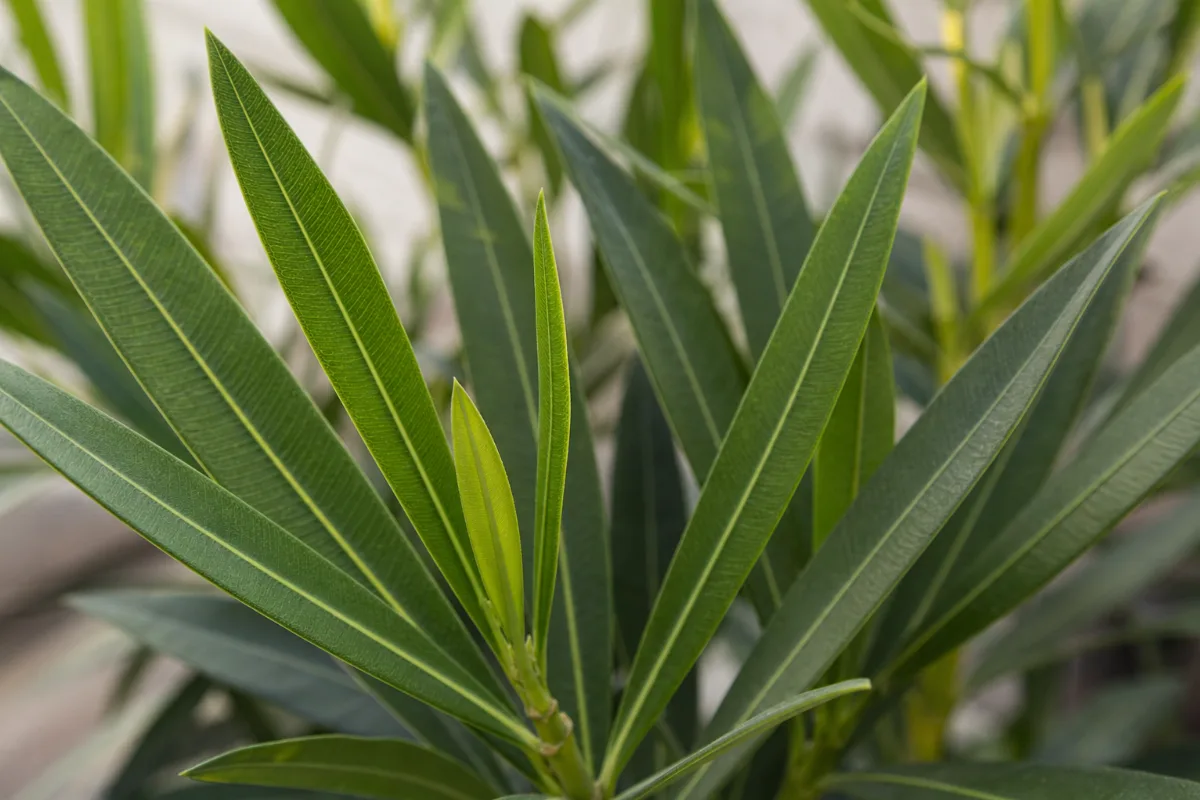
Herbs & Botanicals · Highly poisonous garden shrub
Oleander
Nerium oleander · also called Rose bay, rosebay
Oleander is a common garden shrub, and every part of it is highly poisonous. Its heart-acting glycosides have caused deaths, including after people drank leaf tea. No safe way to use the plant exists. Manufactured extracts have been tested in small cancer trials, with no proven benefit.
General information, not medical advice. Last substantive update · Not medically reviewed. A named clinician has not signed off on this page. How this page is made
About Oleander
Oleander is a common ornamental shrub whose poisons act on the heart. The plant is not a remedy; extracts have only been tested in small, early cancer trials.
Safety first
Do not eat, chew, brew or burn any part of oleander. Leaves, flowers, stems and twigs all contain heart-acting glycosides (oleandrin, neriin, digitoxigenin and others). There is no safe amount and no safe preparation. Deaths are documented, and a review notes that treatment depends on supportive care and a specific antidote that is not always available.
Real examples: an 84-year-old man drank an oleander leaf infusion believing it was bay laurel and developed third-degree heart block that needed antibodies and a pacemaker. Oleander was the plant most often behind food-confusion calls to a French poison centre (289 of 2,197). Smoke from burned clippings was linked to 76 deaths among 205 cattle in one report.
Children, pets and livestock: in a French series of 2,748 children, 8.15% developed symptoms, mostly mild, but any swallowing needs a call to poison control. Keep animals and children away from the plant and do not burn clippings.
If any was swallowed, or you have a slow or irregular heartbeat, vomiting, fainting or vision changes after contact, call Poison Help (US 1-800-222-1222) or your local emergency number now. Do not make the person vomit unless told to.
What it is
Oleander (Nerium oleander) is a garden shrub in the dogbane family (Apocynaceae). It is mainly known by its poisons, which act like the heart drug digoxin. Doctors see the same pattern in digoxin toxicity.
Yellow oleander (Cascabela thevetia, also called Thevetia peruviana) is a different plant with similar poisons. It was found hidden in a weight-loss supplement labelled 'Tejocote root'. It has no page here; never assume it is harmless.
The cancer-extract trials (Phase I and II)
Two manufactured extracts have been tested in people with advanced cancer. Anvirzel, an injectable water extract, was tested in a Phase I study of 18 people (2006): mild injection-site pain, no tumour responses. PBI-05204, an oral extract rich in oleandrin, was tested in a Phase I first-in-human study of 46 people (2014): tiredness, nausea and diarrhoea, grade 1 heart block in 10, and stable disease over four months in 7.
A later Phase II trial of PBI-05204 in 38 analysed people with pancreatic cancer missed its main goal, with one response and serious side effects in 63.2%. Phase I studies mainly test safety; they cannot show that a treatment works. These products are investigational and are not the leaf or tea.
Interactions
Oleander poisoning looks like digoxin toxicity, so combining it with digoxin or other heart-rhythm medicines would be dangerous. No study tested this combination, so the size of the risk is unknown. Oleandrin also confuses digoxin blood tests, which can read falsely high or low, so doctors rely on the heart tracing.
Pregnancy, breastfeeding and children
We found no data on oleander in pregnancy or breastfeeding. Do not use it. Children are at risk from accidental exposure; treat any swallowing as an emergency.
Regulatory status
MedlinePlus (US National Library of Medicine) has a poisoning article and the national Poison Help hotline. We found no approved oleander herbal product. EMA/HMPC, NCCIH, LiverTox, LactMed, WHO and Health Canada were not checked, so their positions are not verified.
At a glance
Traditional uses history, not proof
- Traditional use for cancers and high blood sugar in some countries (not a recommended use)
Studied for research
- Anvirzel injected extract in advanced cancer: insufficient (Phase I)
- PBI-05204 oral extract in advanced cancer: insufficient (Phase I)
- PBI-05204 in pancreatic cancer: low (Phase II, main goal not met)
- Oleander leaf, tea or plant as a remedy: against (poisoning)
Main compounds
- Oleandrin
- Neriin (neriine)
- Digitoxigenin
- Neriifolin
Common forms
- Fresh or dried leaf (poisonous)
- Leaf tea or infusion (poisoning reports)
- Smoke from burning clippings (animal deaths)
- Investigational cancer extracts (trial products, not the plant)
Research links: MedlinePlus: Oleander poisoning · Review of human deaths (PubMed) · Leaf tea mistaken for bay laurel (PubMed) · PBI-05204 Phase I study (PubMed) · Research Library · Genes & Biomarkers Library
The plant and its history
- Accepted scientific name
- Nerium oleander L.
- Naming authority
- GBIF species match, read 2026-10-25: ACCEPTED (key 3169756)
- Common names
- Oleander (English); Rose bay, rosebay (English)
- Botanical family
- Apocynaceae (dogbane family), order Gentianales
- Classification
- Plantae > Apocynaceae > Nerium > Nerium oleander
- Native range
- Not verified in the sources read.
- Habitat
- Ornamental shrub grown in gardens and along roads in warm regions (from the summary; not re-verified).
- What the plant looks like
- Roots: Not verified.; Stems: All parts poisonous (MedlinePlus).; Leaves: Poisonous; mistaken for bay laurel in one case.; Flowers: Poisonous.; Fruit: Not verified.
- Cultivation
- Not covered.
- Harvest and processing
- Not covered.
- Look-alikes and adulterants
- Name: Bay laurel (Laurus nobilis); Note: Oleander leaves were mistaken for bay laurel in an infusion poisoning (Italy).; Name: Yellow oleander (Cascabela thevetia, also called Thevetia peruviana); Note: A different plant in the same family with similar poisons. GBIF accepts Cascabela thevetia (key 3169652). Found as a hidden ingredient in a supplement labelled 'Tejocote root'.
- Sustainability and conservation
- Not covered.
Traditional use and history history, not clinical proof
| Tradition or era | Documented use | Source |
|---|---|---|
| Traditional medicine (India, Turkey, Morocco, China) | Used for cancers and high blood sugar according to a 2023 review. Not traced to original sources and not a reason to use the plant. | p36706925 |
Traditional use shows how a plant was used. It does not show that a supplement works or is safe today.
What is inside, and how it may work
What the plant contains and how those compounds act in cells and animals. Laboratory and animal mechanisms are not proven effects in people.
Main compounds
| Compound | Family | Where it is concentrated | Activity studied | Level of evidence |
|---|---|---|---|---|
| Oleandrin PubChem 11541511 | cardiac glycoside | Leaf (main cytotoxic component of the PBI-05204 extract) | Acts on the heart; studied in cancer cells. 4 11 6 10 | Human data |
| Neriifolin PubChem 441867 | cardiac glycoside | Not stated in sources read | Not described in the sources read. 10 | Insufficient |
| Digitoxigenin PubChem 4369270 | cardiac glycoside aglycone | Listed by MedlinePlus among the poisonous ingredients | Listed as poisonous. 8 10 | Case report |
| Neriin (neriine) | cardiac glycoside | Listed by MedlinePlus | Listed as poisonous. CID not looked up. 8 | Case report |
Mechanisms, receptors and pathways
| Target or pathway | Gene or receptor | What was found | Level |
|---|---|---|---|
| Heart rhythm and conduction | Na+/K+-ATPase (cell sodium-potassium pump), as described in the trial papers | In poisoning, human cases show slow heartbeat and heart block; the clinical picture resembles digoxin toxicity. 7 12 4 | Human data |
| Cancer-cell signalling (Akt, mTOR, GRP78) | Akt, p70S6K, GRP78 | In cells and mice the extract reduced these signals and stem-cell markers. In the Phase I study, Akt and pS6 in blood cells fell on average by 10% and 35%. Laboratory and early human biomarker data only; no proven benefit. 1 4 | Lab |
Absorption, metabolism and elimination
- Absorption
- Not covered for the plant.
- Distribution
- Oleandrin was found in several organs in cattle (animal).
- Metabolism
- A review suggests gut bacteria may change how oleander acts (hypothesis).
- Elimination
- In the oral extract Phase I study, oleandrin half-life ranged from 5 to 13 hours.
- Bioavailability
- Peak oleandrin up to 2 ng/mL in cancer patients taking the extract by mouth.
Isolated compounds versus whole extracts
The trial extracts (Anvirzel, PBI-05204) are manufactured products given in monitored trials. The raw leaf or garden plant has uncontrolled amounts of many glycosides. Trial safety says nothing about the leaf or tea.
Nutritional composition
Not a nutrient. Not a food. Do not eat or drink any part.
1 low certainty1 very low certainty2 not enough evidence1 evidence against
What is Oleander good for?
The plant has no tested benefit. What you may read about oleander and cancer comes from small early trials of manufactured extracts, rated honestly below. They are not a recommendation.
Benefits, one by one
Each card is a research question, not a promise. Tap a goal to filter. Open a card to see the studies, doses and limits.
Anvirzel injected extract in advanced cancer (Phase I safety study)
Not enough evidenceA small early study gave 18 people with advanced cancer an injectable water extract of oleander called Anvirzel. It mainly tested safety. No tumour shrank. It does not show the extract works.
2 studiesNot applicable. No amount, preparation or way of using oleander is gi…
Studies, doses and limits
What the trials found
Phase I trial, 18 adults with advanced solid tumours, injection into muscle. Mostly mild injection-site pain (78%), tiredness, nausea and breathlessness. No objective tumour responses.
Results
No objective tumour responses; the limit was injection volume.
Effect sizes as reported
None; there was no comparison group.
Why this rating
A Phase I trial answers 'is it safe to give', not 'does it work'. No responses were seen and there is no controlled trial.
Form and dose studied
Not applicable. No amount, preparation or way of using oleander is given or recommended on this page.
Who was studied
Adults with refractory solid tumours.
Limits
Small, early, uncontrolled. The extract is a manufactured product, not the plant.
Why researchers looked
Anvirzel was used as a cancer product; this Phase I study tested whether it could be given safely.
Traditional use
Oleander has been used traditionally for cancers in several countries (narrative review); we did not read the original sources.
Proposed mechanism Pharmacological theory
Cardiac glycosides such as oleandrin block a cell pump (Na+/K+-ATPase). Studies in cells suggest this affects cancer-related signals; in the body the same action disturbs the heartbeat.
A proposed mechanism does not show that the effect happens in people.
Every part of oleander is highly poisonous. See the Safety tab first. The tested extracts are medical research products given under trial supervision, not the leaf, tea or garden plant.
PBI-05204 oral oleander extract in advanced cancer (Phase I first-in-human study)
Not enough evidenceIn the first test in people, 46 adults with advanced cancer took an oleander extract called PBI-05204 by mouth. Tiredness, nausea and diarrhoea were common. Some had mild heart-conduction changes on ECG. Seven had stable disease for over four months. This is early safety research, not a treatment.
1 studiesNot applicable. No amount, preparation or way of using oleander is gi…
Studies, doses and limits
What the trials found
Phase I, 46 patients, 21 of every 28 days by mouth. ECG monitoring found grade 1 heart block (AV block) in 10 people and a fast rhythm in 1. Oleandrin blood levels peaked at up to 2 ng/mL.
Results
Stable disease over 4 months in 7 of 46 (15%). Akt and pS6 signals in blood cells fell by 10% and 35% on average.
Effect sizes as reported
None; no comparison group.
Why this rating
Dose-finding study with no comparison group. Stable disease can happen without treatment. The heart-rhythm findings are a reminder of the glycoside action.
Form and dose studied
Not applicable. No amount, preparation or way of using oleander is given or recommended on this page.
Who was studied
Adults with advanced solid tumours, closely monitored.
Limits
Early; industry-linked product. Not the plant.
Why researchers looked
PBI-05204 is a standardised oleander extract with oleandrin, tested to find its safety limits and what the body does with it.
Traditional use
Not a traditional preparation; it is a manufactured extract.
Proposed mechanism Pharmacological theory
Cardiac glycosides such as oleandrin block a cell pump (Na+/K+-ATPase). Studies in cells suggest this affects cancer-related signals; in the body the same action disturbs the heartbeat.
A proposed mechanism does not show that the effect happens in people.
Every part of oleander is highly poisonous. See the Safety tab first. The tested extracts are medical research products given under trial supervision, not the leaf, tea or garden plant.
PBI-05204 in advanced pancreatic cancer (Phase II trial)
Low certaintyA later single-arm trial in 42 people with advanced pancreatic cancer did not meet its main goal. About a quarter were alive at 4.5 months, only one person had a tumour response, and serious side effects were common.
1 studiesNot applicable. No amount, preparation or way of using oleander is gi…
Studies, doses and limits
What the trials found
Phase II single-arm trial: 42 enrolled, 38 analysed. 10 of 38 (26.3%) alive at 4.5 months; median progression-free survival 56 days; 1 response (2.6%); serious (grade 3 or higher) events in 63.2%.
Results
Overall-survival target not met.
Effect sizes as reported
None; no comparison group.
Why this rating
One uncontrolled trial that missed its main goal. The authors call for more trials; the data do not support use.
Form and dose studied
Not applicable. No amount, preparation or way of using oleander is given or recommended on this page.
Who was studied
Adults with stage IV pancreatic cancer after earlier treatment.
Limits
Single-arm; small; industry-linked product.
Why researchers looked
The extract was moved into a Phase II trial in a cancer with few treatment options.
Traditional use
Not applicable.
Proposed mechanism Pharmacological theory
Cardiac glycosides such as oleandrin block a cell pump (Na+/K+-ATPase). Studies in cells suggest this affects cancer-related signals; in the body the same action disturbs the heartbeat.
A proposed mechanism does not show that the effect happens in people.
Every part of oleander is highly poisonous. See the Safety tab first. The tested extracts are medical research products given under trial supervision, not the leaf, tea or garden plant.
Oleander leaf, tea or any plant part as a remedy
Evidence againstNo evidence supports taking oleander leaf, tea or any part of the plant. Every report we found describes poisoning, including deaths and a case of heart block after a tea made by mistake for bay laurel.
5 studiesNot applicable. No amount, preparation or way of using oleander is gi…
Studies, doses and limits
What the trials found
No trial of the plant exists. Case reports, poison-centre series and reviews describe poisoning.
Results
Poisoning with heart block (84-year-old man, tea); 289 oleander food-confusion cases in a French poison-centre series; deaths reviewed in a 2025 literature review.
Effect sizes as reported
None.
Why this rating
The only human evidence is poisoning. No safe amount has been shown, and the tea did not remove the poison.
Form and dose studied
Not applicable. No amount, preparation or way of using oleander is given or recommended on this page.
Who was studied
Anyone; children, pets and livestock are at particular risk.
Limits
Case reports cannot give how often harm happens.
Why researchers looked
Oleander is sometimes promoted for cancer or blood sugar; poisoning reports are what the research actually shows.
Traditional use
Traditional use for cancer and high blood sugar is noted in one review (not verified from original sources).
Proposed mechanism Pharmacological theory
Cardiac glycosides in all parts act on the heart; in poisoning that means slow or irregular heartbeat.
A proposed mechanism does not show that the effect happens in people.
Do not use. If any part was swallowed call poison control now (US 1-800-222-1222).
Oleander extracts and oleandrin against cancer cells (laboratory research)
Very low certaintyIn cell dishes and mice, an oleander extract and its main compound slowed brain-tumour stem cells. This is laboratory research only and says nothing yet about people.
1 studiesNot applicable. No amount, preparation or way of using oleander is gi…
Studies, doses and limits
What the trials found
Cell and mouse study only; no human data.
Results
Fewer and smaller tumour spheres; slower growth of grafted tumours in mice.
Effect sizes as reported
None.
Why this rating
Cell and animal findings often fail in people; the human trials above found no benefit that could be shown.
Form and dose studied
Not applicable. No amount, preparation or way of using oleander is given or recommended on this page.
Who was studied
Not applicable (laboratory).
Limits
Cells and mice only.
Why researchers looked
Scientists test oleandrin and the PBI-05204 extract on cancer cells to find drug leads.
Traditional use
Not applicable.
Proposed mechanism Preliminary mechanism
In cells the extract lowered GRP78 and stem-cell markers and triggered a form of cell death (necroptosis).
A proposed mechanism does not show that the effect happens in people.
Every part of oleander is highly poisonous. See the Safety tab first. The tested extracts are medical research products given under trial supervision, not the leaf, tea or garden plant.
Connections to the rest of health
How Oleander connects to the rest of our health knowledge graph. Every link says what kind of connection it is. A safety link (for example to the liver) is a warning, not a benefit. A study that merely mentions a topic never creates a benefit link.
Explore every connection: goals, body systems, organs, symptoms, genes
A. Wellness goals
| Connected to | Kind of connection | Evidence status | Context | Studies |
|---|---|---|---|---|
| Cellular Protection | Not enough evidence | Anvirzel injected extract in advanced cancer (Phase I safety study): A small early study gave 18 people with advanced cancer an injectable water extract of oleander called Anvirzel. It mainly tested safety. No tumour shrank. It does not show the extract works. PBI-05204 oral oleander extract in advanced cancer (Phase I first-in-human study): In the first test in people, 46 adults with advanced cancer took an oleander extract called PBI-05204 by mouth. Tiredness, nausea and diarrhoea were common. Some had mild heart-conduction changes on ECG. Seven had stable disease for over four months. This is early safety research, not a treatment. | 9 13 4 | |
| Cellular Protection | Low certainty | PBI-05204 in advanced pancreatic cancer (Phase II trial): A later single-arm trial in 42 people with advanced pancreatic cancer did not meet its main goal. About a quarter were alive at 4.5 months, only one person had a tumour response, and serious side effects were common. | 11 | |
| Heart Health | Adverse effect or risk | Evidence against | Oleander leaf, tea or any plant part as a remedy: No evidence supports taking oleander leaf, tea or any part of the plant. Every report we found describes poisoning, including deaths and a case of heart block after a tea made by mistake for bay laurel. | 8 12 7 15 13 |
| Cellular Protection | Very low certainty | Oleander extracts and oleandrin against cancer cells (laboratory research): In cell dishes and mice, an oleander extract and its main compound slowed brain-tumour stem cells. This is laboratory research only and says nothing yet about people. | 1 |
B. Body systems
| Connected to | Kind of connection | Evidence status | Context | Studies |
|---|---|---|---|---|
| Digestive System | Adverse effect or risk | Documented | Nausea, vomiting, diarrhoea and stomach pain are early signs. Preparation or compound: Oleander |
8 5 |
| Immune System | Biological association | Not enough evidence | Studied for: Anvirzel injected extract in advanced cancer (Phase I safety study) | 9 13 |
| Cardiovascular System | Biological association | Not enough evidence | Studied for: PBI-05204 oral oleander extract in advanced cancer (Phase I first-in-human study) Studied for: Oleander leaf, tea or any plant part as a remedy | 4 8 12 7 15 13 |
| Digestive System | Biological association | Low certainty | Studied for: PBI-05204 in advanced pancreatic cancer (Phase II trial) | 11 |
| Nervous System | Biological association | Very low certainty | Studied for: Oleander extracts and oleandrin against cancer cells (laboratory research) | 1 |
C. Body parts and organs
L. Active compounds
| Connected to | Kind of connection | Evidence status | Context | Studies |
|---|---|---|---|---|
| Oleandrin | Biological association | Human | Acts on the heart; studied in cancer cells. Preparation or compound: Leaf (main cytotoxic component of the PBI-05204 extract) |
4 11 6 10 |
| Neriifolin | Biological association | Not enough evidence | Not described in the sources read. Preparation or compound: Not stated in sources read |
10 |
| Digitoxigenin | Biological association | Case report | Listed as poisonous. Preparation or compound: Listed by MedlinePlus among the poisonous ingredients |
8 10 |
| Neriin (neriine) | Biological association | Case report | Listed as poisonous. CID not looked up. Preparation or compound: Listed by MedlinePlus |
8 |
Each connection is stored with the ingredient, the connected record, the kind of connection, the evidence status, the supporting studies, the preparation or compound involved, and a review date (last reviewed October 25, 2026).
The evidence
The research centre for Oleander. Every record here was checked against PubMed or the publisher's page; we never list a study we have not verified.
Evidence by outcome
Bars show how many studies we found for each outcome, not how well it works. People are added up across trials only (reviews are not added, to avoid double counting).
How we rate evidence
High certainty
Several well-run trials or reviews agree; further research is unlikely to change the picture much.
Moderate certainty
Good trials point the same way, but some doubt remains.
Low certainty
Small, short or inconsistent trials. The finding could change with better research.
Very low certainty
Very little or very weak human data. Treat as a possibility only.
Mixed findings
Trials or reviews disagree with each other.
Not enough evidence
Not enough human research to say either way.
Evidence against
Good research found no benefit, or found harm.
We take the reviewers' own risk-of-bias and GRADE statements where they exist, and otherwise judge from study size, design, consistency, directness and whether a product matches what is sold. Many publications do not make evidence high. Method note: We read our existing herb summary, read the abstract of each PubMed record cited, and checked names in GBIF and compounds in PubChem. Pages that could not be opened are marked not verified.
Study library: every study we checked 15
| Study | Design | People | Product, dose, length | Result |
|---|---|---|---|---|
| Chakraborty 2024 PBI-05204, a supercritical CO2 extract of Nerium oleander, suppresses glioblastoma stem cells by inhibiting GRP78 and inducing programmed necroptotic cell death Neoplasia · PMID 38823209 · DOI |
Laboratory research mixed |
Patient-derived brain-tumour stem cells and mouse xenografts | PBI-05204 and oleandrin extract Not given here Not given here |
The extract reduced the number and size of tumour spheres and slowed growth of grafted tumours in mice, and lowered GRP78 and stem-cell markers. Methods, limits and fundingOutcomes: Tumour-sphere growth Limitations: Cell and mouse study only; no information about people. Read: abstract |
| Dasgupta 2014 Bidirectional (negative/positive) interference of oleandrin and oleander extract on a relatively new Loci digoxin assay using Vista 1500 analyzer J Clin Lab Anal · PMID 24375780 · DOI |
Laboratory research mixed |
Serum samples and mice | Oleandrin and oleander extract extract Not given here Not given here |
Oleandrin and oleander extract gave apparent digoxin readings in a digoxin-free serum pool and in fed mice. In serum from people taking digoxin they made readings falsely lower or higher, depending on concentration. Measuring free digoxin did not remove the interference. Methods, limits and fundingOutcomes: Apparent digoxin readings Limitations: Laboratory and mouse study of one digoxin test. Shows the blood test is unreliable with oleander; it does not test a clinical interaction. Read: abstract |
| GBIF 2026 GBIF species match: Nerium oleander and Cascabela thevetia api.gbif.org · Source |
Database record |
Name check | Plant names not applicable Not given here Not given here |
Nerium oleander L. ACCEPTED (key 3169756), family Apocynaceae, order Gentianales. Cascabela thevetia (L.) Lippold ACCEPTED (key 3169652), same family, a separate genus. Methods, limits and fundingOutcomes: Accepted names Limitations: Read 2026-10-25. Synonyms not reviewed. Read: full-text |
| Hong 2014 First-in-human study of PBI-05204, an oleander-derived inhibitor of Akt, FGF-2, NF-kB and p70S6K, in patients with advanced solid tumors Invest New Drugs · PMID 24919855 · DOI |
Clinical trial |
46 Adults with advanced solid tumours |
PBI-05204, a Nerium oleander extract containing oleandrin, by mouth extract (not the raw plant) Not given here Not given here |
46 people took it by mouth for 21 of every 28 days (Phase I, dose-escalation design). Dose-limiting toxicities were protein in the urine and tiredness at the highest level reached. Common effects: tiredness 56.5%, nausea 41.3%, diarrhoea 32.6%. ECG monitoring found grade 1 atrioventricular block in 10 people and a grade 2 fast rhythm (supraventricular tachycardia) in 1. Seven people (15%) had stable disease for more than 4 months. Oleandrin peaked at up to 2 ng/mL; half-life 5 to 13 hours. Akt and pS6 signals in blood cells fell on average by 10% and 35%. Stable disease over 4 months in 7 of 46 Methods, limits and fundingOutcomes: Safety, blood levels, markers Limitations: Early safety study without a comparison group; stable disease is not proof of benefit. Authors are linked to the extract's developer (not confirmed from the abstract; check the full paper). Dose amounts omitted on purpose. Funding and conflicts: Industry-linked (the extract is a company product); not confirmed from the abstract Read: abstract |
| Legendre 2026 Unintentional Exposure to Nerium oleander in Children: A 12-Year Retrospective Study in France Pediatr Emerg Care · PMID 42605237 · DOI |
Observational |
2748 Children aged 0 to 12 in the French national poisoning database |
Nerium oleander (accidental exposure) various Not given here Not given here |
224 of 2,748 children (8.15%) developed symptoms. Mouth and swallowing exposures mostly caused minor digestive or mouth irritation. Eye and skin contact also irritated. Most accidents were at home. Methods, limits and fundingOutcomes: Symptoms and outcome Limitations: Retrospective database; reported cases only; mostly minor outcomes in this series do not mean it is safe. Read: abstract |
| Lisuzzo 2025 Case Report: Oleandrin intoxication by inhalation in beef cattle Front Vet Sci · PMID 40989957 · DOI |
Case report animal |
205 Beef cattle, 76 deaths in 30 hours (Italy) |
Burning of oleander clippings (smoke) clippings Not given here Not given here |
76 of 205 cattle died within 30 hours after oleander clippings were burned about 20 metres from their housing. Oleandrin was found in lungs, kidneys, liver and other tissues. The authors conclude 74 died from breathing it. Methods, limits and fundingOutcomes: Deaths and oleandrin in tissues Limitations: Animal report; inference about the cause. Not shown in people. Read: abstract |
| Mantelli 2023 Laurel but Hardy: unintended poisoning, a case report of oleander misidentification as bay laurel Toxicol Rep · PMID 37885923 · DOI |
Case report |
1 84-year-old man (Italy) |
Nerium oleander leaf infusion leaf Not given here Not given here |
Stomach symptoms 4 hours after the infusion, then third-degree heart block needing digoxin-specific antibodies and external pacing. Discharged on day 8. Standard digoxin assays measured the oleander glycosides poorly, so doctors had to rely on the clinical picture. He stayed free of symptoms for a time despite severe ECG changes. Methods, limits and fundingOutcomes: Outcome of poisoning Limitations: One case. Abstract read only. Read: abstract |
| MedlinePlus (US National Library of Medicine) 2025 Oleander poisoning medlineplus.gov · Source |
Authoritative guidance |
Public encyclopedia article | Nerium oleander and Cascabela thevetia (yellow oleander) all parts Not given here Not given here |
Poisonous ingredients listed: digitoxigenin, neriin, oleandrin, oleondroside. Found in flowers, leaves, stems and twigs. Signs: slow or irregular heartbeat, low blood pressure, weakness, blurred vision, halos, diarrhoea, nausea, vomiting, stomach pain, confusion, dizziness, drowsiness, fainting, rash, hives. Do not make the person vomit unless told to by poison control or a clinician. US Poison Help line 1-800-222-1222. Symptoms last 1 to 3 days and may need a hospital stay. Methods, limits and fundingOutcomes: Poisoning signs and advice Limitations: Information article; US advice. Says death is unlikely, which does not match the fatal cases in the case literature, so we do not rely on that line. Read: full-text |
| Mekhail 2006 Phase I trial of Anvirzel in patients with refractory solid tumors Invest New Drugs · PMID 16763787 · DOI |
Clinical trial |
18 Adults with advanced solid tumours that had stopped responding to treatment |
Anvirzel, a water extract of Nerium oleander, given by injection into muscle extract (not the raw plant) Not given here Not given here |
18 people completed at least one 3-week cycle. Most had mild pain at the injection site (78%); other effects were tiredness, nausea and breathlessness. The usual dose-limiting toxicity was not seen; the limit was the volume that could be injected. No objective tumour responses were seen. No objective responses in 18 people Methods, limits and fundingOutcomes: Safety, maximum tolerated amount, tumour response Limitations: Small, early safety study with no comparison group. Not designed to show benefit. Amounts omitted on purpose. Read: abstract |
| PubChem 2026 PubChem: oleandrin, neriifolin, digitoxigenin pubchem.ncbi.nlm.nih.gov · Source |
Database record |
Compound record check by name | Compounds not applicable Not given here Not given here |
Oleandrin CID 11541511 (C32H48O9); neriifolin CID 441867 (C30H46O8); digitoxigenin CID 4369270 (C23H34O4). Neriin (neriine, as spelled by MedlinePlus) was not looked up. Methods, limits and fundingOutcomes: IDs and formulas Limitations: Matched by name only. Read: full-text |
| Roth 2020 A Phase II, Single-Arm, Open-Label, Bayesian Adaptive Efficacy and Safety Study of PBI-05204 in Patients with Stage IV Metastatic Pancreatic Adenocarcinoma Oncologist · PMID 32452588 · DOI |
Clinical trial |
42 Adults with stage IV pancreatic cancer after prior treatment (38 analysed) |
PBI-05204, a modified supercritical CO2 extract of Nerium oleander leaves, by mouth leaf extract (not the raw plant) Not given here Not given here |
The trial did not meet its main goal. 10 of 38 (26.3%) were alive at 4.5 months; median progression-free survival 56 days; one objective response (2.6%). Serious (grade 3 or higher) adverse events occurred in 63.2%. Common effects: vomiting 23.7%, nausea 18.4%, decreased appetite 18.4%, diarrhoea 15.8%. Primary endpoint not met Methods, limits and fundingOutcomes: Overall survival at 4.5 months Limitations: Single-arm trial, no comparison group, small. The authors still describe 'signals of efficacy'; the numbers do not show benefit. Funding and conflicts: Industry-linked (extract developer); not confirmed from the abstract Read: abstract |
| Sacco 2025 Human Deaths Related to Oleander Poisoning: A Review of the Literature Toxins (Basel) · PMID 40137888 · DOI |
Narrative review |
Published reports of human oleander deaths, including autopsy reports | Nerium oleander and Thevetia peruviana (yellow oleander) all parts Not given here Not given here |
Oleandrin and thevetin act strongly on the heart. Signs range from nausea and stomach pain to severe rhythm problems and sudden cardiac death. Treatment is supportive care, gut decontamination and digoxin-specific antibody fragments (Digifab); limited access to Digifab and delays are problems. Many cases are intentional self-poisoning. Methods, limits and fundingOutcomes: Epidemiology, clinical features, treatment challenges Limitations: Narrative review; few English-language reports from southern Asia and the Mediterranean, where poisoning is more common. Read: abstract |
| Sharma 2023 A toxic shrub turned therapeutic: The dichotomy of Nerium oleander bioactivities Toxicon · PMID 36706925 · DOI |
Narrative review mixed |
Pre-clinical and clinical literature on oleander | Nerium oleander leaf and others Not given here Not given here |
Notes oleander is used traditionally for cancers and high blood sugar in several countries, that clinical studies of its pharmacological effects remain critically under-explored, and that any part can cause fatal toxicity. The authors suggest gut bacteria may affect both benefits and harm. Yellow oleander is deliberately excluded. Methods, limits and fundingOutcomes: Medicinal use versus toxicity Limitations: Narrative review; the gut-bacteria idea is a hypothesis. Read: abstract |
| Theuer 2026 When herbal supplements cause heart problems: Clinical case report and forensic toxicological analysis Toxicol Rep · PMID 41883558 · DOI |
Case report |
1 42-year-old woman (Europe) who bought a weight-loss supplement in the USA |
Supplement labelled 'Tejocote root'; contained yellow oleander (Thevetia peruviana), not the advertised plant root product (as labelled) Not given here Not given here |
Nausea, vomiting, low blood pressure, slow heartbeat (51/min) and first-degree heart block; slow heartbeat lasted five days, full recovery by day nine. Mass spectrometry and DNA barcoding found yellow oleander and none of the advertised Crataegus mexicana. Digoxin tests gave conflicting results across platforms. Methods, limits and fundingOutcomes: Poisoning and product analysis Limitations: One case. Yellow oleander is a different plant from Nerium oleander. Read: abstract |
| Torrents 2024 Food Confusion Between Edible and Poisonous Plants: A 22-Year Retrospective of the Southeastern France Poison Control Center Toxins (Basel) · PMID 39728810 · DOI |
Observational |
2197 Plant food-confusion cases at one French poison centre, 2002 to 2023 |
Many plants; oleander was the most common various Not given here Not given here |
Oleander was involved in 289 of 2,197 cases (13.1%). Across all plants 53.6% had symptoms, 0.5% were severe, 0.4% went to intensive care; one death (a different plant, monkshood). The authors note oleander confusion appears milder than the plant's use in suicide attempts. Methods, limits and fundingOutcomes: Symptoms and severity Limitations: Figures are for all plants together, not oleander alone. One region. Read: abstract |
What we do not know yet
- No trial of oleander leaf, tea or the raw plant.
- Cancer extracts: no randomised, controlled trial found.
- No pregnancy or breastfeeding data found.
- No interaction study with digoxin or other heart drugs.
- EMA/HMPC, NCCIH, LiverTox, LactMed, WHO and Health Canada not checked.
How new research is added
New studies are found by a saved PubMed search and placed in a review queue. A person reads each one before it changes any rating or safety wording.
Lab markers
What changed in blood or saliva tests during trials. A changed number is not the same as feeling or being healthier, and we give no "normal ranges".
Safety
What studies and official sources say about side effects, medicines and who should check first. Each point shows what kind of evidence it comes from.
Main points to know 3
- Every part of oleander is highly poisonous: do not eat, drink, brew or burn it. Leaves, flowers, stems and twigs all contain cardiac glycosides (oleandrin, neriin, digitoxigenin and others). They can slow or disturb the heartbeat and have caused deaths. People have been poisoned by drinking leaf tea, including by mistake for bay laurel. There is no safe amount and no safe way to use the plant. Case report 8 7 12
- Children, pets and livestock. In a French series of 2,748 children, 8.15% developed symptoms, mostly mild stomach and mouth irritation; eye and skin contact also irritated. Mild outcomes in that series do not make it safe. Burning oleander clippings was linked to 76 deaths among 205 cattle in one report. Case series 5 6
- If any is swallowed: poison control now. Do not make the person vomit unless told to. In the US call Poison Help at 1-800-222-1222, or the local emergency number. Say which plant part, how much and when. Authoritative guidance 8
Side effects 6
| Effect | How often | Severity and recovery | Evidence |
|---|---|---|---|
| Nausea, vomiting, diarrhoea and stomach pain Usually the first signs; no frequency data for adults. | Not established | moderate Usually recovered with hospital care | Authoritative guidance 8 5 |
| Slow or irregular heartbeat, heart block, low blood pressure Third-degree heart block occurred after one cup of leaf infusion. | Not established | severe Recovered in the tea case after antibodies and pacing; fatal in others | Case report 7 12 8 |
| Dizziness, confusion, drowsiness, headache, fainting Listed by MedlinePlus. | Not established | moderate Not reported | Authoritative guidance 8 |
| Blurred vision and halos around lights More often with repeated or chronic exposure. | Not established | moderate Not reported | Authoritative guidance 8 |
| Rash and hives; skin or eye irritation Cleaning the contact area is advised in the children's series. | Not established | mild Not reported | Observational 8 5 |
| Heart-conduction changes and tiredness, nausea, diarrhoea in cancer-extract trials Grade 1 AV block in 10 of 46 people (PBI-05204 Phase I); serious events in 63.2% in the Phase II pancreatic trial. | Not established | moderate Closely monitored in trials | Clinical trial 4 11 9 |
Liver
No LiverTox entry for oleander was checked. In the cattle report, tissue damage included liver cell death after oleander smoke, but that is an animal case and not evidence for people. 6
How often. No human data.
Monitoring. Not applicable. Medical care after a poisoning focuses on the heart.
This is a safety connection. It is not evidence that Oleander supports liver health.
Medicines and supplements 3
| With | Why it matters | Importance | Evidence | What to do |
|---|---|---|---|---|
| Digoxin, digitoxin and other heart-glycoside medicines drug | Both act on the same cell pump; oleander poisoning looks like digoxin toxicity. | Adding oleander to digoxin could add to the effect. No study of the plant together with digoxin was read, so the size of the risk is unknown, but it should be treated as dangerous. | Pharmacological theory Not enough evidence 7 8 | Never combine. Tell a doctor or poison centre about any plant swallowed. |
| Other heart-rhythm medicines (beta blockers, calcium-channel blockers, anti-arrhythmics) drug | Both can slow the heartbeat or conduction. | Plausible added slowing of heart rate or heart block. No interaction study was found. | Pharmacological theory Not enough evidence 4 | Do not use oleander. Ask a pharmacist about your own medicines. |
| Digoxin blood tests laboratory test | Oleandrin and oleander extract react in digoxin immunoassays. | Readings can be falsely low or high, so a digoxin level cannot reliably show how much oleander was taken. In the tea case standard assays measured the glycosides poorly. | Laboratory research Moderate certainty 2 7 14 | Doctors rely on the clinical picture and ECG. |
Who should check first 3
| Situation | Advice | Evidence |
|---|---|---|
| Everyone: swallowing any part of the plant, or drinking tea or infusion | Avoid completely. All parts are poisonous. | Authoritative guidance 8 7 |
| People taking digoxin or other heart medicines | Avoid completely; see interactions. | Pharmacological theory 8 |
| Children, pets and livestock around garden plants | Keep away from the plant and do not burn clippings near animals or people. | Case series 5 6 |
Overdose, product quality and regulators
Summary. Highly poisonous. The glycosides act like digoxin and can cause deadly heart rhythm problems. A review of human deaths notes that treatment relies on supportive care, decontamination and digoxin-specific antibody fragments, and that access to the antidote and delays are problems.
Animal. Smoke from burned clippings was linked to 76 deaths among 205 cattle in one report; oleandrin was found in lungs, kidneys and liver.
Human doses studied. No safe amount exists. Amounts are not given on this page.
High dose or long term signals. Heart block and rhythm disturbances; vision changes and appetite loss in chronic overdose (MedlinePlus).
Overdose response. Emergency care. Poison control advice: do not induce vomiting unless told to. Treatment can include activated charcoal, monitoring and digoxin-specific antibody fragments.
Genotoxicity. Not covered.
Toxic plant parts. All parts: flowers, leaves, stems and twigs (MedlinePlus). Smoke from burning clippings was dangerous to cattle.
Look-alike and mislabelling problems are real. Oleander leaves were mistaken for bay laurel. Separately, a weight-loss supplement labelled 'Tejocote root' contained yellow oleander, a different plant.
Look-alike confusion. Oleander was the plant most often involved in food-confusion calls in a 22-year French series (289 of 2,197). An 84-year-old man made a leaf infusion believing it was bay laurel. 15 7
Yellow oleander in a supplement. Mass spectrometry and DNA barcoding found Thevetia peruviana (yellow oleander) and none of the advertised plant in a 'Tejocote root' product. Yellow oleander is a different plant but has similar poisons. 14
| Body | Action | Date |
|---|---|---|
| MedlinePlus (US National Library of Medicine) (United States) | Information article on oleander poisoning with the Poison Help hotline 1-800-222-1222. source | 2025 |
When to get medical help
- If any oleander (leaf, flower, stem, twig, tea or food made with it) was swallowed, or you feel a slow or irregular heartbeat, faint, vomit, or have vision changes after exposure, call Poison Help (US 1-800-222-1222) or the local emergency number straight away. Do not wait for symptoms; heart effects can appear hours later.
Stop the supplement and contact a clinician or emergency service. In the US, Poison Control is 1-800-222-1222.
General information only, not medical advice. Ask a clinician or pharmacist before use, especially with medicines, in pregnancy or with a health condition. See the Natural Remedy Safety guide.
Frequently asked questions
Is oleander safe to use as tea or a supplement?
What are the signs of oleander poisoning?
Nausea, vomiting, diarrhoea, stomach pain, dizziness, confusion and weakness, then slow or irregular heartbeat and low blood pressure. Vision changes and halos are more common with repeated exposure.
What should I do if someone swallowed oleander?
Call Poison Help (US 1-800-222-1222) or your emergency number now. Do not make the person vomit unless told to. Say which plant part and when.
Is oleander dangerous to children and pets?
Why is oleander mistaken for bay laurel?
Is oleander the same as yellow oleander?
Does oleander cure cancer?
What do the Phase I studies show?
Is oleander dangerous with heart medicines such as digoxin?
Why do digoxin tests not show how much oleander was taken?
Explore by health goal
Editorial transparency
- Written by
- AlternativeMed editorial team. Research compiled with AI assistance, then checked against PubMed records.
- Medical review
- None. This page has not been reviewed by a physician or pharmacist.
- First published
- 2026-10-25
- Last substantive update
- 2026-10-25
- How we research
- We read our existing herb summary, read the abstract of each PubMed record cited, and checked names in GBIF and compounds in PubChem. Pages that could not be opened are marked not verified.
- How we rate evidence
- See "How we rate evidence" in the Evidence tab.
- Independence
- No product is promoted on this page. No affiliate links are shown.
Sources 15
Each source was opened and checked. Where we read only the abstract, it says so. The small numbers in the text point here.
- Chakraborty S, Wei D, et al.. PBI-05204, a supercritical CO2 extract of Nerium oleander, suppresses glioblastoma stem cells by inhibiting GRP78 and inducing programmed necroptotic cell death. Neoplasia. 2024. PMID 38823209. DOI 10.1016/j.neo.2024.101008. (abstract)
- Dasgupta A, Welsh KJ, Hwang SA, et al.. Bidirectional (negative/positive) interference of oleandrin and oleander extract on a relatively new Loci digoxin assay using Vista 1500 analyzer. J Clin Lab Anal. 2014. PMID 24375780. DOI 10.1002/jcla.21637. (abstract)
- GBIF. GBIF species match: Nerium oleander and Cascabela thevetia. api.gbif.org. 2026. (full-text)
- Hong DS, Henary H, Falchook GS, et al.. First-in-human study of PBI-05204, an oleander-derived inhibitor of Akt, FGF-2, NF-kB and p70S6K, in patients with advanced solid tumors. Invest New Drugs. 2014. PMID 24919855. DOI 10.1007/s10637-014-0127-0. (abstract)
- Legendre H, Dubois F, et al.. Unintentional Exposure to Nerium oleander in Children: A 12-Year Retrospective Study in France. Pediatr Emerg Care. 2026. PMID 42605237. DOI 10.1097/PEC.0000000000003672. (abstract)
- Lisuzzo A, Spadotto L, et al.. Case Report: Oleandrin intoxication by inhalation in beef cattle. Front Vet Sci. 2025. PMID 40989957. DOI 10.3389/fvets.2025.1666317. (abstract)
- Mantelli G, Carollo M, Losso L, et al.. Laurel but Hardy: unintended poisoning, a case report of oleander misidentification as bay laurel. Toxicol Rep. 2023. PMID 37885923. DOI 10.1016/j.toxrep.2023.10.010. (abstract)
- MedlinePlus (US National Library of Medicine). Oleander poisoning. medlineplus.gov. 2025. (full-text)
- Mekhail T, Kaur H, Ganapathi R, et al.. Phase I trial of Anvirzel in patients with refractory solid tumors. Invest New Drugs. 2006. PMID 16763787. DOI 10.1007/s10637-006-7772-x. (abstract)
- PubChem. PubChem: oleandrin, neriifolin, digitoxigenin. pubchem.ncbi.nlm.nih.gov. 2026. (full-text)
- Roth MT, Cardin DB, Borazanci EH, et al.. A Phase II, Single-Arm, Open-Label, Bayesian Adaptive Efficacy and Safety Study of PBI-05204 in Patients with Stage IV Metastatic Pancreatic Adenocarcinoma. Oncologist. 2020. PMID 32452588. DOI 10.1634/theoncologist.2020-0440. (abstract)
- Sacco MA, Gualtieri S, Princi A, et al.. Human Deaths Related to Oleander Poisoning: A Review of the Literature. Toxins (Basel). 2025. PMID 40137888. DOI 10.3390/toxins17030115. (abstract)
- Sharma R, Singh S, et al.. A toxic shrub turned therapeutic: The dichotomy of Nerium oleander bioactivities. Toxicon. 2023. PMID 36706925. DOI 10.1016/j.toxicon.2023.107047. (abstract)
- Theuer T, Faber K, et al.. When herbal supplements cause heart problems: Clinical case report and forensic toxicological analysis. Toxicol Rep. 2026. PMID 41883558. DOI 10.1016/j.toxrep.2026.102239. (abstract)
- Torrents R, Reynoard J, et al.. Food Confusion Between Edible and Poisonous Plants: A 22-Year Retrospective of the Southeastern France Poison Control Center. Toxins (Basel). 2024. PMID 39728810. DOI 10.3390/toxins16120552. (abstract)