Comfrey (Symphytum officinale): Uses, Evidence and Safety
Comfrey (Symphytum officinale): why swallowing it is linked to liver injury, what the FDA, Health Canada guidance and EU regulators say, and what is known about creams and gels for the skin.
Content last updated . This page has not been medically reviewed.
Safety first. Supplements can cause side effects and interact with medicines. Read mushroom safety and interactions before you use any mushroom product.
What is Comfrey good for?
What the body uses it for, and how strong the evidence is. A normal job in the body is not proof that extra supplements add benefit; each card says which.
Skin gel for knee osteoarthritis pain
Preliminary or mixedOne trial of 220 people in a Cochrane review found that a comfrey extract gel probably reduced knee osteoarthritis pain over three weeks compared with placebo.
Supplements: Single trial of one standardised gel; larger confirmation is needed. Does not apply to oral use or homemade products.
Skin ointment for low back pain
Preliminary or mixedOne trial of 120 people gave low-quality evidence that a comfrey extract ointment relieved short-term low back pain more than placebo.
Supplements: Low-quality evidence from a single trial; Memorial Sloan Kettering describes topical pain data as mixed.
Minor sprains and bruises (traditional skin use)
Preliminary or mixedEU regulators accepted a specific comfrey root cream or ointment for minor sprains and bruises in adults on the basis of long traditional use, not clinical trials.
Supplements: Traditional use only; short skin use up to 10 days, adults, with the alkaloid content specified per product.
Wound healing (laboratory only)
Lab or animal research onlyMemorial Sloan Kettering says laboratory studies suggest effects on wound healing but human data are lacking.
Supplements: No human evidence read.
Oral use for bronchitis, ulcers or cancer
Not enough evidenceMemorial Sloan Kettering says there is no scientific evidence for bronchitis or peptic ulcers, and cancer claims are not backed by research.
Supplements: No evidence of benefit; oral use is hazardous.
Connected topics
Open a group to see how each topic connects and how strong the evidence is.
Health goals (1)
- Joint SupportPreliminary or mixed
Only for specific skin gels in knee osteoarthritis pain, one trial; limited evidence.
Body systems (4)
- Hepatic / Liver SystemDocumented risk
Comfrey taken by mouth is linked to liver injury through its pyrrolizidine alkaloids; this is a risk, not a benefit.
- Liver & DetoxDocumented risk
Comfrey taken by mouth is linked to liver injury through its pyrrolizidine alkaloids; this is a risk, not a benefit. It is not a liver-support herb.
- Bones, Joints & MusclesPreliminary or mixed
Single trials of specific skin gels and ointments suggest pain relief in knee osteoarthritis and low back pain; evidence is limited.
- Pain & InflammationPreliminary or mixed
Specific comfrey skin products showed short-term pain relief versus placebo in single trials; evidence is limited.
Body parts (2)
Functional actions (1)
- Pain ReliefPreliminary or mixed
Topical comfrey products reduced pain versus placebo in single trials; not shown for oral use.
Conditions & symptoms (3)
- Hepatic Veno-Occlusive DiseaseDocumented risk
Case reports describe liver veno-occlusive disease after oral comfrey, from its pyrrolizidine alkaloids.
- Low Back PainPreliminary or mixed
One trial of a comfrey extract ointment found low-quality evidence of short-term pain relief.
- Osteoarthritis, KneePreliminary or mixed
One trial of a comfrey extract gel found less knee pain than placebo over three weeks.
Documented risks and interactions (5)
- Liver toxicity when taken by mouth. Comfrey contains pyrrolizidine alkaloids that are toxic to the liver. Case reports describe liver veno-occlusive disease after oral use.
- Possible cancer risk (animal data). Memorial Sloan Kettering says the alkaloids are mutagenic and carcinogenic and animal experiments suggest liver cancer. Human cancer risk is not established.
- Regulatory action on oral products. In 2001 the US FDA advised supplement makers to remove comfrey products from the market; comfrey is reported prohibited in Australia and New Zealand.
- Confusion with foxglove. Memorial Sloan Kettering reports accidental poisonings, including one fatal case, when foxglove was mistaken for comfrey.
- Species and product variability. Comfrey species differ and products vary; EU regulators require the alkaloid content to be specified for each product.
Do not swallow comfrey, in any form, and do not give it to children. Comfrey contains pyrrolizidine alkaloids, which EMA says have toxic effects on the liver when taken by mouth. [1] In 2001 the US Food and Drug Administration (FDA) asked supplement makers to stop marketing products containing comfrey because of a serious hazard when ingested. [2] Signs of liver trouble such as tiredness, dark urine, or yellow skin or eyes call for medical help; see liver safety and supplements. If someone swallowed comfrey or a plant thought to be comfrey, call Poison Help at 1-800-222-1222 (US) or 911; other countries are on Poison Help by Country.
Overview
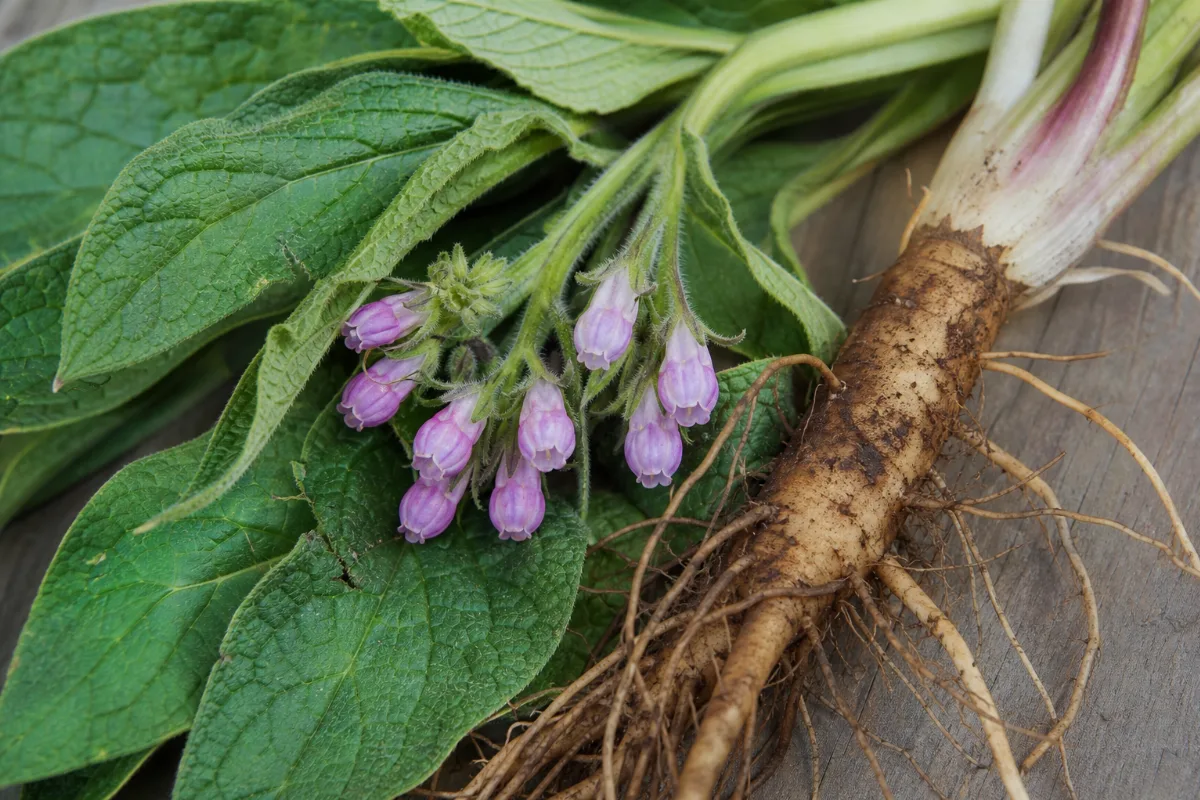
Memorial Sloan Kettering describes comfrey as a fast-growing plant whose leaves and roots have been used historically for wound healing and other conditions. [3] This page covers comfrey as a herb product; it gives no preparation instructions and does not teach how to find or recognize the plant. Memorial Sloan Kettering says comfrey has been confused with foxglove, a poisonous plant with similar leaves, and that several cases of accidental poisoning occurred when what was thought to be comfrey tea was swallowed. [3] Do not rely on a photo or app to identify plants; see plant and mushroom poisoning. The pyrrolizidine alkaloid family is explained on pyrrolizidine alkaloids: comfrey, coltsfoot and borage.Scientific name, plant part and family
Symphytum officinale L. (common comfrey), family Boraginaceae, is the accepted name. [4] EMA says comfrey root is the root of Symphytum officinale. [1] The FDA letter names three species: common comfrey (S. officinale), prickly comfrey (S. asperum) and Russian comfrey (S. x uplandicum). [2] A Canadian Forces fact sheet (2016) says two comfrey species contain pyrrolizidine alkaloids that damage the liver, that echimidine is found in prickly and Russian comfrey, and that not all manufacturers identify the species, so Health Canada has advised Canadians to avoid all of these products. [5]Traditional use
This is tradition, not proof. The Canadian fact sheet says comfrey roots and leaves have been used for centuries for healing properties, historically believed to help heal broken bones and wounds. [5] The EU committee accepted a specific comfrey root ointment for symptoms of minor sprains and bruises based on traditional use of at least 30 years. [1]What research shows
| Use | What the source found | Strength of evidence | Form and population |
|---|---|---|---|
| Knee osteoarthritis pain (skin gel) | The Cochrane review of topical herbs found moderate evidence from a single trial of 220 people that a comfrey extract gel probably improves pain over three weeks. [6] | Promising but limited | Topical extract gel, adults |
| Low back pain (skin ointment) | The Cochrane review of herbal medicine for low back pain found low-quality evidence from one trial of 120 people that a comfrey extract ointment improves short-term pain. [7] | Promising but limited | Topical ointment, adults |
| Minor sprains and bruises (EU assessment) | The committee noted four studies of a different comfrey preparation but did not use them because its exact composition was unknown. [1] | Traditional use only | Specific ethanol extract ointment |
| Taking comfrey by mouth for any condition | Memorial Sloan Kettering lists bronchitis, ulcers and cancer claims as unsupported by scientific evidence. [3] | No good evidence of benefit | Oral |
These results are for particular standardized gels or ointments. Homemade or other products are not covered by them.
Forms and why the form matters
The EU assessment covers only a specific ethanol extract in creams or ointments for the skin. [1] It says the amount of pyrrolizidine alkaloids must be specified in each product. [1] In animals, pyrrolizidine alkaloids are hepatotoxic after oral administration, and in rats some have caused tumors. [8] A 2022 laboratory study with human skin found low penetration of three pyrrolizidine alkaloids through skin, which helps regulators assess skin products; it was a lab model, not a study in people. [9] No tea, capsule or other oral preparation is covered here.Safety
- Liver and cancer concerns: the FDA letter says pyrrolizidine alkaloids are firmly established hepatotoxins in animals, that outbreaks of hepatic veno-occlusive disease have been reported elsewhere and the toxicity in humans is generally accepted. [2] Memorial Sloan Kettering says cases of liver toxicity have been reported and that animal experiments suggest liver cancer. [3]
- Regulators: FDA (United States, July 2001): firms should stop marketing supplements containing comfrey. [2] Health Canada (as quoted in a 2016 Canadian Forces fact sheet): avoid these products until species are identified. [5] Memorial Sloan Kettering also states comfrey is prohibited in Australia and New Zealand; we did not read those regulators directly. [3]
- Skin products (EU): the monograph says no significant risk is expected for short skin use, limits use to 10 days, and says not to apply to broken or irritated skin, eyes or mucous membranes. [8] [1] EMA states a limit on alkaloid exposure per day; the 2015 public summary gives 0.35 microgram and the 2024 monograph below 1 microgram, so check the current figure with a pharmacist. [1] [8]
- Medicines: the EU monograph lists interactions as none reported. [8] See how interactions work.
- Pregnancy and breastfeeding: use is not recommended; pyrrolizidine alkaloids from the plant have shown reproductive toxicity in animals. [8] See pregnancy and breastfeeding.
- Children: under 18, use has not been established. [8]
- Before surgery, kidney, allergy: not described in the sources we read. Tell the surgical team about all products.
Quality notes
The Canadian fact sheet says not all manufacturers identify the species of comfrey in their products. [5] See adulteration and substitution of herbs.Official statements
- FDA (United States, 2001): comfrey in dietary supplements is a serious concern. [2]
- EMA/HMPC (European Union, summary 2015, monograph 2024): traditional use of a specific skin ointment for minor sprains and bruises, adults, up to 10 days. [1] [8]
A clinician or pharmacist decides what is right for a particular person.
Frequently asked questions
Is comfrey safe to take by mouth?
No. Regulators and reviewers link it to liver toxicity. [2] [1]
Is comfrey cream safe?
For a specific, alkaloid-controlled product, EU regulators expect no significant risk for short skin use. [1] Health Canada advises caution with products that do not identify the species. [5]
Does comfrey help sprains or osteoarthritis?
Single trials of specific gels suggest benefit for pain, but evidence is limited. [6]
Can comfrey be confused with other plants?
Yes; foxglove poisonings have occurred. Do not identify plants by photo; call Poison Help at 1-800-222-1222 (US). [3]
Can I use comfrey in pregnancy?
It is not recommended. [8]
References
- European Medicines Agency (EMA), HMPC. Comfrey root: herbal medicinal product, summary for the public, 2015. Read 2026-10-23.
- US Food and Drug Administration. FDA advises dietary supplement manufacturers to remove comfrey products from the market, letter of July 6, 2001 (archived copy read, original on FDA archive). Read 2026-10-23.
- Memorial Sloan Kettering Cancer Center. Comfrey: purported benefits, side effects and more. Read 2026-10-23.
- GBIF Secretariat. Symphytum officinale L., GBIF Backbone Taxonomy (accepted name). Read 2026-10-23.
- Department of National Defence (Canada). Comfrey (fact sheet quoting Health Canada advice), D2-518/2016E-PDF, 2016. Read 2026-10-23.
- Topical herbal therapies for treating osteoarthritis. Cochrane Database Syst Rev. 2013. PMID 23728701. Read 2026-10-23.
- Herbal medicine for low back pain. Cochrane Database Syst Rev. 2014. PMID 25536022. Read 2026-10-23.
- European Medicines Agency (EMA), HMPC. European Union herbal monograph on Symphytum officinale L., radix, final, 31 January 2024. Read 2026-10-23.
- Support for regulatory assessment of percutaneous absorption of retronecine-type pyrrolizidine alkaloids through human skin. Planta Med. 2022. PMID 34116569. Read 2026-10-23.