Herbs & Botanicals · Traditional Chinese root bark
Lycium Root Bark
Lycium chinense · also called Di gu pi, Chinese wolfberry root bark, Lycii Cortex
Lycium root bark (di gu pi) is the dried bark of the root of the Chinese wolfberry shrub. In Chinese medicine it is used for fever with night sweats, cough, high blood pressure and diabetes. No human trial of the bark was found; the evidence is traditional use and animal or laboratory work on its main compound, kukoamine B. Ask a doctor or pharmacist first if you take diabetes, blood-pressure or blood-thinning medicines.
General information, not medical advice. Last substantive update · Not medically reviewed. A named clinician has not signed off on this page. How this page is made
About Lycium Root Bark
Lycium root bark (di gu pi) is the dried bark of the root of the Chinese wolfberry shrub. In Chinese medicine it is used for fever with night sweats, cough, high blood pressure and diabetes. No human trial of the bark was found; the evidence is traditional use and animal or laboratory work on its main compound, kukoamine B. Ask a doctor or pharmacist first if you take diabetes, blood-pressure or blood-thinning medicines.
What it is
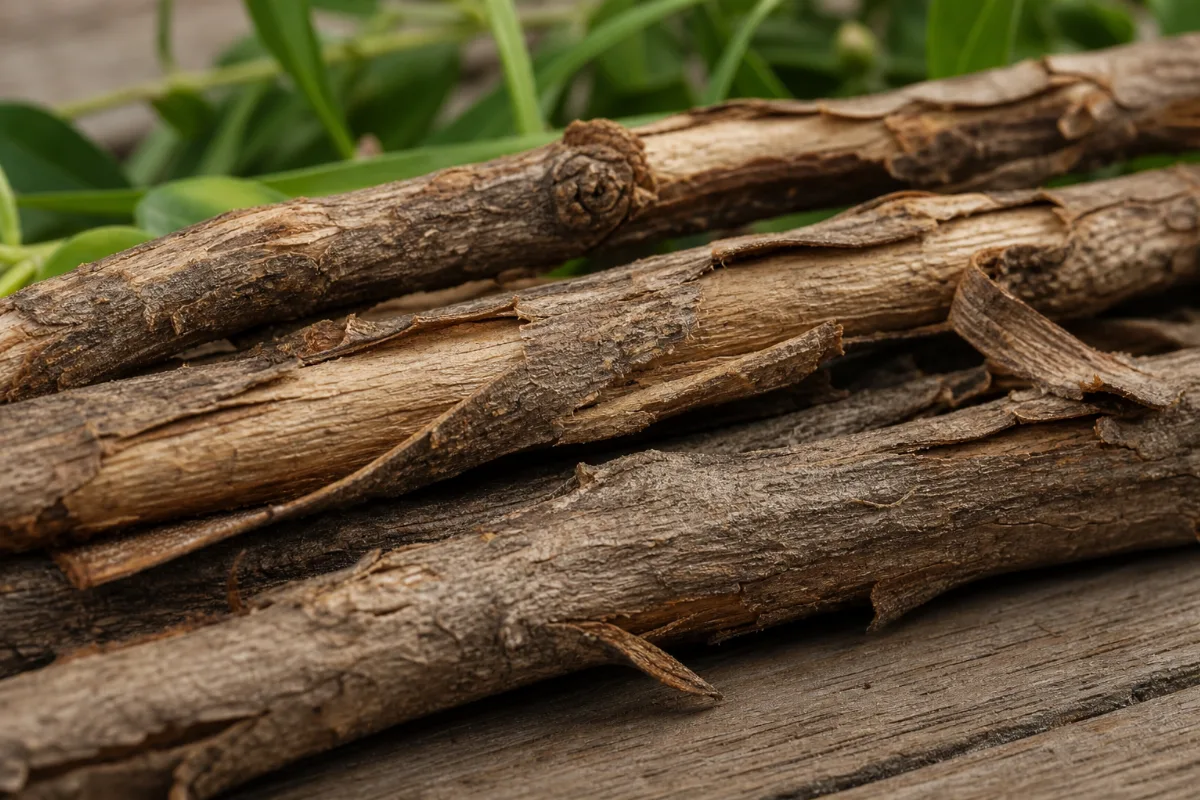
Lycium root bark is the dried bark of the root of the Chinese wolfberry (Lycium chinense), and also of Lycium barbarum. In Chinese medicine it is called di gu pi (Lycii Cortex).
The same shrubs give goji berries. The berry and the bark are different parts with different uses.
Not the same as goji berry
Goji berry (gou qi zi) is the fruit. Reports of raised INR with warfarin and of food-allergy reactions are about the berry and its drinks, not the bark. Whether they apply to the bark is unknown.
See the goji berry page for the fruit.
What it has been used and studied for
Traditional use is for heat in the blood, consumptive fever, cough, high blood pressure and diabetes. Studies so far are on the main compound, kukoamine B, in mice, in the laboratory and, as an injected drug candidate, in healthy volunteers for safety.
The bark by mouth was studied only in aged mice for muscle strength. No human trial of the bark was found.
At a glance
Traditional uses history, not proof
- Chinese medicine: used for 'heat in the blood' and consumptive (bone-steaming) fever
- Eastern Asia: used for chronic problems such as cough, high blood pressure and diabetes
Studied for research
- Blood sugar: insufficient evidence (diabetic mice, one purified compound)
- High blood pressure: insufficient (one negative rat study by mouth)
- Muscle wasting with age: insufficient (aged mice)
- Platelet clumping: insufficient (laboratory only; a bleeding caution)
Main compounds
- Kukoamines A and B: the main marker compounds
- Betaine, cerebrosides, lyciumins and phenolic amides: named for the herb but not verified in a source we read
Common forms
- Dried bark, usually boiled in water as part of formulas
- Extracts; contents vary and some market extracts reportedly had no kukoamines
Research links: Quality control of Lycii Cortex by HPLC using kukoamines, Chinese Medicine 2017 · Kukoamine B in healthy volunteers, Advances in Therapy 2023 · Kukoamine B and diabetes in mice, Frontiers in Pharmacology 2019 · Research Library · Genes & Biomarkers Library
The plant and its history
- Accepted scientific name
- Lycium chinense Mill. (Chinese wolfberry; root bark = di gu pi)
- Naming authority
- Mill.
- Synonyms
- Not listed here: GBIF returns Lycium chinense as ACCEPTED, exact match.
- Common names
- Lycium root bark (English); Chinese wolfberry root bark (English); Di gu pi (Chinese (pinyin)); Lycii Cortex / Cortex Lycii Radicis (Latin/pharmacy)
- Botanical family
- Solanaceae (the nightshade family), order Solanales.
- Classification
- Plantae > Solanales > Solanaceae > Lycium > Lycium chinense
- Native range
- Not verified from a source read.
- Habitat
- Not verified.
- What the plant looks like
- Roots: The root bark is the part used as di gu pi.; Stems: Not verified.; Leaves: Not verified.; Flowers: Not verified.; Fruit: The fruit is goji berry, a separate product.
- Cultivation
- Not verified.
- Harvest and processing
- Not verified.
- Look-alikes and adulterants
- Name: Goji berry (gou qi zi, Lycium barbarum or L. chinense fruit); Note: Same genus, different plant part with different traditional uses and its own safety reports (warfarin, food allergy). Not the product on this page.; Name: Other root barks sold under similar names; Note: Our summary says the herb is often misused or adulterated; check the Latin name on the label (summary-only).
- Sustainability and conservation
- Not verified.
Traditional use and history history, not clinical proof
| Tradition or era | Documented use | Source |
|---|---|---|
| Traditional Chinese medicine (Eastern Asia) | The root bark is used for chronic problems such as cough, high blood pressure and diabetes, and for heat in the blood and consumptive fever. Night sweats and 'bone-steaming' fever are the classical pattern but were not stated in a source we read. | p28077963 |
Traditional use shows how a plant was used. It does not show that a supplement works or is safe today.
What is inside, and how it may work
What the plant contains and how those compounds act in cells and animals. Laboratory and animal mechanisms are not proven effects in people.
Main compounds
| Compound | Family | Where it is concentrated | Activity studied | Level of evidence |
|---|---|---|---|---|
| Kukoamine A PubChem 5318865 | spermine alkaloid (polyamine with phenolic acid groups) | Root bark Limit 1.45 mg/g (95% level, 16 batches) | Antioxidant and anti-inflammatory in lab work; no oral effect on blood pressure in rats. 4 1 8 | Animal research |
| Kukoamine B PubChem 10346914 | spermine alkaloid | Root bark Limit 4.72 mg/g (95% level, 16 batches) | Lowered blood glucose in diabetic mice; binds bacterial toxins; injected form tested in people for tolerability. 4 5 12 8 | Human safety only |
| Betaine PubChem 247 | quaternary amine | Reported in the herb per our summary Not verified in a source read | Not studied for this herb in what we read. 8 | Not verified |
| 13-HODE and 13-HOTrE | oxidised fatty acids | Root bark fractions Not given | Blocked collagen-driven platelet activation in the laboratory. 10 | Laboratory research |
| Cerebrosides, lyciumins (cyclic peptides), phenolic amides | various | Root bark Not verified in a source read | Named in our brief of the herb; not verified in a source we read. | Not verified |
Mechanisms, receptors and pathways
| Target or pathway | Gene or receptor | What was found | Level |
|---|---|---|---|
| NF-kB and PPAR signalling (kukoamine B) | NF-kB, PPAR | Pathway analysis in diabetic mice suggested kukoamine B may regulate these switches, shifting toward metabolic and inflammatory balance. 5 | Animal research |
| Bacterial toxin binding and TLR4/9-NF-kB signalling | LPS, CpG DNA, TLR4/9, MyD88 | A 2026 review says kukoamines neutralise bacterial toxins and suppress this inflammatory signalling. 7 | In vitro/animal |
| Collagen-driven platelet activation | Collagen receptor signalling (integrin, granule release) | Bark fractions and two oxidised fats blocked it but not thrombin activation. 10 | Laboratory research |
| Muscle growth and breakdown genes | Akt, mTOR, myostatin, FoxO3a | Bark and kukoamines shifted these in aged mice and muscle cells. 3 | Animal research |
Absorption, metabolism and elimination
- Absorption
- No oral human data for the bark. The rat study suggests oral absorption of kukoamine A may be limited (authors' idea).
- Distribution
- Injected kukoamine B showed a volume of distribution of 45.74 to 101.90 L (abstract).
- Metabolism
- Not found.
- Elimination
- Injected kukoamine B half-life 3.40 to 4.88 h; clearance 9.35 to 13.49 L/h; accumulation ratios 1.06 (AUC) and 1.02 (Cmax). The review says rapid distribution and urinary excretion.
- Bioavailability
- Not measured for the bark by mouth.
Isolated compounds versus whole extracts
Almost all mechanism and human work tests purified kukoamine B or A, not the bark. The bark is a mix, content varies between batches, and the injected drug differs from a tea or capsule, so those results cannot be read as results for the herb. The only bark-by-mouth finding we read is a mouse muscle study.
Nutritional composition
The root bark is a medicinal herb, not a food. No nutrient table was built for it.
7 not enough evidence
What is Lycium Root Bark good for?
The traditional and studied uses, and how strong the evidence is for each. Almost everything here comes from tradition, animals or the laboratory.
Benefits, one by one
Each card is a research question, not a promise. Tap a goal to filter. Open a card to see the studies, doses and limits.
Blood sugar and type 2 diabetes
Not enough evidenceIn Chinese medicine the root bark is used for diabetes. In diabetic mice, purified kukoamine B (its main compound) lowered blood glucose. We found no human trial of the bark for blood sugar.
3 studiesMouse work used pure kukoamine B, not the bark or a tea. How much kuk…
Studies, doses and limits
What the trials found
None found for the bark. The only human work on kukoamine is a safety study of an injected form in healthy volunteers, which did not test blood sugar.
Results
In db/db mice, 9 weeks of kukoamine B lowered fasting blood glucose without the weight gain and enlarged liver seen with rosiglitazone. The effect was described as different from metformin's. The abstract gives no numbers.
Effect sizes as reported
Not given in the abstract
Why this rating
Animal and laboratory results for one purified compound only. No human trial of the root bark or an extract was found.
Form and dose studied
Mouse work used pure kukoamine B, not the bark or a tea. How much kukoamine a bark preparation delivers is not known (batches vary).
Who was studied
Diabetic mice
Limits
Only the abstract was read. One mouse model. Results in mice often do not carry over to people.
Why researchers looked
Di gu pi has long been used in Eastern Asia for diabetes, so researchers looked for the compound responsible.
Traditional use
The 2017 quality-control paper says the bark is used for chronic diseases including diabetes in Eastern Asia.
Proposed mechanism Animal research
In mice, kukoamine B changed fat and inflammation signals and may act on the NF-kB and PPAR switches (the authors' suggestion). The 2026 review adds activation of the AKT/GSK-3beta pathway.
A proposed mechanism does not show that the effect happens in people.
Because animal work points to lower blood glucose, people on diabetes medicines should ask a prescriber or pharmacist before using the bark. This is a precaution, not a documented interaction.
High blood pressure
Not enough evidenceThe bark is traditionally used for high blood pressure. The one oral animal study we found, in rats, saw no effect of kukoamine A. No human blood-pressure trial of the bark was found.
3 studiesRat work used a synthetic single compound by mouth; the human safety …
Studies, doses and limits
What the trials found
None for the bark. In the injected-kukoamine B safety study, a slow heartbeat (sinus bradycardia) appeared in 3 of 18 people on the drug and in none on placebo; blood pressure effects were not reported in the abstract.
Results
In spontaneously hypertensive rats, 35 days of oral synthetic kukoamine A at 5 or 10 mg/kg had no effect on blood pressure.
Effect sizes as reported
No effect
Why this rating
One negative animal study by mouth, no human trial, and tradition only. Reports of lowering come from other routes or sources that we did not re-open.
Form and dose studied
Rat work used a synthetic single compound by mouth; the human safety study used an injected drug.
Who was studied
Spontaneously hypertensive rats; healthy volunteers (injected drug)
Limits
Different compound forms and routes give different answers, so the traditional bark use is not confirmed or refuted.
Why researchers looked
Traditional use for high blood pressure, and earlier reports that kukoamines lower pressure.
Traditional use
The 2017 paper lists hypertension among the chronic conditions the bark is used for in Eastern Asia.
Proposed mechanism Animal research
Not shown. The rat study found no oral effect; the authors say injected forms may behave differently.
A proposed mechanism does not show that the effect happens in people.
If the bark does lower pressure, it could add to blood-pressure medicines. This is a precaution from theory; no study of the combination was found.
Fever with night sweats, the traditional use
Not enough evidenceIn Chinese medicine di gu pi is used to clear 'heat in the blood' and 'consumptive fever' (the 'bone-steaming' fever with night sweats). This is traditional use only. We found no trial.
2 studiesTraditionally given as part of mixed formulas in water; no preparatio…
Studies, doses and limits
What the trials found
None found.
Results
No trial of fever, night sweats or the traditional pattern was found.
Effect sizes as reported
Not applicable
Why this rating
Traditional use is not proof that a remedy works.
Form and dose studied
Traditionally given as part of mixed formulas in water; no preparation was studied for this use.
Who was studied
None studied
Limits
Nothing to appraise.
Why researchers looked
This is the classical use of the herb in traditional Chinese medicine.
Traditional use
A 2026 paper describes the bark as traditionally used to mitigate heat in the blood and consumptive fever. Night sweats and the term 'bone-steaming' come from the herb's usual description; we did not find a source we read that states them, so they are not verified here.
Proposed mechanism Traditional use
Not tested.
A proposed mechanism does not show that the effect happens in people.
Do not use the bark to treat a lasting fever, drenching night sweats or unexplained weight loss in place of seeing a doctor; these can signal infection or other illness.
Cough and lung heat
Not enough evidenceThe bark is traditionally used for cough, often as one ingredient in formulas. No trial of the bark for cough was found.
1 studiesNot studied for this use.
Studies, doses and limits
What the trials found
None found.
Results
No study of cough was found.
Effect sizes as reported
Not applicable
Why this rating
Tradition only.
Form and dose studied
Not studied for this use.
Who was studied
None studied
Limits
No evidence to appraise.
Why researchers looked
Cough is one of the three chronic complaints named in the 2017 paper.
Traditional use
The 2017 paper says the bark is used to treat chronic diseases like cough in Eastern Asia.
Proposed mechanism Traditional use
Not tested.
A proposed mechanism does not show that the effect happens in people.
A cough that lasts more than a few weeks, or brings blood, needs a doctor's assessment.
Muscle strength and wasting with age (mice)
Not enough evidenceIn old mice, the bark by mouth improved muscle mass, strength and endurance, and kukoamines protected muscle cells in a dish. Not tested in people.
1 studiesRoot bark by mouth in mice; dose not given in the abstract.
Studies, doses and limits
What the trials found
None.
Results
In 16-month-old mice swimming regularly, 8 weeks of the bark raised muscle mass, strength and endurance and lowered plasma lactate and creatinine versus control.
Effect sizes as reported
Direction only; no numbers in the abstract
Why this rating
Mouse and cell study, abstract only, with company-employed authors.
Form and dose studied
Root bark by mouth in mice; dose not given in the abstract.
Who was studied
Aged mice; muscle cells
Limits
Company-linked authors; no human data.
Why researchers looked
Researchers wanted to see whether the bark or its kukoamines protect against age-related muscle loss.
Traditional use
The same paper notes the bark's traditional use for heat in the blood and consumptive fever; muscle strength is a modern research question.
Proposed mechanism Animal research
Changes in genes that build and break down muscle (the abstract lists MyoD, myogenin, Akt, mTOR up; myostatin, FoxO3a, MuRF1, atrogin-1 down).
A proposed mechanism does not show that the effect happens in people.
None specific found.
Inflammation and infection signals (lab, animal and early drug work)
Not enough evidenceLab and animal work says kukoamines calm inflammation and bind bacterial toxins. The injected form was tested for sepsis as a drug candidate. Nothing shows the bark does this in people.
3 studiesPure kukoamine B (injected in the drug trials), not the bark.
Studies, doses and limits
What the trials found
Early trials of injected kukoamine B in healthy and septic people confirmed tolerability according to the 2026 review; the review says clinical validation is limited. Efficacy in sepsis was not read.
Results
In diabetic mice kukoamine B reduced signs of systemic inflammation. The review lists antioxidant and anti-inflammatory activity in preclinical work.
Effect sizes as reported
No pooled numbers read
Why this rating
Mostly laboratory and animal evidence for a purified compound; abstracts only.
Form and dose studied
Pure kukoamine B (injected in the drug trials), not the bark.
Who was studied
Cells and animals; healthy volunteers (safety only)
Limits
Narrative review; the drug is not a herbal product.
Why researchers looked
Kukoamine B was developed as a sepsis drug candidate because it binds bacterial toxins (LPS and CpG DNA).
Traditional use
Not part of the traditional description we read.
Proposed mechanism Animal research
Binding of LPS and CpG DNA and reduced TLR4/9-NF-kB signalling (laboratory and animal; stated by the 2026 review).
A proposed mechanism does not show that the effect happens in people.
See the safety tab for the heart-rate finding in the injected-drug study.
Blood clotting (platelet function, lab only)
Not enough evidenceExtracts of di gu pi slowed platelet clumping in the laboratory. This is not a benefit proven in people, and it raises a bleeding caution.
1 studiesFractions and single fats, not a tea or capsule.
Studies, doses and limits
What the trials found
None.
Results
Fractions of di gu pi inhibited platelet aggregation and activation signals; the two fats blocked collagen but not thrombin activation.
Effect sizes as reported
Qualitative
Why this rating
Test-tube study, abstract only.
Form and dose studied
Fractions and single fats, not a tea or capsule.
Who was studied
Human platelets in the laboratory
Limits
Does not show an effect in the body.
Why researchers looked
Researchers screened Chinese herbs for effects on platelets.
Traditional use
Not part of the traditional description we read.
Proposed mechanism Laboratory research
Oxidised fats (13-HODE, 13-HOTrE) in the bark blocked collagen-driven platelet activation (laboratory).
A proposed mechanism does not show that the effect happens in people.
Could matter for people on blood thinners or before surgery; a precaution from theory only.
Connections to the rest of health
How Lycium Root Bark connects to the rest of our health knowledge graph. Every link says what kind of connection it is. A safety link (for example to the liver) is a warning, not a benefit. A study that merely mentions a topic never creates a benefit link.
Explore every connection: goals, body systems, organs, symptoms, genes
A. Wellness goals
| Connected to | Kind of connection | Evidence status | Context | Studies |
|---|---|---|---|---|
| Blood sugar balance | Traditional use | Not enough evidence | Traditional use for diabetes; mouse findings for kukoamine B only. Preparation or compound: Kukoamine B (purified) |
5 |
| Blood Sugar Balance | Preliminary mechanism | Not enough evidence | Blood sugar and type 2 diabetes: In Chinese medicine the root bark is used for diabetes. In diabetic mice, purified kukoamine B (its main compound) lowered blood glucose. We found no human trial of the bark for blood sugar. | 5 4 7 |
| Metabolic Health | Preliminary mechanism | Not enough evidence | Blood sugar and type 2 diabetes: In Chinese medicine the root bark is used for diabetes. In diabetic mice, purified kukoamine B (its main compound) lowered blood glucose. We found no human trial of the bark for blood sugar. | 5 4 7 |
| Blood Pressure Support | Traditional use | Not enough evidence | High blood pressure: The bark is traditionally used for high blood pressure. The one oral animal study we found, in rats, saw no effect of kukoamine A. No human blood-pressure trial of the bark was found. | 1 4 12 |
| Heart Health | Traditional use | Not enough evidence | High blood pressure: The bark is traditionally used for high blood pressure. The one oral animal study we found, in rats, saw no effect of kukoamine A. No human blood-pressure trial of the bark was found. | 1 4 12 |
| Inflammation Balance | Traditional use | Not enough evidence | Fever with night sweats, the traditional use: In Chinese medicine di gu pi is used to clear 'heat in the blood' and 'consumptive fever' (the 'bone-steaming' fever with night sweats). This is traditional use only. We found no trial. | 3 4 |
| Breathing Support | Traditional use | Not enough evidence | Cough and lung heat: The bark is traditionally used for cough, often as one ingredient in formulas. No trial of the bark for cough was found. | 4 |
| Muscle Recovery | Preliminary mechanism | Not enough evidence | Muscle strength and wasting with age (mice): In old mice, the bark by mouth improved muscle mass, strength and endurance, and kukoamines protected muscle cells in a dish. Not tested in people. | 3 |
| Healthy Aging | Preliminary mechanism | Not enough evidence | Muscle strength and wasting with age (mice): In old mice, the bark by mouth improved muscle mass, strength and endurance, and kukoamines protected muscle cells in a dish. Not tested in people. | 3 |
| Inflammation Balance | Preliminary mechanism | Not enough evidence | Inflammation and infection signals (lab, animal and early drug work): Lab and animal work says kukoamines calm inflammation and bind bacterial toxins. The injected form was tested for sepsis as a drug candidate. Nothing shows the bark does this in people. | 7 5 12 |
| Immune Support | Preliminary mechanism | Not enough evidence | Inflammation and infection signals (lab, animal and early drug work): Lab and animal work says kukoamines calm inflammation and bind bacterial toxins. The injected form was tested for sepsis as a drug candidate. Nothing shows the bark does this in people. | 7 5 12 |
| Healthy Circulation | Preliminary mechanism | Not enough evidence | Blood clotting (platelet function, lab only): Extracts of di gu pi slowed platelet clumping in the laboratory. This is not a benefit proven in people, and it raises a bleeding caution. | 10 |
B. Body systems
| Connected to | Kind of connection | Evidence status | Context | Studies |
|---|---|---|---|---|
| Endocrine System | Biological association | Not enough evidence | Studied for: Blood sugar and type 2 diabetes | 5 4 7 |
| Metabolism Weight | Biological association | Not enough evidence | Studied for: Blood sugar and type 2 diabetes | 5 4 7 |
| Cardiovascular System | Biological association | Not enough evidence | Studied for: High blood pressure Studied for: Blood clotting (platelet function, lab only) | 1 4 12 10 |
| Immune System | Biological association | Not enough evidence | Studied for: Fever with night sweats, the traditional use Studied for: Inflammation and infection signals (lab, animal and early drug work) | 3 4 7 5 12 |
| Respiratory System | Biological association | Not enough evidence | Studied for: Cough and lung heat | 4 |
| Musculoskeletal System | Biological association | Not enough evidence | Studied for: Muscle strength and wasting with age (mice) | 3 |
C. Body parts and organs
| Connected to | Kind of connection | Evidence status | Context | Studies |
|---|---|---|---|---|
| Blood vessels | Theory | Laboratory platelet inhibition; possible bleeding caution with blood thinners. Preparation or compound: Root bark fractions (13-HODE, 13-HOTrE) |
10 |
I. Biomarkers
| Connected to | Kind of connection | Evidence status | Context | Studies |
|---|---|---|---|---|
| Blood glucose | Animal | Lowered blood glucose in diabetic mice; possible additive effect with diabetes medicines. Preparation or compound: Kukoamine B |
5 | |
| Fasting blood glucose (mice) | Biological association | Not enough evidence | Measured in trials: lowered. A lab change is not the same as a health benefit. | 5 |
| Triglycerides and cholesterol (mice) | Biological association | Not enough evidence | Measured in trials: lowered. A lab change is not the same as a health benefit. | 5 12 |
| Blood pressure (rats) | Biological association | Not enough evidence | Measured in trials: no-change. A lab change is not the same as a health benefit. | 1 |
| Muscle mass, strength and endurance (mice) | Biological association | Not enough evidence | Measured in trials: raised. A lab change is not the same as a health benefit. | 3 |
| Platelet aggregation (laboratory) | Biological association | Not enough evidence | Measured in trials: lowered. A lab change is not the same as a health benefit. | 10 |
| Inflammation signals in blood (mice) | Biological association | Not enough evidence | Measured in trials: lowered. A lab change is not the same as a health benefit. | 5 |
L. Active compounds
| Connected to | Kind of connection | Evidence status | Context | Studies |
|---|---|---|---|---|
| Kukoamine A | Biological association | Animal | Antioxidant and anti-inflammatory in lab work; no oral effect on blood pressure in rats. Preparation or compound: Root bark |
4 1 8 |
| Kukoamine B | Biological association | Human safety only | Lowered blood glucose in diabetic mice; binds bacterial toxins; injected form tested in people for tolerability. Preparation or compound: Root bark |
4 5 12 8 |
| Betaine | Biological association | Not verified | Not studied for this herb in what we read. Preparation or compound: Reported in the herb per our summary |
8 |
| 13-HODE and 13-HOTrE | Biological association | In vitro | Blocked collagen-driven platelet activation in the laboratory. Preparation or compound: Root bark fractions |
10 |
| Cerebrosides, lyciumins (cyclic peptides), phenolic amides | Biological association | Not verified | Named in our brief of the herb; not verified in a source we read. Preparation or compound: Root bark |
Each connection is stored with the ingredient, the connected record, the kind of connection, the evidence status, the supporting studies, the preparation or compound involved, and a review date (last reviewed October 25, 2026).
Evidence at a glance: what changed in 6 lab markers
Tap a number to show only those markers. Counts are markers, not people.
The evidence
The research centre for Lycium Root Bark. Every record here was checked against PubMed or the publisher's page; we never list a study we have not verified.
Evidence by outcome
Bars show how many studies we found for each outcome, not how well it works. People are added up across trials only (reviews are not added, to avoid double counting).
How we rate evidence
High certainty
Several well-run trials or reviews agree; further research is unlikely to change the picture much.
Moderate certainty
Good trials point the same way, but some doubt remains.
Low certainty
Small, short or inconsistent trials. The finding could change with better research.
Very low certainty
Very little or very weak human data. Treat as a possibility only.
Mixed findings
Trials or reviews disagree with each other.
Not enough evidence
Not enough human research to say either way.
Evidence against
Good research found no benefit, or found harm.
We take the reviewers' own risk-of-bias and GRADE statements where they exist, and otherwise judge from study size, design, consistency, directness and whether a product matches what is sold. Many publications do not make evidence high. Method note: We built this page from our existing summary of Lycium root bark and checked PubMed abstracts, the GBIF taxonomy record and PubChem. Only abstracts were read; the MSK page was searched, not fully read. EMA, LiverTox and LactMed were not opened and are marked not verified. Certainty ratings are the compiler's own reading, not formal grades. No study is cited that we could not verify.
Study library: every study we checked 12
| Study | Design | People | Product, dose, length | Result |
|---|---|---|---|---|
| Butts 2022 Influence of oral administration of kukoamine A on blood pressure in a rat hypertension model PLoS One · PMID 35522680 · DOI |
Animal research animal |
Spontaneously hypertensive rats; mice for a 14-day safety check | Synthetic kukoamine A by mouth (not the bark) synthetic compound 0, 5 and 10 mg/kg body weight a day in rats (animal dose) 35 days (rats); single dose then 14 days of observation (mice) · vs Vehicle; normal-pressure Wistar Kyoto rats as baseline |
No effect of oral synthetic kukoamine A on high blood pressure in the rats. No negative effects in the mice after a single oral dose. No effect (Not applicable) Methods, limits and fundingOutcomes: Blood pressure Limitations: Animal study of one synthetic compound by mouth. The abstract notes that kukoamines have been reported to lower pressure elsewhere; this study did not confirm it by mouth. Funding and conflicts: Authors declared no competing interests. Read: abstract |
| GBIF 2026 GBIF backbone: Lycium chinense Mill. (key 2928809) and Lycium barbarum L. (key 2928835) GBIF · Source |
Database record not applicable |
Not applicable | Not applicable Not applicable |
Both names returned ACCEPTED, exact match, family Solanaceae, order Solanales, checked 2026-10-25 by the GBIF species/match API. Not applicable (Not applicable) Methods, limits and fundingOutcomes: Not applicable Limitations: Both names returned ACCEPTED, exact match, family Solanaceae, order Solanales, checked 2026-10-25 by the GBIF species/match API. Read: full-text |
| Kim 2026 Lycium Radicis Cortex and Its Kukoamine Constituents Attenuate Sarcopenia by Modulating Anabolic and Catabolic Pathways Biomolecules & Therapeutics · PMID 41327520 · DOI |
Animal research animal |
16-month-old mice doing swimming exercise; muscle cells in a dish | Lycium Radicis Cortex (root bark of L. chinense) by mouth for 8 weeks; kukoamine A and B on muscle cells root bark Not given in the abstract 8 weeks (mice) · vs Control mice |
In aged mice the bark increased muscle mass, strength and endurance and lowered plasma lactate and creatinine. Kukoamine A and B reduced steroid-induced shrinkage of muscle cells in a dish. Direction of effect only (Not applicable) Methods, limits and fundingOutcomes: Muscle mass, strength, endurance, plasma lactate and creatinine, muscle gene activity Limitations: Mouse and cell study. Only the abstract was read. Not shown in people. Funding and conflicts: Several authors were employed by the company HuonsN Co., Ltd.; the rest declared no conflicts. Read: abstract |
| Li 2017 Quality control of Lycium chinense and Lycium barbarum cortex (Digupi) by HPLC using kukoamines as markers Chinese Medicine · PMID 28077963 · DOI |
Laboratory in-vitro |
16 batches of authenticated root bark samples | Lycii Cortex (root bark of L. chinense and L. barbarum); kukoamines A and B as markers root bark Not applicable Not applicable · vs None |
The abstract says the bark is used for cough, high blood pressure and diabetes in Eastern Asia and that no official compendium had a chromatographic test for it. At the 95% confidence level the calculated content limits were 1.45 mg/g for kukoamine A and 4.72 mg/g for kukoamine B. Content limits 1.45 and 4.72 mg/g (kukoamine A, B) (Not applicable) Methods, limits and fundingOutcomes: Validation of an HPLC test and kukoamine content Limitations: Quality-control paper, not a health study. The wider batch range and the finding of market extracts without kukoamines come from our existing summary of the full text and were not re-opened (summary-only). Funding and conflicts: None read Read: abstract |
| Li 2019 A Metabolomics Approach to Investigate Kukoamine B-A Potent Natural Product With Anti-diabetic Properties Frontiers in Pharmacology · PMID 30723413 · DOI |
Animal research animal |
Diabetic (db/db) mice | Purified kukoamine B (the main compound of Lycii Cortex), not the bark pure compound 50 mg/kg/day (as given in the abstract; animal dose) 9 weeks · vs Vehicle; metformin and rosiglitazone as positive controls |
After 9 weeks kukoamine B lowered blood glucose without the weight gain and enlarged liver seen with rosiglitazone. It reduced circulating triglycerides and cholesterol and reduced signs of inflammation. Direction of effect only; no numbers were read in the abstract (Not applicable) Methods, limits and fundingOutcomes: Fasting blood glucose, body weight, blood fats, cytokines Limitations: Mouse study of one purified compound. Only the abstract was read. Says nothing about the whole bark or about people. Funding and conflicts: Abstract does not state funding; authors include a Hong Kong university group and US research institutes. No conflict statement read. Read: abstract |
| Memorial Sloan Kettering Cancer Center 2026 Lycium (goji, wolfberry), About Herbs Memorial Sloan Kettering Cancer Center · Source |
Authoritative guidance not applicable |
Not applicable | Not applicable Not applicable |
Page text searched for warfarin, allergy, enzyme and diabetes statements; it is written mostly about goji fruit, so statements are not assumed to apply to the root bark. Not applicable (Not applicable) Methods, limits and fundingOutcomes: Not applicable Limitations: Page text searched for warfarin, allergy, enzyme and diabetes statements; it is written mostly about goji fruit, so statements are not assumed to apply to the root bark. Read: partly-read |
| Mssillou 2026 Pharmacological properties, safety, pharmacokinetic and clinical trials of kukoamine A and B Inflammopharmacology · PMID 41701421 · DOI |
Narrative review mixed |
Review of laboratory, animal and early human work on kukoamine A and B | Kukoamine A and B, mainly from Lycium chinense root bark (Lycii Cortex) pure compounds Not applicable Not applicable · vs Not applicable |
The review says both compounds show antioxidant and anti-inflammatory activity and improve diabetes-related outcomes in preclinical work. It states that Phase I/II trials confirmed tolerability in healthy and septic people, with mild adverse events such as transient headaches, and that clinical validation remains limited. Narrative review; no pooled numbers read (Not applicable) Methods, limits and fundingOutcomes: Pharmacology, safety, pharmacokinetics, clinical trials Limitations: Narrative (not systematic) review of single compounds. Only the abstract was read. Funding and conflicts: Authors declared no competing interests. Read: abstract |
| PubChem (NCBI) 2026 PubChem compound records: kukoamine A (CID 5318865), kukoamine B (CID 10346914), betaine (CID 247) PubChem (NCBI) · Source |
Database record not applicable |
Not applicable | Not applicable Not applicable |
Names, CIDs and formulas looked up by the PubChem PUG REST API on 2026-10-25; kukoamines A and B are isomers with the same formula, C28H42N4O6. Not applicable (Not applicable) Methods, limits and fundingOutcomes: Not applicable Limitations: Names, CIDs and formulas looked up by the PubChem PUG REST API on 2026-10-25; kukoamines A and B are isomers with the same formula, C28H42N4O6. Read: full-text |
| Rivera 2012 Probable interaction between Lycium barbarum (goji) and warfarin Pharmacotherapy · PMID 22392461 · DOI |
Case report |
1 71-year-old woman on warfarin |
Goji juice (Lycium barbarum, goji berry); NOT the root bark fruit Not applicable 4 days of juice before admission · vs Not applicable |
After 4 days of goji juice she was hospitalised with a very high INR and nosebleed, bruising and rectal bleeding. INR fell to 2.6 over 2 days after stopping the juice and warfarin and giving vitamin K. Naranjo score 6 (probable). The authors say two earlier reports describe similar events with a tea containing L. barbarum. Naranjo score 6 (probable) (Not given in abstract) Methods, limits and fundingOutcomes: INR and bleeding Limitations: Single case report on the berry, not the bark. Funding and conflicts: None read Read: abstract |
| Simpson 2026 13-HODE and 13-HOTrE, Present in the Traditional Chinese Medicine Herbal Extract di gu pi, Selectively Inhibit Platelet Function Pharmaceuticals (Basel) · PMID 41754804 · DOI |
Laboratory in-vitro |
Human platelets in the laboratory | Fractions of di gu pi (root bark of Lycium chinense) and the oxidised fats 13-HODE and 13-HOTrE found in them root bark fractions Not applicable Not applicable · vs Not applicable |
Fractions from di gu pi inhibited platelet aggregation and suppressed platelet activation downstream of the collagen receptor. 13-HODE and 13-HOTrE blocked collagen-driven aggregation but not thrombin-driven activation. Qualitative; no numbers read (Not applicable) Methods, limits and fundingOutcomes: Platelet aggregation, integrin activation, granule release Limitations: Test-tube work on fractions and single fats. It does not show that the bark thins blood in people. Only the abstract was read. Funding and conflicts: Authors declared no conflicts. Read: abstract |
| Zhang 2015 Bleeding due to a probable interaction between warfarin and Gouqizi (Lycium Barbarum L.) Toxicology Reports · PMID 28962463 · DOI |
Case report |
1 65-year-old man on long-term warfarin |
Gouqizi (goji berry) wine; NOT the root bark fruit Not applicable Not given in the abstract · vs Not applicable |
Raised INR with bleeding after drinking goji berry wine; the authors say it fits three earlier reports and call for more frequent INR checks in people on warfarin who use herbs. Case report; no numbers read (Not given in abstract) Methods, limits and fundingOutcomes: INR and bleeding Limitations: Single case report on the berry, not the bark. Funding and conflicts: None read Read: abstract |
| Zhao 2023 Safety, Tolerability, and Pharmacokinetics of Kukoamine B in Healthy Volunteers: A Randomized, Double-Blind, Placebo-Controlled, Multiple-Dose Phase I Study Advances in Therapy · PMID 37233875 · DOI |
Controlled trial |
24 Healthy volunteers (18 on kukoamine B, 6 on placebo) |
Kukoamine B given by drip into a vein (a drug candidate for sepsis); not the bark and not by mouth pure compound (intravenous) 0.06, 0.12 or 0.24 mg/kg every 8 hours (as given in the abstract; not a guide for any use) 7 days, then 7 days follow-up · vs Placebo |
Adverse events occurred in 12 of 18 (66.67%) on kukoamine B and 4 of 6 (66.67%) on placebo. Treatment-related events: 8 of 18 (44.44%) vs 2 of 6 (33.33%). The most common were raised triglycerides (4 [22.22%] vs 2 [33.33%]) and sinus bradycardia, a slow heartbeat (3 [16.67%] vs 0). Half-life 3.40 to 4.88 hours. No significant difference in overall adverse events; slow heartbeat only in the kukoamine B group (Not given in abstract) Methods, limits and fundingOutcomes: Adverse events; pharmacokinetics Limitations: Very small trial of an injected single compound. It does not describe the herb or any product taken by mouth. Pooled drug groups only; not powered to find uncommon events. Funding and conflicts: Two authors were full-time employees of the drug company Tianjin Chasesun Pharmaceutical; the others declared no conflict. Registered NCT02690961. Registration: NCT02690961 Read: abstract |
What we do not know yet
- No human trial of Lycium root bark for any use.
- No oral safety or interaction data for the bark.
- The traditional night-sweat and 'bone-steaming' terms and the cold-spleen caution were not verified in a source we read.
How new research is added
New studies are found by a saved PubMed search and placed in a review queue. A person reads each one before it changes any evidence rating or safety wording. New publications never change ratings automatically.
Lab markers
What changed in blood or saliva tests during trials. A changed number is not the same as feeling or being healthier, and we give no "normal ranges".
Other 6
Fasting blood glucose (mice)
Lowered in trials
Blood sugar after a fast.
Not enough evidenceResults and what it means
Why it was measured
Main outcome in the mouse diabetes model.
Statistical vs. clinical meaning
A change in mice says little about people; a lower glucose number is not the same as better health.
Safety implication
If people also take diabetes drugs, the combined effect on sugar is unknown.
| Study | Result | People | Product |
|---|---|---|---|
| 5 | Kukoamine B lowered blood glucose over 9 weeks (no figures in the abstract) | db/db diabetic mice | Purified kukoamine B, 50 mg/kg/day, vs vehicle, metformin and rosiglitazone |
Triglycerides and cholesterol (mice)
Lowered in trials
Fats carried in the blood.
Not enough evidenceResults and what it means
Why it was measured
Part of the mouse metabolic profile.
Statistical vs. clinical meaning
Animal finding only.
Safety implication
In the human safety study of injected kukoamine B, raised triglycerides were a common adverse event in both drug and placebo groups (4 of 18 vs 2 of 6), so no firm link either way.
| Study | Result | People | Product |
|---|---|---|---|
| 5 | Kukoamine B reduced circulating triglycerides and cholesterol (no figures in the abstract) | db/db diabetic mice | Purified kukoamine B, 9 weeks |
Blood pressure (rats)
No clear change in trials
Pressure of blood in the arteries.
Not enough evidenceResults and what it means
Why it was measured
Main outcome of the kukoamine A rat study.
Statistical vs. clinical meaning
A null result in rats for one compound; the bark was not tested.
Safety implication
None found in this study.
| Study | Result | People | Product |
|---|---|---|---|
| 1 | No effect of oral kukoamine A on arterial hypertension | Spontaneously hypertensive rats | Synthetic kukoamine A 5 or 10 mg/kg/day by mouth, 35 days |
Muscle mass, strength and endurance (mice)
Raised in trials
How much muscle and how strong and enduring it is.
Not enough evidenceResults and what it means
Why it was measured
Main outcomes of the aged-mouse study.
Statistical vs. clinical meaning
Animal result; company-linked.
Safety implication
None specific.
| Study | Result | People | Product |
|---|---|---|---|
| 3 | Increased muscle mass, strength and endurance; lower plasma lactate and creatinine | 16-month-old male mice with swimming | Oral Lycium Radicis Cortex, 8 weeks |
Platelet aggregation (laboratory)
Lowered in trials
How readily platelets clump, which matters for clotting.
Not enough evidenceResults and what it means
Why it was measured
Screening target for blood-thinning activity.
Statistical vs. clinical meaning
Test-tube measure; not a bleeding outcome.
Safety implication
A possible bleeding precaution with anticoagulants or antiplatelets (theory only).
| Study | Result | People | Product |
|---|---|---|---|
| 10 | Inhibited collagen-driven aggregation; no effect on thrombin-induced activation (13-HODE, 13-HOTrE) | Human platelets in the laboratory | Fractions of di gu pi and isolated oxidised fats |
Inflammation signals in blood (mice)
Lowered in trials
Messenger proteins that rise with inflammation.
Not enough evidenceResults and what it means
Why it was measured
Measured to see if kukoamine B changes inflammation.
Statistical vs. clinical meaning
Animal finding only.
Safety implication
None specific.
| Study | Result | People | Product |
|---|---|---|---|
| 5 | Reduced systemic inflammation on a cytokine array (no figures in abstract) | db/db mice | Purified kukoamine B 50 mg/kg/day, 9 weeks |
Safety
What studies and official sources say about side effects, medicines and who should check first. Each point shows what kind of evidence it comes from.
Main points to know 5
- There is no human safety trial of Lycium root bark itself. We found no trial of the root bark or a bark extract by mouth in people. The only human safety data are for purified kukoamine B given by drip into a vein, a drug candidate. Long-term safety of the bark is not established. Evidence gap 12 7
- May add to diabetes and blood-pressure medicines (precaution from animal data). Purified kukoamine B lowered blood glucose in diabetic mice, and the herb is traditionally used for diabetes and high blood pressure. If it acts the same way in people it could add to such medicines. No study of the combination was found, so this is a precaution, not a documented interaction. Ask a prescriber or pharmacist first. Theory 5 1 4
- Possible bleeding caution with blood thinners (theory); the warfarin reports are about goji BERRY. Fractions of di gu pi slowed platelet clumping in the laboratory, so a bleeding caution with anticoagulants, antiplatelet drugs or before surgery is reasonable as a precaution. The published warfarin and INR case reports involve goji berry juice, tea and wine, not the root bark, and their relevance to the bark is unknown. Theory 10 9 11 6
- Slow heartbeat seen with injected kukoamine B. In a small trial of injected kukoamine B, sinus bradycardia (slow heartbeat) occurred in 3 of 18 volunteers on the drug and 0 of 6 on placebo. This was an injected drug candidate, not the bark by mouth, so it does not show a risk of the herb. It is mentioned because the herb is also used for blood pressure. Controlled trial 12
- Not enough information for pregnancy and breastfeeding. No safety data for the root bark in pregnancy or breastfeeding were found. Avoid unless a clinician who knows the herb agrees. Evidence gap
Side effects 3
| Effect | How often | Severity and recovery | Evidence |
|---|---|---|---|
| Adverse events during injected kukoamine B (drug candidate, healthy volunteers) Injected single compound; small trial; two authors employed by the manufacturer. Does not describe the herb. | Any adverse event 12 of 18 (66.67%) vs 4 of 6 (66.67%) on placebo; treatment-related 8 of 18 (44.44%) vs 2 of 6 (33.33%); raised triglycerides 4 of 18 vs 2 of 6; slow heartbeat 3 of 18 vs 0 of 6 | mild to moderate (severity grading not read) Not stated in the abstract | Controlled trial 12 |
| Mild adverse events such as transient headaches (early kukoamine B trials) Review abstract only; applies to the purified compound. | Not established | mild Transient, per the review | Narrative review 7 |
| Raised INR with bleeding in people on warfarin (GOJI BERRY juice, tea or wine, not the bark) Two case reports on the berry; do not assume the same for the bark. | Not established | serious INR fell to 2.6 within 2 days after stopping the juice and warfarin and giving vitamin K in one case | Case report 9 11 |
Liver
We found no published case of liver injury linked to Lycium root bark, and no LiverTox entry was found by a search of the NCBI Books database (not verified; the LiverTox site itself was not opened). In diabetic mice purified kukoamine B did not cause the enlarged liver that rosiglitazone did, according to the abstract. Absence of reports is not proof of safety. 5
How often. No frequency found.
Monitoring. No agency monitoring advice was found.
This is a safety connection. It is not evidence that Lycium Root Bark supports liver health.
Medicines and supplements 4
| With | Why it matters | Importance | Evidence | What to do |
|---|---|---|---|---|
| Diabetes medicines (insulin, metformin, sulfonylureas and others) drug | Theory: kukoamine B lowered blood glucose in diabetic mice, so the effects might add up. | No human or interaction study was found. If it did add up, low blood sugar is the concern. | Theory Very low certainty 5 | Ask a prescriber or pharmacist before combining, and tell them about any herb you use. |
| Blood-pressure medicines drug | Theory: traditional use for high blood pressure; kukoamines are reported to lower pressure, but the one oral rat study found no effect. | Unknown. The injected drug candidate caused slow heartbeat in 3 of 18 people. | Theory Very low certainty 1 12 4 | Tell your doctor or pharmacist if you use the bark and take pressure or heart-rhythm medicines. |
| Anticoagulants and antiplatelet drugs (warfarin, aspirin, clopidogrel and others) and surgery drug | Theory: di gu pi fractions slowed platelet clumping in the laboratory. | No study in people for the bark. Warfarin case reports exist for goji BERRY juice, tea and wine only. | Theory Very low certainty 10 9 11 | If you take warfarin or other blood thinners, ask your clinic before using the bark; tell your surgical team about any herb you use. |
| Medicines cleared by CYP3A4, CYP2C9 or CYP2C19 enzymes drug | MSK says Lycium extracts or juice may induce CYP3A4 or inhibit CYP2C9 and 2C19 in laboratory work. | The MSK page is written mainly about goji fruit; whether the root bark does the same is unknown. | Laboratory research Very low certainty 6 | Ask a pharmacist if you take medicines with a narrow safety margin. |
Who should check first 4
| Situation | Advice | Evidence |
|---|---|---|
| Pregnancy and breastfeeding | Avoid unless a knowledgeable clinician agrees; no safety data were found. | Evidence gap |
| Taking warfarin or other blood thinners, or having surgery planned | Ask first; a bleeding caution from laboratory data (theory). The warfarin case reports are for goji berry. | Theory 10 9 |
| Taking diabetes or blood-pressure medicines, or having low blood sugar or low blood pressure | Ask a prescriber or pharmacist first; additive effects are possible in theory. | Theory 5 |
| Cold, weak digestion or loose stools (traditional 'cold spleen' caution) | Traditional texts commonly advise caution with cooling herbs in such patterns. This is NOT verified: no source we read states it for di gu pi. | Traditional use |
Overdose, product quality and regulators
Summary. No toxicity assessment of the root bark by mouth was found. Lycium belongs to the nightshade family (Solanaceae, per GBIF), but a toxic-parts review for the root bark was not found (not verified).
Animal. A single oral dose of synthetic kukoamine A (5 or 10 mg/kg) caused no negative effects in mice over 14 days.
Human doses studied. No oral human study. The injected kukoamine B trial used 0.06, 0.12 and 0.24 mg/kg every 8 hours for 7 days; this is a drug trial and not guidance.
High dose or long term signals. None found for the bark; not studied.
Overdose response. Not described. Seek medical help for any severe reaction.
Genotoxicity. Not found.
Toxic plant parts. The root bark (not the fruit or leaf) is the part on this page. Fruit-based safety findings, including warfarin reports and food-allergy reactions, belong to goji berry and are not assumed here.
Quality varies. The 2017 paper says no official compendium had a chromatographic quality test for the bark, and our existing summary says the herb is often misused or adulterated and that some market extracts contained no kukoamines (full text not re-opened).
Kukoamine content. Across 16 authenticated batches, the calculated 95% limits were 1.45 mg/g for kukoamine A and 4.72 mg/g for kukoamine B (abstract). Wider batch ranges quoted in our summary were not re-read. 4
Look-alikes. Other root barks and the goji berry are different products with different uses and safety. Check the Latin name Lycii Cortex or Cortex Lycii Radicis on the label. 4
| Body | Action | Date |
|---|---|---|
| Memorial Sloan Kettering Cancer Center (information page, not a regulator) (United States) | Its Lycium page covers mainly goji fruit: warfarin cases, food-allergy reactions and enzyme effects. source | 2021 |
When to get medical help
- Bleeding that does not stop, black stools, or large bruises, especially if you take blood thinners
- Fainting, a very slow heartbeat or severe dizziness
- Shaking, sweating, confusion or other signs of low blood sugar if you take diabetes medicine
- Swelling of the lips or throat, hives or trouble breathing (allergy)
Stop the supplement and contact a clinician or emergency service. In the US, Poison Control is 1-800-222-1222.
General information only, not medical advice. Ask a clinician or pharmacist before use, especially with medicines, in pregnancy or with a health condition. See the Natural Remedy Safety guide.
Frequently asked questions
What is Lycium root bark?
Is it the same as goji berry?
What is it traditionally used for?
Does it lower blood sugar?
In diabetic mice, purified kukoamine B lowered blood glucose. We found no human trial of the bark for blood sugar, so it cannot be recommended for diabetes.
Does it lower blood pressure?
What is kukoamine?
Has it been tested in people?
Can I take it with diabetes or blood-pressure medicines?
Is it safe with warfarin or other blood thinners?
Is it safe in pregnancy or breastfeeding?
No safety data were found, so avoid it unless a clinician who knows the herb agrees.
Does it harm the liver?
No case of liver injury was found, and no LiverTox entry was found. That is not proof of safety.
Should I use it for fever or night sweats?
Lasting fever or drenching night sweats can signal infection or other illness and need a doctor's assessment. The traditional use has not been tested in trials.
Explore by health goal
Inflammation BalanceBlood Sugar BalanceMetabolic HealthBlood Pressure SupportHeart HealthBreathing SupportMuscle RecoveryHealthy AgingImmune SupportHealthy Circulation
Editorial transparency
- Written by
- AlternativeMed editorial team. Research compiled with AI assistance, then checked against PubMed records.
- Medical review
- None. This page has not been reviewed by a physician or pharmacist.
- First published
- 2026-10-25
- Last substantive update
- 2026-10-25
- How we research
- We built this page from our existing summary of Lycium root bark and checked PubMed abstracts, the GBIF taxonomy record and PubChem. Only abstracts were read; the MSK page was searched, not fully read. EMA, LiverTox and LactMed were not opened and are marked not verified. Certainty ratings are the compiler's own reading, not formal grades. No study is cited that we could not verify.
- How we rate evidence
- See "How we rate evidence" in the Evidence tab.
- Independence
- No product is promoted on this page. No affiliate links are shown. If one is added later it will be labelled and kept apart from the evidence.
Sources 12
Each source was opened and checked. Where we read only the abstract, it says so. The small numbers in the text point here.
- Butts CA, Hedderley DI, Martell S, et al.. Influence of oral administration of kukoamine A on blood pressure in a rat hypertension model. PLoS One. 2022. PMID 35522680. DOI 10.1371/journal.pone.0267567. (abstract)
- GBIF. GBIF backbone: Lycium chinense Mill. (key 2928809) and Lycium barbarum L. (key 2928835). GBIF. 2026. (full-text)
- Kim JY, Son RH, Kim SY, et al.. Lycium Radicis Cortex and Its Kukoamine Constituents Attenuate Sarcopenia by Modulating Anabolic and Catabolic Pathways. Biomolecules & Therapeutics. 2026. PMID 41327520. DOI 10.4062/biomolther.2025.134. (abstract)
- Li YY, Di R, Hsu WL, et al.. Quality control of Lycium chinense and Lycium barbarum cortex (Digupi) by HPLC using kukoamines as markers. Chinese Medicine. 2017. PMID 28077963. DOI 10.1186/s13020-016-0121-x. (abstract)
- Li YY, Stewart DA, Ye XM, et al.. A Metabolomics Approach to Investigate Kukoamine B-A Potent Natural Product With Anti-diabetic Properties. Frontiers in Pharmacology. 2019. PMID 30723413. DOI 10.3389/fphar.2018.01575. (abstract)
- Memorial Sloan Kettering Cancer Center. Lycium (goji, wolfberry), About Herbs. Memorial Sloan Kettering Cancer Center. 2026. (partly-read)
- Mssillou I, El Abdali Y, Sovljanski O, et al.. Pharmacological properties, safety, pharmacokinetic and clinical trials of kukoamine A and B. Inflammopharmacology. 2026. PMID 41701421. DOI 10.1007/s10787-026-02140-6. (abstract)
- PubChem (NCBI). PubChem compound records: kukoamine A (CID 5318865), kukoamine B (CID 10346914), betaine (CID 247). PubChem (NCBI). 2026. (full-text)
- Rivera CA, Ferro CL, Bursua AJ, et al.. Probable interaction between Lycium barbarum (goji) and warfarin. Pharmacotherapy. 2012. PMID 22392461. DOI 10.1002/j.1875-9114.2012.01018.x. (abstract)
- Simpson D, Botta E, Yalavarthi P, et al.. 13-HODE and 13-HOTrE, Present in the Traditional Chinese Medicine Herbal Extract di gu pi, Selectively Inhibit Platelet Function. Pharmaceuticals (Basel). 2026. PMID 41754804. DOI 10.3390/ph19020263. (abstract)
- Zhang J, Tian L, Xie B. Bleeding due to a probable interaction between warfarin and Gouqizi (Lycium Barbarum L.). Toxicology Reports. 2015. PMID 28962463. DOI 10.1016/j.toxrep.2015.08.011. (abstract)
- Zhao Q, Liu H, Wang Z, et al.. Safety, Tolerability, and Pharmacokinetics of Kukoamine B in Healthy Volunteers: A Randomized, Double-Blind, Placebo-Controlled, Multiple-Dose Phase I Study. Advances in Therapy. 2023. PMID 37233875. DOI 10.1007/s12325-023-02521-1. (abstract)