Herbs & Botanicals · Traditional urinary and stone herb
Hydrangea root
Hydrangea arborescens · also called Wild hydrangea, smooth hydrangea, seven barks
Hydrangea root is the dried root and underground stem of a North American shrub. It has been used for kidney and bladder stones, urinary complaints and prostate problems. We found no human studies at all, so it is unproven. Large amounts may cause dizziness and chest tightness, it may interact with lithium, and urinary symptoms or kidney disease need a doctor.
General information, not medical advice. Last substantive update · Not medically reviewed. A named clinician has not signed off on this page. How this page is made
About Hydrangea root
Hydrangea root is a traditional herb for urinary stones and urinary complaints with no human research behind it. Safety information is thin, and the cyanide question has not been settled for the root.
Safety first
Very little is known about safety. A consumer drug reference rates large amounts by mouth as possibly unsafe, with dizziness and chest tightness, and says there is not enough reliable information to call lower amounts safe. It may also irritate the stomach and gut.
Cyanide is an open question. A university monograph says hydrangea contains a cyanogenic glycoside called hydrangin, which may explain claimed poisonings from the flowers and leaves. We could not confirm this for the root. No test of the root and no case of cyanide poisoning from it was found. The one modern lab study we found looked at the leaves of a different hydrangea and found another cyanogenic compound, taxiphyllin, which was mostly broken down during processing. Its authors think it is not the cause of vomiting seen with that leaf drug. In short: the risk is possible, unproven and unmeasured. Do not eat garden hydrangea flowers, leaves or stems.
Hydrangea can cause allergic skin reactions in people who handle the plant, especially nursery and flower workers. The allergen is hydrangenol.
If you take lithium, ask your prescriber first. A consumer reference warns that a diuretic-like effect might raise lithium levels. Ask a pharmacist too if you take water pills.
Avoid in pregnancy and breastfeeding because no safety data exist. Do not use it for stones, urinary infections, blood in the urine or kidney disease in place of medical care. Ask a doctor or pharmacist about amounts and your medicines.
What it is
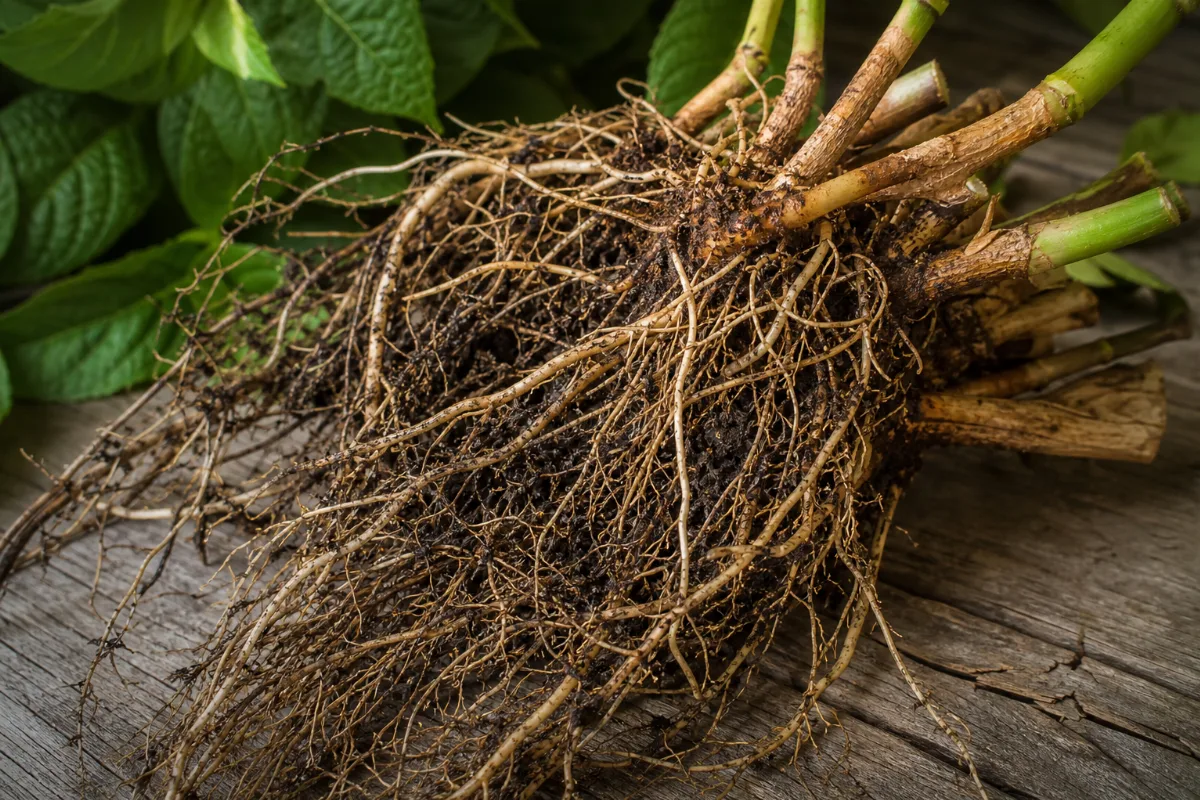
Hydrangea arborescens is a shrub from eastern North America, also called wild or smooth hydrangea, and 'seven barks' for its peeling bark. The medicine is the dried root and underground stem. Older books name saponins, flavonoids and a compound called hydrangin, but we could not confirm what hydrangin is.
Do not confuse it with ornamental hydrangeas such as Hydrangea macrophylla. Those are different plants with different chemistry.
What the research shows
We searched PubMed and read two monographs. No human study of hydrangea root was found for any use. The university monograph itself says 'No human studies presently available'. The consumer drug reference says there is no good scientific evidence for kidney stones, prostate problems, bladder infections or hay fever.
The few lab findings are about other hydrangea species or isolated compounds, such as mouse blood sugar work. They do not apply to the root.
We found no regulator review for hydrangea root. Pages for NCCIH, LiverTox and LactMed had no entry, and the EMA page could not be opened (not verified).
History
The Cherokee used hydrangea for kidney and bladder stones, as did practitioners of traditional Chinese medicine (per a student monograph citing older books; not checked in a primary source). 19th-century American herbal doctors used it for gravel, cystitis and kidney inflammation, and thought it helped small stones pass rather than dissolving them.
At a glance
Traditional uses history, not proof
- Kidney and bladder stones, gravel
- Bladder and urinary tract complaints
- Prostate complaints
- Diuretic (water pill)
Studied for research
- Kidney and bladder stones: insufficient (tradition only)
- Urinary complaints and diuretic action: insufficient (tradition only)
- Prostate complaints: insufficient (tradition only)
- Hay fever: insufficient (listed use only)
- Blood sugar: insufficient (mouse work on another hydrangea species)
Main compounds
- Hydrangenol (skin allergen)
- Saponins (listed in older texts)
- Flavonoids (listed in older texts)
- 'Hydrangin' (name in handbooks; identity not confirmed)
Common forms
- Dried root or rhizome
- Tea or decoction
- Capsule or powder
- Liquid extract
Research links: Natural Medicines: Hydrangea monograph (via Vital.ly) · Southern Cross University: Hydrangea arborescens monograph · PubMed: leaves of Hydrangea macrophylla var. thunbergii and taxiphyllin · PubMed: allergic contact dermatitis from hydrangea (nursery workers) · Research Library · Genes & Biomarkers Library
The plant and its history
- Accepted scientific name
- Hydrangea arborescens
- Naming authority
- L.
- Synonyms
- Hydrangea vulgaris Michx.
- Common names
- Hydrangea root (en); Wild hydrangea (en); Smooth hydrangea (en); Seven barks (en)
- Botanical family
- Hydrangeaceae (hydrangea family)
- Classification
- Plantae > Cornales > Hydrangeaceae > Hydrangea > Hydrangea arborescens
- Native range
- The university monograph says it is native to North America (it also says south-east Asia, which looks like a confusion with other hydrangeas). Not verified here.
- Habitat
- Monograph: rocky areas near streams and moist ground. Not verified in a primary source.
- What the plant looks like
- Plant: A shrub with large dark green oval, toothed leaves and clusters of small white, pink or blue flowers. The bark peels in layers, possibly the source of the name 'seven barks'. The root is grey outside and white inside, and splinters easily (per the monograph).
- Cultivation
- Not found in the sources read for medicine. Widely grown as a garden shrub.
- Harvest and processing
- The dried root and underground stem (rhizome) are the traditional material. No standard preparation found.
- Look-alikes and adulterants
- Name: Other hydrangeas (H. macrophylla, H. paniculata, H. serrata); Note: Different species with different chemistry. A cyanogenic glycoside was found in the leaves of H. macrophylla var. thunbergii, not tested here in H. arborescens root. Ornamental hydrangeas should not be used as medicine.
- Sustainability and conservation
- Not found.
Traditional use and history history, not clinical proof
| Tradition or era | Documented use | Source |
|---|---|---|
| Cherokee and other Native American use | Kidney and bladder stones (as stated by a student monograph citing older books). | s-scu |
| Traditional Chinese medicine (as stated in the monograph) | Kidney and bladder stones. NOT verified: we did not find a primary Chinese source. | s-scu |
| 19th-century American 'eclectic' and Physiomedical practitioners | Kidney disorders including nephritis, urinary gravel and cystitis; thought to help small stones pass. | s-scu |
| Medical journals, 1885 | A note titled 'The Hydrangea Arborescens' appeared in the Buffalo Medical and Surgical Journal. Content NOT read. | p36665385 |
Traditional use shows how a plant was used. It does not show that a supplement works or is safe today.
What is inside, and how it may work
What the plant contains and how those compounds act in cells and animals. Laboratory and animal mechanisms are not proven effects in people.
Main compounds
| Compound | Family | Where it is concentrated | Activity studied | Level of evidence |
|---|---|---|---|---|
| Hydrangenol PubChem 119199 | dihydroisocoumarin (stilbenoid-related) | hydrangea plants (species varies) | The main skin-allergy compound found in hydrangea. 4 1 | Human contact allergy |
| Taxiphyllin PubChem 107721 | cyanogenic glycoside | leaves of H. macrophylla var. thunbergii (a different species) | Can release hydrogen cyanide when broken down. Found in the leaves of another hydrangea; mostly broken down during processing. NOT shown in H. arborescens root. 6 | Plant analysis (other species) |
| Hydrangin | named a 'glycoside' by handbooks | root, flowers, leaves (per handbook claim) | The name appears in old references; its chemical identity was not confirmed in the sources read, and no PubChem record was confirmed. 12 | Secondary source |
| Flavonoids (kaempferol, quercetin, rutin) PubChem 5280343 | flavonoids | reported in the herb (per monograph) | Common plant flavonoids; listed by the monograph from older texts. Quercetin CID shown. 12 10 | Secondary source |
| Saponins, resin, gum and starch | various | root (per monograph) | Listed in the monograph from older texts. Not quantified; no tested role. 12 | Secondary source |
Mechanisms, receptors and pathways
| Target or pathway | Gene or receptor | What was found | Level |
|---|---|---|---|
| Diuretic action (claimed) | not studied | A diuretic-like effect is claimed in traditional texts and is the basis for the lithium warning. No measurement was found. 12 8 | Traditional claim |
| Histamine release and hyaluronidase (lab-made hydrangeol) | hyaluronidase enzyme | The monograph reports that lab-made hydrangeol reduced the enzyme and histamine release in a test tube. Lab only; original not read. 12 | In vitro (reported secondhand) |
| Blood sugar and blood fats (other species) | not stated | Hydrangenol from a Hydrangea macrophylla subspecies lowered blood glucose and free fatty acids in mice, per the monograph. Animal, other species, secondhand. 12 | Animal (reported secondhand) |
| Release of cyanide from cyanogenic glycosides | beta-glucosidase enzymes | In general, cyanogenic glycosides release cyanide when plant or gut enzymes break them down. In the one leaf study found, taxiphyllin was mostly broken down by processing. Nothing is known for H. arborescens root. 6 | Plant analysis (other species) |
Absorption, metabolism and elimination
- Absorption
- Not found.
- Distribution
- Not found.
- Metabolism
- Not found.
- Elimination
- Not found.
- Bioavailability
- Not found.
Isolated compounds versus whole extracts
No study compared isolated compounds with the whole root. The only experimental data in the sources are on isolated compounds from other hydrangea species (mouse sugar work, a test-tube enzyme study) and on contact allergy to hydrangenol.
Nutritional composition
Hydrangea root is not a food or nutrient source. The existing herb summary lists it under herbs, not essential nutrients. No nutrient composition was found.
6 not enough evidence
What is Hydrangea root good for?
What hydrangea root is traditionally used for. For every use below there is no human study, so the honest rating is insufficient.
Benefits, one by one
Each card is a research question, not a promise. Tap a goal to filter. Open a card to see the studies, doses and limits.
Kidney and bladder stones, gravel (traditional use)
Not enough evidenceHydrangea root has long been used for urinary stones and 'gravel'. No human study was found, so we cannot say it helps. Stones need a doctor.
2 studiesTraditionally the dried root and underground stem as a tea (decoction…
Studies, doses and limits
What the trials found
No human study of hydrangea root for stones was found in PubMed or in the two monographs read. The university monograph states 'No human studies presently available'. The consumer drug reference says there is no good scientific evidence for kidney stones.
Results
No verified result.
Effect sizes as reported
None.
Why this rating
Tradition only. No trial, case series or lab test of stone prevention or passage was found.
Form and dose studied
Traditionally the dried root and underground stem as a tea (decoction) or liquid extract. No standard strength exists. We give no amounts.
Who was studied
Not tested in any group.
Why researchers looked
This is the best-known traditional use. The Cherokee and Chinese practitioners used it for kidney and bladder stones, and 19th-century American herbal doctors used it too, mostly to help small stones pass.
Traditional use
The Southern Cross University monograph says the Cherokee used hydrangea for kidney and bladder stones, as did traditional Chinese medicine practitioners, and that 19th-century Physicomedicalists used it for kidney disorders. Older texts thought it helped small stones pass and might help prevent them, not that it dissolved them. These are secondary sources citing old books.
Proposed mechanism Pharmacological theory
No mechanism has been shown in people. Old texts proposed a 'passing through' (diuretic) action. Nothing in the sources we read tests this.
A proposed mechanism does not show that the effect happens in people.
Stones can block the urinary tract and cause infection or kidney damage. Severe side pain, blood in urine, fever or being unable to pass urine need urgent medical care. Do not use a herb in place of that care.
Bladder and urinary tract complaints (cystitis, urethritis, kidney inflammation; traditional use)
Not enough evidenceTraditional texts list hydrangea for bladder irritation, urethritis and kidney inflammation. No human study tests this. Urinary infections and kidney disease need proper diagnosis.
2 studiesTraditional tea or liquid extract of the root; no standard. We give n…
Studies, doses and limits
What the trials found
No human study was found.
Results
No verified result.
Effect sizes as reported
None.
Why this rating
Tradition and old texts only.
Form and dose studied
Traditional tea or liquid extract of the root; no standard. We give no amounts.
Who was studied
Not tested in any group.
Why researchers looked
Old herbal books list bladder, urethra and kidney complaints among the uses of this root.
Traditional use
The university monograph lists urinary stones with gravel and cystitis, urethritis and nephritis (kidney inflammation) as traditional indications, citing 19th and early 20th-century herbal texts. The consumer reference says people use it for bladder and prostate infections and urethral infections, without good evidence.
Proposed mechanism Pharmacological theory
None shown. No lab or animal test of hydrangea root on the urinary tract was found in what we read.
A proposed mechanism does not show that the effect happens in people.
A urinary infection can spread to the kidneys. Burning, fever, back pain, blood in the urine or any urinary symptoms that last more than a day or two need a doctor. Anyone with known kidney disease should not self-treat with a diuretic-type herb without medical advice.
Diuretic (water-pill) action (traditional)
Not enough evidenceOld texts call hydrangea a diuretic, meaning it makes you pass more urine. This was not measured in people in the sources we read. It is also why a lithium warning exists.
2 studiesNot applicable; no tested preparation.
Studies, doses and limits
What the trials found
No human measurement of urine output after hydrangea root was found.
Results
No verified result.
Effect sizes as reported
None.
Why this rating
Traditional claim only.
Form and dose studied
Not applicable; no tested preparation.
Who was studied
Not tested.
Why researchers looked
A diuretic effect is the usual explanation given for its traditional use in the urinary tract.
Traditional use
The university monograph lists 'diuretic', 'antilithic' (against stones) and 'tonic' as traditional actions, and says any action on stones was thought to be by passing them out, not dissolving them.
Proposed mechanism Pharmacological theory
Not shown. Whether the root really increases urine flow in people is unknown.
A proposed mechanism does not show that the effect happens in people.
If it does act like a water pill, it could affect lithium levels and could add to other diuretics or cause fluid and salt loss. See the safety tab.
Enlarged prostate and prostate inflammation (traditional use)
Not enough evidenceTraditional texts list hydrangea for prostate swelling and prostatitis. No human study was found. Prostate symptoms need a proper check.
2 studiesTraditional tea or liquid extract; no standard. We give no amounts.
Studies, doses and limits
What the trials found
No human study was found.
Results
No verified result.
Effect sizes as reported
None.
Why this rating
Tradition only.
Form and dose studied
Traditional tea or liquid extract; no standard. We give no amounts.
Who was studied
Not tested.
Why researchers looked
Old herbal books pair prostate complaints with bladder and urinary ones.
Traditional use
The university monograph lists prostatitis and enlarged prostate as traditional indications. The consumer reference says people use hydrangea for prostate infections and enlarged prostate without good scientific evidence.
Proposed mechanism Pharmacological theory
Not studied.
A proposed mechanism does not show that the effect happens in people.
Trouble passing urine, blood in urine, fever or pelvic pain need a doctor. Prostate problems can look like other conditions, including cancer.
Hay fever (listed by one consumer reference)
Not enough evidenceOne consumer reference lists hay fever among the conditions people use hydrangea for and rates the evidence as insufficient. We found nothing more.
2 studiesNot applicable.
Studies, doses and limits
What the trials found
No human study was found.
Results
No verified result.
Effect sizes as reported
None.
Why this rating
Listed use only; no data.
Form and dose studied
Not applicable.
Who was studied
Not tested.
Why researchers looked
It is listed as a use but we found no source explaining why.
Traditional use
Listed under 'insufficient evidence' by the consumer drug reference. No traditional text in the sources we read describes it.
Proposed mechanism Laboratory research
Not studied for this plant. A university monograph reports that hydrangeol (made in the lab) reduced histamine release in a test-tube study; this is a lab finding on a lab-made compound, not on the root.
A proposed mechanism does not show that the effect happens in people.
Hydrangea plants can themselves cause allergic skin reactions in some people (see safety tab).
Blood sugar (lab and animal work on other hydrangea species only)
Not enough evidenceA compound from a different hydrangea species lowered blood sugar in mice. That is not evidence that hydrangea root works in people.
1 studiesIsolated compound in mice; not relevant to the root.
Studies, doses and limits
What the trials found
None for hydrangea root. The only data are animal and are for a different species.
Results
Mouse result reported secondhand; not verified.
Effect sizes as reported
None verified.
Why this rating
Animal data from another species, read only as a summary in a monograph.
Form and dose studied
Isolated compound in mice; not relevant to the root.
Who was studied
Mice (reported secondhand).
Why researchers looked
Researchers in Asia study the leaves of sweet hydrangeas (Hydrangea macrophylla and relatives), which are a different plant.
Traditional use
Not a traditional use of hydrangea root (Hydrangea arborescens).
Proposed mechanism Animal research
The university monograph reports that hydrangenol, from a subspecies of Hydrangea macrophylla, lowered blood glucose and free fatty acids in mice after two weeks. This is secondhand, from an older reference, and we did not read the original.
A proposed mechanism does not show that the effect happens in people.
Anyone on diabetes medicine should not rely on hydrangea. It is not a tested diabetes treatment.
Connections to the rest of health
How Hydrangea root connects to the rest of our health knowledge graph. Every link says what kind of connection it is. A safety link (for example to the liver) is a warning, not a benefit. A study that merely mentions a topic never creates a benefit link.
Explore every connection: goals, body systems, organs, symptoms, genes
A. Wellness goals
| Connected to | Kind of connection | Evidence status | Context | Studies |
|---|---|---|---|---|
| Urinary Comfort | Traditional use | Not enough evidence | Kidney and bladder stones, gravel (traditional use): Hydrangea root has long been used for urinary stones and 'gravel'. No human study was found, so we cannot say it helps. Stones need a doctor. Bladder and urinary tract complaints (cystitis, urethritis, kidney inflammation; traditional use): Traditional texts list hydrangea for bladder irritation, urethritis and kidney inflammation. No human study tests this. Urinary infections and kidney disease need proper diagnosis. | 12 8 |
| Mens Vitality | Traditional use | Not enough evidence | Enlarged prostate and prostate inflammation (traditional use): Traditional texts list hydrangea for prostate swelling and prostatitis. No human study was found. Prostate symptoms need a proper check. | 12 8 |
| Blood Sugar Balance | Not enough evidence | Blood sugar (lab and animal work on other hydrangea species only): A compound from a different hydrangea species lowered blood sugar in mice. That is not evidence that hydrangea root works in people. | 12 |
B. Body systems
| Connected to | Kind of connection | Evidence status | Context | Studies |
|---|---|---|---|---|
| Urinary system | Traditional use | Not enough evidence | Traditional use for stones and urinary complaints; no human data. Preparation or compound: Hydrangea root |
12 8 |
| Skin | Adverse effect or risk | Case series | Contact allergy in nursery workers. Preparation or compound: Hydrangenol |
1 4 |
| Urinary System | Biological association | Not enough evidence | Studied for: Kidney and bladder stones, gravel (traditional use) Studied for: Bladder and urinary tract complaints (cystitis, urethritis, kidney inflammation; traditional use) | 12 8 |
| Reproductive System | Biological association | Not enough evidence | Studied for: Enlarged prostate and prostate inflammation (traditional use) | 12 8 |
| Respiratory System | Biological association | Not enough evidence | Studied for: Hay fever (listed by one consumer reference) | 8 12 |
| Immune System | Biological association | Not enough evidence | Studied for: Hay fever (listed by one consumer reference) | 8 12 |
| Endocrine System | Biological association | Not enough evidence | Studied for: Blood sugar (lab and animal work on other hydrangea species only) | 12 |
| Metabolism Weight | Biological association | Not enough evidence | Studied for: Blood sugar (lab and animal work on other hydrangea species only) | 12 |
I. Biomarkers
| Connected to | Kind of connection | Evidence status | Context | Studies |
|---|---|---|---|---|
| Urine volume | Biological association | Not enough evidence | Measured in trials: no data. A lab change is not the same as a health benefit. | 12 8 |
| Stone passage or new stones | Biological association | Not enough evidence | Measured in trials: no data. A lab change is not the same as a health benefit. | 8 12 |
| Blood glucose | Biological association | Not enough evidence | Measured in trials: lowered (in mice, other species, reported secondhand). A lab change is not the same as a health benefit. | 12 |
J. Genes, receptors and enzymes
| Connected to | Kind of connection | Evidence status | Context | Studies |
|---|---|---|---|---|
| Beta-glucosidase | Preliminary mechanism | Plant analysis (other species) | General route by which cyanogenic glycosides release cyanide; not tested for hydrangea root. | 6 |
L. Active compounds
| Connected to | Kind of connection | Evidence status | Context | Studies |
|---|---|---|---|---|
| Hydrangenol | Biological association | Human contact allergy | The main skin-allergy compound found in hydrangea. Preparation or compound: hydrangea plants (species varies) |
4 1 |
| Taxiphyllin | Biological association | Plant analysis (other species) | Can release hydrogen cyanide when broken down. Found in the leaves of another hydrangea; mostly broken down during processing. NOT shown in H. arborescens root. Preparation or compound: leaves of H. macrophylla var. thunbergii (a different species) |
6 |
| Hydrangin | Biological association | Secondary source | The name appears in old references; its chemical identity was not confirmed in the sources read, and no PubChem record was confirmed. Preparation or compound: root, flowers, leaves (per handbook claim) |
12 |
| Flavonoids (kaempferol, quercetin, rutin) | Biological association | Secondary source | Common plant flavonoids; listed by the monograph from older texts. Quercetin CID shown. Preparation or compound: reported in the herb (per monograph) |
12 10 |
| Saponins, resin, gum and starch | Biological association | Secondary source | Listed in the monograph from older texts. Not quantified; no tested role. Preparation or compound: root (per monograph) |
12 |
Each connection is stored with the ingredient, the connected record, the kind of connection, the evidence status, the supporting studies, the preparation or compound involved, and a review date (last reviewed October 25, 2026).
The evidence
The research centre for Hydrangea root. Every record here was checked against PubMed or the publisher's page; we never list a study we have not verified.
Evidence by outcome
Bars show how many studies we found for each outcome, not how well it works. People are added up across trials only (reviews are not added, to avoid double counting).
How we rate evidence
High certainty
Several well-run trials or reviews agree; further research is unlikely to change the picture much.
Moderate certainty
Good trials point the same way, but some doubt remains.
Low certainty
Small, short or inconsistent trials. The finding could change with better research.
Very low certainty
Very little or very weak human data. Treat as a possibility only.
Mixed findings
Trials or reviews disagree with each other.
Not enough evidence
Not enough human research to say either way.
Evidence against
Good research found no benefit, or found harm.
We take the reviewers' own risk-of-bias and GRADE statements where they exist, and otherwise judge from study size, design, consistency, directness and whether a product matches what is sold. Many publications do not make evidence high. Method note: We read our existing herb summary, re-read the two monographs it cites, searched PubMed, read the abstract of each PubMed record cited (two records had no abstract and are marked), and checked names in GBIF and NCBI Taxonomy and compounds in PubChem. Regulator pages that could not be opened are marked not verified.
Study library: every study we checked 12
| Study | Design | People | Product, dose, length | Result |
|---|---|---|---|---|
| Avenel-Audran 2000 Allergic contact dermatitis from hydrangea--is it so rare? Contact Dermatitis · PMID 11011916 · DOI |
Case series and review |
8 Eight nursery workers in Angers, France, compared with cases in the literature |
Hydrangea plants (stem and leaf patch-tested; hydrangenol tested) stem and leaf (Hydrangea species not specified) not stated in the abstract |
Hydrangea contact allergy appeared mainly as an occupational hand eczema among nursery workers. Patch tests with stem and leaf were strongly positive in all patients, and hydrangenol, the allergen, was also positive when tested. Sensitisation seemed to follow close, prolonged contact. 8 cases; no rates Methods, limits and fundingOutcomes: Allergic skin reaction to hydrangea Limitations: Small case series from one region; handling the living plant, not taking root by mouth. Read: abstract |
| Caloni 2013 Plant poisoning in domestic animals: epidemiological data from an Italian survey (2000-2011). Veterinary Record · PMID 23716536 · DOI |
Survey animal-survey |
Poison-centre calls about pets and other domestic animals in Milan, Italy | Plants eaten by animals, including Hydrangea macrophylla plant ingestion (Hydrangea macrophylla named; part not stated) not stated in the abstract |
Hydrangea macrophylla was among the plants most often involved in animal poisoning calls. Most exposures caused mild to moderate signs. The abstract does not say what in the plant caused the signs. Survey; no hydrangea-specific numbers in the abstract Methods, limits and fundingOutcomes: Which plants cause animal poisonings Limitations: Animals, not people; a different species (H. macrophylla); cause not stated. Only a pointer that hydrangeas can upset animals that eat them. Read: abstract |
| De Rooij 2006 Occupational allergic contact dermatitis from hydrangea. Contact Dermatitis · PMID 16426301 · DOI |
Case report |
Worker with hydrangea contact allergy (per title; no abstract in PubMed) | Hydrangea plants plant contact not stated in the abstract |
The PubMed record has no abstract; the title reports occupational allergic contact dermatitis from hydrangea. It is the reference the university monograph cites for skin reactions. Title only Methods, limits and fundingOutcomes: Occupational allergic skin reaction Limitations: Only the title and record were read. Read: record only (no abstract available) |
| Hausen 1991 Hydrangenol, a strong contact sensitizer found in hydrangea (Hydrangea sp.; Hydrangeaceae). Contact Dermatitis · PMID 1868712 · DOI |
Lab and clinical report human-and-lab |
People with hydrangea contact allergy (per title; no abstract in PubMed) | Hydrangenol (a hydrangea compound) hydrangea plant (species not stated in the record) not stated in the abstract |
The PubMed record has no abstract. The title states that hydrangenol is a strong contact sensitizer found in hydrangea. Title only Methods, limits and fundingOutcomes: Skin sensitising power of hydrangenol Limitations: Only the title and record were read; no details, numbers or species can be given. Read: record only (no abstract available) |
| No authors listed 1885 The Hydrangea Arborescens. Buffalo Medical and Surgical Journal · PMID 36665385 |
Historical note historical |
Not stated | Hydrangea arborescens not stated not stated in the abstract |
Index record only. A 1885 note about the plant; its content was not read. None Methods, limits and fundingOutcomes: Historic medical-journal note Limitations: Content not read; shows only that doctors were writing about the plant in the 1880s. Read: record only (index entry, content not read) |
| Tsukioka 2023 Quantitative analysis of taxiphyllin, a cyanogenic glycoside, in the leaves of Hydrangea macrophylla var. thunbergii. Journal of Natural Medicine · PMID 37517070 · DOI |
Lab analysis plant-analysis |
Plant leaves (a different species and a different plant part from hydrangea root) | Dried and fermented leaves of Hydrangea macrophylla var. thunbergii ('Sweet Hydrangea Leaf') leaf (different species) not stated in the abstract |
Leaves contained the cyanogenic glycoside taxiphyllin. Content varied more than three-fold depending on when leaves were collected. Taxiphyllin was mostly broken down during processing of the crude drug. The authors suggest cyanogenic glycosides are not the cause of the vomiting seen in food-poisoning cases after drinking a decoction of this leaf drug. Lab measurement; no human outcome Methods, limits and fundingOutcomes: Whether the leaves contain a cyanogenic glycoside, how much, and what happens in processing Limitations: Different species (H. macrophylla var. thunbergii) and a leaf drug, not the root of H. arborescens. It shows hydrangeas can make a cyanogenic glycoside, but says nothing direct about hydrangea root. Read: abstract |
| s-gbif GBIF Backbone: Hydrangea arborescens L. (key 2985986) · Source |
Database record reference |
Methods, limits and fundingRead: read (API, 2026-10-25) | ||
| s-natmed Natural Medicines (consumer drug reference, shown via Vital.ly): Hydrangea monograph · Source |
Reference monograph reference |
Methods, limits and fundingRead: read (web page, 2026-10-25) | ||
| s-ncbi-tax NCBI Taxonomy search: Hydrangea arborescens (taxid 96933) · Source |
Database record reference |
Methods, limits and fundingRead: read (API id list, 2026-10-25) | ||
| s-pubchem PubChem compound records: hydrangenol (CID 119199), taxiphyllin (CID 107721), quercetin (CID 5280343) · Source |
Database record reference |
Methods, limits and fundingRead: read (PUG REST, 2026-10-25) | ||
| s-regulators-notfound Regulator and database searches with no hydrangea root entry (NCCIH, LiverTox, LactMed, EMA/HMPC) · Source |
Regulator search reference |
Methods, limits and fundingRead: searched (2026-10-25); nothing found | ||
| s-scu Southern Cross University: Hydrangea arborescens (student-written plant monograph, 2008) · Source |
Reference monograph reference |
Methods, limits and fundingRead: read (web page, 2026-10-25) |
What we do not know yet
- No human study of hydrangea root for any use.
- Whether the root releases cyanide is untested.
- No regulator review, liver, pregnancy or interaction data beyond a consumer reference.
- No standard preparation or defined strength.
How new research is added
New studies are found by a saved PubMed search and placed in a review queue. A person reads each one before it changes any rating or safety wording.
Lab markers
What changed in blood or saliva tests during trials. A changed number is not the same as feeling or being healthier, and we give no "normal ranges".
Metabolic 1
Blood glucose
Lowered (in mice, other species, reported secondhand) in trials
Sugar level in the blood.
Not enough evidenceResults and what it means
Why it was measured
It is the outcome reported for hydrangenol in mice from another hydrangea species.
Statistical vs. clinical meaning
Animal result for another plant; not applicable to hydrangea root in people.
Safety implication
None established.
| Study | Result | People | Product |
|---|---|---|---|
| 12 | Hydrangenol from Hydrangea macrophylla lowered blood glucose in mice after two weeks, as summarised in the monograph (original not read; no figures given) | Mice | Hydrangenol, an isolated compound from a different hydrangea |
Other 2
Urine volume
No data in trials
How much urine a person passes. A diuretic raises it.
Not enough evidenceResults and what it means
Why it was measured
It would be the simplest test of the 'diuretic' claim.
Statistical vs. clinical meaning
Nothing to interpret. The claim has not been tested.
Safety implication
More urine can mean fluid and salt loss and can change how the body clears lithium.
| Study | Result | People | Product |
|---|---|---|---|
| 12 | Listed as a traditional action only; no measurement reported ('No human studies presently available') | None | Hydrangea root (traditional) |
Stone passage or new stones
No data in trials
Whether kidney stones pass, shrink or come back.
Not enough evidenceResults and what it means
Why it was measured
It is the outcome that matters for the best-known traditional use.
Statistical vs. clinical meaning
No study has measured this.
Safety implication
Stone symptoms with fever or no urine are emergencies.
| Study | Result | People | Product |
|---|---|---|---|
| 8 | 'No good scientific evidence' for kidney stones; no trial reported | None | Hydrangea root |
Safety
What studies and official sources say about side effects, medicines and who should check first. Each point shows what kind of evidence it comes from.
Main points to know 5
- Almost no safety data exist, so safety cannot be assumed. A consumer drug reference rates large oral amounts of hydrangea root as possibly unsafe (dizziness and chest tightness) and says there is not enough reliable information to call lower amounts safe. The only other sources are older texts. No clinical safety study or regulator review was found. Authoritative guidance 8 12 11
- Cyanide: a possibility raised in handbooks, not shown for the root. A university monograph says hydrangea contains a cyanogenic glycoside, 'hydrangin', which may explain claimed toxicity of flowers and leaves. We could not confirm that claim: no test of the root was found, and the consumer reference does not mention cyanide. The only modern chemical study found looked at the leaves of a different species and found a cyanogenic glycoside (taxiphyllin) that was mostly broken down during processing. Its authors suggest this is not what causes the vomiting seen after drinking that leaf drug. So hydrangeas can contain such compounds, but whether the root does, and in what amount, is unknown. Treat it as an unanswered question, not a proven poison and not a proven non-issue. Authoritative guidance 12 6 8
- Skin allergy from handling the plant. Hydrangea contact allergy is documented in nursery and flower workers. Hydrangenol is the main allergen. This is skin contact with the living plant, not taking root by mouth. Case series 1 4 3
- Possible effect on lithium and other water pills. The consumer reference lists a moderate interaction with lithium, because hydrangea might act like a water pill and reduce how well the body clears lithium. This is theory, not a reported case. Do not combine without asking the prescriber. Authoritative guidance 8
- Kidney and urinary symptoms need medical care, not a herb. Stones, urinary infections and kidney disease can cause permanent harm if untreated. No evidence shows hydrangea treats them. Authoritative guidance 8 12
Side effects 4
| Effect | How often | Severity and recovery | Evidence |
|---|---|---|---|
| Dizziness and tightness in the chest after large amounts Described by the consumer reference and by older texts as overdose effects, together with 'disorders of the central nervous system'. The original case descriptions were not found. | Not established | not graded Not reported | Authoritative guidance 8 12 |
| Stomach and gut irritation, gastroenteritis Both monographs mention it. No frequency known. | Not established | not graded Not reported | Authoritative guidance 8 12 |
| Allergic contact dermatitis (skin) from handling hydrangea plants Eight cases in one French nursery area; the allergen is hydrangenol. Not a sign that the root taken by mouth causes the same. | Not established | mild to moderate (chronic hand eczema in nursery workers) Usually settles when contact stops (not stated in the abstract) | Case series 1 4 3 |
| Signs of illness in animals that eat hydrangea (H. macrophylla) Italian poison-centre survey of pets. The part of the plant and the cause were not stated. Different species. | Not established | mostly mild to moderate Not stated | Animal research 2 |
Liver
No LiverTox entry for hydrangea was found, and no case report of liver injury from hydrangea root was found in PubMed. Absence of reports is not proof of safety, because the herb is rarely used and rarely studied. 11
How often. Unknown.
Monitoring. No source gives monitoring advice. Tell a doctor about yellow eyes or skin, dark urine or unusual tiredness.
This is a safety connection. It is not evidence that Hydrangea root supports liver health.
Medicines and supplements 3
| With | Why it matters | Importance | Evidence | What to do |
|---|---|---|---|---|
| Lithium drug | If hydrangea acts as a diuretic it might lower lithium clearance and raise lithium levels. | Rated moderate by the consumer reference. Lithium has a narrow safe range, so raised levels can cause serious side effects. | Authoritative guidance Very low certainty 8 | Ask the prescriber or a pharmacist before any hydrangea product. Do not change lithium on your own. |
| Diuretics (water pills) and other drugs that change fluid or potassium drug | A diuretic-like effect, if real, might add to prescribed water pills. | Theoretical. No report found. | Pharmacological theory Very low certainty 12 8 | Ask a pharmacist, especially with heart, kidney or blood-pressure medicines. |
| Other herbs and supplements herb | None known. | The consumer reference found no known interactions with herbs and supplements. Absence of data, not proof of none. | Authoritative guidance Very low certainty 8 | Tell your pharmacist what you take. |
Who should check first 5
| Situation | Advice | Evidence |
|---|---|---|
| Pregnancy and breastfeeding | Avoid. The consumer reference says there is not enough reliable information and advises staying on the safe side. No LactMed entry was found. | Authoritative guidance 8 11 |
| Kidney disease, kidney stones, urinary infection or blood in urine | Needs a doctor. Do not use hydrangea in place of care. Diuretic-type herbs can matter when kidneys are not working well. | Authoritative guidance 8 12 |
| People taking lithium | Ask the prescriber first. | Authoritative guidance 8 |
| Children | No safety data. Avoid. | Insufficient 8 |
| Known allergy to hydrangea or other plants in the same family | Avoid handling or taking it. Contact allergy is documented. | Case series 1 4 |
Overdose, product quality and regulators
Summary. No toxicity study of hydrangea root was found. The handbooks cited by the university monograph link toxicity to the flowers and leaves, and the monograph says the cyanogenic glycoside 'hydrangin' is also found in the root. That statement is secondary and unverified here.
Animal. No toxicity study of H. arborescens in animals was found. A poison-centre survey of pets lists H. macrophylla among plants often involved in poisonings (cause not stated).
Human doses studied. None. We give no amounts.
High dose or long term signals. Dizziness and chest tightness at large amounts; no data on long-term use.
Overdose response. Not described in the sources. Anyone with severe dizziness, chest tightness, confusion, vomiting or collapse after taking a plant product should get urgent medical help or call poison control.
Genotoxicity. Not found.
Toxic plant parts. Flowers and leaves are the parts claimed toxic in handbooks. The root is the traditional medicine part and is also said to contain the same glycoside. Do not eat ornamental hydrangea flowers, leaves or stems.
Cyanogenic glycoside check. Cyanide question: checked, not settled. Two handbooks (cited by a university student monograph) say the root, flowers and leaves contain a 'cyanogenic glycoside called hydrangin' and that flowers and leaves have been claimed to be toxic. No chemical test of Hydrangea arborescens root for cyanide release, and no case of cyanide poisoning from the root, was found in PubMed or the monographs read.
No analysis of hydrangea root products was found. Product content, species identity and strength are not standardised in the sources read.
Which hydrangea is in the product. Other hydrangeas (H. macrophylla, H. paniculata) are different plants with different chemistry, including a cyanogenic glycoside found in one leaf drug. Check that a product names Hydrangea arborescens and the root. 6 12
| Body | Action | Date |
|---|
When to get medical help
- Severe side or back pain, fever, shaking chills or blood in the urine, especially with a known stone: seek medical care the same day.
- Being unable to pass urine, or passing very little: seek urgent care.
- Severe dizziness, chest tightness, confusion, repeated vomiting or collapse after taking any plant product: call emergency services or poison control.
- Spreading rash, swelling or blistering after handling hydrangea: stop contact and see a doctor.
- If you take lithium and have tremor, vomiting, diarrhoea or confusion: contact your prescriber at once.
Stop the supplement and contact a clinician or emergency service. In the US, Poison Control is 1-800-222-1222.
General information only, not medical advice. Ask a clinician or pharmacist before use, especially with medicines, in pregnancy or with a health condition. See the Natural Remedy Safety guide.
Frequently asked questions
Does hydrangea root dissolve or prevent kidney stones?
Is hydrangea root safe?
Does hydrangea contain cyanide?
Some hydrangeas contain cyanogenic glycosides. A university monograph says hydrangea contains one, called hydrangin, and a modern study found another (taxiphyllin) in leaves of a different species. Nobody has shown how much, if any, is in the root or whether it is released. So it is an open question.
Can I use garden hydrangea flowers or leaves?
Does it affect lithium?
A consumer drug reference rates a moderate interaction because hydrangea might act as a diuretic and slow lithium clearance. It is theoretical, but lithium has a narrow safe range, so ask the prescriber first.
Is it a real diuretic?
Can it help with an enlarged prostate or urinary infection?
Can I take it when pregnant or breastfeeding?
Avoid it. There is not enough safety information, and the consumer reference advises staying on the safe side.
Can hydrangea hurt the liver?
No liver injury report was found, and there is no LiverTox entry. Little research exists, so absence of reports is not proof of safety.
Can touching hydrangea cause a rash?
When should I see a doctor?
How much should I take?
We cannot say. No tested amount or standard product exists. Ask a doctor or pharmacist about amounts and your medicines.
Explore by health goal
Editorial transparency
- Written by
- AlternativeMed editorial team. Research compiled with AI assistance, then checked against PubMed records.
- Medical review
- None. This page has not been reviewed by a physician or pharmacist.
- First published
- 2026-10-25
- Last substantive update
- 2026-10-25
- How we research
- We read our existing herb summary, re-read the two monographs it cites, searched PubMed, read the abstract of each PubMed record cited (two records had no abstract and are marked), and checked names in GBIF and NCBI Taxonomy and compounds in PubChem. Regulator pages that could not be opened are marked not verified.
- How we rate evidence
- See "How we rate evidence" in the Evidence tab.
- Independence
- No product is promoted on this page. No affiliate links are shown.
Sources 12
Each source was opened and checked. Where we read only the abstract, it says so. The small numbers in the text point here.
- Avenel-Audran M, Hausen BM, le Sellin J, et al.. Allergic contact dermatitis from hydrangea--is it so rare?. Contact Dermatitis. 2000. PMID 11011916. DOI 10.1034/j.1600-0536.2000.043004189.x. (abstract)
- Caloni F, Cortinovis C, Rivolta M, et al.. Plant poisoning in domestic animals: epidemiological data from an Italian survey (2000-2011).. Veterinary Record. 2013. PMID 23716536. DOI 10.1136/vr.101225. (abstract)
- De Rooij J, Bruynzeel DP, Rustemeyer T. Occupational allergic contact dermatitis from hydrangea.. Contact Dermatitis. 2006. PMID 16426301. DOI 10.1111/j.0105-1873.2006.0729g.x. (record only (no abstract available))
- Hausen BM. Hydrangenol, a strong contact sensitizer found in hydrangea (Hydrangea sp.; Hydrangeaceae).. Contact Dermatitis. 1991. PMID 1868712. DOI 10.1111/j.1600-0536.1991.tb01712.x. (record only (no abstract available))
- No authors listed. The Hydrangea Arborescens.. Buffalo Medical and Surgical Journal. 1885. PMID 36665385. (record only (index entry, content not read))
- Tsukioka J, Ohki Y, Nakao M, et al.. Quantitative analysis of taxiphyllin, a cyanogenic glycoside, in the leaves of Hydrangea macrophylla var. thunbergii.. Journal of Natural Medicine. 2023. PMID 37517070. DOI 10.1007/s11418-023-01733-7. (abstract)
- . GBIF Backbone: Hydrangea arborescens L. (key 2985986). . . (read (API, 2026-10-25))
- . Natural Medicines (consumer drug reference, shown via Vital.ly): Hydrangea monograph. . . (read (web page, 2026-10-25))
- . NCBI Taxonomy search: Hydrangea arborescens (taxid 96933). . . (read (API id list, 2026-10-25))
- . PubChem compound records: hydrangenol (CID 119199), taxiphyllin (CID 107721), quercetin (CID 5280343). . . (read (PUG REST, 2026-10-25))
- . Regulator and database searches with no hydrangea root entry (NCCIH, LiverTox, LactMed, EMA/HMPC). . . (searched (2026-10-25); nothing found)
- . Southern Cross University: Hydrangea arborescens (student-written plant monograph, 2008). . . (read (web page, 2026-10-25))