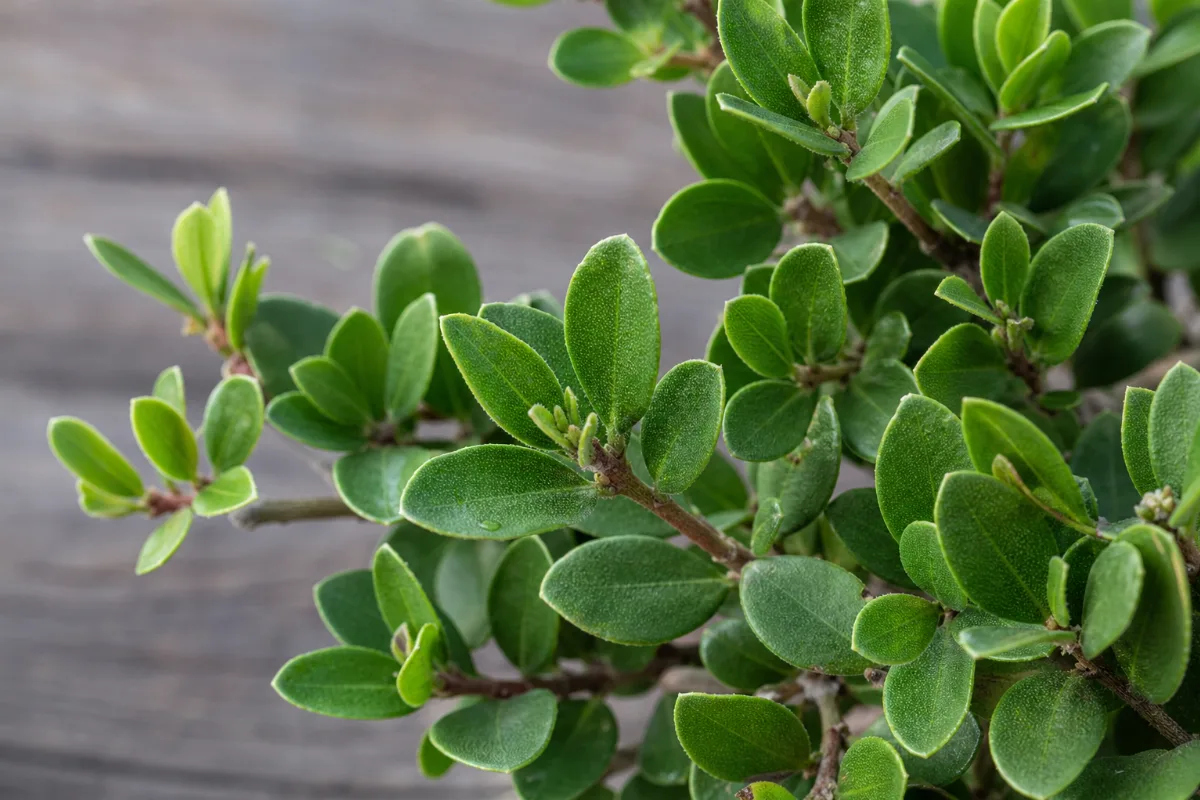
Herbs & Botanicals · Herbs · South African urinary herb with almost no human research and a liver caution for the oil
Buchu (Agathosma betulina)
Agathosma betulina (Bergius) Pillans (GBIF accepted name; formerly Barosma betulina), family Rutaceae; a second species, Agathosma crenulata, is also sold as buchu · also called Buchu, round-leaf buchu, short buchu; Barosma betulina (old name)
Buchu is the leaf of a small shrub from the Cape of South Africa. The Khoisan peoples used it as a tea for kidney and bladder complaints, colds, stomach upset and rheumatism, and in the 1800s it became a popular remedy in Europe and the US. Today it is mostly known for its essential oil, which gives a blackcurrant-type flavour. No trial in people has shown that buchu helps with urinary infections or as a diuretic. The oil contains pulegone, which can harm the liver at high amounts.
General information, not medical advice. Last substantive update · Not medically reviewed. A named clinician has not signed off on this page. How this page is made
About Buchu (Agathosma betulina)
Buchu is a South African shrub whose leaves were once a major remedy for urinary complaints. Modern research is small: lab and animal studies, one unpublished gel study, and warnings about pulegone in the oil. It has not been shown to work for any condition in people.
What it is
Buchu is the leaf of Agathosma betulina (round-leaf buchu) and of the related Agathosma crenulata. Both belong to the Rutaceae, the citrus family, and come from South Africa's Cape region. GBIF lists Agathosma betulina as the accepted name and Barosma betulina as an old synonym.
The leaves are used as tea, tincture, powder or extract. The essential oil is used in food flavouring and perfume. It contains diosphenol, which gives a blackcurrant-type taste, and pulegone, a compound that can harm the liver at high amounts.
History and regulation
The Khoisan peoples used buchu for kidney and urinary infections, colds, stomach complaints and rheumatism. It reached the UK around 1815 and then the US, and was in pharmacopoeias from 1826 for its diuretic effect. It faded with antibiotics and synthetic diuretics.
In 1990 Germany's Commission E gave a negative monograph, saying effectiveness had not been documented. We found no European Medicines Agency monograph. In the US it is sold as a dietary supplement, and the flavour industry's expert panel has affirmed buchu oil and extract as safe as flavourings.
What the research shows
In the lab, buchu oils blocked inflammation-related enzymes and relaxed isolated animal gut, but barely stopped common germs. In rats, a water extract of undisclosed make-up lowered blood sugar and blood pressure. A 2022 review states that no clinical trials support these results and that the literature has not proved any benefit in humans.
The only human study found is a 2002 report of a skin gel in 30 men with sore muscles, which we could not locate.
Products that are not the same
Leaf tea, leaf extracts and the essential oil differ. Pulegone does not dissolve well in water, so tea holds far less than the oil. A. crenulata oil can hold much more pulegone than A. betulina oil.
In a study of 43 samples, some products held senna, grass or other material, and 11 did not match authentic buchu. A. crenulata is sometimes sold as buchu.
At a glance
Traditional uses history, not proof
- Leaf tea or tincture for kidney and bladder infections and as a diuretic
- Colds, stomach aches, rheumatism, gout and fever
- Vinegar infusion or compress on wounds, swelling and bruises
Studied for research
- Urinary tract and bladder infections, insufficient evidence (traditional use only)
- Diuretic effect, insufficient evidence
- Muscle soreness after exercise (oil gel on skin), very low certainty
- Inflammation, pain, blood sugar and blood pressure (lab and animal only), insufficient evidence
Main compounds
- Pulegone (liver toxin at high amounts)
- Diosphenol (blackcurrant-type flavour)
- Menthone, isomenthone and limonene
- 8-mercapto-p-menthan-3-one (sulphur flavour compound)
- Diosmin and other flavonoids
Common forms
- Dried leaf and leaf tea
- Brandy or alcohol tincture
- Capsules and extracts of undisclosed strength
- Essential oil (flavouring and perfume; not for swallowing)
- Gel containing the oil (one small study)
Research links: Brendler and Abdel-Tawab 2022: Buchu review (PubMed) · NIH LiverTox: Buchu · Engels 2013: liver failure case with rooibos-buchu tea (PubMed) · Raman 2015: adulteration in buchu supplements (Europe PMC) · Research Library · Genes & Biomarkers Library
The plant and its history
- Accepted scientific name
- Agathosma betulina (Bergius) Pillans
- Naming authority
- GBIF backbone (API, read 2026-10-25): ACCEPTED species, usage key 3190125, family Rutaceae, order Sapindales. Written in the literature as (P.J.Bergius) Pillans. NCBI Taxonomy lists it as a species (taxid 501610). Second commercial species: Agathosma crenulata (L.) Pillans (GBIF 3190123, NCBI taxid 2486845).
- Synonyms
- Barosma betulina (P.J.Bergius) Bartl. & H.L.Wendl.; Diosma betulina (P.J.Bergius) Thunb.; Hartogia betulina P.J.Bergius; Bucco betulina (P.J.Bergius) Roem. & Schult.; Diosma crenata G.Lodd.; Barosma orbicularis Sweet
- Common names
- Buchu (English / Afrikaans); Round-leaf buchu, short buchu (English (A. betulina))
- Botanical family
- Rutaceae (the citrus family)
- Classification
- Plantae > not checked > not checked > Sapindales > Rutaceae > Agathosma > Agathosma betulina
- Native range
- South Africa. The 2022 review says the genus is indigenous to South Africa and buchu comes from the Cape region.
- Habitat
- Not verified in the sources read beyond Cape origin.
- What the plant looks like
- Roots: Not verified.; Stems: Not verified.; Leaves: The leaves are the part used. The 2015 adulteration paper describes leaf anatomy of both species by microscopy; the leaf shape differences were not read.; Flowers: Not verified.; Fruit: Not verified.
- Cultivation
- Not verified in the sources read.
- Harvest and processing
- Not verified.
- Look-alikes and adulterants
- Name: Agathosma crenulata; Note: The other buchu in trade. Its oil can hold much more pulegone, and it is sometimes sold as or mixed into A. betulina.; Name: Senna, grass and other plant matter; Note: Found as contaminants in some commercial buchu products in a 43-sample study.
- Sustainability and conservation
- Not assessed in the sources read.
Traditional use and history history, not clinical proof
| Tradition or era | Documented use | Source |
|---|---|---|
| Khoisan peoples, southern Africa | Leaves used for spiritual and medicinal purposes: usually an infusion for kidney and urinary infections, colds, stomach ailments, rheumatism, gout and fever; externally as an antiseptic wash and compress. | p35197854 |
| Early 1800s Europe and the US | Introduced to the UK around 1815 and from there to Ireland and the US; exported in great quantity; export peaked in 1873. | p35197854 |
| Pharmacopoeias from 1826 | Compendial since 1826 for diuretic effect and genito-urinary infections; dismissed from the US Pharmacopeia in 1930; interest waned with antibiotics and synthetic diuretics. | p35197854 |
| Germany 1990 | Commission E negative monograph: effectiveness not documented; flavour use in tea acceptable. German medicinal products with buchu had largely disappeared by 1994. | s-kommission-e-1990 |
| Modern industry | Essential oil used as a blackcurrant-type fruit flavour and in perfume; sold as a dietary supplement. | p35197854 |
Traditional use shows how a plant was used. It does not show that a supplement works or is safe today.
What is inside, and how it may work
What the plant contains and how those compounds act in cells and animals. Laboratory and animal mechanisms are not proven effects in people.
Main compounds
| Compound | Family | Where it is concentrated | Activity studied | Level of evidence |
|---|---|---|---|---|
| Pulegone PubChem 442495 | monoterpene ketone | Leaf essential oil Varies strongly. One review table lists about 3% in one A. betulina oil and about 50% in an A. crenulata oil; other samples are listed from 2.4% up to 73.2%. | Liver toxin at high amounts through reactive metabolites; the review calls it the key identification marker of the oil. 2 9 20 | Animal research |
| Diosphenol and pseudo-diosphenol PubChem 79023 | monoterpene | Leaf essential oil The review describes a diosphenol chemotype of A. betulina with diosphenol above 12%; one A. crenulata sample is listed at about 1%. | Unique to the genus; responsible for the distinctive blackcurrant flavour used in food. 2 | Traditional use |
| Menthone and isomenthone PubChem 26447 | monoterpene ketones | Leaf essential oil The isomenthone chemotype has more than 31% isomenthone (review). Isomenthone CID 6432469. | Chemical markers of the oil; their effects in people were not covered. 2 16 | Not studied here |
| Limonene PubChem 22311 | monoterpene | Leaf essential oil Listed at roughly 9 to 17% in samples in the review. | Common citrus terpene; a general review lists limonene among monoterpenes with some liver toxicity. 2 21 | Not studied here |
| 8-mercapto-p-menthan-3-one PubChem 61982 | sulphur-containing terpene | Leaf essential oil Present in small amounts (marked + or ++ in the review table). | Responsible for the flavour and aroma of the oil according to the review. 2 | Traditional use |
| Diosmin (flavonoid) PubChem 5281613 | flavonoid glycoside | Leaf Not given. | A consumer reference lists diosmin, rutin and quercetin in buchu; effects of buchu flavonoids in people were not studied. 4 16 | Not studied here |
Mechanisms, receptors and pathways
| Target or pathway | Gene or receptor | What was found | Level |
|---|---|---|---|
| 5-lipoxygenase and cyclooxygenase enzymes | ALOX5; PTGS1 and PTGS2 | Oils of both species blocked 5-lipoxygenase in the lab (IC50 about 50 and 59 ug/mL); an ethanol extract of A. betulina strongly blocked COX-1 and weakly COX-2. 2 | Laboratory research |
| Smooth muscle relaxation | Calcium channels; cyclic AMP pathway (suggested) | In guinea-pig gut, oils first stimulated then relaxed muscle; A. betulina seemed to block calcium channels, and the phosphodiesterase blocker rolipram increased the relaxing action, suggesting cyclic AMP. 12 | Laboratory research |
| Glucose uptake and inflammatory signals | Not stated | A commercial aqueous extract raised glucose uptake in fat cells and reduced neutrophil and monocyte respiratory burst, adhesion molecules, and release of IL-6 and TNF-alpha in lab tests. 2 | Laboratory research |
| Pulegone activation in the liver | Cytochrome P450 enzymes | P450 enzymes convert pulegone to menthofuran and other reactive products; these deplete glutathione and bind liver proteins, which at high exposure injures liver cells (shown for pennyroyal oil). 9 21 | Animal research |
Absorption, metabolism and elimination
- Absorption
- No study of how buchu compounds are absorbed in people was found.
- Distribution
- Not covered in the sources read.
- Metabolism
- For pulegone, liver P450 enzymes form menthofuran and other reactive metabolites (studied with pennyroyal).
- Elimination
- In a fatal pennyroyal case, serum held 18 ng/mL pulegone and 1 ng/mL menthofuran 72 hours after ingestion. Not buchu-specific.
- Bioavailability
- Unknown for buchu tea, extract or oil.
Isolated compounds versus whole extracts
Leaf tea, leaf extract and essential oil are very different. Pulegone is not water soluble, so tea holds much less than the oil. Results for the oil (gut-muscle relaxation, toxicity) cannot be applied to tea, and rat results for an aqueous extract of undisclosed composition cannot be applied to supplements.
Nutritional composition
Buchu is a flavouring and traditional medicinal herb, not a source of nutrients in meaningful amounts. Its oil is used as a blackcurrant-type flavour in sweets and drinks.
1 very low certainty7 not enough evidence
What is Buchu (Agathosma betulina) good for?
The traditional and studied uses of buchu and how strong the human evidence is. For all of them it is very thin or missing. Treat these as old customs and early clues, not proven benefits.
Benefits, one by one
Each card is a research question, not a promise. Tap a goal to filter. Open a card to see the studies, doses and limits.
Urinary tract and bladder infections (traditional use)
Not enough evidenceBuchu was a leading remedy for bladder and kidney infections in the 1800s. No trial in people has tested it for urinary infection, and German regulators did not recommend it. It is not a substitute for medical treatment of an infection.
5 studiesNot applicable: no dose or product was ever tested for this use in pe…
Studies, doses and limits
What the trials found
A 2022 review found no human trial of buchu for urinary infection and stated that the scientific literature has failed to prove any benefit in humans. A 2008 overview calls the research limited. The German Commission E (1990) did not recommend buchu leaf because effectiveness was not documented.
Results
No evidence of benefit in people. Historic and traditional use only.
Effect sizes as reported
No effect sizes exist; no human trial.
Why this rating
No human trials. Lab data are mixed and the oil, which is the part tested, showed very low activity against common bladder bacteria.
Form and dose studied
Not applicable: no dose or product was ever tested for this use in people.
Who was studied
None studied.
Limits
Traditional use is not proof. An untreated urinary infection can spread to the kidneys; see a doctor for burning, fever or back pain.
Why researchers looked
Buchu leaf tea was a standard South African and later European and US remedy for kidney and bladder infections until antibiotics replaced it.
Traditional use
Used by the Khoisan people of South Africa, taken to Europe and the US in the early 1800s, and in the official pharmacopoeias for diuretic effects and genito-urinary infections until the 1900s; it later became obsolete.
Proposed mechanism Laboratory research
No mechanism has been shown in people. In the lab, a leaf extract had moderate antimicrobial activity but the essential oil had little or none.
A proposed mechanism does not show that the effect happens in people.
Open the Safety tab first. The essential oil contains pulegone, a compound that can harm the liver at high amounts; buchu is not advised in pregnancy, breastfeeding, young children, or liver or kidney disease.
Diuretic (increasing urine flow)
Not enough evidenceBuchu is called a diuretic in books and on product labels, but no human or modern animal measurement of urine output was found.
3 studiesNot applicable.
Studies, doses and limits
What the trials found
No study that measured urine volume in people was found in the sources read. A consumer reference states that buchu has only been studied in vitro and in animals.
Results
Unproven claim.
Effect sizes as reported
None.
Why this rating
Claim rests on tradition and old compendia; no measured trial found.
Form and dose studied
Not applicable.
Who was studied
None studied.
Limits
Because a diuretic effect is unproven, the lithium and dehydration caution is precautionary.
Why researchers looked
Diuretic effect has been the main stated reason for buchu in pharmacopoeias since 1826.
Traditional use
Buchu leaf was in pharmacopoeias from 1826 for its diuretic effect and for genito-urinary infections.
Proposed mechanism Pharmacological theory
Not shown. A consumer reference says no meaningful scientific documentation of a diuretic effect exists.
A proposed mechanism does not show that the effect happens in people.
Open the Safety tab first. The essential oil contains pulegone, a compound that can harm the liver at high amounts; buchu is not advised in pregnancy, breastfeeding, young children, or liver or kidney disease.
Killing germs in the lab (antiseptic use)
Not enough evidenceBuchu is called a urinary antiseptic. In test tubes the oil barely stopped common germs; a leaf extract did somewhat better. None of this has been shown in people.
2 studiesNot applicable.
Studies, doses and limits
What the trials found
Lab only. In a guinea-pig and test-tube study, undiluted oils of both species did not stop two germs (E. hirae, Pseudomonas) and had very low activity against E. coli, yeast and Staph. aureus. A 2022 review reported moderate antimicrobial activity for a leaf extract but not for the essential oil in an MIC test.
Results
Little or no activity of oil; moderate for leaf extract in the lab.
Effect sizes as reported
Not applicable (lab).
Why this rating
Test-tube results only; no human data.
Form and dose studied
Not applicable.
Who was studied
None (lab).
Limits
Test-tube activity does not show it works in the bladder; gut and urinary levels of buchu compounds in people are unmeasured.
Why researchers looked
The traditional use for infections suggests an antimicrobial action.
Traditional use
Used internally for infections and externally as a vinegar or tincture wash for wounds.
Proposed mechanism Laboratory research
Not established. Laboratory activity of leaf extract was moderate; the oil showed little.
A proposed mechanism does not show that the effect happens in people.
Open the Safety tab first. The essential oil contains pulegone, a compound that can harm the liver at high amounts; buchu is not advised in pregnancy, breastfeeding, young children, or liver or kidney disease.
Muscle soreness after hard exercise (gel on the skin)
Very low certaintyOne small, unpublished study of 30 men reported less swelling and pain after a gel containing buchu oil was rubbed on sore muscles. It cannot be checked, and it says nothing about tea or capsules.
3 studiesGel containing buchu essential oil; strength not stated. Not a tea or…
Studies, doses and limits
What the trials found
A 2022 review describes a 2002 double-blind placebo-controlled study in 30 men in which a gel with A. betulina oil applied three times a day reduced swelling and pain after exercise-induced muscle damage. The report is an institute document; we could not find it or a journal paper.
Results
Less swelling and pain than placebo, as described second-hand.
Effect sizes as reported
No numbers available.
Why this rating
Single small study, known only through a review, not peer-reviewed in a journal we could find.
Form and dose studied
Gel containing buchu essential oil; strength not stated. Not a tea or supplement.
Who was studied
30 men, exercise-induced muscle damage.
Limits
Second-hand description; no effect sizes; skin irritation from the oil is possible.
Why researchers looked
Buchu was used as a compress for swelling, bruising and sprains.
Traditional use
Applied externally as a compress or vinegar infusion for swelling and bruises.
Proposed mechanism Laboratory research
Possible anti-inflammatory activity of the oil in the lab (blocks the enzyme 5-lipoxygenase); not shown to explain the gel result.
A proposed mechanism does not show that the effect happens in people.
Buchu oil is a skin and eye irritant and a skin sensitiser (EFSA opinion for animal feed). See the Safety tab.
Inflammation and pain
Not enough evidenceLab tests and mouse studies hint that buchu extracts may calm inflammation and pain. No human trial supports this.
1 studiesNot applicable.
Studies, doses and limits
What the trials found
Lab and animal work only, summarised in a 2022 review, which says clinical trials are lacking. Extract composition was often not stated.
Results
Lab and animal activity only.
Effect sizes as reported
Not applicable.
Why this rating
No human data; animal doses and extracts are not comparable to supplements.
Form and dose studied
Not applicable.
Who was studied
None.
Limits
The review warns that animal results are hard to carry over to people.
Why researchers looked
Used traditionally for rheumatism, gout and joint pain.
Traditional use
Taken as tea or tincture for rheumatism, gout and joint pain.
Proposed mechanism Laboratory research
Oils of both species blocked the enzyme 5-lipoxygenase in the lab; an ethanol extract of A. betulina blocked COX-1 strongly and COX-2 weakly; an ethanol extract reduced pain behaviour in mice.
A proposed mechanism does not show that the effect happens in people.
Open the Safety tab first. The essential oil contains pulegone, a compound that can harm the liver at high amounts; buchu is not advised in pregnancy, breastfeeding, young children, or liver or kidney disease.
Blood sugar, weight and blood pressure (rat studies)
Not enough evidenceIn rats, a water extract of buchu lowered blood sugar and blood pressure and reduced weight gain. No study in people has been done.
1 studiesAqueous extract in rats (human equivalent about 250 mL per day accord…
Studies, doses and limits
What the trials found
Per the 2022 review: in diabetic rats, aqueous buchu extract normalised blood sugar; in rats on a high-fat diet it reduced weight and abdominal fat gain and lowered raised blood pressure. The review calls human trials urgently needed and says the findings stay questionable until they are done and independently confirmed.
Results
Rat and cell findings only.
Effect sizes as reported
Not applicable.
Why this rating
Animal only; extract composition undisclosed in the studies; findings come from few groups.
Form and dose studied
Aqueous extract in rats (human equivalent about 250 mL per day according to the review's calculation).
Who was studied
Rats; cultured cells.
Limits
Not tested in people; extract composition unknown.
Why researchers looked
Animal work around a commercial aqueous extract suggested metabolic effects.
Traditional use
Not part of traditional use.
Proposed mechanism Animal research
In cells, an aqueous extract raised glucose uptake and reduced inflammatory signals (IL-6, TNF-alpha). Effects in rats were not linked to a proven mechanism.
A proposed mechanism does not show that the effect happens in people.
Anyone with diabetes or on blood pressure medicine should not use buchu to replace treatment.
Smooth muscle relaxation (gut and bladder cramps)
Not enough evidenceIn an isolated guinea-pig gut, high doses of buchu oil first stimulated and then relaxed the muscle. This is a lab clue, not a proven effect in people.
2 studiesUndiluted essential oils on isolated tissue.
Studies, doses and limits
What the trials found
Lab only. No human trial of buchu for cramps, indigestion or bladder spasm was found. A consumer reference suggests the finding could reduce bladder pain, but this is speculation.
Results
Isolated animal tissue only.
Effect sizes as reported
Not applicable.
Why this rating
One lab study on animal tissue with high oil concentrations.
Form and dose studied
Undiluted essential oils on isolated tissue.
Who was studied
Guinea-pig ileum.
Limits
Oil, not tea; the stimulating phase before relaxation shows effects can go either way.
Why researchers looked
Used traditionally for stomach aches and bladder discomfort.
Traditional use
Used for stomach aches, indigestion and urinary discomfort.
Proposed mechanism Laboratory research
The relaxing action was post-synaptic and not atropine-like, and A. betulina oil seemed to block calcium channels; A. crenulata oil first stimulated the muscle.
A proposed mechanism does not show that the effect happens in people.
The oil is an irritant and contains pulegone.
Gout, rheumatism, colds, stomach upset and wound washing (traditional use)
Not enough evidenceBuchu has also been used for gout, rheumatism, coughs and colds, indigestion and as an antiseptic wash on wounds. These uses are old customs with no tested evidence.
2 studiesNot applicable.
Studies, doses and limits
What the trials found
No human trials were found for any of these uses.
Results
Traditional use only.
Effect sizes as reported
None.
Why this rating
Tradition only.
Form and dose studied
Not applicable.
Who was studied
None.
Limits
Old use is not proof of benefit or safety.
Why researchers looked
Part of South African and later Western herbal practice.
Traditional use
Aqueous infusion most common, sometimes sweetened; brandy or vinegar tinctures; vinegar infusion as an external antiseptic.
Proposed mechanism Pharmacological theory
Not studied.
A proposed mechanism does not show that the effect happens in people.
Open the Safety tab first. The essential oil contains pulegone, a compound that can harm the liver at high amounts; buchu is not advised in pregnancy, breastfeeding, young children, or liver or kidney disease.
Connections to the rest of health
How Buchu (Agathosma betulina) connects to the rest of our health knowledge graph. Every link says what kind of connection it is. A safety link (for example to the liver) is a warning, not a benefit. A study that merely mentions a topic never creates a benefit link.
Explore every connection: goals, body systems, organs, symptoms, genes
A. Wellness goals
| Connected to | Kind of connection | Evidence status | Context | Studies |
|---|---|---|---|---|
| Muscle Recovery | Potential benefit | Very low certainty | Muscle soreness after hard exercise (gel on the skin): One small, unpublished study of 30 men reported less swelling and pain after a gel containing buchu oil was rubbed on sore muscles. It cannot be checked, and it says nothing about tea or capsules. | 11 2 5 |
| Blood Sugar Balance | Preliminary mechanism | Not enough evidence | Blood sugar, weight and blood pressure (rat studies): In rats, a water extract of buchu lowered blood sugar and blood pressure and reduced weight gain. No study in people has been done. | 2 |
| Weight Management | Preliminary mechanism | Not enough evidence | Blood sugar, weight and blood pressure (rat studies): In rats, a water extract of buchu lowered blood sugar and blood pressure and reduced weight gain. No study in people has been done. | 2 |
| Blood Pressure Support | Preliminary mechanism | Not enough evidence | Blood sugar, weight and blood pressure (rat studies): In rats, a water extract of buchu lowered blood sugar and blood pressure and reduced weight gain. No study in people has been done. | 2 |
B. Body systems
| Connected to | Kind of connection | Evidence status | Context | Studies |
|---|---|---|---|---|
| Urinary System | Biological association | Not enough evidence | Studied for: Urinary tract and bladder infections (traditional use) Studied for: Diuretic (increasing urine flow) | 2 13 10 12 18 4 |
| Immune System | Biological association | Not enough evidence | Studied for: Killing germs in the lab (antiseptic use) | 12 2 |
| Musculoskeletal System | Biological association | Very low certainty | Studied for: Muscle soreness after hard exercise (gel on the skin) Studied for: Inflammation and pain | 11 2 5 18 |
| Metabolism Weight | Biological association | Not enough evidence | Studied for: Blood sugar, weight and blood pressure (rat studies) | 2 |
| Cardiovascular System | Biological association | Not enough evidence | Studied for: Blood sugar, weight and blood pressure (rat studies) | 2 |
| Digestive System | Biological association | Not enough evidence | Studied for: Smooth muscle relaxation (gut and bladder cramps) Studied for: Gout, rheumatism, colds, stomach upset and wound washing (traditional use) | 12 4 2 18 |
| Respiratory System | Biological association | Not enough evidence | Studied for: Gout, rheumatism, colds, stomach upset and wound washing (traditional use) | 2 18 |
C. Body parts and organs
| Connected to | Kind of connection | Evidence status | Context | Studies |
|---|---|---|---|---|
| Liver | Adverse effect or risk | Mixed findings | Pulegone hepatotoxicity in animals; one liver-failure case with a mixed tea; LiverTox lists no linked injury. Pulegone liver toxicity in animals; one liver-failure case with a mixed tea; LiverTox lists no linked injury. Preparation or compound: Buchu essential oil (pulegone); rooibos-buchu tea |
2 6 15 |
| Kidneys | Contraindication | Not enough evidence | Advised against in kidney disease; promoted online without proof. Preparation or compound: Buchu leaf |
4 19 |
G. Root causes and contributing factors
| Connected to | Kind of connection | Evidence status | Context | Studies |
|---|---|---|---|---|
| Medication side effects | Drug or supplement interaction | Not enough evidence | Reasoned concern only; no observed interaction. Preparation or compound: Buchu with lithium or diuretics |
4 |
I. Biomarkers
| Connected to | Kind of connection | Evidence status | Context | Studies |
|---|---|---|---|---|
| Swelling and pain after exercise-induced muscle damage | Biological association | Very low certainty | Measured in trials: lowered. A lab change is not the same as a health benefit. | 11 2 |
| Blood sugar in diabetic rats | Biological association | Not enough evidence | Measured in trials: lowered. A lab change is not the same as a health benefit. | 2 |
J. Genes, receptors and enzymes
K. Biological pathways
| Connected to | Kind of connection | Evidence status | Context | Studies |
|---|---|---|---|---|
| IL-6 and TNF-alpha | Preliminary mechanism | In vitro | Release reduced by a commercial aqueous extract in cell tests. | 2 |
L. Active compounds
| Connected to | Kind of connection | Evidence status | Context | Studies |
|---|---|---|---|---|
| Pulegone | Biological association | Animal | Liver toxin at high amounts through reactive metabolites; the review calls it the key identification marker of the oil. Preparation or compound: Leaf essential oil |
2 9 20 |
| Diosphenol and pseudo-diosphenol | Biological association | Traditional use | Unique to the genus; responsible for the distinctive blackcurrant flavour used in food. Preparation or compound: Leaf essential oil |
2 |
| Menthone and isomenthone | Biological association | Not studied here | Chemical markers of the oil; their effects in people were not covered. Preparation or compound: Leaf essential oil |
2 16 |
| Limonene | Biological association | Not studied here | Common citrus terpene; a general review lists limonene among monoterpenes with some liver toxicity. Preparation or compound: Leaf essential oil |
2 21 |
| 8-mercapto-p-menthan-3-one | Biological association | Traditional use | Responsible for the flavour and aroma of the oil according to the review. Preparation or compound: Leaf essential oil |
2 |
| Diosmin (flavonoid) | Biological association | Not studied here | A consumer reference lists diosmin, rutin and quercetin in buchu; effects of buchu flavonoids in people were not studied. Preparation or compound: Leaf |
4 16 |
Each connection is stored with the ingredient, the connected record, the kind of connection, the evidence status, the supporting studies, the preparation or compound involved, and a review date (last reviewed October 25, 2026).
The evidence
The research centre for Buchu (Agathosma betulina). Every record here was checked against PubMed or the publisher's page; we never list a study we have not verified.
Evidence by outcome
Bars show how many studies we found for each outcome, not how well it works. People are added up across trials only (reviews are not added, to avoid double counting).
How we rate evidence
High certainty
Several well-run trials or reviews agree; further research is unlikely to change the picture much.
Moderate certainty
Good trials point the same way, but some doubt remains.
Low certainty
Small, short or inconsistent trials. The finding could change with better research.
Very low certainty
Very little or very weak human data. Treat as a possibility only.
Mixed findings
Trials or reviews disagree with each other.
Not enough evidence
Not enough human research to say either way.
Evidence against
Good research found no benefit, or found harm.
We take the reviewers' own risk-of-bias and GRADE statements where they exist, and otherwise judge from study size, design, consistency, directness and whether a product matches what is sold. Many publications do not make evidence high. Method note: We started from our existing buchu summary, read the abstract of every PubMed study cited, re-read a 2022 buchu review, and checked plant names in GBIF and NCBI Taxonomy and compounds in PubChem. EMA, NCCIH and MedlinePlus were checked and no buchu page was found; LiverTox was read as an abstract only.
Study library: every study we checked 21
| Study | Design | People | Product, dose, length | Result |
|---|---|---|---|---|
| Anderson 1996 Pennyroyal toxicity: measurement of toxic metabolite levels in two cases and review of the literature. Ann Intern Med · PMID 8633832 · DOI |
Case series |
4 Four people who swallowed pennyroyal; plus review of 18 earlier cases |
Pennyroyal oil or herb (Mentha pulegium; a different plant that is rich in pulegone) oil or herb |
One patient died; one received N-acetylcysteine; two ingested minimally toxic amounts. In the fatal case, 18 ng pulegone and 1 ng menthofuran per mL were found in serum taken 72 hours after ingestion. Review of 18 earlier cases found moderate to severe toxicity in people exposed to at least 10 mL of pennyroyal oil. The abstract describes pennyroyal as long used as an abortifacient despite lethal liver toxicity. Not applicable Methods, limits and fundingOutcomes: Toxicity and metabolite levels Limitations: Pennyroyal, not buchu; very different amounts from tea. Included to show what pulegone does at high exposure. Funding and conflicts: Not stated in the abstract record. Read: abstract |
| Brendler 2022 Buchu (Agathosma betulina and A. crenulata): Rightfully Forgotten or Underutilized? Front Pharmacol · PMID 35197854 · DOI |
Narrative review |
Review of botany, history, chemistry, regulation, lab, animal and the few human data on two buchu species | Buchu leaf, essential oil, and aqueous and ethanolic extracts of A. betulina and A. crenulata leaf Not applicable Not applicable · vs Not applicable |
Traditional use in urinary tract infections made buchu a popular 19th-century remedy, but it became largely obsolete with antibiotics. The review found moderate antimicrobial activity for a leaf extract but not the essential oil, enzyme-blocking activity of the oil in the lab, pain, blood sugar, weight and blood pressure findings in animals, and one small topical gel study in people (known only as an unpublished report). It states that the scientific literature has not proved any benefit in humans and that health claims need randomized, double-blind, placebo-controlled trials. High doses of essential oil were hepatotoxic in rats, attributed to pulegone; caution is advised for A. crenulata oil, which has more pulegone, and the review states the caution does not apply to water extracts. No pooled effect sizes; narrative review Methods, limits and fundingOutcomes: History, regulation, chemistry, pharmacology and safety of buchu Limitations: Narrative (not systematic) review; many extracts in the animal work had undisclosed composition; human evidence is missing. Funding and conflicts: One author (Brendler) is an industry consultant and part-time employee of Traditional Medicinals Inc. (herbal tea maker); other author declared none. Read: full-text |
| Cohen 2020 FEMA GRAS assessment of natural flavor complexes: Mint, buchu, dill and caraway derived flavoring ingredients. Food Chem Toxicol · PMID 31604112 · DOI |
Authoritative guidance |
Flavour-industry expert panel safety re-evaluation | Buchu leaves oil (FEMA 2169) and buchu leaves extract (FEMA 4923) as flavour ingredients leaf oil and extract Not applicable Not applicable · vs Not applicable |
The FEMA Expert Panel affirmed GRAS status for Buchu Leaves Oil (FEMA 2169) and determined GRAS status for Buchu Leaves Extract (FEMA 4923), as flavouring ingredients, along with pennyroyal oil and mint oils. Not applicable Methods, limits and fundingOutcomes: GRAS (generally recognized as safe) status for flavour use Limitations: Flavouring-level use, not supplement or medicinal amounts. The panel is run by the Flavor and Extract Manufacturers Association; authors include FEMA staff. Funding and conflicts: Industry-linked: several authors are FEMA employees. Read: abstract |
| EBSCO CAM Review Board 2024 Buchu as a dietary supplement (EBSCO Research Starters, CAM Review Board) EBSCO Research Starters · Source |
Authoritative guidance |
Consumer reference article | Buchu leaf and oil leaf Not applicable Not applicable · vs Not applicable |
States no meaningful scientific documentation of a diuretic or other medicinal effect exists and buchu has only been studied in vitro and in animals. Says the essential oil contains the known liver toxin pulegone and that young children, pregnant or nursing women, and people with liver or kidney disease should not use it; people taking lithium should use it only under a doctor's supervision because of dehydration. Also says buchu frequently causes stomach upset. (The article also says Commission E recognised potential use; the 2022 review quotes the Commission E text as a negative monograph, so we follow the review on that point.) Not applicable Methods, limits and fundingOutcomes: Uses and safety Limitations: Secondary consumer reference; the pregnancy, children, kidney and lithium advice has no primary source we could read; contradicts the 2022 review on Commission E. Funding and conflicts: Commercial publisher; no conflicts stated. Read: full-text |
| EFSA FEEDAP Panel: Bampidis 2022 Safety and efficacy of a feed additive consisting of an essential oil from the leaves of Agathosma betulina (P.J. Bergius) Pillans (buchu leaf oil) for use in all animal species (FEFANA asbl). EFSA J · PMID 35281638 · DOI |
Authoritative guidance animal |
Animal-feed safety opinion | Essential oil from leaves of A. betulina as a flavouring in animal feed leaf oil Not applicable Not applicable · vs Not applicable |
Judged safe in animal feed up to stated low levels; no concerns for consumer safety up to the highest safe feed levels; the oil should be considered an irritant to skin and eyes and a skin and respiratory sensitiser. Buchu leaf oil was recognised to flavour food. Not applicable Methods, limits and fundingOutcomes: Safety to animals, consumers and users Limitations: About feed additive use in animals, not supplements for people; abstract read only. Funding and conflicts: Regulator opinion; application made by industry body FEFANA. Read: abstract |
| Engels 2013 Tea not Tincture: Hepatotoxicity Associated with Rooibos Herbal Tea. ACG Case Rep J · PMID 26157822 · DOI |
Case report |
1 52-year-old man with acute hepatitis and liver failure |
Traditional South African herbal tea made with rooibos and buchu (amount not given in the abstract) leaf (buchu) plus rooibos |
Tests for common causes were unrevealing; liver biopsy confirmed toxin-mediated injury; liver function recovered after stopping the tea. The authors suggest the cause may be the variable make-up of small-batch herbal teas and say anecdotal reports from South African doctors confirmed suspected cases. The abstract does not name which ingredient was responsible. Not applicable Methods, limits and fundingOutcomes: Liver injury and recovery Limitations: One case; two herbs in the tea so buchu cannot be singled out; no product testing reported in the abstract. Funding and conflicts: Not stated in the abstract record. Read: abstract |
| GBIF Secretariat 2026 GBIF Backbone Taxonomy: Agathosma betulina (Bergius) Pillans (usage key 3190125) GBIF API · Source |
Database record not-applicable |
Taxonomic record | Agathosma betulina NA Not applicable Not applicable · vs Not applicable |
API read 2026-10-25: status ACCEPTED, rank SPECIES, family Rutaceae, order Sapindales. Synonyms include Barosma betulina (P.J.Bergius) Bartl. & H.L.Wendl., Diosma betulina, Hartogia betulina, Bucco betulina, Diosma crenata G.Lodd. and Barosma orbicularis Sweet. Not applicable Methods, limits and fundingOutcomes: Accepted name, family, synonyms Limitations: Name only. Funding and conflicts: Not applicable. Read: full-text |
| GBIF Secretariat 2026 GBIF Backbone Taxonomy: Agathosma crenulata (L.) Pillans (usage key 3190123) GBIF API · Source |
Database record not-applicable |
Taxonomic record | Agathosma crenulata NA Not applicable Not applicable · vs Not applicable |
API read 2026-10-25: status ACCEPTED, family Rutaceae. Synonyms include Diosma crenulata L., Barosma crenulata (L.) Hook., Barosma serratifolia, Barosma crenata and Agathosma latifolia. Not applicable Methods, limits and fundingOutcomes: Accepted name, family, synonyms Limitations: Name only. Funding and conflicts: Not applicable. Read: full-text |
| Gordon 2015 A decades-long investigation of acute metabolism-based hepatotoxicity by herbal constituents: a case study of pennyroyal oil. Drug Metab Rev · PMID 25512112 · DOI |
Narrative review |
Review of studies on pennyroyal oil toxicity | Pennyroyal oil, its components pulegone and menthofuran (a different plant, Mentha pulegium; same toxic compounds) oil Not applicable Not applicable · vs Not applicable |
Pennyroyal oil is ingested as an abortifacient among other uses. The studies identified pulegone and menthofuran as components, and found that cytochrome P450 enzymes oxidise them into products that injure the liver. Not applicable Methods, limits and fundingOutcomes: Mechanism of liver injury Limitations: About pennyroyal, not buchu; shows the mechanism that makes pulegone a concern. Funding and conflicts: Not stated in the abstract record. Read: abstract |
| Kommission E (Germany) 1990 German Commission E negative monograph for buchu leaf (1990), as quoted in Brendler and Abdel-Tawab 2022 Bundesanzeiger (via Brendler 2022) · Source |
Authoritative guidance |
Regulatory monograph | Buchu leaf leaf Not applicable Not applicable · vs Not applicable |
As quoted in the 2022 review: since the claimed effectiveness has not been documented, the application of buchu leaf cannot be recommended; use as an aroma or flavour corrigent in tea mixtures is acceptable. The review states the decision was based on absent toxicological and clinical data, and that no licensed medicinal products remain in Germany except homeopathic ones. Not applicable Methods, limits and fundingOutcomes: Recommendation Limitations: Original monograph not read; known through the review. Funding and conflicts: Regulator. Read: summary-only |
| Lambert 2002 The Efficacy of Buchu (Agathosma Betulina) in Treating Symptoms of Pain and Swelling from Exercise-Induced Muscle Damage (unpublished report) MRC/UCT Research Unit of Exercise Science and Sports Medicine report · Source |
Controlled trial |
30 30 men with exercise-induced muscle damage |
Gel containing A. betulina essential oil applied three times a day (strength not given in the review) leaf oil gel · vs placebo |
As described by Brendler 2022: a double-blind, placebo-controlled study in 30 men reported less swelling and pain with the buchu oil gel. We could not find the report itself or any journal publication. Not available Methods, limits and fundingOutcomes: Swelling and pain after exercise-induced muscle damage Limitations: Known only second-hand through a review; unpublished institute report; gel containing essential oil, not a tea or capsule; no details of size of effect, funding or product. Funding and conflicts: Not stated in the review. Read: summary-only |
| Lis-Balchin 2001 Buchu (Agathosma betulina and A. crenulata, Rutaceae) essential oils: their pharmacological action on guinea-pig ileum and antimicrobial activity on microorganisms. J Pharm Pharmacol · PMID 11341377 · DOI |
Laboratory research in-vitro |
Isolated guinea-pig gut muscle and test-tube microbes | Essential oils of A. betulina and A. crenulata (undiluted 10 microL for microbes) leaf oil Not applicable Not applicable · vs Not applicable |
At high concentration the oils first stimulated, then relaxed, the gut muscle; the relaxing action did not look atropine-like. A. betulina appeared to block calcium channels. Neither oil stopped Enterococcus hirae or Pseudomonas aeruginosa and activity against E. coli, yeast and Staph. aureus was very low, so the authors saw little potential as antimicrobials. Not applicable (no human data) Methods, limits and fundingOutcomes: Gut muscle contraction and relaxation; microbe growth Limitations: Isolated animal tissue and test tubes only; an essential oil, not a tea. Funding and conflicts: Not stated in the abstract record. Read: abstract |
| Moolla 2008 'Buchu' - Agathosma betulina and Agathosma crenulata (Rutaceae): a review. J Ethnopharmacol · PMID 18725278 · DOI |
Narrative review |
Overview of botany, traditional and modern uses, chemistry and pharmacology of buchu | Buchu leaf and oil leaf Not applicable Not applicable · vs Not applicable |
Abstract only: says buchu research is limited and has not been coherently assembled, and aims to unite botany, traditional and modern uses, chemistry and pharmacology. No detail beyond that was read. None given in the abstract Methods, limits and fundingOutcomes: Botany, uses, chemistry, pharmacology Limitations: Only the abstract was read; the full review was not opened. Funding and conflicts: Not stated in the abstract record. Read: abstract |
| NCBI Taxonomy 2026 NCBI Taxonomy: Agathosma betulina (taxid 501610) and Agathosma crenulata (taxid 2486845) NCBI Taxonomy · Source |
Database record not-applicable |
Taxonomic record | Agathosma betulina; Agathosma crenulata NA Not applicable Not applicable · vs Not applicable |
E-utilities read 2026-10-25: both listed as species; A. crenulata lists Diosma crenulata as a synonym. Not applicable Methods, limits and fundingOutcomes: Names Limitations: Name only. Funding and conflicts: Not applicable. Read: full-text |
| NIDDK LiverTox (NIH) 2023 Buchu (LiverTox: Clinical and Research Information on Drug-Induced Liver Injury) LiverTox, NIDDK · PMID 37011126 |
Authoritative guidance |
Database entry on herbal products and liver injury | Buchu preparations (tea and dried extracts) leaf Not applicable Not applicable · vs Not applicable |
Buchu preparations have not been linked to instances of serum enzyme elevations or clinically apparent liver injury with jaundice (as stated in the abstract record). Not applicable Methods, limits and fundingOutcomes: Liver injury Limitations: Only the abstract record was read; the full LiverTox page blocked automated access. Absence of a link is not proof of safety. Funding and conflicts: Public (NIH) resource. Read: abstract |
| PubChem (NCBI) 2026 PubChem compound records: pulegone CID 442495, diosphenol CID 79023, menthone CID 26447, isomenthone CID 6432469, limonene CID 22311, p-mentha-8-thiol-3-one CID 61982, menthofuran CID 329983, diosmin CID 5281613 PubChem PUG REST · Source |
Database record not-applicable |
Chemical records | Name look-ups NA Not applicable Not applicable · vs Not applicable |
Name look-up on 2026-10-25 returned these compound IDs and formulas (e.g. (+)-pulegone C10H16O; diosphenol, listed as 2-hydroxypiperitone, C10H16O2; p-mentha-8-thiol-3-one C10H18OS). Not applicable Methods, limits and fundingOutcomes: Compound identity and formula Limitations: Identity only; matching diosphenol to the compound the buchu literature means rests on PubChem's name match. Funding and conflicts: Not applicable. Read: full-text |
| Raman 2015 Adulteration in commercial buchu dietary supplements: Analyses of commercial and authentic buchu samples and comparative studies of Agathosma betulina and Agathosma crenulata by microscopy and HPTLC S Afr J Bot · Source · DOI |
Laboratory analysis laboratory |
43 43 authentic and commercial buchu samples |
Commercial buchu products and authentic buchu leaf leaf Not applicable Not applicable · vs Not applicable |
Microscopy and HPTLC fingerprinting of 43 samples found adulteration or contamination with senna, grass and other extraneous material in some products, and the fingerprints of 11 samples did not match authentic, botanically verified buchu. The authors note that A. crenulata leaves, which may contain high pulegone in the essential oil, are often marketed as or used to adulterate buchu, making a product potentially unsafe. 11 of 43 samples did not match authentic fingerprint Methods, limits and fundingOutcomes: Identity and purity of products Limitations: Abstract read via Europe PMC record (no PubMed entry); number of commercial vs authentic samples not given in the abstract. Funding and conflicts: Authors from the University of Mississippi National Center for Natural Products Research and University of Johannesburg; funding not stated in the abstract record. Read: abstract |
| Simpson 1998 Buchu--South Africa's amazing herbal remedy. Scott Med J · PMID 9924759 · DOI |
Narrative review |
Short overview article | Buchu leaves and oil leaf Not applicable Not applicable · vs Not applicable |
Abstract says buchu was used by the indigenous people of South Africa for hundreds of years, was taken up by early Dutch settlers, introduced into UK pharmaceutical industry, and is used as a diuretic and for stomach aches, rheumatism, bladder and kidney infections, coughs and colds. None Methods, limits and fundingOutcomes: History and uses of buchu Limitations: Abstract only; a short descriptive article, not a study of effect. Funding and conflicts: Not stated in the abstract record. Read: abstract |
| Vamenta-Morris 2014 Internet claims on dietary and herbal supplements in advanced nephropathy: truth or myth. Am J Nephrol · PMID 25376340 · DOI |
Other |
184 184 websites selling supplements for kidney disease |
Ten plants including buchu, uva ursi, dandelion, juniper, horsetail various Not applicable Not applicable · vs Not applicable |
Of 184 websites, 28% claimed to slow chronic kidney disease progression, 60% did not advise seeing a doctor first, and more than 90% did not mention drug interactions or cautions in pregnancy or children. Buchu was one of ten plants commonly claimed to help kidneys; the authors say these were not adequately studied in humans and that available animal studies showed detrimental effects and potential drug interactions. Not applicable Methods, limits and fundingOutcomes: Claims versus evidence for kidney disease Limitations: A review of web claims, not a clinical study; buchu not assessed separately in the abstract. Funding and conflicts: Not stated in the abstract record. Read: abstract |
| Voigt 2024 Risk Assessment of Pulegone in Foods Based on Benchmark Dose-Response Modeling. Foods · PMID 39335834 · DOI |
Risk assessment animal |
Re-analysis of 2-year US National Toxicology Program rat and mouse studies of pulegone | Pulegone (pure compound) in animals; food intake estimates NA Not applicable 2-year animal studies · vs Not applicable |
Pulegone is classed as possibly carcinogenic to humans (IARC Group 2B). Because the animal studies had no no-effect level, the authors used benchmark-dose modelling and calculated an acceptable daily intake of 48 micrograms per kg body weight per day, lower than the older tolerable daily intake of 0.1 mg/kg per day (1997). Genotoxicity studies pointed to a thresholded, non-genotoxic mechanism. They estimated EU and US food intakes of pulegone to be below the new value. ADI 48 ug/kg body weight/day (as calculated by the authors) Methods, limits and fundingOutcomes: Acceptable daily intake of pulegone Limitations: Animal-data risk model for food intake, not for buchu supplements; buchu oil can hold much more pulegone than normal food intake. Funding and conflicts: No conflicts declared. Read: abstract |
| Zarybnicky 2018 Hepatotoxicity of monoterpenes and sesquiterpenes. Arch Toxicol · PMID 28905185 · DOI |
Narrative review |
Review of liver toxicity of terpenes | Terpenes in essential oils including pulegone, menthofuran, camphor, limonene NA Not applicable Not applicable · vs Not applicable |
Several monoterpenes, including pulegone, menthofuran, camphor and limonene, show liver toxicity based mainly on reactive metabolites, oxygen radicals and weakened antioxidant defence. Many other terpenes may also be hepatotoxic and need study. Not applicable Methods, limits and fundingOutcomes: Liver toxicity of terpenes Limitations: Review of lab, animal and some human data on terpene classes, not buchu-specific. Funding and conflicts: Not stated in the abstract record. Read: abstract |
What we do not know yet
- No randomized trial of buchu leaf in people for any condition was found.
- The single human study (a gel) is unpublished and known only second-hand.
- No interaction study or case report, and no data in pregnancy, breastfeeding or children.
- Pulegone content of buchu tea is unknown.
- No EMA monograph, NCCIH page, WHO monograph or LactMed entry was found.
How new research is added
New studies are found by a saved PubMed search and placed in a review queue. A person reads each one before it changes any rating or safety wording.
Lab markers
What changed in blood or saliva tests during trials. A changed number is not the same as feeling or being healthier, and we give no "normal ranges".
Metabolic 1
Blood sugar in diabetic rats
Lowered in trials
The amount of sugar in the blood.
Not enough evidenceResults and what it means
Why it was measured
A standard marker of diabetes control.
Statistical vs. clinical meaning
Animal result; unknown whether it applies to people.
Safety implication
Not tested in people; those on diabetes drugs should not combine without advice.
| Study | Result | People | Product |
|---|---|---|---|
| 2 | Aqueous buchu extract normalised blood glucose in diabetic rats (as summarised in the review). | Diabetic rats | Aqueous buchu extract |
Other 1
Swelling and pain after exercise-induced muscle damage
Lowered in trials
How swollen and sore muscles are after a hard workout, measured by limb size and pain scores.
Very low certaintyResults and what it means
Why it was measured
Used to judge whether a treatment speeds up recovery from muscle damage.
Statistical vs. clinical meaning
Symptom measures, second-hand description of an unpublished report.
Safety implication
Skin irritation or sensitisation from the oil is possible.
| Study | Result | People | Product |
|---|---|---|---|
| 11 | Less swelling and pain with buchu oil gel than placebo, as described in a review; no values given. | 30 men | A. betulina oil gel three times a day versus placebo |
Safety
What studies and official sources say about side effects, medicines and who should check first. Each point shows what kind of evidence it comes from.
Main points to know 4
- Pulegone in the essential oil can harm the liver. Buchu essential oil contains pulegone, which is a known liver toxin at high amounts. High doses of buchu oil harmed rat livers. Pulegone is not water soluble, so teas hold much less than the oil, and the review says A. crenulata oil carries more pulegone than A. betulina. Do not swallow the essential oil. Animal research 2 9 21 4
- Almost no human safety data. There is no clinical trial of buchu leaf in people, so the usual side effects and safe amounts are unknown. A consumer reference says buchu frequently causes stomach upset. Authoritative guidance 2 4
- Pregnancy, breastfeeding, young children, liver or kidney disease: avoid. A consumer reference says these groups should not use buchu. The reasons are precaution: pulegone toxicity, effects on the rat uterus at high oil doses, and no safety data. Pennyroyal, a different herb rich in the same compound, has been used as an abortifacient with lethal liver injury. Authoritative guidance 4 2 1
- Products may not contain true buchu. In a lab study of 43 samples, some had senna, grass or other material, and 11 had fingerprints that did not match authentic buchu. A. crenulata, with more pulegone, is sometimes sold as buchu. Laboratory 17
Side effects 3
| Effect | How often | Severity and recovery | Evidence |
|---|---|---|---|
| Stomach upset Stated in a consumer reference with no frequency and no primary study; it also says the herb should be used only with great caution. | Not established | mild (as described) Not stated | Authoritative guidance 4 |
| Skin and eye irritation; skin and breathing-passage sensitisation (essential oil) EFSA says the A. betulina oil should be considered an irritant to skin and eyes and a skin and respiratory sensitiser (opinion on animal feed use). | Not established | not stated Not stated | Authoritative guidance 5 |
| Possible dehydration if a diuretic effect exists A diuretic effect is itself unproven; this is a precaution, not an observed event. | Not established | not stated Not stated | Pharmacological theory 4 |
Liver
Sources disagree. LiverTox says buchu preparations have not been linked to liver enzyme rises or clinically apparent liver injury. But a 52-year-old man developed acute hepatitis and liver failure after a South African tea made with rooibos and buchu; biopsy showed toxin-mediated injury and he recovered after stopping it. The authors cannot say which ingredient caused it and mention unconfirmed cases reported by South African doctors. The essential oil contains pulegone, which harmed rat livers, and pulegone and menthofuran (from a related plant) are known to injure the liver after being changed by liver enzymes. 15 6 2 9 21
How often. No frequency can be given. LiverTox lists no linked injury; one case report exists; the authors mention anecdotal reports.
Monitoring. No agency monitoring advice for buchu was found. People with liver disease are advised by a consumer reference not to use it. Seek medical help for yellow skin or eyes, dark urine or pain in the upper right abdomen.
- . 6
This is a safety connection. It is not evidence that Buchu (Agathosma betulina) supports liver health.
Medicines and supplements 5
| With | Why it matters | Importance | Evidence | What to do |
|---|---|---|---|---|
| Lithium drug | If buchu were a diuretic it could cause fluid and salt loss, and lithium levels can rise with dehydration. | No study or case report was found. A consumer reference advises use only under a doctor's supervision. The diuretic effect itself is unproven. | Pharmacological theory Not enough evidence 4 | Ask the prescriber before using buchu with lithium. |
| Water pills (diuretics) and medicines that affect fluid, blood pressure or kidneys drug | Possible additive fluid loss or blood pressure lowering, based on tradition and rat findings. | No human data. Rat studies reported lower blood pressure with an aqueous extract. | Pharmacological theory Not enough evidence 2 19 | Ask a doctor or pharmacist first, especially with kidney disease or heart failure. |
| Paracetamol (acetaminophen), alcohol and other medicines that strain the liver drug | Pulegone toxicity involves liver enzymes and glutathione depletion; other liver stressors may add to it. | No study of buchu combinations. This is a reasoned concern from pulegone studies only. | Pharmacological theory Not enough evidence 9 2 | Avoid combining with the oil; ask a pharmacist about the tea. |
| Diabetes medicines drug | Rat extracts lowered blood sugar. | Animal finding only; no human report. | Animal research Not enough evidence 2 | Monitor and ask your doctor if you use both. |
| All other medicines general | No interaction study or case report for buchu was found. | Unknown, not proven safe. | Authoritative guidance Not enough evidence 2 | Tell your pharmacist you are using buchu. |
Who should check first 7
| Situation | Advice | Evidence |
|---|---|---|
| Pregnancy | Avoid. No human safety data; high-dose oil affected the rat uterus in the review; pulegone-rich pennyroyal has caused fatal poisonings. | Authoritative guidance 4 2 1 |
| Breastfeeding | Avoid. Advised against by a consumer reference; no breast-milk data found. | Authoritative guidance 4 |
| Young children | Avoid. | Authoritative guidance 4 |
| Liver disease | Avoid. | Authoritative guidance 4 6 |
| Kidney disease | Avoid unless a kidney doctor agrees. Buchu is promoted online for kidney disease without proof; a review of 184 websites found these plants not adequately studied in humans. | Authoritative guidance 4 19 |
| Taking lithium | Only with the prescriber's agreement. | Pharmacological theory 4 |
| Known allergy to plants of the citrus family (Rutaceae), or skin sensitivity to essential oils | Cross-allergy was not studied. Avoid the oil on the skin if you react to essential oils. | Pharmacological theory 5 |
Overdose, product quality and regulators
Summary. Pulegone is the main concern. Animal tests led to a cancer classification for pulegone (IARC Group 2B, possibly carcinogenic), and a 2024 analysis set a lower daily intake limit than before. Buchu essential oil can contain a lot of pulegone, especially A. crenulata.
Animal. High doses of buchu essential oil were hepatotoxic in rats and affected liver and uterine functions; the review links this to pulegone, which depletes glutathione and causes liver cell death. In the NTP two-year studies of pure pulegone, an acceptable daily intake of 48 micrograms per kg body weight per day was calculated (2024 analysis).
Human doses studied. No dose ranges are given here.
High dose or long term signals. In pennyroyal poisonings, at least 10 mL of oil caused moderate to severe toxicity and one person died. This is a different plant but the same compound.
Overdose response. For the oil, see pennyroyal reports: liver injury; N-acetylcysteine was used in one case. No buchu overdose report was found.
Genotoxicity. The 2024 analysis says genotoxicity studies indicate a thresholded, non-genotoxic mechanism for pulegone.
Toxic plant parts. The essential oil from the leaves holds the pulegone; leaf tea holds far less according to the review. Content varies by species and chemotype (A. crenulata oil much higher in some reports).
Buchu products can be mixed up or adulterated.
Adulteration and wrong species. In 43 samples, some products had senna, grass or other extraneous material, and 11 did not match authentic buchu fingerprints. A. crenulata, which may have high pulegone, is often marketed as buchu. 17
Content of tea and extracts. The review notes the composition of buchu extracts used in research and sold is often undisclosed. 2
| Body | Action | Date |
|---|---|---|
| US FDA / FEMA (United States) | Buchu leaves oil (FEMA 2169) and buchu leaves extract (FEMA 4923) are affirmed or determined generally recognized as safe as flavourings by the industry FEMA Expert Panel. Buchu is sold in the US as a dietary supplement; the review says pulegone is authorised as a synthetic flavouring in the US Code of Federal Regulations. source | 2020 |
| EFSA (European Union) | 2022 opinion on buchu leaf oil as an animal-feed flavouring: safe up to low stated levels; irritant and sensitiser; no consumer safety concern at those levels. source | 2022 |
| NCCIH (United States) | No NCCIH buchu page found. | |
| NIH LiverTox (United States) | Buchu preparations not linked to enzyme elevations or clinically apparent liver injury. source | 2023 |
When to get medical help
- Yellow skin or eyes, dark urine, pale stools, severe tiredness, vomiting or pain in the upper right abdomen after taking buchu: stop it and get medical care.
- Swallowing buchu essential oil: contact a poison centre or emergency service.
- Fever, back or flank pain, or blood in the urine: a urinary or kidney infection needs a doctor, not herbs.
- Rash, swelling of the face or trouble breathing: allergic reaction.
Stop the supplement and contact a clinician or emergency service. In the US, Poison Control is 1-800-222-1222.
General information only, not medical advice. Ask a clinician or pharmacist before use, especially with medicines, in pregnancy or with a health condition. See the Natural Remedy Safety guide.
Frequently asked questions
What is buchu?
Does buchu work for urinary tract infections?
Is buchu a diuretic?
Is buchu safe for the liver?
What is pulegone and why does it matter?
Pulegone is a compound in buchu oil, and in pennyroyal. Liver enzymes turn it into products that can injure the liver. Pennyroyal poisonings have caused serious harm and one death. Tea holds much less pulegone than the oil, and A. crenulata oil has more than A. betulina. Do not swallow the oil.
Is buchu safe in pregnancy or when breastfeeding?
Can children, or people with kidney disease, use buchu?
Does buchu interact with lithium or other medicines?
No interaction has been reported. A reference article advises people taking lithium to use buchu only under a doctor's supervision because a diuretic effect, if real, could cause dehydration. Rat studies also showed lower blood pressure and blood sugar, so ask a pharmacist if you take medicines for these.
What are the side effects?
Why does buchu taste like blackcurrant?
Explore by health goal
Muscle RecoveryBlood Sugar BalanceWeight ManagementBlood Pressure Support
Editorial transparency
- Written by
- AlternativeMed editorial team. Research compiled with AI assistance, then checked against PubMed records.
- Medical review
- None. This page has not been reviewed by a physician or pharmacist.
- First published
- 2026-10-25
- Last substantive update
- 2026-10-25
- How we research
- We started from our existing buchu summary, read the abstract of every PubMed study cited, re-read a 2022 buchu review, and checked plant names in GBIF and NCBI Taxonomy and compounds in PubChem. EMA, NCCIH and MedlinePlus were checked and no buchu page was found; LiverTox was read as an abstract only.
- How we rate evidence
- See "How we rate evidence" in the Evidence tab.
- Independence
- No product is promoted on this page. No affiliate links are shown. Source conflicts, such as on liver risk and Commission E, are flagged where they occur.
Sources 21
Each source was opened and checked. Where we read only the abstract, it says so. The small numbers in the text point here.
- Anderson IB, Mullen WH, Meeker JE, et al.. Pennyroyal toxicity: measurement of toxic metabolite levels in two cases and review of the literature.. Ann Intern Med. 1996. PMID 8633832. DOI 10.7326/0003-4819-124-8-199604150-00004. (abstract)
- Brendler T, Abdel-Tawab M. Buchu (Agathosma betulina and A. crenulata): Rightfully Forgotten or Underutilized?. Front Pharmacol. 2022. PMID 35197854. DOI 10.3389/fphar.2022.813142. (full-text)
- Cohen SM, Eisenbrand G, Fukushima S, et al.. FEMA GRAS assessment of natural flavor complexes: Mint, buchu, dill and caraway derived flavoring ingredients.. Food Chem Toxicol. 2020. PMID 31604112. DOI 10.1016/j.fct.2019.110870. (abstract)
- EBSCO CAM Review Board. Buchu as a dietary supplement (EBSCO Research Starters, CAM Review Board). EBSCO Research Starters. 2024. (full-text)
- EFSA FEEDAP Panel: Bampidis V, Azimonti G, Bastos ML, et al.. Safety and efficacy of a feed additive consisting of an essential oil from the leaves of Agathosma betulina (P.J. Bergius) Pillans (buchu leaf oil) for use in all animal species (FEFANA asbl).. EFSA J. 2022. PMID 35281638. DOI 10.2903/j.efsa.2022.7160. (abstract)
- Engels M, Wang C, Matoso A, et al.. Tea not Tincture: Hepatotoxicity Associated with Rooibos Herbal Tea.. ACG Case Rep J. 2013. PMID 26157822. DOI 10.14309/crj.2013.20. (abstract)
- GBIF Secretariat. GBIF Backbone Taxonomy: Agathosma betulina (Bergius) Pillans (usage key 3190125). GBIF API. 2026. (full-text)
- GBIF Secretariat. GBIF Backbone Taxonomy: Agathosma crenulata (L.) Pillans (usage key 3190123). GBIF API. 2026. (full-text)
- Gordon P, Khojasteh SC. A decades-long investigation of acute metabolism-based hepatotoxicity by herbal constituents: a case study of pennyroyal oil.. Drug Metab Rev. 2015. PMID 25512112. DOI 10.3109/03602532.2014.990032. (abstract)
- Kommission E (Germany). German Commission E negative monograph for buchu leaf (1990), as quoted in Brendler and Abdel-Tawab 2022. Bundesanzeiger (via Brendler 2022). 1990. (summary-only)
- Lambert MI, Burgess T, Noakes TD. The Efficacy of Buchu (Agathosma Betulina) in Treating Symptoms of Pain and Swelling from Exercise-Induced Muscle Damage (unpublished report). MRC/UCT Research Unit of Exercise Science and Sports Medicine report. 2002. (summary-only)
- Lis-Balchin M, Hart S, Simpson E. Buchu (Agathosma betulina and A. crenulata, Rutaceae) essential oils: their pharmacological action on guinea-pig ileum and antimicrobial activity on microorganisms.. J Pharm Pharmacol. 2001. PMID 11341377. DOI 10.1211/0022357011775703. (abstract)
- Moolla A, Viljoen AM. 'Buchu' - Agathosma betulina and Agathosma crenulata (Rutaceae): a review.. J Ethnopharmacol. 2008. PMID 18725278. DOI 10.1016/j.jep.2008.07.036. (abstract)
- NCBI Taxonomy. NCBI Taxonomy: Agathosma betulina (taxid 501610) and Agathosma crenulata (taxid 2486845). NCBI Taxonomy. 2026. (full-text)
- NIDDK LiverTox (NIH). Buchu (LiverTox: Clinical and Research Information on Drug-Induced Liver Injury). LiverTox, NIDDK. 2023. PMID 37011126. (abstract)
- PubChem (NCBI). PubChem compound records: pulegone CID 442495, diosphenol CID 79023, menthone CID 26447, isomenthone CID 6432469, limonene CID 22311, p-mentha-8-thiol-3-one CID 61982, menthofuran CID 329983, diosmin CID 5281613. PubChem PUG REST. 2026. (full-text)
- Raman V, Sagi S, Galal AM, et al.. Adulteration in commercial buchu dietary supplements: Analyses of commercial and authentic buchu samples and comparative studies of Agathosma betulina and Agathosma crenulata by microscopy and HPTLC. S Afr J Bot. 2015. DOI 10.1016/j.sajb.2015.05.012. (abstract)
- Simpson D. Buchu--South Africa's amazing herbal remedy.. Scott Med J. 1998. PMID 9924759. DOI 10.1177/003693309804300610. (abstract)
- Vamenta-Morris H, Dreisbach A, Shoemaker-Moyle M, et al.. Internet claims on dietary and herbal supplements in advanced nephropathy: truth or myth.. Am J Nephrol. 2014. PMID 25376340. DOI 10.1159/000368724. (abstract)
- Voigt V, Franke H, Lachenmeier DW. Risk Assessment of Pulegone in Foods Based on Benchmark Dose-Response Modeling.. Foods. 2024. PMID 39335834. DOI 10.3390/foods13182906. (abstract)
- Zarybnicky T, Bousova I, Ambroz M, et al.. Hepatotoxicity of monoterpenes and sesquiterpenes.. Arch Toxicol. 2018. PMID 28905185. DOI 10.1007/s00204-017-2062-2. (abstract)