Herbs & Botanicals · Soothing garden-flower herb
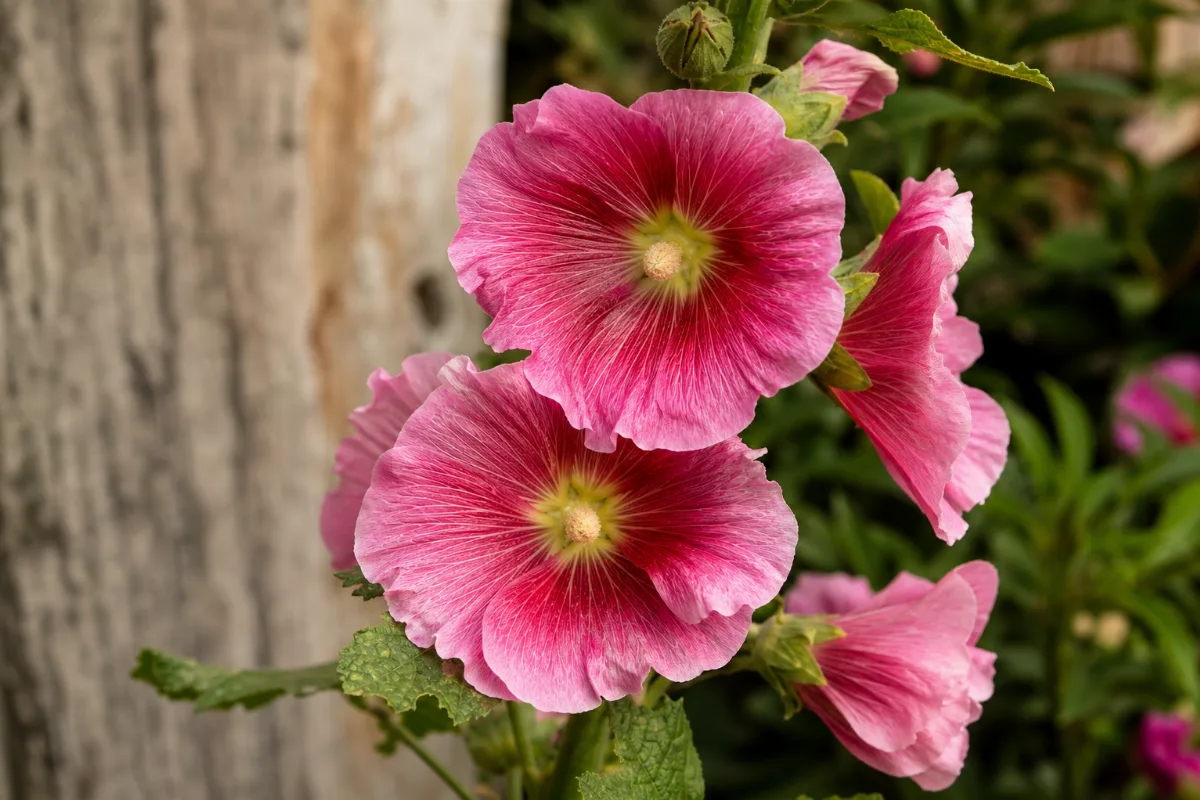
Hollyhock
Alcea rosea · also called Garden hollyhock, black hollyhock (dark-flowered form)
Hollyhock is the tall garden flower, and its flowers and leaves are a traditional soothing herb for sore throats and coughs, like its relatives marshmallow and mallow. We found no trial of it taken by mouth; the research is plant chemistry, test-tube and mouse work, plus one small trial of a leaf compress for breast engorgement. Like marshmallow it contains a slippery gel that may slow how other medicines are absorbed. Ask a doctor or pharmacist before use if you take medicines, are pregnant or are breastfeeding.
General information, not medical advice. Last substantive update · Not medically reviewed. A named clinician has not signed off on this page. How this page is made
About Hollyhock
Hollyhock (Alcea rosea) is the tall garden plant of the mallow family. Its flowers and leaves are a traditional soothing herb for sore throat and cough, like marshmallow and mallow, because they contain mucilage, a slippery gel. We found no clinical trial of hollyhock taken by mouth and no regulator assessment. The only human research is one small trial of a leaf compress for breast engorgement, plus lab and mouse studies on inflammation, blood sugar and cancer cells. Safety has not been studied. For the related marshmallow root, EU guidance says to space it from other medicines and not to use it in pregnancy or breastfeeding, and we apply that caution here by analogy. Ask a doctor or pharmacist about amounts.
What it is
Hollyhock is a tall perennial garden flower in the mallow family (Malvaceae), the same family as marshmallow, common mallow and hibiscus. Dark-flowered forms (black hollyhock) are rich in colour pigments.
Older papers call it Althaea rosea. It is easy to mix up with marshmallow (Althaea officinalis); one trial title uses the marshmallow name for hollyhock.
Traditional uses and what research exists
Hollyhock flower and leaf are used as a soothing tea for sore throats and coughs, and a leaf compress is a folk remedy for swollen breasts. Plant studies measured mucilage in flowers, leaves and roots, and found that how the plant is dried changes the amount.
In people there is one small trial of the leaf compress and a Cochrane review that lists it among herbal compresses with low-certainty results. Everything else is test-tube or mouse work on solvent extracts, which is not the same as tea.
Hollyhock, marshmallow and mallow
Marshmallow root has an EU traditional-use monograph for throat and cough; hollyhock does not. Do not assume hollyhock works or is safe just because its relative is recognised. See the mallow and marshmallow root pages for those herbs.
At a glance
Traditional uses history, not proof
- European and Mediterranean folk medicine: flower or leaf tea for sore throat and cough
- Folk leaf compress for swollen breasts while nursing
- Traditional Chinese medicine: flower as an anti-diabetes ingredient
Studied for research
- Sore throat and cough: insufficient evidence (no human study)
- Breast engorgement, leaf compress on the skin: low certainty (one small trial)
- Blood sugar, inflammation, colon cancer cells: lab and mouse only, insufficient
Main compounds
- Mucilage (slippery plant gel)
- Anthocyanins, mainly malvidin compounds
- Flavonoids such as kaempferol compounds (tiliroside)
Common forms
- Dried flower as tea; leaf compress on the skin; lab studies used solvent extracts, not tea
- Marshmallow root and mallow are better-known relatives and are covered on their own pages
Research links: Cochrane review: treatments for breast engorgement (2020) · Leaf compress trial for breast engorgement (2017) · EU monograph for marshmallow root, a related plant · Research Library · Genes & Biomarkers Library
The plant and its history
- Accepted scientific name
- Alcea rosea L.
- Naming authority
- L.
- Synonyms
- Althaea rosea (older name, used in several papers)
- Common names
- Hollyhock (English); Black hollyhock (dark-flowered form, var. nigra) (English); Alceae flos (flower drug name) (Latin)
- Botanical family
- Malvaceae (mallow family), the same family as marshmallow (Althaea officinalis), common mallow (Malva) and hibiscus.
- Classification
- Plantae > Malvales > Malvaceae > Alcea > Alcea rosea
- Native range
- Not verified from a source read; a paper describes hollyhock as a perennial garden plant spread through warm temperate and tropical regions.
- Habitat
- Not verified.
- What the plant looks like
- Roots: Contain mucilage (measured in black hollyhock).; Stems: Not covered.; Leaves: Contain mucilage; used as a compress.; Flowers: Tall garden flower; dark forms are rich in anthocyanins. Flowers are the usual tea part.; Fruit: Not covered.
- Cultivation
- Garden ornamental; not verified further.
- Harvest and processing
- Drying method changes phenols and mucilage in black hollyhock (shade or low-heat drying kept the most).
- Look-alikes and adulterants
- Name: Marshmallow (Althaea officinalis); Note: Close relative with a regulator-recognised root. The compress trial title uses this name for what it calls hollyhock, so labels can be mixed up.; Name: Mallow (Malva species); Note: Another soothing mallow-family herb.
- Sustainability and conservation
- Not verified.
Traditional use and history history, not clinical proof
| Tradition or era | Documented use | Source |
|---|---|---|
| European and Mediterranean folk medicine | Flower (and leaf) as a soothing herb for sore throat and cough, in the manner of marshmallow and mallow. Taken from plant papers; not checked against a historical text. | p40234760 |
| Traditional Chinese medicine | Flower used as an anti-diabetes ingredient, according to a 2015 paper. | p25677352 |
| Southern Ecuador | Flowers are part of a traditional "Horchata" infusion with some medicinal properties attributed. | p38254537 |
| Folk breast-engorgement remedy | Leaf compress for breast swelling while nursing. | p26603219 |
Traditional use shows how a plant was used. It does not show that a supplement works or is safe today.
What is inside, and how it may work
What the plant contains and how those compounds act in cells and animals. Laboratory and animal mechanisms are not proven effects in people.
Main compounds
| Compound | Family | Where it is concentrated | Activity studied | Level of evidence |
|---|---|---|---|---|
| Mucilage polysaccharides | plant gum (polysaccharide) | Flower, leaf, root | Slippery gel when wet; measured as a percentage of dry black hollyhock. The soothing role is traditional and not tested in people. 3 | Plant analysis |
| Malvidin glycosides (anthocyanins) PubChem 159287 | anthocyanin | Dark flowers | The most abundant anthocyanins in flower extracts (e.g. malvidin 3-glucoside, CID 443652). Colour pigments with antioxidant activity in the lab. 8 14 | Plant analysis |
| Kaempferol glycosides (e.g. tiliroside) PubChem 5320686 | flavonol glycoside | Flower | Most abundant flavonol glycosides in flower extracts; kaempferol itself is CID 5280863. 8 6 14 | Plant analysis |
| Dihydroflavonol glycosides (roseaflavanonolosides A to C) | flavonoid | Flower | Raised glucose uptake in liver cells by about 30 to 40 percent at 20 ug/mL. 10 | Laboratory research |
| Flavanones | flavonoid | Flower powder | High in an Ecuadorian flower powder. 1 | Plant analysis |
Mechanisms, receptors and pathways
| Target or pathway | Gene or receptor | What was found | Level |
|---|---|---|---|
| Inflammation proteins (COX-2, NF-kB, PPAR-gamma) | COX-2, NF-kB, PPAR-gamma | Extracts lowered these protein levels in colon cancer cell lines; also reduced paw swelling in mice (animal). 6 | Laboratory research |
| Glucose and fat handling | AMPK, IRS2, PI3K, AKT, GLUT4 | Flower extract up-regulated these liver genes in diabetic mice (animal) and isolated compounds raised glucose uptake in liver cells. 10 | Animal research |
| Cell death in colon cancer lines | PARP, caspase 3, Slug, Cyclin D1, Vimentin | Isolated compounds raised apoptosis markers and lowered movement-related proteins in cells; docking suggested binding to Shh, Wnt3a and Notch1. 7 | Laboratory research |
| Soothing mucilage film | Not applicable | General idea that mucilage coats irritated lining; not tested for hollyhock. 3 | Laboratory research |
Absorption, metabolism and elimination
- Absorption
- No data for hollyhock compounds in people.
- Distribution
- Not found.
- Metabolism
- Not found.
- Elimination
- Not found.
- Bioavailability
- Not established.
Isolated compounds versus whole extracts
The lab work used solvent extracts or isolated compounds. Nobody compared those with whole-flower tea. Tea is mostly water-soluble mucilage and pigments, not the lab extracts.
Nutritional composition
Dried flower powder from Ecuador was mostly carbohydrate with notable fibre and fructose, low in fat and rich in flavanones. Not meaningful as a nutrient source.
1 low certainty5 not enough evidence
What is Hollyhock good for?
The traditional uses and how strong the evidence is for each. Apart from one small compress trial, there is no human research.
Benefits, one by one
Each card is a research question, not a promise. Tap a goal to filter. Open a card to see the studies, doses and limits.
Sore throat and cough (traditional use)
Not enough evidenceHollyhock flower and leaf are a traditional European and Mediterranean remedy for sore throats and coughs, like its relatives marshmallow and mallow. We found no trial in people and no regulator assessment of hollyhock for this. The reason it is used is its mucilage, a slippery plant gel, but that has been measured in the plant, not tested in a cough.
2 studiesThis page gives no amounts. Ask a doctor or pharmacist.
Studies, doses and limits
What the trials found
None found. No trial of hollyhock for sore throat or cough turned up in our searches.
Results
No outcome in people. The only data are plant measurements: shade drying kept the most phenols and antioxidant activity in black hollyhock flowers, and strong microwave drying lowered mucilage.
Effect sizes as reported
None for any health outcome.
Why this rating
Use rests on tradition and on plant chemistry. Nothing was tested in people with a cough or sore throat.
Form and dose studied
This page gives no amounts. Ask a doctor or pharmacist.
Who was studied
None studied.
Limits
Plant measurements do not show relief of symptoms. Black hollyhock (var. nigra) was the form measured. A tea is not the same as the lab extracts.
Why researchers looked
Hollyhock belongs to the same family as marshmallow and mallow, which are used to soothe the throat. People used it the same way.
Traditional use
Traditional soothing herb for throat and cough; listed in plant papers as a folk remedy. No regulator monograph for hollyhock was found.
Proposed mechanism Preliminary mechanism
Mucilage forms a slippery film when wet. The general idea (not tested for hollyhock) is that it coats irritated throat lining. A 2025 plant study confirmed mucilage in the flowers, leaves and roots of black hollyhock and that drying method changes the amount.
A proposed mechanism does not show that the effect happens in people.
A cough that lasts more than a couple of weeks, brings up blood, or comes with fever or breathlessness needs a doctor.
Breast engorgement while breastfeeding (leaf compress on the skin)
Low certaintyOne small trial of 40 breastfeeding women found that adding a hollyhock leaf compress to routine care eased engorgement more than routine care alone. A big Cochrane review of engorgement treatments names hollyhock among the herbal compresses tested but says certainty is low and no firm conclusion can be drawn. This is a compress on the skin, not tea.
3 studiesA compress of leaves on the breast, applied 6 times over 2 days along…
Studies, doses and limits
What the trials found
One randomised trial (40 women) plus a Cochrane review that lists it. LactMed calls the study moderately well done.
Results
Overall engorgement severity differed between the hollyhock group and the routine-care group (P < .001). The abstract gives no numbers for the size of the difference. The Cochrane review pooled nothing for hollyhock and rated evidence for compresses as low or very low.
Effect sizes as reported
No effect size available in the abstract.
Why this rating
One small trial with an unclear description in the abstract, and the species is described inconsistently (hollyhock in the text, Althaea officinalis in the title). The review rates herbal compress evidence low.
Form and dose studied
A compress of leaves on the breast, applied 6 times over 2 days alongside warm and cold compresses. No dose advice here.
Who was studied
Breastfeeding women with engorgement, Iran.
Limits
Small, single trial; no information on blinding or side effects in the abstract.
Why researchers looked
Compresses of leaves are an old home remedy for swollen, painful breasts, and trials have tested several plants.
Traditional use
Folk use of leaf compresses for breast swelling; this was tested in an Iranian trial.
Proposed mechanism Unknown
Not established. Leaves may contain mucilage, flavonoids and tannins, but the reason for any effect is not known.
A proposed mechanism does not show that the effect happens in people.
Skin irritation was reported for herbal compresses as a group in the Cochrane review (2 of 250 women). Engorgement that comes with fever, redness or a hard lump needs a midwife or doctor (possible mastitis).
Inflammation (lab and mouse findings)
Not enough evidenceSolvent extracts of hollyhock reduced inflammation markers in test tubes and cut paw swelling in mice. Nobody has tested whether hollyhock tea helps inflammation in people.
1 studiesLab solvent extracts only.
Studies, doses and limits
What the trials found
None found.
Results
In test tubes extracts blocked protein breakdown, nitric oxide production and membrane rupture (IC50 47 to 268 ug/mL). In mice, two extracts reduced LPS-induced paw swelling.
Effect sizes as reported
IC50 47-268 ug/mL (test tube). No human numbers.
Why this rating
Lab and mouse work from one group using solvent extracts. Nothing in people.
Form and dose studied
Lab solvent extracts only.
Who was studied
None studied.
Limits
Not tea. Test-tube and mouse results often fail to carry over to people.
Why researchers looked
Many soothing herbs are screened for anti-inflammatory activity, and hollyhock is used traditionally for irritated and inflamed tissue.
Traditional use
Folk use for inflamed tissues is mentioned in plant papers.
Proposed mechanism Preliminary mechanism
Extracts lowered COX-2, NF-kB and PPAR-gamma protein levels in cancer cell lines and reduced nitric oxide in tests. Kaempferol derivatives, alpha-tocopherol and phytol were found in the extracts. These are lab clues only.
A proposed mechanism does not show that the effect happens in people.
No safety conclusion can be drawn from this.
Blood sugar and blood fats (mouse and cell work)
Not enough evidenceAn alcohol extract of hollyhock flower lowered blood sugar and triglycerides in diabetic mice and raised sugar uptake in liver cells in a dish. Nothing is known in people, so it should not be used in place of diabetes care.
1 studiesLab ethanol extract only.
Studies, doses and limits
What the trials found
None found.
Results
Ethanol flower extract by mouth for 8 weeks lowered serum triglyceride and glucose in KK-Ay mice. At 20 ug/mL the isolated compounds raised glucose uptake in HepG2 cells by about 30 to 40 percent.
Effect sizes as reported
Cells +30-40% glucose uptake; mouse numbers not in the abstract.
Why this rating
One mouse and cell study. No human data.
Form and dose studied
Lab ethanol extract only.
Who was studied
None studied.
Limits
Mouse and cell work; not tea.
Why researchers looked
Hollyhock flower was used as an anti-diabetes ingredient in traditional Chinese medicine, which led researchers to test it.
Traditional use
Used in traditional Chinese medicine as an anti-diabetes ingredient, per the paper.
Proposed mechanism Preliminary mechanism
In mice the extract up-regulated liver genes in the AMPK-insulin pathway (AMPK, IRS2, PI3K, AKT, GLUT4). Isolated dihydroflavonol glycosides raised glucose uptake in liver cells.
A proposed mechanism does not show that the effect happens in people.
If it did lower blood sugar in people, it could add to diabetes medicines. This is theory; see the Safety tab.
Effects on colon cancer cells in dishes
Not enough evidenceExtracts and compounds from hollyhock reduced the survival of colon cancer cell lines in the lab. This does not mean hollyhock treats or prevents cancer; the authors say tests in living animals must come first.
2 studiesLab extracts and isolated compounds.
Studies, doses and limits
What the trials found
None found.
Results
Colon cancer cell lines HCT116, HT29 and SW480: extract IC50 31 to 63 ug/mL; two isolated compounds IC50 about 75 to 225 ug/mL.
Effect sizes as reported
IC50 values only.
Why this rating
Cell lines and computer docking from one research group.
Form and dose studied
Lab extracts and isolated compounds.
Who was studied
None studied.
Limits
Cell results rarely carry over to people. Not a treatment.
Why researchers looked
Researchers screen many traditional plants for cell-killing activity.
Traditional use
Not a traditional use.
Proposed mechanism Preliminary mechanism
Extracts changed inflammation and cell-death proteins (COX-2, NF-kB, cleaved PARP and caspase 3). Two isolated compounds raised apoptosis markers and lowered proteins linked to cell movement.
A proposed mechanism does not show that the effect happens in people.
None.
Antioxidant pigments (anthocyanins and flavonoids)
Not enough evidenceDark hollyhock flowers are rich in anthocyanin pigments and flavonoids that act as antioxidants in the lab. No study measured a health effect in people. Researchers see more use as a food colour or ingredient.
3 studiesDried flowers and powders analysed in the lab.
Studies, doses and limits
What the trials found
None found.
Results
Black hollyhock flowers held 171.75 mg GAE/g of total phenols and 68.97 mg RE/g of flavonoids when shade dried. Chemistry only; no health outcome.
Effect sizes as reported
Phenols 171.75 mg GAE/g dry weight (shade-dried flowers).
Why this rating
Chemical analysis only. Antioxidant tests in a dish rarely predict benefit in people.
Form and dose studied
Dried flowers and powders analysed in the lab.
Who was studied
None studied.
Limits
No human or animal test. Pigment content depends on variety and drying.
Why researchers looked
Dark flowers are rich in pigments, so chemists measured them.
Traditional use
Dark flowers are used as a natural colouring.
Proposed mechanism Preliminary mechanism
Anthocyanins (mainly malvidin glycosides) and flavonol glycosides (mainly kaempferol glycosides such as tiliroside) were identified. Flower powder was rich in flavanones. Antioxidant activity was measured in test tubes.
A proposed mechanism does not show that the effect happens in people.
None.
Connections to the rest of health
How Hollyhock connects to the rest of our health knowledge graph. Every link says what kind of connection it is. A safety link (for example to the liver) is a warning, not a benefit. A study that merely mentions a topic never creates a benefit link.
Explore every connection: goals, body systems, organs, symptoms, genes
A. Wellness goals
| Connected to | Kind of connection | Evidence status | Context | Studies |
|---|---|---|---|---|
| Respiratory Comfort | Traditional use | Not enough evidence | Sore throat and cough (traditional use): Hollyhock flower and leaf are a traditional European and Mediterranean remedy for sore throats and coughs, like its relatives marshmallow and mallow. We found no trial in people and no regulator assessment of hollyhock for this. The reason it is used is its mucilage, a slippery plant gel, but that has been measured in the plant, not tested in a cough. | 3 13 |
| Lung Support | Traditional use | Not enough evidence | Sore throat and cough (traditional use): Hollyhock flower and leaf are a traditional European and Mediterranean remedy for sore throats and coughs, like its relatives marshmallow and mallow. We found no trial in people and no regulator assessment of hollyhock for this. The reason it is used is its mucilage, a slippery plant gel, but that has been measured in the plant, not tested in a cough. | 3 13 |
| Womens Wellness | Potential benefit | Low certainty | Breast engorgement while breastfeeding (leaf compress on the skin): One small trial of 40 breastfeeding women found that adding a hollyhock leaf compress to routine care eased engorgement more than routine care alone. A big Cochrane review of engorgement treatments names hollyhock among the herbal compresses tested but says certainty is low and no firm conclusion can be drawn. This is a compress on the skin, not tea. | 4 9 5 |
| Inflammation Balance | Potential benefit | Not enough evidence | Inflammation (lab and mouse findings): Solvent extracts of hollyhock reduced inflammation markers in test tubes and cut paw swelling in mice. Nobody has tested whether hollyhock tea helps inflammation in people. | 6 |
| Blood Sugar Support | Potential benefit | Not enough evidence | Blood sugar and blood fats (mouse and cell work): An alcohol extract of hollyhock flower lowered blood sugar and triglycerides in diabetic mice and raised sugar uptake in liver cells in a dish. Nothing is known in people, so it should not be used in place of diabetes care. | 10 |
| Cellular Protection | Not enough evidence | Effects on colon cancer cells in dishes: Extracts and compounds from hollyhock reduced the survival of colon cancer cell lines in the lab. This does not mean hollyhock treats or prevents cancer; the authors say tests in living animals must come first. | 6 7 | |
| Cellular Protection | Potential benefit | Not enough evidence | Antioxidant pigments (anthocyanins and flavonoids): Dark hollyhock flowers are rich in anthocyanin pigments and flavonoids that act as antioxidants in the lab. No study measured a health effect in people. Researchers see more use as a food colour or ingredient. | 3 8 1 |
B. Body systems
| Connected to | Kind of connection | Evidence status | Context | Studies |
|---|---|---|---|---|
| Respiratory System | Biological association | Not enough evidence | Studied for: Sore throat and cough (traditional use) | 3 13 |
| Reproductive System | Biological association | Low certainty | Studied for: Breast engorgement while breastfeeding (leaf compress on the skin) | 4 9 5 |
| Pain Inflammation | Biological association | Not enough evidence | Studied for: Inflammation (lab and mouse findings) | 6 |
| Metabolic System | Biological association | Not enough evidence | Studied for: Blood sugar and blood fats (mouse and cell work) | 10 |
| Digestive System | Biological association | Not enough evidence | Studied for: Effects on colon cancer cells in dishes | 6 7 |
| Whole Body | Biological association | Not enough evidence | Studied for: Antioxidant pigments (anthocyanins and flavonoids) | 3 8 1 |
D. Symptoms
| Connected to | Kind of connection | Evidence status | Context | Studies |
|---|---|---|---|---|
| Breast engorgement | Potential benefit | Low certainty | One small compress trial; Cochrane review rates evidence low. Preparation or compound: Hollyhock leaf compress |
4 9 |
| Sore throat and cough | Traditional use | Not enough evidence | Traditional use only. Preparation or compound: Hollyhock flower, mucilage |
3 |
E. Health conditions
| Connected to | Kind of connection | Evidence status | Context | Studies |
|---|---|---|---|---|
| Pregnancy and breastfeeding | Authoritative guidance | Safety not established. Preparation or compound: Hollyhock herb (by analogy with marshmallow root) |
5 11 | |
| Diabetes | In vitro | Lowered blood sugar in diabetic mice; theory for people. Preparation or compound: Flower extract |
10 |
I. Biomarkers
| Connected to | Kind of connection | Evidence status | Context | Studies |
|---|---|---|---|---|
| Breast engorgement severity (scored) | Biological association | Low certainty | Measured in trials: lowered. A lab change is not the same as a health benefit. | 4 |
| Blood glucose and triglycerides, diabetic mice | Biological association | Not enough evidence | Measured in trials: lowered. A lab change is not the same as a health benefit. | 10 |
J. Genes, receptors and enzymes
| Connected to | Kind of connection | Evidence status | Context | Studies |
|---|---|---|---|---|
| COX-2 / NF-kB | Preliminary mechanism | In vitro | Lowered in cancer cell lines by extracts. | 6 |
K. Biological pathways
| Connected to | Kind of connection | Evidence status | Context | Studies |
|---|---|---|---|---|
| AMPK-insulin signalling | Preliminary mechanism | Animal | Genes up-regulated in diabetic mouse liver by a flower extract. | 10 |
L. Active compounds
| Connected to | Kind of connection | Evidence status | Context | Studies |
|---|---|---|---|---|
| Mucilage polysaccharides | Biological association | Plant analysis | Slippery gel when wet; measured as a percentage of dry black hollyhock. The soothing role is traditional and not tested in people. Preparation or compound: Flower, leaf, root |
3 |
| Malvidin glycosides (anthocyanins) | Biological association | Plant analysis | The most abundant anthocyanins in flower extracts (e.g. malvidin 3-glucoside, CID 443652). Colour pigments with antioxidant activity in the lab. Preparation or compound: Dark flowers |
8 14 |
| Kaempferol glycosides (e.g. tiliroside) | Biological association | Plant analysis | Most abundant flavonol glycosides in flower extracts; kaempferol itself is CID 5280863. Preparation or compound: Flower |
8 6 14 |
| Dihydroflavonol glycosides (roseaflavanonolosides A to C) | Biological association | In vitro | Raised glucose uptake in liver cells by about 30 to 40 percent at 20 ug/mL. Preparation or compound: Flower |
10 |
| Flavanones | Biological association | Plant analysis | High in an Ecuadorian flower powder. Preparation or compound: Flower powder |
1 |
Each connection is stored with the ingredient, the connected record, the kind of connection, the evidence status, the supporting studies, the preparation or compound involved, and a review date (last reviewed October 25, 2026).
Evidence at a glance: what changed in 2 lab markers
Tap a number to show only those markers. Counts are markers, not people.
The evidence
The research centre for Hollyhock. Every record here was checked against PubMed or the publisher's page; we never list a study we have not verified.
Evidence by outcome
Bars show how many studies we found for each outcome, not how well it works. People are added up across trials only (reviews are not added, to avoid double counting).
How we rate evidence
High certainty
Several well-run trials or reviews agree; further research is unlikely to change the picture much.
Moderate certainty
Good trials point the same way, but some doubt remains.
Low certainty
Small, short or inconsistent trials. The finding could change with better research.
Very low certainty
Very little or very weak human data. Treat as a possibility only.
Mixed findings
Trials or reviews disagree with each other.
Not enough evidence
Not enough human research to say either way.
Evidence against
Good research found no benefit, or found harm.
We take the reviewers' own risk-of-bias and GRADE statements where they exist, and otherwise judge from study size, design, consistency, directness and whether a product matches what is sold. Many publications do not make evidence high. Method note: We started from the nutrient summary we hold, read PubMed abstracts, checked GBIF and PubChem, and read the EU marshmallow root monograph for the related-plant cautions. The full LactMed entry and the 2023 review were not read. Certainty ratings are our own reading. No study is cited that we could not verify.
Study library: every study we checked 14
| Study | Design | People | Product, dose, length | Result |
|---|---|---|---|---|
| Castillo-Carrion 2024 Nutritional, Fatty Acids, (Poly)phenols and Technological Properties of Flower Powders from Fuchsia hybrida and Alcea rosea Foods · PMID 38254537 · DOI |
Plant chemistry plant |
Dried flower powders from southern Ecuador (a traditional "Horchata" infusion flower) | Alcea rosea ("malvagoma") flower powder was mostly carbohydrate with notable fibre and fructose, low in fat, and high in flavanones. The authors suggest uses as a food ingredient or colourant source. n/a Methods, limits and fundingOutcomes: Composition, fatty acids, polyphenols Limitations: Composition only; no health outcome measured. Funding and conflicts: Authors declare no conflicts of interest. Read: abstract | |
| Duan 2022 Lead, zinc tolerance mechanism and phytoremediation potential of Alcea rosea (Linn.) Cavan. and Hydrangea macrophylla (Thunb.) Ser. and ethylenediaminetetraacetic acid effect Environ Sci Pollut Res Int · PMID 35088277 · DOI |
Plant chemistry plant |
Potted plants in a greenhouse with lead and zinc added to soil | Alcea rosea tolerated the metals; zinc was concentrated in its leaves (38.5%); lead uptake and transfer factors were below 1. The authors see potential for cleaning contaminated soil. n/a Methods, limits and fundingOutcomes: Metal uptake and plant stress Limitations: Soil science, not a product-safety study. Shows the plant can take up metals. Funding and conflicts: Not stated in the abstract. Read: abstract | |
| Ghorbani 2025 Effect of drying methods on mucilage, anthocyanin content, and antioxidant activity of black hollyhock (Alcea rosea var. nigra) BMC Plant Biol · PMID 40234760 · DOI |
Plant chemistry plant |
Dried plant material (flowers, leaves, roots) of black hollyhock | Shade drying kept the most phenols (171.75 mg GAE/g dry weight in flowers), flavonoids and antioxidant activity; low-temperature oven drying (40 C) also kept them; strong microwave power (900 W) reduced mucilage. No human or animal testing. n/a Methods, limits and fundingOutcomes: Mucilage percentage, total phenol, flavonoids, anthocyanin, antioxidant activity Limitations: Measures the plant material only. The mucilage percentages are in the full paper, which was not re-read here. Funding and conflicts: Authors declare no competing interests. Read: abstract | |
| Khosravan 2017 The Effect of Hollyhock (Althaea officinalis L) Leaf Compresses Combined With Warm and Cold Compress on Breast Engorgement in Lactating Women: A Randomized Clinical Trial J Evid Based Complement Altern Med · PMID 26603219 · DOI |
Controlled trial |
40 Breastfeeding women with breast engorgement, Iran |
Overall engorgement severity differed between groups (P < .001) and fell over time (P < .001). No effect size in the abstract Methods, limits and fundingOutcomes: Overall breast engorgement severity Limitations: Small trial (40 women). The abstract does not describe blinding, how engorgement was scored, or any side effects. The title calls the plant Althaea officinalis (marshmallow) while describing it as hollyhock, so the exact species is unclear. A leaf compress on the skin, not something swallowed. Funding and conflicts: Authors declare no conflicts of interest. Read: abstract | |
| National Institute of Child Health and Human Development (LactMed) 2021 Hollyhock (LactMed record) Drugs and Lactation Database (LactMed) · PMID 29999948 |
Reference database n/a |
Breastfeeding | LactMed states hollyhock leaf constituents are not well described, few breastfeeding studies exist, and one moderately well done study found that a leaf compress sped resolution of engorgement. n/a Methods, limits and fundingOutcomes: Breastfeeding safety Limitations: Only the PubMed abstract record was read, not the full LactMed entry. No statement on safety of drinking hollyhock tea while breastfeeding was seen. Funding and conflicts: Public database. Read: abstract | |
| Parry 2025 Anti-inflammatory and anticancer properties of Alcea rosea extracts: Insights from in vitro and in vivo studies Front Pharmacol · PMID 40703352 · DOI |
Laboratory research lab |
Test-tube assays, human colon cancer cell lines (HCT116, HT29, SW480), BALB/c mice | Extracts blocked protein breakdown, nitric oxide and membrane rupture in test tubes (IC50 47 to 268 ug/mL), reduced survival of three colon cancer cell lines (IC50 31 to 63 ug/mL), lowered COX-2, NF-kB and PPAR-gamma levels, and reduced LPS-induced paw swelling in mice. IC50 values only; no human outcome Methods, limits and fundingOutcomes: Anti-inflammatory assays, cell survival, protein levels, mouse paw swelling Limitations: Lab and mouse work only; solvent extracts, not tea. Authors conclude only a potential for further work. Funding and conflicts: Authors declare no commercial or financial relationships. Read: abstract | |
| Parry 2025 Exploring the cytotoxic effects of bioactive compounds from Alcea rosea against stem cell driven colon carcinogenesis Sci Rep · PMID 39966572 · DOI |
Laboratory research lab |
Human colon cancer cell lines | Two compounds reduced survival of colon cancer cells (IC50 about 75 to 225 ug/mL) and raised apoptosis markers. The authors state validation in living organisms is needed before any clinical trial. IC50 values only Methods, limits and fundingOutcomes: Cell survival, apoptosis markers, signalling proteins, docking Limitations: Cells and computer docking only. Funding and conflicts: Authors declare no competing interests. Read: abstract | |
| Wisniewska 2026 Comprehensive LC-MS Analysis of the Most Abundant Flavonoid Glycosides in the Extracts of Alcea rosea Flowers Molecules · PMID 42588583 · DOI |
Plant chemistry plant |
Methanol and 75% ethanol extracts of Alcea rosea flowers from two manufacturers | Anthocyanins (mainly malvidin glycosides) and flavonol glycosides (mainly kaempferol glycosides such as tiliroside) were identified in all extracts. n/a Methods, limits and fundingOutcomes: Identification of flavonoid glycosides Limitations: Chemistry only; no biological testing. Funding and conflicts: Authors declare no conflicts of interest. Read: abstract | |
| Zakarija-Grkovic 2020 Treatments for breast engorgement during lactation Cochrane Database Syst Rev · PMID 32944940 · DOI |
Systematic review |
2170 21 randomised trials of breast engorgement treatments (2,170 women) |
Hollyhock is named as one of the herbal compresses tested. Trials were too different to pool. Overall conclusion: some treatments may be promising, but certainty is low and no firm conclusions can be drawn. Among women using herbal compresses 2 of 250 had skin irritation versus 0 of 250 with a hot compress. No hollyhock-specific effect size given in the abstract Methods, limits and fundingOutcomes: Breast pain, hardness, engorgement, satisfaction, breastfeeding duration, adverse events Limitations: Hollyhock results are not broken out in the abstract. The skin-irritation figure covers herbal compresses as a group, not hollyhock alone. Funding and conflicts: One author is a lactation consultant (declared); no commercial funding stated in the abstract. Read: abstract | |
| Zhang 2015 Hypoglycemic activity evaluation and chemical study on hollyhock flowers Fitoterapia · PMID 25677352 · DOI |
Animal research animal |
KK-Ay mice (a diabetes model); HepG2 liver cells | The extract lowered serum triglyceride and glucose in the mice. Liver genes in the AMPK-insulin pathway were up-regulated. Three new dihydroflavonol glycosides were isolated; at 20 ug/mL they raised glucose uptake in HepG2 cells by about 30 to 40 percent. Glucose uptake +30-40% in cells at 20 ug/mL; no mouse numbers in the abstract Methods, limits and fundingOutcomes: Serum triglyceride and glucose; liver gene expression; glucose uptake in cells Limitations: Mouse and cell work only; a lab ethanol extract, not tea. Group sizes not given in the abstract. Funding and conflicts: Not stated in the abstract. Read: abstract | |
| s-ema-marshmallow EU herbal monograph on Althaea officinalis L., radix (marshmallow root), EMA/HMPC/436679/2015 · Source |
Regulatory document n/a |
Methods, limits and fundingRead: full-text | ||
| s-gbif-alcea GBIF Backbone: Alcea rosea L. · Source |
Reference database n/a |
Methods, limits and fundingRead: full-text | ||
| s-graph-hollyhock Our nutrient-graph summary for hollyhock (herb-hollyhock.json) |
Internal summary n/a |
Methods, limits and fundingRead: summary-only | ||
| s-pubchem-compounds PubChem compound records: malvidin, malvidin 3-glucoside, kaempferol, tiliroside · Source |
Reference database n/a |
Methods, limits and fundingRead: full-text |
What we do not know yet
- What the evidence supports: almost nothing in people. One small compress trial; the rest is lab and mouse work.
- What is uncertain: whether hollyhock tea soothes the throat or cough, and how it interacts with medicines.
- What is missing: any trial of hollyhock by mouth, any safety or interaction study, and any regulator assessment.
How new research is added
New studies are found by a saved PubMed search and queued for a person to read before any rating or safety wording changes.
Lab markers
What changed in blood or saliva tests during trials. A changed number is not the same as feeling or being healthier, and we give no "normal ranges".
Other 2
Breast engorgement severity (scored)
Lowered in trials
A rating of how swollen, hard and painful the breasts are while nursing.
Low certaintyResults and what it means
Why it was measured
It is what women with engorgement feel and what the trial set out to change.
Statistical vs. clinical meaning
A real symptom outcome, but from one small trial with limited reporting.
Safety implication
None specific.
| Study | Result | People | Product |
|---|---|---|---|
| 4 | Overall severity differed between groups (P < .001) and fell over time (P < .001); size not given in the abstract | 40 breastfeeding women, Iran | Hollyhock leaf compress added to routine care and warm/cold compresses |
Blood glucose and triglycerides, diabetic mice
Lowered in trials
Sugar and fat levels in the blood of a mouse model of type 2 diabetes.
Not enough evidenceResults and what it means
Why it was measured
Standard first test for plants used against diabetes.
Statistical vs. clinical meaning
A mouse result only.
Safety implication
Theoretical additive effect with blood-sugar medicines.
| Study | Result | People | Product |
|---|---|---|---|
| 10 | Serum glucose and triglyceride were lowered after 8 weeks; numbers not given in the abstract | KK-Ay mice | Ethanol extract of hollyhock flower by mouth |
Safety
What studies and official sources say about side effects, medicines and who should check first. Each point shows what kind of evidence it comes from.
Main points to know 5
- Evidence is extremely thin. We found no clinical trial of hollyhock taken by mouth, no regulator assessment of hollyhock, and no systematic safety review. Lack of reports of harm here mostly means nobody has looked. Other 13
- Pregnancy and breastfeeding: not established. There is no safety information for hollyhock tea or extracts in pregnancy. For breastfeeding, LactMed only notes one study of a leaf compress on the breast. For the related marshmallow root, the EU monograph says safety in pregnancy and breastfeeding is not established and use is not recommended. We apply that caution here by analogy only. Authoritative guidance 5 11
- Slippery plant gel may slow other medicines (by analogy). Hollyhock contains mucilage like marshmallow. The EU marshmallow root monograph says absorption of other medicines taken at the same time may be delayed and advises, as a precaution, not taking it within about half an hour to an hour of other medicines. Nothing like this has been tested for hollyhock, so this is a labelled analogy, not a finding. Authoritative guidance 11
- Possible effect on blood sugar (theory). A flower extract lowered blood sugar in diabetic mice. If anything similar happened in people it could add to diabetes medicines. This is theory from animal work; nobody has tested it in people. Laboratory research 10
- Allergy: no data. We found no report of allergy to hollyhock. Plants in the same family can occasionally cause reactions in sensitive people, but this is general knowledge, not something we found for hollyhock. Theory
Side effects 2
| Effect | How often | Severity and recovery | Evidence |
|---|---|---|---|
| Skin irritation from herbal compresses The figure covers herbal compresses as a group, not hollyhock alone. | 2 of 250 women using herbal compresses (all herbs together) versus 0 of 250 with hot compress | mild Not stated in the abstract | Systematic review 9 |
| Side effects of hollyhock tea or supplements The compress trial abstract does not mention side effects either way. | Unknown; no data found | unknown unknown | Other 13 |
Liver
No case of liver injury from hollyhock was found in our searches, and we did not locate a LiverTox entry for it. This is absence of evidence, not proof of safety. One lab paper tested a flower extract of a related species (Alcea hohenackeri) in liver-damaged animals; it is not a human safety signal and was not read.
How often. Not known.
Monitoring. None advised by any source found.
This is a safety connection. It is not evidence that Hollyhock supports liver health.
Medicines and supplements 3
| With | Why it matters | Importance | Evidence | What to do |
|---|---|---|---|---|
| Any medicine taken by mouth (tablets, capsules, liquids) prescription | By analogy with marshmallow root: mucilage can coat the gut and delay absorption of other medicines. | Unknown for hollyhock; the EU marshmallow monograph gives a precaution, not a measured effect. | Authoritative guidance Not enough evidence 11 | Ask a pharmacist about spacing hollyhock tea and medicines, especially medicines where timing matters. |
| Diabetes medicines and insulin prescription | Theory: a flower extract lowered blood sugar in diabetic mice. | Unknown; no human study. | Laboratory research Not enough evidence 10 | If you take diabetes medicines, ask your doctor or pharmacist and keep checking your blood sugar as usual. |
| Marshmallow, mallow, slippery elm and other mucilage herbs herb | Theory: stacking slippery-gel herbs adds to any slowing of absorption. | Unknown. | Theory Not enough evidence | Mention all herbs to your pharmacist. |
Who should check first 4
| Situation | Advice | Evidence |
|---|---|---|
| Pregnancy | Avoid unless a doctor agrees; no safety data. | Authoritative guidance 11 |
| Breastfeeding (by mouth) | Not enough information; ask a midwife or lactation consultant. A leaf compress on the breast has one small trial. | Authoritative guidance 5 4 |
| Children | No data; ask a doctor first (the EU marshmallow monograph says use in young children is not established). | Authoritative guidance 11 |
| Diabetes on medicines | Ask first; theoretical effect on blood sugar. | Laboratory research 10 |
Overdose, product quality and regulators
Summary. No human toxicity data on hollyhock were found. A mouse paper reported no deaths after a single large oral dose of two extracts, which is not a safety study (summary-only; not re-read).
Animal. Not re-read; see summary note.
Human doses studied. None.
High dose or long term signals. None found; not studied.
Overdose response. None found.
Genotoxicity. Not found.
Toxic plant parts. No toxic part reported in the sources read.
No survey of hollyhock products for adulteration, heavy metals or pesticides was found. One greenhouse study shows the plant tolerates lead and zinc and moves zinc into its leaves.
Metals from soil. Alcea rosea tolerated lead and zinc in a greenhouse; zinc was concentrated in the leaves (38.5%). This suggests plants grown on contaminated land could carry metals. It is not a finding about products on sale. 2
Name confusion. The compress trial title calls the plant Althaea officinalis (marshmallow) while describing hollyhock; older name Althaea rosea also exists. Check the Latin name on a product. 4
| Body | Action | Date |
|---|---|---|
| European Medicines Agency (HMPC), marshmallow root (related plant) (European Union) | Traditional-use monograph for Althaea officinalis root: absorption of other medicines may be delayed; take about half an hour to an hour apart; no interactions reported; use in pregnancy, breastfeeding and young children not established. Used here by analogy. source | 2016 |
When to get medical help
- Swelling of the lips or face, rash or trouble breathing after first use (possible allergy)
- Breast pain with fever, redness or a hard lump (possible mastitis)
- A cough with blood, breathlessness or fever, or a cough lasting more than a couple of weeks
- Very low blood sugar signs (shaking, sweating, confusion) if you take diabetes medicines
Stop the supplement and contact a clinician or emergency service. In the US, Poison Control is 1-800-222-1222.
General information only, not medical advice. Ask a clinician or pharmacist before use, especially with medicines, in pregnancy or with a health condition. See the Natural Remedy Safety guide.
Frequently asked questions
What is hollyhock used for?
Does hollyhock help a cough or sore throat?
Not shown. It contains mucilage, a slippery gel that is the traditional reason for using it, but no one has tested it for these in people. A cough that lasts or worsens needs a doctor.
Does a hollyhock leaf compress help breast engorgement?
Is hollyhock the same as marshmallow or mallow?
Can hollyhock lower blood sugar?
A flower extract lowered blood sugar in diabetic mice. It has not been tested in people, so do not use it in place of diabetes care.
Does hollyhock fight cancer?
Can hollyhock affect other medicines?
Possibly, by analogy with marshmallow root: the EU monograph says absorption of other medicines may be delayed and advises spacing them. This has not been tested for hollyhock. Ask a pharmacist.
Is hollyhock safe in pregnancy or breastfeeding?
Are there side effects or allergies?
We found no reports of either, and no safety studies. A small review mentions skin irritation with herbal compresses as a group. Stop and seek help for swelling, rash or breathing trouble.
What gives dark hollyhock flowers their colour?
Does it matter how the flower is dried?
For the plant chemistry, yes. In black hollyhock, shade drying and low-heat oven drying kept the most phenols, and very strong microwave drying lowered mucilage.
Where can I read more about amounts?
This page gives none because they have not been studied. Ask a doctor or pharmacist.
Explore by health goal
Cellular ProtectionRespiratory ComfortLung SupportWomens WellnessInflammation BalanceBlood Sugar Support
Editorial transparency
- Written by
- AlternativeMed editorial team. Research compiled with AI assistance, then checked against PubMed records.
- Medical review
- None. This page has not been reviewed by a physician or pharmacist.
- First published
- 2026-10-25
- Last substantive update
- 2026-10-25
- How we research
- We started from the nutrient summary we hold, read PubMed abstracts, checked GBIF and PubChem, and read the EU marshmallow root monograph for the related-plant cautions. The full LactMed entry and the 2023 review were not read. Certainty ratings are our own reading. No study is cited that we could not verify.
- How we rate evidence
- See "How we rate evidence" in the Evidence tab.
- Independence
- No product is promoted on this page. No affiliate links are shown.
Sources 14
Each source was opened and checked. Where we read only the abstract, it says so. The small numbers in the text point here.
- Castillo-Carrion M, Martinez-Espinosa R, Perez-Alvarez JA, Fernandez-Lopez J, Viuda-Martos M, Lucas-Gonzalez R. Nutritional, Fatty Acids, (Poly)phenols and Technological Properties of Flower Powders from Fuchsia hybrida and Alcea rosea. Foods. 2024. PMID 38254537. DOI 10.3390/foods13020237. (abstract)
- Duan Y, Zhang Y, Zhao B. Lead, zinc tolerance mechanism and phytoremediation potential of Alcea rosea (Linn.) Cavan. and Hydrangea macrophylla (Thunb.) Ser. and ethylenediaminetetraacetic acid effect. Environ Sci Pollut Res Int. 2022. PMID 35088277. DOI 10.1007/s11356-021-18243-2. (abstract)
- Ghorbani A, Eghlima G, Farzaneh M, Rezghiyan A. Effect of drying methods on mucilage, anthocyanin content, and antioxidant activity of black hollyhock (Alcea rosea var. nigra). BMC Plant Biol. 2025. PMID 40234760. DOI 10.1186/s12870-025-06524-8. (abstract)
- Khosravan S, Mohammadzadeh-Moghadam H, Mohammadzadeh F, Fadafen SA, Gholami M. The Effect of Hollyhock (Althaea officinalis L) Leaf Compresses Combined With Warm and Cold Compress on Breast Engorgement in Lactating Women: A Randomized Clinical Trial. J Evid Based Complement Altern Med. 2017. PMID 26603219. DOI 10.1177/2156587215617106. (abstract)
- National Institute of Child Health and Human Development (LactMed). Hollyhock (LactMed record). Drugs and Lactation Database (LactMed). 2021. PMID 29999948. (abstract)
- Parry RA, Wani SH, Mir IA, Bhat BA, Hussain MU, Mir MA, Bashir N, Fadul AN, Jangra S, Vats S, Ganie SA. Anti-inflammatory and anticancer properties of Alcea rosea extracts: Insights from in vitro and in vivo studies. Front Pharmacol. 2025. PMID 40703352. DOI 10.3389/fphar.2025.1595604. (abstract)
- Parry RA, Mir IA, Bhat BA, Hussain MU, Ashraf S, Zaman GS, Bashir N, Vats S, Ganie SA. Exploring the cytotoxic effects of bioactive compounds from Alcea rosea against stem cell driven colon carcinogenesis. Sci Rep. 2025. PMID 39966572. DOI 10.1038/s41598-025-89714-6. (abstract)
- Wisniewska W, Beszterda-Buszczak M, Franski R. Comprehensive LC-MS Analysis of the Most Abundant Flavonoid Glycosides in the Extracts of Alcea rosea Flowers. Molecules. 2026. PMID 42588583. DOI 10.3390/molecules31152737. (abstract)
- Zakarija-Grkovic I, Stewart F. Treatments for breast engorgement during lactation. Cochrane Database Syst Rev. 2020. PMID 32944940. DOI 10.1002/14651858.CD006946.pub4. (abstract)
- Zhang Y, Jin L, Chen Q, Wu Z, Dong Y, Han L, Wang T. Hypoglycemic activity evaluation and chemical study on hollyhock flowers. Fitoterapia. 2015. PMID 25677352. DOI 10.1016/j.fitote.2015.02.001. (abstract)
- . EU herbal monograph on Althaea officinalis L., radix (marshmallow root), EMA/HMPC/436679/2015. . . (full-text)
- . GBIF Backbone: Alcea rosea L.. . . (full-text)
- . Our nutrient-graph summary for hollyhock (herb-hollyhock.json). . . (summary-only)
- . PubChem compound records: malvidin, malvidin 3-glucoside, kaempferol, tiliroside. . . (full-text)