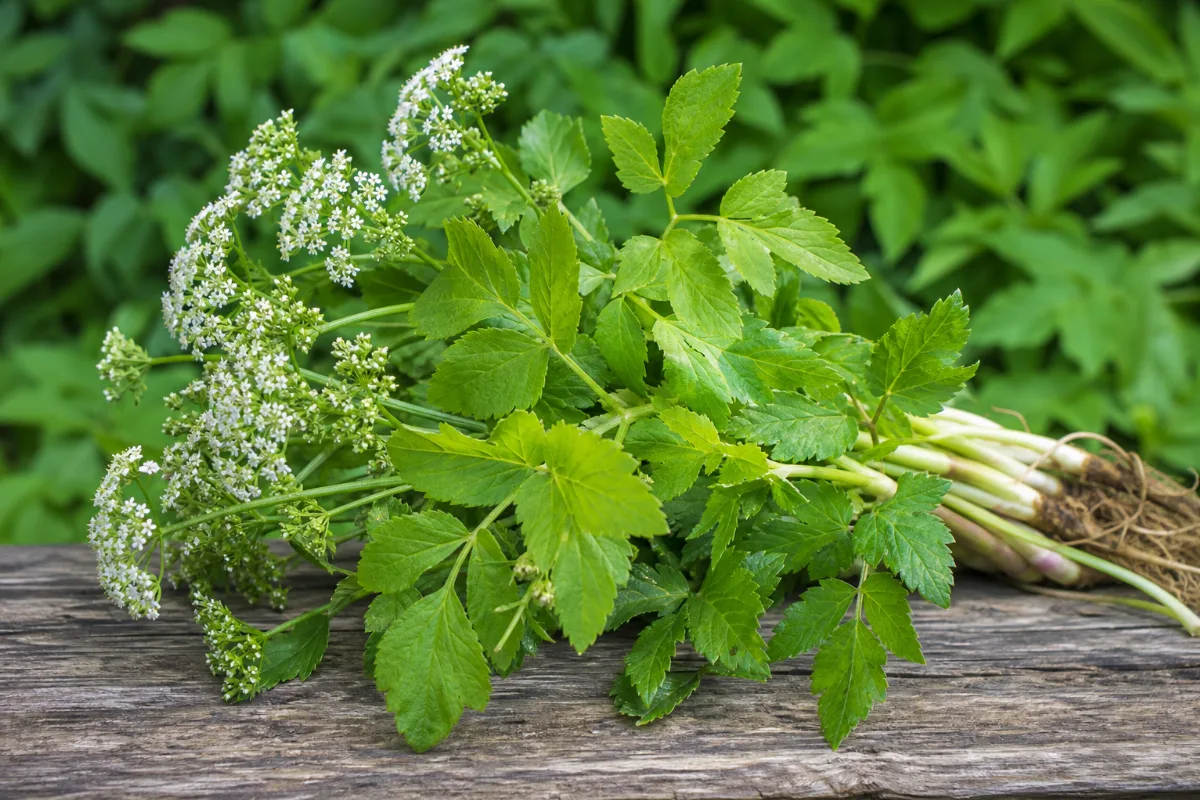
Herbs & Botanicals · Traditional gout herb, wild edible
Ground elder
Aegopodium podagraria · also called Goutweed, bishop's weed, St. Gerard's herb
Ground elder is a garden weed whose leaves were used in European folk medicine for gout and joint pain, and are also eaten as a wild green. We found no trial in people, only tradition, lab and animal work. The most important caution is identification: the carrot family includes deadly look-alikes such as poison hemlock, so never eat or brew a wild plant unless an expert has identified it in person.
General information, not medical advice. Last substantive update · Not medically reviewed. A named clinician has not signed off on this page. How this page is made
About Ground elder
Ground elder (Aegopodium podagraria), or goutweed, is a creeping carrot-family weed. In European folk medicine its leaves were used for gout, arthritis, rheumatism and sciatica, and young leaves are also eaten. The evidence is extremely thin: no human trial, one enzyme study on falcarindiol, one rat study with metformin, and a narrative review. The main danger is wrong identification, because the carrot family includes poison hemlock and other deadly plants. Skin allergy and sun sensitivity are possible but unproven, and pregnancy data are missing. Ask a doctor or pharmacist about amounts.
What it is
Ground elder (goutweed) is a creeping perennial in the carrot family, known as a garden weed. Its leaves and aerial parts are the traditional medicinal part, and young leaves are also eaten as a wild green.
The carrot family also contains deadly plants. This page is about Aegopodium podagraria only.
Traditional uses and what research exists
It was a folk remedy for gout, arthritis, rheumatism and sciatica. The research is lab and animal work: a COX-1 enzyme finding for falcarindiol, animal reports on uric acid excretion, and a rat study with metformin. No human trial was found.
The main review calls the plant anti-inflammatory, antioxidant, antibacterial, diuretic and more, but these are reported properties, not shown in people.
At a glance
Traditional uses history, not proof
- European folk medicine: leaf tea and poultice for gout, arthritis, rheumatism and sciatica
- Diuretic in herbal tradition
- Eaten as a young wild leaf
Studied for research
- Inflammation and pain: lab enzyme finding and animal work, insufficient evidence
- Uric acid: animal reports only, insufficient evidence
- Blood sugar and blood fats: one rat study, insufficient evidence
Main compounds
- Falcarindiol and other polyacetylenes
- Coumarins and furanocoumarins such as angelicin
- Flavonoids
- Essential-oil terpenes
Common forms
- Leaf tea, fresh juice, tincture or crushed-leaf poultice; studies used extracts and tinctures, not tea
- Eaten fresh as a wild green
Research links: Review: Goutweed, an edible weed with health-promoting properties (2025) · Falcarindiol and COX-1 (2007) · Rat study with metformin · Poison hemlock case report (2026) · Research Library · Genes & Biomarkers Library
The plant and its history
- Accepted scientific name
- Aegopodium podagraria L.
- Naming authority
- L.
- Synonyms
- Not listed here; GBIF accepted-name check only.
- Common names
- Ground elder (English); Goutweed (English); Bishop's weed (English); St. Gerard's herb (English); Podagraria / Giersch (German (not checked))
- Botanical family
- Apiaceae (carrot or celery family), the family of carrot, parsley, celery, and also of poison hemlock and hemlock water dropwort.
- Classification
- Plantae > Tracheophyta > Magnoliopsida > Apiales > Apiaceae > Aegopodium > Aegopodium podagraria
- Native range
- Not verified from a primary source read. Common in Europe as a weed; spread elsewhere (general knowledge, not verified here).
- Habitat
- Not verified here. Known as a persistent garden weed (general knowledge).
- What the plant looks like
- Roots: Creeping underground stems (general knowledge, not verified in a source read).; Stems: Not verified.; Leaves: Not verified in a source read. Descriptions of leaf shape should come from an expert flora or a local botanist.; Flowers: White umbels (general knowledge, not verified in a source read).; Fruit: Not covered.
- Cultivation
- Not covered.
- Harvest and processing
- Leaf and aerial parts are the traditional medicinal part; preparation as tea, tincture, juice or poultice per the 2025 review.
- Look-alikes and adulterants
- Name: Poison hemlock (Conium maculatum); Note: Deadly. Carrot-family weed; the 2026 Istanbul case series describes poisoning after a meal of wild greens that turned out to be hemlock. No source we read says it is confused with ground elder specifically, but wrong identification of wild carrot-family greens is the danger.; Name: Hemlock water dropwort (Oenanthe crocata); Note: Deadly. Likely cause of a child poisoning in France after eating a wild carrot-family root.; Name: Fool's parsley (Aethusa cynapium); Note: Poisonous; confused with parsley and other edible carrot-family plants (Massey University page, summary-only).; Name: Water hemlock (Cicuta) and other wild Apiaceae; Note: Named among the main poisonous Apiaceae in France in the case report abstract.
- Sustainability and conservation
- Not applicable; widespread weed (general knowledge).
Traditional use and history history, not clinical proof
| Tradition or era | Documented use | Source |
|---|---|---|
| European folk medicine | Leaf poultice and tea for gout, arthritis, rheumatism and sciatica. The common name goutweed reflects the gout use. | p40286209 |
| Wild food tradition | Young leaves eaten as a spring green. | p40286209 |
| Regulatory | No EMA/HMPC monograph found (page tried returned 404; not verified that none exists). | s-ema-aegopodium |
Traditional use shows how a plant was used. It does not show that a supplement works or is safe today.
What is inside, and how it may work
What the plant contains and how those compounds act in cells and animals. Laboratory and animal mechanisms are not proven effects in people.
Main compounds
| Compound | Family | Where it is concentrated | Activity studied | Level of evidence |
|---|---|---|---|---|
| Falcarindiol PubChem 5281148 | polyacetylene (falcarin type) | Flowers highest in June 2006; varies by season and part 88 mg/g plant material in flowers collected June 2006 (one study) | Inhibited COX-1 in an enzyme assay (IC50 0.3 micromolar). 2 13 | Laboratory research |
| Falcarinol (panaxynol) PubChem 5281149 | polyacetylene (falcarin type) | Not specified for ground elder in the sources read | Skin allergen in common ivy and widespread in Apiaceae and Araliaceae. Whether ground elder contains it in meaningful amounts was not confirmed in an abstract read here. 6 3 13 | Human patch test (ivy) |
| Angelicin (isopsoralen) PubChem 10658 | furanocoumarin | Listed in the plant per our earlier summary of the review (summary-only) | Furanocoumarins in some other plants cause photosensitivity. Not shown for ground elder. 1 13 | Not established |
| Flavonoids, other coumarins and essential-oil terpenes | mixed | Leaf and aerial parts | Listed as plant metabolites in the review abstract; individual compounds not verified here. 1 | Descriptive |
Mechanisms, receptors and pathways
| Target or pathway | Gene or receptor | What was found | Level |
|---|---|---|---|
| COX-1 enzyme | PTGS1 | Falcarindiol inhibited COX-1 in a test tube (IC50 0.3 micromolar). 2 | Laboratory research |
| Blood sugar and blood fats | Not identified | A tincture added to low-dose metformin's effect in dexamethasone-treated rats. 4 | Animal research |
| Uric acid and kidney excretion | Not identified | Reported higher excretion of uric acid, urea and creatinine in rodents (summary-only). 1 | Animal research |
Absorption, metabolism and elimination
- Absorption
- Not studied for ground elder compounds in people.
- Distribution
- Not studied.
- Metabolism
- Not studied.
- Elimination
- Not studied.
- Bioavailability
- Unknown.
Isolated compounds versus whole extracts
The COX-1 finding is for isolated falcarindiol, not for tea. Content varies by season and part, so a tea may differ greatly. Falcarin compounds can act in opposite ways at low and high concentrations in cell work.
Nutritional composition
Leaves are eaten as a wild green; the review calls the plant nutritionally valuable (details summary-only). Eating wild Apiaceae greens carries identification risk.
9 not enough evidence
What is Ground elder good for?
The main traditional uses and how strong the evidence is for each. For all of them it is insufficient: no human trial was found.
Benefits, one by one
Each card is a research question, not a promise. Tap a goal to filter. Open a card to see the studies, doses and limits.
Gout, arthritis, rheumatism and sciatica (traditional use)
Not enough evidenceGround elder is called goutweed because old European herbal tradition used its leaves, as a tea or a crushed-leaf poultice, for gout, joint pain, rheumatism and sciatica. We found no study in people. The tradition is the only support, and it is not proof that the plant works.
1 studiesStudies used extracts or tinctures. Traditional preparations are leaf…
Studies, doses and limits
What the trials found
None found. No trial of ground elder in gout, osteoarthritis, rheumatoid arthritis or sciatica turned up.
Results
No outcome has been measured in people.
Effect sizes as reported
None.
Why this rating
Support is traditional use only. The 2025 review describes no human trial.
Form and dose studied
Studies used extracts or tinctures. Traditional preparations are leaf tea, juice and poultice. Amounts are not established and this page gives none. Ask a doctor or pharmacist about amounts.
Who was studied
None studied.
Limits
Tradition does not show benefit. Gout and inflammatory arthritis can damage joints and need medical care.
Why researchers looked
Gout was the plant's main historical use; the common name comes from it.
Traditional use
Folk remedy for gout (arthritis), rheumatism and sciatica, in leaf tea, fresh juice and poultice form, as described in a 2025 review.
Proposed mechanism Preliminary mechanism
The suggested explanations are anti-inflammatory chemistry (falcarindiol) and a possible effect on uric acid, but both come from lab or animal work only.
A proposed mechanism does not show that the effect happens in people.
Do not replace gout or arthritis treatment with ground elder. See the Safety tab for look-alike plants and skin cautions.
Inflammation and pain (lab and animal findings)
Not enough evidenceIn the lab, a compound from ground elder called falcarindiol blocked COX-1, an enzyme involved in pain and inflammation, and the plant's extracts show anti-inflammatory effects in animal work described in a review. No one has tested whether this helps people with pain or swelling.
3 studiesStudies used extracts or tinctures. Traditional preparations are leaf…
Studies, doses and limits
What the trials found
None found.
Results
Test-tube: falcarindiol (isolated from ground elder) inhibited COX-1 with an IC50 of 0.3 micromolar. Flowers collected in June 2006 had the most falcarindiol, 88 mg/g plant material; content varied by season and plant part. The 2025 review reports anti-inflammatory and pain-relieving effects of extracts in cell and animal studies (details summary-only).
Effect sizes as reported
COX-1 IC50 0.3 micromolar (enzyme assay). No human effect size.
Why this rating
One enzyme study plus a narrative review of lab and animal work. No human data.
Form and dose studied
Studies used extracts or tinctures. Traditional preparations are leaf tea, juice and poultice. Amounts are not established and this page gives none. Ask a doctor or pharmacist about amounts.
Who was studied
None studied.
Limits
Enzyme assay on an isolated compound. Seasonal and plant-part variation means a tea or product may contain very different amounts. Falcarin compounds can act in opposite ways at low and high concentrations in cell work.
Why researchers looked
Researchers looked for a reason behind the gout and joint-pain tradition.
Traditional use
Used for pain and rheumatism in European folk medicine.
Proposed mechanism Laboratory research
Falcarindiol inhibited COX-1 in an enzyme test (IC50 0.3 micromolar). Falcarin-type compounds are also described as anti-inflammatory in other plants. This does not show the same effect in a person who drinks a tea.
A proposed mechanism does not show that the effect happens in people.
Falcarinol-type compounds can cause skin allergy in some people (see Safety tab).
Antioxidant activity (lab measurements)
Not enough evidenceExtracts of ground elder show antioxidant activity in laboratory tests. Antioxidant tests in a dish do not show a health benefit in people, so we rate this as insufficient.
1 studiesStudies used extracts or tinctures. Traditional preparations are leaf…
Studies, doses and limits
What the trials found
None found.
Results
The 2025 review lists antioxidant activity among the plant's reported properties (details summary-only).
Effect sizes as reported
None.
Why this rating
Lab measurements only, from a narrative review.
Form and dose studied
Studies used extracts or tinctures. Traditional preparations are leaf tea, juice and poultice. Amounts are not established and this page gives none. Ask a doctor or pharmacist about amounts.
Who was studied
None studied.
Limits
Lab antioxidant assays do not predict benefits in the body.
Why researchers looked
Antioxidant assays are a routine first screen for edible and medicinal plants.
Traditional use
Eaten as a wild green and used as tea; antioxidant claims are modern, not traditional.
Proposed mechanism Laboratory research
Phenolic compounds and flavonoids in the leaf scavenge reactive molecules in test-tube assays. This is a chemistry measurement, not a body effect.
A proposed mechanism does not show that the effect happens in people.
None specific.
Calming or sedative effect (reported, not tested in people)
Not enough evidenceA 2025 review lists a sedative effect among the plant's reported properties. We found no human study. Treat it as unproven.
1 studiesStudies used extracts or tinctures. Traditional preparations are leaf…
Studies, doses and limits
What the trials found
None found.
Results
Listed in the review abstract without detail; underlying studies not read.
Effect sizes as reported
None.
Why this rating
Only a one-word mention in the abstract of a narrative review; nothing read behind it.
Form and dose studied
Studies used extracts or tinctures. Traditional preparations are leaf tea, juice and poultice. Amounts are not established and this page gives none. Ask a doctor or pharmacist about amounts.
Who was studied
None studied.
Limits
We could not check the original sources.
Why researchers looked
Sedative effects are listed in the review's overview of bioactivity.
Traditional use
Not a major traditional use; appears in the review's summary of reported properties.
Proposed mechanism Unknown
Not established. We did not read the underlying animal work.
A proposed mechanism does not show that the effect happens in people.
If it were sedating, it could add to sleep medicines or alcohol. That is theory only, not a reported problem.
Uric acid and diuretic effect (animal findings)
Not enough evidenceHerbalists call ground elder a diuretic, and animal tests described in a 2025 review reported more uric acid, urea and creatinine passing out in urine. No one has shown that it lowers uric acid or treats gout in people.
1 studiesStudies used extracts or tinctures. Traditional preparations are leaf…
Studies, doses and limits
What the trials found
None found.
Results
Animal results as summarised in the 2025 review; the original animal papers were not read here (summary-only).
Effect sizes as reported
None.
Why this rating
Animal findings from a review, not re-checked at source; no human data.
Form and dose studied
Studies used extracts or tinctures. Traditional preparations are leaf tea, juice and poultice. Amounts are not established and this page gives none. Ask a doctor or pharmacist about amounts.
Who was studied
None studied.
Limits
Mouse and rat tests; extracts and oils differ from tea.
Why researchers looked
Gout is caused by excess uric acid, so the plant's name and tradition prompted tests of uric acid excretion.
Traditional use
Traditional diuretic and gout remedy.
Proposed mechanism Preliminary mechanism
Reported to raise excretion of uric acid, urea and creatinine in mice and rats (extracts or flower oil). The route is not established.
A proposed mechanism does not show that the effect happens in people.
A true diuretic could matter for kidney disease, water pills and lithium. That is theory only.
Blood sugar and blood fats (rat study)
Not enough evidenceIn one rat study, a ground elder tincture added to the effect of a low dose of the diabetes drug metformin. It lowered triglycerides and raised HDL cholesterol. This is animal work only and no one has tested it in people.
1 studiesStudies used extracts or tinctures. Traditional preparations are leaf…
Studies, doses and limits
What the trials found
None found.
Results
Rat study: the tincture plus a low metformin dose gave the lowest glucose curve; the tincture alone lowered triglycerides and raised HDL; the LDL-lowering tendency was lost in the combination.
Effect sizes as reported
Qualitative in the abstract.
Why this rating
One rat study by one author, no human data.
Form and dose studied
Studies used extracts or tinctures. Traditional preparations are leaf tea, juice and poultice. Amounts are not established and this page gives none. Ask a doctor or pharmacist about amounts.
Who was studied
None studied in people.
Limits
Rats with drug-induced insulin resistance; one tincture; one author.
Why researchers looked
Earlier animal work suggested the tincture lowered blood sugar, so the author tested it with metformin.
Traditional use
Not a main traditional use.
Proposed mechanism Animal study
The combination lowered blood sugar more than the low metformin dose alone in dexamethasone-treated rats. The tincture's LDL-lowering effect disappeared when combined with metformin.
A proposed mechanism does not show that the effect happens in people.
Because it appeared to add to metformin in rats, people on diabetes medicines should ask a doctor or pharmacist before combining. This is a theory from animal data, not a reported human problem.
Kidney and liver protection (reported, animal or lab)
Not enough evidenceThe 2025 review lists protective effects on the kidneys and liver among the plant's reported properties. We read no human study, and the original animal work was not re-checked here.
1 studiesStudies used extracts or tinctures. Traditional preparations are leaf…
Studies, doses and limits
What the trials found
None found.
Results
Listed in the review abstract without detail; underlying studies not read.
Effect sizes as reported
None.
Why this rating
One-line mention in a review abstract only.
Form and dose studied
Studies used extracts or tinctures. Traditional preparations are leaf tea, juice and poultice. Amounts are not established and this page gives none. Ask a doctor or pharmacist about amounts.
Who was studied
None studied.
Limits
We could not check the original sources.
Why researchers looked
Listed among reported bioactivity in the review.
Traditional use
Diuretic tradition suggests kidney use.
Proposed mechanism Unknown
Not established.
A proposed mechanism does not show that the effect happens in people.
Do not use ground elder to treat kidney or liver disease.
Antibacterial and antifungal activity (lab)
Not enough evidenceThe 2025 review lists antibacterial and antifungal activity of the plant's extracts and essential oil in the lab. This does not show it treats any infection in people.
2 studiesStudies used extracts or tinctures. Traditional preparations are leaf…
Studies, doses and limits
What the trials found
None found.
Results
Reported lab activity (summary-only); polyacetylene antimicrobial role described in a plant-biology review.
Effect sizes as reported
None.
Why this rating
Lab reports only.
Form and dose studied
Studies used extracts or tinctures. Traditional preparations are leaf tea, juice and poultice. Amounts are not established and this page gives none. Ask a doctor or pharmacist about amounts.
Who was studied
None studied.
Limits
Dish results do not show treatment of an infection.
Why researchers looked
Essential oils and polyacetylenes often show activity against microbes in a dish. Falcarin compounds are linked to plant defence against microbes.
Traditional use
Not a main traditional use.
Proposed mechanism Laboratory research
Falcarins show antimicrobial properties linked to plant defence, per a review of plant polyacetylenes.
A proposed mechanism does not show that the effect happens in people.
None specific.
Eaten as a wild green (nutrition)
Not enough evidenceYoung ground elder leaves are eaten as a wild food. The 2025 review calls the plant edible with high nutritional value. This is food use, not a treatment, and it carries a real identification risk (see Safety tab).
1 studiesLeaf eaten as food; amounts and preparation not standardised.
Studies, doses and limits
What the trials found
None found as a health outcome.
Results
The review abstract describes it as an edible plant of high nutritional value.
Effect sizes as reported
None.
Why this rating
Descriptive review statement, no health outcomes measured.
Form and dose studied
Leaf eaten as food; amounts and preparation not standardised.
Who was studied
None studied.
Limits
Nutrient content depends on soil and season. A food being edible does not mean a health benefit.
Why researchers looked
The plant is a common garden weed, which led to interest in it as a food.
Traditional use
Eaten as a spring green in parts of Europe.
Proposed mechanism Other
Not a drug effect. Nutritional composition is described in the review (detail summary-only).
A proposed mechanism does not show that the effect happens in people.
Never eat wild carrot-family plants unless a trained expert has identified them. See Safety tab.
Connections to the rest of health
How Ground elder connects to the rest of our health knowledge graph. Every link says what kind of connection it is. A safety link (for example to the liver) is a warning, not a benefit. A study that merely mentions a topic never creates a benefit link.
Explore every connection: goals, body systems, organs, symptoms, genes
A. Wellness goals
| Connected to | Kind of connection | Evidence status | Context | Studies |
|---|---|---|---|---|
| Joint Support | Traditional use | Not enough evidence | Gout, arthritis, rheumatism and sciatica (traditional use): Ground elder is called goutweed because old European herbal tradition used its leaves, as a tea or a crushed-leaf poultice, for gout, joint pain, rheumatism and sciatica. We found no study in people. The tradition is the only support, and it is not proof that the plant works. | 1 |
| Mobility Support | Traditional use | Not enough evidence | Gout, arthritis, rheumatism and sciatica (traditional use): Ground elder is called goutweed because old European herbal tradition used its leaves, as a tea or a crushed-leaf poultice, for gout, joint pain, rheumatism and sciatica. We found no study in people. The tradition is the only support, and it is not proof that the plant works. | 1 |
| Inflammation Balance | Preliminary mechanism | Not enough evidence | Inflammation and pain (lab and animal findings): In the lab, a compound from ground elder called falcarindiol blocked COX-1, an enzyme involved in pain and inflammation, and the plant's extracts show anti-inflammatory effects in animal work described in a review. No one has tested whether this helps people with pain or swelling. Uric acid and diuretic effect (animal findings): Herbalists call ground elder a diuretic, and animal tests described in a 2025 review reported more uric acid, urea and creatinine passing out in urine. No one has shown that it lowers uric acid or treats gout in people. | 2 1 8 |
| Joint Support | Preliminary mechanism | Not enough evidence | Inflammation and pain (lab and animal findings): In the lab, a compound from ground elder called falcarindiol blocked COX-1, an enzyme involved in pain and inflammation, and the plant's extracts show anti-inflammatory effects in animal work described in a review. No one has tested whether this helps people with pain or swelling. | 2 1 8 |
| Healthy Aging | Preliminary mechanism | Not enough evidence | Antioxidant activity (lab measurements): Extracts of ground elder show antioxidant activity in laboratory tests. Antioxidant tests in a dish do not show a health benefit in people, so we rate this as insufficient. | 1 |
| Calm Relaxation | Not enough evidence | Calming or sedative effect (reported, not tested in people): A 2025 review lists a sedative effect among the plant's reported properties. We found no human study. Treat it as unproven. | 1 | |
| Blood Sugar Balance | Preliminary mechanism | Not enough evidence | Blood sugar and blood fats (rat study): In one rat study, a ground elder tincture added to the effect of a low dose of the diabetes drug metformin. It lowered triglycerides and raised HDL cholesterol. This is animal work only and no one has tested it in people. | 4 |
| Metabolic Health | Preliminary mechanism | Not enough evidence | Blood sugar and blood fats (rat study): In one rat study, a ground elder tincture added to the effect of a low dose of the diabetes drug metformin. It lowered triglycerides and raised HDL cholesterol. This is animal work only and no one has tested it in people. | 4 |
| Detoxification Support | Not enough evidence | Kidney and liver protection (reported, animal or lab): The 2025 review lists protective effects on the kidneys and liver among the plant's reported properties. We read no human study, and the original animal work was not re-checked here. | 1 | |
| Immune Support | Preliminary mechanism | Not enough evidence | Antibacterial and antifungal activity (lab): The 2025 review lists antibacterial and antifungal activity of the plant's extracts and essential oil in the lab. This does not show it treats any infection in people. | 1 3 |
| Balanced Nutrition | Not enough evidence | Eaten as a wild green (nutrition): Young ground elder leaves are eaten as a wild food. The 2025 review calls the plant edible with high nutritional value. This is food use, not a treatment, and it carries a real identification risk (see Safety tab). | 1 |
B. Body systems
| Connected to | Kind of connection | Evidence status | Context | Studies |
|---|---|---|---|---|
| Bones Joints Muscles | Biological association | Not enough evidence | Studied for: Gout, arthritis, rheumatism and sciatica (traditional use) | 1 |
| Musculoskeletal System | Biological association | Not enough evidence | Studied for: Gout, arthritis, rheumatism and sciatica (traditional use) | 1 |
| Pain Inflammation | Biological association | Not enough evidence | Studied for: Inflammation and pain (lab and animal findings) | 2 1 8 |
| Whole Body Balance | Biological association | Not enough evidence | Studied for: Antioxidant activity (lab measurements) | 1 |
| Nervous System | Biological association | Not enough evidence | Studied for: Calming or sedative effect (reported, not tested in people) | 1 |
| Kidney Urinary | Biological association | Not enough evidence | Studied for: Uric acid and diuretic effect (animal findings) Studied for: Kidney and liver protection (reported, animal or lab) | 1 |
| Blood Sugar Support | Biological association | Not enough evidence | Studied for: Blood sugar and blood fats (rat study) | 4 |
| Liver Detox | Biological association | Not enough evidence | Studied for: Kidney and liver protection (reported, animal or lab) | 1 |
| Immune System | Biological association | Not enough evidence | Studied for: Antibacterial and antifungal activity (lab) | 1 3 |
| Digestive System | Biological association | Not enough evidence | Studied for: Eaten as a wild green (nutrition) | 1 |
D. Symptoms
| Connected to | Kind of connection | Evidence status | Context | Studies |
|---|---|---|---|---|
| Contact dermatitis (falcarinol) | Not enough evidence | Shown for ivy; theory for ground elder. Preparation or compound: Falcarinol-type polyacetylenes |
6 |
E. Health conditions
| Connected to | Kind of connection | Evidence status | Context | Studies |
|---|---|---|---|---|
| Gout | Traditional use | Not enough evidence | Traditional use; animal uric acid findings only. Preparation or compound: Ground elder leaf |
1 |
I. Biomarkers
| Connected to | Kind of connection | Evidence status | Context | Studies |
|---|---|---|---|---|
| COX-1 enzyme activity (lab) | Biological association | Not enough evidence | Measured in trials: lowered. A lab change is not the same as a health benefit. | 2 |
| Uric acid excretion in urine (animals) | Biological association | Not enough evidence | Measured in trials: raised. A lab change is not the same as a health benefit. | 1 |
| Triglycerides and HDL cholesterol (rats) | Biological association | Not enough evidence | Measured in trials: mixed. A lab change is not the same as a health benefit. | 4 |
J. Genes, receptors and enzymes
| Connected to | Kind of connection | Evidence status | Context | Studies |
|---|---|---|---|---|
| PTGS1 (COX-1) | Preliminary mechanism | In vitro | Falcarindiol inhibited the enzyme in a test tube. | 2 |
L. Active compounds
| Connected to | Kind of connection | Evidence status | Context | Studies |
|---|---|---|---|---|
| Falcarindiol | Biological association | In vitro | Inhibited COX-1 in an enzyme assay (IC50 0.3 micromolar). Preparation or compound: Flowers highest in June 2006; varies by season and part |
2 13 |
| Falcarinol (panaxynol) | Biological association | Human patch test (ivy) | Skin allergen in common ivy and widespread in Apiaceae and Araliaceae. Whether ground elder contains it in meaningful amounts was not confirmed in an abstract read here. Preparation or compound: Not specified for ground elder in the sources read |
6 3 13 |
| Angelicin (isopsoralen) | Biological association | Not established | Furanocoumarins in some other plants cause photosensitivity. Not shown for ground elder. Preparation or compound: Listed in the plant per our earlier summary of the review (summary-only) |
1 13 |
| Flavonoids, other coumarins and essential-oil terpenes | Biological association | Descriptive | Listed as plant metabolites in the review abstract; individual compounds not verified here. Preparation or compound: Leaf and aerial parts |
1 |
Each connection is stored with the ingredient, the connected record, the kind of connection, the evidence status, the supporting studies, the preparation or compound involved, and a review date (last reviewed October 25, 2026).
Evidence at a glance: what changed in 3 lab markers
Tap a number to show only those markers. Counts are markers, not people.
The evidence
The research centre for Ground elder. Every record here was checked against PubMed or the publisher's page; we never list a study we have not verified.
Evidence by outcome
Bars show how many studies we found for each outcome, not how well it works. People are added up across trials only (reviews are not added, to avoid double counting).
How we rate evidence
High certainty
Several well-run trials or reviews agree; further research is unlikely to change the picture much.
Moderate certainty
Good trials point the same way, but some doubt remains.
Low certainty
Small, short or inconsistent trials. The finding could change with better research.
Very low certainty
Very little or very weak human data. Treat as a possibility only.
Mixed findings
Trials or reviews disagree with each other.
Not enough evidence
Not enough human research to say either way.
Evidence against
Good research found no benefit, or found harm.
We take the reviewers' own risk-of-bias and GRADE statements where they exist, and otherwise judge from study size, design, consistency, directness and whether a product matches what is sold. Many publications do not make evidence high. Method note: We read the nutrient summary we hold, searched PubMed and read abstracts, checked GBIF and PubChem, and tried an EMA page (not found). Some details of the 2025 review and the poison-plant pages were carried from the earlier summary and not re-read. Certainty ratings are our own reading. No study is cited that we could not verify.
Study library: every study we checked 14
| Study | Design | People | Product, dose, length | Result |
|---|---|---|---|---|
| Dębia 2025 Goutweed (Aegopodium podagraria L.)-An Edible Weed with Health-Promoting Properties. Molecules · PMID 40286209 · DOI |
Narrative review review |
None: a review of the plant, its chemistry and the lab, animal and traditional literature | The abstract names gout, rheumatism and sciatica as traditional uses and lists reported anti-inflammatory, antirheumatic, antioxidant, antibacterial, antifungal, diuretic, sedative and kidney- and liver-protective effects. It describes no human trial. Detail beyond the abstract (animal findings on uric acid, essential oil and others) is taken from our earlier summary, which read only part of the full text. No effect sizes; descriptive review Methods, limits and fundingOutcomes: Chemistry, traditional use, nutrition, reported bioactivity Limitations: Narrative review, not systematic. Abstract read directly; the full text (about 239,000 characters) was only partly read through a summariser earlier, so details beyond the abstract are marked summary-only. Funding and conflicts: Authors declare no conflicts of interest. Read: abstract (full text partly read earlier, summary-only) | |
| Prior 2007 The polyacetylene falcarindiol with COX-1 activity isolated from Aegopodium podagraria L. Journal of Ethnopharmacology · PMID 17574359 · DOI |
Laboratory research lab |
Enzyme assay (cyclooxygenase-1) with plant extracts; HPLC of plant parts collected in different seasons | Falcarindiol was identified as the active compound. Its IC50 was 0.3 micromolar in the COX-1 assay. Flowers collected in June 2006 had the highest falcarindiol content, 88 mg/g plant material. IC50 0.3 micromolar (enzyme assay) Methods, limits and fundingOutcomes: COX-1 inhibition; falcarindiol content by season and plant part Limitations: Test-tube enzyme work only; no cells, animals or people. An enzyme result does not show pain or joint relief. Content varied by season and plant part. Funding and conflicts: Not stated in the abstract (Research Support, Non-U.S. Gov't). Read: abstract | |
| Santos 2022 Structural diversity, biosynthesis, and function of plant falcarin-type polyacetylenic lipids. Journal of Experimental Botany · PMID 35560192 · DOI |
Narrative review review |
Plant chemistry review | Falcarins are widespread in the plant kingdom, are made from oleic acid, and are linked to plant defence through antimicrobial activity. The abstract notes interest in anti-cancer and anti-inflammatory properties. Descriptive Methods, limits and fundingOutcomes: Distribution, biosynthesis, plant defence Limitations: Plant biology review; not specific to ground elder and no human evidence. Funding and conflicts: Not stated in the abstract. Read: abstract | |
| Tovchiga 2017 The influence of goutweed (Aegopodium podagraria L.) tincture and metformin on the carbohydrate and lipid metabolism in dexamethasone-treated rats. BMC Complementary and Alternative Medicine · PMID 27450405 · DOI |
Animal research animal |
Rats given dexamethasone to mimic metabolic syndrome / type 2 diabetes (5 groups) | The tincture combined with the low metformin dose added to metformin's effect on basal blood sugar and on the short insulin test. The lowest glucose curve was seen with the combination. The tincture lowered triglycerides and raised HDL cholesterol. Its LDL-lowering ability was lost when given together with metformin. The author concludes the tincture partly increases metformin's efficacy in these rats. Qualitative in the abstract; no numbers quoted here Methods, limits and fundingOutcomes: Glucose and insulin tolerance, triglycerides, HDL and LDL cholesterol, liver glycogen Limitations: Rats only. A single author and one tincture. Not a trial in people and not a test of safety. Funding and conflicts: Not stated in the abstract. Read: abstract | |
| p18206356 [Child poisoning after ingestion of a wild apiaceae: a case report]. · Source |
Case report |
Methods, limits and fundingRead: abstract (English abstract) | ||
| p20236156 Dermatitis from common ivy (Hedera helix L. subsp. helix) in Europe: past, present, and future. · Source |
Review and patch test series |
Methods, limits and fundingRead: abstract | ||
| p26451696 Bioactive C17-Polyacetylenes in Carrots (Daucus carota L.): Current Knowledge and Future Perspectives. · Source |
Narrative review review |
Methods, limits and fundingRead: abstract | ||
| p32155852 Biphasic Dose-Response Induced by Phytochemicals: Experimental Evidence. · Source |
Narrative review review |
Methods, limits and fundingRead: abstract | ||
| p41922968 Divergent clinical outcomes after shared poison hemlock ingestion: evidence suggesting a dose-related effect. · Source |
Case report |
Methods, limits and fundingRead: abstract | ||
| s-ema-aegopodium EMA herbal medicines page for Aegopodium podagraria herb (guessed address) · Source |
Regulator page not found n/a |
Methods, limits and fundingRead: not-found | ||
| s-gbif-aegopodium GBIF backbone: Aegopodium podagraria L. (key 3034620) · Source |
Taxonomy database n/a |
Methods, limits and fundingRead: api-response | ||
| s-massey-fools-parsley Massey University Poisonous Plants: Fool's parsley (Aethusa cynapium) · Source |
University reference page n/a |
Methods, limits and fundingRead: summary-only | ||
| s-pubchem-compounds PubChem compound records: falcarindiol (CID 5281148), falcarinol (listed as panaxynol, CID 5281149), angelicin (listed as isopsoralen, CID 10658) · Source |
Chemistry database n/a |
Methods, limits and fundingRead: api-response | ||
| s-wa-hemlock Washington State Noxious Weed Control Board: Poison hemlock (Conium maculatum) · Source |
Government weed board page n/a |
Methods, limits and fundingRead: summary-only |
What we do not know yet
- What the evidence supports: almost nothing in people. It is tradition, lab and animal work.
- What is uncertain: whether the plant helps gout or joints at all, whether it causes skin or sun reactions, and what is safe in pregnancy.
- What is missing: any clinical trial, safety study, interaction study or regulator monograph.
How new research is added
New studies are found by a saved PubMed search and queued for a person to read before any rating or safety wording changes.
Lab markers
What changed in blood or saliva tests during trials. A changed number is not the same as feeling or being healthier, and we give no "normal ranges".
Other 3
COX-1 enzyme activity (lab)
Lowered in trials
Activity of cyclooxygenase-1, an enzyme that makes inflammation- and pain-related chemicals, measured in a test tube.
Not enough evidenceResults and what it means
Why it was measured
A standard screen for anti-inflammatory plants.
Statistical vs. clinical meaning
Shows the compound can act on an enzyme in a dish. It does not show relief of pain or joint disease in people.
Safety implication
COX-1 also protects the stomach lining; a strong effect in the body could in theory irritate the stomach, but this is not shown for ground elder.
| Study | Result | People | Product |
|---|---|---|---|
| 2 | Falcarindiol inhibited COX-1, IC50 0.3 micromolar | Enzyme assay (no animals or people) | Falcarindiol isolated from ground elder |
Uric acid excretion in urine (animals)
Raised in trials
The amount of uric acid passed out in urine, measured in mice and rats.
Not enough evidenceResults and what it means
Why it was measured
Gout involves too much uric acid in the blood.
Statistical vs. clinical meaning
Animal signal only. It does not show lowered blood uric acid or fewer gout attacks in people.
Safety implication
If true in people, it could affect kidneys or medicines that depend on kidney handling.
| Study | Result | People | Product |
|---|---|---|---|
| 1 | Extracts or flower oil increased excretion of uric acid, urea and creatinine in mice and rats (summary-only, original animal papers not read) | Mice and rats | Ground elder extracts or flower oil |
Triglycerides and HDL cholesterol (rats)
Mixed results in trials
Blood fats measured in rats after a ground elder tincture.
Not enough evidenceResults and what it means
Why it was measured
Part of metabolic syndrome.
Statistical vs. clinical meaning
One rat study; no human data.
Safety implication
Could add to diabetes medicine effects (theory from animal data).
| Study | Result | People | Product |
|---|---|---|---|
| 4 | Tincture lowered triglycerides and raised HDL; LDL-lowering effect lost when combined with metformin | Dexamethasone-treated rats | Ground elder aerial-part tincture, with and without low-dose metformin |
Safety
What studies and official sources say about side effects, medicines and who should check first. Each point shows what kind of evidence it comes from.
Main points to know 6
- Identification is a deadly risk with wild carrot-family plants. Ground elder belongs to the carrot family (Apiaceae), which also contains some of the most poisonous plants in Europe and North America: poison hemlock (Conium maculatum), hemlock water dropwort (Oenanthe crocata), water hemlock (Cicuta) and fool's parsley (Aethusa cynapium). A child in France became ill after eating the root of a wild carrot-family plant he took for wild carrot, and two people in Turkey were poisoned by a meal of wild greens that turned out to be poison hemlock; one needed a breathing tube. None of these reports names ground elder, but they show how easily wild leaves of this family are mixed up. Do not eat or make tea from any wild carrot-family plant unless an experienced local expert has identified it in person. A phone app or a photo is not enough. Case report 9 5 14 12
- Evidence for any benefit is extremely thin. We found no human trial of ground elder. Safety in people is therefore mostly unknown. 'No reported problems' means little has been looked for. Other 1
- Skin allergy to falcarinol-type compounds. Falcarinol, a close relative of falcarindiol (the compound found in ground elder), is the main allergen in common ivy and is described as widespread in the carrot family. In patch-test clinics, 10 of 127 people (7.9%) tested positive to falcarinol. People who react to ivy, carrots, parsnips or celery plants may react to ground elder on the skin, especially with fresh crushed leaves or a poultice. This is a theory for ground elder; no case has been found for it. Theory 6 7 3
- Sun sensitivity (photosensitivity): possible, not shown. Ground elder contains furanocoumarins such as angelicin (isopsoralen). Some furanocoumarins in other carrot-family plants cause skin burns or blistering after skin contact and sunlight. No source we read reports this for ground elder, so the risk is unproven either way. If you handle the plant a lot, rinse skin afterwards and avoid strong sun on wet or crushed-leaf skin until you know how you react. Theory 1 13
- Pregnancy and breastfeeding: no safety data. No source we read gives safety data. With no evidence, it is wiser to avoid medicinal amounts in pregnancy and breastfeeding and to ask a doctor or midwife. A wrong plant in the mix would be much worse in pregnancy. Other
- Kidney disease, water pills, diabetes medicines. Ground elder is called a diuretic in tradition, and a rat study found it added to metformin. Neither has been shown in people. If you take water pills, lithium, or diabetes medicines, or have kidney disease, ask a doctor or pharmacist first. Theory 4 1
Side effects 2
| Effect | How often | Severity and recovery | Evidence |
|---|---|---|---|
| Allergic contact dermatitis from falcarinol-type compounds Ground elder-specific case reports were not found. | Not known for ground elder; 7.9% of people patch-tested for falcarinol in a Danish clinic series (mostly ivy cases) | mild to moderate rash Usually clears when contact stops | Theory 6 |
| Reactions to ground elder tea, juice or leaves eaten as food Absence of reports is not proof of safety. | None found; not studied | unknown unknown | Other |
Liver
No case of liver injury linked to ground elder was found, and no LiverTox entry was found. This is absence of evidence, not proof of safety. A review abstract lists liver-protective effects as reported, but that was not checked. 1
How often. Not known.
Monitoring. None advised by any source found.
This is a safety connection. It is not evidence that Ground elder supports liver health.
Medicines and supplements 4
| With | Why it matters | Importance | Evidence | What to do |
|---|---|---|---|---|
| Diabetes medicines (metformin and others) prescription | In rats, a ground elder tincture added to the effect of low-dose metformin on blood sugar. | Unknown in people; could mean lower blood sugar than expected. | Animal research Not enough evidence 4 | Ask a doctor or pharmacist before combining. |
| Water pills (diuretics), lithium, kidney-affecting medicines prescription | Theory: a diuretic plant might add to drug effects on fluid and salt balance. Ground elder has not been shown to be a diuretic in people. | Unknown; no case or study found. | Theory Not enough evidence 1 | Ask a doctor or pharmacist, especially about lithium. |
| Gout medicines (allopurinol, colchicine and others) prescription | Theory only: animal findings on uric acid excretion. | Unknown. | Theory Not enough evidence 1 | Do not stop gout medicine for ground elder. Tell your doctor if you use it. |
| Sleep or calming medicines, alcohol prescription | Theory only: a sedative effect is listed as reported in a review. | Unknown. | Theory Not enough evidence 1 | Ask a pharmacist if you use sedatives. |
Who should check first 4
| Situation | Advice | Evidence |
|---|---|---|
| Anyone unable to identify the plant with certainty | Do not eat, brew or apply it. Wild carrot-family plants include deadly look-alikes. | Case report 9 5 |
| Known allergy to ivy, carrot-family plants (carrot, parsnip, celery) or falcarinol | Avoid skin contact and poultices. | Theory 6 |
| Pregnancy, breastfeeding, small children | No safety data; avoid medicinal use and ask a clinician. | Other |
| Kidney disease, gout on treatment, diabetes on treatment | Ask a doctor or pharmacist first. | Theory 4 |
Overdose, product quality and regulators
Summary. No toxicity data for ground elder in people were found. Falcarin-type compounds have opposite effects at different concentrations in cell work.
Animal. No acute toxicity study of ground elder was found in the sources read.
Human doses studied. None.
High dose or long term signals. None found; not studied. Falcarinol and falcarindiol show biphasic (low-dose versus high-dose) behaviour in cell cultures.
Overdose response. None found.
Genotoxicity. Not found.
Toxic plant parts. No toxic part of ground elder is reported in the sources read. The deadly parts in look-alikes are in the plant, root or seed of hemlock, water dropwort and fool's parsley.
No survey of ground elder products for contamination was found. Wild plants may grow in polluted soil, roadsides or near sprayed gardens.
Mix-up with poisonous plants. The main contamination risk is wrong plant material from wild gathering. 9 5
Chemical variation. Falcarindiol content varied by season and plant part in one study. 2
| Body | Action | Date |
|---|
When to get medical help
- After eating any wild plant: confusion, drowsiness, vomiting, drooling, muscle weakness, trouble breathing, trembling or fits. Call emergency services or poison control at once and keep a piece of the plant.
- Blistering, burning or severe rash on skin after plant contact and sun
- Swelling of the face or throat, wheeze or hives after contact or eating
Stop the supplement and contact a clinician or emergency service. In the US, Poison Control is 1-800-222-1222.
General information only, not medical advice. Ask a clinician or pharmacist before use, especially with medicines, in pregnancy or with a health condition. See the Natural Remedy Safety guide.
Frequently asked questions
Why is it called goutweed?
Because old European herbal tradition used it for gout, a painful joint condition. That is tradition. We found no trial in people showing it helps gout.
Does ground elder work for gout or arthritis?
Is ground elder edible?
Which poisonous plants can be confused with it?
What should I do if I ate a wild plant and feel unwell?
Can it cause a skin reaction?
Is it safe in pregnancy or breastfeeding?
Unknown. No safety data were found, so avoid medicinal use and ask a doctor or midwife.
Can I take it with my medicines?
Unknown. A rat study suggests it may add to metformin, and tradition calls it a diuretic. If you take diabetes medicines, water pills, lithium or gout medicine, ask a doctor or pharmacist.
What is in the plant?
Does ground elder lower uric acid?
Only animal tests report higher uric acid excretion. Nothing is shown in people.
Is there regulatory approval?
We found no EU herbal monograph; the page we tried returned 404, so we cannot say none exists.
Where can I learn about the related compound falcarinol?
See devil's club, a related plant containing falcarinol, in the Related list below.
Explore by health goal
Joint SupportInflammation BalanceMobility SupportHealthy AgingCalm RelaxationBlood Sugar BalanceMetabolic HealthDetoxification SupportImmune SupportBalanced Nutrition
Editorial transparency
- Written by
- AlternativeMed editorial team. Research compiled with AI assistance, then checked against PubMed records.
- Medical review
- None. This page has not been reviewed by a physician or pharmacist.
- First published
- 2026-10-25
- Last substantive update
- 2026-10-25
- How we research
- We read the nutrient summary we hold, searched PubMed and read abstracts, checked GBIF and PubChem, and tried an EMA page (not found). Some details of the 2025 review and the poison-plant pages were carried from the earlier summary and not re-read. Certainty ratings are our own reading. No study is cited that we could not verify.
- How we rate evidence
- See "How we rate evidence" in the Evidence tab.
- Independence
- No product is promoted on this page. No affiliate links are shown.
Sources 14
Each source was opened and checked. Where we read only the abstract, it says so. The small numbers in the text point here.
- Dębia K, Dzięcioł M, Wróblewska A, Janda-Milczarek K. Goutweed (Aegopodium podagraria L.)-An Edible Weed with Health-Promoting Properties.. Molecules. 2025. PMID 40286209. DOI 10.3390/molecules30071603. (abstract (full text partly read earlier, summary-only))
- Prior R, Lundgaard N, Light M, Stafford G, van Staden J, Jäger A. The polyacetylene falcarindiol with COX-1 activity isolated from Aegopodium podagraria L.. Journal of Ethnopharmacology. 2007. PMID 17574359. DOI 10.1016/j.jep.2007.05.005. (abstract)
- Santos P, Busta L, Yim W, Cahoon E, Kosma D. Structural diversity, biosynthesis, and function of plant falcarin-type polyacetylenic lipids.. Journal of Experimental Botany. 2022. PMID 35560192. DOI 10.1093/jxb/erac006. (abstract)
- Tovchiga O. The influence of goutweed (Aegopodium podagraria L.) tincture and metformin on the carbohydrate and lipid metabolism in dexamethasone-treated rats.. BMC Complementary and Alternative Medicine. 2017. PMID 27450405. DOI 10.1186/s12906-016-1221-y. (abstract)
- . [Child poisoning after ingestion of a wild apiaceae: a case report].. . . (abstract (English abstract))
- . Dermatitis from common ivy (Hedera helix L. subsp. helix) in Europe: past, present, and future.. . . (abstract)
- . Bioactive C17-Polyacetylenes in Carrots (Daucus carota L.): Current Knowledge and Future Perspectives.. . . (abstract)
- . Biphasic Dose-Response Induced by Phytochemicals: Experimental Evidence.. . . (abstract)
- . Divergent clinical outcomes after shared poison hemlock ingestion: evidence suggesting a dose-related effect.. . . (abstract)
- . EMA herbal medicines page for Aegopodium podagraria herb (guessed address). . . (not-found)
- . GBIF backbone: Aegopodium podagraria L. (key 3034620). . . (api-response)
- . Massey University Poisonous Plants: Fool's parsley (Aethusa cynapium). . . (summary-only)
- . PubChem compound records: falcarindiol (CID 5281148), falcarinol (listed as panaxynol, CID 5281149), angelicin (listed as isopsoralen, CID 10658). . . (api-response)
- . Washington State Noxious Weed Control Board: Poison hemlock (Conium maculatum). . . (summary-only)