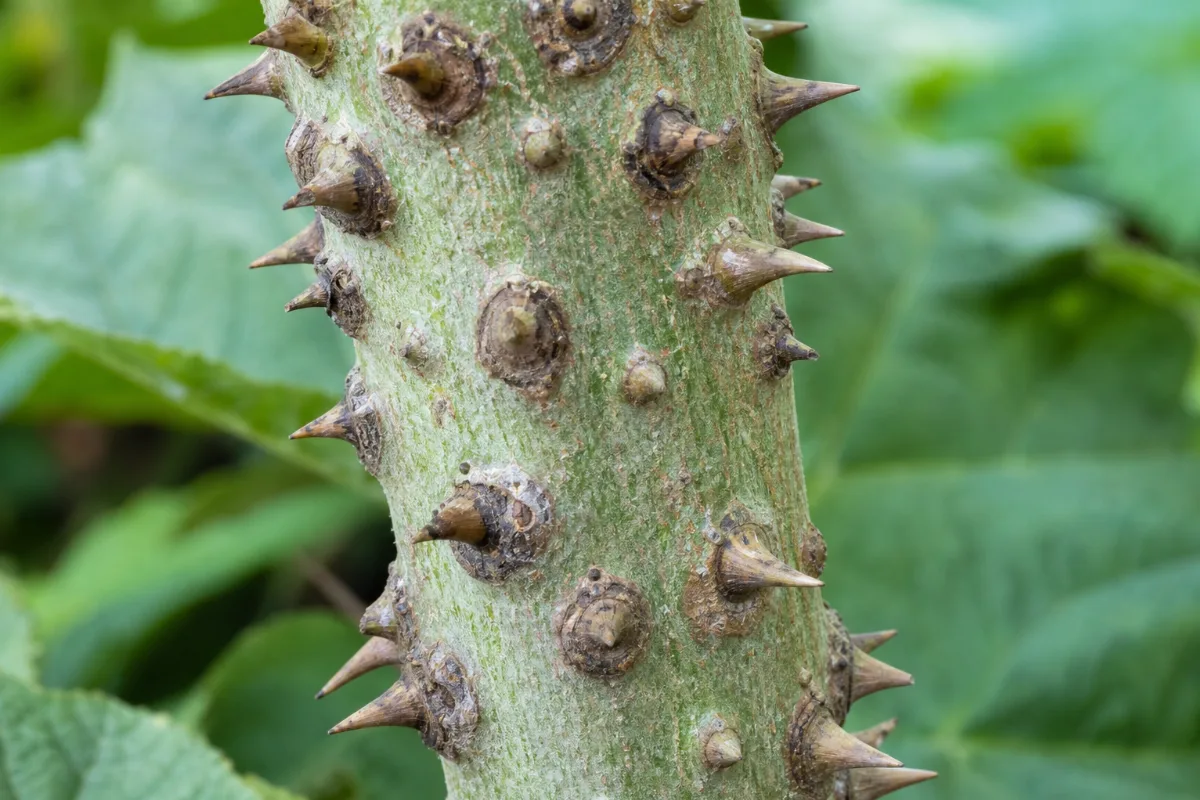
Herbs & Botanicals · Spiny Pacific Northwest bark
Devil's Club
Oplopanax horridus · also called Devil's-club, Alaskan ginseng (misleading trade name)
Devil's club is a tall, spiny shrub of the Pacific Northwest and Alaska. Its inner bark is important in the traditional medicine of many Indigenous peoples. We found no trial in people, so its benefits are unproven. Its spines and skin allergy are real cautions, and it is not ginseng, devil's claw or Eleuthero.
General information, not medical advice. Last substantive update · Not medically reviewed. A named clinician has not signed off on this page. Not reviewed by an Indigenous cultural reviewer. How this page is made
About Devil's Club
Devil's club (Oplopanax horridus) is a spiny shrub of the Pacific Northwest and Alaska, in the same plant family as ginseng. Its inner bark has been used by many Indigenous peoples. Research is thin: one tiny human pilot, some lab work and a review.
What it is
Devil's club grows in moist forest of the Pacific Northwest and Alaska, with an isolated population near Lake Superior. It reaches 1 to 5 m tall. Spines cover the stems and both sides of the large, palm-shaped leaves.
It belongs to the ginseng and ivy family (Araliaceae), but it is not ginseng.
Traditional knowledge and respect
For many Indigenous peoples of the Pacific Northwest and Alaska, devil's club is among the most important medicine plants, and it has spiritual and ceremonial meaning. The knowledge belongs to those peoples.
What we say here comes from outside written sources. It is not a substitute for what the knowledge holders say, and it has not yet been reviewed by an Indigenous cultural reviewer.
The plant grows slowly and is easily harmed by heavy picking. Wild harvest can hurt stands that communities depend on, so please do not pick it in the wild.
What research shows
In people: one 1990 pilot of four people drinking the tea found no blood-sugar-lowering effect. That is all.
In the lab: polyynes from the bark killed tuberculosis bacteria, Candida and ordinary bacteria on plates. An extract slowed pancreatic cancer cells in dishes. A related species, Oplopanax elatus, reduced tumours in mice.
None of this shows that devil's club helps a person.
Names that get mixed up
Devil's club is not devil's claw (Harpagophytum, an African plant), not Eleuthero (Siberian ginseng) and not Asian or American ginseng (Panax).
At a glance
Traditional uses history, not proof
- Bark decoction for colds, fever, sore throat and stomach trouble.
- Inner bark on wounds and swellings.
- Spiritual and ceremonial use by some peoples.
Studied for research
- Blood sugar: one 4-person pilot, no effect seen (insufficient).
- Cancer cells and TB germs: lab studies only.
- Everything else: no study.
Main compounds
- Polyynes such as falcarindiol, oplopandiol and falcarinol.
- Sesquiterpenes, lignans, triterpenoids and volatile oils.
Common forms
- Inner bark decoction or tea (traditional).
- Commercial extracts (content varies and is not covered by the sources read).
Research links: 2018 review of the plant (PubMed) · 1990 pilot on blood sugar (PubMed) · Consumer monograph (RxList) · Research Library · Genes & Biomarkers Library
The plant and its history
- Accepted scientific name
- Oplopanax horridus (Sm.) Miq.
- Naming authority
- (Sm.) Miq.
- Synonyms
- Fatsia horrida; Echinopanax horridus; Aralia erinacea; Oplopanax horridum (variant spelling)
- Common names
- Devil's club (English); Devil's-club (English); Alaskan ginseng (misleading trade name) (English)
- Botanical family
- Araliaceae, the ginseng and ivy family. Ginseng (Panax) is a relative, but devil's club is a different genus.
- Classification
- Plantae > Apiales > Araliaceae > Oplopanax > Oplopanax horridus
- Native range
- Pacific Northwest and Alaska, with an isolated population around Lake Superior in Michigan (2018 review).
- Habitat
- Moist rainforest and wet woods; not checked beyond the review.
- What the plant looks like
- Roots: The root without spines is similar to the stem (review).; Stems: Spiny, 1 to 1.5 m tall, up to 3 to 5 m in undisturbed rainforest; stems up to 3 cm across.; Leaves: Large, palm-shaped, 5 to 13 lobes, 20 to 40 cm across, with spines on both surfaces.; Flowers: Dense umbels of five-petalled greenish-white flowers.; Fruit: Small red berries (drupes) 4 to 7 mm across.
- Cultivation
- Not verified from a source read.
- Harvest and processing
- Inner bark of root and stem is the part used traditionally; handling methods of the peoples concerned are theirs to share and are not described here.
- Look-alikes and adulterants
- Name: Devil's claw (Harpagophytum procumbens); Note: An African plant in a different family. Different part (root tuber), different uses. Not interchangeable. It has its own page on this site.; Name: Eleuthero or Siberian ginseng (Eleutherococcus senticosus); Note: An Asian shrub in the same family but a different genus. Not devil's club.; Name: Oplopanax elatus; Note: A close Asian relative with its own research. Its lab and animal results should not be assigned to devil's club.
- Sustainability and conservation
- The review says the plant grows slowly and is very sensitive to human impact. No formal conservation status was checked.
Traditional use and history history, not clinical proof
| Tradition or era | Documented use | Source |
|---|---|---|
| Pacific Northwest and Alaska First Nations and Alaska Native peoples | Root or stem bark decoction for colds, fever, burns, stomach trouble, body pain, sore throat, swollen glands, constipation and tuberculosis; inner bark on wounds and swellings; also spiritual and ceremonial importance. The review mentions many language groups (over 30). This is an outsider summary, not the knowledge holders' own account. | p30302120 |
| Gitksan (north-western British Columbia) | Part of a study of 37 medicinal plants; the abstract says most were used similarly by other cultures, and many show active chemistry. Devil's club is not named in the abstract. | p16790066 |
| 20th-century medical interest | A 1938 hypoglycaemic-substance report and a 1990 pilot of the tea in four people. | p21249104 |
Traditional use shows how a plant was used. It does not show that a supplement works or is safe today.
What is inside, and how it may work
What the plant contains and how those compounds act in cells and animals. Laboratory and animal mechanisms are not proven effects in people.
Main compounds
| Compound | Family | Where it is concentrated | Activity studied | Level of evidence |
|---|---|---|---|---|
| Falcarindiol PubChem 5281148 | polyyne (polyacetylene) | Root and stem bark Not found in the sources read. | Antimycobacterial in culture (with oplopandiol). 3 7 | In vitro |
| Oplopandiol PubChem 6474833 | polyyne | Inner stem bark Not found in the sources read. | Main anti-TB compound in culture, with falcarindiol. 3 8 | In vitro |
| Falcarinol (panaxynol) PubChem 5281149 | polyyne | Bark Not found in the sources read. | Listed by the review among the bark's antibacterial polyynes; the same compound is a known contact allergen in ivy. 15 11 9 | In vitro; allergen evidence from other plants |
| Nerolidol-type sesquiterpenes (neroplomacrol, neroplofurol) | sesquiterpene | Inner stem bark Not found. | Linked to the anti-TB fraction. 3 | In vitro |
| Sesamin | lignan | Inner stem bark Not found. | Isolated; activity not reported in the abstract. 3 | Chemistry only |
| Other classes: phenylpropanoids, lignan glycosides, triterpenoids, volatile oil | various | Varies by part Not found. | Described in the review; the phenylpropanoids tested were not cytotoxic to cancer cell lines. 15 | Review of chemistry |
Mechanisms, receptors and pathways
| Target or pathway | Gene or receptor | What was found | Level |
|---|---|---|---|
| Cell-death (mitochondrial) pathway in pancreatic cancer cells | Cytochrome C, claspin, cIAP-2, HTRA2/Omi markers up | Ethanol extract slowed cell growth and raised these markers in cell lines. 1 | In vitro |
| Mycobacterial growth | Not identified | Polyynes and sesquiterpenes together killed TB bacteria on plates. 3 5 | In vitro |
| Wnt pathway in colon cells (a DIFFERENT species, O. elatus) | beta-catenin, cyclin D1 | Polyyne-rich extract lowered these proteins in mice and cells. 12 | Animal (other species) |
Absorption, metabolism and elimination
- Absorption
- Not studied in people for devil's club.
- Distribution
- Not found.
- Metabolism
- Not found.
- Elimination
- Not found.
- Bioavailability
- Not measured.
Isolated compounds versus whole extracts
Most lab work used isolated polyynes or concentrated extracts. The traditional use is a decoction of bark. Lab results from purified compounds cannot be assumed for a tea.
Nutritional composition
Devil's club is not a food or a nutrient source.
8 not enough evidence
What is Devil's Club good for?
Devil's club has no proven health use. The rows below show what has been tried or claimed, and every one is rated insufficient.
Benefits, one by one
Each card is a research question, not a promise. Tap a goal to filter. Open a card to see the studies, doses and limits.
Blood sugar and diabetes
Not enough evidenceDevil's club has been used by some people for diabetes. The only human check we found is a tiny 1990 pilot of four people, and it did not show a blood-sugar-lowering effect.
3 studiesNot given here and not advised.
Studies, doses and limits
What the trials found
One pilot of four people (one with insulin-dependent diabetes, one newly diagnosed non-insulin-dependent, two healthy) drinking devil's club tea.
Results
The authors say the limited data do not show any blood-sugar-lowering effect of the tea.
Effect sizes as reported
None to report.
Why this rating
Four people, no control group, tea not described. No controlled trial exists in the sources we read.
Form and dose studied
Not given here and not advised.
Who was studied
Four adults in 1990. Nothing in children, in pregnancy or in people on several medicines.
Limits
Too small to show or rule out an effect. The animal finding is from 1938 and was read only through a review.
Why researchers looked
Devil's club was promoted for diabetes, and some physicians reported anecdotes of patients keeping normal blood sugar.
Traditional use
Some accounts list diabetes among its uses. Written records come from outside observers, so this is a second-hand picture.
Proposed mechanism Animal and in vitro, weak
Not known. A 1938 report of a slight drop in rabbits is the source of the idea; a 2018 review notes that three phenolic compounds from the root bark did not block the sugar-digesting enzyme alpha-glucosidase in the lab.
A proposed mechanism does not show that the effect happens in people.
Anyone using diabetes medicine should not change it, and should ask a doctor or pharmacist before trying any herb, because blood sugar could move either way.
Cancer cell growth (laboratory only)
Not enough evidenceIn dishes, devil's club extracts and some of its compounds slowed the growth of several cancer cell types. There is no study in people.
3 studiesNot applicable.
Studies, doses and limits
What the trials found
None.
Results
Cell-line results only. A close relative, Oplopanax elatus, reduced tumours in a mouse model, but that is another species and not devil's club.
Effect sizes as reported
Lab figures only (for example combination index 0.44 in PANC-1 cells). They do not translate into any effect in people.
Why this rating
Cells in a dish do not predict what happens in a person. No human trial.
Form and dose studied
Not applicable.
Who was studied
None studied.
Limits
Cell lines and one different-species mouse study. Authors of some lab papers are from groups developing the plant.
Why researchers looked
Related plants in the ginseng family have been studied for cancer, and devil's club contains polyynes, a compound type that is toxic to cells in the lab.
Traditional use
The 2018 review says formal documentation of traditional use for cancer is lacking, so this research did not come from a traditional use.
Proposed mechanism In vitro
An ethanol extract of the inner bark slowed growth of three human pancreatic cell lines and pointed to the cell's mitochondrial death pathway. With a low concentration of paclitaxel it showed synergy in one cell line (combination index 0.44).
A proposed mechanism does not show that the effect happens in people.
Anyone having cancer treatment should tell the cancer team before using any herb. A lab synergy with a chemotherapy drug is a reason for caution, not for combining.
Tuberculosis bacteria (laboratory only)
Not enough evidenceCompounds from the bark killed tuberculosis bacteria in culture. That is a test-tube finding. Devil's club must never replace medical treatment for tuberculosis.
3 studiesNot applicable.
Studies, doses and limits
What the trials found
None.
Results
Activity on culture plates only.
Effect sizes as reported
Not applicable.
Why this rating
Laboratory only.
Form and dose studied
Not applicable.
Who was studied
None studied.
Limits
A test-tube result does not show a tea works. Tuberculosis is a serious infection that needs proper medicines.
Why researchers looked
Written records say several peoples used bark decoctions for tuberculosis and chest illness.
Traditional use
Traditional use for tuberculosis appears in the written sources we read. We cannot describe the knowledge itself; that belongs to the peoples who hold it.
Proposed mechanism In vitro
Two polyynes, oplopandiol and falcarindiol, were the main anti-tuberculosis compounds in the inner stem bark, acting together with some sesquiterpenes. Isolated polyynes killed Mycobacterium tuberculosis and isoniazid-resistant Mycobacterium avium on plates.
A proposed mechanism does not show that the effect happens in people.
Anyone with a long cough, night sweats, weight loss or blood in the sputum needs a doctor, not a herb.
Bacteria and fungi in general (laboratory only)
Not enough evidenceThe same polyynes also hit Candida (a yeast) and ordinary bacteria on culture plates.
1 studiesNot applicable.
Studies, doses and limits
What the trials found
None.
Results
Disk test activity only.
Effect sizes as reported
Not applicable.
Why this rating
Laboratory only.
Form and dose studied
Not applicable.
Who was studied
None studied.
Limits
No test on infected wounds or in people.
Why researchers looked
Bark preparations were traditionally put on wounds and sores.
Traditional use
See the wound and skin entry in the next file.
Proposed mechanism In vitro
Five polyynes from devil's club showed anti-Candida and antibacterial activity in a disk test.
A proposed mechanism does not show that the effect happens in people.
The same compound family is a skin allergen in some people (see safety). Do not put raw bark on an infected wound.
Colds, fever, sore throat and chest illness
Not enough evidenceSeveral Pacific Northwest peoples drank a bark decoction for colds, fever, sore throat and chest illness. No trial in people exists.
3 studiesNot given here and not advised.
Studies, doses and limits
What the trials found
None.
Results
No human results to report.
Effect sizes as reported
None.
Why this rating
Traditional use and a consumer reference rating of 'insufficient evidence'. No trial.
Form and dose studied
Not given here and not advised.
Who was studied
None studied.
Limits
Traditional use is valued knowledge but is not trial evidence.
Why researchers looked
Long traditional use.
Traditional use
The 2018 review, drawing on written sources, says the root or stem bark decoction was drunk for colds, fever, burns, stomach trouble, sore throats, swollen glands, constipation and tuberculosis. Use is also tied to ceremony and spiritual practice; that belongs to the peoples who hold it and is not something research can confirm or deny.
Proposed mechanism Theory
Not known. The microbe-killing polyynes found in the lab are one idea only.
A proposed mechanism does not show that the effect happens in people.
Fever that lasts, trouble breathing or a long cough needs a doctor.
Arthritis and body pain
Not enough evidenceUsed traditionally for body pain, swelling and arthritis. No human or reliable animal study was found.
2 studiesNot given here and not advised.
Studies, doses and limits
What the trials found
None.
Results
No human results to report.
Effect sizes as reported
None.
Why this rating
No study.
Form and dose studied
Not given here and not advised.
Who was studied
None studied.
Limits
Nothing to weigh beyond traditional use.
Why researchers looked
Traditional use of root, stem bark and leaf.
Traditional use
Body pains and swelling are on the list of traditional uses in the 2018 review. A consumer reference lists arthritis as 'insufficient evidence to rate'.
Proposed mechanism Theory
Not known.
A proposed mechanism does not show that the effect happens in people.
New or worsening joint pain with swelling or fever should be seen by a doctor.
Wounds, boils and skin infections
Not enough evidenceHeated or prepared inner bark was traditionally applied to wounds and sores. There is lab activity against microbes but no clinical study. The same compound family can cause skin allergy.
3 studiesNot given here and not advised.
Studies, doses and limits
What the trials found
None.
Results
No human results to report.
Effect sizes as reported
None.
Why this rating
No study of skin use in people.
Form and dose studied
Not given here and not advised.
Who was studied
None studied.
Limits
Lab activity does not show a wound heals better, and the plant's spines and possible allergy are real risks.
Why researchers looked
Traditional topical use to stop infection and reduce swelling, recorded in the 2018 review.
Traditional use
Written sources describe inner bark used on wounds and swellings.
Proposed mechanism In vitro
Polyynes killed bacteria and yeast on plates, which is a possible explanation. Polyynes of the falcarinol type are also known skin sensitisers in related plants.
A proposed mechanism does not show that the effect happens in people.
See the safety file: spines can injure skin and falcarinol-type compounds can cause allergic rash. Infected wounds need proper care.
Stomach trouble and constipation
Not enough evidenceListed among traditional uses. No study.
2 studiesNot given here and not advised.
Studies, doses and limits
What the trials found
None.
Results
No human results to report.
Effect sizes as reported
None.
Why this rating
No study.
Form and dose studied
Not given here and not advised.
Who was studied
None studied.
Limits
A use that causes vomiting or emptying of the bowels is not a gentle one, and safety is unknown.
Why researchers looked
Traditional use.
Traditional use
Stomach trouble and constipation appear in the traditional-use list of the 2018 review; the consumer reference also lists use for emptying the bowels and causing vomiting.
Proposed mechanism Theory
Not known.
A proposed mechanism does not show that the effect happens in people.
Do not use for ongoing stomach pain or vomiting; see a doctor.
Connections to the rest of health
How Devil's Club connects to the rest of our health knowledge graph. Every link says what kind of connection it is. A safety link (for example to the liver) is a warning, not a benefit. A study that merely mentions a topic never creates a benefit link.
Explore every connection: goals, body systems, organs, symptoms, genes
A. Wellness goals
| Connected to | Kind of connection | Evidence status | Context | Studies |
|---|---|---|---|---|
| Blood Sugar Balance | Traditional use | Not enough evidence | Blood sugar and diabetes: Devil's club has been used by some people for diabetes. The only human check we found is a tiny 1990 pilot of four people, and it did not show a blood-sugar-lowering effect. | 14 6 15 |
| Cellular Protection | Not enough evidence | Cancer cell growth (laboratory only): In dishes, devil's club extracts and some of its compounds slowed the growth of several cancer cell types. There is no study in people. | 1 12 15 | |
| Immune Support | Not enough evidence | Tuberculosis bacteria (laboratory only): Compounds from the bark killed tuberculosis bacteria in culture. That is a test-tube finding. Devil's club must never replace medical treatment for tuberculosis. Bacteria and fungi in general (laboratory only): The same polyynes also hit Candida (a yeast) and ordinary bacteria on culture plates. | 5 3 15 | |
| Immune Support | Traditional use | Not enough evidence | Colds, fever, sore throat and chest illness: Several Pacific Northwest peoples drank a bark decoction for colds, fever, sore throat and chest illness. No trial in people exists. | 15 13 4 |
| Breathing Support | Traditional use | Not enough evidence | Colds, fever, sore throat and chest illness: Several Pacific Northwest peoples drank a bark decoction for colds, fever, sore throat and chest illness. No trial in people exists. | 15 13 4 |
| Joint Support | Traditional use | Not enough evidence | Arthritis and body pain: Used traditionally for body pain, swelling and arthritis. No human or reliable animal study was found. | 15 13 |
| Inflammation Balance | Traditional use | Not enough evidence | Arthritis and body pain: Used traditionally for body pain, swelling and arthritis. No human or reliable animal study was found. | 15 13 |
| Healthy Skin | Traditional use | Not enough evidence | Wounds, boils and skin infections: Heated or prepared inner bark was traditionally applied to wounds and sores. There is lab activity against microbes but no clinical study. The same compound family can cause skin allergy. | 15 5 11 |
| Digestive Support | Traditional use | Not enough evidence | Stomach trouble and constipation: Listed among traditional uses. No study. | 15 13 |
B. Body systems
| Connected to | Kind of connection | Evidence status | Context | Studies |
|---|---|---|---|---|
| Skin | Not enough evidence | Spine injury and possible contact allergy. Preparation or compound: Spines; falcarinol-type polyynes |
11 10 15 | |
| Blood sugar | Not enough evidence | Theoretical interaction with diabetes medicine; no effect seen in a 4-person pilot. Preparation or compound: Bark tea |
14 | |
| Blood Sugar Support | Biological association | Not enough evidence | Studied for: Blood sugar and diabetes | 14 6 15 |
| Wellness Prevention | Biological association | Not enough evidence | Studied for: Cancer cell growth (laboratory only) | 1 12 15 |
| Respiratory Health | Biological association | Not enough evidence | Studied for: Tuberculosis bacteria (laboratory only) Studied for: Colds, fever, sore throat and chest illness | 5 3 15 13 4 |
| Immune Support | Biological association | Not enough evidence | Studied for: Bacteria and fungi in general (laboratory only) Studied for: Colds, fever, sore throat and chest illness | 5 15 13 4 |
| Pain Inflammation | Biological association | Not enough evidence | Studied for: Arthritis and body pain | 15 13 |
| Skin Hair Beauty | Biological association | Not enough evidence | Studied for: Wounds, boils and skin infections | 15 5 11 |
| Digestive System | Biological association | Not enough evidence | Studied for: Stomach trouble and constipation | 15 13 |
D. Symptoms
I. Biomarkers
| Connected to | Kind of connection | Evidence status | Context | Studies |
|---|---|---|---|---|
| Blood glucose | Biological association | Not enough evidence | Measured in trials: no change. A lab change is not the same as a health benefit. | 14 |
| Cancer cell growth (cell culture) | Biological association | Not enough evidence | Measured in trials: decrease (in dish). A lab change is not the same as a health benefit. | 1 |
| Tuberculosis bacteria growth (culture) | Biological association | Not enough evidence | Measured in trials: decrease (on plate). A lab change is not the same as a health benefit. | 5 3 |
L. Active compounds
| Connected to | Kind of connection | Evidence status | Context | Studies |
|---|---|---|---|---|
| Falcarindiol | Biological association | In vitro | Antimycobacterial in culture (with oplopandiol). Preparation or compound: Root and stem bark |
3 7 |
| Oplopandiol | Biological association | In vitro | Main anti-TB compound in culture, with falcarindiol. Preparation or compound: Inner stem bark |
3 8 |
| Falcarinol (panaxynol) | Biological association | In vitro; allergen evidence from other plants | Listed by the review among the bark's antibacterial polyynes; the same compound is a known contact allergen in ivy. Preparation or compound: Bark |
15 11 9 |
| Nerolidol-type sesquiterpenes (neroplomacrol, neroplofurol) | Biological association | In vitro | Linked to the anti-TB fraction. Preparation or compound: Inner stem bark |
3 |
| Sesamin | Biological association | Chemistry only | Isolated; activity not reported in the abstract. Preparation or compound: Inner stem bark |
3 |
| Other classes: phenylpropanoids, lignan glycosides, triterpenoids, volatile oil | Biological association | Review of chemistry | Described in the review; the phenylpropanoids tested were not cytotoxic to cancer cell lines. Preparation or compound: Varies by part |
15 |
Each connection is stored with the ingredient, the connected record, the kind of connection, the evidence status, the supporting studies, the preparation or compound involved, and a review date (last reviewed October 25, 2026).
The evidence
The research centre for Devil's Club. Every record here was checked against PubMed or the publisher's page; we never list a study we have not verified.
Evidence by outcome
Bars show how many studies we found for each outcome, not how well it works. People are added up across trials only (reviews are not added, to avoid double counting).
How we rate evidence
High certainty
Several well-run trials or reviews agree; further research is unlikely to change the picture much.
Moderate certainty
Good trials point the same way, but some doubt remains.
Low certainty
Small, short or inconsistent trials. The finding could change with better research.
Very low certainty
Very little or very weak human data. Treat as a possibility only.
Mixed findings
Trials or reviews disagree with each other.
Not enough evidence
Not enough human research to say either way.
Evidence against
Good research found no benefit, or found harm.
We take the reviewers' own risk-of-bias and GRADE statements where they exist, and otherwise judge from study size, design, consistency, directness and whether a product matches what is sold. Many publications do not make evidence high. Method note: We searched PubMed, GBIF and PubChem and read a consumer monograph. One source is title-only (1938 rabbit paper). Not verified: EMA/HMPC, NCCIH (no page found), LiverTox, LactMed, FDA. Ratings are the compiler's own reading, not formal grades.
Study library: every study we checked 15
| Study | Design | People | Product, dose, length | Result |
|---|---|---|---|---|
| Cheung 2015 Inhibition of Human Pancreatic Cancer Cell Proliferation by Devil's Club Oplopanax horridus and Its Polyacetylene Bioactive Compound. Nutrition and Cancer · PMID 26221768 · DOI |
Laboratory study (cell lines) in vitro |
Human pancreatic cell lines (HP62, PANC-1, BxPC-3) | 70% ethanol extract of devil's club (Oplopanax horridus), alone and with cisplatin, gemcitabine or paclitaxel Inner root and stem bark Concentrations in cell culture (percent v/v) Cell culture · vs Untreated cells |
The extract slowed growth of all three cell lines. Combined with a low concentration of paclitaxel it showed synergy on PANC-1 cells (combination index 0.44). Cell-death markers pointed to the mitochondrial pathway. The authors suggest it may be useful as an add-on; that is their hypothesis, not a result in people. Growth slowed in cells; combination index 0.44 with paclitaxel (cells) Methods, limits and fundingOutcomes: Cell growth, cell-cycle and cell-death markers Limitations: Cells in a dish only. Authors are from a research group working on the plant; funding not stated in the abstract. Funding and conflicts: Not stated in the abstract. Read: abstract |
| GBIF Secretariat 2026 GBIF Backbone Taxonomy: Oplopanax horridus (Sm.) Miq. GBIF API · Source |
Taxonomy database record not applicable |
Not applicable | Not applicable Not applicable Not applicable Not applicable · vs Not applicable |
Strict match returned usage key 3036356, status ACCEPTED, match type EXACT, family Araliaceae, order Apiales. Synonyms include Fatsia horrida, Echinopanax horridus and Aralia erinacea. Not applicable Methods, limits and fundingOutcomes: Accepted name, family, synonyms Limitations: NCBI Taxonomy was not checked. Funding and conflicts: Not applicable Read: API (read 2026-10-25) |
| Inui 2010 Sesquiterpenes from Oplopanax horridus. Journal of Natural Products · PMID 20218656 · DOI |
Laboratory study (compound isolation and activity guided testing) in vitro |
Test-tube Mycobacterium tuberculosis (Erdman strain) | Fractions and compounds from devil's club inner stem bark Inner stem bark Not stated Not stated · vs Not stated |
Two new nerolidol-type sesquiterpenes were isolated along with oplopandiol, falcarindiol and sesamin. The polyynes oplopandiol and falcarindiol were the main anti-TB active compounds, and the sesquiterpenes were linked to a complex fraction that acts together with them. Anti-TB activity in culture, linked mainly to two polyynes Methods, limits and fundingOutcomes: Which compounds carry the anti-tuberculosis activity in a culture test Limitations: Test-tube chemistry. Not a treatment study. Funding and conflicts: Not stated in the abstract. Read: abstract |
| Johnson 2006 Gitksan medicinal plants--cultural choice and efficacy. Journal of Ethnobiology and Ethnomedicine · PMID 16790066 · DOI |
Ethnobotanical analysis human (cultural study) |
37 37 medicinal plants used by the Gitksan of north-western British Columbia, Canada |
Gitksan medicinal plants (devil's club among them) Various Not stated in the abstract. Not stated in the abstract. · vs None stated. |
70% of the 37 Gitksan plants were used in similar ways by other cultures. Eleven plants, including the eight most often mentioned, also have active chemistry or lab results that fit their use. The abstract does not name devil's club; the link to this plant comes from the summary we hold on it. Not applicable Methods, limits and fundingOutcomes: Why plants were chosen and whether their traditional uses fit chemistry or lab results Limitations: The abstract does not discuss devil's club by name. It is about plant choice and likely activity, not clinical benefit. Written by an outside researcher. Funding and conflicts: Not stated in the abstract. Read: abstract |
| Kobaisy 1997 Antimycobacterial polyynes of Devil's Club (Oplopanax horridus), a North American native medicinal plant. Journal of Natural Products · PMID 9392889 · DOI |
Laboratory study (compound isolation and disk test) in vitro |
Test-tube microbe cultures | Five polyynes isolated from devil's club (three known, two new) Plant material not specified in the abstract 10 micrograms per disk Not stated · vs Not stated |
All five polyynes showed anti-Candida, antibacterial and antimycobacterial activity. They could kill Mycobacterium tuberculosis and isoniazid-resistant Mycobacterium avium in a disk test. Activity on culture plates only Methods, limits and fundingOutcomes: Whether the compounds kill Candida, bacteria and mycobacteria on a plate Limitations: Test-tube result. Says nothing about whether a tea or extract helps a person with an infection, and says nothing about safety. Funding and conflicts: Not stated in the abstract. Read: abstract |
| Large 1938 A hypoglycaemic substance from the roots of the Devil's Club (Fatsia horrida). Canadian Medical Association Journal · PMID 20321017 |
Animal study (1938) animal |
Not available (no abstract on PubMed) | A substance from devil's club root (listed under the old name Fatsia horrida) Root Not stated in the abstract. Not stated in the abstract. · vs None stated. |
Only the title is on PubMed. A 2018 review describes it as a slight blood-sugar drop in rabbits ('lab hares'). Slight drop reported by the 2018 review, not verified here Methods, limits and fundingOutcomes: Blood sugar Limitations: Title-only here. Animal result from 1938, not confirmed in people. Funding and conflicts: Not stated. Read: title-only |
| NCBI PubChem 2026 PubChem compound record: Falcarindiol (CID 5281148) PubChem PUG REST · Source |
Chemistry database record not applicable |
Not applicable | Not applicable Not applicable Not applicable Not applicable · vs Not applicable |
Name search returned CID 5281148, title Falcarindiol, formula C17H24O2. Not applicable Methods, limits and fundingOutcomes: Compound identity and formula Limitations: Identity only. Funding and conflicts: Not applicable Read: API (read 2026-10-25) |
| NCBI PubChem 2026 PubChem compound record: Oplopandiol (CID 6474833) PubChem PUG REST · Source |
Chemistry database record not applicable |
Not applicable | Not applicable Not applicable Not applicable Not applicable · vs Not applicable |
Name search returned CID 6474833, title Oplopandiol, formula C17H26O2. Not applicable Methods, limits and fundingOutcomes: Compound identity and formula Limitations: Identity only. Funding and conflicts: Not applicable Read: API (read 2026-10-25) |
| NCBI PubChem 2026 PubChem compound record: Panaxynol (CID 5281149) PubChem PUG REST · Source |
Chemistry database record not applicable |
Not applicable | Not applicable Not applicable Not applicable Not applicable · vs Not applicable |
Name search returned CID 5281149, title Panaxynol, formula C17H24O. Not applicable Methods, limits and fundingOutcomes: Compound identity and formula Limitations: Identity only. PubChem lists falcarinol under the title Panaxynol; that they are the same compound is standard chemistry but was not separately checked in this round. Funding and conflicts: Not applicable Read: API (read 2026-10-25) |
| Oka 1999 The allergens of Dendropanax trifidus Makino and Fatsia japonica Decne. et Planch. and evaluation of cross-reactions with other plants of the Araliaceae family. Contact Dermatitis · PMID 10208509 · DOI |
Patch test study |
5 5 people already allergic to Dendropanax trifidus |
Falcarinol-type allergens from Dendropanax and Fatsia (Araliaceae family plants), skin patch tests Leaves and root powder Not stated in the abstract Patch test · vs Not stated |
A falcarinol analogue was a strong skin sensitiser. The 5 allergic people also reacted to ivy (Hedera helix) and Schefflera, and one reacted to ginseng root extract. The authors conclude there is cross-reaction within the Araliaceae family. 5 of 5 reacted to ivy and Schefflera (patch tests); 1 to ginseng Methods, limits and fundingOutcomes: Skin reactions to related plants Limitations: Five already-allergic people; devil's club was not tested. It shows that a plant-family allergy is possible, not that devil's club causes it. Funding and conflicts: Not stated in the abstract. Read: abstract |
| Paulsen 2010 Dermatitis from common ivy (Hedera helix L. subsp. helix) in Europe: past, present, and future. Contact Dermatitis · PMID 20236156 · DOI |
Patch test series and review |
127 127 Danish patients patch-tested with falcarinol over 16 years |
Falcarinol, the main ivy allergen, 0.03% in petrolatum (skin patch) Not applicable (pure compound) 0.03% patch 16-year series · vs None |
10 of 127 (7.9%) tested positive; 7 were sensitised at work. The authors note falcarinol is widespread in the ivy family (Araliaceae) and in the carrot family. 10 of 127 positive (7.9%) Methods, limits and fundingOutcomes: Positive allergic skin reactions Limitations: Patients were people already referred for suspected plant allergy, so the rate is not a rate for the public. Devil's club was not tested. Funding and conflicts: Not stated in the abstract. Read: abstract |
| Qiao 2017 Polyyne-Enriched Extract from Oplopanax elatus Significantly Ameliorates the Progression of Colon Carcinogenesis in ApcMin/+ Mice. Molecules · PMID 28937627 · DOI |
Animal and cell study animal |
ApcMin/+ mice (prone to bowel tumours) and two human colon cancer cell lines | Polyyne-enriched extract of Oplopanax elatus (a DIFFERENT species from devil's club) Not stated in the abstract 0.2% of diet 12 weeks · vs Untreated mice |
In the mice the extract reduced tumour burden and number compared with untreated mice and lowered Wnt-pathway proteins. It also reduced cell viability in two colon cancer cell lines. Fewer and smaller tumours in mice (numbers not in abstract) Methods, limits and fundingOutcomes: Tumour numbers and burden; cell-signalling proteins Limitations: Different species (Oplopanax elatus, from north-east Asia), mouse model. Shown only because it is the closest animal work on the same type of compounds. Cannot be applied to devil's club or to people. Funding and conflicts: Not stated in the abstract. Read: abstract |
| RxList / Natural Medicines Comprehensive Database 2026 Devil's Club (RxList supplements monograph, Natural Medicines content) RxList (consumer drug reference) · Source |
Consumer drug reference monograph mixed |
General readers | Not applicable Not applicable Not applicable Not applicable · vs Not applicable |
Lists many traditional uses (arthritis, wounds, fever, tuberculosis, stomach trouble, cough, colds, diabetes, low blood sugar) as 'Insufficient Evidence to Rate'. Says there is not enough information to know if it is safe or what the side effects might be, and advises avoiding it in pregnancy and breastfeeding. Says there is not enough information to set a dose. Not applicable Methods, limits and fundingOutcomes: Uses, safety, precautions Limitations: A short consumer summary, not a full review. No references are checked here. Funding and conflicts: Not stated. Read: full page text |
| Thommasen 1990 Effect of Devil's Club Tea on Blood Glucose Levels in Diabetes Mellitus. Canadian Family Physician · PMID 21249104 |
Pilot study (4 people, uncontrolled) |
4 One person with insulin-dependent diabetes, one newly diagnosed with non-insulin-dependent diabetes, and two healthy adults |
Devil's club tea (Oplopanax horridum) Not stated in the abstract (the tea's preparation is not described there) Not stated in the abstract. Not stated in the abstract. · vs None stated. |
The authors say the limited data do not show any blood-sugar-lowering effect of the tea. The abstract adds that several physicians had reported patients who kept normal blood glucose while taking devil's club preparations. No blood-sugar-lowering effect seen in 4 people Methods, limits and fundingOutcomes: Blood glucose while drinking the tea Limitations: Four people, no control group, tea strength not described, 1990. Cannot rule out an effect, and cannot show one. Funding and conflicts: Not stated. Read: abstract |
| Wu 2018 Oplopanax horridus: Phytochemistry and Pharmacological Diversity and Structure-Activity Relationship on Anticancer Effects. Evidence-Based Complementary and Alternative Medicine · PMID 30302120 · DOI |
Narrative review mixed |
Review of the chemistry and of animal and test-tube work on devil's club | Devil's club extracts and isolated compounds (Oplopanax horridus) Root bark, stem bark, leaf, berry (varies by study) Not applicable (review) Not applicable · vs Not applicable |
Abstract read in full, plus the passages of the open full text on traditional use, chemistry, diabetes, tuberculosis and labelling. The review lists traditional uses (colds, fever, stomach trouble, body pain, wounds, tuberculosis), describes the polyynes as the main active-looking compounds, says the plant grows slowly and is very sensitive to human impact, and says the 'Alaskan ginseng' marketing is now forbidden in the US because it misleads. On diabetes it says use should be cautious and that one tea study found no blood-sugar effect. The abstract describes animal and in vitro studies only; no human trial is described. Not applicable (narrative review) Methods, limits and fundingOutcomes: What the plant contains; traditional uses; animal and test-tube findings, mostly on cancer cells Limitations: Narrative review, not systematic. Only the passages above were read, not every table. It describes mostly cell and mouse work. Funding and conflicts: Not stated in the abstract. Read: abstract+full text (parts) |
What we do not know yet
- No clinical trial of devil's club for any use.
- No human safety, pregnancy or interaction data.
- Traditional use is described only through outside written sources.
- Lab results are on extracts and isolated compounds, not teas.
How new research is added
New studies are found by a saved PubMed search and placed in a review queue. A person reads each one before it is added.
Lab markers
What changed in blood or saliva tests during trials. A changed number is not the same as feeling or being healthier, and we give no "normal ranges".
Metabolic 1
Blood glucose
No change in trials
The amount of sugar in the blood.
Not enough evidenceResults and what it means
Why it was measured
The usual way to check whether something lowers blood sugar.
Statistical vs. clinical meaning
Too small to say anything firm.
Safety implication
Anyone on diabetes medicine should still check with a clinician.
| Study | Result | People | Product |
|---|---|---|---|
| 14 | No hypoglycaemic effect seen in 4 people. | 4 adults |
Other 2
Cancer cell growth (cell culture)
Decrease (in dish) in trials
How fast cancer cells multiply in a dish.
Not enough evidenceTuberculosis bacteria growth (culture)
Decrease (on plate) in trials
Whether a compound stops the TB germ growing on a plate.
Not enough evidenceSafety
What studies and official sources say about side effects, medicines and who should check first. Each point shows what kind of evidence it comes from.
Main points to know 5
- Almost nothing is known about safety. A consumer drug reference says there is not enough information to know if devil's club is safe or what its side effects might be. We found no human safety study. Authoritative guidance 13
- Avoid in pregnancy and breastfeeding. The same reference advises staying on the safe side and avoiding it, because not enough is known. Authoritative guidance 13
- Sharp spines. The stems and both sides of the leaves carry spines (2018 review). They can pierce skin. The review does not cover spine injuries; the injury risk is common sense about the plant, not a studied finding. Description 15
- Skin allergy is plausible. Devil's club contains falcarinol-type polyynes. Falcarinol is a known contact allergen in ivy and other plants of the same family (Araliaceae). No case of contact allergy to devil's club itself was found. Related plant evidence 11 10 15
- Do not treat diabetes or tuberculosis with it. It has not been shown to lower blood sugar or treat tuberculosis. Do not replace prescribed treatment. Authoritative guidance 14 5
Side effects 3
| Effect | How often | Severity and recovery | Evidence |
|---|---|---|---|
| No side effects have been documented for devil's club taken by mouth. Absence of reports is not proof of safety. The 1990 pilot of four people did not describe side effects in its abstract. | Not established | unknown Not stated | Insufficient 13 |
| Skin puncture and irritation from the spines. Based on the plant's description, not an injury study. | Not established | mild to moderate Usually heals; spines may break off and become infected | Description 15 |
| Allergic contact dermatitis (itchy, red, blistering rash) is possible in people who react to falcarinol-type compounds. Applies to a related compound in related plants. Not shown for devil's club. | Falcarinol patch tests: 10 of 127 (7.9%) positive in a referred group of Danish patients (ivy allergen, not devil's club). | mild to moderate Usually settles when contact stops | Related plant evidence 11 10 |
Liver
We found no liver-injury report for devil's club. A liver-safety record (LiverTox) was not located. No liver study was read. 13
How often. Unknown.
Monitoring. No official advice. Anyone with liver disease should ask a doctor before using any herbal product.
This is a safety connection. It is not evidence that Devil's Club supports liver health.
Medicines and supplements 3
| With | Why it matters | Importance | Evidence | What to do |
|---|---|---|---|---|
| Diabetes medicines (insulin, metformin, sulfonylureas and others) drug | Traditional use for diabetes and a 1938 rabbit report suggest a blood-sugar effect is possible. The only human pilot (4 people) saw none. | Unknown. If a real effect existed, it could add to the medicine and cause low blood sugar. If none exists, someone could skip needed treatment. | Theoretical Not enough evidence 14 6 15 | Do not change diabetes treatment. Ask a doctor or pharmacist before using it, and check blood sugar as advised. |
| Cancer treatment (chemotherapy such as paclitaxel) drug | An extract showed synergy with paclitaxel in a lab cell line. | Lab finding only. Could in theory change how well a treatment works or how toxic it is; unknown. | Laboratory Not enough evidence 1 | Tell the cancer team about any herb before use. |
| Other medicines and supplements drug | Nothing is known about enzyme or transporter effects. | No interaction study exists. | Insufficient Not enough evidence 13 | Ask a doctor or pharmacist, especially with blood thinners, immune-suppressing drugs or anything with a narrow safety margin. |
Who should check first 4
| Situation | Advice | Evidence |
|---|---|---|
| Pregnancy and breastfeeding | Avoid. Not enough is known. | Authoritative guidance 13 |
| Known allergy to ivy, Fatsia, Schefflera, ginseng or other Araliaceae plants, or to falcarinol | Avoid skin contact and use. Cross-reaction inside the family has been seen on patch tests. | Related plant evidence 10 11 |
| Diabetes treated with medicine | Ask a doctor first. Do not replace or stop medicine. | Theoretical 14 15 |
| Children | No information; do not give. | Insufficient 13 |
Overdose, product quality and regulators
Summary. No toxicity study of devil's club in people was found.
Animal. None read for toxicity.
Human doses studied. None established. The 1990 pilot used tea of unstated strength in four people.
High dose or long term signals. None reported; none studied.
Overdose response. Unknown. Seek medical help for severe vomiting, bleeding or collapse after using it.
Genotoxicity. Not studied.
Toxic plant parts. Root bark and inner stem bark are the traditional parts. Spines on stems and leaves can injure the skin. No part is known to be poisonous, but safety is simply not established.
No product testing was found. Risks are wrong plant, weak products and wild-harvest problems.
Mislabelling as 'Alaskan ginseng'. The 2018 review says selling devil's club as 'Alaskan ginseng' or 'Pacific ginseng' is now forbidden in the US because it misleads. It is related to ginseng but is a different plant. 15
Look-alike plants and names. Devil's claw (Harpagophytum) and Eleuthero (Siberian ginseng) are unrelated plants. Oplopanax elatus is a close Asian relative with its own research; its results should not be applied to devil's club. 2 12
Wild harvest. The plant grows slowly, takes many years to set seed and is very sensitive to human impact (2018 review). Wild picking can harm stands that Indigenous communities depend on. 15
| Body | Action | Date |
|---|---|---|
| Natural Medicines content on RxList (United States) | Rates all listed uses 'insufficient evidence'; says safety is unknown; advises avoiding it in pregnancy and breastfeeding. source | 2026 |
When to get medical help
- A spreading red, hot or swollen area, pus or fever after a spine injury.
- Hives, swelling of the face or trouble breathing after skin contact or use.
- Shaky, sweaty, confused or faint feeling in someone taking diabetes medicine.
- A cough that lasts more than 2 or 3 weeks, night sweats or weight loss: see a doctor for possible tuberculosis.
Stop the supplement and contact a clinician or emergency service. In the US, Poison Control is 1-800-222-1222.
General information only, not medical advice. Ask a clinician or pharmacist before use, especially with medicines, in pregnancy or with a health condition. See the Natural Remedy Safety guide.
Frequently asked questions
What is devil's club?
Is devil's club ginseng, or 'Alaskan ginseng'?
Is it the same as devil's claw?
No. Devil's claw is an African plant in a different family, used for joint pain. It is not related to devil's club. See our devil's claw page.
Is it the same as Eleuthero or Siberian ginseng?
No. Eleuthero is an Asian shrub, a different genus. Results for one cannot be applied to the other.
What was it used for traditionally?
Written sources say the bark was used for colds, fever, sore throat, stomach trouble, body pain, wounds and tuberculosis, and that it has spiritual and ceremonial importance. That knowledge belongs to the peoples who hold it. We describe it only through outside written sources and do not claim to speak for them.
Does it lower blood sugar?
Does it treat cancer or tuberculosis?
How strong is the evidence?
Is it safe?
Not known. A consumer reference says there is not enough information on safety or side effects. We found no human safety study.
Can I use it in pregnancy or while breastfeeding?
It is advised to avoid it, because not enough is known.
Can it hurt or irritate the skin?
Explore by health goal
Immune SupportBlood Sugar BalanceCellular ProtectionBreathing SupportJoint SupportInflammation BalanceHealthy SkinDigestive Support
Editorial transparency
- Written by
- AlternativeMed editorial team. Research compiled with AI assistance, then checked against the sources cited.
- Medical review
- None. This page has not been reviewed by a physician or pharmacist.
- First published
- 2026-10-25
- Last substantive update
- 2026-10-25
- How we research
- We searched PubMed, GBIF and PubChem and read a consumer monograph. One source is title-only (1938 rabbit paper). Not verified: EMA/HMPC, NCCIH (no page found), LiverTox, LactMed, FDA. Ratings are the compiler's own reading, not formal grades.
- How we rate evidence
- See "How we rate evidence" in the Evidence tab.
- Independence
- No product is promoted on this page. No affiliate links are shown. This is an information page, not advice to use devil's club.
Sources 15
Each source was opened and checked. Where we read only the abstract, it says so. The small numbers in the text point here.
- Cheung SS, Tai J, Hasman D, Ou D, Warnock GL. Inhibition of Human Pancreatic Cancer Cell Proliferation by Devil's Club Oplopanax horridus and Its Polyacetylene Bioactive Compound.. Nutrition and Cancer. 2015. PMID 26221768. DOI 10.1080/01635581.2015.1055367. (abstract)
- GBIF Secretariat. GBIF Backbone Taxonomy: Oplopanax horridus (Sm.) Miq.. GBIF API. 2026. (API (read 2026-10-25))
- Inui T, Wang Y, Nikolic D, Smith DC, Franzblau SG, Pauli GF. Sesquiterpenes from Oplopanax horridus.. Journal of Natural Products. 2010. PMID 20218656. DOI 10.1021/np900674d. (abstract)
- Johnson LM. Gitksan medicinal plants--cultural choice and efficacy.. Journal of Ethnobiology and Ethnomedicine. 2006. PMID 16790066. DOI 10.1186/1746-4269-2-29. (abstract)
- Kobaisy M, Abramowski Z, Lermer L, Saxena G, Hancock RE, Towers GH, Doxsee D, Stokes RW. Antimycobacterial polyynes of Devil's Club (Oplopanax horridus), a North American native medicinal plant.. Journal of Natural Products. 1997. PMID 9392889. DOI 10.1021/np970182j. (abstract)
- Large RG, Brocklesby HN. A hypoglycaemic substance from the roots of the Devil's Club (Fatsia horrida).. Canadian Medical Association Journal. 1938. PMID 20321017. (title-only)
- NCBI PubChem. PubChem compound record: Falcarindiol (CID 5281148). PubChem PUG REST. 2026. (API (read 2026-10-25))
- NCBI PubChem. PubChem compound record: Oplopandiol (CID 6474833). PubChem PUG REST. 2026. (API (read 2026-10-25))
- NCBI PubChem. PubChem compound record: Panaxynol (CID 5281149). PubChem PUG REST. 2026. (API (read 2026-10-25))
- Oka K, Saito F, Yasuhara T, Sugimoto A. The allergens of Dendropanax trifidus Makino and Fatsia japonica Decne. et Planch. and evaluation of cross-reactions with other plants of the Araliaceae family.. Contact Dermatitis. 1999. PMID 10208509. DOI 10.1111/j.1600-0536.1999.tb06036.x. (abstract)
- Paulsen E, Christensen LP, Andersen KE. Dermatitis from common ivy (Hedera helix L. subsp. helix) in Europe: past, present, and future.. Contact Dermatitis. 2010. PMID 20236156. DOI 10.1111/j.1600-0536.2009.01677.x. (abstract)
- Qiao X, Sun W, Wang C, Zhang L, Li P, Wen X, Yang J, Yuan C. Polyyne-Enriched Extract from Oplopanax elatus Significantly Ameliorates the Progression of Colon Carcinogenesis in ApcMin/+ Mice.. Molecules. 2017. PMID 28937627. DOI 10.3390/molecules22101593. (abstract)
- RxList / Natural Medicines Comprehensive Database. Devil's Club (RxList supplements monograph, Natural Medicines content). RxList (consumer drug reference). 2026. (full page text)
- Thommasen HV, Wilson RA, McIlwain RG. Effect of Devil's Club Tea on Blood Glucose Levels in Diabetes Mellitus.. Canadian Family Physician. 1990. PMID 21249104. (abstract)
- Wu K, Wang CZ, Yuan CS, Huang WH. Oplopanax horridus: Phytochemistry and Pharmacological Diversity and Structure-Activity Relationship on Anticancer Effects.. Evidence-Based Complementary and Alternative Medicine. 2018. PMID 30302120. DOI 10.1155/2018/9186926. (abstract+full text (parts))