Herbs & Botanicals · West African malaria root tea
Cryptolepis
Cryptolepis sanguinolenta · also called Cryptolepis root, Phyto-Laria and Nibima (Ghanaian product names)
Cryptolepis is the root of a West African climbing shrub, drunk as a tea in Ghana for malaria. One small study without a comparison group reported that parasites cleared in people who finished it, but no proper trial against standard treatment exists. Its main alkaloid is toxic to cells in the lab. Malaria can turn deadly within a day, so do not treat it yourself with this root.
General information, not medical advice. Last substantive update · Not medically reviewed. A named clinician has not signed off on this page. How this page is made
About Cryptolepis
Cryptolepis sanguinolenta is a West African shrub whose root is a traditional Ghanaian malaria remedy. Evidence in people is one small uncontrolled study. The main alkaloid, cryptolepine, binds DNA and is toxic to cells in lab tests, so safety matters more than benefit claims.
What it is
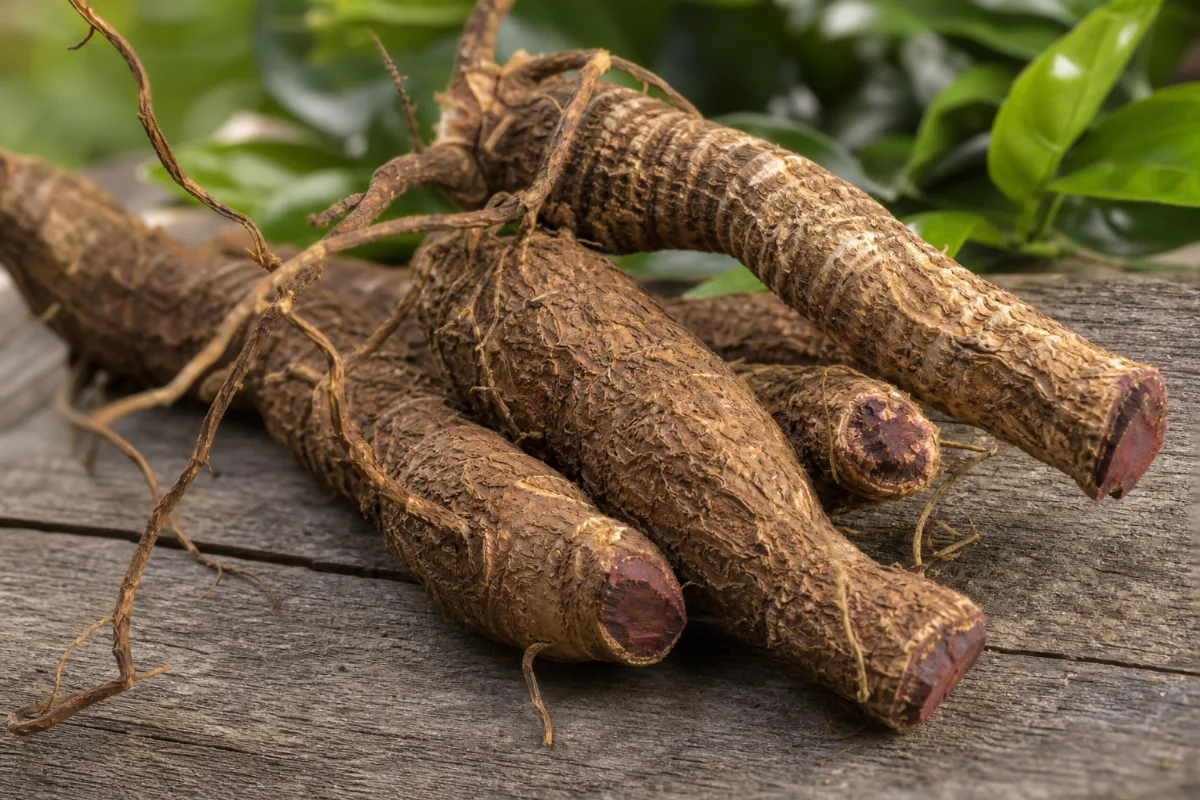
Cryptolepis sanguinolenta is a thin, climbing shrub of West Africa. The root is the medicinal part. It is sold in Ghana as a root decoction, a tea bag of root powder, and bottled liquid mixtures, often with other plants.
What makes it distinctive
The root holds indoloquinoline alkaloids: cryptolepine, neocryptolepine and isocryptolepine. In one farming trial cryptolepine made up about 2 percent of the dry root.
Cryptolepine acts against malaria parasites in dishes, but it also binds DNA and is toxic to human cells. Chemists are now designing safer look-alike molecules.
What people use it for
Traditional use is for malaria in Ghana and across West Africa. A review also lists diarrhoea and breathing complaints. Willcox lists it among six government-approved improved traditional malaria medicines.
What the research shows
One open study in Accra tested a root tea bag in 44 people with uncomplicated malaria; 31 finished. Parasites cleared in all of them by Day 7 and two relapsed. There was no comparison group, so we cannot tell how it compares with standard medicine. Lab studies show activity against the parasite, but a test of 20 bottled products found only 6 potent ones.
At a glance
Traditional uses history, not proof
- Malaria (decoction or tea bag of the root)
- Diarrhoea and respiratory complaints (reported in a review)
Studied for research
- Malaria: one small open study; very low certainty
- Activity against malaria parasites in dishes: lab only
- Cancer-cell toxicity: lab only; this is also a safety concern
- Blood sugar, infection and inflammation: lab or animal only
Main compounds
- Cryptolepine, the main alkaloid; binds DNA and is toxic to cells in the lab
- Neocryptolepine and isocryptolepine, related alkaloids
Common forms
- Root decoction
- Tea bag of root powder
- Bottled liquid mixtures, often with other plants
- Isolated cryptolepine (a lab compound, not a consumer product)
Research links: Tea-bag trial in Ghana (2010) · Lab study of cryptolepine with malaria drugs (2017) · Review of indoloquinoline alkaloids as antimalarials (2024) · Cryptolepine and DNA, lab study (1999) · WHO malaria fact sheet · Research Library · Genes & Biomarkers Library
The plant and its history
- Accepted scientific name
- Cryptolepis sanguinolenta (Lindl.) Schltr.
- Naming authority
- (Lindl.) Schltr.
- Synonyms
- Pergularia sanguinolenta Lindl. (named in the Bugyei 2010 trial)
- Common names
- Cryptolepis (English); Nibima and Phyto-Laria (Ghanaian product names, not plant names) (Ghana)
- Botanical family
- Apocynaceae
- Classification
- Plantae > Gentianales > Apocynaceae > Cryptolepis > Cryptolepis sanguinolenta
- Native range
- West Africa and wider tropical Africa (reviews describe a scrambling, thin-stemmed shrub found in Africa).
- Habitat
- Wild climbing shrub; being domesticated in Ghana.
- What the plant looks like
- Roots: The root is the medicinal part and contains the indoloquinoline alkaloids; about 2 percent cryptolepine of dry root in one cultivation trial.; Stems: Thin and twining.; Leaves: Not described in sources read.; Flowers: Not described in sources read.; Fruit: Not described in sources read.
- Cultivation
- A Ghanaian trial found higher planting density gave more root and cryptolepine, with the best yield at about 15 months.
- Harvest and processing
- Roots are dried and powdered or boiled as a decoction; bottled products are sold in Ghana.
- Look-alikes and adulterants
- Name: Other Cryptolepis species and plants sold under similar names; Note: Not checked in this lean build.
- Sustainability and conservation
- Not assessed here.
Traditional use and history history, not clinical proof
| Tradition or era | Documented use | Source |
|---|---|---|
| Traditional West African medicine, especially Ghana | The root decoction is used for malaria and, per a review, also for diarrhoea and respiratory conditions. | p29750083 |
| Modern Ghana | Root powder tea bags and bottled mixtures are sold in shops and clinics; Willcox lists Cryptolepis among six government-approved improved traditional malaria medicines. | p21204042 |
Traditional use shows how a plant was used. It does not show that a supplement works or is safe today.
What is inside, and how it may work
What the plant contains and how those compounds act in cells and animals. Laboratory and animal mechanisms are not proven effects in people.
Main compounds
| Compound | Family | Where it is concentrated | Activity studied | Level of evidence |
|---|---|---|---|---|
| Cryptolepine PubChem 82143 | indoloquinoline alkaloid | root About 2 mg per 100 mg dry root in one cultivation trial. | Acts against malaria parasites; binds DNA and is toxic to cells in lab tests. 12 5 6 1 | Laboratory research |
| Neocryptolepine PubChem 390526 | indoloquinoline alkaloid | root | Antimalarial in the lab; also limited by toxicity to cells. 13 11 | Laboratory research |
| Isocryptolepine | indoloquinoline alkaloid | root | Named with the other two alkaloids as an antimalarial scaffold; PubChem ID not looked up. 11 | Laboratory research |
Mechanisms, receptors and pathways
| Target or pathway | Gene or receptor | What was found | Level |
|---|---|---|---|
| DNA binding and topoisomerase II | DNA; topoisomerase II | Cryptolepine binds tightly to DNA and stabilises the topoisomerase II-DNA complex, which explains much of its cell toxicity. 5 17 | Laboratory research |
| Malaria parasite stages | Plasmodium falciparum | Active against late-stage gametocytes (the stage that infects mosquitoes) as well as asexual stages. 6 | Laboratory research |
| Heart potassium channel | hERG | Cryptolepine blocked hERG in the lab (IC50 7.8 uM). 4 | Laboratory research |
Absorption, metabolism and elimination
- Absorption
- Not described for people. In rats a second blood peak after oral dosing suggests recycling through bile.
- Distribution
- Not described in sources read.
- Metabolism
- Not described.
- Elimination
- Rat data suggest enterohepatic circulation after biliary excretion.
- Bioavailability
- Not established.
Isolated compounds versus whole extracts
Most lab work is on isolated cryptolepine, which is more toxic to cells and is being redesigned as drug analogues. The human study used whole root powder tea; results cannot be swapped between the two.
Nutritional composition
Cryptolepis is a medicinal herb, not a nutrient.
1 very low certainty4 not enough evidence
What is Cryptolepis good for?
What Cryptolepis has been studied for and how strong the evidence is. The only human evidence is one small open study, so every rating here is low or insufficient.
Benefits, one by one
Each card is a research question, not a promise. Tap a goal to filter. Open a card to see the studies, doses and limits.
Malaria: traditional use and one small human study
Very low certaintyIn Ghana and elsewhere in West Africa the root is drunk as a tea for malaria. One small open study of a root tea bag in 44 people with malaria reported that parasites cleared in everyone who finished. It had no comparison group, so it cannot show the tea works as well as standard medicine.
4 studiesTested form: a tea bag of root powder taken for five days. Ask a doct…
Studies, doses and limits
What the trials found
One prospective open (uncontrolled) study of a Ghanaian root tea bag in people with uncomplicated falciparum malaria: 44 enrolled, 31 completed. An editorial by an author with a commercial interest backed the findings. Willcox's review lists Cryptolepis among six government-approved improved traditional malaria medicines. The Bugyei paper also cites an older randomised comparison with chloroquine (22 patients); that was read only second-hand and is not counted here.
Results
Half of patients cleared parasites by 72 hours and all 31 completers by Day 7. Fever, chills, nausea and vomiting cleared by Day 3. Two of 31 had the parasite return (Days 21 and 28), giving the reported 93.5 percent cure rate. 13 of 44 did not finish.
Effect sizes as reported
Parasite clearance in all completers by Day 7 (no control group)
Why this rating
A single open study with no comparison group and 30 percent of people not completing; it was done in semi-immune people who had lived with malaria before; no randomised trial of the modern product was found.
Form and dose studied
Tested form: a tea bag of root powder taken for five days. Ask a doctor or pharmacist about amounts and forms; this page gives no dose advice.
Who was studied
Adults and children aged 11 to 50 in Accra, Ghana. Pregnant and breastfeeding women were excluded.
Limits
Open design, no control, many dropouts, semi-immune patients, a branded product; the paper's own claim of 'non-toxic' rests on routine lab tests only. Results may not apply to other products or to people with no prior malaria exposure.
Why researchers looked
The root has been used for malaria in West Africa for generations, and Ghana sells root products to the public.
Traditional use
A decoction of the root is the traditional form; tea bags and bottled liquid mixtures are sold in Ghana, often with other plants.
Proposed mechanism Pharmacological theory
Not fully known. The main alkaloid cryptolepine acts against malaria parasites in the lab (see the lab benefit below).
A proposed mechanism does not show that the effect happens in people.
Malaria is an emergency and needs proper tests and medicine. Do not rely on a root tea. See the Safety tab.
Activity against malaria parasites in lab dishes
Not enough evidenceIn test tubes and cell cultures the root extract and cryptolepine act against malaria parasites, including the stage that spreads to mosquitoes. This is lab work. It does not show that drinking the tea cures malaria.
4 studiesLab studies used root extract, isolated cryptolepine and bottled mixt…
Studies, doses and limits
What the trials found
No human data for this benefit. A systematic review of 200 papers found Cryptolepis sanguinolenta among five African plants with consistently very good lab antimalarial activity, but 81.9 percent of all experiments were in vitro. A 2025 test of 20 bottled Ghanaian herbal malaria products found only 6 with potent activity.
Results
Aqueous root extract IC50 49.65 nM and cryptolepine IC50 1965 nM against late-stage gametocytes (lab). Of 20 bottled Ghanaian herbal products, 6 (30 percent) had IC50 under 50 ug/ml; most were poor.
Effect sizes as reported
Lab potency only
Why this rating
Evidence is lab or cell work. It has not been confirmed in controlled human trials.
Form and dose studied
Lab studies used root extract, isolated cryptolepine and bottled mixtures.
Who was studied
Parasites in dishes.
Limits
Lab results often fail in people. Products on the market differ and some perform poorly.
Why researchers looked
Researchers looked for the chemical reason behind the traditional use.
Traditional use
Same traditional root decoction.
Proposed mechanism Laboratory research
Cryptolepine and related alkaloids bind DNA and are thought to harm the parasite this way; the same DNA binding is why they are also toxic to human cells.
A proposed mechanism does not show that the effect happens in people.
Malaria is an emergency and needs proper tests and medicine. Do not rely on a root tea. See the Safety tab.
Combinations with malaria medicines and with neem (lab only)
Not enough evidenceIn dishes, cryptolepine worked especially well with the medicine amodiaquine, added to chloroquine and lumefantrine, and worked against mefloquine. A root extract plus neem extract was also stronger together than alone. None of this has been tested in people.
2 studiesNot applicable.
Studies, doses and limits
What the trials found
No human interaction study exists. Lab work only.
Results
Cryptolepine with amodiaquine: synergistic (mean sum of FIC50 0.287). With lumefantrine and chloroquine: additive (1.017 and 1.465). With mefloquine: antagonistic (4.182). Root plus neem extracts: combination index 0.15 to 0.52 (3D7) and 0.23 to 0.61 (DD2), meaning synergy in dishes.
Effect sizes as reported
Lab interaction scores only
Why this rating
Parasite cultures only; no animal or human interaction data.
Form and dose studied
Not applicable.
Who was studied
Parasites in dishes.
Limits
Cannot be turned into advice about taking the tea with malaria medicines.
Why researchers looked
Ghanaian herbal products often mix plants, and researchers wanted to know how the root behaves beside standard drugs.
Traditional use
Polyherbal malaria products are common in Ghana.
Proposed mechanism Laboratory research
Not established; interaction was measured as parasite growth in dishes.
A proposed mechanism does not show that the effect happens in people.
Because it may change how malaria medicines work in the body, never combine it with prescribed antimalarials without talking to a doctor or pharmacist.
Toxicity to cancer cells (lab only)
Not enough evidenceCryptolepine kills many kinds of cells in dishes, including cancer cells, by binding DNA. Researchers study it as a lead for cancer drugs. This is a toxicity finding, not a sign the tea treats cancer, and there is no human cancer data.
4 studiesIsolated cryptolepine and root extract in dishes.
Studies, doses and limits
What the trials found
No human studies of cancer. Reviews describe cell and animal work only.
Results
Cryptolepine was much more toxic to B16 melanoma cells than two related alkaloids and altered the cell cycle in HL60 leukemia cells.
Effect sizes as reported
Cell toxicity only
Why this rating
Test-tube and cell work with the isolated compound; the same toxicity is a safety concern for healthy cells.
Form and dose studied
Isolated cryptolepine and root extract in dishes.
Who was studied
Cell lines.
Limits
Not shown in animals or people in the sources read; toxicity limits drug development.
Why researchers looked
The same DNA-binding property that harms malaria parasites also harms human cells.
Traditional use
None; the traditional use is for malaria.
Proposed mechanism Laboratory research
Cryptolepine binds DNA, poisons topoisomerase II and changes the cell cycle in melanoma and leukemia cells.
A proposed mechanism does not show that the effect happens in people.
Cell toxicity is the main safety worry. See the Safety tab. Do not use this plant as a cancer remedy.
Other claimed uses: infections, blood sugar and inflammation
Not enough evidenceReviews list antibacterial, antifungal, blood-sugar-lowering and anti-inflammatory effects of cryptolepine from lab and animal work. No human trial of these uses was found.
3 studiesNot applicable.
Studies, doses and limits
What the trials found
No human trial found. Review-level summaries only.
Results
No effect sizes reported in the abstracts read.
Effect sizes as reported
None
Why this rating
Lab and animal evidence only, abstracts of reviews only.
Form and dose studied
Not applicable.
Who was studied
Not applicable.
Limits
Abstracts only; primary studies not re-read.
Why researchers looked
Reviewers collected every effect reported for the plant and its main alkaloid.
Traditional use
Traditional uses in West Africa also include diarrhoea and respiratory conditions (per a review).
Proposed mechanism In vitro and animal
Not established.
A proposed mechanism does not show that the effect happens in people.
Do not use the plant to replace diabetes or infection treatment.
Connections to the rest of health
How Cryptolepis connects to the rest of our health knowledge graph. Every link says what kind of connection it is. A safety link (for example to the liver) is a warning, not a benefit. A study that merely mentions a topic never creates a benefit link.
Explore every connection: goals, body systems, organs, symptoms, genes
A. Wellness goals
| Connected to | Kind of connection | Evidence status | Context | Studies |
|---|---|---|---|---|
| Immune Support | Traditional use | Very low certainty | Malaria: traditional use and one small human study: In Ghana and elsewhere in West Africa the root is drunk as a tea for malaria. One small open study of a root tea bag in 44 people with malaria reported that parasites cleared in everyone who finished. It had no comparison group, so it cannot show the tea works as well as standard medicine. | 3 16 18 19 |
| Immune Support | Not enough evidence | Activity against malaria parasites in lab dishes: In test tubes and cell cultures the root extract and cryptolepine act against malaria parasites, including the stage that spreads to mosquitoes. This is lab work. It does not show that drinking the tea cures malaria. Combinations with malaria medicines and with neem (lab only): In dishes, cryptolepine worked especially well with the medicine amodiaquine, added to chloroquine and lumefantrine, and worked against mefloquine. A root extract plus neem extract was also stronger together than alone. None of this has been tested in people. | 6 15 20 11 8 | |
| Inflammation Balance | Not enough evidence | Other claimed uses: infections, blood sugar and inflammation: Reviews list antibacterial, antifungal, blood-sugar-lowering and anti-inflammatory effects of cryptolepine from lab and animal work. No human trial of these uses was found. | 14 17 10 | |
| Blood Sugar Balance | Not enough evidence | Other claimed uses: infections, blood sugar and inflammation: Reviews list antibacterial, antifungal, blood-sugar-lowering and anti-inflammatory effects of cryptolepine from lab and animal work. No human trial of these uses was found. | 14 17 10 |
B. Body systems
| Connected to | Kind of connection | Evidence status | Context | Studies |
|---|---|---|---|---|
| Immune System | Biological association | Very low certainty | Studied for: Malaria: traditional use and one small human study Studied for: Activity against malaria parasites in lab dishes | 3 16 18 19 6 15 20 11 8 14 17 10 |
| Cells | Biological association | Not enough evidence | Studied for: Toxicity to cancer cells (lab only) | 5 2 17 14 |
| Endocrine System | Biological association | Not enough evidence | Studied for: Other claimed uses: infections, blood sugar and inflammation | 14 17 10 |
E. Health conditions
I. Biomarkers
| Connected to | Kind of connection | Evidence status | Context | Studies |
|---|---|---|---|---|
| Malaria parasites in the blood | Biological association | Very low certainty | Measured in trials: decrease. A lab change is not the same as a health benefit. | 3 19 |
| Fever clearance time | Biological association | Very low certainty | Measured in trials: decrease. A lab change is not the same as a health benefit. | 3 |
| Cell survival in culture | Biological association | Not enough evidence | Measured in trials: decrease. A lab change is not the same as a health benefit. | 5 |
J. Genes, receptors and enzymes
L. Active compounds
| Connected to | Kind of connection | Evidence status | Context | Studies |
|---|---|---|---|---|
| Cryptolepine | Biological association | In vitro | Acts against malaria parasites; binds DNA and is toxic to cells in lab tests. Preparation or compound: root |
12 5 6 1 |
| Neocryptolepine | Biological association | In vitro | Antimalarial in the lab; also limited by toxicity to cells. Preparation or compound: root |
13 11 |
| Isocryptolepine | Biological association | In vitro | Named with the other two alkaloids as an antimalarial scaffold; PubChem ID not looked up. Preparation or compound: root |
11 |
Each connection is stored with the ingredient, the connected record, the kind of connection, the evidence status, the supporting studies, the preparation or compound involved, and a review date (last reviewed October 25, 2026).
The evidence
The research centre for Cryptolepis. Every record here was checked against PubMed or the publisher's page; we never list a study we have not verified.
Evidence by outcome
Bars show how many studies we found for each outcome, not how well it works. People are added up across trials only (reviews are not added, to avoid double counting).
How we rate evidence
High certainty
Several well-run trials or reviews agree; further research is unlikely to change the picture much.
Moderate certainty
Good trials point the same way, but some doubt remains.
Low certainty
Small, short or inconsistent trials. The finding could change with better research.
Very low certainty
Very little or very weak human data. Treat as a possibility only.
Mixed findings
Trials or reviews disagree with each other.
Not enough evidence
Not enough human research to say either way.
Evidence against
Good research found no benefit, or found harm.
We take the reviewers' own risk-of-bias and GRADE statements where they exist, and otherwise judge from study size, design, consistency, directness and whether a product matches what is sold. Many publications do not make evidence high. Method note: We read the one human trial in full text, the WHO fact sheet, and abstracts of lab studies and reviews, and checked GBIF and PubChem. No study is cited that we could not verify.
Study library: every study we checked 20
| Study | Design | People | Product, dose, length | Result |
|---|---|---|---|---|
| Amissah 2024 Increasing the planting density of Cryptolepis sanguinolenta increased root biomass and cryptolepine yield Heliyon · PMID 38770341 |
Other plant |
Six plant accessions grown at three planting densities in Ghana | Cryptolepis sanguinolenta root root not given here not given here · vs none |
At the highest planting density roots had a cryptolepine content of 2.08 mg per 100 mg dry root; 15 months of growth gave the maximum cryptolepine yield. Shows cryptolepine is a major root constituent (about 2 percent of dry root in this trial). Farming trial Methods, limits and fundingOutcomes: Root biomass and cryptolepine content Limitations: Agricultural study, not human health. Funding and conflicts: Not stated in abstract Read: abstract |
| Ansah 2013 A review of the anticancer potential of the antimalarial herbal Cryptolepis sanguinolenta and its major alkaloid cryptolepine Ghana Medical Journal · PMID 24391229 |
Narrative review review |
Literature on cytotoxicity and cancer cells | Root aqueous extract and cryptolepine root not given here not given here · vs none |
Says the root extract and cryptolepine are strongly cytotoxic to mammalian cells and may have a role as anticancer agents, and links this to anti-inflammatory action. All evidence discussed is laboratory work. Review; lab findings Methods, limits and fundingOutcomes: Cytotoxic mechanisms and anticancer potential Limitations: Abstract only; no human cancer data. Funding and conflicts: Not stated in abstract Read: abstract |
| Bugyei 2010 Clinical efficacy of a tea-bag formulation of Cryptolepis sanguinolenta root in the treatment of acute uncomplicated falciparum malaria Ghana Medical Journal · PMID 21326984 · DOI |
Open label trial |
44 People aged 11 to 50 with symptomatic uncomplicated falciparum malaria, three clinics in Accra, Ghana (pregnant and breastfeeding women excluded) |
Cryptolepis sanguinolenta root powder tea bag (a Ghanaian product) root not given here not given here · vs none |
44 enrolled, 31 completed (12 defaulted, 1 withdrawn). Half cleared parasites by 72 hours and all completers by Day 7. Fever, chills, nausea and vomiting cleared by Day 3. Two recrudescences (Days 21 and 28) gave a 93.5 percent cure rate. Alkaline phosphatase stayed raised through the study (peak Day 14); AST and ALT did not differ significantly. The authors did not see signs of toxicity. Parasites cleared in all 31 completers by Day 7; 29 of 31 stayed clear to Day 28 Methods, limits and fundingOutcomes: Parasite clearance, fever clearance, symptoms, blood and liver tests up to Day 28 Limitations: Open trial, no comparison group, no randomisation; 13 of 44 did not finish; semi-immune patients only; adults and older children; the lab tests were not designed to rule out harm. Funding and conflicts: Conflict of interest: none declared in the paper. Read: full-text |
| Chenu 2026 Antiplasmodial activity and pharmacokinetic profiling of cryptolepine and 2,7-dibromocryptolepine Drug Development Research · PMID 41631973 · DOI |
In vitro and animal rat and in-vitro |
Lab assays and rats | Isolated cryptolepine and a synthetic analogue not applicable not given here not given here · vs none |
The abstract notes concern about cryptolepine toxicity because it intercalates DNA. Cryptolepine blocked the hERG heart potassium channel in the lab (IC50 7.8 uM; the analogue 1.0 uM). In rats a second blood peak after oral dosing suggested the compound is recycled through bile (enterohepatic circulation). Lab and rat findings Methods, limits and fundingOutcomes: Antiplasmodial activity, hERG channel block, rat pharmacokinetics Limitations: No human pharmacokinetic data; isolated compound. Funding and conflicts: Not stated in abstract Read: abstract |
| Dassonneville 1999 Stimulation of topoisomerase II-mediated DNA cleavage by three DNA-intercalating plant alkaloids: cryptolepine, matadine, and serpentine Biochemistry · PMID 10387011 · DOI |
Laboratory research in-vitro |
DNA, enzyme assays, B16 melanoma and HL60 leukemia cells | Isolated cryptolepine not applicable not given here not given here · vs none |
Cryptolepine bound tightly to DNA like a typical intercalating agent, stabilised the topoisomerase II-DNA complex, was much more toxic to B16 melanoma cells than the two related alkaloids and changed the cell cycle in HL60 leukemia cells. Cell toxicity and DNA effects in the lab Methods, limits and fundingOutcomes: DNA binding, topoisomerase II poisoning, cell toxicity Limitations: Isolated compound, cell and test-tube work; not shown in people drinking the root. Funding and conflicts: Not stated in abstract Read: abstract |
| Forkuo 2017 In vitro anti-malarial interaction and gametocytocidal activity of cryptolepine Malaria Journal · PMID 29282057 · DOI |
Laboratory research in-vitro |
Cultured Plasmodium falciparum (3D7 and NF54 strains) | Cryptolepis sanguinolenta aqueous root extract and isolated cryptolepine root not given here not given here · vs none |
The root extract (IC50 49.65 nM) and cryptolepine (IC50 1965 nM) were active against late-stage gametocytes. Cryptolepine was synergistic with amodiaquine, additive with lumefantrine and chloroquine, and antagonistic with mefloquine. Lab activity and lab drug interactions only Methods, limits and fundingOutcomes: Activity against late-stage gametocytes; drug interaction with four standard antimalarials Limitations: Parasites in dishes; not a human interaction study. Funding and conflicts: Not stated in abstract Read: abstract |
| GBIF 2026 GBIF species match: Cryptolepis sanguinolenta GBIF API (checked 2026-10-25) · Source |
Database record plant |
Not applicable | Cryptolepis sanguinolenta (Lindl.) Schltr. not applicable not given here not given here · vs none |
Accepted, exact match; usage key 5524969; family Apocynaceae; order Gentianales; genus Cryptolepis. Database record Methods, limits and fundingOutcomes: Accepted name and family Limitations: NCBI Taxonomy not checked. Funding and conflicts: Not applicable Read: full-text |
| Korsah 2026 Synergistic combination of Cryptolepis sanguinolenta and Azadirachta indica against Plasmodium falciparum Advances in Pharmacological and Pharmaceutical Sciences · PMID 42677102 · DOI |
Laboratory research in-vitro |
Chloroquine-sensitive (3D7) and resistant (DD2) P. falciparum in dishes | Aqueous extracts of Cryptolepis sanguinolenta and neem (Azadirachta indica) root (Cryptolepis); plant part for neem not stated in abstract not given here not given here · vs none |
Each extract alone had IC50 of 10 ug/ml or less. The two together were synergistic against both strains (combination index 0.15 to 0.52 for 3D7; 0.23 to 0.61 for DD2). Synergy in the lab Methods, limits and fundingOutcomes: Antimalarial activity of each extract and of the combination Limitations: Parasites in dishes; not tested in animals or people. Funding and conflicts: Not stated in abstract Read: abstract |
| Mensah 2019 Cryptolepine, the main alkaloid of the antimalarial Cryptolepis sanguinolenta, induces malformations in zebrafish embryo Biochemistry Research International · PMID 31360547 · DOI |
Laboratory research zebrafish |
Zebrafish eggs treated from 6 to 72 hours after fertilisation | Isolated cryptolepine not applicable not given here not given here · vs none |
Cryptolepine caused dose- and time-dependent death (LC50 260 uM), blocked hatching above 500 uM and caused smaller body size, eye and heart-sac changes and muscle malformations. The abstract also says an earlier study found it toxic to mouse embryos in vivo without signs of teratogenicity. Embryo toxicity in a fish model Methods, limits and fundingOutcomes: Embryo death, hatching and malformations Limitations: Fish embryos at high concentrations; not a measure of risk from tea. Funding and conflicts: Not stated in abstract Read: abstract |
| Osafo 2017 Phytochemical and pharmacological review of Cryptolepis sanguinolenta (Lindl.) Schlechter Advances in Pharmacological Sciences · PMID 29750083 · DOI |
Narrative review review |
Literature on the plant | Cryptolepis sanguinolenta whole plant, mainly root not given here not given here · vs none |
Describes the plant as a thin-stemmed shrub used in West Africa for malaria, diarrhoea and respiratory conditions and concludes that research shows potential as a source of lead compounds, with grey areas still open. Review; no numbers Methods, limits and fundingOutcomes: Traditional use, chemistry, pharmacology, toxicology Limitations: Abstract only; authors include researchers on the plant. Funding and conflicts: Not stated in abstract Read: abstract |
| Parvatkar 2024 Indoloquinoline alkaloids as antimalarials: advances, challenges, and opportunities ChemMedChem · PMID 38840271 · DOI |
Narrative review review |
Literature on cryptolepine, neocryptolepine and isocryptolepine | Indoloquinoline alkaloids root alkaloids not given here not given here · vs none |
Calls the three alkaloids potent against malaria parasites in the lab but says their rigid structure and toxicity to cells are major drawbacks for drug development; chemists are making analogues to reduce toxicity. Review; no pooled numbers Methods, limits and fundingOutcomes: Antimalarial effects, mechanisms, toxicity limits Limitations: Abstract only; drug-design focus. Funding and conflicts: Not stated in abstract Read: abstract |
| PubChem 2026 PubChem: cryptolepine (CID 82143) PubChem API (checked 2026-10-25) · Source |
Database record compound |
Not applicable | Cryptolepine not applicable not given here not given here · vs none |
5-methylindolo[3,2-b]quinoline, formula C16H12N2. Database record Methods, limits and fundingOutcomes: Structure Limitations: Not applicable Funding and conflicts: Not applicable Read: full-text |
| PubChem 2026 PubChem: neocryptolepine (CID 390526) PubChem API (checked 2026-10-25) · Source |
Database record compound |
Not applicable | Neocryptolepine not applicable not given here not given here · vs none |
Formula C16H12N2. Database record Methods, limits and fundingOutcomes: Structure Limitations: Not applicable Funding and conflicts: Not applicable Read: full-text |
| Shnyder 2021 Recent advances in the chemistry and pharmacology of cryptolepine Progress in the Chemistry of Organic Natural Products · PMID 33797643 · DOI |
Narrative review review |
Literature of the last decade | Cryptolepine and analogues root alkaloid not given here not given here · vs none |
Reviews herbal malaria use and analogues for malaria, trypanosomiasis and cancer, and lists antimicrobial, antidiabetic and anti-inflammatory activities plus pharmacokinetics and toxicity. Review; no pooled numbers Methods, limits and fundingOutcomes: Chemistry, pharmacology, pharmacokinetics, toxicity Limitations: Abstract only. Funding and conflicts: Not stated in abstract Read: abstract |
| Tajbakhsh 2021 Antiplasmodial, antimalarial activities and toxicity of African medicinal plants: a systematic review of literature Malaria Journal · PMID 34433465 · DOI |
Systematic review review |
200 articles, 722 experiments, 502 African plant species | African medicinal plants including Cryptolepis sanguinolenta mixed not given here not given here · vs none |
Cryptolepis sanguinolenta was one of five plants with consistently very good activity across studies. 81.9 percent of experiments were in vitro and only one plant (Cochlospermum planchonii) had been clinically trialled. Pure compounds were more active than crude extracts (p=0.044). Consistent lab activity; very little clinical testing overall Methods, limits and fundingOutcomes: Antiplasmodial activity and toxicity Limitations: Mostly in vitro work; different methods across studies; abstract only was read. Funding and conflicts: Not stated in abstract Read: abstract |
| Tempesta 2010 The clinical efficacy of Cryptolepis sanguinolenta in the treatment of malaria (editorial) Ghana Medical Journal · PMID 21326982 |
Editorial |
Not applicable (commentary on the Bugyei trial) | Cryptolepis sanguinolenta root root not given here not given here · vs none |
Editorial supporting the plant as a malaria remedy. The author has a commercial interest (Phytica, Inc.), as recorded in the existing summary; the PubMed record has no abstract. Opinion, not data Methods, limits and fundingOutcomes: Commentary on clinical evidence Limitations: Commercial interest of the author; no new data. Funding and conflicts: Author linked to Phytica, Inc. (per existing summary; not re-opened). Read: summary-only |
| Tudu 2023 Unravelling the pharmacological properties of cryptolepine and its derivatives: a mini-review insight Naunyn-Schmiedeberg's Archives of Pharmacology · PMID 36251044 · DOI |
Narrative review review |
Literature on cryptolepine | Cryptolepine and derivatives root alkaloid not given here not given here · vs none |
Summarises in vitro work on anticancer and antimalarial effects through DNA synthesis and topoisomerase II inhibition, and lists antibacterial, antifungal, anti-hyperglycaemic, anti-inflammatory and other properties. Review; lab findings Methods, limits and fundingOutcomes: Pharmacological properties Limitations: Abstract only; mostly in vitro. Funding and conflicts: Not stated in abstract Read: abstract |
| Willcox 2011 Improved traditional phytomedicines in current use for the clinical treatment of malaria Planta Medica · PMID 21204042 · DOI |
Narrative review review |
Six government-approved plant medicines for malaria | Six plant medicines including Cryptolepis sanguinolenta mixed not given here not given here · vs none |
Lists Cryptolepis sanguinolenta among six phytomedicines approved by at least one government and used on a relatively large scale, and reviews their clinical trials and research priorities. Abstract only was read. Descriptive Methods, limits and fundingOutcomes: Development, chemistry, pharmacology and trials of improved traditional malaria medicines Limitations: Abstract only; does not give Cryptolepis-specific numbers in the abstract. Funding and conflicts: Not stated in abstract Read: abstract |
| World Health Organization 2026 Malaria fact sheet WHO fact sheet · Source |
Authoritative guidance |
General public | Not applicable not applicable not given here not given here · vs none |
Left untreated, P. falciparum malaria can progress to severe illness and death within 24 hours. Artemisinin-based combination therapies are the most effective treatment for P. falciparum malaria. Infants, children under 5, pregnant women, travellers and people with HIV or AIDS are at higher risk of severe infection. The page is not about Cryptolepis. Guidance Methods, limits and fundingOutcomes: Malaria severity and treatment Limitations: Does not mention Cryptolepis. Funding and conflicts: WHO Read: full-text |
| Yeboah et al. 2025 The efficacy of selected Ghanaian herbal antimalarials against laboratory strains and clinical isolates of Plasmodium falciparum Scientific Reports · PMID 41068365 · DOI |
Laboratory research in-vitro |
20 20 liquid herbal malaria products bought in Accra, tested on five lab strains and two clinical isolates |
Commercial Ghanaian herbal malaria products (some may contain Cryptolepis; ingredient lists not re-opened) mixed not given here not given here · vs none |
6 of 20 products (30 percent) had potent activity (IC50 under 50 ug/ml); most showed poor activity. The authors call for stronger regulation and quality monitoring of traditional medicines in Ghana. Most products weak in the lab Methods, limits and fundingOutcomes: Growth inhibition of malaria parasites in dishes Limitations: Only the abstract was re-read for this file; which products contain Cryptolepis was not re-checked; lab only. Funding and conflicts: Not stated in abstract Read: abstract |
What we do not know yet
- No randomised trial of Cryptolepis for malaria, and none against standard treatment.
- The only human study was open-label with 13 of 44 not finishing.
- No human data on interactions, pregnancy, children or long-term safety.
- No EMA, LiverTox, NCCIH or LactMed record was read.
- Cause of the raised alkaline phosphatase is unknown.
How new research is added
New studies are found by a saved PubMed search and are placed in a review queue. A person reads each one before it changes any evidence rating or safety wording.
Lab markers
What changed in blood or saliva tests during trials. A changed number is not the same as feeling or being healthier, and we give no "normal ranges".
Other 3
Malaria parasites in the blood
Decrease in trials
The number of malaria parasites seen in a blood smear and how fast they disappear after treatment.
Very low certaintyResults and what it means
Why it was measured
It shows whether a malaria treatment is killing the parasite.
Statistical vs. clinical meaning
Encouraging but uncontrolled; cannot be compared with standard medicine.
Safety implication
If parasites are not cleared quickly, malaria can become severe within hours to days. Always test and treat with proven medicine.
| Study | Result | People | Product |
|---|---|---|---|
| 3 | Half of 44 treated patients had no parasites by 72 hours and all 31 completers by Day 7; two relapses (Days 21 and 28). | People with uncomplicated falciparum malaria, Ghana | Root powder tea bag (Ghanaian product) |
Fever clearance time
Decrease in trials
How many hours a fever takes to go away after treatment starts.
Very low certaintyResults and what it means
Why it was measured
Fever is the commonest malaria symptom.
Statistical vs. clinical meaning
Typical of many malaria treatments; no control group.
Safety implication
Feeling better does not prove the infection is gone.
| Study | Result | People | Product |
|---|---|---|---|
| 3 | Mean fever clearance time was 25.2 hours (SD 21.2); fever, chills, nausea and vomiting had cleared by Day 3. | As above | Root powder tea bag |
Cell survival in culture
Decrease in trials
The share of cells that stay alive after exposure to a compound in the lab.
Not enough evidenceResults and what it means
Why it was measured
It measures how toxic a substance is to living cells.
Statistical vs. clinical meaning
A safety warning in the lab, not a treatment result.
Safety implication
The reason cryptolepine is treated as a drug lead with toxicity problems.
| Study | Result | People | Product |
|---|---|---|---|
| 5 | Cryptolepine was strongly toxic to melanoma cells and altered the cycle of leukemia cells. | B16 melanoma and HL60 leukemia cell lines | Isolated cryptolepine |
Safety
What studies and official sources say about side effects, medicines and who should check first. Each point shows what kind of evidence it comes from.
Main points to know 5
- Malaria needs medical care, not a root tea. The WHO says untreated falciparum malaria can become severe and fatal within 24 hours, and that artemisinin-based combinations are the most effective treatment. The one small human study of Cryptolepis had no comparison group. If you have fever in or after a trip to a malaria area, get tested and treated by a clinic. Authoritative guidance 19 3
- The main alkaloid is toxic to cells in the lab. Cryptolepine binds DNA, poisons an enzyme that handles DNA (topoisomerase II) and kills many cell types in dishes. Reviewers call this toxicity a major drawback for drug development. What this means for people drinking the root tea is not known. Laboratory research 5 11 2
- A liver blood test (alkaline phosphatase) stayed raised in the human study. In the Ghanaian tea-bag study, alkaline phosphatase stayed higher than before treatment throughout, with a peak on Day 14. AST and ALT did not differ significantly. The authors did not see signs of toxicity, but the cause of the ALP rise was not worked out and malaria itself can change liver tests. No case of liver injury was found in this search. Other 3
- Pregnancy and breastfeeding: avoid. Pregnant and breastfeeding women were excluded from the human study. Cryptolepine harmed fish embryos in the lab, and the same abstract notes an earlier mouse study found it toxic to embryos. Malaria in pregnancy is itself serious, so pregnant women should see a clinic and not self-treat. Laboratory research 9 3 19
- Possible drug interactions are untested in people. In dishes, cryptolepine added to or enhanced some malaria medicines and worked against mefloquine. In the lab it also blocked a heart potassium channel (hERG). Nobody has tested these in people, so ask a pharmacist before combining it with malaria medicines, heart-rhythm medicines or diabetes medicines. Laboratory research 6 4
Side effects 3
| Effect | How often | Severity and recovery | Evidence |
|---|---|---|---|
| Raised alkaline phosphatase (liver or bile-duct blood test) Persistently raised through the study with a peak on Day 14; ALT and AST not significantly changed. | Not established | mild lab change; cause not established Not reported beyond Day 28 in the sources read | Other 3 |
| Diarrhoea, upper respiratory infection, fainting (reported as reasons patients left the study) The paper lists these in the context of withdrawals and does not say they were caused by the tea. Malaria itself causes similar symptoms. | Not established | not graded Not stated | Other 3 |
| Embryo toxicity and malformations Zebrafish embryos at high concentrations; not a measure of risk from tea. | Not established | serious in the lab model Not applicable | Laboratory research 9 |
Liver
No case report of liver injury from Cryptolepis was found in this search, and an NCBI Bookshelf search found no LiverTox entry. In the one human study, alkaline phosphatase was persistently higher than before treatment (peak Day 14) while AST and ALT showed no significant difference; the authors did not interpret this as toxicity but the cause was not established. The paper also notes that Ghanaian liquid decoctions have been preserved with chloroform, which is toxic to the liver, and the tea bag was designed to avoid it. 3
How often. Not known; one small study of 44.
Monitoring. No monitoring guidance exists. People with liver or bile-duct disease should not use it without a doctor.
This is a safety connection. It is not evidence that Cryptolepis supports liver health.
Medicines and supplements 4
| With | Why it matters | Importance | Evidence | What to do |
|---|---|---|---|---|
| Antimalarial medicines (amodiaquine, chloroquine, lumefantrine, mefloquine) prescription | In lab cultures cryptolepine was synergistic with amodiaquine, additive with chloroquine and lumefantrine and antagonistic with mefloquine. | Unknown in people. Mefloquine antagonism is a lab result only. | Laboratory research Not enough evidence 6 | Do not mix with prescribed malaria medicine without talking to a clinician or pharmacist. |
| Heart-rhythm medicines and other drugs that affect the heart's electrical rhythm prescription | Cryptolepine blocked the hERG potassium channel in lab tests (IC50 7.8 uM); blocking this channel can lengthen the heart's QT interval. | Theoretical. No human heart data were found. | Pharmacological theory Not enough evidence 4 | Ask a pharmacist first if you take heart-rhythm medicines. |
| Diabetes medicines prescription | Reviews list blood-sugar-lowering effects of cryptolepine in lab and animal work. | Theoretical; no human data. | Pharmacological theory Not enough evidence 17 14 | Tell your doctor if you use the root and have diabetes. |
| Neem (Azadirachta indica) and other plants in Ghanaian mixtures herb | Synergy against malaria parasites in dishes. | Unknown in people; mixed products make it hard to know what a person actually takes. | Laboratory research Not enough evidence 8 20 | Check labels; mixed products are common in Ghana. |
Who should check first 5
| Situation | Advice | Evidence |
|---|---|---|
| Suspected or confirmed malaria | Seek testing and proven treatment; do not self-treat with the herb. | Authoritative guidance 19 |
| Pregnancy and breastfeeding | Avoid; excluded from the human study and embryo-toxic in lab models. | Laboratory research 9 3 |
| Children | Not enough data; the study enrolled people aged 11 to 50. Children with fever need a clinic. | Other 3 19 |
| Liver or bile-duct disease | Avoid unless a doctor agrees; liver enzyme changes were seen and safety is unproven. | Other 3 |
| Cancer treatment or planned surgery | Tell your care team; the main alkaloid affects DNA and cells in the lab. | Pharmacological theory 5 |
Overdose, product quality and regulators
Summary. Cryptolepine is cytotoxic and DNA-intercalating in lab studies. This is why reviewers consider the compound difficult to develop as a medicine.
Animal. An earlier mouse study (cited in a zebrafish paper's abstract) found cryptolepine toxic to embryos without signs of teratogenicity. Zebrafish embryos showed death and malformations at high concentrations (LC50 260 uM).
Human doses studied. Not given here.
High dose or long term signals. Not known. The human study ran five days with 28 days of follow-up.
Overdose response. No data found.
Genotoxicity. Binds DNA and poisons topoisomerase II in the lab; a review also describes concern about DNA intercalation. Not studied in people.
Toxic plant parts. The root holds the alkaloids and is the medicinal part; other plant parts were not assessed here.
Quality of bottled Ghanaian herbal malaria products is uneven and ingredient content is poorly controlled.
Potency varies. Only 6 of 20 bottled herbal malaria products tested had potent lab activity; the authors call for better regulation and quality monitoring. 20
Chloroform preservative. The Bugyei paper says many Ghanaian liquid decoctions have been preserved with chloroform, which is toxic to the liver. 3
Mixed products. Many products combine several plants, so effects cannot be pinned on the root alone. 8 20
| Body | Action | Date |
|---|---|---|
| WHO (Global) | Malaria fact sheet: artemisinin-based combinations are the most effective treatment for P. falciparum; untreated infection can become severe within 24 hours. The page does not mention Cryptolepis. source | 2026 |
When to get medical help
- Fever, shaking chills, headache or vomiting in or after a trip to a malaria area: get a malaria test the same day.
- Confusion, seizures, trouble breathing, very dark urine or yellow skin or eyes: go to an emergency department.
- Fainting, racing or irregular heartbeat after using the root: stop and seek care.
Stop the supplement and contact a clinician or emergency service. In the US, Poison Control is 1-800-222-1222.
General information only, not medical advice. Ask a clinician or pharmacist before use, especially with medicines, in pregnancy or with a health condition. See the Natural Remedy Safety guide.
Frequently asked questions
What is Cryptolepis?
Does Cryptolepis cure malaria?
Can I use it instead of malaria medicine?
No. The WHO says untreated falciparum malaria can become severe and fatal within 24 hours and that artemisinin-based combinations are the most effective treatment. See a clinic for a test.
Is Cryptolepis safe?
Is it safe in pregnancy or breastfeeding?
Can it harm the liver?
No liver injury case was found, but alkaline phosphatase stayed raised in the human study and the cause was not worked out. Some bottled Ghanaian decoctions were preserved with chloroform, which is liver-toxic.
Does it interact with malaria medicines?
In dishes it was synergistic with amodiaquine, additive with chloroquine and lumefantrine and antagonistic with mefloquine. No human study exists, so ask a pharmacist.
What is cryptolepine?
Does it help with cancer?
Are bottled Ghanaian herbal malaria products reliable?
Not necessarily. In a 2025 lab test, only 6 of 20 products were potent and the authors asked for better regulation and quality checks.
What about the neem combination?
In dishes, root plus neem extracts were synergistic against malaria parasites. It has not been tested in animals or people.
How much should I take?
This page gives no amounts. Because of the safety concerns, talk to a doctor or pharmacist first.
Explore by health goal
Editorial transparency
- Written by
- AlternativeMed editorial team. Research compiled with AI assistance, then checked against PubMed records.
- Medical review
- None. This page has not been reviewed by a physician or pharmacist.
- First published
- 2026-10-25
- Last substantive update
- 2026-10-25
- How we research
- We read the one human trial in full text, the WHO fact sheet, and abstracts of lab studies and reviews, and checked GBIF and PubChem. No study is cited that we could not verify.
- How we rate evidence
- See "How we rate evidence" in the Evidence tab.
- Independence
- No product is promoted on this page. No affiliate links are shown. If one is added later it will be labelled and kept apart from the evidence.
Sources 20
Each source was opened and checked. Where we read only the abstract, it says so. The small numbers in the text point here.
- Amissah JN, Opoku-Agyemang, Asem et al.. Increasing the planting density of Cryptolepis sanguinolenta increased root biomass and cryptolepine yield. Heliyon. 2024. PMID 38770341. (abstract)
- Ansah C, Mensah KB. A review of the anticancer potential of the antimalarial herbal Cryptolepis sanguinolenta and its major alkaloid cryptolepine. Ghana Medical Journal. 2013. PMID 24391229. (abstract)
- Bugyei KA, Boye GL, Addy ME. Clinical efficacy of a tea-bag formulation of Cryptolepis sanguinolenta root in the treatment of acute uncomplicated falciparum malaria. Ghana Medical Journal. 2010. PMID 21326984. DOI 10.4314/gmj.v44i1.68849. (full-text)
- Chenu E, Duffy S, Forkuo AD, Gbedema SY, Abdelall et al.. Antiplasmodial activity and pharmacokinetic profiling of cryptolepine and 2,7-dibromocryptolepine. Drug Development Research. 2026. PMID 41631973. DOI 10.1002/ddr.70245. (abstract)
- Dassonneville L, Bonjean K, De Pauw-Gillet MC, et al.. Stimulation of topoisomerase II-mediated DNA cleavage by three DNA-intercalating plant alkaloids: cryptolepine, matadine, and serpentine. Biochemistry. 1999. PMID 10387011. DOI 10.1021/bi990094t. (abstract)
- Forkuo AD, Ansah C, Mensah KB, et al.. In vitro anti-malarial interaction and gametocytocidal activity of cryptolepine. Malaria Journal. 2017. PMID 29282057. DOI 10.1186/s12936-017-2142-z. (abstract)
- GBIF. GBIF species match: Cryptolepis sanguinolenta. GBIF API (checked 2026-10-25). 2026. (full-text)
- Korsah S, Nortey et al.. Synergistic combination of Cryptolepis sanguinolenta and Azadirachta indica against Plasmodium falciparum. Advances in Pharmacological and Pharmaceutical Sciences. 2026. PMID 42677102. DOI 10.1155/adpp/1273876. (abstract)
- Mensah KB, Benneh CK, Forkuo AD, Ansah C. Cryptolepine, the main alkaloid of the antimalarial Cryptolepis sanguinolenta, induces malformations in zebrafish embryo. Biochemistry Research International. 2019. PMID 31360547. DOI 10.1155/2019/7076986. (abstract)
- Osafo N, Mensah KB, Yeboah OK. Phytochemical and pharmacological review of Cryptolepis sanguinolenta (Lindl.) Schlechter. Advances in Pharmacological Sciences. 2017. PMID 29750083. DOI 10.1155/2017/3026370. (abstract)
- Parvatkar PT, Diagne, Zhao, Manetsch. Indoloquinoline alkaloids as antimalarials: advances, challenges, and opportunities. ChemMedChem. 2024. PMID 38840271. DOI 10.1002/cmdc.202400254. (abstract)
- PubChem. PubChem: cryptolepine (CID 82143). PubChem API (checked 2026-10-25). 2026. (full-text)
- PubChem. PubChem: neocryptolepine (CID 390526). PubChem API (checked 2026-10-25). 2026. (full-text)
- Shnyder SD, Wright CW. Recent advances in the chemistry and pharmacology of cryptolepine. Progress in the Chemistry of Organic Natural Products. 2021. PMID 33797643. DOI 10.1007/978-3-030-64853-4_4. (abstract)
- Tajbakhsh E, Kwenti TE, Kheyri P, et al.. Antiplasmodial, antimalarial activities and toxicity of African medicinal plants: a systematic review of literature. Malaria Journal. 2021. PMID 34433465. DOI 10.1186/s12936-021-03866-0. (abstract)
- Tempesta MS. The clinical efficacy of Cryptolepis sanguinolenta in the treatment of malaria (editorial). Ghana Medical Journal. 2010. PMID 21326982. (summary-only)
- Tudu CK, Bandyopadhyay A, Kumar M, et al.. Unravelling the pharmacological properties of cryptolepine and its derivatives: a mini-review insight. Naunyn-Schmiedeberg's Archives of Pharmacology. 2023. PMID 36251044. DOI 10.1007/s00210-022-02302-7. (abstract)
- Willcox M. Improved traditional phytomedicines in current use for the clinical treatment of malaria. Planta Medica. 2011. PMID 21204042. DOI 10.1055/s-0030-1250548. (abstract)
- World Health Organization. Malaria fact sheet. WHO fact sheet. 2026. (full-text)
- Yeboah et al.. The efficacy of selected Ghanaian herbal antimalarials against laboratory strains and clinical isolates of Plasmodium falciparum. Scientific Reports. 2025. PMID 41068365. DOI 10.1038/s41598-025-19429-1. (abstract)