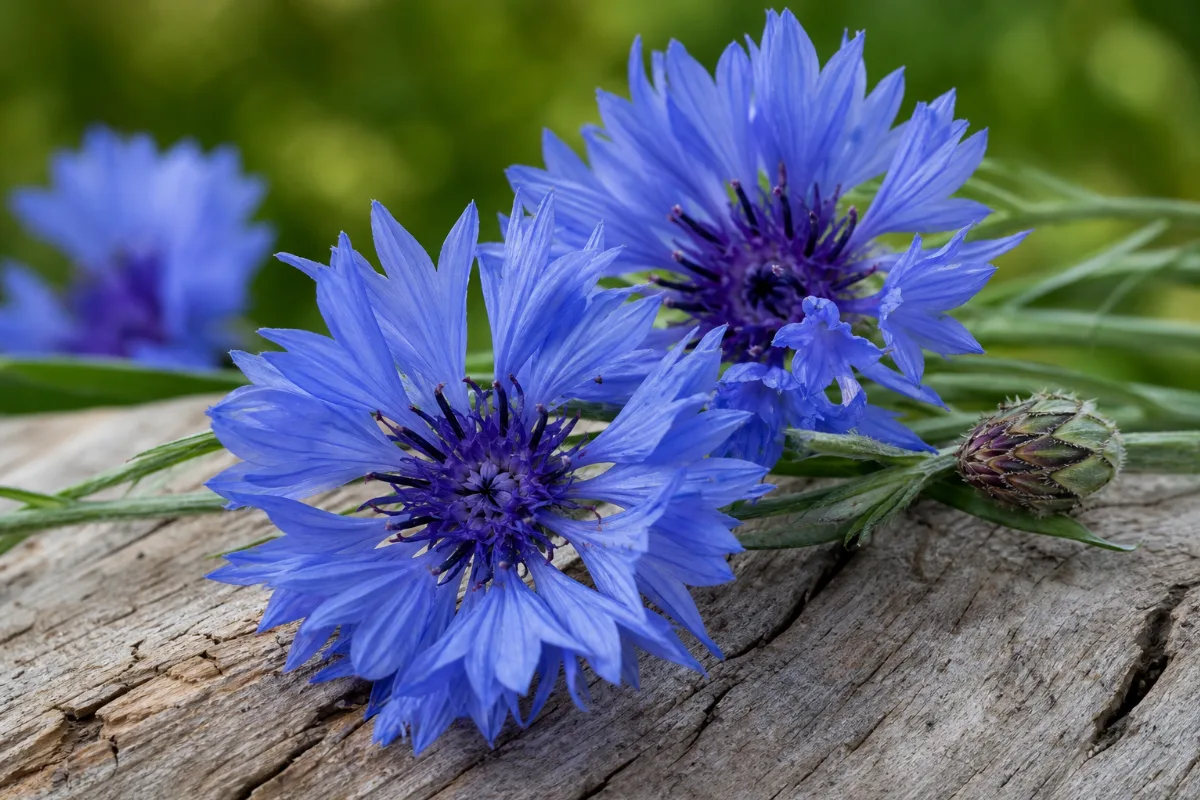
Herbs & Botanicals · Blue flower, traditional eye wash
Cornflower
Centaurea cyanus · also called Bachelor's button, bluebottle, Flos Cyani, aciano (Spanish)
Cornflower is a blue wildflower whose petals go into herbal tea blends and food, and were traditionally used as an eye wash and a mild diuretic tea. We found no human studies; the rest is lab and mouse research. Never put home-made cornflower tea in your eyes, because eye products must be sterile. People allergic to daisy-family plants should be careful.
General information, not medical advice. Last substantive update · Not medically reviewed. A named clinician has not signed off on this page. How this page is made
About Cornflower
Cornflower is a blue daisy-family wildflower used for colour in tea and food and, traditionally, as an eye wash and mild diuretic tea. Research is very thin: no human trial, and only lab, cell and mouse studies. The key cautions are non-sterile eye use, daisy-family allergy, unknown pregnancy safety, and mix-ups with centaury and blessed thistle.
What it is
Cornflower is the common name for Centaurea cyanus, a plant in the daisy family (Asteraceae). The blue flower heads are used. They contain blue anthocyanin pigments and flavonoids, and the daisy family as a whole is known for bitter sesquiterpene lactones.
It grows as a field weed in much of Europe. Petals are used as a garnish, as colour in tea blends, and in some skin creams.
Not centaury, not blessed thistle
The names are easy to mix up. Centaury (Centaurium erythraea) is a bitter digestive herb from the gentian family. Blessed thistle (Centaurea benedicta) is another plant in the same genus as cornflower, but a different herb with different uses. Everything on this page is about Centaurea cyanus. Check the Latin name on the label.
What it is used for
Traditionally the flowers were made into an eye wash or poultice and a mild diuretic tea, and used for digestion, kidney and liver complaints. No regulator has accepted these uses, and we found no EU, US or WHO monograph.
What the research shows
We found no human trial. Lab studies show antioxidant activity and some effects on skin inflammation signals and bacteria in dishes. A mouse study looked at steroid muscle wasting. One tiny uncontrolled study of multi-ingredient creams included cornflower water but cannot show its own effect. Lab and mouse results often do not carry over to people.
At a glance
Traditional uses history, not proof
- Eye wash or poultice for tired or inflamed eyes (old folk use)
- Mild diuretic tea, and digestive, kidney and liver uses (folk use)
- Edible flower and natural colour in food and tea blends
Studied for research
- Eye wash: traditional only, no trial
- Antioxidant activity: test tube only
- Skin inflammation signals: cells and enzymes only
- Germ-killing: lab dish only
- Steroid muscle wasting: cells and mice only
- Skin cream ingredient: one tiny uncontrolled study, cornflower not separated out
Main compounds
- Anthocyanins (blue pigments such as cyanin)
- Flavonoids, including apigenin derivatives
- N-feruloylserotonin
- Bitter sesquiterpene lactones are typical of the daisy family (not confirmed for cornflower in our sources)
Common forms
- Dried petals in tea blends
- Fresh or dried petals as food
- Tea / infusion (untested)
- Flower water in some skin creams
- Laboratory extracts (not the same as tea)
Research links: PubMed: Lebanese Medicinal Plants with Ophthalmic Properties (2025) · PubMed: Allergic Potential of Medicinal Plants From the Asteraceae Family (2025) · FDA: What You Should Know About Eye Drops · PubMed: cornflower extract and skin inflammation, cell study (2021) · Research Library · Genes & Biomarkers Library
The plant and its history
- Accepted scientific name
- Centaurea cyanus L.
- Naming authority
- GBIF backbone: accepted species, exact match, confidence 100 (key 3089561), checked 2026-10-25.
- Common names
- Cornflower (English); Bachelor's button (English); Bluebottle (English); Flos Cyani (Latin (drug name)); Aciano (Spanish)
- Botanical family
- Asteraceae (the daisy family), order Asterales.
- Classification
- Plantae > Asterales > Asteraceae > Centaurea > Centaurea cyanus
- Native range
- Not verified in a source read. A 2022 review describes it as an old arable weed (archaeophyte) in Central Europe but does not give the native range.
- Habitat
- Arable fields and field edges (2022 weeds review).
- What the plant looks like
- Roots: Not verified.; Stems: Not verified.; Leaves: A water extract of the leaves was used in the mouse muscle study.; Flowers: The blue flower heads (petals) are the part used in tea blends, food and traditional eye washes.; Fruit: Not the medicinal part.
- Cultivation
- Not verified.
- Harvest and processing
- Dried petals for tea blends; fresh petals as garnish.
- Look-alikes and adulterants
- Name: Centaury (Centaurium erythraea); Note: A gentian-family bitter digestive herb with an EU monograph; unrelated apart from the name. See /herbs-botanicals/centaury.; Name: Blessed thistle (Centaurea benedicta); Note: Another Centaurea but a different plant used mainly for digestion and nursing; see /herbs-botanicals/blessed-thistle.; Name: Knapweeds (other Centaurea species); Note: Other species of the same genus; not interchangeable.
- Sustainability and conservation
- Not verified. Common weed in much of Europe; some herbicide-resistant populations have appeared (2023 study).
Traditional use and history history, not clinical proof
| Tradition or era | Documented use | Source |
|---|---|---|
| European folk medicine | Flower wash or poultice for tired or inflamed eyes; also reported as a mild diuretic and for digestive, kidney and liver complaints. | p36616213 |
| Lebanese folk medicine | Eye use documented in a 2025 review of Lebanese plants (local name El Quantarioun per our earlier summary). | p40005969 |
| Culinary use | Petals as edible flower and food colouring; blue petals in tea blends. | p40428498 |
Traditional use shows how a plant was used. It does not show that a supplement works or is safe today.
What is inside, and how it may work
What the plant contains and how those compounds act in cells and animals. Laboratory and animal mechanisms are not proven effects in people.
Main compounds
| Compound | Family | Where it is concentrated | Activity studied | Level of evidence |
|---|---|---|---|---|
| Cyanin (cyanidin 3,5-diglucoside) PubChem 441688 | anthocyanin (blue pigment) | Petals | Described in the cornflower literature as a blue pigment. The 2026 phenolic study reports anthocyanins among 35 phenolic compounds; cyanin itself is not named in the abstract we read. 7 15 | Laboratory research |
| Apigenin derivatives PubChem 5280443 | flavone | Flowers 42.18 mg/g DW total phenolics in best extract | Predominant phenolics in the defatted ethanol extract (42.18 mg/g dry weight total phenolics); the specific compounds are apigenin glycosides, not apigenin itself. 7 15 | Laboratory research |
| N-feruloylserotonin PubChem 5969616 | hydroxycinnamic acid amide of serotonin | Extract used in the 2021 study | Blocked the chemokine CCL22 in lab tests and contributed to the extract's anti-inflammatory effect in cells. 4 15 | Laboratory research |
| Graveobioside A | flavone glycoside | Water extract | Proposed in docking to act on CB1/CB2 cannabinoid receptors in the mouse muscle study. PubChem CID not looked up. 10 | Animal research |
| Sesquiterpene lactones (class) | terpene (bitter) | Daisy family generally | Named at family level as skin sensitisers. Presence and amount in cornflower petals were not confirmed in a source we read (NOT verified for this species). 8 | Laboratory research |
Mechanisms, receptors and pathways
| Target or pathway | Gene or receptor | What was found | Level |
|---|---|---|---|
| Chemokines CCL17/CCL22; COX-2 and 5-LOX enzymes | CCL17, CCL22, PTGS2 (COX-2), ALOX5 (5-LOX) | A cornflower extract neutralised the chemokines in skin cells and inhibited the two enzymes. 4 | Laboratory research |
| Cannabinoid receptors and gut bacteria (muscle model) | CB1, CB2 | Docking predicted action of graveobioside A on CB1/CB2; the extract protected muscle in dexamethasone-treated cells and mice and increased gut bacterial diversity. 10 | Animal research |
| Antioxidant and antibacterial chemistry | not applicable | High DPPH/ABTS/FRAP values and moderate activity against E. coli in dish tests. 7 | Laboratory research |
Absorption, metabolism and elimination
- Absorption
- No human data.
- Distribution
- Not established.
- Metabolism
- Not established.
- Elimination
- Not established.
- Bioavailability
- Unknown. Anthocyanins in general are poorly absorbed, but this was not studied for cornflower.
Isolated compounds versus whole extracts
Lab results come from solvent extracts (ethanol, methanol, water) or from single compounds, and results differ by solvent. None of this equals a cup of petal tea, and no tea has been tested.
Nutritional composition
Petals are used for colour and garnish. They are not a meaningful source of any vitamin or mineral that we found data for.
8 not enough evidence
What is Cornflower good for?
The main proposed uses and how strong the human evidence is for each. 'Insufficient' means there are no human studies, only traditional use or lab and animal results. Ratings are this profile's own reading, not formal grades.
Benefits, one by one
Each card is a research question, not a promise. Tap a goal to filter. Open a card to see the studies, doses and limits.
Traditional eye wash and poultice
Not enough evidenceCornflower flowers were traditionally used as an eye wash or poultice for tired, puffy or inflamed eyes. We found no human study. Home-made eye preparations are not sterile, so this page does not suggest trying it.
4 studiesTraditional use was as a flower wash or poultice. Nothing here is adv…
Studies, doses and limits
What the trials found
No human trial of cornflower was found. The 2025 review documents the traditional use; it does not report an experiment on cornflower.
Results
No human results.
Effect sizes as reported
None (no human data).
Why this rating
Tradition only. No trial, and the review itself warns that some listed plants can harm the eyes.
Form and dose studied
Traditional use was as a flower wash or poultice. Nothing here is advice to use any form. Eye products must be sterile.
Who was studied
Not studied.
Limits
Nothing shows cornflower eases any eye problem. Home-brewed tea or flower water is not sterile and should not go in the eyes.
Why researchers looked
An old folk use for the eyes, listed in a 2025 review of Lebanese eye plants and in a review of Central European arable weeds.
Traditional use
Traditional eye wash or poultice made from the flowers. No regulator has accepted this use.
Proposed mechanism Not shown
No mechanism has been shown in the eye. Anti-inflammatory findings in skin cells exist (see below) but were not tested in eyes.
A proposed mechanism does not show that the effect happens in people.
Contaminated eye products have caused eye infections and vision loss (FDA). A red, painful or sore eye with vision change needs prompt medical care (NHS).
Antioxidant activity (test tube only)
Not enough evidenceCornflower flower extracts show antioxidant activity in test-tube chemistry. This does not show any benefit in people.
2 studiesLaboratory extracts (ethanol, methanol, water) are not the same as te…
Studies, doses and limits
What the trials found
A 2026 lab study of six flower extracts found 35 phenolic compounds. The defatted ethanol extract had the highest total (42.18 mg/g dry weight), mostly apigenin derivatives, and scored high on three antioxidant assays. A 2023 study found higher antioxidant activity in flowers from herbicide-resistant plants than from susceptible plants.
Results
Assay values only (for example DPPH 240.34 umol TE/g for the best extract). No human outcome.
Effect sizes as reported
None for people.
Why this rating
Chemistry and cell work only. Lab antioxidant scores are not proof of a health effect.
Form and dose studied
Laboratory extracts (ethanol, methanol, water) are not the same as tea.
Who was studied
Not studied in people.
Limits
Results depend on solvent and on the plant's growing history. They do not show that drinking or eating the flowers helps.
Why researchers looked
Flowers contain anthocyanins (blue pigments), flavonoids and other phenolic compounds, which score well in antioxidant chemistry tests.
Traditional use
Not a traditional use. Petals are used for colour in tea blends and food.
Proposed mechanism Laboratory research
Phenolic compounds can neutralise reactive molecules in lab assays such as DPPH, ABTS and FRAP.
A proposed mechanism does not show that the effect happens in people.
None specific.
Skin inflammation signals (cells and enzymes only)
Not enough evidenceA cornflower extract calmed some inflammation signals in cultured skin cells and blocked two inflammation enzymes in the lab. It was not tested on people.
1 studiesA cornflower extract used for lab testing; not a tea.
Studies, doses and limits
What the trials found
The extract neutralised the two chemicals in the cell line and inhibited COX-2 and 5-LOX. The authors say the findings need confirming in vivo.
Results
No numbers taken from the abstract.
Effect sizes as reported
None for people.
Why this rating
Cell line and enzyme tests only, by company authors (Merck KGaA and Greenpharma). No animal or human test.
Form and dose studied
A cornflower extract used for lab testing; not a tea.
Who was studied
Not studied in people.
Limits
Company-linked. No skin-tolerance test in people was found.
Why researchers looked
Researchers at a company looked for plant compounds that block two skin-inflammation chemicals (CCL17 and CCL22) linked to eczema-prone skin.
Traditional use
Not a traditional use.
Proposed mechanism Laboratory research
N-feruloylserotonin, found in the extract, blocked CCL22 in computer and screening tests. The extract reduced chemical signals in a skin-cell line and blocked the COX-2 and 5-LOX enzymes.
A proposed mechanism does not show that the effect happens in people.
Daisy-family plants can cause contact allergy; see the safety tab.
Flower water in skin creams
Not enough evidenceCornflower flower water is an ingredient in some skin-care creams. One tiny uncontrolled study of multi-ingredient creams saw lower wrinkle scores, but cornflower's own effect cannot be separated out.
1 studiesCosmetic cream; no advice on products.
Studies, doses and limits
What the trials found
Small uncontrolled 28-day study in women aged 55-65 of melatonin and N-acetylcysteine creams (our earlier summary counts six women and lists cornflower water as one ingredient). Wrinkle and facial sagging scores fell, with no comparison group. The authors call the clinical results preliminary.
Results
Not attributable to cornflower.
Effect sizes as reported
None for cornflower alone.
Why this rating
No control group, tiny numbers, many ingredients. The abstract does not mention cornflower.
Form and dose studied
Cosmetic cream; no advice on products.
Who was studied
Women aged 55-65.
Limits
Cornflower's own effect is unknown.
Why researchers looked
Used as a cosmetic ingredient.
Traditional use
Cosmetic use rather than a traditional medicine.
Proposed mechanism Not shown
None shown for cornflower itself.
A proposed mechanism does not show that the effect happens in people.
Daisy-family allergy can show up on skin; patch-test new products and stop if skin reacts.
Germ-killing activity (test tube only)
Not enough evidenceFlower extracts were moderately active against some bacteria in lab dishes. This is not evidence that cornflower treats or prevents an infection.
1 studiesEthanol extract for lab use.
Studies, doses and limits
What the trials found
The best extract was moderately active, most strongly against E. coli (MIC 0.5 mg/mL), and did not harm two fibroblast cell lines up to 5 mg/mL. Our earlier summary notes it was less active against Candida.
Results
MIC 0.5 mg/mL against E. coli in a dish.
Effect sizes as reported
None for people.
Why this rating
Dish tests only. Cell compatibility in a dish is not proof of safety.
Form and dose studied
Ethanol extract for lab use.
Who was studied
Not studied in people.
Limits
Not a treatment for any infection. Do not use plant preparations on an infected eye or wound without medical advice.
Why researchers looked
Researchers tested phenolic-rich flower extracts for use in cosmetics.
Traditional use
Not a traditional use.
Proposed mechanism Laboratory research
Phenolic compounds can slow bacterial growth in dishes.
A proposed mechanism does not show that the effect happens in people.
See the eye warning on the safety tab.
Steroid-linked muscle wasting (cells and mice only)
Not enough evidenceA cornflower water extract helped muscle cells and mice in a steroid-induced muscle-wasting model. No person has been tested.
1 studiesWater extract (leaves per our earlier summary), not the petal tea.
Studies, doses and limits
What the trials found
In mice the extract improved grip strength and exercise performance and changed muscle gene activity versus dexamethasone alone, according to the abstract.
Results
No numbers taken from the abstract.
Effect sizes as reported
None for people.
Why this rating
Mouse and cell study with an extreme model; receptor claims came partly from computer predictions.
Form and dose studied
Water extract (leaves per our earlier summary), not the petal tea.
Who was studied
Mice and muscle cells.
Limits
Do not use steroid-linked muscle loss as a reason to self-treat; talk to a doctor.
Why researchers looked
Korean researchers tested whether the extract could protect muscle from the steroid dexamethasone.
Traditional use
Not a traditional use.
Proposed mechanism Animal research
Computer docking suggested cannabinoid receptors CB1 and CB2 as targets of the compound graveobioside A. The extract also changed gut bacteria diversity in mice. These ideas are untested in people.
A proposed mechanism does not show that the effect happens in people.
None specific.
Traditional diuretic, kidney, liver and digestive uses
Not enough evidenceOld folk uses include a mild diuretic tea and help for digestion, kidneys and liver. These rest on single cited sources and tradition. We found no human trial and no regulator listing.
2 studiesTraditional tea of the petals; not tested.
Studies, doses and limits
What the trials found
The authors of a 2026 review of wild daisy-family food plants say the evidence for such uses is weak. No diuretic measurement (urine volume, blood pressure, electrolytes) was found for cornflower.
Results
None.
Effect sizes as reported
None.
Why this rating
Tradition only; no human or animal measurement of urine output found.
Form and dose studied
Traditional tea of the petals; not tested.
Who was studied
Not studied.
Limits
The idea that it acts as a diuretic is not supported by any measurement we found. Diuretics in general can matter for people on lithium or blood-pressure medicines.
Why researchers looked
Folk herbal books and reviews list these uses.
Traditional use
Traditional diuretic (water-passing) tea, and digestive, kidney and liver uses. Not accepted by EMA/HMPC (no monograph found).
Proposed mechanism Not shown
Bitter and phenolic compounds are often offered as an explanation for bitter herbs, but this has not been shown for cornflower in people.
A proposed mechanism does not show that the effect happens in people.
See the medicine-interaction note on the safety tab.
Edible flower and food colouring
Not enough evidencePetals are eaten as a garnish and used for colour in cakes, salads and tea blends. Health effects of eating them are untested in people.
2 studiesFresh or dried petals as food.
Studies, doses and limits
What the trials found
Reviews of edible flowers report only lab-type health findings and discuss microbial risks of fresh flowers.
Results
None.
Effect sizes as reported
None.
Why this rating
No human data on health effects.
Form and dose studied
Fresh or dried petals as food.
Who was studied
Not studied.
Limits
Wild-picked flowers can come from sprayed fields.
Why researchers looked
Culinary use.
Traditional use
Culinary and colour use.
Proposed mechanism Not shown
Anthocyanins give the blue colour; no effect from eating them has been shown for cornflower.
A proposed mechanism does not show that the effect happens in people.
Edible flower reviews note contamination risk (Salmonella and others) in fresh flowers.
Connections to the rest of health
How Cornflower connects to the rest of our health knowledge graph. Every link says what kind of connection it is. A safety link (for example to the liver) is a warning, not a benefit. A study that merely mentions a topic never creates a benefit link.
Explore every connection: goals, body systems, organs, symptoms, genes
A. Wellness goals
| Connected to | Kind of connection | Evidence status | Context | Studies |
|---|---|---|---|---|
| Healthy Vision | Traditional use | Not enough evidence | Traditional eye wash and poultice: Cornflower flowers were traditionally used as an eye wash or poultice for tired, puffy or inflamed eyes. We found no human study. Home-made eye preparations are not sterile, so this page does not suggest trying it. | 1 11 12 14 |
| Cellular Protection | Preliminary mechanism | Not enough evidence | Antioxidant activity (test tube only): Cornflower flower extracts show antioxidant activity in test-tube chemistry. This does not show any benefit in people. | 7 6 |
| Healthy Skin | Preliminary mechanism | Not enough evidence | Skin inflammation signals (cells and enzymes only): A cornflower extract calmed some inflammation signals in cultured skin cells and blocked two inflammation enzymes in the lab. It was not tested on people. | 4 |
| Inflammation Balance | Preliminary mechanism | Not enough evidence | Skin inflammation signals (cells and enzymes only): A cornflower extract calmed some inflammation signals in cultured skin cells and blocked two inflammation enzymes in the lab. It was not tested on people. | 4 |
| Healthy Skin | Not enough evidence | Flower water in skin creams: Cornflower flower water is an ingredient in some skin-care creams. One tiny uncontrolled study of multi-ingredient creams saw lower wrinkle scores, but cornflower's own effect cannot be separated out. | 2 | |
| Anti Aging Support | Not enough evidence | Flower water in skin creams: Cornflower flower water is an ingredient in some skin-care creams. One tiny uncontrolled study of multi-ingredient creams saw lower wrinkle scores, but cornflower's own effect cannot be separated out. | 2 | |
| Immune Support | Preliminary mechanism | Not enough evidence | Germ-killing activity (test tube only): Flower extracts were moderately active against some bacteria in lab dishes. This is not evidence that cornflower treats or prevents an infection. | 7 |
| Muscle Recovery | Preliminary mechanism | Not enough evidence | Steroid-linked muscle wasting (cells and mice only): A cornflower water extract helped muscle cells and mice in a steroid-induced muscle-wasting model. No person has been tested. | 10 |
| Kidney Urinary | Traditional use | Not enough evidence | Traditional diuretic, kidney, liver and digestive uses: Old folk uses include a mild diuretic tea and help for digestion, kidneys and liver. These rest on single cited sources and tradition. We found no human trial and no regulator listing. | 9 11 |
| Digestive Support | Traditional use | Not enough evidence | Traditional diuretic, kidney, liver and digestive uses: Old folk uses include a mild diuretic tea and help for digestion, kidneys and liver. These rest on single cited sources and tradition. We found no human trial and no regulator listing. | 9 11 |
| Nutrition | Not enough evidence | Edible flower and food colouring: Petals are eaten as a garnish and used for colour in cakes, salads and tea blends. Health effects of eating them are untested in people. | 3 11 |
B. Body systems
| Connected to | Kind of connection | Evidence status | Context | Studies |
|---|---|---|---|---|
| Sensory System | Biological association | Not enough evidence | Studied for: Traditional eye wash and poultice | 1 11 12 14 |
| Whole Body | Biological association | Not enough evidence | Studied for: Antioxidant activity (test tube only) | 7 6 |
| Skin | Biological association | Not enough evidence | Studied for: Skin inflammation signals (cells and enzymes only) Studied for: Flower water in skin creams | 4 2 |
| Immune System | Biological association | Not enough evidence | Studied for: Germ-killing activity (test tube only) | 7 |
| Musculoskeletal System | Biological association | Not enough evidence | Studied for: Steroid-linked muscle wasting (cells and mice only) | 10 |
| Urinary System | Biological association | Not enough evidence | Studied for: Traditional diuretic, kidney, liver and digestive uses | 9 11 |
| Digestive System | Biological association | Not enough evidence | Studied for: Traditional diuretic, kidney, liver and digestive uses Studied for: Edible flower and food colouring | 9 11 3 |
C. Body parts and organs
D. Symptoms
| Connected to | Kind of connection | Evidence status | Context | Studies |
|---|---|---|---|---|
| Tired or puffy eyes | Traditional use | Not enough evidence | Traditional only; do not use non-sterile preparations in the eyes. Preparation or compound: Traditional flower wash |
1 |
E. Health conditions
| Connected to | Kind of connection | Evidence status | Context | Studies |
|---|---|---|---|---|
| Daisy-family plant allergy | Documented risk | Family-level evidence; no cornflower-specific case found. Preparation or compound: Whole plant, sesquiterpene lactones (family-level) |
8 |
J. Genes, receptors and enzymes
| Connected to | Kind of connection | Evidence status | Context | Studies |
|---|---|---|---|---|
| CCL17, CCL22, PTGS2, ALOX5 | Preliminary mechanism | In vitro | Inflammation signals affected by a cornflower extract in cell tests. | 4 |
L. Active compounds
| Connected to | Kind of connection | Evidence status | Context | Studies |
|---|---|---|---|---|
| Cyanin (cyanidin 3,5-diglucoside) | Biological association | In vitro | Described in the cornflower literature as a blue pigment. The 2026 phenolic study reports anthocyanins among 35 phenolic compounds; cyanin itself is not named in the abstract we read. Preparation or compound: Petals |
7 15 |
| Apigenin derivatives | Biological association | In vitro | Predominant phenolics in the defatted ethanol extract (42.18 mg/g dry weight total phenolics); the specific compounds are apigenin glycosides, not apigenin itself. Preparation or compound: Flowers |
7 15 |
| N-feruloylserotonin | Biological association | In vitro | Blocked the chemokine CCL22 in lab tests and contributed to the extract's anti-inflammatory effect in cells. Preparation or compound: Extract used in the 2021 study |
4 15 |
| Graveobioside A | Biological association | Animal | Proposed in docking to act on CB1/CB2 cannabinoid receptors in the mouse muscle study. PubChem CID not looked up. Preparation or compound: Water extract |
10 |
| Sesquiterpene lactones (class) | Biological association | In vitro | Named at family level as skin sensitisers. Presence and amount in cornflower petals were not confirmed in a source we read (NOT verified for this species). Preparation or compound: Daisy family generally |
8 |
Each connection is stored with the ingredient, the connected record, the kind of connection, the evidence status, the supporting studies, the preparation or compound involved, and a review date (last reviewed October 25, 2026).
The evidence
The research centre for Cornflower. Every record here was checked against PubMed or the publisher's page; we never list a study we have not verified.
Evidence by outcome
Bars show how many studies we found for each outcome, not how well it works. People are added up across trials only (reviews are not added, to avoid double counting).
How we rate evidence
High certainty
Several well-run trials or reviews agree; further research is unlikely to change the picture much.
Moderate certainty
Good trials point the same way, but some doubt remains.
Low certainty
Small, short or inconsistent trials. The finding could change with better research.
Very low certainty
Very little or very weak human data. Treat as a possibility only.
Mixed findings
Trials or reviews disagree with each other.
Not enough evidence
Not enough human research to say either way.
Evidence against
Good research found no benefit, or found harm.
We take the reviewers' own risk-of-bias and GRADE statements where they exist, and otherwise judge from study size, design, consistency, directness and whether a product matches what is sold. Many publications do not make evidence high. Method note: We started from our existing cornflower summary, checked the PubMed records and abstracts, the GBIF accepted name and the PubChem compound records, and searched for regulator entries. Several papers were read in the earlier summary and not re-opened; these are marked as summary-only in the data. Certainty ratings are the compiler's reading. No study is cited that we could not verify.
Study library: every study we checked 16
| Study | Design | People | Product, dose, length | Result |
|---|---|---|---|---|
| Andary 2025 Lebanese Medicinal Plants with Ophthalmic Properties Pharmaceuticals (Basel) · PMID 40005969 · DOI |
Narrative review n/a |
52 plant species used for eye problems in Lebanon | Methods, limits and fundingFunding and conflicts: No conflicts declared. Read: abstract (full text summary-only) | |
| Birsan M et al. 2026 A New Cosmeceutical Approach for Mature Skin: Antioxidant Activity, In Vitro Permeation, and Preliminary Clinical Performance of melatonin-N-acetylcysteine formulations Antioxidants (Basel) · PMID 42650255 · DOI |
Uncontrolled pilot human, small |
Women aged 55-65, 28 days; our earlier summary counts six women | Methods, limits and fundingFunding and conflicts: Not checked. Read: abstract (cornflower water detail summary-only) | |
| Carboni AD et al. 2025 A Comprehensive Review of Edible Flowers with a Focus on Microbiological, Nutritional, and Potential Health Aspects Foods · PMID 40428498 · DOI |
Narrative review n/a |
Edible flowers in general | Methods, limits and fundingFunding and conflicts: Not checked. Read: abstract (cornflower detail summary-only) | |
| Carola 2021 A Cornflower Extract Containing N-Feruloylserotonin Reduces Inflammation in Human Skin by Neutralizing CCL17 and CCL22 and Inhibiting COX-2 and 5-LOX Mediators of Inflammation · PMID 34557056 · DOI |
Laboratory research cell line and enzyme assays |
HaCaT skin cell line; enzyme assays | Methods, limits and fundingFunding and conflicts: Authors from Merck KGaA and Greenpharma; the paper states no conflict of interest. Company-linked. Read: abstract | |
| Carpena M et al. 2024 Chemical and microbial risk assessment of wild edible plants and flowers EFSA Journal · PMID 39712919 · DOI |
Narrative review n/a |
Wild edible plants and flowers | Methods, limits and fundingFunding and conflicts: Not checked. Read: summary-only | |
| Gawlik-Dziki U et al. 2023 Herbicide resistance status impacts the profile of non-anthocyanin polyphenolics and some phytomedical properties of edible cornflower (Centaurea cyanus L.) flowers Scientific Reports · PMID 37460793 · DOI |
Laboratory research plant material |
Flowers of herbicide-resistant and susceptible biotypes | Methods, limits and fundingFunding and conflicts: Not checked. Read: abstract | |
| Kalinowska-Lis 2026 The Phenolic Composition of Centaurea cyanus L. Flower Extracts: Antioxidant, Antimicrobial, and Fibroblast Biocompatibility of a Phenolic-Rich Ethanolic Extract Int J Mol Sci · PMID 42794531 · DOI |
Laboratory research plant extract, cultured cells |
Six flower extracts (methanol, ethanol, water); L929 and Hs68 fibroblasts | Methods, limits and fundingFunding and conflicts: No conflicts declared. Read: abstract | |
| Kljucevsek 2025 Allergic Potential of Medicinal Plants From the Asteraceae Family Health Science Reports · PMID 39995792 · DOI |
Narrative review n/a |
Daisy-family medicinal plants in general | Methods, limits and fundingFunding and conflicts: Not checked. Read: abstract | |
| Kozuharova E et al. 2026 The Wild Plants from the Family Asteraceae That Are Traditionally Used for Food in Sicily and Bulgaria and Their Health Benefits Foods · PMID 41897716 · DOI |
Narrative review n/a |
36 wild daisy-family food plants | Methods, limits and fundingFunding and conflicts: Not checked. Read: abstract (cornflower detail summary-only) | |
| Nguyen NB et al. 2024 Cornflower Extract and Its Active Components Alleviate Dexamethasone-Induced Muscle Wasting by Targeting Cannabinoid Receptors and Modulating Gut Microbiota Nutrients · PMID 38674820 · DOI |
Animal research mouse and muscle cells; computer docking |
C2C12 muscle cells and mice given dexamethasone | Methods, limits and fundingFunding and conflicts: No conflicts declared. Read: abstract | |
| Pinke G et al. 2022 Iconic Arable Weeds: The Significance of Corn Poppy (Papaver rhoeas), Cornflower (Centaurea cyanus), and Field Larkspur Plants (Basel) · PMID 36616213 · DOI |
Narrative review n/a |
Arable weeds of Central Europe | Methods, limits and fundingFunding and conflicts: Not checked. Read: summary-only | |
| s-fda-eye-drops US FDA: What You Should Know About Eye Drops · Source |
Regulator guidance n/a |
Methods, limits and fundingRead: summary-only | ||
| s-gbif-centaurea-cyanus GBIF backbone: Centaurea cyanus L. · Source |
Database record n/a |
Methods, limits and fundingRead: full-record | ||
| s-nhs-conjunctivitis NHS: Conjunctivitis · Source |
Health service guidance n/a |
Methods, limits and fundingRead: summary-only | ||
| s-pubchem-compounds PubChem compound records (cyanin CID 441688; apigenin CID 5280443; N-feruloylserotonin CID 5969616) · Source |
Database record n/a |
Methods, limits and fundingRead: full-record | ||
| s-regulators-none Regulator and monograph search (EMA/HMPC, NCCIH, LiverTox, LactMed, MedlinePlus) · Source |
Search record n/a |
Methods, limits and fundingRead: not found |
What we do not know yet
- What the evidence supports: traditional use only, with no human trial of any kind.
- No measurement of a diuretic effect, and no test of cornflower on the eye.
- Interactions with lithium, water pills and blood-pressure medicines are unstudied.
- Pregnancy, breastfeeding, children and long-term safety are unstudied.
- No EMA/HMPC, NCCIH, LiverTox or LactMed entry was found.
How new research is added
New studies are found by a saved PubMed search and placed in a review queue. A person reads each one before it changes any evidence rating or safety wording.
Lab markers
What changed in blood or saliva tests during trials. A changed number is not the same as feeling or being healthier, and we give no "normal ranges".
Safety
What studies and official sources say about side effects, medicines and who should check first. Each point shows what kind of evidence it comes from.
Main points to know 4
- Do not put home-made cornflower tea or flower water in your eyes. Eye products must be sterile. Home-brewed tea or flower water is not, and contaminated eye products have caused infections and vision loss. A red, painful or sore eye, or any change in vision, needs medical care. Authoritative guidance 12 14 1
- Daisy-family allergy. Cornflower is in the daisy family (Asteraceae). People allergic to plants such as ragweed, mugwort, chamomile or marigold may react. Bitter sesquiterpene lactones in the family can cause skin allergy. No cornflower-specific human allergy report was found. Authoritative guidance 8
- Pregnancy and breastfeeding: unknown. No safety data for cornflower in pregnancy or breastfeeding were found, so it is simply unknown. Ask a doctor or pharmacist. Authoritative guidance 16
- Not the same plant as centaury or blessed thistle. Centaury (Centaurium erythraea) and blessed thistle (Centaurea benedicta) are different plants with different uses and cautions. Check the Latin name Centaurea cyanus on the label. Authoritative guidance 13
Side effects 3
| Effect | How often | Severity and recovery | Evidence |
|---|---|---|---|
| No documented side effects in people Absence of reports is not proof of safety: there are no human studies and no regulator monograph. | Not established | not applicable Not applicable | Authoritative guidance 16 |
| Possible skin or breathing allergy (daisy family) Family-level evidence only; no cornflower case was found. | Not established | mild to moderate Usually settles when exposure stops | Authoritative guidance 8 |
| Eye infection from non-sterile home preparations General warning about non-sterile eye products, not a cornflower case report. | Not established | can be serious (vision loss) Variable | Authoritative guidance 12 |
Liver
No liver injury report for cornflower was found and no LiverTox entry exists in what we could check. This is absence of data, not proof of safety. 16
How often. No frequency is available.
Monitoring. No agency monitoring advice was found.
This is a safety connection. It is not evidence that Cornflower supports liver health.
Medicines and supplements 2
| With | Why it matters | Importance | Evidence | What to do |
|---|---|---|---|---|
| Lithium prescription | Diuretics in general can raise lithium levels. Cornflower has not been shown to be a diuretic in any measurement we found. | Unknown for cornflower. | Pharmacological theory Not enough evidence 9 | If you take lithium, ask your pharmacist before using any herb sold as a diuretic. |
| Water pills, blood-pressure medicines prescription | A herb that truly increased urine output could add to these medicines. Not shown for cornflower. | Unknown. | Pharmacological theory Not enough evidence 9 | Tell your pharmacist you use it. |
Who should check first 2
Overdose, product quality and regulators
Summary. The safety of the plant is not established. Our earlier summary found a review citing conflicting sources on whether cornflower is toxic and giving no data. No human toxicity study was found.
Animal. No animal toxicity study was found.
Human doses studied. None.
High dose or long term signals. Unknown.
Overdose response. Unknown.
Genotoxicity. Not found.
Toxic plant parts. Not established.
Flowers eaten fresh can carry germs, and wild-picked flowers may come from sprayed fields.
Microbes. An edible-flowers review lists Salmonella, Bacillus and others as risks for fresh flowers; our earlier summary says cornflower is among flowers where Salmonella was found in samples. 3
Herbicides and metals. Cornflower is an arable weed and herbicide-resistant plants exist; the 2023 study did not test residues. An EFSA report on wild edible flowers mentions lead at 0.2 mg/kg in some samples, with samples overall below EU limits and no cornflower-specific result (from our earlier summary). 6 5
Name mix-ups. Centaury (Centaurium erythraea, Gentianaceae) and blessed thistle (Centaurea benedicta) are different plants, and 'Centaurea' also covers many knapweeds. 13
| Body | Action | Date |
|---|
When to get medical help
- A red, painful or sore eye, sensitivity to light or any change in vision, especially after anything was put in the eye.
- Swelling of the lips or face, wheezing or trouble breathing after contact or eating.
- A spreading itchy rash.
Stop the supplement and contact a clinician or emergency service. In the US, Poison Control is 1-800-222-1222.
General information only, not medical advice. Ask a clinician or pharmacist before use, especially with medicines, in pregnancy or with a health condition. See the Natural Remedy Safety guide.
Frequently asked questions
What is cornflower used for?
Can I use cornflower tea or water as an eye wash?
Is cornflower a diuretic?
It is traditionally called a mild diuretic, but we found no study that measured it. Reviewers call the evidence weak.
Is there good research on cornflower?
Can I take cornflower if I am allergic to daisies or ragweed?
Be careful. Cornflower is in the daisy family, which can cause skin and breathing allergies. No cornflower-specific human case was found, but ask a pharmacist first.
Is cornflower safe in pregnancy or breastfeeding?
Unknown. No safety data were found, so ask a doctor or pharmacist.
Does cornflower interact with lithium or water pills?
No interaction has been reported. Diuretics in general can raise lithium levels, and cornflower is traditionally called a diuretic, so a pharmacist should be asked. This is theory, not a documented effect.
Is cornflower the same as centaury or blessed thistle?
No. Centaury (Centaurium erythraea) is a different bitter digestive herb. Blessed thistle (Centaurea benedicta) is a related plant with different uses. Check the Latin name Centaurea cyanus.
Does cornflower have antioxidants?
Is it safe to eat cornflower petals?
Does it work for skin?
Has a regulator approved cornflower?
We found no EMA/HMPC monograph, NCCIH page, LiverTox or LactMed entry for cornflower.
Explore by health goal
Healthy SkinHealthy VisionCellular ProtectionInflammation BalanceAnti Aging SupportImmune SupportMuscle RecoveryKidney UrinaryDigestive SupportNutrition
Editorial transparency
- Written by
- AlternativeMed editorial team. Research compiled with AI assistance, then checked against PubMed records and plant and chemical databases.
- Medical review
- None. This page has not been reviewed by a physician or pharmacist.
- First published
- 2026-10-25
- Last substantive update
- 2026-10-25
- How we research
- We started from our existing cornflower summary, checked the PubMed records and abstracts, the GBIF accepted name and the PubChem compound records, and searched for regulator entries. Several papers were read in the earlier summary and not re-opened; these are marked as summary-only in the data. Certainty ratings are the compiler's reading. No study is cited that we could not verify.
- How we rate evidence
- See "How we rate evidence" in the Evidence tab.
- Independence
- No product is promoted on this page. No affiliate links are shown. If one is added later it will be labelled and kept apart from the evidence.
Sources 16
Each source was opened and checked. Where we read only the abstract, it says so. The small numbers in the text point here.
- Andary J, El Ballouz H, Abou-Khalil R. Lebanese Medicinal Plants with Ophthalmic Properties. Pharmaceuticals (Basel). 2025. PMID 40005969. DOI 10.3390/ph18020155. (abstract (full text summary-only))
- Birsan M et al.. A New Cosmeceutical Approach for Mature Skin: Antioxidant Activity, In Vitro Permeation, and Preliminary Clinical Performance of melatonin-N-acetylcysteine formulations. Antioxidants (Basel). 2026. PMID 42650255. DOI 10.3390/antiox15080991. (abstract (cornflower water detail summary-only))
- Carboni AD et al.. A Comprehensive Review of Edible Flowers with a Focus on Microbiological, Nutritional, and Potential Health Aspects. Foods. 2025. PMID 40428498. DOI 10.3390/foods14101719. (abstract (cornflower detail summary-only))
- Carola C, Salazar A, Rakers C, Himbert F, Do QT, Bernard P, von Hagen J. A Cornflower Extract Containing N-Feruloylserotonin Reduces Inflammation in Human Skin by Neutralizing CCL17 and CCL22 and Inhibiting COX-2 and 5-LOX. Mediators of Inflammation. 2021. PMID 34557056. DOI 10.1155/2021/6652791. (abstract)
- Carpena M et al.. Chemical and microbial risk assessment of wild edible plants and flowers. EFSA Journal. 2024. PMID 39712919. DOI 10.2903/j.efsa.2024.e221111. (summary-only)
- Gawlik-Dziki U et al.. Herbicide resistance status impacts the profile of non-anthocyanin polyphenolics and some phytomedical properties of edible cornflower (Centaurea cyanus L.) flowers. Scientific Reports. 2023. PMID 37460793. DOI 10.1038/s41598-023-38520-z. (abstract)
- Kalinowska-Lis U, Czerwonka L, Piatczak E, Gonciarz W, Kolniak-Ostek J. The Phenolic Composition of Centaurea cyanus L. Flower Extracts: Antioxidant, Antimicrobial, and Fibroblast Biocompatibility of a Phenolic-Rich Ethanolic Extract. Int J Mol Sci. 2026. PMID 42794531. DOI 10.3390/ijms27188101. (abstract)
- Kljucevsek T, Kreft S. Allergic Potential of Medicinal Plants From the Asteraceae Family. Health Science Reports. 2025. PMID 39995792. DOI 10.1002/hsr2.70398. (abstract)
- Kozuharova E et al.. The Wild Plants from the Family Asteraceae That Are Traditionally Used for Food in Sicily and Bulgaria and Their Health Benefits. Foods. 2026. PMID 41897716. DOI 10.3390/foods15060988. (abstract (cornflower detail summary-only))
- Nguyen NB et al.. Cornflower Extract and Its Active Components Alleviate Dexamethasone-Induced Muscle Wasting by Targeting Cannabinoid Receptors and Modulating Gut Microbiota. Nutrients. 2024. PMID 38674820. DOI 10.3390/nu16081130. (abstract)
- Pinke G et al.. Iconic Arable Weeds: The Significance of Corn Poppy (Papaver rhoeas), Cornflower (Centaurea cyanus), and Field Larkspur. Plants (Basel). 2022. PMID 36616213. DOI 10.3390/plants12010084. (summary-only)
- . US FDA: What You Should Know About Eye Drops. . . (summary-only)
- . GBIF backbone: Centaurea cyanus L.. . . (full-record)
- . NHS: Conjunctivitis. . . (summary-only)
- . PubChem compound records (cyanin CID 441688; apigenin CID 5280443; N-feruloylserotonin CID 5969616). . . (full-record)
- . Regulator and monograph search (EMA/HMPC, NCCIH, LiverTox, LactMed, MedlinePlus). . . (not found)