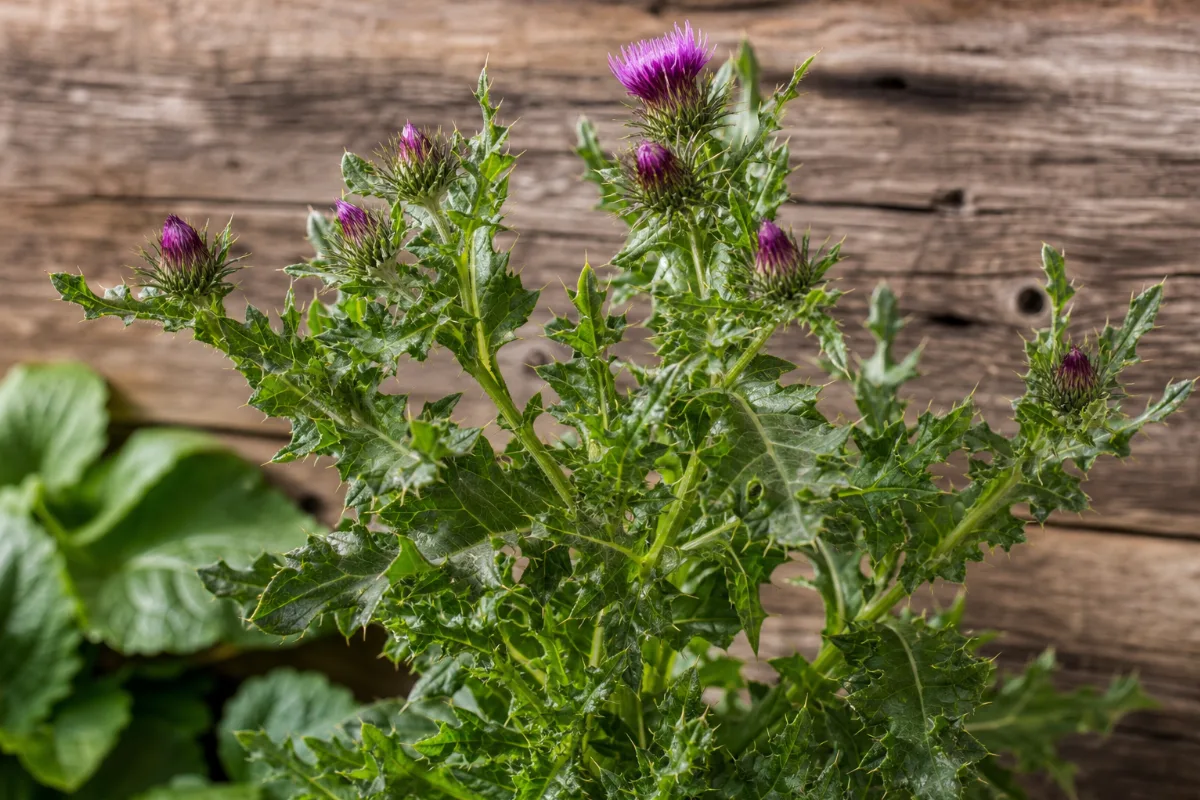
Herbs & Botanicals · Herbs · Blessed thistle herb, bitter tonic, appetite and digestion, no clinical trials, pregnancy warning
Blessed Thistle
Centaurea benedicta (L.) L. (= Cnicus benedictus L.) · also called Holy thistle, St. Benedict's thistle, spotted thistle, Cnici benedicti herba
Blessed thistle is a bitter herb in the daisy family. The flowering tops are used in Europe as a traditional herbal medicine for lost appetite and mild indigestion. This rests on use going back centuries, not on trials: EU regulators found no clinical study of the herb. It is also sold to boost breast milk, with no trial to back that. It is not recommended in pregnancy, in breastfeeding or under 18, and people allergic to daisy-family plants should avoid it.
General information, not medical advice. Last substantive update · Not medically reviewed. A named clinician has not signed off on this page. How this page is made
About Blessed Thistle
Blessed thistle is a bitter herb that has been used for centuries to stir the appetite and ease indigestion. In the EU it is a traditional herbal medicine for these uses. No clinical trial of the herb exists. It is sold for breast milk too, also without a trial. It is not for pregnancy, and people allergic to daisy-family plants should avoid it.
What it is
Blessed thistle is an annual plant in the daisy family. Its current accepted name is Centaurea benedicta; older books call it Cnicus benedictus. The part used is the dried flowering tops. It is not milk thistle, which is a different plant.
The main bitter compound is cnicin. The herb also contains other bitter lactones, lignans such as arctigenin and arctiin, tannins and minerals. The EU monograph covers the dried herb as tea or powder, a liquid extract and a tincture, both made with alcohol.
What the research shows
The European Medicines Agency accepts blessed thistle as a traditional medicine for lost appetite and for mild indigestion and gut cramps. It also says it found no clinical studies of the herb for any disease, and that the pharmacology is limited. Acceptance rests on long use.
The only human data we found are an open study of a six-herb liquid that included blessed thistle, with no control group, and surveys of use. For breast milk, LactMed says no valid trial supports it, and a 2020 Cochrane review of 41 trials did not name blessed thistle among the herbs it covered. Reports of pain relief, nerve repair, killing worms or cancer cells come from cells and animals, often using pure cnicin.
At a glance
Traditional uses history, not proof
- Bitter tonic for poor appetite, wind and indigestion, for more than 2,000 years (EMA)
- Stimulating bile flow and 'strengthening the liver' in old herbals (EMA)
- Bringing on menstruation or ending pregnancy, and to boost breast milk (EMA)
- Flavouring in drinks such as Benedictine liqueur (EMA)
Studied for research
- Lost appetite, insufficient evidence (EU traditional use, no trial)
- Indigestion and mild gut cramps, insufficient evidence (EU traditional use; one open study of a six-herb mix)
- Breast milk supply, insufficient evidence (no trial; agencies disagree on safety)
- Pain, inflammation, nerve repair, worms, cancer cells: lab and animal only
Main compounds
- Cnicin (CID 5281435), the main bitter
- Salonitenolide (CID 5281498)
- Arctigenin (CID 64981)
- Arctiin (CID 100528)
- Trachelogenin (CID 452855)
- Tannins (about 8%, EMA)
Common forms
- Dried herb as a tea (EU monograph)
- Powder (EU monograph)
- Liquid extract 1:1 in 25% alcohol (EU monograph)
- Tincture 1:5 in 25% alcohol (EU monograph)
- Mixed digestive liquids and milk-supply teas (not covered by the monograph)
Research links: EMA herbal monograph (2023) · EMA assessment report (2023) · Cochrane review of milk-supply aids (2020) · Skin allergy test in guinea pigs (1985) · Review of the plant's lab science (2024) · Product check of 21 supplements (2022) · Research Library · Genes & Biomarkers Library
The plant and its history
- Accepted scientific name
- Centaurea benedicta (L.) L.
- Naming authority
- (L.) L.
- Synonyms
- Cnicus benedictus L.; Carduus benedictus (L.) Thell.; Carbenia benedicta (L.) Adans.; Benedicta officinalis Bernh.
- Common names
- Blessed thistle (English); Holy thistle (English); St. Benedict's thistle (English); Spotted thistle (English); Cnici benedicti herba (Latin (drug name)); Cardo santo (Spanish); Benediktenkraut (German)
- Botanical family
- Asteraceae (daisy or Compositae family)
- Classification
- Plantae > Tracheophyta > Magnoliopsida > Asterales > Asteraceae > Centaurea > Centaurea benedicta
- Native range
- Mediterranean region and western Asia (EMA, quoting reference books). Brought into cultivation in Europe in the 16th century.
- Habitat
- An annual herb. Details beyond EMA's description were not read.
- What the plant looks like
- Roots: Not described in sources read; Stems: Not described in sources read; Leaves: Not described in sources read; Flowers: Collected when in flower (EMA); Fruit: Seeds analysed in one paper (oil, fibre, sterols); plant form not described in sources read
- Cultivation
- Cultivated in Europe since the 16th century (EMA). Seeds of a Bulgarian-grown line were analysed in one paper.
- Harvest and processing
- Dried aerial parts collected when the plant is in flower (EMA). Austrian Pharmacopoeia monograph exists; there is no European Pharmacopoeia monograph.
- Look-alikes and adulterants
- Name: Milk thistle (Silybum marianum); Note: A different plant and a separate page on this site. Both are in the daisy family. Do not swap them.
- Sustainability and conservation
- Not covered.
Traditional use and history history, not clinical proof
| Tradition or era | Documented use | Source |
|---|---|---|
| Antiquity to today (European herbal tradition) | Used for more than 2,000 years as a bitter to stimulate appetite and bile flow, aid digestion, ease wind and strengthen the liver; also as a diuretic, sweat-inducer, to bring on menstruation, as a contraceptive and fever remedy. | s-ema-assessment-report-2023 |
| 16th century Europe | Brought into cultivation and mentioned as a 'heal-all' in treatises on the plague, which gave the species its name 'benedictus'. | s-ema-assessment-report-2023 |
| Reference books 1938 to 2000 | Listed as an aperitive and bitter tonic for loss of appetite and flatulent indigestion (Hagers Handbuch 1938, British Herbal Compendium 1992, Newall 1996, Blumenthal 2000). | s-ema-assessment-report-2023 |
| Food flavouring | Used as a bitter flavouring, for example in Benedictine liqueur. | s-ema-assessment-report-2023 |
| EU traditional herbal medicine | Products registered in Poland since 1993; EMA adopted a traditional-use monograph in September 2023 for loss of appetite and dyspepsia. | s-ema-hmpc-monograph-2023 |
Traditional use shows how a plant was used. It does not show that a supplement works or is safe today.
What is inside, and how it may work
What the plant contains and how those compounds act in cells and animals. Laboratory and animal mechanisms are not proven effects in people.
Main compounds
| Compound | Family | Where it is concentrated | Activity studied | Level of evidence |
|---|---|---|---|---|
| Cnicin PubChem 5281435 | Sesquiterpene lactone (bitter) | Aerial parts 0.2-0.7% of the herb (EMA); 0.9-10.3 mg/g across samples (Avula 2022) | The main bitter. Anti-inflammatory in rats, pain-reducing and nerve-regrowing in animals, anti-worm in lab and mice. Allergenic family of compounds. 5 3 8 2 11 | Animal research |
| Salonitenolide PubChem 5281498 | Sesquiterpene lactone | Aerial parts | Listed as a constituent; activity not covered in the sources read. 5 | Not studied |
| Arctigenin PubChem 64981 | Lignan (lignanolide) | Aerial parts | Named as an active constituent in a pre-clinical review. 5 16 | Laboratory research |
| Arctiin PubChem 100528 | Lignan glycoside | Aerial parts | Measured as a marker compound in supplements. 3 16 | Analytical |
| Trachelogenin PubChem 452855 | Lignan | Aerial parts | Listed as a constituent; activity not covered in the sources read. 5 | Not studied |
| Chlorogenic acid PubChem 1794427 | Phenolic acid | Aerial parts | Marker compound measured in the 2022 product test. 3 | Analytical |
| Tannins | Polyphenols | Aerial parts About 8% (EMA) | EMA notes chronic intake of plants with 10% or more tannins may upset the gut. 5 | Authoritative guidance |
| Beta-sitosterol and other plant sterols PubChem 222284 | Phytosterol | Seeds (analysed); also listed in the herb Sterols 0.9% of seed; beta-sitosterol 59.5% of those | Seed composition only. 13 5 | Analytical |
Mechanisms, receptors and pathways
| Target or pathway | Gene or receptor | What was found | Level |
|---|---|---|---|
| Taste-buds and digestive reflex (proposed) | Bitter taste receptors (not named in sources) | Bitter cnicin is thought to raise saliva and gastric juice. EMA found no pharmacological study demonstrating it. 5 | Theory |
| Inflammation | Not identified | Isolated cnicin reduced carrageenan paw swelling in rats, with effect close to indomethacin in an old (1987) test. 5 | Animal research |
| Platelet-activating factor | PAF receptor | Blessed thistle is described as a PAF antagonist (reference book), which in theory could raise bleeding risk. Not proven in people. 5 | Theory |
| Pain pathways | Opioid receptors; nitric oxide / cGMP / K-ATP | Leaf methanol extract and cnicin reduced pain behaviour in mice; blockers of these pathways reduced the effect. 2 | Animal research |
| Axon regrowth | Vasohibin (VASH) | Cnicin promoted nerve fibre growth in culture and nerve recovery in animals; interaction with vasohibin suggested. 8 | Animal / in vitro |
| Bacteria and parasites | Not identified | Old lab tests: antibacterial. Cnicin killed schistosome worms in a dish and by injection in mice, not by mouth. 5 11 | In vitro / animal |
| Skin allergy | T-cell sensitisation to alpha-methylene lactones | Sesquiterpene lactones with an alpha-methylene group are the allergens; blessed thistle extract was a strong sensitiser in guinea pigs. 15 10 | Animal research |
Absorption, metabolism and elimination
- Absorption
- No human data. EMA: no pharmacokinetic data. In rats, pure cnicin had an oral bioavailability of 84.7% (a 2024 animal study of the isolated compound).
- Distribution
- Not found.
- Metabolism
- Not found for people.
- Elimination
- Blood half-life after injection of pure cnicin in rats: 12.7 minutes.
- Bioavailability
- Rat figure above is for the isolated compound only; nothing for tea or extracts, and nothing in people.
Isolated compounds versus whole extracts
EU recognition covers the whole dried herb as tea or powder and alcohol extracts (1:1 liquid extract and 1:5 tincture, 25% ethanol). Most lab and animal results are for isolated cnicin, a methanol leaf extract or an injected dose. Those cannot be read as effects of tea or capsules.
Nutritional composition
The herb is not a nutrient source in practice. EMA lists a high mineral content (mainly potassium, manganese, magnesium, calcium). A Bulgarian seed analysis found mostly carbohydrate (68.5%, half of it fibre), protein 16.4% and oil about 11%, but seeds are not the medicinal part.
6 not enough evidence
What is Blessed Thistle good for?
The studied uses and how strong the human evidence is. 'Insufficient' means no human trial of the herb, or lab and animal work only. Safety comes first: see the Safety tab.
Benefits, one by one
Each card is a research question, not a promise. Tap a goal to filter. Open a card to see the studies, doses and limits.
Temporary loss of appetite (bitter tonic)
Not enough evidenceIn the EU, blessed thistle herb is a registered traditional herbal medicine for temporary loss of appetite. It is accepted because it has been used for a very long time, not because of trial results. EMA found no clinical study of the herb on any disease.
2 studiesThe EU monograph covers the dried cut herb as a tea, powder, a 1:1 li…
Studies, doses and limits
What the trials found
None. EMA's assessment report says no clinical studies on blessed thistle herb for any disease were found, and that the existing data do not meet the 'well-established use' standard. The EU position rests on long-standing use and plausibility only.
Results
No trial results exist.
Effect sizes as reported
Not applicable: no trial.
Why this rating
No human trial of the herb alone was found. The traditional-use status is a regulatory category, not a finding that it works.
Form and dose studied
The EU monograph covers the dried cut herb as a tea, powder, a 1:1 liquid extract in 25% alcohol and a 1:5 tincture in 25% alcohol, taken before meals. Ask a doctor or pharmacist about amounts.
Who was studied
Adults and older adults only. Not recommended under 18, in pregnancy or in breastfeeding.
Limits
No clinical data, no dose-response data, and no safety trial. EMA says to see a doctor if symptoms last longer than 2 weeks.
Why researchers looked
It is a classic bitter herb, used for more than 2,000 years to stir the appetite and aid digestion.
Traditional use
EMA records use as a bitter, to stimulate appetite, bile flow and digestion, going back more than 2,000 years, and as a bitter tonic in Polish and German reference books from the 1930s to 1990s. Registered products have been sold in the EU since at least 1993.
Proposed mechanism Preliminary mechanism
The bitter compound cnicin is thought to stimulate the taste buds, which reflexly raises saliva and stomach juice and so the appetite. EMA states that no pharmacological study demonstrating this was found.
A proposed mechanism does not show that the effect happens in people.
Avoid if allergic to daisy-family plants. See the Safety tab.
Indigestion and mild gut cramps (dyspepsia)
Not enough evidenceThe EU also registers the herb as a traditional medicine to ease indigestion and mild gut spasms, again on long use only. One open study of a six-herb liquid that contained blessed thistle reported fewer symptoms after 2 weeks, but nothing can be credited to blessed thistle alone.
3 studiesDifferent forms are covered by the EU monograph (tea, powder, liquid …
Studies, doses and limits
What the trials found
No trial of blessed thistle alone. One non-interventional open study (Wegener 2016, 149 outpatients including 59 with diabetes) gave a liquid mix of chamomile, silverweed, licorice, angelica, blessed thistle and wormwood for 2 weeks. Vomiting score fell 66.7% and retching 52.2%, and about 90% rated overall improvement. There was no comparison group.
Results
Combination only, open study: symptoms improved. Blessed thistle alone: no human data.
Effect sizes as reported
Vomiting -66.7% and retching -52.2% (diabetic subgroup -63.9% and -53.6%), before-and-after in an open study with no control group.
Why this rating
The only human data are from a six-herb combination without a control group. The single herb has no trial.
Form and dose studied
Different forms are covered by the EU monograph (tea, powder, liquid extract, tincture). The combination study used a branded liquid. Ask a doctor or pharmacist about amounts.
Who was studied
Adults with mild digestive complaints in the combination study.
Limits
No control group, six herbs at once, branded-product study with funding not stated in the abstract, 2-week follow-up.
Why researchers looked
Bitter herbs are traditionally used before meals for fullness, wind and cramps.
Traditional use
Listed in EU reference books and in Polish pharmacy lists as a digestive aid for lack of appetite and flatulent indigestion. It is also a flavouring in Benedictine liqueur.
Proposed mechanism Preliminary mechanism
Possibly the same bitter reflex as above. A cnicin extract and the whole herb have not been shown to relax gut muscle in any study we found.
A proposed mechanism does not show that the effect happens in people.
Seven of 149 patients reported mild adverse events with the mix (nausea five times, a stomach spasm, burning mouth). Strong tea can irritate the stomach, and EMA says use may be unwise in peptic ulcer disease.
Bitter-tonic action on digestive juices (lab reasoning)
Not enough evidenceBlessed thistle is thought to work as a 'bitter': a taste that triggers saliva and stomach juice. This is a proposed mechanism from reference books. EMA could not find a study that demonstrates it.
2 studiesNot applicable.
Studies, doses and limits
What the trials found
None.
Results
Not tested.
Effect sizes as reported
Not applicable.
Why this rating
A proposed mechanism with no study behind it.
Form and dose studied
Not applicable.
Who was studied
None.
Limits
Reference-book reasoning only.
Why researchers looked
It explains why the herb is taken before meals.
Traditional use
Described as a stomachic, aperitive and carminative in reference books cited by EMA.
Proposed mechanism Preliminary mechanism
Cnicin (a sesquiterpene lactone, bitter index about 1:1,800 and 0.2 to 0.7% of the herb by the EMA's figures) stimulates the taste buds and reflexly raises digestive secretions, according to the British Herbal Compendium as quoted by EMA. No pharmacological study found.
A proposed mechanism does not show that the effect happens in people.
If the herb really does raise stomach acid, it could work against acid-reducing medicines (theory). See the Safety tab.
Increasing breast milk (promoted use)
Not enough evidenceBlessed thistle is sold to nursing mothers to raise milk supply. No scientifically valid clinical trial supports this, and the reviews we read found no trial of it. EMA advises against use in lactation because safety is not established, while a Spanish database rates it compatible, so agencies disagree.
7 studiesOften an ingredient in mixed 'milk supply' teas and capsules. Mixture…
Studies, doses and limits
What the trials found
No trial of blessed thistle. LactMed says no scientifically valid clinical trials support the use. A 2012 review that searched for blessed thistle named no trial of it. The 2020 Cochrane review (41 trials, 3005 mothers; certainty low to very low) lists other natural galactagogues in its abstract, not blessed thistle. A Spanish database (e-lactancia) found no published data on passage into breast milk, found no proof of effectiveness, and rates the herb compatible with breastfeeding because of low toxicity and wide use. EMA and the LactMed-cited sources say safety in lactation is not established.
Results
No human efficacy data.
Effect sizes as reported
Not applicable.
Why this rating
No trial of blessed thistle exists in the sources read; the claim rests on tradition and marketing.
Form and dose studied
Often an ingredient in mixed 'milk supply' teas and capsules. Mixtures cannot show what any single herb does. Ask a doctor, lactation consultant or pharmacist about use.
Who was studied
Breastfeeding mothers.
Limits
Reviews we read did not include a blessed thistle trial; we did not search the full text of the Cochrane review for mixed teas that may contain it.
Why researchers looked
Insufficient milk is a common worry, and herbal 'galactagogues' are widely used.
Traditional use
EMA notes it has been used traditionally to stimulate lactation. In a Western Australian survey of 304 breastfeeding women, 24.3% used a herb to raise supply and 5.9% used blessed thistle.
Proposed mechanism Preliminary mechanism
Unknown. No study of how the herb might affect milk production was found.
A proposed mechanism does not show that the effect happens in people.
EMA does not recommend use in lactation. One woman who drank Mother's Milk Tea (a mix containing blessed thistle) had raised liver enzymes (per LactMed). Frequent, effective feeding and expert latch help come first.
Skin use as an antiseptic (traditional, not accepted)
Not enough evidenceOlder books describe blessed thistle for sores and ulcers on the skin. EMA says there are no EU products and no dosing information for this, so it is not an accepted use.
2 studiesNot applicable.
Studies, doses and limits
What the trials found
None.
Results
Not tested in people.
Effect sizes as reported
Not applicable.
Why this rating
Lab tests only; no human data; EMA does not accept this as a traditional use.
Form and dose studied
Not applicable.
Who was studied
None.
Limits
Very old studies with incomplete information (per EMA).
Why researchers looked
Old reference books list it as an antiseptic for ulcers.
Traditional use
Polish pharmacy lists from 1955 and 1959 and British reference books describe skin use.
Proposed mechanism Laboratory research
Old lab tests found the dried herb, a water extract, cnicin and the essential oil stopped some bacteria. EMA calls these very old studies with incomplete information.
A proposed mechanism does not show that the effect happens in people.
The plant is a strong skin sensitiser in guinea pigs and may cause contact dermatitis. Do not put it on broken skin.
Pain, inflammation, nerve repair, parasites, cancer cells (lab and animal only)
Not enough evidenceMany other effects are reported for the herb or for isolated cnicin, but all come from cells, test tubes or animals. We found no human trial for any of them. Some were done with pure cnicin or injected extracts, which are not the same as tea.
5 studiesNot applicable.
Studies, doses and limits
What the trials found
None found.
Results
Lab and animal findings only.
Effect sizes as reported
Not applicable to people.
Why this rating
No human studies; cell and animal results often fail in people.
Form and dose studied
Not applicable.
Who was studied
None.
Limits
Isolated compound or injected extracts; different from tea or capsules. Animal doses cannot be carried over to people.
Why researchers looked
Cnicin and the lignans arctigenin and arctiin are active in many lab tests.
Traditional use
Folk uses include fever, malaria, plague sores and as a general tonic (EMA).
Proposed mechanism In vitro / animal
Isolated cnicin reduced rat paw swelling in an old test and caused belly pain in mice at a low dose (EMA). A leaf extract and cnicin reduced pain behaviour in mice, with opioid and nitric oxide pathways involved. Injected cnicin sped nerve recovery in animals and oral cnicin helped in mice (vasohibin suggested as a target). Cnicin killed schistosome worms in a dish and when injected in mice, but not by mouth in mice. A computer study supports the traditional use but is not evidence of effect.
A proposed mechanism does not show that the effect happens in people.
Do not use the herb in place of medicine. Cnicin itself caused abdominal pain in mice and has an oral lethal dose in mice reported by EMA.
Connections to the rest of health
How Blessed Thistle connects to the rest of our health knowledge graph. Every link says what kind of connection it is. A safety link (for example to the liver) is a warning, not a benefit. A study that merely mentions a topic never creates a benefit link.
Explore every connection: goals, body systems, organs, symptoms, genes
A. Wellness goals
| Connected to | Kind of connection | Evidence status | Context | Studies |
|---|---|---|---|---|
| Digestive Support | Traditional use | Not enough evidence | Temporary loss of appetite (bitter tonic): In the EU, blessed thistle herb is a registered traditional herbal medicine for temporary loss of appetite. It is accepted because it has been used for a very long time, not because of trial results. EMA found no clinical study of the herb on any disease. Indigestion and mild gut cramps (dyspepsia): The EU also registers the herb as a traditional medicine to ease indigestion and mild gut spasms, again on long use only. One open study of a six-herb liquid that contained blessed thistle reported fewer symptoms after 2 weeks, but nothing can be credited to blessed thistle alone. | 4 5 14 |
| Gut Health | Traditional use | Not enough evidence | Indigestion and mild gut cramps (dyspepsia): The EU also registers the herb as a traditional medicine to ease indigestion and mild gut spasms, again on long use only. One open study of a six-herb liquid that contained blessed thistle reported fewer symptoms after 2 weeks, but nothing can be credited to blessed thistle alone. | 4 5 14 |
| Digestive Support | Preliminary mechanism | Not enough evidence | Bitter-tonic action on digestive juices (lab reasoning): Blessed thistle is thought to work as a 'bitter': a taste that triggers saliva and stomach juice. This is a proposed mechanism from reference books. EMA could not find a study that demonstrates it. | 5 19 |
| Womens Wellness | Not enough evidence | Increasing breast milk (promoted use): Blessed thistle is sold to nursing mothers to raise milk supply. No scientifically valid clinical trial supports this, and the reviews we read found no trial of it. EMA advises against use in lactation because safety is not established, while a Spanish database rates it compatible, so agencies disagree. | 9 1 7 6 12 4 5 | |
| Healthy Skin | Preliminary mechanism | Not enough evidence | Skin use as an antiseptic (traditional, not accepted): Older books describe blessed thistle for sores and ulcers on the skin. EMA says there are no EU products and no dosing information for this, so it is not an accepted use. | 5 15 |
| Inflammation Balance | Preliminary mechanism | Not enough evidence | Pain, inflammation, nerve repair, parasites, cancer cells (lab and animal only): Many other effects are reported for the herb or for isolated cnicin, but all come from cells, test tubes or animals. We found no human trial for any of them. Some were done with pure cnicin or injected extracts, which are not the same as tea. | 5 16 2 8 11 |
| Immune Support | Preliminary mechanism | Not enough evidence | Pain, inflammation, nerve repair, parasites, cancer cells (lab and animal only): Many other effects are reported for the herb or for isolated cnicin, but all come from cells, test tubes or animals. We found no human trial for any of them. Some were done with pure cnicin or injected extracts, which are not the same as tea. | 5 16 2 8 11 |
B. Body systems
| Connected to | Kind of connection | Evidence status | Context | Studies |
|---|---|---|---|---|
| Digestive System | Biological association | Not enough evidence | Studied for: Temporary loss of appetite (bitter tonic) Studied for: Indigestion and mild gut cramps (dyspepsia) | 4 5 14 19 |
| Reproductive System | Biological association | Not enough evidence | Studied for: Increasing breast milk (promoted use) | 9 1 7 6 12 4 5 |
| Integumentary System | Biological association | Not enough evidence | Studied for: Skin use as an antiseptic (traditional, not accepted) | 5 15 |
| Immune System | Biological association | Not enough evidence | Studied for: Pain, inflammation, nerve repair, parasites, cancer cells (lab and animal only) | 5 16 2 8 11 |
| Nervous System | Biological association | Not enough evidence | Studied for: Pain, inflammation, nerve repair, parasites, cancer cells (lab and animal only) | 5 16 2 8 11 |
E. Health conditions
| Connected to | Kind of connection | Evidence status | Context | Studies |
|---|---|---|---|---|
| Loss of appetite | Traditional use | Not enough evidence | EMA traditional use; no clinical studies. Preparation or compound: Dried herb, tea, extracts |
4 5 |
| Indigestion (dyspepsia) | Traditional use | Not enough evidence | EMA traditional use; one open combination study. EMA traditional use; one open study of a six-herb mix. Preparation or compound: Dried herb, tea, extracts |
4 14 |
| Pregnancy | Contraindication | Authoritative guidance | Not recommended; traditional abortifacient and emmenagogue use. Not recommended; traditional use to start menstruation or end pregnancy. Preparation or compound: All preparations |
4 5 |
| Breastfeeding | Contraindication | Mixed findings | EMA advises against; e-lactancia rates compatible; no efficacy proof. EMA advises against; e-lactancia rates compatible; no proof it raises milk supply. Preparation or compound: All preparations |
4 1 9 |
| Daisy-family (Asteraceae) allergy | Contraindication | Authoritative guidance | Strong skin sensitiser in guinea pigs; cross-reactions. Preparation or compound: Sesquiterpene lactones (cnicin) |
4 15 10 |
J. Genes, receptors and enzymes
| Connected to | Kind of connection | Evidence status | Context | Studies |
|---|---|---|---|---|
| Vasohibin (VASH1/VASH2) | Preliminary mechanism | Animal | Suggested target of cnicin in nerve regrowth studies. | 8 |
K. Biological pathways
| Connected to | Kind of connection | Evidence status | Context | Studies |
|---|---|---|---|---|
| Opioid and nitric oxide signalling | Preliminary mechanism | Animal | Involved in the mouse pain effect of a leaf extract. | 2 |
L. Active compounds
| Connected to | Kind of connection | Evidence status | Context | Studies |
|---|---|---|---|---|
| Cnicin | Biological association | Animal | The main bitter. Anti-inflammatory in rats, pain-reducing and nerve-regrowing in animals, anti-worm in lab and mice. Allergenic family of compounds. Preparation or compound: Aerial parts |
5 3 8 2 11 |
| Salonitenolide | Biological association | Not studied | Listed as a constituent; activity not covered in the sources read. Preparation or compound: Aerial parts |
5 |
| Arctigenin | Biological association | In vitro | Named as an active constituent in a pre-clinical review. Preparation or compound: Aerial parts |
5 16 |
| Arctiin | Biological association | Analytical | Measured as a marker compound in supplements. Preparation or compound: Aerial parts |
3 16 |
| Trachelogenin | Biological association | Not studied | Listed as a constituent; activity not covered in the sources read. Preparation or compound: Aerial parts |
5 |
| Chlorogenic acid | Biological association | Analytical | Marker compound measured in the 2022 product test. Preparation or compound: Aerial parts |
3 |
| Tannins | Biological association | Authoritative guidance | EMA notes chronic intake of plants with 10% or more tannins may upset the gut. Preparation or compound: Aerial parts |
5 |
| Beta-sitosterol and other plant sterols | Biological association | Analytical | Seed composition only. Preparation or compound: Seeds (analysed); also listed in the herb |
13 5 |
Each connection is stored with the ingredient, the connected record, the kind of connection, the evidence status, the supporting studies, the preparation or compound involved, and a review date (last reviewed October 25, 2026).
The evidence
The research centre for Blessed Thistle. Every record here was checked against PubMed or the publisher's page; we never list a study we have not verified.
Evidence by outcome
Bars show how many studies we found for each outcome, not how well it works. People are added up across trials only (reviews are not added, to avoid double counting).
How we rate evidence
High certainty
Several well-run trials or reviews agree; further research is unlikely to change the picture much.
Moderate certainty
Good trials point the same way, but some doubt remains.
Low certainty
Small, short or inconsistent trials. The finding could change with better research.
Very low certainty
Very little or very weak human data. Treat as a possibility only.
Mixed findings
Trials or reviews disagree with each other.
Not enough evidence
Not enough human research to say either way.
Evidence against
Good research found no benefit, or found harm.
We take the reviewers' own risk-of-bias and GRADE statements where they exist, and otherwise judge from study size, design, consistency, directness and whether a product matches what is sold. Many publications do not make evidence high. Method note: We read the full EMA monograph and assessment report, searched PubMed, read the abstracts of the studies cited, and checked plant names against GBIF and NCBI. Pages that could not be opened (LiverTox, the full LactMed page) or were not found (NCCIH) are marked as such. Where only a summary was available, we say so.
Study library: every study we checked 19
| Study | Design | People | Product, dose, length | Result |
|---|---|---|---|---|
| APILAM (Asociacion para la Promocion e Investigacion cientifica y cultural de la Lactancia Materna) 2023 e-lactancia (APILAM): Cardo santo / Blessed thistle and breastfeeding e-lactancia.org · Source |
Authoritative guidance |
Breastfeeding mothers | Blessed thistle herb preparations aerial parts (herb) Not given here Not applicable · vs None |
Rated 'Compatible' (very low risk) with breastfeeding. No published data on excretion into breast milk were found. Widely used as a galactogogue. A cited report found no adverse effects or weight gain differences in infants whose mothers drank an infusion containing blessed thistle. No proof of effectiveness as a galactogogue. Reasoning: lack of toxicity and wide use, so moderate intake can be considered compatible. Not applicable Methods, limits and fundingOutcomes: Breastfeeding compatibility rating Limitations: Spanish-language database page, last updated 22 December 2023. Disagrees with EMA (which advises against use in lactation for lack of data). Underlying reports it cites (Wagner 2019 etc.) were not opened. Funding and conflicts: Non-profit association Read: full-text |
| Ahmadimoghaddam 2020 Antinociceptive activity of Cnicus benedictus L. leaf extract: a mechanistic evaluation Research in Pharmaceutical Sciences · PMID 33628288 · DOI |
Animal research mouse |
Leaf methanol extract; isolated cnicin leaf Not given here Not applicable · vs None |
A methanol extract of the leaves (150 and 300 mg/kg, injected into the belly cavity) and pure cnicin (30 mg/kg) reduced pain responses in mice in several pain tests. The effect was blocked by drugs that block opioid receptors and the nitric-oxide pathway. Not applicable Methods, limits and fundingLimitations: Mice, injected extract; not the tea or capsule form; no human data. Funding and conflicts: Not stated in the part we read Read: abstract | |
| Avula 2022 Simultaneous determination and characterization of flavonoids, sesquiterpene lactone, and other phenolics from Centaurea benedicta and dietary supplements using UHPLC-PDA-MS and LC-DAD-QToF Journal of Pharmaceutical and Biomedical Analysis · PMID 35533533 · DOI |
Lab analysis plant and product analysis |
21 21 dietary supplements and plant samples |
Blessed thistle herb preparations aerial parts (herb) Not given here Not applicable · vs None |
Measured cnicin, arctiin, chlorogenic acid and four flavonoids. Cnicin varied from 0.9 to 10.3 mg/g across plant samples. Of 21 dietary supplements claiming to contain C. benedictus extract, 13 (62%) showed all the marker compounds and were confirmed to contain the plant; the abstract does not say what the other 8 contained. Not applicable Methods, limits and fundingLimitations: Abstract read only. Does not say which products failed or why. Not a test of safety or of effects. Funding and conflicts: Not stated in the abstract (US National Center for Natural Products Research authors) Read: abstract |
| EMA Committee on Herbal Medicinal Products (HMPC) 2023 EMA/HMPC: European Union herbal monograph on Cnicus benedictus L., herba (final, 20 September 2023) European Medicines Agency · Source |
Authoritative guidance |
Blessed thistle herb preparations aerial parts (herb) Not given here Not applicable · vs None |
Traditional use only, for temporary loss of appetite and for relief of dyspepsia and mild spasmodic disorders of the gut. Contraindication: allergy to the plant or other Asteraceae (daisy family). Not recommended under 18, in pregnancy or in lactation (safety not established). Interactions: none reported. Undesirable effects: none known. Very strong tea (over 5 g herb per cup) may cause stomach irritation and vomiting; no overdose cases. Reproductive toxicity, genotoxicity and carcinogenicity tests have not been performed. Not applicable Methods, limits and fundingOutcomes: Regulatory conclusions Limitations: Traditional-use document, not a trial. States that use rests exclusively on long-standing use. Funding and conflicts: Public body Read: full-text | |
| EMA Committee on Herbal Medicinal Products (HMPC) 2023 EMA/HMPC: Assessment report on Cnicus benedictus L., herba (final) European Medicines Agency · Source |
Authoritative guidance |
Blessed thistle herb preparations aerial parts (herb) Not given here Not applicable · vs None |
No clinical studies on any disease were found; well-established use cannot be accepted, traditional use can. Pharmacology is limited: the bitter compound cnicin may stimulate digestive juices, but no pharmacological study demonstrating this was found. Lab/animal items: old antibacterial studies, anti-inflammatory effect of cnicin in rats, oral LD50 of cnicin in mice, one Ames test of a tincture with no mutagenicity. Safety: contact dermatitis possible with cross-reaction in the daisy family; theoretical weakening of antacids, H2-blockers and proton pump inhibitors; platelet-activating-factor antagonism (possible bleeding risk, not proven in humans); traditionally used to stimulate menstruation or induce abortion, so avoid in pregnancy; not recommended in lactation for lack of safety data; may be inadvisable in peptic ulcer. Not applicable Methods, limits and fundingOutcomes: Regulatory assessment Limitations: Secondary regulatory review. Many safety statements cite one reference book (Ulbricht et al. 2008) or older sources that we did not open. Funding and conflicts: Public body Read: full-text | |
| Foong 2020 Oral galactagogues (natural therapies or drugs) for increasing breast milk production in mothers of non-hospitalised term infants (Cochrane review) Cochrane Database of Systematic Reviews · PMID 32421208 · DOI |
Systematic review |
3005 Mothers of healthy term infants |
Oral galactagogues (drugs and natural) aerial parts (herb) Not given here Not applicable · vs None |
41 randomised trials, 3005 mothers. Overall certainty low to very low. Natural galactagogues named in the abstract: banana flower, fennel, fenugreek, ginger, ixbut, levant cotton, moringa, palm dates, pork knuckle, shatavari, silymarin, torbangun leaves and mixed products. Blessed thistle is not among the named herbs. The authors conclude we are very uncertain about the size of any effect, and that high-quality trials are urgently needed. Not applicable Methods, limits and fundingOutcomes: Milk volume, infant weight, continued breastfeeding Limitations: Abstract read only; we did not search the full text for blessed thistle inside mixed teas. Only term infants of non-hospitalised mothers. Funding and conflicts: Cochrane; non-industry (not detailed in abstract) Read: abstract |
| Forinash 2012 The use of galactogogues in the breastfeeding mother Annals of Pharmacotherapy · PMID 23012383 · DOI |
Review |
Breastfeeding mothers | Blessed thistle herb preparations aerial parts (herb) Not given here Not applicable · vs None |
Review of human data on galactogogues in the US. The search terms included blessed thistle (as 'Onicus benedictus' in the paper) and milk thistle. The authors conclude that peer-reviewed studies proving efficacy of herbal options are lacking; the herbs they say gave mixed results in small trials were fenugreek and milk thistle (with metoclopramide and oxytocin). No blessed thistle trial is named. Not applicable Methods, limits and fundingOutcomes: Breast milk production Limitations: Abstract read only. Searched to June 2012; newer trials are not covered. Funding and conflicts: Not stated in the part we read Read: abstract |
| Gobrecht 2024 Cnicin promotes functional nerve regeneration Phytomedicine · PMID 38718639 · DOI |
Animal research cell culture, mouse, rat |
Isolated cnicin Not applicable Not given here Not applicable · vs None |
Pure cnicin (from blessed thistle) helped nerve fibres grow in cell culture, including human cells, and sped recovery after nerve injury in animals when injected into a vein. In rats the blood half-life after injection was 12.7 minutes and oral bioavailability 84.7%; oral cnicin also helped nerve recovery in mice. A possible target is the enzyme family vasohibin. Not applicable Methods, limits and fundingLimitations: Lab and animal study of the isolated compound, not the herb. Nothing shown in people. Funding and conflicts: Not stated in the part we read Read: abstract | |
| National Institute of Child Health and Human Development 2006 Blessed Thistle. In: Drugs and Lactation Database (LactMed) Drugs and Lactation Database (LactMed) · PMID 30000834 |
Authoritative guidance |
Breastfeeding mothers | Blessed thistle herb preparations aerial parts (herb) Not given here Not applicable · vs None |
Blessed thistle is a purported galactogogue and is in some proprietary mixtures promoted to increase milk supply, but no scientifically valid clinical trials support this use. It is a member of the ragweed (daisy) family so allergy is a concern; high doses reportedly cause stomach cramps, nausea and vomiting. Elevated liver enzymes occurred in a woman taking Mother's Milk Tea, which contains blessed thistle and other ingredients. US FDA lists it as generally recognised as safe (GRAS) as a flavouring in alcoholic drinks. Not applicable Methods, limits and fundingOutcomes: Lactation safety summary Limitations: Only the PubMed record summary was read. The full LactMed page (and its detailed case reference) was blocked by a robot check and not opened. Last update shown in the record: 2022. Funding and conflicts: Public body Read: abstract |
| Paulsen 2023 The sesquiterpene lactone mix: A review of past, present and future aspects Contact Dermatitis · PMID 37820718 · DOI |
Review |
Patch-tested patients | Sesquiterpene lactone mix (patch test) Not applicable Not given here Not applicable · vs None |
Sesquiterpene lactones are the main allergens of the daisy (Compositae/Asteraceae) family. In routine patch testing the SL mix is positive in about 1% of people in Europe and 0.8% in North America (0% to 10.7% elsewhere). Not applicable Methods, limits and fundingOutcomes: Prevalence of positive patch tests Limitations: General review of the plant family, not specific to blessed thistle. Abstract read only. Funding and conflicts: Not stated in the part we read Read: abstract |
| Queiroz 2021 In vitro and in vivo evaluation of cnicin from blessed thistle (Centaurea benedicta) and its inclusion complexes with cyclodextrins against Schistosoma mansoni Parasitology Research · PMID 33164156 · DOI |
Animal research mouse and parasite worms |
Isolated cnicin Not applicable Not given here Not applicable · vs None |
Cnicin killed adult schistosome worms in a dish and worked in mice when injected into the belly cavity. Oral cnicin alone, or with beta-cyclodextrin, showed no significant worm reduction in mice. Not applicable Methods, limits and fundingLimitations: Isolated compound in mice and worms; not the herb; no human data. Abstract read in part. Funding and conflicts: Not stated in the part we read Read: abstract | |
| Sim 2013 The use of herbal medicines during breastfeeding: a population-based survey in Western Australia BMC Complementary and Alternative Medicine · PMID 24219150 · DOI |
Survey |
304 Women breastfeeding or who had breastfed in the past 12 months, Perth |
Blessed thistle herb preparations aerial parts (herb) Not given here Not applicable · vs None |
304 breastfeeding women returned questionnaires (27.2% response). 59.9% took at least one herb; 24.3% used at least one herb to raise milk supply. Blessed thistle was used by 5.9%. Most (70.1%) felt there was too little information. Not applicable Methods, limits and fundingOutcomes: Pattern of herb use Limitations: Self-reported, low response rate, one region. Does not measure effect or safety. Funding and conflicts: Not stated in the part we read Read: abstract |
| Teneva 2024 Centaurea benedicta - A Potential Source of Nutrients and Bioactive Components Plants (Basel) · PMID 39771277 · DOI |
Lab analysis plant analysis |
Blessed thistle herb preparations seeds Not given here Not applicable · vs None |
Chemical analysis of seeds of plants grown in Bulgaria: carbohydrates 68.5% (fibre 32.2%), protein 16.4%, oil about 11.0% (mostly linoleic and oleic acids), sterols 0.9% (beta-sitosterol 59.5%), tocopherols 492 mg/kg. The introduction repeats the folk claims (appetite, liver, bile, antioxidant). Not applicable Methods, limits and fundingLimitations: Seeds, not the aerial parts used in the EU monograph. Composition only; no effect on health tested. Funding and conflicts: Not stated in the part we read Read: abstract | |
| Wegener 2016 Treatment of Mild Gastrointestinal Disorders with a Herbal Combination: Results of a Non-interventional Study with Gastritol Liquid Phytotherapy Research · PMID 26522087 · DOI |
Observational combination |
149 Adults with mild gastrointestinal disorders, including diabetics |
Liquid six-herb combination containing blessed thistle (Gastritol Liquid) aerial parts (herb) Not given here 2 weeks · vs None |
Open study of 149 outpatients (59 with diabetes) given Gastritol Liquid, a mix of chamomile, silverweed, licorice, angelica, blessed thistle and wormwood, for 2 weeks. Symptoms improved (vomiting -66.7%, retching -52.2%); about 90% rated overall improvement. Seven patients had mild adverse events (five times short-lived nausea, one stomach spasm, one burning mouth). No control group. Not applicable Methods, limits and fundingOutcomes: Symptom scores, tolerability Limitations: Six-herb mix, so nothing can be credited to blessed thistle. Open study without comparison group; placebo effect and natural recovery cannot be excluded. Branded-product study. Funding and conflicts: Not stated in the abstract; treat as industry-linked (branded product study) until checked Read: abstract |
| Zeller 1985 The sensitizing capacity of Compositae plants. VI. Guinea pig sensitization experiments with ornamental plants and weeds using different methods Archives of Dermatological Research · PMID 3970585 · DOI |
Animal research guinea pig |
Guinea pigs | Ether extract of blessed thistle aerial parts (herb) Not given here Not applicable · vs None |
Ether extracts of 20 daisy-family species were tested in guinea pigs. Cnicus benedictus (blessed thistle), ox-eye daisy and dwarf sunflower were strong sensitizers (cause skin allergy). Cross-reactions between species were common, linked to sesquiterpene lactones with an alpha-methylene group. People with daisy-family contact allergy are advised to avoid all related plants. Not applicable Methods, limits and fundingOutcomes: Skin sensitisation Limitations: Guinea pig skin tests with ether extracts; not a human study and not about taking the herb by mouth. Funding and conflicts: Not stated in the part we read Read: abstract |
| Zietal 2024 Cnicus benedictus: Folk Medicinal Uses, Biological Activities, and In Silico Screening of Main Phytochemical Constituents Planta Medica · PMID 39265629 · DOI |
Review |
Blessed thistle herb preparations aerial parts (herb) Not given here Not applicable · vs None |
Narrative review of pre-clinical (lab and animal) work on the plant's main compounds (the sesquiterpene lactone cnicin and the lignans arctigenin and arctiin), plus a computer (in silico) prediction of their absorption and toxicity. The authors say the computer results 'support' traditional use. No human trial is described in the abstract. Not applicable Methods, limits and fundingOutcomes: Pharmacology review Limitations: Abstract read only. Computer predictions are not evidence of effect or safety in people. Funding and conflicts: Not stated in the part we read Read: abstract | |
| s-gbif-centaurea-benedicta 2026 GBIF species match: Centaurea benedicta (L.) L. (and synonym Cnicus benedictus L.) · Source |
Database record |
Blessed thistle herb preparations aerial parts (herb) Not given here Not applicable · vs None |
Centaurea benedicta (L.) L.: status ACCEPTED, match EXACT, confidence 100, family Asteraceae, order Asterales, GBIF key 3127691. Cnicus benedictus L. (key 3127698) is listed as a SYNONYM of it. Not applicable Methods, limits and fundingOutcomes: Accepted name Limitations: Name and family only. Native range and plant description were not read from GBIF. Funding and conflicts: Public database Read: database-record | |
| s-ncbi-taxonomy-50282 2026 NCBI Taxonomy: Centaurea benedicta (taxid 50282) · Source |
Database record |
Blessed thistle herb preparations aerial parts (herb) Not given here Not applicable · vs None |
Taxid 50282, rank species, scientific name Centaurea benedicta, status active. Not applicable Methods, limits and fundingOutcomes: Accepted name Limitations: Name record only. Funding and conflicts: Public database Read: database-record | |
| s-pubchem-cids 2026 PubChem compound records: cnicin, arctigenin, arctiin, salonitenolide, trachelogenin, chlorogenic acid, beta-sitosterol · Source |
Database record |
Blessed thistle herb preparations aerial parts (herb) Not given here Not applicable · vs None |
CIDs checked by API: cnicin 5281435 (C20H26O7), arctigenin 64981 (C21H24O6), arctiin 100528 (C27H34O11), salonitenolide 5281498 (C15H20O4), trachelogenin 452855 (C21H24O7), chlorogenic acid 1794427, beta-sitosterol 222284. Not applicable Methods, limits and fundingOutcomes: Compound identity Limitations: Identity and formula only. Funding and conflicts: Public database Read: database-record |
What we do not know yet
- No clinical trial of blessed thistle alone, for any use.
- No trial for breast milk supply, and no data on passage into breast milk.
- No interaction study; the antacid and bleeding concerns are theory.
- No human case report of allergy to blessed thistle itself; the evidence is a guinea pig test and family risk.
- LactMed's full page and LiverTox could not be read; NCCIH page not found.
- The reference books behind EMA's safety statements were not opened.
- Which of the 21 supplements failed a label check, and what they held, is not reported in the abstract.
How new research is added
New studies are found by a saved PubMed search and placed in a review queue. A person reads each one before it changes any rating or safety wording.
Lab markers
What changed in blood or saliva tests during trials. A changed number is not the same as feeling or being healthier, and we give no "normal ranges".
Safety
What studies and official sources say about side effects, medicines and who should check first. Each point shows what kind of evidence it comes from.
Main points to know 7
- Avoid in pregnancy. EMA says safety in pregnancy is not established and advises against use. Blessed thistle has been used traditionally to bring on menstruation or end a pregnancy. EMA says safety and effectiveness for that have not been established, and that reproductive toxicity tests have not been performed. We found no animal or human pregnancy study. Whether it stimulates the womb is a theory based on traditional use only. Authoritative guidance 4 5
- Breastfeeding: sources disagree. EMA does not recommend use in lactation because safety data are lacking. A Spanish database (e-lactancia) rates it compatible with breastfeeding, given its low toxicity and wide use, but found no data on passage into milk. LactMed says no valid trials support its use for milk supply and notes a raised-liver-enzyme case with a tea mix containing it. It is not proven to raise milk supply. Authoritative guidance 4 5 1 9
- Allergy to daisy-family plants. Allergy to blessed thistle or to other plants of the daisy (Asteraceae) family is a listed contraindication. Sesquiterpene lactones in this family are the main skin allergens, and in guinea pigs blessed thistle extract was a strong sensitiser with cross-reactions to other family members. EMA notes that no documented hypersensitivity reaction to blessed thistle itself was located, only the theoretical risk and contact dermatitis reports. Authoritative guidance 4 5 15 10
- Strong tea can upset the stomach. Very strong tea (EMA names more than 5 g of herb per cup) has been reported to cause stomach irritation and vomiting. This comes from reference-book and post-market reports, not trials. EMA also notes use may be inadvisable in peptic ulcer disease, because the herb is traditionally believed to increase stomach acid. Authoritative guidance 4 5
- Little human safety data. EMA lists no known side effects and no overdose case, but it found no clinical studies at all. 'None known' reflects scarce data, not proven safety. Tests for genotoxicity and cancer risk have not been done on the preparations. Authoritative guidance 4 5
- Products may not contain what the label says. In one laboratory test, only 13 of 21 supplements claiming to contain blessed thistle showed all the plant's marker compounds. The amount of the main bitter compound varied about 10-fold across plant samples. Lab analysis 3
- Not for people under 18. EMA does not recommend use under 18 because there are not enough data. Authoritative guidance 4
Side effects 4
| Effect | How often | Severity and recovery | Evidence |
|---|---|---|---|
| No side effects known to EMA Reflects limited use data, not proof of safety. If one occurs, see a doctor or qualified practitioner. | Not established | Not applicable Not applicable | Authoritative guidance 4 |
| Stomach irritation and vomiting with very strong tea From post-market reports cited by EMA (Ulbricht 2008). We did not open the original. No frequency is given. | Not established | Not stated Not stated | Case report 5 |
| Contact dermatitis (skin allergy) EMA says blessed thistle may cause contact dermatitis with cross-reaction in the daisy family. The strong-sensitiser finding is from guinea pigs. We found no human case report. | Not established | Not stated Not stated | Authoritative guidance 5 15 |
| Mild nausea, stomach spasm, burning mouth with a six-herb mix Five times temporary nausea after intake, once a gastric spasm and once oral burning. Cannot be credited to blessed thistle because the product had six herbs. | 7 of 149 patients | Mild Temporary | Observational 14 |
Liver
No liver injury entry (LiverTox) for blessed thistle could be read: the LiverTox page was blocked by a robot check. LactMed reports raised liver enzymes in one woman taking Mother's Milk Tea, a mix that contains blessed thistle and other ingredients, so the cause cannot be pinned on blessed thistle. Lab-only liver-protection findings in animals were not read. 'Not found' does not mean safe for the liver. 9
How often. No frequency of liver injury is available.
Monitoring. No monitoring advice was found. Stop and seek care for yellow eyes or skin, dark urine, or severe stomach pain.
- .
This is a safety connection. It is not evidence that Blessed Thistle supports liver health.
Medicines and supplements 6
| With | Why it matters | Importance | Evidence | What to do |
|---|---|---|---|---|
| Antacids, H2-blockers (such as famotidine) and proton pump inhibitors (such as omeprazole) prescription | In theory, because the herb may raise stomach acid, it could work against acid-reducing medicines. EMA cites the US National Library of Medicine for this idea. | No interaction study. Theoretical. | Pharmacological theory Not enough evidence 5 | Ask a pharmacist, especially if you take acid-reducing medicine for ulcer or reflux. |
| Blood thinners and antiplatelet medicines (warfarin, apixaban, aspirin, clopidogrel) and NSAIDs prescription | Blessed thistle has been described as a platelet-activating-factor antagonist, which in theory could add to bleeding risk. EMA says this has not been proven in human studies. | No clotting, INR or bleeding study was found. | Pharmacological theory Not enough evidence 5 | Ask a pharmacist before combining. Tell your doctor before surgery. |
| Medicines that need alcohol avoided (tinctures and liquid extracts) prescription | The EU liquid extract and tincture are made with 25% alcohol, and EMA requires alcohol labelling on them. We found no study of any drug interaction caused by this. | Not studied; a labelling point. | Authoritative guidance Not enough evidence 4 | Check the label if you must avoid alcohol or take a medicine that forbids it. |
| Medicines broken down by liver enzymes (CYP) or moved by transporters prescription | No enzyme or transporter study of the herb was found. EMA: no pharmacokinetic data. | Unknown. | Pharmacological theory Not enough evidence 5 | Ask a pharmacist if you take medicine with a narrow safety margin. |
| Other bitter or digestive herbs, and other daisy-family herbs herb | Any added allergen load from related plants is theory. No combination study with blessed thistle alone exists; the only combination data are from one branded six-herb liquid. | Unknown. | Pharmacological theory Not enough evidence 14 5 | Do not stack several herbs without advice. |
| Food, supplements and lab tests food-and-tests | Nothing found for food, vitamins, or effect on blood tests. | Not found. | Not found Not enough evidence 5 | None available. |
Who should check first 8
| Situation | Advice | Evidence |
|---|---|---|
| Pregnancy or trying to conceive | Avoid. Safety is not established, and traditional use to bring on menstruation or end pregnancy (EMA). | Authoritative guidance 4 5 |
| Breastfeeding | EMA advises against it for lack of data. One Spanish database rates it compatible. Ask your doctor, midwife or lactation consultant. | Authoritative guidance 4 1 |
| Allergy to blessed thistle or to daisy-family plants (ragweed, chamomile, arnica, marigold, sunflower, artichoke) | Avoid. Contraindicated by EMA; cross-reaction is likely among sesquiterpene lactone plants. | Authoritative guidance 4 5 15 |
| Under 18 | Not recommended (EMA). | Authoritative guidance 4 |
| Stomach or duodenal ulcer | Ask a doctor first. EMA says use may be inadvisable because of its traditional effect of raising stomach acid. | Pharmacological theory 5 |
| On blood thinners, or before surgery | Ask a doctor first (theoretical bleeding risk). | Pharmacological theory 5 |
| Needing to avoid alcohol | Tinctures and liquid extracts contain alcohol. | Authoritative guidance 4 |
| Symptoms last longer than 2 weeks or get worse | See a doctor. Lost appetite or indigestion can have serious causes. | Authoritative guidance 4 |
Overdose, product quality and regulators
Summary. There is no human toxicity study. EMA reports no overdose case. For the isolated compound cnicin, EMA cites mouse data: an oral lethal dose of 1.6 to 3.2 mmol/kg and belly pain at a low dose.
Animal. Cnicin oral LD50 in mice 1.6-3.2 mmol/kg; cnicin caused writhing (belly pain) in mice with an ED50 of 6.2 micromol/kg (Schneider 1987, as quoted by EMA). No repeat-dose study.
Human doses studied. No trial of the single herb. The EU uses tea, powder, liquid extract and tincture. No amounts are given here.
High dose or long term signals. Stomach irritation and vomiting at very strong tea (EMA's figure: more than 5 g of herb per cup). Plants with 10% or more tannins may upset the gut with chronic intake; EMA lists tannins at about 8% for this herb. No long-term safety study.
Overdose response. No overdose case reported (EMA).
Genotoxicity. One Ames bacterial test of a 60% ethanol tincture found no mutagenicity; EMA still calls genotoxicity data inadequate. Carcinogenicity and reproductive toxicity: no data.
Toxic plant parts. Medicinal use is of the flowering aerial parts. No part is named as toxic in the sources read.
Main risks are a product that is not what it says, wild-picked plant from polluted ground, and mistaking one thistle for another.
Label accuracy. Only 13 of 21 supplements claiming blessed thistle extract showed all marker compounds. Cnicin ranged from 0.9 to 10.3 mg/g across plant samples. 3
Mixed products. Milk-supply teas and digestive liquids blend several herbs. A raised-liver-enzyme case with such a tea, and mild side effects with a six-herb liquid, cannot be assigned to one herb. 9 14
Mistaken identity. Blessed thistle is not milk thistle; they are different plants with different compounds. We found no case of mix-up in the sources read, so treat this as a precaution. 17
| Body | Action | Date |
|---|---|---|
| EMA / HMPC (European Union) (EU) | Final EU herbal monograph (adopted 20 September 2023): traditional herbal medicinal product for temporary loss of appetite and for symptomatic relief of dyspepsia and mild spasmodic disorders of the gut; based exclusively on long-standing use; not recommended under 18, in pregnancy or in lactation. Well-established use and an EU list entry were not supported (no clinical data, inadequate genotoxicity data). source | 2023-09-20 |
When to get medical help
- Swelling of lips, tongue or throat, hives, wheeze or trouble breathing after taking it or touching the plant: get emergency care.
- Repeated vomiting, severe stomach pain or vomiting blood or black stools.
- Yellow eyes or skin, or dark urine.
- Bleeding or cramping when you are or might be pregnant.
- Unusual bruising or bleeding if you also take a blood thinner.
Stop the supplement and contact a clinician or emergency service. In the US, Poison Control is 1-800-222-1222.
General information only, not medical advice. Ask a clinician or pharmacist before use, especially with medicines, in pregnancy or with a health condition. See the Natural Remedy Safety guide.
Frequently asked questions
What is blessed thistle used for?
Does blessed thistle increase breast milk?
Is blessed thistle safe while breastfeeding?
Is it safe in pregnancy?
Does it work for indigestion and appetite?
What are the side effects?
Can people allergic to ragweed or daisies use it?
Does it interact with medicines?
No interaction has been reported, but there is no study. In theory it could weaken antacids, H2-blockers and proton pump inhibitors, and could add to bleeding with blood thinners. Neither is proven in people. Ask a pharmacist.
Is it good for the liver?
Is blessed thistle the same as milk thistle?
Are supplements what they say?
Not always. In one lab test, 13 of 21 supplements claiming blessed thistle extract showed all the marker compounds, and the amount of the main bitter compound varied about 10-fold across plant samples.
Explore by health goal
Digestive SupportGut HealthWomens WellnessHealthy SkinInflammation BalanceImmune Support
Editorial transparency
- Written by
- AlternativeMed editorial team. Research compiled with AI assistance, then checked against PubMed records and the EMA documents.
- Medical review
- None. This page has not been reviewed by a physician or pharmacist.
- First published
- 2026-10-25
- Last substantive update
- 2026-10-25
- How we research
- We read the full EMA monograph and assessment report, searched PubMed, read the abstracts of the studies cited, and checked plant names against GBIF and NCBI. Pages that could not be opened (LiverTox, the full LactMed page) or were not found (NCCIH) are marked as such. Where only a summary was available, we say so.
- How we rate evidence
- See "How we rate evidence" in the Evidence tab.
- Independence
- No product is promoted on this page. No affiliate links are shown.
Sources 19
Each source was opened and checked. Where we read only the abstract, it says so. The small numbers in the text point here.
- APILAM (Asociacion para la Promocion e Investigacion cientifica y cultural de la Lactancia Materna). e-lactancia (APILAM): Cardo santo / Blessed thistle and breastfeeding. e-lactancia.org. 2023. (full-text)
- Ahmadimoghaddam D, Sadeghian R, Ranjbar A, Izadidastenaei Z, Mohammadi S. Antinociceptive activity of Cnicus benedictus L. leaf extract: a mechanistic evaluation. Research in Pharmaceutical Sciences. 2020. PMID 33628288. DOI 10.4103/1735-5362.297849. (abstract)
- Avula B, Katragunta K, Wang YH, Ali Z, Khan IA. Simultaneous determination and characterization of flavonoids, sesquiterpene lactone, and other phenolics from Centaurea benedicta and dietary supplements using UHPLC-PDA-MS and LC-DAD-QToF. Journal of Pharmaceutical and Biomedical Analysis. 2022. PMID 35533533. DOI 10.1016/j.jpba.2022.114806. (abstract)
- EMA Committee on Herbal Medicinal Products (HMPC). EMA/HMPC: European Union herbal monograph on Cnicus benedictus L., herba (final, 20 September 2023). European Medicines Agency. 2023. (full-text)
- EMA Committee on Herbal Medicinal Products (HMPC). EMA/HMPC: Assessment report on Cnicus benedictus L., herba (final). European Medicines Agency. 2023. (full-text)
- Foong SC, Tan ML, Foong WC, Marasco LA, Ho JJ, Ong JH. Oral galactagogues (natural therapies or drugs) for increasing breast milk production in mothers of non-hospitalised term infants (Cochrane review). Cochrane Database of Systematic Reviews. 2020. PMID 32421208. DOI 10.1002/14651858.CD011505.pub2. (abstract)
- Forinash AB, Yancey AM, Barnes KN, Myles TD. The use of galactogogues in the breastfeeding mother. Annals of Pharmacotherapy. 2012. PMID 23012383. DOI 10.1345/aph.1R167. (abstract)
- Gobrecht P, Gebel J, Leibinger M, Zeitler C, Chen Z, Gruendemann D, Fischer D. Cnicin promotes functional nerve regeneration. Phytomedicine. 2024. PMID 38718639. DOI 10.1016/j.phymed.2024.155641. (abstract)
- National Institute of Child Health and Human Development. Blessed Thistle. In: Drugs and Lactation Database (LactMed). Drugs and Lactation Database (LactMed). 2006. PMID 30000834. (abstract)
- Paulsen E. The sesquiterpene lactone mix: A review of past, present and future aspects. Contact Dermatitis. 2023. PMID 37820718. DOI 10.1111/cod.14419. (abstract)
- Queiroz LS, Ferreira EA, Mengarda AC, et al.. In vitro and in vivo evaluation of cnicin from blessed thistle (Centaurea benedicta) and its inclusion complexes with cyclodextrins against Schistosoma mansoni. Parasitology Research. 2021. PMID 33164156. DOI 10.1007/s00436-020-06963-2. (abstract)
- Sim TF, Sherriff J, Hattingh HL, Parsons R, Tee LB. The use of herbal medicines during breastfeeding: a population-based survey in Western Australia. BMC Complementary and Alternative Medicine. 2013. PMID 24219150. DOI 10.1186/1472-6882-13-317. (abstract)
- Teneva O, Petkova Z, Dobreva A, Dzhurmanski A, Stoyanova L, Angelova-Romova M. Centaurea benedicta - A Potential Source of Nutrients and Bioactive Components. Plants (Basel). 2024. PMID 39771277. DOI 10.3390/plants13243579. (abstract)
- Wegener T, Heimueller E. Treatment of Mild Gastrointestinal Disorders with a Herbal Combination: Results of a Non-interventional Study with Gastritol Liquid. Phytotherapy Research. 2016. PMID 26522087. DOI 10.1002/ptr.5502. (abstract)
- Zeller W, de Gols M, Hausen BM. The sensitizing capacity of Compositae plants. VI. Guinea pig sensitization experiments with ornamental plants and weeds using different methods. Archives of Dermatological Research. 1985. PMID 3970585. DOI 10.1007/BF00406478. (abstract)
- Zietal K, Mirowska-Guzel D, Nowaczyk A, Blecharz-Klin K. Cnicus benedictus: Folk Medicinal Uses, Biological Activities, and In Silico Screening of Main Phytochemical Constituents. Planta Medica. 2024. PMID 39265629. DOI 10.1055/a-2401-6049. (abstract)
- . GBIF species match: Centaurea benedicta (L.) L. (and synonym Cnicus benedictus L.). . 2026. (database-record)
- . NCBI Taxonomy: Centaurea benedicta (taxid 50282). . 2026. (database-record)
- . PubChem compound records: cnicin, arctigenin, arctiin, salonitenolide, trachelogenin, chlorogenic acid, beta-sitosterol. . 2026. (database-record)