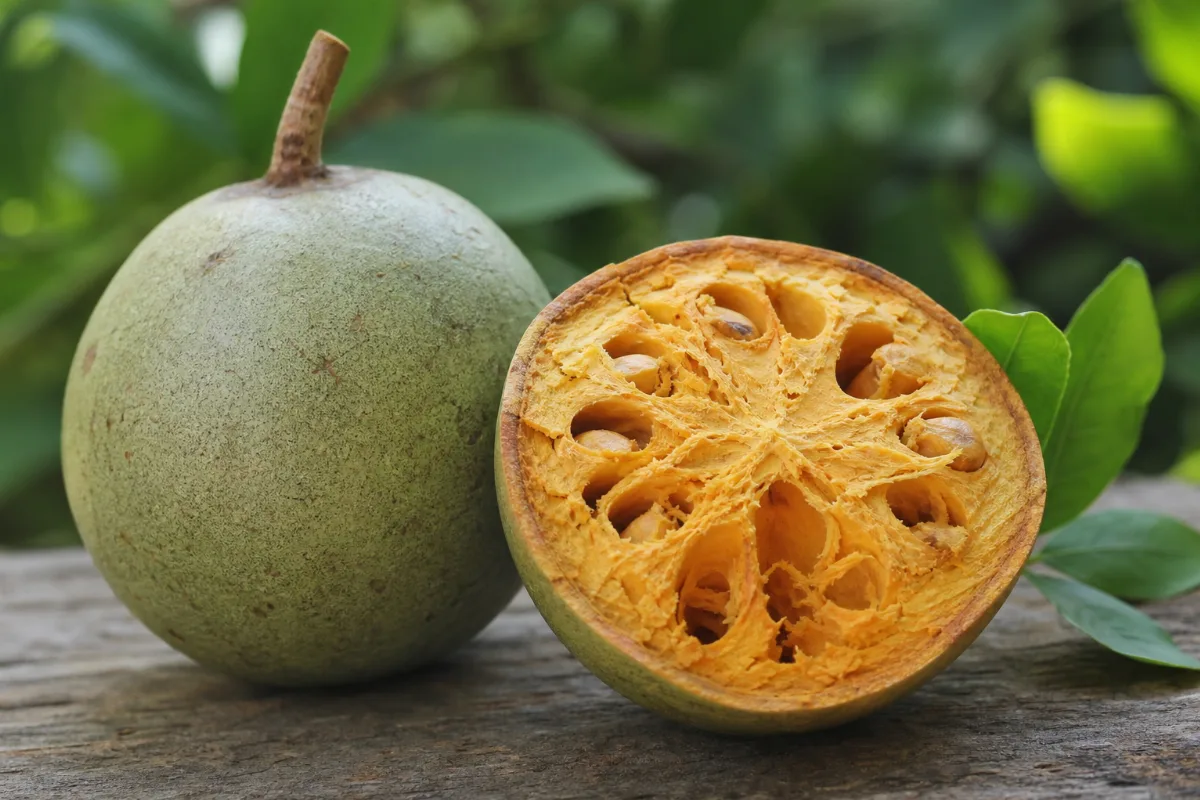
Herbs & Botanicals · Ayurvedic fruit for digestion
Bael
Aegle marmelos · also called Bilva, bel, bael fruit, stone apple
Bael is an Indian fruit tree whose fruit and leaf are used in Ayurveda for digestion, diarrhea and blood sugar. Almost all the support is from animals and lab tests, with only a few small, old human trials. Aegeline, a bael compound, was in supplements linked to serious liver injury in 2013, which is a separate issue from the fruit. Ask a doctor first if you take diabetes medicine or are pregnant.
General information, not medical advice. Last substantive update · Not medically reviewed. A named clinician has not signed off on this page. How this page is made
About Bael
Bael (Aegle marmelos) is a fruit tree of South and Southeast Asia used in Ayurveda. Human evidence is a handful of small, old trials, and most claims come from animals and lab work. Safety of the fruit and leaf in people is not well studied. Aegeline-containing weight-loss supplements were linked to severe liver injury in 2013.
What it is
Aegle marmelos is a tree in the citrus family (Rutaceae). GBIF and NCBI list it as an accepted species. The fruit pulp is eaten fresh or dried; the leaf, root and bark are used separately.
Unripe and ripe fruit are used for different things in tradition, so we keep them apart.
Traditional and current uses
In Ayurveda (Bilva) the unripe fruit is used for diarrhea and dysentery, and the ripe fruit as a tonic and laxative. A leaf porridge is a Sri Lankan remedy for diabetes.
Human research is limited to a shigellosis trial that found no benefit, an IBS trial of a two-herb mix, and a food study of a leaf porridge.
Safety in short
Aegeline is a compound found in bael leaf and fruit. In 2013 an aegeline-containing supplement, OxyELITE Pro, was linked by CDC, FDA and Hawaii investigators to a cluster of severe liver injury. The cause was never pinned down and one group disputes the link. This is a supplement issue, separate from eating the fruit.
For fruit and leaf, there are no human safety studies. Possible low blood sugar with diabetes medicine is a theory-based caution. In the lab, bael fruit extract blocked two drug-handling enzymes. No EMA, NCCIH or LactMed record was found.
At a glance
Traditional uses history, not proof
- Unripe or dried unripe fruit for diarrhea and dysentery (Ayurveda).
- Ripe fruit as a digestive tonic, cooling sherbet and mild laxative.
- Leaf porridge as a Sri Lankan food remedy for diabetes.
- Leaf, root and bark in other traditional preparations.
Studied for research
- Diarrhea and dysentery: one small trial showed no benefit
- Irritable bowel syndrome: one old trial of a two-herb mix, very low certainty
- Blood sugar: animal and lab only, no human trial
- Liver protection and antioxidant action: animal and lab only
Main compounds
- Aegeline: an alkaloid found in leaf and fruit; used in supplements linked to liver injury.
- Marmelosin (imperatorin) and marmesinin: furanocoumarins that blocked CYP3A4 in the lab.
- Gallic, ellagic and protocatechuic acid: phenolic acids in the fruit.
Common forms
- Fresh or dried fruit pulp
- Juice or sherbet
- Unripe fruit decoction or powder
- Leaf, root or bark preparations
- Capsule or extract (content not standardised)
Research links: Hawaii outbreak investigation (CDC and Hawaii) · Unripe bael powder for shigellosis (trial) · Bael fruit review (2022) · Research Library · Genes & Biomarkers Library
The plant and its history
- Accepted scientific name
- Aegle marmelos (L.) Corrêa
- Naming authority
- (L.) Corrêa (GBIF species key 5421195)
- Common names
- Bael (English); Bilva (Sanskrit (Ayurveda)); Bel (Hindi / Bengali); Stone apple (English)
- Botanical family
- Rutaceae (the citrus family), per GBIF and the 2022 review.
- Classification
- Plantae > Tracheophyta > Magnoliopsida > Sapindales > Rutaceae > Aegle > Aegle marmelos
- Native range
- Tropical and subtropical Asia, widely cultivated in southeast Asia (review abstract).
- Habitat
- Not verified.
- What the plant looks like
- Roots: Root also used traditionally (graph summary); not the same as fruit.; Stems: Bark also used traditionally.; Leaves: Leaf is used separately (leaf porridge, leaf extracts).; Flowers: Not described.; Fruit: Fruit pulp is eaten fresh or dried; unripe and ripe fruit are used for different purposes.
- Cultivation
- Not verified.
- Harvest and processing
- Not verified.
- Look-alikes and adulterants
- Name: Other fruits sold as "wood apple" or "stone apple"; Note: Not verified in the sources read; check the Latin name on the label.
- Sustainability and conservation
- Not verified.
Traditional use and history history, not clinical proof
| Tradition or era | Documented use | Source |
|---|---|---|
| Ayurveda (Bilva) | Unripe fruit for diarrhea and dysentery; ripe fruit as a digestive tonic and laxative; leaf, root and bark used in other preparations. | s-graph-herb-bael |
| Sri Lankan food remedy | Leaf-extract porridge for diabetes. | p22849311 |
| Modern supplement era (2012 to 2013) | Aegeline added to weight-loss and muscle-building supplements; the products were linked to a liver injury outbreak in 2013. | p26327730 |
Traditional use shows how a plant was used. It does not show that a supplement works or is safe today.
What is inside, and how it may work
What the plant contains and how those compounds act in cells and animals. Laboratory and animal mechanisms are not proven effects in people.
Main compounds
| Compound | Family | Where it is concentrated | Activity studied | Level of evidence |
|---|---|---|---|---|
| Aegeline PubChem 15558419 | alkaloidal amide | leaf and fruit (per 2021 paper) | Subject of lab work for diabetes and obesity; added to supplements and implicated in liver injury cluster; weak CYP3A4 inhibitor. 11 22 17 18 | Laboratory research |
| Marmelosin (imperatorin) PubChem 10212 | furanocoumarin | fruit | Inhibited CYP3A4 and CYP1A2 in human liver microsomes. PubChem resolves the name marmelosin to imperatorin. 11 17 | Laboratory research |
| Marmesinin PubChem 216283 | furanocoumarin glycoside | fruit | Moderate CYP3A4 and CYP1A2 inhibition in vitro. 11 17 | Laboratory research |
| Gallic acid PubChem 370 | phenolic acid | fruit | Listed as a phenolic acid in the fruit; antioxidant in lab assays. 11 19 | Laboratory research |
| Ellagic acid PubChem 5281855 | phenolic acid | fruit | Listed phenolic acid; lab antioxidant. 11 19 | Laboratory research |
| Protocatechuic acid PubChem 72 | phenolic acid | fruit | Listed phenolic acid; lab antioxidant. 11 19 | Laboratory research |
Mechanisms, receptors and pathways
| Target or pathway | Gene or receptor | What was found | Level |
|---|---|---|---|
| CYP3A4 and CYP1A2 drug-metabolising enzymes | CYP3A4, CYP1A2 | Fruit extract and marmelosin inhibited CYP3A4 (time-dependent) and CYP1A2 (reversible) in human liver microsomes; CYP2D6, 2C9, 2C19 not significantly affected. 17 | Laboratory research |
| Liver detox and antioxidant enzymes | Cytochrome P450, glutathione S-transferase and others | A leaf extract raised these enzymes in mouse liver. 20 | Animal research |
| Aegeline bioactivation | CYP2C19 | Aegeline was converted to a reactive intermediate mainly by CYP2C19 in rat liver preparations; blocking CYP2C19 reduced cell toxicity. 22 | Laboratory research |
| Sugar-digesting enzymes and glucose uptake | Not specified | From our summary: leaf extract blocked sugar-digesting enzymes in the lab and extracts lowered glucose in diabetic rats. Not re-opened. 6 19 | Animal research |
Absorption, metabolism and elimination
- Absorption
- Aegeline was absorbed quickly in mice (peak at 0.5 hours). No human data for any bael compound.
- Distribution
- Aegeline reached liver, kidney and brain tissue in mice.
- Metabolism
- Aegeline is converted by CYP2C19 to a reactive product in rat liver systems.
- Elimination
- Mouse plasma half-life about 1.3 to 1.4 hours; liver half-life 1.2 to 1.7 hours.
- Bioavailability
- Unknown in people.
Isolated compounds versus whole extracts
Aegeline is one compound of bael leaf and fruit, but whole fruit or leaf is not the same as a synthetic or concentrated aegeline ingredient. LiverTox (search summary only, NOT verified) says the aegeline in OxyELITE Pro was synthetic. Whether natural fruit or leaf carries the same risk is unknown. Safety data for whole fruit or leaf in people is lacking.
Nutritional composition
Bael fruit is a food: reviews describe carbohydrates, proteins, minerals and vitamins in the pulp. This page does not give nutrient amounts.
1 very low certainty8 not enough evidence
What is Bael good for?
The main uses and how strong the evidence is. 'Very low' or 'insufficient' means the research is too thin to rely on. Fruit, leaf and aegeline supplements are different, and mixes cannot be credited to bael alone.
Benefits, one by one
Each card is a research question, not a promise. Tap a goal to filter. Open a card to see the studies, doses and limits.
Diarrhea and dysentery (unripe fruit)
Not enough evidenceIn Ayurveda the unripe fruit is a classic remedy for diarrhea and dysentery. The one human trial we found, in 82 men with shigellosis, did not show a benefit from dried unripe bael powder. Other support is from mice and test-tube work.
4 studiesNot applicable: no amounts are given here. Ask a doctor or pharmacist…
Studies, doses and limits
What the trials found
Haider 1991: a double-blind trial in 82 men with shigellosis compared dried unripe bael fruit powder (16 men), two other plant powders, ampicillin (15) and placebo (17). The plant powders did not show clinical improvement or bacteriological cure compared with ampicillin. The abstract does not give separate bael-versus-placebo numbers. No other human trial of bael alone for diarrhea was found.
Results
One small human trial: no benefit shown. Everything else is animal or lab.
Effect sizes as reported
None reported in the abstract.
Why this rating
One tiny, old trial that showed no benefit; supportive findings are from animals and test tubes only.
Form and dose studied
Not applicable: no amounts are given here. Ask a doctor or pharmacist about amounts.
Who was studied
Men with shigellosis in Bangladesh (trial); no children or women studied.
Limits
16 men on bael; no numbers for bael versus placebo; 1991. Diarrhea with fever or blood needs medical care, not herbs alone.
Why researchers looked
Unripe bael fruit has long been used in South Asia for loose stools and dysentery.
Traditional use
Ayurveda (Bilva): unripe or dried unripe fruit for diarrhea and dysentery, ripe fruit as a tonic and laxative.
Proposed mechanism Animal research
Our summary of the full-text reviews reports that fruit extracts reduced castor-oil diarrhea in mice and blocked Shigella bacteria in the lab. Not re-opened.
A proposed mechanism does not show that the effect happens in people.
Dehydration is the main danger of diarrhea; see a clinician if it is severe or bloody.
Irritable bowel syndrome (two-herb Ayurvedic mix)
Very low certaintyA 1989 trial of a mix of bael and Bacopa found more people improved than on placebo, especially with diarrhea-type IBS. Because it is two herbs, bael cannot be credited alone.
1 studiesNot applicable: no amounts are given here. Ask a doctor or pharmacist…
Studies, doses and limits
What the trials found
Yadav 1989: 169 patients with IBS had a compound preparation of Aegle marmelos plus Bacopa monnieri (57), standard drugs (60) or placebo (52) for 6 weeks. Judged effective in 64.9% on the herbal mix, 78.3% on standard therapy and 32.7% on placebo. The mix did best in diarrhea-predominant IBS. After 6 months of follow-up both treatments were no better than placebo at preventing relapse.
Results
Short-term improvement versus placebo; no lasting advantage.
Effect sizes as reported
64.9% vs 32.7% placebo (no statistics in the abstract).
Why this rating
One old trial of a two-herb combination, abstract only, no statistics given, no lasting benefit.
Form and dose studied
Not applicable: no amounts are given here. Ask a doctor or pharmacist about amounts.
Who was studied
Adults with IBS in India.
Limits
Combination product; 1989; relapse not reduced at 6 months.
Why researchers looked
Ayurvedic practice uses bael for bowel complaints with loose stools.
Traditional use
Bilva is used in Ayurvedic gut formulas.
Proposed mechanism Pharmacological theory
No mechanism was tested in this trial; lab work suggests several plant compounds, but this is theory.
A proposed mechanism does not show that the effect happens in people.
No side effects are described in the abstract.
Blood sugar and diabetes
Not enough evidenceBael is widely promoted for diabetes. Reviews find the support is animal and lab work. The only human data we found is a food study of a leaf porridge with a low-to-medium glycaemic index, which cannot be credited to bael.
5 studiesNot applicable: no amounts are given here. Ask a doctor or pharmacist…
Studies, doses and limits
What the trials found
Senadheera 2013 measured glycaemic index of Sri Lankan leafy porridges: the Aegle marmelos porridge scored 50 +/- 8, and peak blood glucose fell 25% or more in nearly all leafy porridges versus a glucose control. The porridge also contains rice and coconut milk, so this is a food result, not a test of bael. A 2009 narrative review lists bael among plants that "could be useful" and calls for clinical trials against standard diabetes pills. The 2022 and 2021 reviews describe animal and lab support only. No randomized trial of bael for blood sugar was found.
Results
No human trial shows bael lowers blood sugar or HbA1c.
Effect sizes as reported
Porridge GI 50 +/- 8 (food study).
Why this rating
Animal and lab data plus one food study; no clinical trial.
Form and dose studied
Not applicable: no amounts are given here. Ask a doctor or pharmacist about amounts.
Who was studied
Not described in the porridge abstract.
Limits
Porridge result is not bael alone; reviews are narrative.
Why researchers looked
Ayurvedic and Sri Lankan food remedies use bael leaf and fruit for diabetes.
Traditional use
Bael leaf porridge is a Sri Lankan dietary remedy for diabetes (from the study abstract).
Proposed mechanism Animal research
Our summary reports diabetic-rat studies and a lab study in which leaf extract blocked sugar-digesting enzymes. Not re-opened.
A proposed mechanism does not show that the effect happens in people.
Could add to the effect of diabetes medicine in theory; do not replace diabetes treatment.
Digestive tonic and laxative (ripe fruit)
Not enough evidenceRipe bael is traditionally eaten as a digestive tonic and laxative. We found no trial of this use.
2 studiesNot applicable.
Studies, doses and limits
What the trials found
No human trial found.
Results
None.
Effect sizes as reported
None.
Why this rating
Traditional use only.
Form and dose studied
Not applicable.
Who was studied
None studied.
Limits
No data.
Why researchers looked
Traditional use only.
Traditional use
Ayurveda: ripe fruit pulp or sherbet as a cooling tonic and mild laxative.
Proposed mechanism Pharmacological theory
Bael fruit contains fibre; no mechanism for a laxative effect was tested in the sources read.
A proposed mechanism does not show that the effect happens in people.
Unripe and ripe fruit are used for opposite problems in tradition; see the Safety tab for constipation.
Ulcerative colitis-type gut inflammation (animals)
Not enough evidenceBael extracts eased colitis in mice and rats in recent studies. Not tested in people in the sources read.
2 studiesNot applicable.
Studies, doses and limits
What the trials found
None.
Results
Animal only.
Effect sizes as reported
Not given.
Why this rating
Animal and computer-model results only.
Form and dose studied
Not applicable.
Who was studied
Mice and rats.
Limits
Animal only; detail not re-opened.
Why researchers looked
Traditional gut use led to animal colitis models.
Traditional use
Traditional gut remedy.
Proposed mechanism Animal research
Animal and computer-model findings summarised in a 2021 review.
A proposed mechanism does not show that the effect happens in people.
Not applicable.
Liver protection (animals)
Not enough evidenceBael extracts protected rat livers from chemical injury in animal tests. There is no human data. This is very different from the real liver injuries linked to aegeline supplements (see Safety).
3 studiesNot applicable.
Studies, doses and limits
What the trials found
None.
Results
Animal only.
Effect sizes as reported
Not given.
Why this rating
Animal only.
Form and dose studied
Not applicable.
Who was studied
Rats.
Limits
Animal only; detail not re-opened.
Why researchers looked
Traditional use and lab interest.
Traditional use
Not a classic traditional claim in the sources read.
Proposed mechanism Animal research
Animal studies summarised by the reviews; authors call them limited.
A proposed mechanism does not show that the effect happens in people.
Do not treat this as a reason to take aegeline products: those were linked to severe liver injury.
Antioxidant activity (lab)
Not enough evidenceExtracts and their phenolic compounds show antioxidant activity in test-tube assays. This does not show a benefit in people.
3 studiesNot applicable.
Studies, doses and limits
What the trials found
None.
Results
Lab and mouse only.
Effect sizes as reported
Not given.
Why this rating
Lab assays do not show a clinical benefit.
Form and dose studied
Not applicable.
Who was studied
Cells and mice.
Limits
Not a human outcome.
Why researchers looked
Fruit and leaf contain phenolic acids and flavonoids.
Traditional use
Not applicable.
Proposed mechanism Laboratory research
Radical-scavenging in lab assays; a mouse leaf-extract study raised liver detox and antioxidant enzymes.
A proposed mechanism does not show that the effect happens in people.
Enzyme-inducing effect in mice is a possible interaction signal, not proven in people.
Cholesterol (multi-herb tablet)
Not enough evidenceAn 8-week trial of a Thai multi-herb tablet containing bael did not improve blood fats; the decoction lowered triglycerides. Bael cannot be separated from the other herbs.
1 studiesNot applicable.
Studies, doses and limits
What the trials found
From our summary of the 2022 report (listing only, not re-opened): tablet no lipid improvement; decoction lowered triglycerides.
Results
Mixed; combination only.
Effect sizes as reported
Not available.
Why this rating
Multi-herb product; details unread.
Form and dose studied
Not applicable.
Who was studied
People with high blood fats (per summary).
Limits
Summary-only.
Why researchers looked
Part of a Thai herbal formula.
Traditional use
Thai traditional formula.
Proposed mechanism Pharmacological theory
Not examined.
A proposed mechanism does not show that the effect happens in people.
None reported in what we read.
Radiation protection (animals)
Not enough evidenceOne mouse study found a statistically insignificant protective effect, so the authors did not pursue it.
2 studiesNot applicable.
Studies, doses and limits
What the trials found
None.
Results
Negative animal result.
Effect sizes as reported
Insignificant dose-reduction factor (from review summary).
Why this rating
Single negative animal result.
Form and dose studied
Not applicable.
Who was studied
Mice.
Limits
Summary-only.
Why researchers looked
Some Indian fruits were screened as radioprotectors.
Traditional use
Not applicable.
Proposed mechanism Animal research
Not applicable.
A proposed mechanism does not show that the effect happens in people.
Not applicable.
Connections to the rest of health
How Bael connects to the rest of our health knowledge graph. Every link says what kind of connection it is. A safety link (for example to the liver) is a warning, not a benefit. A study that merely mentions a topic never creates a benefit link.
Explore every connection: goals, body systems, organs, symptoms, genes
A. Wellness goals
| Connected to | Kind of connection | Evidence status | Context | Studies |
|---|---|---|---|---|
| Digestive Support | Traditional use | Not enough evidence | Diarrhea and dysentery (unripe fruit): In Ayurveda the unripe fruit is a classic remedy for diarrhea and dysentery. The one human trial we found, in 82 men with shigellosis, did not show a benefit from dried unripe bael powder. Other support is from mice and test-tube work. Digestive tonic and laxative (ripe fruit): Ripe bael is traditionally eaten as a digestive tonic and laxative. We found no trial of this use. | 13 19 23 6 |
| Gut Health | Traditional use | Not enough evidence | Diarrhea and dysentery (unripe fruit): In Ayurveda the unripe fruit is a classic remedy for diarrhea and dysentery. The one human trial we found, in 82 men with shigellosis, did not show a benefit from dried unripe bael powder. Other support is from mice and test-tube work. | 13 19 23 6 |
| Digestive Support | Potential benefit | Very low certainty | Irritable bowel syndrome (two-herb Ayurvedic mix): A 1989 trial of a mix of bael and Bacopa found more people improved than on placebo, especially with diarrhea-type IBS. Because it is two herbs, bael cannot be credited alone. | 24 |
| Gut Health | Potential benefit | Very low certainty | Irritable bowel syndrome (two-herb Ayurvedic mix): A 1989 trial of a mix of bael and Bacopa found more people improved than on placebo, especially with diarrhea-type IBS. Because it is two herbs, bael cannot be credited alone. | 24 |
| Blood Sugar Balance | Traditional use | Not enough evidence | Blood sugar and diabetes: Bael is widely promoted for diabetes. Reviews find the support is animal and lab work. The only human data we found is a food study of a leaf porridge with a low-to-medium glycaemic index, which cannot be credited to bael. | 1 12 19 23 6 |
| Metabolic Health | Traditional use | Not enough evidence | Blood sugar and diabetes: Bael is widely promoted for diabetes. Reviews find the support is animal and lab work. The only human data we found is a food study of a leaf porridge with a low-to-medium glycaemic index, which cannot be credited to bael. | 1 12 19 23 6 |
| Gut Health | Preliminary mechanism | Not enough evidence | Ulcerative colitis-type gut inflammation (animals): Bael extracts eased colitis in mice and rats in recent studies. Not tested in people in the sources read. | 23 6 |
| Inflammation Balance | Preliminary mechanism | Not enough evidence | Ulcerative colitis-type gut inflammation (animals): Bael extracts eased colitis in mice and rats in recent studies. Not tested in people in the sources read. | 23 6 |
| Liver Support | Preliminary mechanism | Not enough evidence | Liver protection (animals): Bael extracts protected rat livers from chemical injury in animal tests. There is no human data. This is very different from the real liver injuries linked to aegeline supplements (see Safety). | 19 23 6 |
| Healthy Aging | Preliminary mechanism | Not enough evidence | Antioxidant activity (lab): Extracts and their phenolic compounds show antioxidant activity in test-tube assays. This does not show a benefit in people. Radiation protection (animals): One mouse study found a statistically insignificant protective effect, so the authors did not pursue it. | 19 23 20 6 |
| Cholesterol Balance | Potential benefit | Not enough evidence | Cholesterol (multi-herb tablet): An 8-week trial of a Thai multi-herb tablet containing bael did not improve blood fats; the decoction lowered triglycerides. Bael cannot be separated from the other herbs. | 5 |
B. Body systems
| Connected to | Kind of connection | Evidence status | Context | Studies |
|---|---|---|---|---|
| Digestive System | Biological association | Not enough evidence | Studied for: Diarrhea and dysentery (unripe fruit) Studied for: Irritable bowel syndrome (two-herb Ayurvedic mix) | 13 19 23 6 24 |
| Endocrine System | Biological association | Not enough evidence | Studied for: Blood sugar and diabetes | 1 12 19 23 6 |
| Metabolism Weight | Biological association | Not enough evidence | Studied for: Blood sugar and diabetes | 1 12 19 23 6 |
| Immune System | Biological association | Not enough evidence | Studied for: Ulcerative colitis-type gut inflammation (animals) Studied for: Antioxidant activity (lab) | 23 6 19 20 |
| Hepatic System | Biological association | Not enough evidence | Studied for: Liver protection (animals) | 19 23 6 |
| Cardiovascular System | Biological association | Not enough evidence | Studied for: Cholesterol (multi-herb tablet) | 5 |
C. Body parts and organs
| Connected to | Kind of connection | Evidence status | Context | Studies |
|---|---|---|---|---|
| Liver | Adverse effect or risk | Low certainty | Severe liver injury cluster in 2013; cause not established; one group disputes the link. 2013 liver injury cluster; separate from fruit and leaf. Preparation or compound: Aegeline-containing supplement (not fruit or leaf) |
2 15 3 14 16 |
| Pancreas | Drug or supplement interaction | Not enough evidence | Possible added blood sugar lowering with diabetes medicine; theory only. Preparation or compound: Fruit and leaf |
19 |
| Gut | Traditional use | Not enough evidence | Traditional diarrhea and digestive use; one null trial. Preparation or compound: Unripe and ripe fruit |
13 |
I. Biomarkers
| Connected to | Kind of connection | Evidence status | Context | Studies |
|---|---|---|---|---|
| Clinical and bacteriological cure in shigellosis | Biological association | Not enough evidence | Measured in trials: no-change. A lab change is not the same as a health benefit. | 13 |
| IBS symptom improvement | Biological association | Very low certainty | Measured in trials: mixed. A lab change is not the same as a health benefit. | 24 |
| Glycaemic index of a bael-leaf porridge | Biological association | Not enough evidence | Measured in trials: lowered. A lab change is not the same as a health benefit. | 1 |
| Triglycerides (blood fats) | Biological association | Not enough evidence | Measured in trials: mixed. A lab change is not the same as a health benefit. | 5 |
K. Biological pathways
L. Active compounds
| Connected to | Kind of connection | Evidence status | Context | Studies |
|---|---|---|---|---|
| Aegeline | Biological association | In vitro | Subject of lab work for diabetes and obesity; added to supplements and implicated in liver injury cluster; weak CYP3A4 inhibitor. Preparation or compound: leaf and fruit (per 2021 paper) |
11 22 17 18 |
| Marmelosin (imperatorin) | Biological association | In vitro | Inhibited CYP3A4 and CYP1A2 in human liver microsomes. PubChem resolves the name marmelosin to imperatorin. Preparation or compound: fruit |
11 17 |
| Marmesinin | Biological association | In vitro | Moderate CYP3A4 and CYP1A2 inhibition in vitro. Preparation or compound: fruit |
11 17 |
| Gallic acid | Biological association | In vitro | Listed as a phenolic acid in the fruit; antioxidant in lab assays. Preparation or compound: fruit |
11 19 |
| Ellagic acid | Biological association | In vitro | Listed phenolic acid; lab antioxidant. Preparation or compound: fruit |
11 19 |
| Protocatechuic acid | Biological association | In vitro | Listed phenolic acid; lab antioxidant. Preparation or compound: fruit |
11 19 |
Each connection is stored with the ingredient, the connected record, the kind of connection, the evidence status, the supporting studies, the preparation or compound involved, and a review date (last reviewed October 25, 2026).
The evidence
The research centre for Bael. Every record here was checked against PubMed or the publisher's page; we never list a study we have not verified.
Evidence by outcome
Bars show how many studies we found for each outcome, not how well it works. People are added up across trials only (reviews are not added, to avoid double counting).
How we rate evidence
High certainty
Several well-run trials or reviews agree; further research is unlikely to change the picture much.
Moderate certainty
Good trials point the same way, but some doubt remains.
Low certainty
Small, short or inconsistent trials. The finding could change with better research.
Very low certainty
Very little or very weak human data. Treat as a possibility only.
Mixed findings
Trials or reviews disagree with each other.
Not enough evidence
Not enough human research to say either way.
Evidence against
Good research found no benefit, or found harm.
We take the reviewers' own risk-of-bias and GRADE statements where they exist, and otherwise judge from study size, design, consistency, directness and whether a product matches what is sold. Many publications do not make evidence high. Method note: We read PubMed abstracts for the trials, outbreak reports and reviews. EMA, NCCIH and LactMed records were not found, and the LiverTox page could not be opened.
Study library: every study we checked 24
| Study | Design | People | Product, dose, length | Result |
|---|---|---|---|---|
| Anuruddhika Subhashinie Senadheera 2013 Green leafy porridges: how good are they in controlling glycaemic response? Int J Food Sci Nutr · PMID 22849311 · DOI |
Other human |
Sri Lankan green leafy porridges tested for glycaemic index (volunteer details not given in abstract) | Porridge made with Aegle marmelos leaf water extract, rice and coconut milk (one of nine leafy porridges) leaf Not given here Not stated in abstract · vs Glucose control |
The Aegle marmelos porridge had a GI of 50 +/- 8 (low-to-medium). Peak blood glucose fell by 25% or more in all leafy porridges tested except Cassia auriculata and Atlantia zeylanica. GI 50 +/- 8 Methods, limits and fundingOutcomes: Glycaemic index (GI), peak blood glucose Limitations: A food (rice and coconut milk included), not an extract; the effect cannot be credited to bael; participants not described in abstract. Read: abstract |
| Centers for Disease Control and Prevention (CDC) 2013 Notes from the field: acute hepatitis and liver failure following the use of a dietary supplement intended for weight loss or muscle building--May-October 2013. MMWR Morb Mortal Wkly Rep · PMID 24113901 |
Case series |
7 Seven previously healthy people in Hawaii with severe hepatitis and liver failure |
OxyELITE Pro (multi-ingredient weight-loss and muscle-gain supplement) unspecified Not given here Not stated in abstract · vs Not stated in abstract |
On 9 September 2013 the Hawaii Department of Health was told of seven patients with severe acute hepatitis and fulminant liver failure of unknown cause; all had used OxyELITE Pro before illness. Not applicable Methods, limits and fundingOutcomes: Alert about a liver cluster Limitations: Short alert; the abstract does not name aegeline. Read: abstract |
| Chatham-Stephens 2017 Hepatotoxicity associated with weight loss or sports dietary supplements, including OxyELITE Pro - United States, 2013. Drug Test Anal · PMID 27367536 · DOI |
Outbreak investigation |
40 40 people in 23 states and two military bases with unexplained acute hepatitis after weight-loss or muscle-building supplements |
Weight-loss or muscle-building supplements; 25 took OxyELITE Pro unspecified Not given here Not stated in abstract · vs Not stated in abstract |
25 of 40 (62.5%) reported OxyELITE Pro; 17 of 22 with data were hospitalised and 1 had a liver transplant. 25 of 40 took OxyELITE Pro Methods, limits and fundingOutcomes: Case finding across the US Limitations: Case finding by reports; not all cases linked to one product. Funding and conflicts: US government (CDC, FDA, Department of Defense). Read: abstract |
| Database / agency record 2013 FDA warning letter to USPlabs about OxyELITE Pro and VERSA-1, 11 Oct 2013, and recall (trade press report) NutraIngredients, 2013 · Source |
Authoritative guidance not-applicable |
Not applicable | Not applicable unspecified Not given here Not stated in abstract · vs Not stated in abstract |
Trade press reports FDA said aegeline had no lawful pre-1994 marketing record or new-dietary-ingredient notification, so the products were treated as adulterated, and that USPlabs recalled them. The FDA letter itself was not opened, so this is NOT verified; the missing notification is also stated in Klontz 2015. Not applicable Methods, limits and fundingOutcomes: Identity or status record Limitations: Secondary report; FDA document not read. Read: summary-only |
| Database / agency record 2022 Nawametho tablet vs decoction in hyperlipidemia (Evid Based Complement Alternat Med 2022; Europe PMC MED 35966727; listing only) Evid Based Complement Alternat Med · Source |
Controlled trial |
Not applicable | Not applicable unspecified Not given here Not stated in abstract · vs Not stated in abstract |
From our summary: in an 8-week trial a Thai multi-herb tablet containing bael did not improve lipids, while the decoction lowered triglycerides. Not re-opened. Not applicable Methods, limits and fundingOutcomes: Identity or status record Limitations: Multi-herb product; bael cannot be separated; details unread. Read: summary-only |
| Database / agency record 2026 Our nutrient-graph summary for bael (herb-bael.json) alternativemed.com internal summary · Source |
Summary not-applicable |
Not applicable | Not applicable unspecified Not given here Not stated in abstract · vs Not stated in abstract |
Internal starting summary of forms, uses and sources. Used for identity, forms and animal-study statements; items marked summary-only were not re-opened. Not applicable Methods, limits and fundingOutcomes: Identity or status record Limitations: Internal summary; not independent evidence. Read: summary-only |
| Database / agency record 2026 LiverTox: OxyELITE Pro (NCBI Bookshelf NBK548935) NIDDK LiverTox via NCBI Bookshelf · Source |
Authoritative guidance not-applicable |
Not applicable | Not applicable unspecified Not given here Not stated in abstract · vs Not stated in abstract |
An entry exists (found by web search). The search summary says the product was withdrawn in 2013, was reformulated from DMAA to aegeline, that the aegeline used was a synthetic product that may have contained contaminants, and that the guilty ingredient is unknown. The page itself was blocked by a browser check, so this is NOT verified from the entry. Not applicable Methods, limits and fundingOutcomes: Identity or status record Limitations: Page text not read; search-snippet only. Read: summary-only |
| Database / agency record 2026 Regulator search: EMA/HMPC, NCCIH, LactMed for bael / Aegle marmelos Agency sites, checked 2026-10-25 · Source |
Authoritative guidance not-applicable |
Not applicable | Not applicable unspecified Not given here Not stated in abstract · vs Not stated in abstract |
No bael or Aegle marmelos monograph, fact sheet or record was found. A guessed EMA herbal URL and a guessed NCCIH URL returned 404 (NCCIH bael page); NCBI Bookshelf pages were blocked by a browser check. NOT verified as absent. Not applicable Methods, limits and fundingOutcomes: Identity or status record Limitations: Absence not proven; sites partly blocked. Read: summary-only |
| Database / agency record 2026 GBIF: Aegle marmelos (L.) Corrêa (species key 5421195) GBIF API, checked 2026-10-25 · Source |
Authoritative guidance not-applicable |
Not applicable | Not applicable unspecified Not given here Not stated in abstract · vs Not stated in abstract |
Accepted species, family Rutaceae, order Sapindales (exact match, status ACCEPTED). Not applicable Methods, limits and fundingOutcomes: Identity or status record Limitations: Taxonomy only. Read: full-text |
| Database / agency record 2026 NCBI Taxonomy: Aegle marmelos (taxid 68527) NCBI Taxonomy esummary, checked 2026-10-25 · Source |
Authoritative guidance not-applicable |
Not applicable | Not applicable unspecified Not given here Not stated in abstract · vs Not stated in abstract |
Species rank, active record, taxid 68527. Not applicable Methods, limits and fundingOutcomes: Identity or status record Limitations: Taxonomy only. Read: full-text |
| Database / agency record 2026 PubChem: aegeline, imperatorin (marmelosin), marmesinin, gallic, ellagic and protocatechuic acid PubChem PUG REST, checked 2026-10-25 · Source |
Authoritative guidance not-applicable |
Not applicable | Not applicable unspecified Not given here Not stated in abstract · vs Not stated in abstract |
Aegeline CID 15558419 (C18H19NO3); name "marmelosin" resolves to imperatorin CID 10212 (C16H14O4); marmesinin CID 216283; gallic acid CID 370; ellagic acid CID 5281855; protocatechuic acid CID 72. Not applicable Methods, limits and fundingOutcomes: Identity or status record Limitations: Identifiers only; plant content not given. Read: full-text |
| Dwivedi 2009 Indigenous drugs in ischemic heart disease in patients with diabetes. J Altern Complement Med · PMID 19922253 · DOI |
Narrative review review |
Narrative review of plants for type 2 diabetes with heart disease | Several plants including bael unspecified Not given here Not stated in abstract · vs Not stated in abstract |
Lists bael among plants "found to be useful" in diabetes with heart disease and says they were shown to be safe in long-term use; calls for more clinical research against standard diabetes pills. Not applicable Methods, limits and fundingOutcomes: Overview Limitations: Brief narrative review; the safety statement is the authors' claim and is not backed here by a trial we read. Read: abstract |
| Haider 1991 Evaluation of indigenous plants in the treatment of acute shigellosis. Trop Geogr Med · PMID 1816661 |
Controlled trial |
82 82 men with acute shigellosis (bacterial dysentery) in Bangladesh; 16 got bael |
Dried unripe bael fruit powder (also thankuni and gandhavadulia powders) fruit (unripe) Not given here Not stated in abstract · vs Ampicillin (15 men) and placebo (17 men) |
Treatment with the plant powders did not show clinical improvement or bacteriological cure compared with ampicillin. The abstract does not give separate numbers for bael versus placebo. No benefit shown versus ampicillin; no numbers reported in abstract Methods, limits and fundingOutcomes: Clinical improvement and bacteriological cure Limitations: Very small groups (16 men on bael); men only; 1991; abstract gives no effect sizes. Read: abstract |
| Heidemann 2016 Severe Acute Hepatocellular Injury Attributed to OxyELITE Pro: A Case Series. Dig Dis Sci · PMID 27142670 · DOI |
Case series |
7 Seven patients in the US Drug-Induced Liver Injury Network registry |
OxyELITE Pro unspecified Not given here Median 18 weeks of use (range 5 to 102) · vs Not stated in abstract |
Median peak ALT 2242 U/L and bilirubin 15.0 mg/dL; 6 hospitalised, 3 developed acute liver failure, 2 had liver transplants. Causality scores were definite in 1, highly likely in 3, probable in 2, possible in 1. Four of the five without a transplant recovered fully within 6 months. 2 of 7 transplanted Methods, limits and fundingOutcomes: Presentation and 6-month outcome Limitations: Seven cases; attributed to the product, not to one named ingredient. Funding and conflicts: No conflicts of interest declared. Read: abstract |
| Johnston 2016 Hepatotoxicity associated with the dietary supplement OxyELITE Pro - Hawaii, 2013. Drug Test Anal · PMID 26538199 · DOI |
Outbreak investigation |
44 Hawaii residents with acute hepatitis of unknown cause; 76 reports, 44 met the case definition |
OxyELITE Pro unspecified Not given here Not stated in abstract · vs Not stated in abstract |
Of 44 cases, 36 (82%) reported OxyELITE Pro in the two months before illness. Two OxyELITE Pro patients needed a liver transplant and a third died. Excessive dosing was not reported. Product tests matched the label; the mechanism of liver injury was not identified. 36 of 44 cases exposed (82%) Methods, limits and fundingOutcomes: Cases, exposure, product analysis Limitations: Outbreak investigation, not a trial; mechanism and the guilty ingredient not identified. Funding and conflicts: One author (now at the Natural Products Association) was an FDA employee at the time; government and public-health authors. Read: abstract |
| Klontz 2015 The Role of Adverse Event Reporting in the FDA Response to a Multistate Outbreak of Liver Disease Associated with a Dietary Supplement. Public Health Rep · PMID 26327730 · DOI |
Case series |
114 114 adverse-event reports to FDA MedWatch, Feb 2012 to Feb 2014 |
OxyELITE Pro, alone or with other supplements unspecified Not given here Not stated in abstract · vs Not stated in abstract |
55 of 114 reports (48%) described liver disease with no other known cause; 33 were hospitalised and 3 had liver transplants. In early 2013 a new formulation replaced 1,3-dimethylamylamine with aegeline, and the maker did not file the required "new dietary ingredient" notice. FDA lab tests found no drugs, poisons, toxic metals, usnic acid, pyrrolizidine alkaloids, aristolochic acid or phenethylamines. 55 of 114 liver-disease reports Methods, limits and fundingOutcomes: Adverse event reports; product testing Limitations: Voluntary reports; cannot prove cause; the abstract does not say which ingredient caused harm. Funding and conflicts: FDA authors. Read: abstract |
| Manda 2016 Inhibition of CYP3A4 and CYP1A2 by Aegle marmelos and its constituents. Xenobiotica · PMID 26247834 · DOI |
Laboratory research in-vitro |
Human liver microsomes and recombinant enzymes | Methanol extract of bael fruit; marmelosin, marmesinin, 8-hydroxypsoralen, aegeline fruit Not given here Not stated in abstract · vs Not applicable |
The fruit extract and marmelosin competitively and time-dependently inhibited CYP3A4; CYP1A2 inhibition was reversible. Marmesinin moderately inhibited CYP3A4 and 1A2. Aegeline was a very weak CYP3A4 inhibitor and did not inhibit CYP1A2. No significant inhibition of CYP2D6, 2C9 or 2C19. Not applicable Methods, limits and fundingOutcomes: Inhibition of CYP3A4, 2D6, 1A2, 2C9, 2C19 Limitations: Test tube only; no human drug-level study; relevance to eating the fruit unknown. Read: abstract |
| Manda 2019 Pharmacokinetics and Tissue Distribution of Aegeline after Oral Administration in Mice. Planta Med · PMID 30754052 · DOI |
Animal research animal |
ND4 mice | Aegeline by mouth (30 mg/kg and 300 mg/kg) unspecified Not given here Blood and tissue sampled over 8 hours · vs Not stated in abstract |
Peak plasma level at 0.5 hours; plasma half-life about 1.4 and 1.3 hours at the two doses; half-life in liver 1.2 and 1.7 hours; not detectable in plasma at 8 hours. Not applicable Methods, limits and fundingOutcomes: Blood and tissue levels Limitations: Mice, one compound; no human data. Funding and conflicts: Declared no conflict of interest. Read: abstract |
| Sharma 2022 Aegle marmelos (L.) Correa: An Underutilized Fruit with High Nutraceutical Values: A Review. Int J Mol Sci · PMID 36142805 · DOI |
Narrative review review |
Review of bael fruit nutrition and lab/animal pharmacology | Bael fruit extracts fruit Not given here Not stated in abstract · vs Not stated in abstract |
Describes nutrition (carbohydrates, proteins, minerals, vitamins) and phytochemicals (alkaloids, flavonoids, phenolic acids such as protocatechuic, gallic and ellagic acid). Activities listed (antidiarrheal, antioxidant, antidiabetic, hepatoprotective, radioprotective, anticancer, antiulcer) come from in vivo and in vitro work. Specific animal findings used on this page come from our nutrient-graph summary of the full text and were not re-opened. Not applicable Methods, limits and fundingOutcomes: Nutrition, chemistry and pharmacological activities Limitations: Narrative review; mostly animal and lab studies. Read: abstract |
| Singh 2000 Effect of Aegle marmelos on biotransformation enzyme systems and protection against free-radical-mediated damage in mice. J Pharm Pharmacol · PMID 11007071 · DOI |
Animal research animal |
Mice | Hydroalcoholic leaf extract (50 and 100 mg/kg daily) leaf Not given here 14 days · vs Not stated in abstract |
The leaf extract raised liver cytochrome P450 and other detox and antioxidant enzymes (it acted as an inducer of phase I and II enzymes) and lowered a lipid-damage marker. Not applicable Methods, limits and fundingOutcomes: Liver enzyme systems and oxidative markers Limitations: Mice only; a leaf extract, not the fruit. Read: abstract |
| Teschke 2016 The Honolulu Liver Disease Cluster at the Medical Center: Its Mysteries and Challenges. Int J Mol Sci · PMID 27043544 · DOI |
Narrative review |
Re-examination of the Honolulu hospital cases | OxyELITE Pro unspecified Not given here Not stated in abstract · vs Not stated in abstract |
The authors argue the Honolulu hospital group was mixed (other liver diseases, acetaminophen, NSAIDs, viral hepatitis, multiple supplements) and that their own causality reassessment found no causality for OxyELITE Pro in the cases they evaluated. They criticise the CDC, Hawaii and FDA conclusions. Not applicable Methods, limits and fundingOutcomes: Causality reassessment Limitations: A minority, contested position; other investigators (DILIN, CDC) rated many cases as probable or higher. We give both views. Read: abstract |
| Tian 2021 Metabolic activation of aegeline mediated by CYP2C19. Xenobiotica · PMID 33892609 · DOI |
Laboratory research in-vitro |
Rat liver microsomes, rat bile, rat hepatocytes | Aegeline unspecified Not given here Not stated in abstract · vs Not stated in abstract |
Aegeline was turned into a reactive intermediate, mainly by CYP2C19; the CYP2C19 blocker ticlopidine reduced this and lowered aegeline toxicity to liver cells. The authors say the mechanism of aegeline liver injury remains unclear. Not applicable Methods, limits and fundingOutcomes: Reactive metabolites and cell toxicity Limitations: Rat and cell work; not shown in people. Read: abstract |
| Venthodika 2021 Bioactive compounds of Aegle marmelos L., medicinal values and its food applications: A critical review. Phytother Res · PMID 33159390 · DOI |
Narrative review review |
Review of bael fruit compounds and health effects | Bael fruit and other parts fruit Not given here Not stated in abstract · vs Not stated in abstract |
Lists possible benefits assessed mostly in in vivo and in vitro studies (including antidiarrheal, antidiabetic, anti-ulcerative colitis, hepatoprotective). The authors say more research is needed to balance pharmacological and toxic effects. Not applicable Methods, limits and fundingOutcomes: Overview Limitations: Narrative review; animal colitis and liver detail was not re-opened (summary-only). Read: abstract |
| Yadav 1989 Irritable bowel syndrome: therapeutic evaluation of indigenous drugs. Indian J Med Res · PMID 2697693 |
Controlled trial |
169 169 patients with irritable bowel syndrome (IBS); 57 on the Ayurvedic preparation |
Compound Ayurvedic preparation of Aegle marmelos plus Bacopa monnieri (a combination) unspecified Not given here 6 weeks (long-term follow-up over 6 months) · vs Standard drugs (clidinium bromide, chlordiazepoxide, isaphaghulla; 60 patients) and matching placebo (52 patients) |
Judged effective in 64.9% on the Ayurvedic preparation, 78.3% on standard therapy and 32.7% on placebo. Most helpful in diarrhoea-predominant IBS versus placebo. Long-term follow-up (over 6 months): both therapies no better than placebo at limiting relapse. 64.9% vs 32.7% placebo (no test statistics in abstract) Methods, limits and fundingOutcomes: Proportion improved; relapse on follow-up Limitations: Two-herb combination, so bael cannot be credited alone; 1989 trial; abstract gives no statistics. Read: abstract |
What we do not know yet
- What the evidence supports: nothing firmly. One null shigellosis trial, one old two-herb IBS trial, and animal and lab work.
- What is uncertain: fruit versus leaf, ripe versus unripe, and natural versus synthetic aegeline.
- Safety gaps: human safety of fruit and leaf, pregnancy, breastfeeding, drug interactions; no EMA, NCCIH or LactMed record found.
How new research is added
New studies are found by a saved PubMed search and placed in a review queue. A person reads each one before it changes any rating.
Lab markers
What changed in blood or saliva tests during trials. A changed number is not the same as feeling or being healthier, and we give no "normal ranges".
Metabolic 1
Triglycerides (blood fats)
Mixed results in trials
Fat carried in the blood.
Not enough evidenceResults and what it means
Why it was measured
Heart-risk marker.
Statistical vs. clinical meaning
Combination product; summary-only.
Safety implication
None reported.
| Study | Result | People | Product |
|---|---|---|---|
| 5 | Decoction lowered triglycerides; tablet did not improve lipids (per summary, not re-opened) | Adults with high blood fats (per summary) | Thai multi-herb product containing bael |
Other 3
Clinical and bacteriological cure in shigellosis
No clear change in trials
Whether symptoms settle and stool tests clear the infection.
Not enough evidenceResults and what it means
Why it was measured
Shows whether a remedy actually treats the infection.
Statistical vs. clinical meaning
Small trial, no numbers reported; no benefit shown.
Safety implication
Untreated or poorly treated shigellosis can be serious.
| Study | Result | People | Product |
|---|---|---|---|
| 13 | Plant powders did not show clinical improvement or bacteriological cure compared with ampicillin (no numbers in abstract) | 82 men with shigellosis | Dried unripe bael fruit powder (16 men) |
IBS symptom improvement
Mixed results in trials
Overall improvement judged by doctor and patient.
Very low certaintyResults and what it means
Why it was measured
Main outcome in IBS trials.
Statistical vs. clinical meaning
Short-term gain over placebo in one old combination trial; no lasting effect.
Safety implication
No adverse events are described in the abstract.
| Study | Result | People | Product |
|---|---|---|---|
| 24 | Effective in 64.9% (herbal mix) vs 78.3% (standard drugs) vs 32.7% (placebo); no better than placebo for relapse after 6 months | 169 IBS patients | Aegle marmelos plus Bacopa monnieri mix, 6 weeks |
Glycaemic index of a bael-leaf porridge
Lowered in trials
How fast a food raises blood sugar compared with glucose.
Not enough evidenceResults and what it means
Why it was measured
Food measure, not a disease outcome.
Statistical vs. clinical meaning
Cannot be credited to bael; rice and coconut milk are in the porridge.
Safety implication
Possible added glucose lowering with diabetes medicine is untested.
| Study | Result | People | Product |
|---|---|---|---|
| 1 | Aegle marmelos porridge GI 50 +/- 8; peak glucose reductions of 25% or more in most leafy porridges vs glucose control | Not described in abstract | Leaf-extract porridge with rice and coconut milk |
Safety
What studies and official sources say about side effects, medicines and who should check first. Each point shows what kind of evidence it comes from.
Main points to know 5
- Aegeline supplements are a separate and serious safety issue. Aegeline is a compound found in bael leaf and fruit. In 2013 the weight-loss and muscle-gain supplement OxyELITE Pro, reformulated in early 2013 to contain aegeline in place of 1,3-dimethylamylamine, was linked by CDC, FDA and Hawaii investigators to a cluster of severe liver injury, including liver failure, transplants and at least one death. The causing ingredient was never established, and one group disputes the link. Eating bael fruit or taking bael leaf is a different exposure, but products that list aegeline should be avoided. Case series 2 15 3 14 16 21
- No human safety data for the fruit or leaf themselves. The reviews report no human toxicity or adverse-effect data for bael fruit or leaf and ask for clinical trials to confirm safety. One review says the plants were safe in long-term use but gives no trial; we treat that as an unproven claim. Not having data is not proof of safety. Systematic review 19 23 12
- Possible low blood sugar with diabetes medicines. Because bael is promoted for lowering glucose, people taking diabetes medicine should tell their prescriber. No documented case or human interaction study was found; this is reasoned from animal and lab claims. Pharmacological theory 19 12
- Bowel effects: constipation and loose stools. Traditionally the unripe or dried unripe fruit is used to stop diarrhea and the ripe fruit as a laxative. So the unripe fruit could cause constipation, and ripe fruit could loosen stools. These are traditional-use expectations from our summary; no trial or case report of either was found. Traditional use 6 13
- Lab signal for some medicines handled by CYP3A4 and CYP1A2. In human liver microsomes a bael fruit extract and its compound marmelosin inhibited CYP3A4 and CYP1A2. The authors say it is unknown whether eating bael changes drug levels in people. Laboratory research 17
Side effects 3
| Effect | How often | Severity and recovery | Evidence |
|---|---|---|---|
| Severe liver injury with aegeline-containing OxyELITE Pro (a multi-ingredient supplement, not bael fruit or leaf) Hawaii outbreak: 44 cases met definition, 36 had used OxyELITE Pro; DILIN: 2 of 7 transplanted; FDA reports: 3 transplants. Cause not identified. | Not established | severe Most non-transplanted DILIN patients recovered within 6 months; some needed transplant, at least one died | Case series 2 15 3 14 16 |
| Adverse effects of bael fruit or leaf eaten as food or taken as extract None reported in the human trial abstracts we read, but trials were tiny and old. | Not established | unknown Unknown | Systematic review 19 23 |
| Constipation or loose stools Expected from traditional use of unripe fruit (binding) and ripe fruit (laxative); not documented in trials. | Not established | unknown Unknown | Traditional use 6 |
Liver
Bael fruit and leaf: no liver injury case report was found. Aegeline products: serious injury is documented. During 2013 CDC, Hawaii Department of Health and FDA investigated acute hepatitis linked to OxyELITE Pro (Hawaii: 44 cases met the definition and 36 had used the product; 40 cases across 23 states; FDA received 55 reports of non-viral liver disease, with 3 transplants). In a US liver-injury network series of 7 patients, median peak ALT was 2242 U/L, 3 developed liver failure and 2 had a transplant. The FDA noted the 2013 reformulation swapped 1,3-dimethylamylamine for aegeline and that its lab found no drugs, poisons, toxic metals or other known liver toxins in the products. Investigators did not identify which ingredient was responsible, and one group (Teschke and Eickhoff) argues many cases had other causes. LiverTox has an OxyELITE Pro entry (NOT verified, page blocked; search summary says the aegeline used was synthetic and the cause unknown). A lab study suggests aegeline can be turned into a reactive product by the enzyme CYP2C19 in rat liver cells. 2 15 3 14 16 21 22 7
How often. Unknown. The number of people who took the product safely is not known.
Monitoring. Liver blood tests are the standard check for unexplained jaundice or dark urine; no agency advice specific to bael was found.
- . 7 patients, median use 18 weeks; 6 hospitalised, 3 liver failure, 2 transplants.
- . Hawaii 2013: 36 of 44 cases exposed; 2 transplants and 1 death among exposed.
- . FDA MedWatch: 55 of 114 reports non-viral liver disease; 33 hospitalised; 3 transplants.
This is a safety connection. It is not evidence that Bael supports liver health.
Medicines and supplements 5
| With | Why it matters | Importance | Evidence | What to do |
|---|---|---|---|---|
| Diabetes medicines (insulin, metformin, sulfonylureas, others) prescription | Bael is promoted to lower glucose; animal and lab data only. | Possible extra drop in blood sugar; no human case or trial found. | Pharmacological theory Not enough evidence 19 12 | Tell your doctor or pharmacist; keep checking blood sugar. |
| Medicines broken down by CYP3A4 or CYP1A2 (many common drugs) prescription | Bael fruit extract and marmelosin inhibited these enzymes in human liver microsomes; aegeline was a very weak CYP3A4 inhibitor. | Unknown in people; no drug-level study. | Laboratory research Very low certainty 17 | Ask a pharmacist before combining concentrated bael products with prescribed medicines. |
| Medicines handled by liver enzymes (leaf extract) prescription | A leaf extract raised liver cytochrome P450 and other detox enzymes in mice. | Opposite direction to the lab inhibition result; unknown in people. | Animal research Not enough evidence 20 | Same advice: tell your pharmacist. |
| CYP2C19 blockers such as ticlopidine, with aegeline prescription | In rat liver cells a CYP2C19 blocker reduced aegeline toxicity; a reason to avoid aegeline, not a treatment. | Not tested in people. | Laboratory research Not enough evidence 22 | Do not try to protect yourself this way; avoid aegeline products. |
| Other liver-affecting supplements and alcohol supplement | Liver cases in the 2013 outbreak involved multi-ingredient products; stacking such products adds risk. | Not quantified. | Case series Low certainty 16 14 | Avoid combining weight-loss or muscle-building supplements; seek care for jaundice. |
Who should check first 5
| Situation | Advice | Evidence |
|---|---|---|
| Any product listing aegeline (weight loss or muscle building) | Avoid. Linked to severe liver injury in 2013; FDA advised consumers not to use OxyELITE Pro or VERSA-1 (trade press report; FDA letter not opened). | Case series 2 15 3 14 16 4 |
| People taking diabetes medicine | Check with the prescriber; monitor blood sugar. | Pharmacological theory 19 |
| Existing liver disease or unexplained jaundice | Avoid concentrated bael or aegeline products unless a clinician agrees. | Case series 14 |
| Pregnancy and breastfeeding (concentrated products) | No human data; avoid supplements unless a clinician advises. Normal food amounts of fruit are not studied either. | Pharmacological theory 8 |
| Constipation, or before surgery or planned blood sugar control | Ask a clinician; unripe fruit is traditionally binding and blood sugar effects are untested. | Traditional use 6 |
Overdose, product quality and regulators
Summary. No human toxicity data for bael fruit or leaf. Animal toxicity detail was not re-opened. Aegeline had liver toxicity signals in lab work and in a human outbreak linked to a product containing it.
Animal. Mice absorbed aegeline within 30 minutes and cleared it with a half-life of about 1.3 to 1.4 hours (30 and 300 mg/kg). The LiverTox search summary also mentions deaths in mice given OxyELITE Pro (NOT verified).
Human doses studied. Human trials were tiny: unripe fruit powder (16 men) and a two-herb mix for 6 weeks.
High dose or long term signals. OxyELITE Pro cases had used it for a median of 18 weeks in one series; excessive dosing was not reported in Hawaii.
Overdose response. No overdose case found.
Genotoxicity. Not assessed in the sources read.
Toxic plant parts. None known from the sources read. NOT verified from a regulator.
Aegeline itself was not found contaminated in FDA lab tests of OxyELITE Pro, which found no drugs, toxic metals or common liver toxins. LiverTox (search summary only, NOT verified) says the aegeline used was synthetic and may have contained impurities or other forms. Bael fruit and leaf herbal products: no adulteration report found.
Natural bael versus aegeline in supplements. Aegeline is found in bael leaf and fruit, but the supplement ingredient was reported by LiverTox (unverified) to be synthetic. We cannot say whether natural fruit or leaf would behave the same. 7 16 22
| Body | Action | Date |
|---|---|---|
| CDC / Hawaii Department of Health / FDA (United States) | Investigated the 2013 acute hepatitis outbreak linked to OxyELITE Pro (reports, MMWR alert) source | 2013 |
When to get medical help
- Yellow skin or eyes, dark urine, pale stools, severe tiredness or belly pain after taking a supplement
- Persistent nausea or vomiting with weight-loss or muscle-building supplements
- Shakiness, sweating, confusion or fainting (low blood sugar) if you take diabetes medicine
- Diarrhea with blood, high fever or signs of dehydration
- No bowel movement with severe belly pain or swelling
Stop the supplement and contact a clinician or emergency service. In the US, Poison Control is 1-800-222-1222.
General information only, not medical advice. Ask a clinician or pharmacist before use, especially with medicines, in pregnancy or with a health condition. See the Natural Remedy Safety guide.
Frequently asked questions
What is bael used for?
Does bael help diarrhea?
Not shown. In a double-blind trial in 82 men with shigellosis, dried unripe bael fruit powder did not show clinical improvement or bacteriological cure compared with ampicillin. Diarrhea with blood or fever needs medical care.
Does bael lower blood sugar?
Is bael good for irritable bowel syndrome?
One old trial of a bael plus Bacopa mix found more people improved than on placebo, but the benefit did not last at 6 months and bael cannot be credited alone.
What was the OxyELITE Pro liver outbreak?
In 2013 investigators in Hawaii and across the US reported severe hepatitis, with liver failure and transplants, in people who used OxyELITE Pro, a weight-loss and muscle-building supplement. The 2013 formula contained aegeline. The responsible ingredient was not identified and one group disputes the link.
Is aegeline the same as bael?
Is bael safe for the liver?
Can bael interact with medicines?
Can bael cause constipation?
Is bael safe in pregnancy or breastfeeding?
Unknown. No human safety data and no LactMed or regulator record were found. Avoid supplements unless a clinician advises.
Do EMA, NCCIH or LiverTox cover bael?
Should I ask a doctor about amounts?
Yes. This page does not give amounts. A doctor or pharmacist can advise, especially with medicines or health conditions.
Explore by health goal
Digestive SupportGut HealthHealthy AgingBlood Sugar BalanceMetabolic HealthInflammation BalanceLiver SupportCholesterol Balance
Editorial transparency
- Written by
- AlternativeMed editorial team. Research compiled with AI assistance, then checked against PubMed records.
- Medical review
- None. This page has not been reviewed by a physician or pharmacist.
- First published
- 2026-10-25
- Last substantive update
- 2026-10-25
- How we research
- We read PubMed abstracts for the trials, outbreak reports and reviews. EMA, NCCIH and LactMed records were not found, and the LiverTox page could not be opened.
- How we rate evidence
- See "How we rate evidence" in the Evidence tab.
- Independence
- No product is promoted on this page. No affiliate links are shown.
Sources 24
Each source was opened and checked. Where we read only the abstract, it says so. The small numbers in the text point here.
- Anuruddhika Subhashinie Senadheera SP, Ekanayake S.. Green leafy porridges: how good are they in controlling glycaemic response?. Int J Food Sci Nutr. 2013. PMID 22849311. DOI 10.3109/09637486.2012.710895. (abstract)
- Centers for Disease Control and Prevention (CDC). Notes from the field: acute hepatitis and liver failure following the use of a dietary supplement intended for weight loss or muscle building--May-October 2013.. MMWR Morb Mortal Wkly Rep. 2013. PMID 24113901. (abstract)
- Chatham-Stephens K, Taylor E, Chang A, et al.. Hepatotoxicity associated with weight loss or sports dietary supplements, including OxyELITE Pro - United States, 2013.. Drug Test Anal. 2017. PMID 27367536. DOI 10.1002/dta.2036. (abstract)
- Database / agency record. FDA warning letter to USPlabs about OxyELITE Pro and VERSA-1, 11 Oct 2013, and recall (trade press report). NutraIngredients, 2013. 2013. (summary-only)
- Database / agency record. Nawametho tablet vs decoction in hyperlipidemia (Evid Based Complement Alternat Med 2022; Europe PMC MED 35966727; listing only). Evid Based Complement Alternat Med. 2022. (summary-only)
- Database / agency record. Our nutrient-graph summary for bael (herb-bael.json). alternativemed.com internal summary. 2026. (summary-only)
- Database / agency record. LiverTox: OxyELITE Pro (NCBI Bookshelf NBK548935). NIDDK LiverTox via NCBI Bookshelf. 2026. (summary-only)
- Database / agency record. Regulator search: EMA/HMPC, NCCIH, LactMed for bael / Aegle marmelos. Agency sites, checked 2026-10-25. 2026. (summary-only)
- Database / agency record. GBIF: Aegle marmelos (L.) Corrêa (species key 5421195). GBIF API, checked 2026-10-25. 2026. (full-text)
- Database / agency record. NCBI Taxonomy: Aegle marmelos (taxid 68527). NCBI Taxonomy esummary, checked 2026-10-25. 2026. (full-text)
- Database / agency record. PubChem: aegeline, imperatorin (marmelosin), marmesinin, gallic, ellagic and protocatechuic acid. PubChem PUG REST, checked 2026-10-25. 2026. (full-text)
- Dwivedi S, Aggarwal A.. Indigenous drugs in ischemic heart disease in patients with diabetes.. J Altern Complement Med. 2009. PMID 19922253. DOI 10.1089/acm.2009.0187. (abstract)
- Haider R, Khan AK, Aziz KM, et al.. Evaluation of indigenous plants in the treatment of acute shigellosis.. Trop Geogr Med. 1991. PMID 1816661. (abstract)
- Heidemann LA, Navarro VJ, Ahmad J, et al.. Severe Acute Hepatocellular Injury Attributed to OxyELITE Pro: A Case Series.. Dig Dis Sci. 2016. PMID 27142670. DOI 10.1007/s10620-016-4181-7. (abstract)
- Johnston DI, Chang A, Viray M, et al.. Hepatotoxicity associated with the dietary supplement OxyELITE Pro - Hawaii, 2013.. Drug Test Anal. 2016. PMID 26538199. DOI 10.1002/dta.1894. (abstract)
- Klontz KC, DeBeck HJ, LeBlanc P, et al.. The Role of Adverse Event Reporting in the FDA Response to a Multistate Outbreak of Liver Disease Associated with a Dietary Supplement.. Public Health Rep. 2015. PMID 26327730. DOI 10.1177/003335491513000515. (abstract)
- Manda VK, Avula B, Chittiboyina AG, et al.. Inhibition of CYP3A4 and CYP1A2 by Aegle marmelos and its constituents.. Xenobiotica. 2016. PMID 26247834. DOI 10.3109/00498254.2015.1053006. (abstract)
- Manda VK, Haron MH, Mir TM, et al.. Pharmacokinetics and Tissue Distribution of Aegeline after Oral Administration in Mice.. Planta Med. 2019. PMID 30754052. DOI 10.1055/a-0851-6879. (abstract)
- Sharma N, Radha, Kumar M, et al.. Aegle marmelos (L.) Correa: An Underutilized Fruit with High Nutraceutical Values: A Review.. Int J Mol Sci. 2022. PMID 36142805. DOI 10.3390/ijms231810889. (abstract)
- Singh RP, Banerjee S, Rao AR.. Effect of Aegle marmelos on biotransformation enzyme systems and protection against free-radical-mediated damage in mice.. J Pharm Pharmacol. 2000. PMID 11007071. DOI 10.1211/0022357001774714. (abstract)
- Teschke R, Eickhoff A.. The Honolulu Liver Disease Cluster at the Medical Center: Its Mysteries and Challenges.. Int J Mol Sci. 2016. PMID 27043544. DOI 10.3390/ijms17040476. (abstract)
- Tian M, Zhou S, Li W, et al.. Metabolic activation of aegeline mediated by CYP2C19.. Xenobiotica. 2021. PMID 33892609. DOI 10.1080/00498254.2021.1913666. (abstract)
- Venthodika A, Chhikara N, Mann S, et al.. Bioactive compounds of Aegle marmelos L., medicinal values and its food applications: A critical review.. Phytother Res. 2021. PMID 33159390. DOI 10.1002/ptr.6934. (abstract)
- Yadav SK, Jain AK, Tripathi SN, et al.. Irritable bowel syndrome: therapeutic evaluation of indigenous drugs.. Indian J Med Res. 1989. PMID 2697693. (abstract)