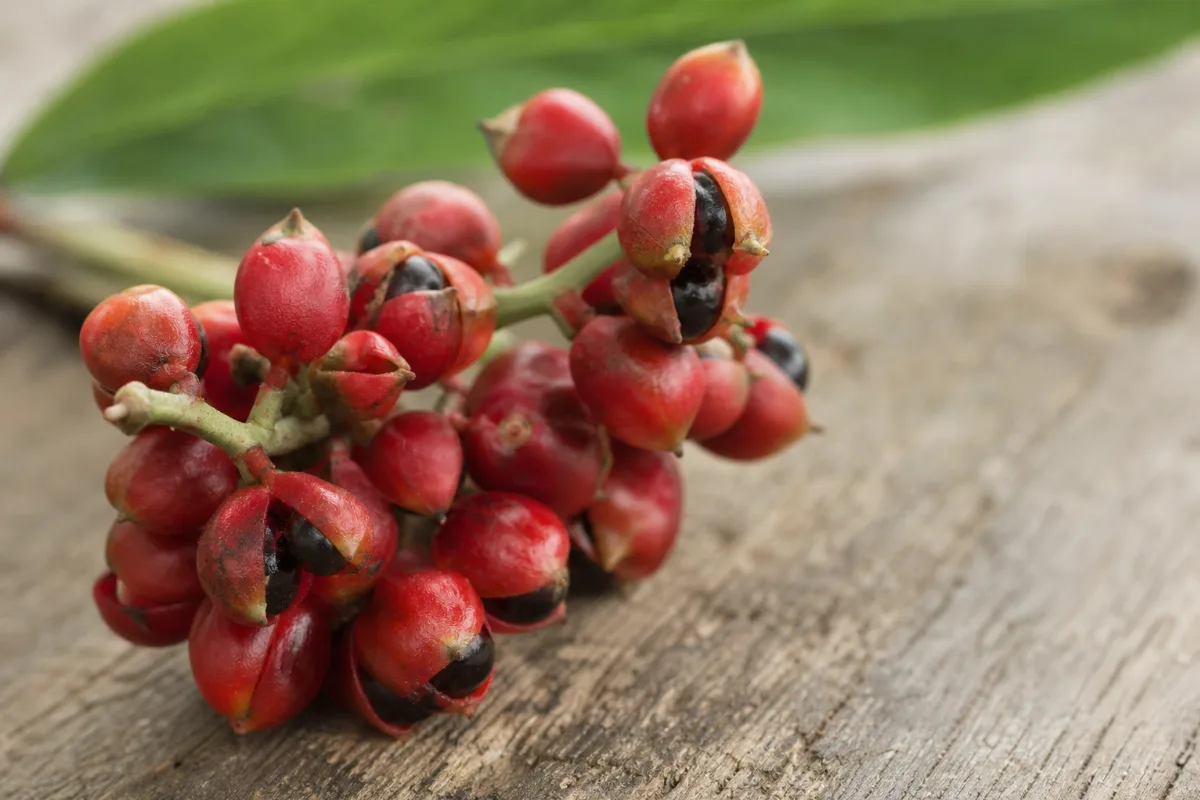
Herbs & Botanicals · Chinese digestive spice herb
Amomum
Amomum villosum (Wurfbainia villosa) · also called Sha ren, amomum fruit, Fructus Amomi
Amomum, called sha ren in China, is the seed pod of a ginger-family plant related to cardamom. It is used in Chinese medicine for indigestion and vomiting. Research is mostly lab and animal work, with one small trial on blood sugar after a meal. Safety in pregnancy and with blood thinners is not established, so ask a doctor or pharmacist first.
General information, not medical advice. Last substantive update · Not medically reviewed. A named clinician has not signed off on this page. How this page is made
About Amomum
Amomum (sha ren) is the dried seed pod of Wurfbainia villosa, also written Amomum villosum, a ginger-family plant of tropical Asia. It is a Chinese digestive herb and a spice, related to cardamom.
What it is
Sha ren is the fruit of a ginger-family plant from tropical and subtropical Asia. The accepted botanical name is now Wurfbainia villosa; most papers still say Amomum villosum.
It is related to cardamom but is a different plant. About 500 compounds have been found in the plant, and the aromatic oil contains bornyl acetate and camphor.
Traditional and current uses
Chinese medicine has used the fruit since at least the Tang Dynasty to warm the stomach, ease vomiting and settle digestion. It is often used in mixed formulas, so effects cannot be given to one herb.
Traditional use also includes pregnancy vomiting and a restless foetus. This is tradition, not tested safety.
What the research shows
We found no controlled trial of sha ren for indigestion or nausea. Reviews list clinical use in digestive disorders, but we only read abstracts.
One small crossover trial in 40 healthy adults found a lower rise in blood sugar and insulin after a meal with a water extract than with placebo. It was a single dose and has not been repeated.
Rat and mouse studies suggest protection of the gut lining and lower inflammation. A mouse study also found benefit in a pre-eclampsia model. These do not show effects in people.
At a glance
Traditional uses history, not proof
- Chinese medicine: warming the stomach, easing vomiting and indigestion
- Pregnancy-related vomiting and a "restless foetus" (traditional only)
- Spice and flavouring
Studied for research
- Digestive disorders: traditional use, trials not seen
- Gut-lining protection: rat and mouse studies only
- Blood sugar after a meal: one small trial in healthy adults
- Pre-eclampsia: one mouse study
Main compounds
- Bornyl acetate (main oil compound)
- Camphor and other oil terpenes
- Vanillic acid (in the water decoction)
Common forms
- Dried fruit or seed
- Decoction
- Powder
- Capsules and tablets
- Mixed Chinese formulas
- Volatile oil (research use)
Research links: Overview review (2024) · Digestive-use review (2018) · Blood-sugar trial (2020) · Rat gut study (2017) · Mouse pre-eclampsia study (2025) · Research Library · Genes & Biomarkers Library
The plant and its history
- Accepted scientific name
- Wurfbainia villosa (Lour.) Skornick. & A.D.Poulsen
- Naming authority
- (Lour.) Skornick. & A.D.Poulsen
- Synonyms
- Amomum villosum Lour. (the name used in most papers); Amomum xanthioides (sold under the same trade name; treated as a related source plant, not checked in GBIF here)
- Common names
- Sha ren (Chinese (pinyin)); Amomum fruit (English); Fructus Amomi / Amomi Fructus (Latin pharmacopoeia); Chinese amomum (English (not verified))
- Botanical family
- Zingiberaceae (ginger family; GBIF), the same family as cardamom, ginger and turmeric.
- Classification
- Plantae > Tracheophyta > Liliopsida > Zingiberales > Zingiberaceae > Wurfbainia > Wurfbainia villosa
- Native range
- Tropical and subtropical Asia (2024 review abstract); more exact range not verified.
- Habitat
- Not verified.
- What the plant looks like
- Roots: Not verified.; Stems: Perennial herb with creeping stems (family description from the 2024 Heliyon abstract).; Leaves: Not verified.; Flowers: Not verified.; Fruit: The fruit (seed pod) is the part used; description not verified.
- Cultivation
- Not verified.
- Harvest and processing
- Not verified.
- Look-alikes and adulterants
- Name: Other Amomum species (e.g. Amomum tsao-ko, A. kravanh, A. subulatum); Note: Different plants with different oil chemistry; origin and species confusion in sha ren is reported.; Name: Green cardamom (Elettaria cardamomum); Note: A different genus in the same family, often compared with amomum.
- Sustainability and conservation
- Not assessed.
Traditional use and history history, not clinical proof
| Tradition or era | Documented use | Source |
|---|---|---|
| Traditional Chinese medicine, since the Tang Dynasty | Fruit used to warm the middle, regulate Qi, harmonise the stomach and ease vomiting, and "nourish deficiencies" (2024 review). | p39069030 |
| Traditional Chinese medicine, pregnancy | Pregnancy-related vomiting and prevention of miscarriage (restless foetus), as stated in a 2025 mouse paper; a practitioner website agrees but advises caution. | p39672393 |
Traditional use shows how a plant was used. It does not show that a supplement works or is safe today.
What is inside, and how it may work
What the plant contains and how those compounds act in cells and animals. Laboratory and animal mechanisms are not proven effects in people.
Main compounds
| Compound | Family | Where it is concentrated | Activity studied | Level of evidence |
|---|---|---|---|---|
| Bornyl acetate PubChem 93009 | monoterpene ester | fruit (volatile oil) Described as the main compound of the oil in the rat study; percentage not read. | Protected the rat gut in the 5-FU model; anti-cancer-cell effects in cells. 11 8 | Animal and in vitro |
| Camphor PubChem 2537 | monoterpene ketone | fruit (volatile oil) Named as a notable oil component; amount not read. | Toxic as an isolated concentrated product (see Safety). 6 9 8 | Case report (isolated) |
| Vanillic acid PubChem 8468 | phenolic acid | fruit (water extract) Called the major component of the water decoction in the mouse paper. | In mice, helped enrich Bifidobacterium bifidum and eased pre-eclampsia signs. 5 8 | Animal research |
Mechanisms, receptors and pathways
| Target or pathway | Gene or receptor | What was found | Level |
|---|---|---|---|
| Gut-lining (tight junction) proteins and inflammation | ZO-1, occludin, p38 MAPK, TNF-alpha, COX-2 | Oil and water extract raised lining proteins and lowered inflammatory signals in rats and mice. 11 2 | Animal research |
| Gut bacteria and the placenta (gut-placenta axis) | Bifidobacterium bifidum; sFlt-1/PlGF; GPX4 | In mice the extract shifted gut bacteria and reduced placental ferroptosis. 5 | Animal research |
| Sugar-digesting enzyme | alpha-glucosidase | Authors link the post-meal glucose effect partly to blocking this enzyme and glucose transport. 7 | Laboratory research |
Absorption, metabolism and elimination
- Absorption
- Not established in people.
- Distribution
- No data.
- Metabolism
- No data.
- Elimination
- No data.
- Bioavailability
- No data.
Isolated compounds versus whole extracts
Some animal findings come from the volatile oil or a single compound (bornyl acetate), others from water extracts. The one human trial used a water extract. These forms differ, so results should not be mixed up.
Nutritional composition
Sha ren is a spice and herb, not a source of any essential nutrient.
1 low certainty2 very low certainty3 not enough evidence
What is Amomum good for?
What amomum is claimed to do and what the research shows. "Insufficient" means too little human research to judge. Nothing here is proven to work.
Benefits, one by one
Each card is a research question, not a promise. Tap a goal to filter. Open a card to see the studies, doses and limits.
Digestive upset, bloating and vomiting (traditional use)
Not enough evidenceSha ren has been used in Chinese medicine since at least the Tang Dynasty to warm the stomach and settle vomiting and digestive upset. Reviews list digestive disorders, gastritis and H. pylori infection in children as clinical uses, but we could not see the trials behind that, so the benefit is not shown.
2 studiesDried fruit or seed, decoction, powder, capsules and many Chinese for…
Studies, doses and limits
What the trials found
The 2018 review abstract names functional digestive disorder, gastritis and H. pylori infection in children as clinical applications. The abstract gives no trial sizes or results, and we did not read the trials.
Results
Insufficient: used traditionally and reported in clinical practice, but no controlled trial result was seen.
Effect sizes as reported
No effect sizes available from the sources read.
Why this rating
Only review abstracts and traditional use. We could not judge the trials behind the clinical-use list.
Form and dose studied
Dried fruit or seed, decoction, powder, capsules and many Chinese formulas exist; strength varies. No amount or product is suggested here.
Who was studied
Adults with indigestion in traditional use; children with H. pylori infection are mentioned in a review.
Limits
Narrative reviews read as abstracts only. Many clinical reports in Chinese medicine are small or uncontrolled, but we did not check these ones.
Why researchers looked
Long traditional use as a digestive herb in China, and the fruit is also a spice.
Traditional use
The 2024 review says the fruit has been recorded since the Tang Dynasty and is described as warming the middle, regulating Qi and harmonising the stomach to ease vomiting.
Proposed mechanism In vitro and animal
Lab and animal work reports gut-protective, anti-inflammatory, pain-relieving and anti-diarrhoea effects of the fruit and its oil. These are not tested in people with indigestion.
A proposed mechanism does not show that the effect happens in people.
Not shown to be safe in pregnancy or with blood-thinning drugs; see the Safety tab.
Protecting the gut lining (rat and mouse studies)
Very low certaintyIn rats given a chemotherapy drug, the fruit oil and its main compound, bornyl acetate, reduced weight loss, diarrhoea and gut damage. In mice with chemical colitis, a water extract reduced inflammation. These are animal results only.
2 studiesVolatile oil and bornyl acetate (rats); fruit water extract (mice). N…
Studies, doses and limits
What the trials found
No human study of gut-lining protection or chemotherapy side effects was found.
Results
Protective in two animal models. Not tested in people.
Effect sizes as reported
Not stated as numbers in the abstracts we read.
Why this rating
Animal studies only; the rat oil study did not test whether the oil interferes with the cancer drug.
Form and dose studied
Volatile oil and bornyl acetate (rats); fruit water extract (mice). Not the same as tea or powder. No amount is suggested here.
Who was studied
Rats and mice only.
Limits
Chemically induced injury in animals does not match human illness. Mixed forms: oil in one study, water extract in the other.
Why researchers looked
The herb is used for the gut, so researchers tested it on animal gut-injury models.
Traditional use
Linked to the traditional use for the stomach and gut.
Proposed mechanism Animal research
In the rats the oil lowered p38 MAPK and caspase-3 (cell-stress signals), raised gut-lining proteins (zonula occludens-1, occludin) and shifted gut bacteria. In the mice the extract lowered TNF-alpha, COX-2, IL-6 and IL-1 beta and restored the same kind of lining proteins.
A proposed mechanism does not show that the effect happens in people.
People having chemotherapy should talk to their cancer team before using any herb; interference is untested.
Nausea and a restless pregnancy (traditional use only)
Not enough evidenceTraditional Chinese medicine uses sha ren for vomiting in pregnancy and to calm a restless foetus. We found no human trial or safety study of this use, so it is not supported by evidence we could check.
2 studiesTraditional decoction or formula; not studied in pregnant women. No a…
Studies, doses and limits
What the trials found
No human trial of amomum for pregnancy nausea or miscarriage prevention was found in the searches we ran. Ginger, a different herb, does have human trials for pregnancy nausea; amomum has none that we found.
Results
Insufficient. Traditional use only.
Effect sizes as reported
None.
Why this rating
No human evidence of benefit or of safety in pregnancy.
Form and dose studied
Traditional decoction or formula; not studied in pregnant women. No amount is suggested here.
Who was studied
Pregnant women (traditional use).
Limits
The only sources are traditional statements and a commercial practitioner website with no cited studies.
Why researchers looked
Traditional practice, repeated in the background of a 2025 mouse paper.
Traditional use
The 2025 mouse paper says the herb is widely used for pregnancy-related vomiting and to prevent miscarriage. A practitioner website also lists morning sickness but advises caution in pregnancy.
Proposed mechanism Animal research
Not established. A mouse study suggests gut bacteria and placental pathways in pre-eclampsia, which is a different problem from nausea.
A proposed mechanism does not show that the effect happens in people.
Pregnancy safety is not established. See the Safety tab and ask a doctor or midwife.
Blood sugar and insulin after a meal (one small trial, healthy adults)
Low certaintyIn one small crossover trial of 40 healthy adults, a water extract of the fruit was followed by a much smaller rise in blood sugar and insulin after a meal than placebo. It was a single dose in healthy people, so it does not show that the herb helps anyone with diabetes.
1 studiesFruit water extract; dose is in the paper but not repeated here. No a…
Studies, doses and limits
What the trials found
Single-blind, randomised crossover study, 40 healthy adults, one week apart. Compared with placebo, the 0 to 120 minute blood glucose area fell 67.26% (P = 0.011) and the insulin area fell 59.95% (P < 0.003).
Results
A large short-term drop in meal-related glucose and insulin in healthy adults.
Effect sizes as reported
Glucose AUC -67.26% (P=0.011); insulin AUC -59.95% (P<0.003). No confidence intervals in the abstract.
Why this rating
One small single-blind study with very large, unreplicated effects, a single dose and healthy people only.
Form and dose studied
Fruit water extract; dose is in the paper but not repeated here. No amount or product is suggested.
Who was studied
40 healthy adults.
Limits
Single dose, healthy volunteers, no diabetic group, no long-term outcome such as HbA1c, funding not stated in the abstract.
Why researchers looked
Lab work suggested the extract blocks a sugar-digesting enzyme.
Traditional use
Not a classic traditional use; reviews list blood-sugar lowering among lab-reported activities.
Proposed mechanism Laboratory research
The authors suggest it partly blocks alpha-glucosidase (an enzyme that breaks down starch) and glucose transport. This explanation comes from lab work.
A proposed mechanism does not show that the effect happens in people.
If you take diabetes medicines, ask your doctor or pharmacist before adding any herb, since blood sugar could fall further.
Pre-eclampsia (mouse study only)
Very low certaintyA hot-water extract lowered blood pressure and improved fetal growth in pregnant mice with chemically induced pre-eclampsia. There is no human data, and it says nothing about safety in pregnant women.
1 studiesFreeze-dried hot-water decoction (mice). No amount is suggested.
Studies, doses and limits
What the trials found
None found.
Results
Protective in a drug-induced mouse model.
Effect sizes as reported
Not given as numbers in the abstract.
Why this rating
Single mouse study of a chemically induced model.
Form and dose studied
Freeze-dried hot-water decoction (mice). No amount is suggested.
Who was studied
Pregnant mice.
Limits
No toxicity data; mouse pre-eclampsia is a model.
Why researchers looked
Traditional use in pregnancy prompted a mouse test.
Traditional use
Traditionally used in pregnancy-related vomiting and to prevent miscarriage.
Proposed mechanism Animal research
In mice, the extract (and its main component vanillic acid) enriched the gut bacterium Bifidobacterium bifidum, strengthened gut and placental barriers and reduced placental ferroptosis (a form of cell death).
A proposed mechanism does not show that the effect happens in people.
Not evidence of safety in pregnancy.
Antioxidant, anti-inflammatory and liver-protective effects (lab and animal only)
Not enough evidenceReviews report antioxidant, anti-inflammatory, liver-protective, anti-obesity, antimicrobial and anti-tumour effects of the fruit, its oil and compounds in cells and animals. None of this has been shown in people.
2 studiesFruit, extracts, oil, isolated compounds. No amount is suggested.
Studies, doses and limits
What the trials found
None for these effects.
Results
Lab and animal findings only.
Effect sizes as reported
None.
Why this rating
No human data; reviews read as abstracts only.
Form and dose studied
Fruit, extracts, oil, isolated compounds. No amount is suggested.
Who was studied
Cells and animals.
Limits
Different species of Amomum are mixed in some reviews; abstracts only.
Why researchers looked
The fruit is chemically rich (about 500 compounds in one review).
Traditional use
Not a specific traditional use.
Proposed mechanism In vitro and animal
Many compounds act in cell and animal tests; none has been linked to a human result in the sources read.
A proposed mechanism does not show that the effect happens in people.
Lab effects do not show safe human use.
Connections to the rest of health
How Amomum connects to the rest of our health knowledge graph. Every link says what kind of connection it is. A safety link (for example to the liver) is a warning, not a benefit. A study that merely mentions a topic never creates a benefit link.
Explore every connection: goals, body systems, organs, symptoms, genes
A. Wellness goals
| Connected to | Kind of connection | Evidence status | Context | Studies |
|---|---|---|---|---|
| Digestive Support | Traditional use | Not enough evidence | Digestive upset, bloating and vomiting (traditional use): Sha ren has been used in Chinese medicine since at least the Tang Dynasty to warm the stomach and settle vomiting and digestive upset. Reviews list digestive disorders, gastritis and H. pylori infection in children as clinical uses, but we could not see the trials behind that, so the benefit is not shown. | 3 10 |
| Gut Health | Traditional use | Not enough evidence | Digestive upset, bloating and vomiting (traditional use): Sha ren has been used in Chinese medicine since at least the Tang Dynasty to warm the stomach and settle vomiting and digestive upset. Reviews list digestive disorders, gastritis and H. pylori infection in children as clinical uses, but we could not see the trials behind that, so the benefit is not shown. | 3 10 |
| Gut Health | Very low certainty | Protecting the gut lining (rat and mouse studies): In rats given a chemotherapy drug, the fruit oil and its main compound, bornyl acetate, reduced weight loss, diarrhoea and gut damage. In mice with chemical colitis, a water extract reduced inflammation. These are animal results only. | 11 2 | |
| Blood Sugar Balance | Low certainty | Blood sugar and insulin after a meal (one small trial, healthy adults): In one small crossover trial of 40 healthy adults, a water extract of the fruit was followed by a much smaller rise in blood sugar and insulin after a meal than placebo. It was a single dose in healthy people, so it does not show that the herb helps anyone with diabetes. | 7 | |
| Womens Wellness | Very low certainty | Pre-eclampsia (mouse study only): A hot-water extract lowered blood pressure and improved fetal growth in pregnant mice with chemically induced pre-eclampsia. There is no human data, and it says nothing about safety in pregnant women. | 5 |
B. Body systems
| Connected to | Kind of connection | Evidence status | Context | Studies |
|---|---|---|---|---|
| Digestive System | Biological association | Not enough evidence | Studied for: Digestive upset, bloating and vomiting (traditional use) Studied for: Protecting the gut lining (rat and mouse studies) | 3 10 11 2 |
| Gut Health | Biological association | Not enough evidence | Studied for: Digestive upset, bloating and vomiting (traditional use) Studied for: Protecting the gut lining (rat and mouse studies) | 3 10 11 2 |
| Reproductive Health | Biological association | Not enough evidence | Studied for: Nausea and a restless pregnancy (traditional use only) Studied for: Pre-eclampsia (mouse study only) | 5 1 |
| Blood Sugar Support | Biological association | Low certainty | Studied for: Blood sugar and insulin after a meal (one small trial, healthy adults) | 7 |
| Liver Detox | Biological association | Not enough evidence | Studied for: Antioxidant, anti-inflammatory and liver-protective effects (lab and animal only) | 3 6 |
E. Health conditions
| Connected to | Kind of connection | Evidence status | Context | Studies |
|---|---|---|---|---|
| Nausea and vomiting in pregnancy | Traditional use | Not enough evidence | Traditional use only; no human trial or safety study. Preparation or compound: Fruit decoction (traditional) |
5 1 |
I. Biomarkers
| Connected to | Kind of connection | Evidence status | Context | Studies |
|---|---|---|---|---|
| Blood sugar after a meal (glucose AUC 0-120 min) | Biological association | Low certainty | Measured in trials: decrease. A lab change is not the same as a health benefit. | 7 |
| Insulin after a meal (insulin AUC 0-120 min) | Biological association | Low certainty | Measured in trials: decrease. A lab change is not the same as a health benefit. | 7 |
J. Genes, receptors and enzymes
| Connected to | Kind of connection | Evidence status | Context | Studies |
|---|---|---|---|---|
| Preliminary mechanism | 7 |
K. Biological pathways
| Connected to | Kind of connection | Evidence status | Context | Studies |
|---|---|---|---|---|
| Preliminary mechanism | 11 |
L. Active compounds
| Connected to | Kind of connection | Evidence status | Context | Studies |
|---|---|---|---|---|
| Camphor | Case report | Poisoning is described for swallowed camphor itself; amomum fruit is not shown to cause it. Preparation or compound: Isolated camphor |
9 | |
| Bornyl acetate | Biological association | Animal and in vitro | Protected the rat gut in the 5-FU model; anti-cancer-cell effects in cells. Preparation or compound: fruit (volatile oil) |
11 8 |
| Camphor | Biological association | Case report (isolated) | Toxic as an isolated concentrated product (see Safety). Preparation or compound: fruit (volatile oil) |
6 9 8 |
| Vanillic acid | Biological association | Animal | In mice, helped enrich Bifidobacterium bifidum and eased pre-eclampsia signs. Preparation or compound: fruit (water extract) |
5 8 |
Each connection is stored with the ingredient, the connected record, the kind of connection, the evidence status, the supporting studies, the preparation or compound involved, and a review date (last reviewed October 25, 2026).
The evidence
The research centre for Amomum. Every record here was checked against PubMed or the publisher's page; we never list a study we have not verified.
Evidence by outcome
Bars show how many studies we found for each outcome, not how well it works. People are added up across trials only (reviews are not added, to avoid double counting).
How we rate evidence
High certainty
Several well-run trials or reviews agree; further research is unlikely to change the picture much.
Moderate certainty
Good trials point the same way, but some doubt remains.
Low certainty
Small, short or inconsistent trials. The finding could change with better research.
Very low certainty
Very little or very weak human data. Treat as a possibility only.
Mixed findings
Trials or reviews disagree with each other.
Not enough evidence
Not enough human research to say either way.
Evidence against
Good research found no benefit, or found harm.
We take the reviewers' own risk-of-bias and GRADE statements where they exist, and otherwise judge from study size, design, consistency, directness and whether a product matches what is sold. Many publications do not make evidence high. Method note: We started from our existing summary of this herb, then checked each cited paper in PubMed and the accepted name in GBIF. Regulator and reference documents we could not open are marked as second-hand. No study is cited that we could not verify.
Study library: every study we checked 12
| Study | Design | People | Product, dose, length | Result |
|---|---|---|---|---|
| American Dragon (commercial practitioner website 2017 Sha Ren (Fructus Amomi) - practitioner herb page American Dragon · Source |
Practitioner website not applicable |
fruit not given here |
As recorded in our earlier summary (page not re-opened): lists traditional use for morning sickness and calming the restless fetus, advises caution in pregnancy, and advises caution with anticoagulant and antiplatelet drugs. It cites no studies. Practitioner opinion Methods, limits and fundingOutcomes: Traditional uses and cautions Limitations: Commercial website with no cited evidence; second-hand in this file. Every safety claim from it is treated as unverified. Funding and conflicts: not read Read: summary-only | |
| Choi 2025 Anti-Inflammatory Effects of Amomum villosum Extract on Dextran Sodium Sulfate-Induced Colitis in Mice. Current Issues in Molecular Biology · PMID 40699788 · DOI |
Animal research animal |
Mice with DSS colitis | A. villosum fruit water extract fruit not given here |
A water extract of the fruit reduced signs of colitis in mice given dextran sodium sulfate: better body weight, longer colon, lower inflammatory signals (TNF-alpha, COX-2, IL-6, IL-1 beta) and restored gut-barrier proteins. The authors say clinical potential and safety need further study. Protective in this mouse model Methods, limits and fundingOutcomes: Weight, colon length, inflammatory markers, barrier proteins Limitations: Mouse model of colitis; no human data; no safety data in the abstract. Funding and conflicts: not read Read: abstract |
| Feng 2024 Amomum villosum Lour.: An insight into ethnopharmacological, phytochemical, and pharmacological overview. Journal of Ethnopharmacology · PMID 39069030 · DOI |
Narrative review review |
Fruit of A. villosum (reviewed literature) | Fruit and extracts fruit not given here |
Review of botany, traditional use, chemistry, pharmacology, clinical use and toxicology. About 500 compounds identified. Reported activities (in cells and animals) include anti-inflammatory, antioxidant, liver-protective, anti-tumour, blood-sugar-lowering, antimicrobial and gut-regulating effects. The authors say research on the active parts and how they work is limited and urge priority for pharmacokinetic and toxicity studies. Narrative review; no pooled effect Methods, limits and fundingOutcomes: Traditional use, chemistry, pharmacology, toxicology Limitations: Abstract only. No quality rating of the clinical reports it mentions. Narrative, not systematic. Funding and conflicts: not read Read: abstract |
| GBIF 2026 GBIF species match: Wurfbainia villosa / Amomum villosum GBIF · Source |
Database record not applicable |
fruit not given here |
API checked 2026-10-25: Wurfbainia villosa (Lour.) Skornick. & A.D.Poulsen is ACCEPTED (species key 11082522), family Zingiberaceae, order Zingiberales. Amomum villosum Lour. (key 5301710) is a SYNONYM pointing to it. See results Methods, limits and fundingOutcomes: Accepted name, family Limitations: Taxonomic record, not a trial. NCBI taxonomy not checked; POWO was not reachable. Funding and conflicts: not read Read: full-text | |
| He 2025 Amomum villosum Lour. alleviates pre-eclampsia by inducing enrichment of Bifidobacterium bifidum through vanillic acid to inhibit placental ferroptosis. Journal of Ethnopharmacology · PMID 39672393 · DOI |
Animal research animal |
Pregnant mice with L-NAME-induced pre-eclampsia | Water decoction of A. villosum, freeze-dried fruit not given here |
In mice with pre-eclampsia induced by a chemical (L-NAME), a freeze-dried hot-water decoction lowered maternal blood pressure and urine protein and improved fetal growth in a dose-dependent way. It changed gut bacteria (more Bifidobacterium and Akkermansia) and raised placental and gut barrier proteins. Transplanting gut bacteria from treated mice reproduced the benefit. The abstract opens by saying the herb is widely used traditionally for pregnancy-related vomiting and to prevent miscarriage. Protective in this mouse model Methods, limits and fundingOutcomes: Blood pressure, urine protein, fetal growth, gut bacteria, placental markers Limitations: Mouse model made with a drug, not human pre-eclampsia. The abstract reports no toxicity or safety data for the pregnancy. Does not show the herb is safe or useful in pregnant women. Funding and conflicts: not read Read: abstract |
| Imran 2024 Health-promoting compounds in Amomum villosum Lour and Amomum tsao-ko: Fruit essential oil exhibiting great potential for human health. Heliyon · PMID 38463888 · DOI |
Narrative review review |
Fruit essential oil, two Amomum species | Essential oil fruit not given here |
Names camphor, methyl chavicol, bornyl acetate, trans-p-(1-butenyl)anisole, alpha-pinene and beta-pinene as notable parts of the essential oils of two Amomum species. Antioxidant, antidiabetic, anticancer, anti-obesity, antimicrobial and anti-inflammatory findings come from in-vitro and animal work and compound analysis. Narrative review; lab and animal findings Methods, limits and fundingOutcomes: Oil chemistry and pharmacology Limitations: Abstract only. Covers two species (A. villosum and A. tsao-ko), which are not the same herb. No human data in the abstract. Funding and conflicts: not read Read: abstract |
| Kim 2020 Acute effects of Amomum villosum Lour. fruit extract on postprandial glycemia and insulin secretion: A single-blind, placebo-controlled, crossover study in healthy subjects. Saudi Journal of Biological Sciences · PMID 33100854 · DOI |
Randomized crossover trial (single blind) |
40 40 healthy adults |
A. villosum fruit water extract vs placebo fruit not given here |
In 40 healthy adults, one serving of A. villosum water extract versus placebo (one week apart) was followed by a 67.26% lower blood-glucose rise over 120 minutes (P = 0.011) and a 59.95% lower insulin rise (P < 0.003). The authors link this partly to blocking the enzyme alpha-glucosidase and glucose transport (lab-based explanation). Glucose AUC 0-120 min -67.26% (P=0.011); insulin AUC -59.95% (P<0.003) versus placebo Methods, limits and fundingOutcomes: Blood glucose and insulin after a meal (AUC 0-120 min) Limitations: Single dose in healthy people, so it says nothing about people with diabetes or about long-term use. Single-blind, one small study, not replicated that we found. The effect sizes are very large and the abstract gives no confidence intervals. The abstract does not say who paid for it. Which product/extract was used is not described beyond water extract. Funding and conflicts: not read Read: abstract |
| PubChem (NCBI) 2026 PubChem compound lookups: bornyl acetate, camphor, vanillic acid PubChem · Source |
Database record not applicable |
not given here |
Name lookups on 2026-10-25: camphor CID 2537; vanillic acid CID 8468; bornyl acetate returned several CIDs, the first being 93009 (stereo-forms such as 6448 also listed). See results Methods, limits and fundingOutcomes: Compound identifiers Limitations: Identifier lookup only; for bornyl acetate the exact stereo-form in the herb was not verified. Funding and conflicts: not read Read: full-text | |
| Santos 2015 Persistent effects after camphor ingestion: a case report and literature review. Journal of Emergency Medicine · PMID 25511464 · DOI |
Case report with review |
1 One adult who swallowed a cube of camphor |
Camphor (isolated) isolated compound not given here |
Camphor is a known poison behind thousands of poisonings a year. Effects start within minutes and can include stomach, nerve, lung and heart effects; severe cases can lead to seizures, stopped breathing and coma. A woman who swallowed a cube of camphor for a rash had delirium and headache for 19 days. Most people are free of symptoms after 24 to 48 hours. Case report Methods, limits and fundingOutcomes: Camphor poisoning symptoms Limitations: This is about swallowed camphor itself (a concentrated product), not amomum. It shows why camphor in any product deserves care, but does not show that amomum fruit causes this. Funding and conflicts: not read Read: abstract |
| Suo 2018 Phytochemicals, pharmacology, clinical application, patents, and products of Amomi fructus. Food and Chemical Toxicology · PMID 29802946 · DOI |
Narrative review review |
Fruit of Amomum species (reviewed literature) | Fruit and extracts fruit not given here |
Over 100 compounds isolated (volatile oils, saponins, flavonoids, organic acids, polysaccharides). Gut-protective, anti-inflammatory, pain-relieving, anti-diarrhoea, antibacterial and blood-sugar effects reported in lab and animal work. Clinical uses listed: functional digestive disorder, gastritis, H. pylori infection in children and mastitis. 23 patents and 405 drug products noted. Narrative review; no pooled effect Methods, limits and fundingOutcomes: Chemistry, pharmacology, clinical applications Limitations: Abstract only: the trials behind the listed clinical uses were not seen, so their size and quality are unknown. Funding and conflicts: not read Read: abstract |
| Zhang 2017 Volatile Oil from Amomi Fructus Attenuates 5-Fluorouracil-Induced Intestinal Mucositis. Frontiers in Pharmacology · PMID 29170638 · DOI |
Animal research animal |
Rats with 5-FU gut injury | Volatile oil and bornyl acetate fruit (oil) not given here |
In rats given the chemotherapy drug 5-fluorouracil, the fruit volatile oil and its main compound bornyl acetate raised body weight, eased diarrhoea, reversed gut tissue damage and inflammation, strengthened gut-lining proteins (zonula occludens-1, occludin) and shifted gut bacteria toward probiotic types. The oil lowered p38 MAPK and caspase-3 activity. Protective in this rat model Methods, limits and fundingOutcomes: Weight, diarrhoea, gut tissue, inflammation, barrier proteins, gut bacteria Limitations: Rat study of the oil and one isolated compound, not the whole fruit or tea. Does not test whether the oil interferes with the cancer drug. No human data. Funding and conflicts: not read Read: abstract |
| Zhang 2025 Comprehensive Discrimination of Amomi Fructus From Different Origins Using UHPLC-Q-Orbitrap MS, HS-GC-MS/MS, NMR and MIR Technologies Based On Data Fusion. Analytical Science Advances · PMID 40718850 · DOI |
Laboratory method study not applicable |
Amomi Fructus samples from different origins | Fruit samples fruit not given here |
The authors say origin and species confusion in sha ren is a serious practical problem. They tested 286 compounds across samples with four analysis methods and built models that could tell origins apart; 27 differing compounds were screened. Lab method; no safety finding Methods, limits and fundingOutcomes: Chemical fingerprints by origin Limitations: Chemistry paper about telling samples apart. It does not measure harm or how common mislabelled products are. Funding and conflicts: not read Read: abstract |
What we do not know yet
- No controlled human trial for digestive complaints or nausea.
- No human pregnancy or toxicity study.
- No CYP or interaction study.
- Trials of blood-sugar effects beyond one single dose are missing.
How new research is added
New studies are found by a saved PubMed search and are placed in a review queue. A person reads each one before it changes any evidence rating or safety wording.
Lab markers
What changed in blood or saliva tests during trials. A changed number is not the same as feeling or being healthier, and we give no "normal ranges".
Metabolic 2
Blood sugar after a meal (glucose AUC 0-120 min)
Decrease in trials
AUC is the total blood-sugar rise over two hours after eating.
Low certaintyResults and what it means
Why it was measured
Shows how sharply blood sugar climbs after food.
Statistical vs. clinical meaning
Large but unreplicated in a single dose with healthy people; it does not show a lasting effect.
Safety implication
People on diabetes drugs should ask a doctor first.
| Study | Result | People | Product |
|---|---|---|---|
| 7 | Glucose AUC was 67.26% lower than placebo (P = 0.011). | 40 healthy adults | A. villosum water extract, single dose, crossover |
Insulin after a meal (insulin AUC 0-120 min)
Decrease in trials
The total insulin rise over two hours after eating.
Low certaintyResults and what it means
Why it was measured
Shows how much insulin the body releases after food.
Statistical vs. clinical meaning
Matches the glucose result; same limits.
Safety implication
As above.
| Study | Result | People | Product |
|---|---|---|---|
| 7 | Insulin AUC was 59.95% lower than placebo (P < 0.003). | 40 healthy adults | A. villosum water extract, single dose, crossover |
Safety
What studies and official sources say about side effects, medicines and who should check first. Each point shows what kind of evidence it comes from.
Main points to know 5
- No proper human safety data. The 2024 review says pharmacokinetic and toxicity studies should be a priority. We found no human safety trial, no case reports of harm and no regulator monograph for sha ren. Absence of reports is not proof of safety. Review 3
- Pregnancy: traditional use and caution point in opposite directions. Traditional medicine uses sha ren for pregnancy vomiting and a restless foetus, while a practitioner website advises caution in pregnancy. No human safety study exists, so it is best not to use it in pregnancy without a doctor or midwife. Traditional use 5 1
- Possible blood-thinner interaction (unverified). One practitioner website advises caution with anticoagulant and antiplatelet drugs. It cites no study and we found none. Theoretical 1
- The oil contains camphor. Camphor is among the notable oil parts. Swallowed camphor itself is a known poison, but this is a concentrated product, and we found nothing showing the fruit causes that. Concentrated oils deserve extra care. Case report 6 9
- Species and origin mix-ups. Origin and species confusion in sha ren is described as a serious practical problem, so what is in a product can vary. Lab 12
Side effects 2
| Effect | How often | Severity and recovery | Evidence |
|---|---|---|---|
| No adverse effect profile established No side-effect data were found in the sources read. Common sense for any aromatic spice: stomach upset is possible, but we did not find a study that measures it. | Not established | unknown unknown | Insufficient 3 |
| Blood sugar falling too low when combined with glucose-lowering drugs (theoretical) Only one single-dose study in healthy people showed lower glucose after a meal; hypoglycaemia was not reported in the abstract. | Not established | unknown unknown | Theoretical 7 |
Liver
No liver injury from sha ren was found in the sources we read. The PubMed safety search returned no case reports on amomum. We did not open the NIH LiverTox database for this herb, so absence there is not checked. 3
How often. Unknown. Not studied.
Monitoring. No agency monitoring advice was found. Yellow skin or eyes, dark urine or severe itching after using any herbal product needs urgent medical advice.
This is a safety connection. It is not evidence that Amomum supports liver health.
Medicines and supplements 4
| With | Why it matters | Importance | Evidence | What to do |
|---|---|---|---|---|
| Anticoagulant and antiplatelet drugs (warfarin, clopidogrel, aspirin) prescription | Not established. A practitioner website advises caution, with no study behind it. | Unknown. | Traditional practitioner opinion Not enough evidence 1 | Ask a doctor or pharmacist before combining, especially before surgery. |
| Diabetes medicines prescription | One trial in healthy people found lower glucose and insulin after a meal, so an added effect is possible in theory. | Not studied in people on diabetes drugs. | Human single trial Very low certainty 7 | Ask a doctor or pharmacist; watch blood sugar if you test it. |
| Medicines broken down by liver enzymes (CYP enzymes) or moved by P-glycoprotein prescription | We searched for CYP or transporter studies of sha ren and found none. Many plant oils can affect these enzymes, so a gap is not an all-clear. | Unknown. | No data Not enough evidence 3 | Tell your pharmacist you use it, particularly if you take medicines with a narrow safety margin. |
| Chemotherapy such as 5-fluorouracil prescription | The rat study that protected the gut did not test whether the oil changes the drug action. | Untested. | Animal research Not enough evidence 11 | Ask the cancer team before use. |
Who should check first 4
| Situation | Advice | Evidence |
|---|---|---|
| Pregnancy and breastfeeding | Safety not established; avoid unless a doctor or midwife advises. Traditional use in pregnancy exists, but it is not safety evidence. | Traditional use versus caution 5 1 |
| Upcoming surgery or bleeding disorders | Ask a doctor first because of the unverified blood-thinner caution. | Theoretical 1 |
| Traditional Chinese medicine "heat" or yin-deficiency patterns | Traditional practitioners describe sha ren as a warming herb and usually advise caution where signs of heat or dryness dominate. We did not read a source that states this rule, so treat it as a traditional view only, not tested. | Traditional use 3 |
| Acid reflux or a sensitive stomach | No study was found. Aromatic, warming spices and oils can aggravate reflux in some people, but this is a general caution, not a finding about sha ren. | No data |
Overdose, product quality and regulators
Summary. The fruit and seed are the parts used. No toxicity study in animals or people was read. The 2024 review says toxicity research is a priority.
Animal. Not found in the abstracts read; the animal studies we read (rats, mice) did not report toxicity results.
Human doses studied. Not given here.
High dose or long term signals. Not studied.
Overdose response. Not described. For the camphor component, poisoning from concentrated camphor itself is well described (seizures, breathing problems), but this is not shown for amomum fruit.
Genotoxicity. Not found.
Toxic plant parts. Fruit or seed is used. Other parts not assessed.
Species and origin confusion is the main quality problem reported. Pesticide, heavy-metal and microbial testing were not covered in the sources read.
Species and origin confusion. A 2025 paper says origin and species confusion in sha ren is a serious practical problem. Other Amomum species have different oil chemistry. 12
| Body | Action | Date |
|---|
When to get medical help
- Yellow skin or eyes, dark urine, pale stools or intense itching
- Unusual bleeding or bruising if you take blood thinners
- Seizure, confusion or trouble breathing after swallowing any concentrated oil (call emergency services)
- Vaginal bleeding or severe pain in pregnancy
Stop the supplement and contact a clinician or emergency service. In the US, Poison Control is 1-800-222-1222.
General information only, not medical advice. Ask a clinician or pharmacist before use, especially with medicines, in pregnancy or with a health condition. See the Natural Remedy Safety guide.
Frequently asked questions
What is amomum (sha ren)?
Is amomum the same as cardamom?
No. It is in the same family but a different genus. Green cardamom is Elettaria cardamomum. See our cardamom page.
Does amomum help digestion?
Does it help morning sickness?
Is amomum safe in pregnancy?
Can it lower blood sugar?
One small trial in 40 healthy adults found a lower blood-sugar rise after a meal with a water extract. It was a single dose and not repeated, so it does not show help for diabetes.
Does it interact with blood thinners?
A practitioner website advises caution with anticoagulant and antiplatelet drugs, but we found no study. Ask a doctor or pharmacist.
Does it affect liver enzymes or other medicines?
We found no study of CYP enzymes or transporters, so we cannot say. Ask your pharmacist.
Is the camphor in the oil dangerous?
Is amomum safe for people with acid reflux or "heat" signs?
No study was found. Traditional practitioners call it warming and usually advise caution with heat or dryness, but we did not read a source for this rule. Ask a doctor or practitioner.
How do I know what is in a product?
Species and origin mix-ups are reported. Choose products that name the plant and show testing, and ask a doctor or pharmacist about amounts.
Does it protect the gut during chemotherapy?
In rats the oil reduced gut damage from a chemotherapy drug. It has not been tested in people, and interference with the drug is untested. Ask the cancer team.
Explore by health goal
Gut HealthDigestive SupportBlood Sugar BalanceWomens Wellness
Editorial transparency
- Written by
- AlternativeMed editorial team. Research compiled with AI assistance, then checked against PubMed records.
- Medical review
- None. This page has not been reviewed by a physician or pharmacist.
- First published
- 2026-10-25
- Last substantive update
- 2026-10-25
- How we research
- We started from our existing summary of this herb, then checked each cited paper in PubMed and the accepted name in GBIF. Regulator and reference documents we could not open are marked as second-hand. No study is cited that we could not verify.
- How we rate evidence
- See "How we rate evidence" in the Evidence tab.
- Independence
- No product is promoted on this page. No affiliate links are shown. If one is added later it will be labelled and kept apart from the evidence.
Sources 12
Each source was opened and checked. Where we read only the abstract, it says so. The small numbers in the text point here.
- Choi HB, Kim RW, Bae GS, et al.. Anti-Inflammatory Effects of Amomum villosum Extract on Dextran Sodium Sulfate-Induced Colitis in Mice.. Current Issues in Molecular Biology. 2025. PMID 40699788. DOI 10.3390/cimb47060389. (abstract)
- Feng L, Wang Z, Lei Z, et al.. Amomum villosum Lour.: An insight into ethnopharmacological, phytochemical, and pharmacological overview.. Journal of Ethnopharmacology. 2024. PMID 39069030. DOI 10.1016/j.jep.2024.118615. (abstract)
- GBIF. GBIF species match: Wurfbainia villosa / Amomum villosum. GBIF. 2026. (full-text)
- He P, He H, Su C, et al.. Amomum villosum Lour. alleviates pre-eclampsia by inducing enrichment of Bifidobacterium bifidum through vanillic acid to inhibit placental ferroptosis.. Journal of Ethnopharmacology. 2025. PMID 39672393. DOI 10.1016/j.jep.2024.119217. (abstract)
- Imran S, Bibi Y, Yang LE, et al.. Health-promoting compounds in Amomum villosum Lour and Amomum tsao-ko: Fruit essential oil exhibiting great potential for human health.. Heliyon. 2024. PMID 38463888. DOI 10.1016/j.heliyon.2024.e27492. (abstract)
- Kim HR, Paulrayer A, Kwon YG, et al.. Acute effects of Amomum villosum Lour. fruit extract on postprandial glycemia and insulin secretion: A single-blind, placebo-controlled, crossover study in healthy subjects.. Saudi Journal of Biological Sciences. 2020. PMID 33100854. DOI 10.1016/j.sjbs.2020.07.017. (abstract)
- PubChem (NCBI). PubChem compound lookups: bornyl acetate, camphor, vanillic acid. PubChem. 2026. (full-text)
- Santos CD, Cho CS, Lavonas EJ, et al.. Persistent effects after camphor ingestion: a case report and literature review.. Journal of Emergency Medicine. 2015. PMID 25511464. DOI 10.1016/j.jemermed.2014.05.015. (abstract)
- Suo S, Lai Y, Li M, et al.. Phytochemicals, pharmacology, clinical application, patents, and products of Amomi fructus.. Food and Chemical Toxicology. 2018. PMID 29802946. DOI 10.1016/j.fct.2018.05.051. (abstract)
- Zhang T, Lu SH, Bi Q, et al.. Volatile Oil from Amomi Fructus Attenuates 5-Fluorouracil-Induced Intestinal Mucositis.. Frontiers in Pharmacology. 2017. PMID 29170638. DOI 10.3389/fphar.2017.00786. (abstract)
- Zhang Y, Li Y, Li Z, et al.. Comprehensive Discrimination of Amomi Fructus From Different Origins Using UHPLC-Q-Orbitrap MS, HS-GC-MS/MS, NMR and MIR Technologies Based On Data Fusion.. Analytical Science Advances. 2025. PMID 40718850. DOI 10.1002/ansa.70029. (abstract)