Soy Milk: Nutrients, What Research Shows and Safety
Soy milk as a drink: USDA nutrients for fortified and unfortified types, what trials found on cholesterol and hot flashes, plus allergy, thyroid medicine and baby cautions.
Content last updated . This page has not been medically reviewed.
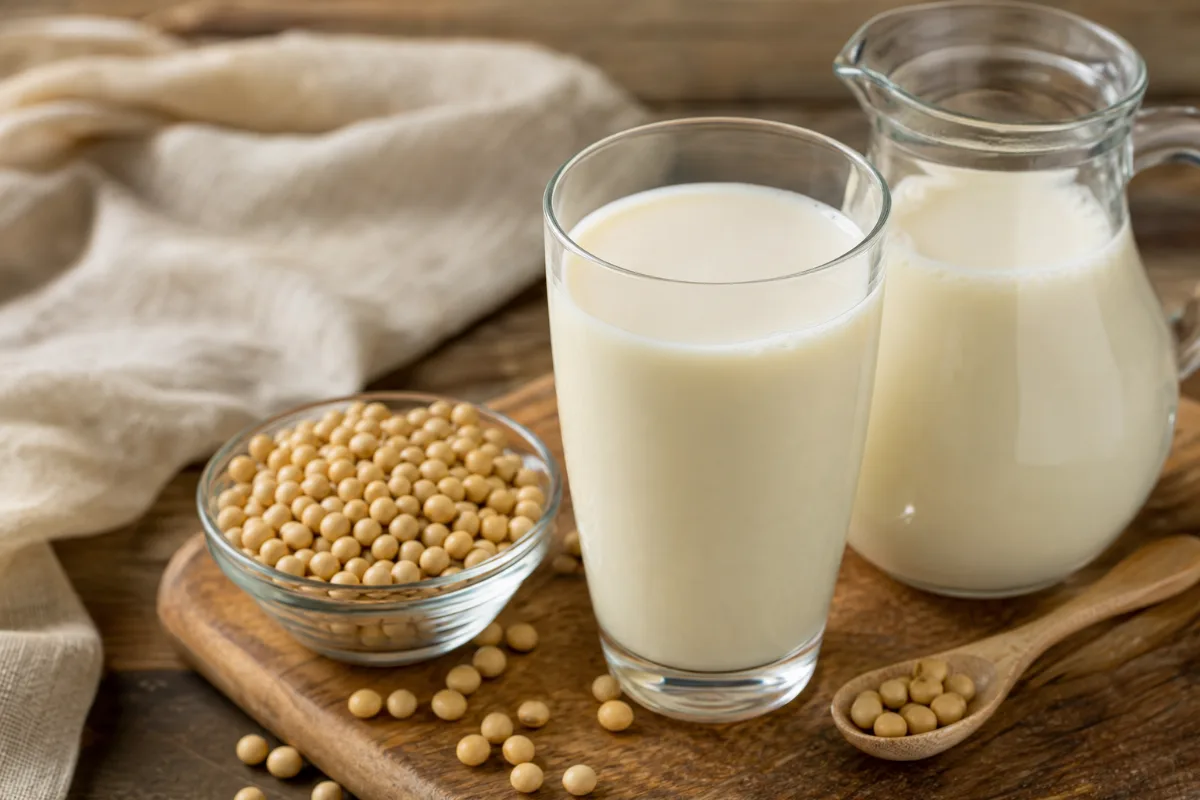
Soy milk is a drink made from soybeans, the seeds of Glycine max, a legume (see our soy foods page). The National Center for Complementary and Integrative Health (NCCIH) lists soy milk with tofu, miso, tempeh and edamame as common soy foods. [1] People drink it as a dairy-free milk, for its protein, or because they have lactose intolerance or follow a plant-based diet. This page covers soy milk as a drink. It keeps soy protein or isoflavone supplements apart, because most research used those.
Read this first
- Allergy: soybeans are one of the nine major food allergens named by the U.S. FDA, and the NHS lists soy among common food allergens. [2] [3] For trouble breathing or swelling of the face or throat, call 911 (or your local emergency number).
- If it replaces milk, check the label. USDA lists about 301 mg calcium in a cup of unsweetened, calcium-fortified soy milk but about 61 mg in an unfortified original and vanilla one. [4] [5] CDC says fortified dairy alternatives are the only milk alternatives that help meet a child's dairy needs, and not before 12 months. [6]
- Thyroid medicine: MedlinePlus says foods with soybeans, walnuts and fiber may affect how levothyroxine works, so talk with your doctor. [7] A review found the evidence mostly case reports and said the effect of soy milk is unresolved. [8]
- Evidence in one line: pooled trials of soy protein show a small drop in LDL cholesterol; the abstract does not say how many used soy milk. [9] Evidence for hot flashes, cancer and other claims is mixed or limited.
What is in it (USDA values)
The main table is for unsweetened soy milk with added calcium and vitamins A and D (USDA FoodData Central item 175215, SR Legacy). [4] The serving column is the USDA household portion of 1 cup, 243 g. USDA lists no values for vitamin D, vitamin A or zinc in this record in the data we used, even though the record name says vitamins A and D were added, so we show no figures for them.
| Nutrient | Per 100 g | Per 1 cup (243 g) | % Daily Value per serving |
|---|---|---|---|
| Energy | 33 kcal | 80.2 kcal | no DV |
| Total fat | 1.61 g | 3.91 g | 5% |
| Saturated fat | 0.21 g | 0.5 g | 3% |
| Polyunsaturated fat | 1.01 g | 2.45 g | no DV |
| Protein | 2.86 g | 6.95 g | 14% |
| Carbohydrate | 1.74 g | 4.23 g | 2% |
| Total sugars | 0.41 g | 1 g | no DV |
| Fiber | 0.5 g | 1.22 g | 4% |
| Calcium | 124 mg | 301 mg | 23% |
| Potassium | 120 mg | 292 mg | 6% |
| Sodium | 37 mg | 89.9 mg | 4% |
| Magnesium | 16 mg | 38.9 mg | 9% |
| Copper | 0.082 mg | 0.2 mg | 22% |
| Thiamin (B1) | 0.15 mg | 0.37 mg | 31% |
| Riboflavin (B2) | 0.21 mg | 0.5 mg | 39% |
| Vitamin B12 | 1.11 mcg | 2.7 mcg | 112% |
% Daily Value uses the FDA 2016 Daily Values; values vary by brand and recipe. The serving figures are the 100 g values multiplied by 2.43. Products differ a lot, as this second USDA record shows (original and vanilla soy milk with no added nutrients, FDC 172446). [5]
| Per 1 cup (243 g) | Unsweetened, calcium-fortified (FDC 175215) | Original and vanilla, unfortified (FDC 172446) |
|---|---|---|
| Energy (kcal) | 80.2 | 131 |
| Protein (g) | 6.95 | 7.95 |
| Total sugars (g) | 1 | 9.7 |
| Calcium (mg) | 301 | 60.8 |
| Vitamin B12 (mcg) | 2.7 | 0 |
| Sodium (mg) | 89.9 | 124 |
USDA does not say how much of the 9.7 g of sugars in the original and vanilla record is added sugar. [5]
Plant compounds: soy contains isoflavones, which bind to estrogen receptors, mostly the beta type, in laboratory work. [10] USDA lists no isoflavone values for these soy milk records, and we did not find isoflavone amounts for soy milk in the sources we read.
What research says
| Health goal | What the sources found | Strength of evidence | What was studied |
|---|---|---|---|
| LDL ("bad") cholesterol | A meta-analysis of 46 FDA-identified trials (43 with usable data; median 25 g soy protein a day, median 6 weeks) found LDL fell by 4.76 mg/dL (95% CI 2.80 to 6.71), about 3-4%. [9] The U.S. soy protein heart claim names 25 g or more a day. [11] | Established for a small LDL change (a blood marker, not heart attacks) | Soy protein trials (the abstract does not break out soy milk); the review was funded by Canadian public bodies |
| Heart disease events | We did not read a trial of soy milk with heart attack or stroke as the outcome. | Insufficient evidence | Not applicable |
| Menopause hot flashes | A Cochrane review of 43 trials (4,364 women) found no conclusive evidence that phytoestrogen supplements reduce hot flashes; soy food trials could not be pooled and were small. [12] NCCIH says any effect may be small and not fully consistent. [1] | Mixed | Soy foods, extracts and supplements |
| Breast cancer | NCCIH says observational studies in Asian and Asian-American women link higher soy intake with lower breast cancer risk, and soy supplements have not been shown to reduce risk. [1] A 2026 review says cohort studies suggest lower risk but trials measuring risk markers do not support it. [10] | Mixed (observational) | Cohort studies; lifelong food intake |
| Thyroid hormones | A meta-analysis of 18 randomized trials found no change in free T3 or free T4 and only a very small rise in TSH (0.248 mIU/L); the authors said the clinical meaning is unclear. [13] | Promising but limited (small measured effect) | Soy interventions in trials (foods and supplements) |
| Male hormones | A meta-analysis of placebo-controlled trials found no effect of soy protein or isoflavones on testosterone or related measures in men. [14] | No effect found | Soy foods and isoflavone supplements |
| As a milk substitute | In a New Zealand analysis, soy drinks had the most milk-like composition and the only comparable amino-acid content. [15] | Established (food composition) | Lab analysis and labels |
NCCIH also says isoflavones probably help bone density after menopause and may modestly lower blood pressure, and that it is uncertain whether soy improves blood sugar control in people who already have diabetes; those findings concern isoflavones, and the summary we read does not separate out soy milk. [1] The FDA proposed in October 2017 to revoke the soy protein heart claim, saying the evidence was inconsistent; comments were due in January 2018. [16] We did not find the final outcome. The eCFR text we read (version dated 2025-01-01) still contains the claim. [11]
Eaten as food vs taken as supplement. The trials above tested soy protein, soy foods, extracts or isoflavone supplements, and the abstracts we read do not break out soy milk. A cup of soy milk has about 7 g protein, from USDA values. [4] Do not assume a soy milk trial result exists because a soy protein result does.
How much is a normal serving
The USDA household portion is 1 cup (243 g), which has 80 kcal for the unsweetened fortified record. [4] The NHS says unsweetened, calcium-fortified dairy alternatives such as soya drinks count toward the dairy food group. [17] That is information, not a prescription for you.Safety, allergy and medicines
- Soy allergy: soy is a major U.S. allergen and NCCIH notes that U.S. labels must indicate its presence. [2] [1] Soy is not automatically a safe swap for milk allergy: the milk allergy guideline lists soy formula as one option and does not assess how well soy is tolerated. Ask an allergist. [18]
- Thyroid medicine: see the bullet near the top of this page. MedlinePlus says levothyroxine is usually taken on an empty stomach 30 minutes to 1 hour before breakfast. [7] Do not change a medicine on your own; ask your prescriber or pharmacist.
- Hormone-sensitive conditions: soy foods are often asked about after breast cancer. The sources we read show mixed observational findings and no clear advice. Ask your cancer care team. [10] [1]
- Pregnancy and breastfeeding: NCCIH says soy during pregnancy may be unsafe in amounts greater than those usually found in foods, and little is known about larger amounts while breastfeeding. [1]
- Babies: CDC says not to give soy or other fortified dairy alternatives as a milk before 12 months. [6] This is about soy milk as a drink, not infant formula.
- Digestion: NCCIH lists bloating, constipation, diarrhea and nausea as possible side effects of soy. [1]
- Antidepressants called MAOIs: NCCIH names tofu and soy sauce, which are high in tyramine, as risky with MAOIs. It does not name soy milk, and we did not find tyramine values for soy milk. Ask your pharmacist. [1]
- Kidney disease: NIDDK suggests asking a dietitian about plant or soy milk. [19] USDA lists 120 mg potassium per 100 g, about 292 mg a cup. [4]
- Sweetened and flavored soy milk: the 2025-2030 Dietary Guidelines say no amount of added sugars is recommended. [20] CDC says to choose unsweetened versions for children. [6]
Choosing, storing and food safety
- Look for "unsweetened" and for added calcium and vitamin D on the label. [6]
- Shake the carton. In a laboratory analysis, protein and calcium in some plant drinks differed between shaken and unshaken samples. [15]
- Salt was the most common added ingredient in a review of plant drinks, so check sodium. [21] USDA lists 37 mg sodium per 100 g in the unsweetened fortified record. [4]
- We did not read storage or shelf-life rules; follow the package.
Related pages
Health connections for Soy Milk
What research links to eating or drinking this food, and how strong the evidence is. Many studies are observational or use juice, powder, oil or extracts rather than the food as eaten; each card says which.
Soy milk as a plant alternative to cow's milk
Established roleUnsweetened calcium-fortified soy milk has about 301 mg calcium, 7 g protein and 2.7 mcg vitamin B12 per cup (USDA); unfortified types have far less calcium. Soy drinks were the most milk-like in one lab analysis.
Supplements: This is about nutrients in the drink, not a treatment for any disease.
Soy protein and LDL cholesterol
Clinically supportedA meta-analysis of 46 FDA-identified trials found soy protein lowered LDL by 4.76 mg/dL (about 3-4%) at a median of 25 g protein a day for 6 weeks.
Supplements: Supported only for a small change in an LDL blood marker; the abstract does not say how many trials used soy milk. The FDA proposed in 2017 to revoke the soy protein heart claim; the final outcome was not found.
Soy and menopausal hot flashes
Preliminary or mixedA Cochrane review of 43 trials found no conclusive evidence that phytoestrogen supplements reduce hot flashes; soy food trials were small and could not be pooled.
Supplements: Mostly supplements and extracts were tested; NCCIH says any effect may be small.
Soy foods and breast cancer
Preliminary or mixedObservational studies in Asian and Asian-American women link higher soy intake with lower breast cancer risk; trials measuring risk markers do not support it, and soy supplements have not been shown to reduce risk.
Supplements: Observational findings are not proof; ask your cancer care team if you have had breast cancer.
Soy and thyroid function
Preliminary or mixedA meta-analysis of 18 trials found no change in free T3 or free T4 and a very small rise in TSH; the authors said the clinical meaning is unclear.
Supplements: Trials used soy foods and supplements; no clear harm shown.
Connected topics
Open a group to see how each topic connects and how strong the evidence is.
Health goals (1)
- Cholesterol BalanceClinically supported
Pooled trials of soy protein found a small LDL drop (about 4.8 mg/dL). The abstract does not say how many used soy milk.
Body systems (3)
- Immune SystemDocumented risk
Soy is a major food allergen and can cause serious reactions.
- Cardiovascular SystemClinically supported
Small LDL change in pooled soy protein trials.
- Digestive SystemDocumented risk
NCCIH lists bloating, constipation, diarrhea and nausea as possible soy side effects.
Functional actions (1)
- Cardiovascular SupportClinically supported
Small LDL lowering seen in pooled soy protein trials.
Root causes (2)
- Medication Side EffectsDocumented risk
Foods with soybeans may affect levothyroxine; the evidence is mostly case reports.
- Nutrient DeficiencyEstablished role
Fortified soy milk supplies calcium and vitamin B12 (USDA); unfortified types supply much less.
Habits (1)
- Balanced NutritionPreliminary or mixed
The NHS says unsweetened calcium-fortified soya drinks count toward the dairy food group.
Biomarkers (1)
- LDL CholesterolClinically supported
Soy protein lowered LDL by 4.76 mg/dL in pooled trials.
Conditions & symptoms (3)
- AnaphylaxisDocumented risk
Call 911 for trouble breathing or swelling of the face or throat.
- Food AllergyDocumented risk
Soy is one of the nine major U.S. food allergens.
- HypothyroidismDocumented risk
People taking levothyroxine are told foods with soybeans may affect it; evidence is limited.
Documented risks and interactions (5)
- Soy and levothyroxine (thyroid medicine) absorption. MedlinePlus says foods with soybeans, walnuts and fiber may affect how levothyroxine works. A narrative review found mostly case reports; one crossover trial found no difference, and the effect of soy milk is unresolved.
- Soy allergy. Soy is one of nine major U.S. food allergens and is a common food allergen in the UK. Serious reactions need emergency care (911).
- Soy in pregnancy and breastfeeding at amounts above food. NCCIH says soy in pregnancy may be unsafe in amounts greater than those commonly found in foods; little is known about larger amounts while breastfeeding.
- Soy milk for babies under 12 months. CDC says fortified dairy alternatives, including soy, should not be given as a milk before 12 months.
- Added sugar in sweetened or flavored soy milk. USDA lists 1 g sugars per cup for the unsweetened record and 9.7 g for original and vanilla; the 2025-2030 Dietary Guidelines say no amount of added sugars is recommended.
Frequently asked questions
Does soy milk lower cholesterol?
In pooled trials, soy protein lowered LDL by about 4.8 mg/dL on average, a small change, and we could not tell from the abstract how many trials used soy milk. [9]
Is soy milk as nutritious as cow's milk?
Only calcium-fortified soy was broadly comparable in one analysis. [15] Check the label for calcium, vitamin B12 and added sugar. [4] [5]
Does soy milk lower testosterone in men?
A meta-analysis of placebo-controlled trials found no effect of soy protein or isoflavones on testosterone and related measures. [14]
Can I drink soy milk with thyroid medicine?
MedlinePlus says foods with soybeans may affect levothyroxine, and a review found the data limited. Ask your prescriber or pharmacist about timing. [7] [8]
Is soy milk safe after breast cancer?
The sources we read show mixed observational findings and no clear advice, so ask your cancer care team. [10] [1]
References
- NCCIH. Soy: usefulness and safety. last updated April 2025. Read 2026-10-24.
- U.S. Food and Drug Administration. Food Allergies. Read 2026-10-24.
- NHS. Food allergy. Read 2026-10-24.
- U.S. Department of Agriculture. FoodData Central: Soymilk (all flavors), unsweetened, with added calcium, vitamins A and D (SR Legacy, FDC 175215). April 2018 release. Read 2026-10-24.
- U.S. Department of Agriculture. FoodData Central: Soymilk, original and vanilla, unfortified (SR Legacy, FDC 172446). April 2018 release. Read 2026-10-24.
- CDC. Cow's milk and milk alternatives (infant and toddler nutrition). Read 2026-10-24.
- MedlinePlus. Levothyroxine. last revised 2019-02-15. Read 2026-10-24.
- Endocrine Practice. Interference or noninterference between soy and levothyroxine: a narrative review of literature (abstract read via Europe PMC). 2023. Read 2026-10-24.
- Blanco Mejia S et al. A meta-analysis of 46 studies identified by the FDA demonstrates that soy protein decreases circulating LDL and total cholesterol concentrations in adults. J Nutr (abstract read via Europe PMC). 2019. Read 2026-10-24.
- Messina M, Duncan AM. Soy intake during childhood and/or adolescence and adult breast cancer: an examination of the early soy intake hypothesis. Nutrients (abstract read via Europe PMC). 2026. Read 2026-10-24.
- U.S. Government (eCFR). 21 CFR 101.82: Health claims: Soy protein and risk of coronary heart disease. text version dated 2025-01-01. Read 2026-10-24.
- Lethaby A et al. (Cochrane). Phytoestrogens for menopausal vasomotor symptoms. Cochrane Database Syst Rev (abstract read via Europe PMC). 2013. Read 2026-10-24.
- Otun J et al. Systematic review and meta-analysis on the effect of soy on thyroid function. Sci Rep (abstract read via Europe PMC). 2019. Read 2026-10-24.
- Hamilton-Reeves JM et al. Clinical studies show no effects of soy protein or isoflavones on reproductive hormones in men: results of a meta-analysis. Fertil Steril (abstract read via Europe PMC). 2010. Read 2026-10-24.
- Smith NW et al. Nutritional assessment of plant-based beverages in comparison to bovine milk. Front Nutr 9:957486 (full text read). 2022. Read 2026-10-24.
- Venable LLP. Healthy no more? Authorized soy protein and heart disease health claim on FDA's chopping block (law-firm summary of the FDA proposal of 31 October 2017). 2017. Read 2026-10-24.
- NHS. Milk and dairy in your diet. Read 2026-10-24.
- Venter C et al. (WAO DRACMA panel). WAO DRACMA guidelines update XVI: nutritional management of cow's milk allergy. World Allergy Organ J (abstract read via Europe PMC). 2024. Read 2026-10-24.
- NIDDK. Eating and nutrition for chronic kidney disease. Read 2026-10-24.
- U.S. Department of Agriculture and U.S. Department of Health and Human Services. Dietary Guidelines for Americans, 2025-2030. January 2026. Read 2026-10-24.
- Fructuoso I et al. An overview on nutritional aspects of plant-based beverages used as substitutes for cow's milk. Nutrients (abstract read via Europe PMC). 2021. Read 2026-10-24.