Geranium Oil
Geranium oil comes from Pelargonium graveolens. Small trials of inhaled geranium report less anxiety and fatigue; skin allergy is documented, and the oil is never swallowed.
Content last updated . This page has not been medically reviewed.
Safety first. Natural products can cause side effects and interact with medicines. Read essential oil safety before you use anything on this page.
Safety first. Geranium oil is a skin allergen for some people. In a worldwide patch-test study of 178 fragrance-sensitive patients, geranium oil bourbon was among the substances that reacted at a rate of 2% or higher. [1] Essential oils should not be swallowed; a poison-centre review found that oils such as camphorated and eucalyptus oil can be harmful, even life-threatening, if ingested by children. [2] For a swallowed oil, call Poison Help at 1-800-222-1222 (US); for collapse, seizure or trouble breathing, call 911. See Essential oil safety.
What it is
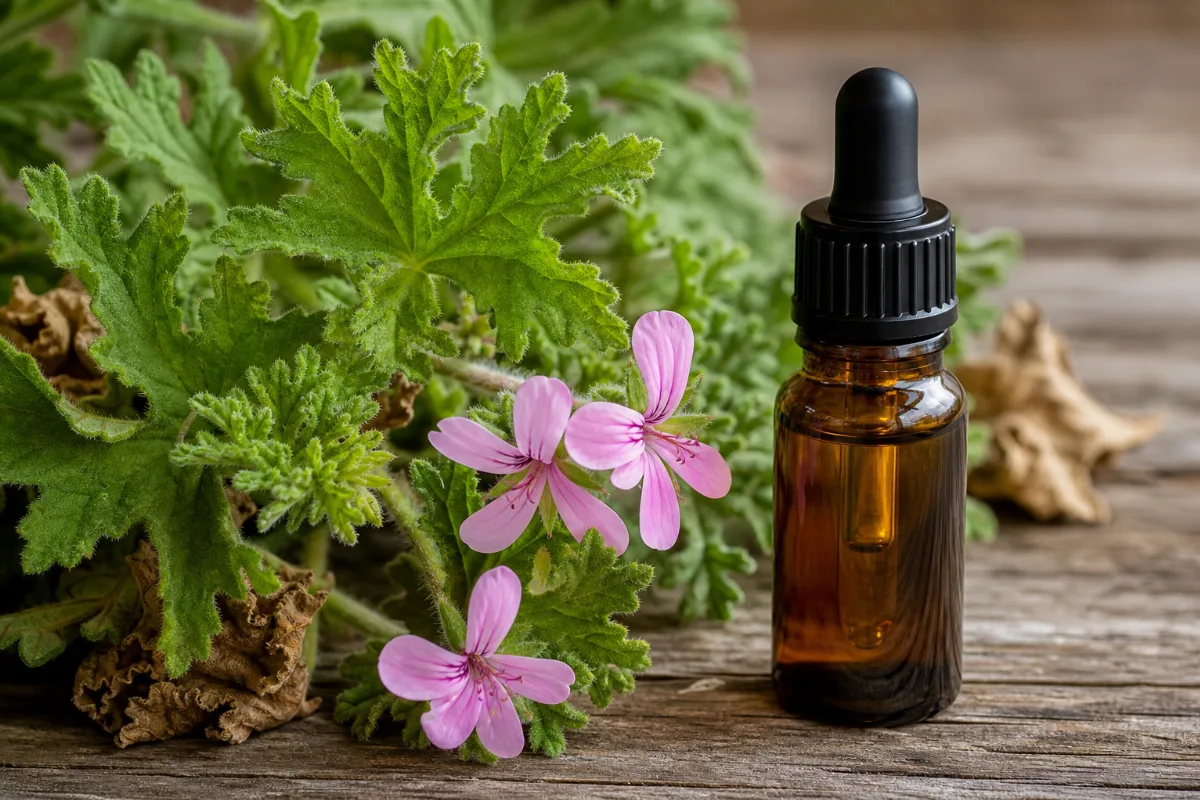
Geranium oil usually means oil from rose-scented geranium, Pelargonium graveolens (Thunb.) L'Hér., an accepted species in the family Geraniaceae. [3] A research paper describes it as an economically important plant. [4] The oil is obtained from the plant by distillation, and a related product, the absolute, by solvent extraction. [4] See Absolutes, hydrosols and infused oils explained. Several trials below name the plant (P. graveolens); others say only "geranium", so the species is not always certain.Traditional use
Proper evidence not found: we looked for a documented traditional use of geranium oil in PubMed and in the sources listed below, and did not find a source that describes one. Claims that it is "traditionally used" for hormones or skin are therefore not repeated here.What research shows
Human studies are small trials of inhaled geranium, mostly in hospital patients, and most measure self-rated anxiety or pain. Smell is hard to blind, and a 2025 meta-analysis of inhalation aromatherapy flagged lack of blinding and differing study designs. [5]| Question | What the source found | Strength of evidence | Form and people studied |
|---|---|---|---|
| Anxiety after heart attack | A triple-blind, placebo-controlled trial in 80 patients found geranium reduced anxiety scores more than placebo. [6] | Promising but limited | Inhaled via oxygen-mask patch, hospital patients |
| Anxiety before hernia surgery | 150 patients: geranium and music each lowered anxiety versus a control group that got nothing; the control had no placebo scent. [7] | Promising but limited | Inhaled |
| Anxiety in first-stage labor | In 100 first-time mothers, a geranium group was compared with a placebo group and anxiety fell. [8] | Promising but limited | Inhaled |
| Pain and sleep after gallbladder surgery | Pain fell with lavender or geranium compared with standard care alone. Sleep improved more with geranium than lavender, but the control group got no scent. [9] | Promising but limited | Inhaled, 153 patients, single-blind |
| Fatigue in intensive care nurses | In a double-blind trial of 84 nurses, fatigue scores were lower with geranium than with a sunflower-oil placebo; sleep scores did not differ before and after. [10] | Promising but limited | Inhaled |
| Allergic rhinitis symptoms | A blend of sandalwood, geranium and Ravensara beat almond oil on nasal symptom scores. The result cannot be assigned to geranium alone. [11] | Insufficient evidence for geranium | Inhaled blend, 54 adults |
| Stress in nurses (massage) | Six massages with lavender and geranium at 1% in cream were followed by lower heart rate and blood pressure; this was a pilot study. [12] | Insufficient evidence | Massage, blend |
| Hormones | In one study, smelling geranium and rose otto raised salivary estrogen compared with a control odor. [13] | Preliminary; a lab marker, not a symptom outcome | Inhaled, perimenopausal women |
| Acne, wounds, skin infection | Proper evidence not found: our PubMed searches for human trials of geranium oil on skin did not return any. | No good evidence | Not applicable |
The trials share limits: short follow-up, self-reported outcomes and, in several, a control group with no scent, which cannot separate the smell's effect from expectation. [7] A systematic review of aromatherapy for anxiety in labor included geranium among several oils and asked for methodologically stronger studies. [14] A review of aromatherapy massage in cancer care rated the evidence very low quality. [15]
On hormones, the salivary estrogen result is a single biomarker measurement; it does not show relief of menopause symptoms, and no source we read shows geranium oil changes health outcomes through hormones. For symptoms, see Essential oils for menopause and period symptoms.
Forms and why they matter
Trial results apply to the oil that was tested and the way it was delivered (patch in a mask, cotton, massage cream). Chemistry varies: a meta-analysis of reported geranium oil compositions from different countries found, for example, that menthone and isomenthone, and citronellol and geraniol, tended to move in opposite directions. [4] A chemistry review notes that in some oils, including geranium, 450 to 500 different chemicals have been found. [16] Labels and testing are covered on Reading an essential oil label.Uses studied and safety checks for Geranium Oil
Read the safety checks first. Each card says whether a finding comes from people or only from the lab, which way the oil was used (scent, on skin or swallowed) and how strong the evidence is. A finding for one way of using an oil does not carry over to another.
Check before you use (5)
- Skin allergy and patch tests. In a worldwide study of 178 fragrance-sensitive patients, geranium oil bourbon and l-citronellol were among the materials reacting at 2% or higher; the authors asked for further evaluation. In an animal skin test (local lymph node assay), geranium oil was negative, so tests can disagree.
- Cats and dogs (plant entry). ASPCA lists the geranium plant (Pelargonium) as toxic to dogs, cats and horses, naming geraniol and linalool as toxic principles, with vomiting, appetite loss, depression and skin irritation. This is the plant, not a statement about the oil or diffusing.
- Pregnancy and breastfeeding. A 1999 review said safety of aromatherapy oils in pregnancy, childbirth and babies had not been clearly demonstrated. Geranium-specific statements were not found.
- Swallowing: poison center warnings. Poison Control says some essential oils are very dangerous if swallowed. Call 1-800-222-1222 (US) or your local emergency number. No geranium-specific swallowing case was found.
- Children. Poison Control says children's thin skin and immature livers may make them more vulnerable; keep oils out of reach. Geranium-specific child statements were not found.
Geranium scent and anxiety around medical events (inhaled)
Preliminary or mixedSmall randomized trials of inhaled geranium report lower self-rated anxiety in 80 heart-attack patients (triple-blind, placebo), 150 hernia-surgery patients (control got no scent) and 100 first-time mothers in early labor (placebo).
Supplements: Research is on the scent or oil itself; it is not a nutrient and not a treatment. Small trials; not shown to treat anxiety disorders.
Fatigue in intensive care nurses (inhaled)
Preliminary or mixedIn a double-blind trial of 84 ICU nurses, inhaled Pelargonium graveolens oil lowered fatigue scores more than a sunflower-oil placebo; sleep quality did not differ significantly between groups.
Supplements: One small trial; sleep did not improve.
Sleep quality (inhaled)
Not enough evidenceIn the same ICU nurse trial, sleep quality did not differ significantly between the geranium and placebo groups.
Supplements: No good evidence of benefit from this trial.
Hormone questions: salivary estrogen
Not enough evidenceIn one study, smelling geranium or rose otto raised salivary estrogen compared with a control odor in perimenopausal women. It is a single lab marker; sample details were not given in the abstract and no symptom benefit was shown.
Supplements: No source we read shows it changes health outcomes through hormones.
Acne, wounds, skin infection
Not enough evidenceProper evidence not found in the sources we read for human trials of geranium oil on skin conditions.
Supplements: No good evidence found.
Connected topics
Open a group to see how each topic connects and how strong the evidence is.
Health goals (3)
- Anxiety SupportPreliminary or mixed
Several small inhaled trials in patients report lower self-rated anxiety; hard to blind and short.
- Calm & RelaxationPreliminary or mixed
Lower anxiety scores in small inhaled trials; no wider claim is supported.
- Reduce FatiguePreliminary or mixed
One double-blind trial in 84 ICU nurses found lower fatigue than a placebo oil.
Body systems (3)
- Skin, Hair & BeautyDocumented risk
Skin allergy to geranium oil bourbon was documented in patch tests of fragrance-sensitive people.
- Energy & FatiguePreliminary or mixed
Fatigue scores fell versus placebo in one nurse trial.
- Stress & MoodPreliminary or mixed
Anxiety scores fell in small inhaled trials.
Body parts (1)
- SkinDocumented risk
Allergic contact dermatitis is documented; reactions can occur on skin contact.
Functional actions (1)
- CalmingPreliminary or mixed
Small inhaled trials report lower anxiety scores.
Conditions & symptoms (3)
- AnxietyPreliminary or mixed
Small inhaled trials in patients; self-rated scores.
- Contact DermatitisDocumented risk
Geranium oil bourbon reacted in patch tests of fragrance-sensitive people.
- FatiguePreliminary or mixed
One double-blind nurse trial found lower fatigue than placebo.
Frequently asked questions
Is geranium oil the same as rose geranium oil?
The trials and chemistry papers we read use "geranium" and "rose-scented geranium" for oil from Pelargonium graveolens, but not every trial states the species. [4] [3]
Does geranium oil balance hormones?
Not shown. One study saw a rise in salivary estrogen after smelling geranium and rose otto. [13] That is a lab marker and does not show symptom relief.
Can geranium oil cause an allergic skin reaction?
Yes, in some people. Patch tests in fragrance-sensitive patients reacted to geranium oil bourbon. [1]
Does geranium oil help with anxiety?
Small inhaled trials report lower self-rated anxiety in patients awaiting or recovering from procedures, but they are small and hard to blind. [6] [7]
Can I swallow geranium oil?
No advice to swallow essential oils is given here. Call Poison Help at 1-800-222-1222 in the US if an oil is swallowed. [2]
More details: evidence, limits and cautions
The details behind this page: cautions, limits of the evidence and where sources disagree. Open any note to read it.
Safety details
- Skin allergy: the patch-test study above is a clinic population of people already suspected to be fragrance sensitive, so it does not give a rate for the general public. [1] In an animal skin-sensitization test (local lymph node assay), geranium oil was negative, which shows tests can disagree. [17] A large German dermatology series of 12 tested oils reported sensitization to essential oils as infrequent for most, and sensitization risk is higher for masseurs and cosmeticians. [18] Patch-test guidance is on Patch testing and stopping a reaction.
- Pregnancy and breastfeeding: a 1999 review said safety in pregnancy, childbirth and babies had not been clearly demonstrated. [19] A geranium-specific pregnancy statement is not described in the sources we read. See Essential oils in pregnancy and breastfeeding.
- Pets: the ASPCA lists the geranium plant (Pelargonium species) as toxic to dogs, cats and horses, with vomiting, anorexia, depression and dermatitis as clinical signs. [20] That is the plant entry, not the oil, and we found no pet source for geranium oil itself, so keep the oil away from pets too.
- Medicines, liver and kidney, children: not described in the sources we read for geranium oil specifically; check How interactions work and ask a pharmacist.
A clinician or pharmacist decides what is right for a person. Tell the surgical team about any oils used before an operation.
References
- Fragrance contact dermatitis: a worldwide multicenter investigation (Part II), Contact Dermatitis 2001. Read 2026-10-23.
- Unintentional exposure of young children to camphor and eucalyptus oils, Paediatrics & Child Health 2001. Read 2026-10-23.
- GBIF Backbone Taxonomy: Pelargonium graveolens, GBIF. Read 2026-10-23.
- Studies on essential oil from rose-scented geranium, Pelargonium graveolens L'Hérit. (Geraniaceae), Natural Product Research 2021. Read 2026-10-23.
- Inhalation aromatherapy for the treatment of comorbid insomnia: a systematic review and meta-analysis, Frontiers in Psychiatry 2025. Read 2026-10-23.
- Effects of geranium aroma on anxiety among patients with acute myocardial infarction: A triple-blind randomized clinical trial, Complementary Therapies in Clinical Practice 2017. Read 2026-10-23.
- Comparing the effects of geranium aromatherapy and music therapy on the anxiety level of patients undergoing inguinal hernia surgery: A clinical trial, Explore 2022. Read 2026-10-23.
- Effect of Inhalation of Aroma of Geranium Essence on Anxiety and Physiological Parameters during First Stage of Labor in Nulliparous Women: a Randomized Clinical Trial, Journal of Caring Sciences 2015. Read 2026-10-23.
- Aromatherapy Improves Pain, Sleep and Physiological Parameters in Laparoscopic Cholecystectomy Patients: A Single-Blind, Parallel Group, and Randomized Controlled Trial, Chinese Journal of Integrative Medicine 2025. Read 2026-10-23.
- The effect of Aromatherapy with Pelargonium graveolens (P. graveolens) on the fatigue and sleep quality of critical care nurses during the Covid-19 pandemic: A randomized controlled trial, Explore 2024. Read 2026-10-23.
- Effect of Inhalation of Aromatherapy Oil on Patients with Perennial Allergic Rhinitis: A Randomized Controlled Trial, Evidence-Based Complementary and Alternative Medicine 2016. Read 2026-10-23.
- Effectiveness of aromatherapy massage on the stress of the surgical center nursing team: a pilot study, Revista da Escola de Enfermagem da USP 2018. Read 2026-10-23.
- Effects of essential oil exposure on salivary estrogen concentration in perimenopausal women, Neuro Endocrinology Letters 2017. Read 2026-10-23.
- A Systematic Review on the Anxiolytic Effect of Aromatherapy during the First Stage of Labor, Journal of Caring Sciences 2019. Read 2026-10-23.
- Massage with or without aromatherapy for symptom relief in people with cancer, Cochrane Database of Systematic Reviews 2016. Read 2026-10-23.
- Essential Oils, Part III: Chemical Composition, Dermatitis 2016. Read 2026-10-23.
- Investigation of the dermal sensitization potential of various essential oils in the local lymph node assay, Food and Chemical Toxicology 2006. Read 2026-10-23.
- Contact sensitization to essential oils: IVDK data of the years 2010-2019, Contact Dermatitis 2022. Read 2026-10-23.
- Possible health and safety problems in the use of novel plant essential oils and extracts in aromatherapy, Journal of the Royal Society for the Promotion of Health 1999. Read 2026-10-23.
- ASPCA Animal Poison Control, Toxic and Non-Toxic Plants: Geranium. Read 2026-10-23.