Daikon Radish: Nutrients, What Research Shows and Safety
Daikon radish explained: USDA nutrients, what the sources say about glucosinolates, the enzyme claim, kimchi and goitrogens, and safety notes.
Content last updated . This page has not been medically reviewed.
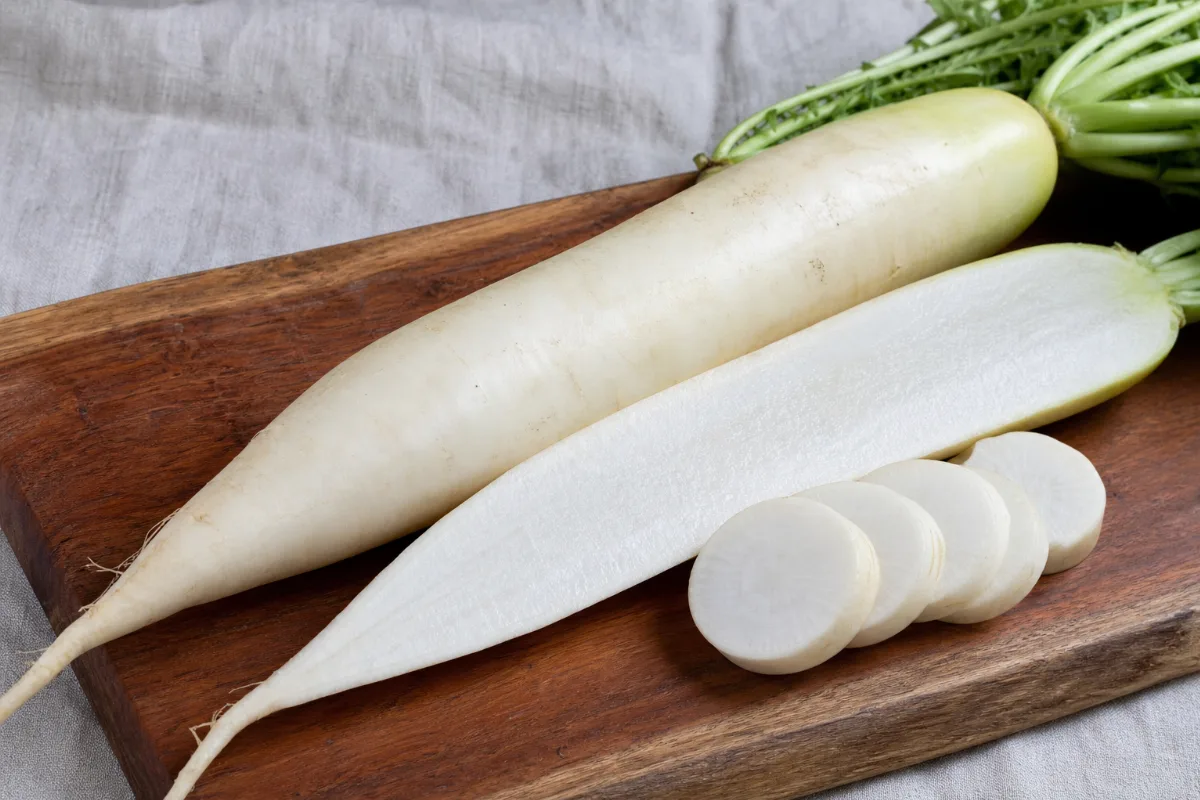
Daikon (Raphanus sativus var. longipinnatus) is a long, white radish in the cabbage family (Brassicaceae, the cruciferous vegetables). The thick root is the part usually eaten, raw, cooked or pickled, and it is common in Japanese, Korean and Chinese cooking. People eat it for its crisp, mild-peppery taste and for its vitamin C and plant compounds. This page keeps the food apart from supplements and from hype, and says plainly where evidence is thin.
Read this first
- Daikon is an everyday food and serious problems are not described in the sources we read. As with any food, an allergic reaction is possible. For trouble breathing or swelling of the face or throat, call 911. See food allergy basics and emergency signs.
- The popular claim that daikon "helps digest starchy food because of its enzymes" is not backed by a human study we could find. See below.
- Goitrogens (compounds that can affect the thyroid) in crucifers matter, at most, when a person eats large amounts and also gets too little iodine. [3]
- In short: daikon is a low-calorie, water-rich root with some vitamin C. No source we read shows that eating it prevents or treats a disease.
What is in it (USDA values)
USDA FoodData Central lists "Radishes, oriental, raw" (FDC 168451), which is daikon. [1] The USDA household portion is 1 cup of slices (116 g). Per-serving numbers below are the per-100 g values multiplied by 1.16.
| Nutrient | Per 100 g | Per 1 cup slices (116 g) | % Daily Value per serving |
|---|---|---|---|
| Energy | 18 kcal | 21 kcal | n/a |
| Water | 94.6 g | 110 g | n/a |
| Fiber | 1.6 g | 1.9 g | 7% |
| Total sugars | 2.5 g | 2.9 g | n/a |
| Vitamin C | 22 mg | 25.5 mg | 28% |
| Potassium | 227 mg | 263 mg | 6% |
| Folate (DFE) | 28 mcg | 32.5 mcg | 8% |
| Copper | 0.12 mg | 0.14 mg | 15% |
| Magnesium | 16 mg | 18.6 mg | 4% |
| Calcium | 27 mg | 31 mg | 2% |
| Vitamin K | 0.3 mcg | 0.35 mcg | 0% |
| Vitamin A (RAE) | 0 mcg | 0 mcg | 0% |
Source: USDA FoodData Central, FDC 168451, SR Legacy. [1] % Daily Value uses the FDA 2016 Daily Values; values vary with variety, ripeness and storage.
Like other crucifers, radishes contain glucosinolates, sulfur compounds that break down into isothiocyanates when the vegetable is chopped or chewed. [2] Laboratory analysis of radish plants found several glucosinolates, including glucoraphasatin and glucoraphenin; that study did not give amounts and did not test people. [5] Most of the evidence on what isothiocyanates do in the body comes from lab and animal work, so it does not show a benefit from eating daikon.
What research says
| Health goal | What the sources found | Strength of evidence | What was studied |
|---|---|---|---|
| Vitamin C intake | USDA lists 22 mg per 100 g, 24% of the Daily Value. [1] This is a nutrient value, not a trial. | Established (as a source of the nutrient) | Whole raw root, laboratory analysis |
| Digestion of starchy food ("digestive enzymes", amylase) | We searched Europe PMC for radish or daikon amylase and found no human study and no paper measuring daikon's own enzyme activity. | Insufficient evidence | No relevant study found |
| Glucosinolates and isothiocyanates | Radish contains glucosinolates; the compounds that form after chopping are studied in the lab. [2][5] | Lab or animal only | Cell, animal and plant analysis |
| Gut and general health through fermented vegetables (kimchi) | A 2025 review found consistent associations between fermented food intake and several outcomes, but called for better trials. [6] | Mixed (observational links, not proof) | Fermented foods in general, not daikon alone |
| Thyroid effects of crucifers | The Linus Pauling Institute says goitrogens are not of clinical importance unless eaten in large amounts, or with iodine deficiency. [3] | Established as a caution, rarely a problem | Reviews of foods and iodine |
| Disease prevention (any) | We did not find a trial or review we could read on daikon itself. | Insufficient evidence | Not applicable |
The enzyme claim. Many web pages say daikon contains amylase or "diastase" that helps digest rice or starch. Plants do contain enzymes, and stomach acid and our own digestive enzymes handle most of the work. We found no paper we could read that measured daikon enzyme activity in food as eaten or tested whether eating it changes digestion in people. Proper evidence not found in the sources we read. One 2026 lab paper tested wild radish (R. raphanistrum) extracts for blocking amylase, which is a different question and not a digestion study. [7]
Eaten as food vs taken as a supplement or extract. Everything above is about the root as food. Radish extracts, juice or powders are different products, and we found no trial of them that we could read, so nothing here applies to them.
Daikon in kimchi and Asian cooking
Daikon is used in cooking raw (grated beside fish, in salads), simmered in soups and stews, dried, and fermented. In Korean cooking, cubed or sliced daikon is the base of some kimchi. See kimchi and kimchi vs sauerkraut. The health reputation of kimchi comes mostly from observational studies of fermented foods, which cannot prove cause and effect. [6] Fermented kimchi is also high in salt, and fermented foods can contain histamine; see histamine, tyramine and fermented foods. We did not find a study that separates the effect of daikon from the other kimchi ingredients.
Heat changes the chemistry: cooking inactivates myrosinase, the enzyme that turns glucosinolates into isothiocyanates, so gut bacteria then supply much of that activity. [2] We found no source saying whether this changes health outcomes for daikon.
How much is a normal serving
- The USDA household portion for daikon is 1 cup of slices (116 g). [1]
- The NHS counts 80 g of fresh, canned or frozen vegetables as one portion of its 5 A DAY advice (last reviewed 9 June 2026). [8] The WHO fact sheet (26 January 2026) says at least 400 g of fruits and vegetables a day for people older than 10. [9]
- These are official figures and information, not a prescription for you.
Safety, allergy and medicines
- Allergy: radish allergy is not described in the sources we read, but food allergy to any vegetable can occur. Trouble breathing or swelling of the face or throat is an emergency: call 911.
- Thyroid (goitrogens): crucifers contain goitrogens, which can interfere with how the thyroid uses iodine. The Linus Pauling Institute (reviewed June 2024) says most are not of clinical importance unless eaten in large amounts, or when iodine is also low. [3] A 2020 narrative review looked at whether such "anti-nutrients" are a real threat; we read only its abstract, which does not state a conclusion on the thyroid. [4] People with a thyroid condition or on thyroid medicine can ask a clinician; see thyroid conditions and iodine.
- Medicines: USDA lists only 0.3 mcg of vitamin K per 100 g of daikon, so it is not a leafy-green-sized source. [1] We did not find a source describing a medicine interaction with daikon as a food, so we make no claim either way. A pharmacist can check.
- Potassium and kidneys: 227 mg per 100 g is a modest amount [1], but people on a low-potassium diet should follow their care team's advice; see foods, kidney disease, potassium and oxalates.
- Digestive comfort: we did not find a source we could read about gas or bloating from daikon, so no claim is made.
- Pregnancy: we found no source on daikon in pregnancy; eating it as an ordinary food is not addressed by the sources we read.
Choosing, storing and food safety
- Pick roots that are not bruised or damaged, and keep cut or peeled roots in the refrigerator at 40 °F or below. [10]
- Rinse under running water before eating, even if you peel it, and scrub firm roots with a clean brush. Do not use soap or produce wash. [10]
- Cut away damaged areas and throw out rotten produce. [10]
- Home-fermented daikon is a separate topic; see fermented foods: safety and home fermentation risks.
Related pages
Health connections for Daikon Radish
What research links to eating or drinking this food, and how strong the evidence is. Many studies are observational or use juice, powder, oil or extracts rather than the food as eaten; each card says which.
Vitamin C intake
Deficiency linkDaikon supplies vitamin C: 22 mg per 100 g, 24% of the Daily Value (USDA).
Supplements: Eating it as food adds to vitamin C intake; this page does not show extra benefit beyond preventing deficiency.
Low-calorie, water-rich vegetable
Established roleRaw daikon is about 95% water and 18 kcal per 100 g.
Supplements: Not applicable: studied as a whole food only.
Fiber and potassium contribution
Established roleA cup of slices (116 g) gives about 1.9 g fiber (7% DV) and 263 mg potassium (6% DV).
Supplements: Not applicable.
Glucosinolates and isothiocyanates
Lab or animal research onlyRadish contains glucosinolates, which turn into isothiocyanates when the vegetable is chopped or chewed.
Supplements: No supplement or extract trial for daikon was found.
Kimchi and fermented vegetables
Preliminary or mixedDaikon is used in kimchi. Fermented foods are linked in observational studies with better outcomes, which cannot prove cause.
Supplements: Not applicable: food only.
Cooking and chopping effects on glucosinolates
Lab or animal research onlyCooking inactivates myrosinase, so gut bacteria supply most of the conversion to isothiocyanates in cooked crucifers.
Supplements: Not applicable.
Connected topics
Open a group to see how each topic connects and how strong the evidence is.
Health goals (3)
- Gut HealthPreliminary or mixed
Kimchi and fermented vegetables show observational links; daikon alone not studied.
- Preventive WellnessEstablished role
Vegetables as part of an overall pattern are recommended by WHO and NHS; no daikon-specific prevention evidence.
- Thyroid SupportDocumented risk
Large crucifer intake with low iodine can affect the thyroid; not a thyroid treatment.
Body systems (3)
- Digestive SystemPreliminary or mixed
Daikon is eaten as part of meals and fermented in kimchi; the 'digestive enzyme' claim has no good human evidence.
- Endocrine SystemDocumented risk
Goitrogens in crucifers matter only with large intake plus low iodine.
- Gut HealthPreliminary or mixed
Fermented vegetable foods are linked with gut-related outcomes in observational work; daikon alone was not studied.
Body parts (2)
Functional actions (1)
- AntioxidantLab or animal research only
Vitamin C and glucosinolate breakdown products have lab antioxidant activity; benefit from eating daikon in people was not shown.
Root causes (2)
- Nutrient DeficiencyDeficiency link
Daikon provides vitamin C (24% DV per 100 g), which prevents scurvy; it is one food among many sources.
- Poor DietEstablished role
A low-calorie vegetable that can add fiber, vitamin C and potassium to meals; official bodies encourage vegetables in general.
Habits (2)
- Balanced NutritionEstablished role
Counts as a vegetable portion (NHS: 80 g is one portion).
- Meal PlanningEstablished role
Easy to add raw, cooked or pickled to meals; information only.
Conditions & symptoms (2)
Documented risks and interactions (3)
- Goitrogens and the thyroid. Crucifers contain goitrogens; they are not of clinical importance unless eaten in large amounts or with iodine deficiency (LPI).
- Allergy. Any vegetable can cause an allergic reaction; radish allergy specifics were not found in sources we read.
- Washing and food safety. FDA advises rinsing produce under running water, scrubbing firm produce, no soap, and refrigerating at 40 F or below.
Frequently asked questions
Does daikon help digest food because it has enzymes?
We did not find a study showing this. We searched for papers on daikon or radish amylase and found none that measured the enzyme in the food or tested digestion in people. The claim is common, but it is not supported by the sources we read.
Is daikon good for you?
It is a low-calorie, water-rich root with 22 mg of vitamin C per 100 g (24% of the Daily Value). [1] No source we read shows that it prevents or treats a disease.
Can daikon hurt my thyroid?
Crucifers contain goitrogens, but the Linus Pauling Institute says they are not of clinical importance unless eaten in large amounts or when iodine is also low. [3] If you have a thyroid condition, ask your clinician.
Is kimchi with daikon healthy?
Reviews link fermented foods with better outcomes, but these are mostly observational and cannot prove cause. [6] Kimchi can be high in salt, and we found no study isolating the daikon.
Should I eat it raw or cooked?
Chopping lets glucosinolates turn into isothiocyanates; cooking stops that enzyme step. [2] We found no evidence that one way is better for health.
References
- U.S. Department of Agriculture. Radishes, oriental, raw (FDC 168451), FoodData Central, SR Legacy. April 2018 release. Read 2026-10-23.
- Linus Pauling Institute, Oregon State University. Isothiocyanates. Updated March 2017. Read 2026-10-23.
- Linus Pauling Institute, Oregon State University. Iodine. Updated May 2024. Read 2026-10-23.
- Petroski W, Minich DM. Is There Such a Thing as "Anti-Nutrients"? A Narrative Review of Perceived Problematic Plant Compounds. Nutrients 2020. PMID 32987890. Abstract read 2026-10-23.
- Hasenstein KH et al. Glucosinolate and Sugar Profiles in Space-Grown Radish. Plants (Basel) 2025. PMID 40648072. Abstract read 2026-10-23.
- Sampsell K et al. Current Research in Fermented Foods: Bridging Tradition and Science. Adv Nutr 2025. PMID 41232606. Abstract read 2026-10-23.
- Tasdemir I et al. Bioactivity and developmental toxicity of Raphanus raphanistrum. RSC Advances 2026. PMID 42583300. Abstract read 2026-10-23.
- NHS. 5 A DAY: what counts. Last reviewed 9 June 2026. Read 2026-10-23.
- World Health Organization. Healthy diet fact sheet. 26 January 2026. Read 2026-10-23.
- U.S. Food and Drug Administration. Selecting and Serving Produce Safely. Content current as of 3 May 2024. Read 2026-10-23.