Cauliflower: Nutrients, What Research Shows and Safety
What cauliflower offers (vitamin C, vitamin K, folate, choline), what research says on glucosinolates, thyroid and bloating, and who should take care.
Content last updated . This page has not been medically reviewed.
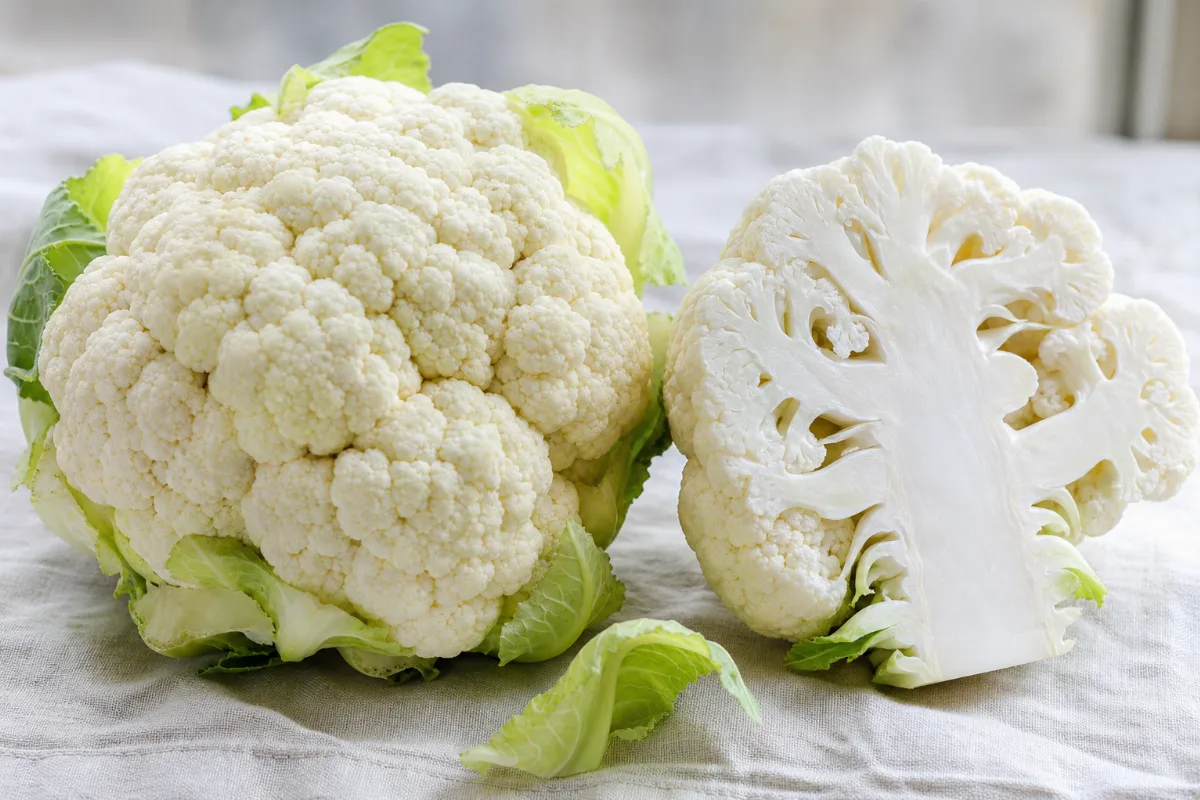
Cauliflower (Brassica oleracea var. botrytis) is a vegetable in the cabbage family (Brassicaceae). The part we eat is the dense flower head, called the curd, which is usually white but can also be green, yellow or purple. People eat it for its vitamins and fiber, as a low-calorie side dish and as a stand-in for rice or flour. This page keeps the food apart from supplements and from hype, and says what research does and does not show. It is information, not a plan for what to eat.
Read this first
- If you take warfarin (a blood thinner), MedlinePlus lists cauliflower among foods high in vitamin K and says sudden changes in vitamin K intake can change how the medicine works. The advice is to eat about the same amount every day and ask your provider. [2]
- Gas and bloating: the NHS lists cauliflower among hard-to-digest foods that can cause wind and bloating in some people. [4] Allergic reactions to any food are possible. For trouble breathing or swelling of the face or throat, call 911.
- Thyroid: reviews of the research found no harm to thyroid function from eating brassica vegetables, especially when iodine intake is adequate. Ask your clinician if you have a thyroid condition. [6][7]
- Evidence in one line: cauliflower is a good source of vitamin C and a useful source of vitamin K, folate and choline. Studies of people who eat more vegetables overall show better health, but we found no good evidence that cauliflower itself prevents or treats a disease.
What is in it (USDA values)
| Nutrient | Per 100 g, raw | Per typical serving: 1 cup chopped, raw (107 g) | % Daily Value per serving |
|---|---|---|---|
| Energy | 25 kcal | 27 kcal | n/a |
| Carbohydrate | 4.97 g | 5.3 g | 2% |
| Fiber | 2.0 g | 2.1 g | 8% |
| Total sugars | 1.91 g | 2.0 g | n/a |
| Vitamin C | 48.2 mg | 51.6 mg | 57% |
| Folate (DFE) | 57 mcg | 61 mcg | 15% |
| Vitamin K | 15.5 mcg | 16.6 mcg | 14% |
| Vitamin B6 | 0.18 mg | 0.19 mg | 11% |
| Choline | 44.3 mg | 47.4 mg | 9% |
| Potassium | 299 mg | 320 mg | 7% |
| Manganese | 0.15 mg | 0.16 mg | 7% |
| Vitamin A (RAE) | 0 mcg | 0 mcg | 0% |
Source: USDA FoodData Central, "Cauliflower, raw" (SR Legacy, FDC 169986). [1] % Daily Value uses the FDA 2016 Daily Values; values vary with variety, ripeness and storage. Per-serving numbers are our arithmetic from the USDA per-100 g values.
Cauliflower contains glucosinolates, sulfur-containing compounds found in cruciferous vegetables. A Linus Pauling Institute review lists 22 mg of total glucosinolates in half a cup (50 g) of chopped raw cauliflower, and notes that cauliflower gave the lowest isothiocyanate yield (1.5 micromoles per 100 g) among nine vegetables tested. [9] When glucosinolates break down they form isothiocyanates such as sulforaphane. Most of the protective findings for these compounds come from cell and animal studies; the same review calls clinical evidence of protection in people "scarce." [9] Colored varieties differ: one 2026 comparison found green curds had more sulforaphane and yellow or gold curds more flavonoids and phenolic acids. [16] USDA lists no carotenoids in white cauliflower, apart from a trace of lutein plus zeaxanthin (1 mcg per 100 g). [1]
What research says
| Health goal | What the sources found | Strength of evidence | What was studied |
|---|---|---|---|
| Supplying vitamin C, folate, vitamin K and choline | USDA measured these nutrients in raw cauliflower (see table). [1] Mean US choline intakes are below the adequate intake for most people, and cruciferous vegetables are named among rich choline sources. [11] | Established (nutrient content only; we did not read a trial of cauliflower for deficiency) | Laboratory measurement of the food; national survey data for choline |
| Heart disease, cancer and early death (overall vegetable pattern) | A meta-analysis of 95 prospective studies linked higher fruit and vegetable intake to lower risk of heart disease, cancer and death from any cause. For total cancer the effect was small (relative risk 0.97 per 200 g a day). The authors say the numbers imply fewer deaths only if the associations are causal. [8] | Promising but limited (observational, all fruit and vegetables, not cauliflower alone) | Cohort studies of whole fruit and vegetables |
| Cancer prevention by cauliflower specifically | Proper evidence not found in the sources we read (we searched Europe PMC for cauliflower intake and health outcomes). | Insufficient evidence | N/A |
| Glucosinolates and sulforaphane protecting cells | Findings are mainly from cells and animals; human studies are limited and mixed. [9] | Lab or animal only | Cell, animal and a few human studies, mostly of broccoli and isolated sulforaphane |
| Thyroid function | A 2024 review of 123 studies (cells, animals and people) found most results did not support an antithyroid effect of brassica vegetables in humans. [6] Another review found commercial broccoli, kale and similar vegetables low in goitrin. [7] | Mixed (some lab findings, reassuring human data) | Cells, animals, people; mostly not cauliflower alone |
| Low-carb swap (cauliflower for rice or flour) and weight or blood sugar | USDA lists 5 g of carbohydrate and 25 kcal per 100 g raw. [1] We found no trial testing cauliflower rice or cauliflower-based foods for weight or blood sugar. | Insufficient evidence | N/A |
| FODMAPs, gas and bloating | The NHS lists cauliflower among foods that can cause wind and bloating. [3][4] A network meta-analysis found a low-FODMAP diet ranked first for symptoms in irritable bowel syndrome (IBS) trials, but it does not name cauliflower. [5] | Insufficient evidence (cauliflower-specific) | Adults with IBS (diet as a whole) |
Eaten as food vs taken as a supplement or extract. Everything in the table is about the whole vegetable except the glucosinolate rows, where laboratory work often uses purified sulforaphane or broccoli extracts. Those results do not carry over to cauliflower on a plate, and cauliflower supplements are a different product that we do not cover. Eating cauliflower is not a substitute for medicine.
How much is a normal serving
- USDA household portion: 1 cup chopped raw (107 g); one floweret is 13 g. [1]
- NHS: 80 g of fresh, canned or frozen vegetables counts as one of the "5 A DAY" portions (last reviewed 9 June 2026). [15] A cup of chopped cauliflower is a little more than one portion by that measure.
- WHO: at least 400 g of fruits and vegetables a day for people over 10 (fact sheet dated 26 January 2026). [14]
- These are public-health figures for information, not a prescription.
- Cooking: a 2026 study found cauliflower had the lowest sulforaphane of four brassicas tested, that cooking and freezing lowered it, that pan-frying lost the most, and that boiling moved much of it into the cooking water. [10] Cooking inactivates the plant enzyme (myrosinase) that makes isothiocyanates, though light steaming under about five minutes keeps some; gut bacteria can still produce some after cooking. [9] We did not find a source on vitamin C loss in cauliflower, so no claim is made. See fresh, frozen and canned produce.
Safety, allergy and medicines
- Warfarin and vitamin K: MedlinePlus names cauliflower among high-vitamin-K foods and says to keep intake steady rather than swing up or down; ask your provider whether to monitor it. [2] One cup raw gives about 14% of the Daily Value for vitamin K. [1]
- Gas, bloating and IBS: the NHS suggests avoiding cabbage-family foods such as cauliflower if you have wind, bloating or cramps. [4] See the NHS list of when to see a doctor: bloating that is frequent, lasts after changing diet, or comes with weight loss, blood in stool, vomiting or fever needs medical advice. [3] We did not find a source we could read that gives the FODMAP content of cauliflower, so we do not state one. Anyone trying a low-FODMAP diet should do it with a dietitian.
- Thyroid and goitrogens: cruciferous vegetables contain goitrin and thiocyanate precursors that, in lab settings, can interfere with thyroid iodine uptake. One review of goitrin content found it minimal in common commercial brassicas and concluded thiocyanate from them is low risk. [7] The 2024 systematic review concluded daily brassica intake, especially with adequate iodine, poses no adverse effects on thyroid function. [6] This is reassurance for normal food amounts, not advice for people with thyroid disease or those taking thyroid medicine; ask your clinician. See thyroid conditions and iodine.
- Kidney disease and potassium: cauliflower has 299 mg potassium per 100 g (6% Daily Value). [1] We did not read a source that sets limits for cauliflower in kidney disease, so we make no claim; people on potassium restriction should follow their care team's plan.
- Allergy: we did not find a source we could read on cauliflower allergy. Food allergy can happen with any food; see food allergy basics and emergency signs.
- Pregnancy: the Linus Pauling Institute says the need for choline is probably higher in pregnancy and fewer than 9% of pregnant women in US survey data meet the adequate intake. [11] That is information about choline in the diet. We found no source that singles out cauliflower for or against in pregnancy.
- Pesticide residues and iodine fortification: we did not read a source on cauliflower residues, so we make no claim. A 2026 laboratory study explored cauliflower as a carrier for iodine fortification (it tracked iodine stability and goitrogenic compounds after steaming or boiling); this is food-technology work, not a health trial. [12]
Choosing, storing and food safety
- Avoid bruised or damaged produce. Keep cut or pre-cut cauliflower in the refrigerator at 40°F (4°C) or below. [13]
- Rinse under running water. The FDA says soap, detergent or commercial produce wash is not recommended, and that washing reduces bacteria but does not remove them all. [13]
- Use separate cutting boards for produce and raw meat, poultry and seafood. [13]
- Frozen and canned vegetables count as portions too; see fresh, frozen and canned produce.
Related pages
Health connections for Cauliflower
What research links to eating or drinking this food, and how strong the evidence is. Many studies are observational or use juice, powder, oil or extracts rather than the food as eaten; each card says which.
Vitamin C, folate and vitamin K as a food source
Established roleRaw cauliflower is a good source of vitamin C (about 57% of the Daily Value in one cup) and a useful source of folate, vitamin K and vitamin B6.
Supplements: Eating the food supplies the nutrients; this says nothing about supplements.
Choline from food
Established roleOne cup of raw cauliflower provides about 9% of the Daily Value for choline. Cruciferous vegetables are named among rich food sources, and most US adults do not reach the adequate intake.
Supplements: Food contribution only; cauliflower is not shown to correct low choline on its own.
Fruit and vegetable pattern and long-term health
Preliminary or mixedLarge studies link higher overall fruit and vegetable intake to lower risk of heart disease, cancer and early death. These are observational and not specific to cauliflower.
Supplements: Whole-food pattern evidence only; not a supplement result.
Fiber and low-calorie, low-carbohydrate food
Not enough evidenceRaw cauliflower has 2 g of fiber, 5 g of carbohydrate and 25 kcal per 100 g. No trial was found on cauliflower rice or flour swaps for weight or blood sugar.
Supplements: Proper evidence not found.
Glucosinolates and sulforaphane
Lab or animal research onlyCauliflower contains glucosinolates but gave the lowest isothiocyanate yield among nine vegetables in one review. Protective findings are mostly from cells and animals; human evidence is scarce.
Supplements: Results with purified sulforaphane or broccoli extracts do not apply to cauliflower on the plate.
Cooking, freezing and sulforaphane
Lab or animal research onlyCooking and freezing lowered sulforaphane in cauliflower in a 2026 study; boiling moved much into the water. Light steaming keeps some of the enzyme that forms isothiocyanates.
Supplements: Not applicable.
Goitrogens and the thyroid
Preliminary or mixedCruciferous vegetables contain goitrin and thiocyanate precursors, but reviews found minimal risk in common commercial brassicas and no adverse thyroid effect at daily intake with adequate iodine. People with thyroid disease should ask a clinician.
Supplements: Not applicable.
Potassium and kidney disease: not assessed
Not enough evidenceCauliflower has 299 mg potassium per 100 g (6% Daily Value). We read no source setting limits for cauliflower in kidney disease.
Supplements: Unknown.
Connected topics
Open a group to see how each topic connects and how strong the evidence is.
Health goals (1)
- Preventive WellnessPreliminary or mixed
Eating more vegetables overall is linked to lower risk of heart disease, cancer and early death in observational studies; not specific to cauliflower, and association is not proof.
Body systems (2)
- Digestive SystemDocumented risk
The NHS lists cauliflower among foods that can cause wind and bloating in some people; it also supplies about 2 g of fiber per 100 g.
- Endocrine SystemPreliminary or mixed
Goitrogen question: reviews found no adverse thyroid effect from eating brassica vegetables, especially with adequate iodine.
Body parts (2)
- GutDocumented risk
Cabbage-family foods such as cauliflower can cause gas and bloating in some people, per the NHS.
- ThyroidPreliminary or mixed
Cauliflower contains goitrogen precursors; a 2024 review found no adverse effect on thyroid function from daily intake with adequate iodine. Ask a clinician if you have thyroid disease.
Root causes (1)
- Medication Side EffectsDocumented risk
High in vitamin K: people taking warfarin should keep intake steady and ask their provider.
Habits (1)
- Balanced NutritionPreliminary or mixed
Counts toward official vegetable targets (WHO 400 g of fruit and vegetables a day; NHS 80 g per portion). Information, not a prescription.
Conditions & symptoms (2)
- FlatulenceDocumented risk
The NHS lists cauliflower among foods that can cause wind and bloating in some people.
- HypothyroidismPreliminary or mixed
A 2024 review found no adverse effect of brassica vegetables on thyroid function in humans; ask a clinician if you have thyroid disease or take thyroid medicine.
Documented risks and interactions (3)
- Vitamin K and warfarin. Cauliflower is listed as a high vitamin K food. People on warfarin are advised to keep intake steady and ask their provider before big changes.
- Gas and bloating. The NHS lists cauliflower among hard-to-digest foods that can cause wind and bloating. We found no source giving its FODMAP content.
- Washing and storing safely. The FDA advises rinsing produce under running water without soap, keeping cut produce at 40 F or below, and using separate cutting boards from raw meat.
Frequently asked questions
Can I eat cauliflower if I take warfarin?
Many people do. MedlinePlus lists cauliflower as a food high in vitamin K and advises eating about the same amount each day, because sudden changes can alter the medicine's effect. Ask your provider or anticoagulation clinic. [2]
Is cauliflower bad for the thyroid?
A 2024 systematic review of 123 studies found most results did not support an antithyroid effect of brassica vegetables in people, and that daily intake with adequate iodine poses no adverse effects on thyroid function. If you have a thyroid condition, ask your clinician. [6]
Why does cauliflower make me gassy?
The NHS lists cauliflower among cabbage-family foods that can cause wind and bloating in some people. We did not find a source giving its FODMAP content. If bloating is frequent or comes with weight loss, blood in stool or vomiting, see a doctor. [3][4]
Is cauliflower rice better than rice for weight or blood sugar?
USDA lists about 5 g of carbohydrate and 25 kcal per 100 g raw cauliflower. [1] We found no trial testing cauliflower rice for weight or blood sugar, so we cannot say it works better. Proper evidence not found.
Does cooking destroy the good compounds?
A 2026 study found cooking and freezing lowered sulforaphane in cauliflower, with pan-frying losing the most and boiling moving much of it into the water. [10] Light steaming keeps some of the enzyme that forms these compounds. [9] Whether this matters for health in people is not shown.
References
- U.S. Department of Agriculture. Cauliflower, raw (SR Legacy), FoodData Central item 169986. SR Legacy, April 2018 release. Read 2026-10-23.
- MedlinePlus (U.S. National Library of Medicine). Vitamin K in diet. Review date 21 January 2025. Read 2026-10-23.
- NHS (England). Bloating. Page last reviewed 21 January 2026. Read 2026-10-23.
- NHS (England). Diet, lifestyle and medicines for IBS. Page last reviewed 17 March 2025. Read 2026-10-23.
- Black CJ, Staudacher HM, Ford AC. Efficacy of a low FODMAP diet in irritable bowel syndrome: systematic review and network meta-analysis. Gut 2022. PMID 34376515. Abstract read 2026-10-23.
- Galanty A et al. Do Brassica vegetables affect thyroid function? A comprehensive systematic review. Int J Mol Sci 2024. PMID 38612798. Abstract read 2026-10-23.
- Felker P, Bunch R, Leung AM. Concentrations of thiocyanate and goitrin in human plasma, their precursor concentrations in brassica vegetables, and associated potential risk for hypothyroidism. Nutr Rev 2016. PMID 26946249. Abstract read 2026-10-23.
- Aune D et al. Fruit and vegetable intake and the risk of cardiovascular disease, total cancer and all-cause mortality: a systematic review and dose-response meta-analysis of prospective studies. Int J Epidemiol 2017. PMID 28338764. Abstract read 2026-10-23.
- Linus Pauling Institute, Oregon State University. Isothiocyanates. Reviewed April 2017. Read 2026-10-23.
- Sungur S, Tek F, Koroglu M. Impact of thermal processing and freezing on sulforaphane levels in selected brassica vegetables. Eur Food Res Technol 2026. Abstract read 2026-10-23.
- Linus Pauling Institute, Oregon State University. Choline. Reviewed July 2023. Read 2026-10-23.
- Jankowska A et al. Influence of heat treatment prior to fortification on goitrogenic compounds, iodine stability and antioxidant activity in cauliflower. Foods 2026. PMID 41596913. Abstract read 2026-10-23.
- U.S. Food and Drug Administration. Selecting and Serving Produce Safely. Content current as of 5 March 2024. Read 2026-10-23.
- World Health Organization. Healthy diet fact sheet. Dated 26 January 2026. Read 2026-10-23.
- NHS (England). 5 A DAY: what counts. Last reviewed 9 June 2026. Read 2026-10-23.
- Wang D et al. Color-associated metabolic divergence and nutritional variation in colored cauliflower curds. Food Chem X 2026. PMID 42519758. Abstract read 2026-10-23.