Cabbage: Nutrients, What Research Shows and Safety
Cabbage, green and red: USDA nutrients, what research says about glucosinolates, red cabbage pigments and cabbage leaf wraps, plus vitamin K, thyroid and gas questions.
Content last updated . This page has not been medically reviewed.
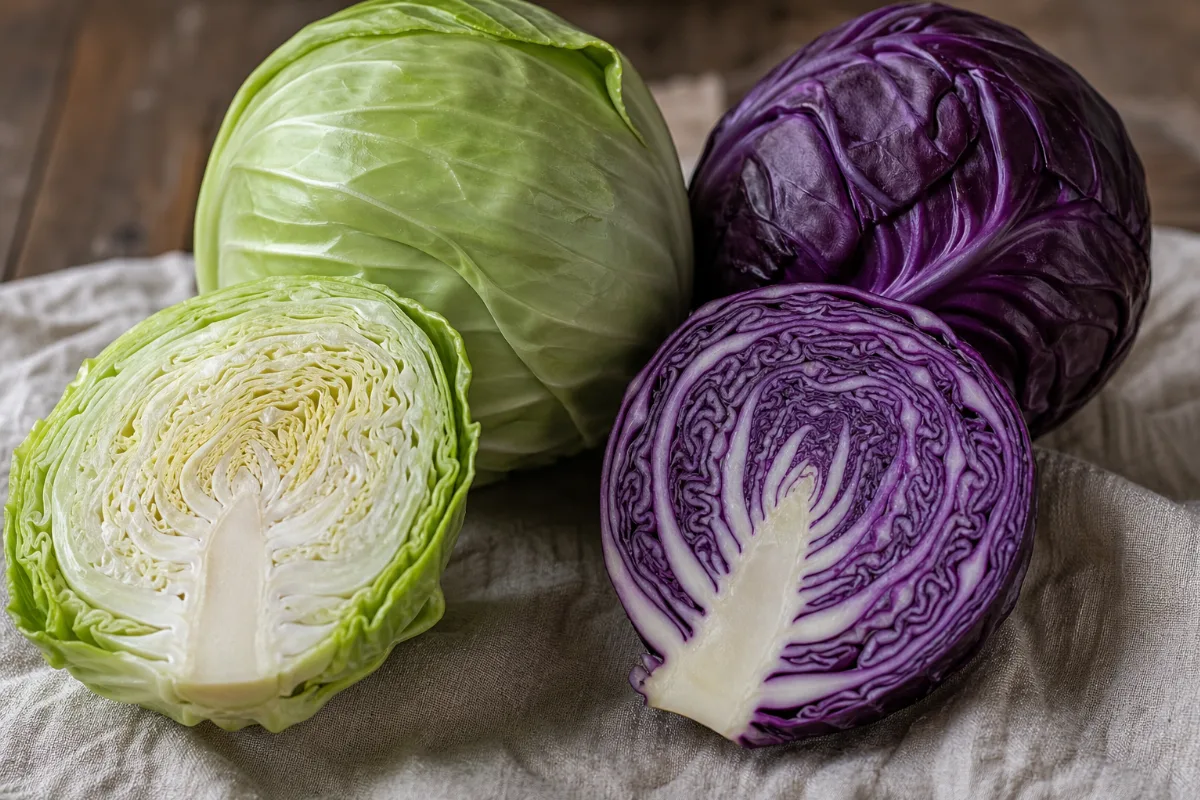
Cabbage (Brassica oleracea var. capitata) belongs to the mustard or cabbage family (Brassicaceae). The leaves of the tight head are eaten, raw or cooked, and green, white and red types are common. People eat it for vitamin C, vitamin K and fiber, and for plant compounds called glucosinolates. This page keeps the food apart from supplements and from hype, and says what the research does and does not show. Fermented cabbage has its own pages: sauerkraut and kimchi.
Read this first
- Warfarin: cabbage is a vitamin K food. MedlinePlus lists it among vegetables with vitamin K and says sudden changes in vitamin K intake can change how warfarin works, so intake should stay fairly steady. [4] The NHS says you do not have to avoid such vegetables but should ask your warfarin clinic for advice. [5] This is information, not a prescription.
- Thyroid: a 2024 systematic review of 123 studies found eating brassica vegetables, especially with enough iodine, showed no adverse effect on thyroid function. [6] If you have a thyroid condition, ask your clinician.
- Allergy: food allergy is possible with any food. For trouble breathing or swelling of the face or throat, call 911.
- Evidence in one line: cabbage is a good everyday source of vitamin C and vitamin K. We found no trial showing that eating cabbage prevents or treats a disease, and cabbage leaf wraps have mixed, limited support.
What is in it (USDA values)
| Nutrient | Green, raw, per 100 g [1] | Red, raw, per 100 g [2] | Green, per serving (1 cup chopped, 89 g) | % Daily Value, green serving |
|---|---|---|---|---|
| Energy | 25 kcal | 31 kcal | 22 kcal | n/a |
| Fiber | 2.5 g | 2.1 g | 2.2 g | 8% |
| Total sugars | 3.2 g | 3.83 g | 2.8 g | n/a |
| Vitamin C | 36.6 mg | 57.0 mg | 32.6 mg | 36% |
| Vitamin K | 76.0 µg | 38.2 µg | 67.6 µg | 56% |
| Folate (DFE) | 43 µg | 18 µg | 38 µg | 10% |
| Potassium | 170 mg | 243 mg | 151 mg | 3% |
| Vitamin B6 | 0.12 mg | 0.21 mg | 0.11 mg | 6% |
| Manganese | 0.16 mg | 0.24 mg | 0.14 mg | 6% |
| Vitamin A (RAE) | 5 µg | 56 µg | 4.5 µg | 0% |
| Beta-carotene | 42 µg | 670 µg | 37 µg | n/a |
| Lutein + zeaxanthin | 30 µg | 329 µg | 27 µg | n/a |
The USDA lists 1 cup chopped as 89 g for both green and red cabbage; for red cabbage that serving gives about 51 mg vitamin C (56% DV), 34 µg vitamin K (28% DV) and 49.8 µg vitamin A (6% DV). [2] % Daily Value uses the FDA 2016 Daily Values; values vary with variety, ripeness and storage. Source: USDA FoodData Central, SR Legacy items 169975 and 169977. [1][2]
Main plant compounds:
- Glucosinolates are sulfur-containing compounds typical of the cabbage family. A 2026 lab analysis of white cabbage lines found total glucosinolates of 19.7 to 67.8 µmol per gram dry weight, about 73% of them the aliphatic type. [8] Amounts differ by variety. A 2026 review argues that glucosinolate content alone is a poor guide to health value, because what the body gets depends on conversion to isothiocyanates, which varies with processing and gut factors. [17] This is plant-chemistry and review evidence, not a proven health effect.
- Anthocyanins give red cabbage its purple color. The red cabbage work we read in 2026 was a lab study of extracts, which found the pigments can be stabilized for use in foods; it did not test health effects in people. [9] Proper evidence not found for red cabbage anthocyanins improving health outcomes in people in the sources we read.
What research says
| Health goal | What the sources found | Strength of evidence | What was studied |
|---|---|---|---|
| Vitamin C intake and scurvy | MedlinePlus lists cabbage among vegetables high in vitamin C; too little vitamin C causes scurvy, the severe form. [3] | Established (deficiency and essential role) | Nutrient role; cabbage as a food source |
| Glucosinolates and cancer risk | A 2026 review describes inverse associations between cruciferous vegetable intake and cancer risk, with variable results; much of the mechanism work is lab-based. [10] We did not find a cabbage-specific trial. | Promising but limited (observational; association is not proof) | Mixed cruciferous vegetables; cohort and lab studies |
| Red cabbage anthocyanins | Lab work on extracts only. [9] | Lab or animal only | Extracts in lab tests |
| Cabbage leaves for breast engorgement | LactMed reports one meta-analysis found no good evidence cabbage leaves worked better than no treatment, and another review found cold leaves may reduce breast pain but not engorgement. [11] | Mixed | Leaves applied to the breast; trial numbers not given in the entry we read |
| Cabbage leaves for knee osteoarthritis pain | A randomized open-label trial in people with grade 3 to 4 knee osteoarthritis compared cabbage leaf, a cooling gel pad and diclofenac gel for 4 weeks. Cabbage leaf and the cooling pad improved similarly, and both did better than the gel. [12] A 2025 narrative review of topical pain products rated cabbage leaf wraps level B for some short-term musculoskeletal pain. [13] | Promising but limited (one small, unblinded trial; the cooling pad did as well, so cold may explain it) | Leaf wraps on the knee |
| Gas and bloating | A UK survey of 516 adults found 23% believed Brussels sprouts cause flatulence; this reflects belief, not measurement. [14] | Insufficient evidence for cabbage specifically | Survey |
| Thyroid function | A 2024 systematic review concluded eating brassica vegetables with adequate iodine poses no adverse thyroid effects. [6] | Established as not harmful in normal diets, per that review | 123 lab, animal and human studies |
Eaten as food vs taken as a supplement or extract. Nearly all the human data above concern cabbage or related vegetables as food, or leaves used on the skin. Concentrated glucosinolate or sulforaphane products are separate products with their own questions; see sulforaphane and glucosinolates. Results from extracts and lab studies do not transfer to a plate of cabbage.
How much is a normal serving
- The USDA household portion for raw cabbage is 1 cup chopped (89 g) or 1 cup shredded (70 g). [1] This is information, not a prescription.
- The WHO healthy-diet fact sheet (26 January 2026) advises at least 400 g of fruits and vegetables a day for people older than 10. [16] The NHS says 80 g of fresh, canned or frozen vegetables counts as one portion of its 5 A DAY (reviewed 9 June 2026). [16]
- Cooking: a 2026 review says processing such as cooking changes glucosinolate breakdown and isothiocyanate formation, but we did not find a source that says which way is better for health. [10][17] See fresh, frozen and canned produce.
Safety, allergy and medicines
- Warfarin and other blood thinners: cabbage contains vitamin K. MedlinePlus lists cabbage among foods with vitamin K and says to keep intake fairly steady, because sudden changes can change warfarin's effect. [4] The NHS says you do not need to avoid vitamin K vegetables but should ask your warfarin clinic. [5] See foods and medicine interactions.
- Thyroid (goitrogens): some glucosinolate breakdown products (goitrin, thiocyanate) can reduce thyroid iodine uptake in theory. A review found collards, Brussels sprouts and some kale have enough goitrin to matter in theory, and judged the risk from thiocyanate minimal. [7] It did not single out cabbage. The 2024 systematic review found no adverse thyroid effect from eating brassica vegetables, especially with adequate iodine. [6] People with thyroid disease or iodine deficiency should ask a clinician; see thyroid conditions and iodine.
- Gas: we found no study that measured gas from cabbage itself. [14] Fiber foods can cause gas in some people; see how much fiber and side effects.
- Breastfeeding: LactMed says evidence that mothers eating cabbage causes colic in infants is of low quality. [11]
- Leaf wraps: we found no safety data for cabbage leaves on skin in the sources we read. Broken, infected or very sore breasts need a clinician; see mastitis advice from your provider.
- Allergy: true allergy to cabbage is possible but we did not find a source quantifying it. Seek urgent care for trouble breathing or swelling of the face or throat.
Choosing, storing and food safety
- Wash produce under running water and dry it; the FDA says soap, detergent or commercial produce wash is not recommended, and washing reduces but does not eliminate bacteria. [15]
- Cut away damaged or bruised areas, and refrigerate pre-cut or packaged produce at 40°F or below. [15]
Related pages
Health connections for Cabbage
What research links to eating or drinking this food, and how strong the evidence is. Many studies are observational or use juice, powder, oil or extracts rather than the food as eaten; each card says which.
Vitamin C intake and scurvy prevention
Deficiency linkCabbage is a good vegetable source of vitamin C. Too little vitamin C causes scurvy.
Supplements: As food it contributes to normal intake; no evidence of extra benefit beyond preventing deficiency.
Vitamin K and blood clotting
Established roleCabbage supplies vitamin K, which the body needs for normal blood clotting.
Supplements: Eating the food covers normal needs; this is not a treatment.
Glucosinolates and cancer risk (observational)
Preliminary or mixedCabbage-family vegetables contain glucosinolates. Studies of people who eat more of them link this to lower cancer risk in some analyses, but results vary and association is not proof.
Supplements: Eating the food is the studied form; concentrated products are separate and were not assessed here.
Glucosinolates in cabbage varieties
Lab or animal research onlyWhite cabbage lines differ widely in glucosinolate content, mostly aliphatic types. What the body gets depends on conversion to isothiocyanates.
Supplements: Content in the plant is not proof of a health effect.
Red cabbage anthocyanins
Lab or animal research onlyAnthocyanins give red cabbage its purple color. The work we read was a lab study of extracts, not a test in people.
Supplements: No human health outcome evidence found in the sources read.
Cabbage leaves for breast engorgement
Preliminary or mixedCold or room-temperature leaves are applied to the breast. LactMed reports one meta-analysis found no good evidence they beat no treatment; another found cold leaves may reduce pain but not engorgement.
Supplements: Mixed; trial numbers were not given in the entry read. Painful, red or feverish breasts need a clinician.
Cabbage leaf wraps for knee osteoarthritis pain
Preliminary or mixedOne randomized open-label trial found leaf wraps and a cooling gel pad improved knee symptoms similarly, both better than diclofenac gel over 4 weeks.
Supplements: Limited; one small trial.
Gas and bloating
Not enough evidenceMany people believe cabbage-family vegetables cause gas. We found no study measuring this for cabbage.
Supplements: Not applicable.
Connected topics
Open a group to see how each topic connects and how strong the evidence is.
Health goals (1)
- Joint SupportPreliminary or mixed
Leaf wraps showed symptom relief in one small knee osteoarthritis trial; limited evidence.
Body systems (3)
- Bones, Joints & MusclesPreliminary or mixed
Studied as a topical leaf wrap for knee osteoarthritis pain in one small trial; not an eaten food effect.
- Digestive SystemPreliminary or mixed
Cabbage is a fiber-containing food; many people believe it causes gas, but we found no study measuring this.
- Endocrine SystemDocumented risk
Goitrogens in cabbage-family vegetables are a theoretical thyroid question; a 2024 systematic review found no adverse effect from eating them, especially with adequate iodine.
Body parts (2)
- JointsPreliminary or mixed
One small randomized trial found cabbage leaf wraps eased knee osteoarthritis pain about as much as a cooling pad.
- ThyroidDocumented risk
Glucosinolate breakdown products can reduce thyroid iodine uptake in theory; the evidence in people does not show harm with adequate iodine.
Functional actions (1)
- Pain ReliefPreliminary or mixed
Cabbage leaf wraps relieved knee osteoarthritis pain in one small trial and cold leaves may ease breast pain per LactMed; evidence is limited.
Root causes (2)
- Medication Side EffectsDocumented risk
Cabbage contains vitamin K, which can affect how warfarin works if intake changes suddenly; keep intake steady and ask your clinic.
- Nutrient DeficiencyDeficiency link
Cabbage is a source of vitamin C, whose deficiency causes scurvy; as food it helps meet normal needs but is not a treatment.
Conditions & symptoms (3)
- ScurvyDeficiency link
Scurvy is the severe form of vitamin C deficiency; cabbage is one vitamin C food source.
- HypothyroidismDocumented risk
Goitrogens are a theoretical concern; a 2024 review found no adverse thyroid effect from eating brassica vegetables with adequate iodine.
- Osteoarthritis, KneePreliminary or mixed
One small randomized open-label trial found cabbage leaf wraps similar to a cooling pad and better than diclofenac gel for symptoms over 4 weeks.
Documented risks and interactions (2)
- Vitamin K and warfarin. People on warfarin should keep vitamin K intake fairly steady because sudden changes can change the medicine's effect. Cabbage is a vitamin K food.
- Goitrogens and the thyroid. Cabbage-family vegetables contain compounds that can reduce thyroid iodine uptake in theory. A 2024 review found no adverse thyroid effect from eating them, especially with adequate iodine.
Frequently asked questions
Is red cabbage healthier than green cabbage?
They differ. Per 100 g, USDA lists red cabbage higher in vitamin C (57.0 vs 36.6 mg) and vitamin A, and green higher in vitamin K (76 vs 38.2 µg). [1][2] We found no trial comparing their health effects.
Can I eat cabbage if I take warfarin?
Cabbage contains vitamin K. MedlinePlus advises keeping vitamin K intake fairly steady, and the NHS says to ask your warfarin clinic for advice. [4][5]
Does cabbage harm the thyroid?
A 2024 systematic review found no adverse thyroid effect from eating brassica vegetables, especially with adequate iodine. [6] Ask your clinician if you have a thyroid condition.
Do cabbage leaves help engorged breasts or sore knees?
For engorgement, LactMed reports no good evidence they beat no treatment, though cold leaves may ease pain. [11] For knee osteoarthritis, one small trial found leaf wraps similar to a cooling pad. [12]
Does cabbage cause gas?
Many people believe so, but we found no study measuring it for cabbage. [14]
References
- U.S. Department of Agriculture. FoodData Central: Cabbage, raw (SR Legacy 169975). April 2018 release. Read 2026-10-23.
- U.S. Department of Agriculture. FoodData Central: Cabbage, red, raw (SR Legacy 169977). April 2018 release. Read 2026-10-23.
- MedlinePlus. Vitamin C. Review date 1/21/2025. Read 2026-10-23.
- MedlinePlus. Vitamin K. Review date 1/21/2025. Read 2026-10-23.
- NHS. Warfarin. Last reviewed 24 February 2026. Read 2026-10-23.
- Galanty A et al. Do Brassica vegetables affect thyroid function? A comprehensive systematic review. Int J Mol Sci 2024. PMID 38612798. Abstract read 2026-10-23.
- Felker P et al. Concentrations of thiocyanate and goitrin in human plasma, their precursor concentrations in brassica vegetables, and associated potential risk for hypothyroidism. Nutr Rev 2016. PMID 26946249. Abstract read 2026-10-23.
- Fabjan P et al. Glucosinolate variation, heterosis, and prediction of hybrid performance from parental values in white cabbage. Front Plant Sci 2026. PMID 41799973. Abstract read 2026-10-23.
- Kaur S et al. Red cabbage anthocyanin-rich natural colorant: optimization of ultrasound-assisted extraction, microencapsulation, bioaccessibility, and functional yogurt development. Ultrason Sonochem 2026. PMID 41351955. Abstract read 2026-10-23.
- Labudda M et al. The chemopreventive and anticancer potential of glucosinolates and their hydrolysis products from cruciferous vegetables. Nutrients 2026. PMID 41829922. Abstract read 2026-10-23.
- National Institute of Child Health and Human Development. Cabbage. Drugs and Lactation Database (LactMed). PMID 30000833. Record read 2026-10-23.
- Chobpenthai T et al. Efficacy of cabbage leaf versus cooling gel pad or diclofenac gel for patients with knee osteoarthritis: a randomized open-labeled controlled clinical trial. Pain Res Manag 2022. PMID 35719197. Abstract read 2026-10-23.
- Smith AC et al. Making sense of topical pain relief options: comparing topical analgesics in efficacy and safety. Sports Health 2025. PMID 39460722. Abstract read 2026-10-23.
- Thomson CL et al. Prevalence of gastrointestinal symptoms in the UK adult population and perceived effects of foods. Eur J Nutr 2025. PMID 40848137. Abstract read 2026-10-23.
- U.S. Food and Drug Administration. Selecting and Serving Produce Safely. Current as of 5 March 2024. Read 2026-10-23.
- World Health Organization, Healthy diet fact sheet (26 January 2026); NHS, 5 A DAY: what counts (reviewed 9 June 2026). Figures confirmed by the site team 2026-10-23.
- Wondołowska-Grabowska A et al. From glucosinolate content to isothiocyanate yield: rethinking Brassica functionality. Nutrients 2026. PMID 42654204. Abstract read 2026-10-23.