Bell Peppers: Nutrients, What Research Shows and Safety
Bell peppers as food: USDA nutrients in red and green, vitamin C and carotenoids, nightshade-avoidance claims checked, and notes on allergy and latex links.
Content last updated . This page has not been medically reviewed.
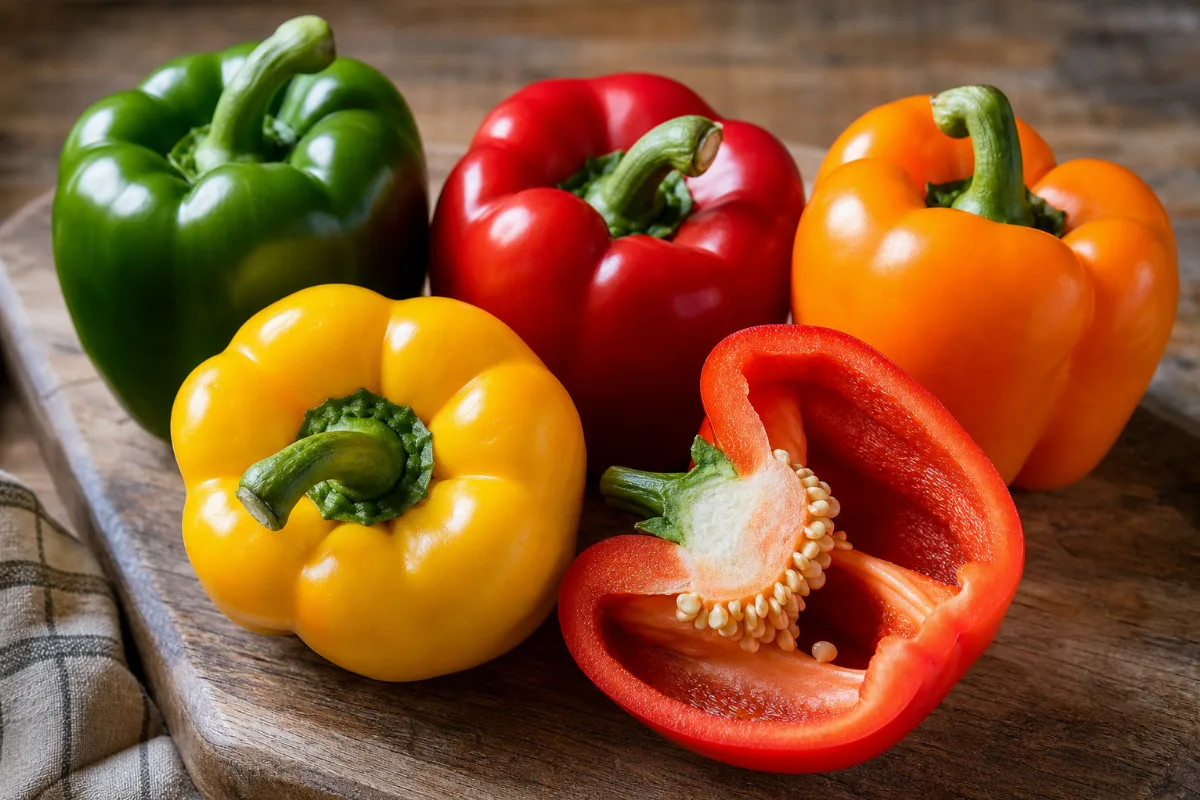
Bell peppers (Capsicum annuum) are the mild, thick-walled fruits of a plant in the nightshade family (Solanaceae). The whole fruit is eaten except the stem and seeds, raw or cooked, in green, yellow, orange and red colors. People eat them for vitamin C, fiber and colorful plant pigments called carotenoids. This page covers bell peppers as a food and keeps them apart from supplements and from hype. Hot chili peppers are a different product; see chili peppers.
Read this first
- Allergy: pepper allergy is described as rare, but it is documented, and people with latex allergy or pollen-related food allergies may react to peppers. For trouble breathing or swelling of the face or throat, call 911. See food allergy basics and emergency signs. [1]
- Nightshade worries: Harvard Health says there is no scientific evidence that avoiding nightshade vegetables improves rheumatoid arthritis. [2] If a food seems to make you feel worse, that is worth discussing with a clinician.
- Vitamin C: a red bell pepper is among the higher food sources of vitamin C in the table used by the Linus Pauling Institute. Vitamin C prevents scurvy; eating peppers has not been shown to prevent colds. [3][4]
- Evidence in one line: studies of people who eat more vegetables in general link it with lower risk of heart disease and early death, but these are observational studies, and we found no trial of bell peppers on a disease outcome.
What is in it (USDA values)
USDA FoodData Central, SR Legacy items 170108 (sweet red pepper, raw) and 170427 (sweet green pepper, raw). [5][6] The serving is the USDA household portion of 1 cup chopped (149 g) for both. Where two numbers are given, the first is red and the second is green.
| Nutrient | Per 100 g (red / green) | Per 1 cup chopped, 149 g (red / green) | % Daily Value per serving (red / green) |
|---|---|---|---|
| Energy | 26 / 20 kcal | 39 / 30 kcal | not set |
| Fiber | 2.1 / 1.7 g | 3.1 / 2.5 g | 11% / 9% |
| Total sugars | 4.2 / 2.4 g | 6.3 / 3.6 g | not set |
| Vitamin C | 127.7 / 80.4 mg | 190 / 120 mg | 211% / 133% |
| Vitamin A (RAE) | 157 / 18 µg | 234 / 27 µg | 26% / 3% |
| Beta-carotene | 1,624 / 208 µg | 2,420 / 310 µg | not set |
| Lutein + zeaxanthin | 51 / 341 µg | 76 / 508 µg | not set |
| Folate (DFE) | 46 / 10 µg | 69 / 15 µg | 17% / 4% |
| Vitamin B6 | 0.29 / 0.22 mg | 0.43 / 0.33 mg | 25% / 19% |
| Vitamin E | 1.58 / 0.37 mg | 2.35 / 0.55 mg | 16% / 4% |
| Vitamin K | 4.9 / 7.4 µg | 7.3 / 11 µg | 6% / 9% |
| Potassium | 211 / 175 mg | 314 / 261 mg | 7% / 6% |
% Daily Value uses the FDA 2016 Daily Values; values vary with variety, ripeness and storage. Serving columns and percentages are our arithmetic from the USDA per-100 g values.
Ripeness and color. The two USDA items differ clearly. Red pepper has more vitamin C, vitamin A (from beta-carotene) and folate, while green has more lutein plus zeaxanthin. [5][6] A 2019 review says pepper carotenoids, mainly capsanthin and capsorubin together with beta-carotene, beta-cryptoxanthin, lutein and zeaxanthin, vary in profile and level with the stage of fruit maturity. [7] We did not read a source that compares yellow and orange peppers, so USDA numbers for them are not shown here.
Plant compounds. The same review describes carotenoids as fat-soluble antioxidants and says in vitro (lab), animal and clinical studies point to protective effects against degenerative diseases. [7] We read only the abstract, so we cannot tell how strong the human part is. Treat it as lab-level evidence for peppers specifically. USDA lists lycopene as 0 in both raw items. [5][6]
What research says
| Health goal | What the sources found | Strength of evidence | What was studied (form, who) |
|---|---|---|---|
| Preventing scurvy (severe vitamin C deficiency) | Scurvy is caused by too little vitamin C and is rare in developed countries; as little as 10 mg a day can prevent it. [3][4] | Established | Dietary vitamin C in general; peppers are one rich source |
| Preventing colds | A Cochrane review (29 trial comparisons, 11,306 people) found regular vitamin C supplements did not lower the chance of catching a cold in the general community (risk ratio 0.97, 0.94 to 1.00). It did in 598 marathon runners, skiers and soldiers (0.48). Colds were 8% shorter in adults and 14% shorter in children. [8] | Mixed (supplements, not peppers) | Vitamin C tablets, at least 0.2 g a day; no trial of peppers |
| Heart disease, cancer and early death | A meta-analysis of 95 prospective studies linked higher fruit and vegetable intake with lower risk of cardiovascular disease (relative risk 0.92 per 200 g a day), total cancer (0.97) and death from any cause (0.90). [9] | Promising but limited (association only) | Fruits and vegetables as a group; bell peppers were not singled out in the abstract |
| Eye health through lutein and zeaxanthin | USDA measures these carotenoids in peppers, but we did not read a trial of bell peppers and eye disease. [5][6] | Insufficient evidence | Not studied in the sources we read |
| "Antioxidant" benefits of pepper carotenoids | A 2019 review reports lab, animal and clinical findings and suggests peppers might fit health strategies; the abstract gives no trial details. [7] | Lab or animal mostly | Pigment extracts and cells; abstract only |
| Arthritis symptoms and avoiding nightshades | Harvard Health: no scientific evidence that avoiding nightshades improves rheumatoid arthritis. The Arthritis Foundation says there is little scientific evidence on either side. [2][10] | No good evidence of benefit from avoidance | Opinion and expert review; no trial found |
People who eat more vegetables also differ from others in income, exercise and smoking, so a link is not proof that vegetables, or peppers, are the cause.
Eaten as food vs taken as a supplement or extract. The Cochrane cold results used vitamin C tablets, not peppers, so they tell us nothing about eating peppers. [8] The NHS says taking more than 1,000 mg a day of vitamin C as supplements may cause stomach pain, diarrhea and gas, and that this stops when the supplements are stopped. [4] We did not read trials of pepper extracts or capsule products and make no claims about them.
How much is a normal serving
This is information, not a prescription. The USDA household portion is 1 cup chopped (149 g), 1 cup sliced (92 g) or 1 medium pepper (119 g). [5] The NHS counts 80 g of fresh, canned or frozen vegetables as one of its 5 A DAY portions (page last reviewed 9 June 2026), and the WHO fact sheet (26 January 2026) says everyone older than 10 should aim for at least 400 g of fruits and vegetables a day. [11][12] We did not read a source on how cooking, freezing or canning changes the vitamin C in peppers. The NHS vitamin C page does not describe cooking effects. [4]Safety, allergy and medicines
- Allergy: a 2022 paper says allergy to Capsicum (the pepper genus) is considered rare and lists nine reported pepper allergens, among them a profilin and a protein related to latex allergens. [1]
- Latex link: the same paper says bell pepper can cross-react with latex through some of these proteins. [1] If you have a latex allergy or reactions to other fruits, vegetables or pollens, tell an allergist; they can test for it. The paper does not study birch or mugwort cross-reactions directly, though it notes that nightshades are part of the celery-birch-mugwort-spice pattern. [1]
- Oral allergy symptoms: the sources we read do not describe the exact mouth symptoms from bell peppers or whether cooking removes them. The paper does not test cooking. [1] Proper evidence not found in the sources we read.
- Case detail: the paper's main case was one 16-year-old with several food and pollen allergies whose reactions to chili pepper included swelling and anaphylaxis, so reactions can be serious. [1]
- Nightshade-avoidance claims: the Arthritis Foundation says all nightshades contain solanine, but it found no research showing toxicity at typical food amounts; green potatoes are the exception it names, not peppers. Older mouse studies suggested gut harm, newer ones the opposite, and it notes mouse studies rarely carry over to people. [10] If you suspect a sensitivity, it describes an elimination and re-introduction approach; ask a clinician first.
- Medicines: a one-cup serving gives about 6% to 9% of the vitamin K Daily Value by our arithmetic from USDA, far less than leafy greens. [5][6] We did not find a source describing a medicine interaction with bell peppers as a food. See foods and medicine interactions.
- Pesticide residues: pepper lists such as the EWG "Dirty Dozen" exist, but we could not open the EWG or USDA Pesticide Data Program pages, so we do not report their numbers. Washing under running water is the FDA's advice for all produce. [13]
Choosing, storing and food safety
- Choose produce that is not bruised or damaged, and bag it separately from raw meat, poultry and seafood. [13]
- Wash peppers under running water before cutting; the FDA says not to use soap, detergent or commercial produce wash, and to dry with a clean cloth or paper towel. [13]
- Keep cut or pre-cut peppers in a refrigerator at 40°F (4°C) or below. [13]
Related pages
Health connections for Bell Peppers
What research links to eating or drinking this food, and how strong the evidence is. Many studies are observational or use juice, powder, oil or extracts rather than the food as eaten; each card says which.
Vitamin C intake and scurvy prevention
Deficiency linkRed and green bell peppers are rich in vitamin C (127.7 and 80.4 mg per 100 g, USDA). Vitamin C prevents scurvy, which is rare in developed countries.
Supplements: Food or supplements correct deficiency; extra amounts beyond adequate intake are not shown to add benefit for scurvy.
Vitamin C, colds and eating peppers
Preliminary or mixedA Cochrane review of vitamin C tablets found no drop in colds in the general community, a halving in runners, skiers and soldiers, and slightly shorter colds. No trial of peppers was found.
Supplements: Regular vitamin C tablets shortened colds by 8% in adults; they did not lower cold risk in the general public.
Carotenoids and ripeness colors
Lab or animal research onlyRed peppers have more beta-carotene and vitamin A (USDA); green have more lutein plus zeaxanthin. A review links pepper carotenoid profiles to fruit maturity.
Supplements: Not applicable; health claims for pepper carotenoids rest mostly on lab, animal and unclear clinical findings from an abstract.
Fiber, folate and other nutrients
Established roleOne cup chopped (149 g) gives about 11% (red) or 9% (green) of the fiber Daily Value; red also gives folate 17%, vitamin B6 25% and vitamin E 16% by our arithmetic.
Supplements: Not applicable; food-based nutrient intake.
Vegetable intake and heart disease or early death
Preliminary or mixedPooled cohort studies link more fruit and vegetables with lower risk of cardiovascular disease and death. Bell peppers were not studied alone.
Supplements: Not applicable; observational food-pattern evidence.
Nightshade-avoidance claims and arthritis
Not enough evidenceHarvard Health says no scientific evidence that avoiding nightshades improves rheumatoid arthritis; the Arthritis Foundation says little evidence either way.
Supplements: No good evidence of benefit from avoidance.
Eye health and lutein plus zeaxanthin
Not enough evidenceUSDA measures lutein plus zeaxanthin in peppers (higher in green), but no bell pepper eye-disease trial was read.
Supplements: Not applicable.
Connected topics
Open a group to see how each topic connects and how strong the evidence is.
Body systems (1)
- Immune SystemDocumented risk
Allergy to peppers is rare but documented, including cross-reaction with latex; for trouble breathing or swelling call 911.
Functional actions (1)
- AntioxidantLab or animal research only
A review describes pepper carotenoids as fat-soluble antioxidants, with evidence mainly from lab and animal work.
Root causes (1)
- Nutrient DeficiencyDeficiency link
Peppers are a rich food source of vitamin C, and vitamin C deficiency causes scurvy. Eating peppers is one way to get it; this is about food, not extra amounts.
Habits (1)
- Balanced NutritionPreliminary or mixed
Pooled studies link more fruit and vegetables with lower heart disease and death risk, but these are observational and not specific to peppers.
Conditions & symptoms (3)
- ScurvyDeficiency link
Scurvy results from too little vitamin C, and peppers are a rich food source; as little as 10 mg a day can prevent it per the Linus Pauling Institute.
- Common ColdPreliminary or mixed
Vitamin C tablets did not lower colds in the general public (Cochrane); no trial of peppers.
- Food AllergyDocumented risk
Pepper allergy is rare but documented and can be serious; cross-reaction with latex is described.
Documented risks and interactions (4)
- Pepper allergy and latex cross-reactivity. Pepper allergy is considered rare but documented; bell pepper can cross-react with latex through some shared proteins. Reactions can be serious.
- Oral allergy (pollen-food) reactions. Nightshades are part of the celery-birch-mugwort-spice pattern per the 2022 paper; specific mouth symptoms from bell pepper and cooking effects were not described.
- Vitamin C supplements and stomach upset. The NHS says more than 1,000 mg a day from supplements may cause stomach pain, diarrhea and gas. This concerns supplements, not eating peppers.
- Food safety: washing and cold storage. FDA: wash under running water without soap, dry, and keep cut produce at 40 F or below.
Frequently asked questions
Are bell peppers a good source of vitamin C?
Yes. USDA lists 127.7 mg per 100 g for raw red pepper and 80.4 mg for raw green, which is above the FDA Daily Value in one cup chopped. [5][6] Vitamin C prevents scurvy, but vitamin C supplements did not lower the chance of catching a cold in the general public in a Cochrane review. [3][8]
Are red peppers healthier than green peppers?
They are different. By USDA values, red has more vitamin C, vitamin A, folate and vitamin E per 100 g, while green has more lutein plus zeaxanthin and vitamin K. [5][6] We found no study comparing health outcomes of red and green peppers.
Should I avoid bell peppers because they are nightshades?
Harvard Health says there is no scientific evidence that avoiding nightshade vegetables improves rheumatoid arthritis, and the Arthritis Foundation says there is little evidence either way. [2][10] If you think peppers upset you, a clinician can help you test that safely.
Can people with a latex allergy eat bell peppers?
Some people with latex allergy react to peppers, because the two share certain proteins. [1] Ask an allergist; this page cannot say whether you are affected.
Do peppers contain carotenoids?
Yes. USDA measures beta-carotene, lutein and zeaxanthin in raw peppers, and a 2019 review describes capsanthin as the main pigment of red types. [5][6][7] Evidence of health benefit from these in peppers comes mostly from lab and animal work.
References
- Takei M et al. Capsicum Allergy: Involvement of Cap a 7, a New Clinically Relevant Gibberellin-Regulated Protein Cross-Reactive With Cry j 7. Allergy Asthma Immunol Res 2022;14(3):328-338. Read 2026-10-23.
- Harvard Health Publishing. Do nightshade vegetables worsen rheumatoid arthritis?. Date shown May 11, 2026. Read 2026-10-23.
- Linus Pauling Institute, Oregon State University. Vitamin C. Micronutrient Information Center; first 100,000 characters read 2026-10-23.
- NHS. Vitamin C. Last reviewed 3 August 2020. Read 2026-10-23.
- US Department of Agriculture. FoodData Central, Peppers, sweet, red, raw (SR Legacy 170108). April 2018 release. Read 2026-10-23.
- US Department of Agriculture. FoodData Central, Peppers, sweet, green, raw (SR Legacy 170427). April 2018 release. Read 2026-10-23.
- Mohd Hassan N et al. Carotenoids of Capsicum Fruits: Pigment Profile and Health-Promoting Functional Attributes. Antioxidants 2019. PMID 31600964. Abstract read 2026-10-23.
- Hemilä H, Chalker E. Vitamin C for preventing and treating the common cold. Cochrane Database Syst Rev 2013. PMID 23440782. Abstract read 2026-10-23.
- Aune D et al. Fruit and vegetable intake and the risk of cardiovascular disease, total cancer and all-cause mortality. Int J Epidemiol 2017. PMID 28338764. Abstract read 2026-10-23.
- Arthritis Foundation. What You Should Know About Nightshades and Arthritis. No date shown. Read 2026-10-23.
- NHS. 5 A DAY: what counts. Last reviewed 9 June 2026. Read 2026-10-23.
- World Health Organization. Healthy diet fact sheet. 26 January 2026. Read 2026-10-23.
- US Food and Drug Administration. Selecting and Serving Produce Safely. Content current as of 03/05/2024. Read 2026-10-23.