Arugula (Rocket): Nutrients, What Research Shows and Safety
What the sources say about arugula (rocket): its vitamin K, nitrate and glucosinolates, the warfarin question, what trials do not show, and leafy-green food safety.
Content last updated . This page has not been medically reviewed.
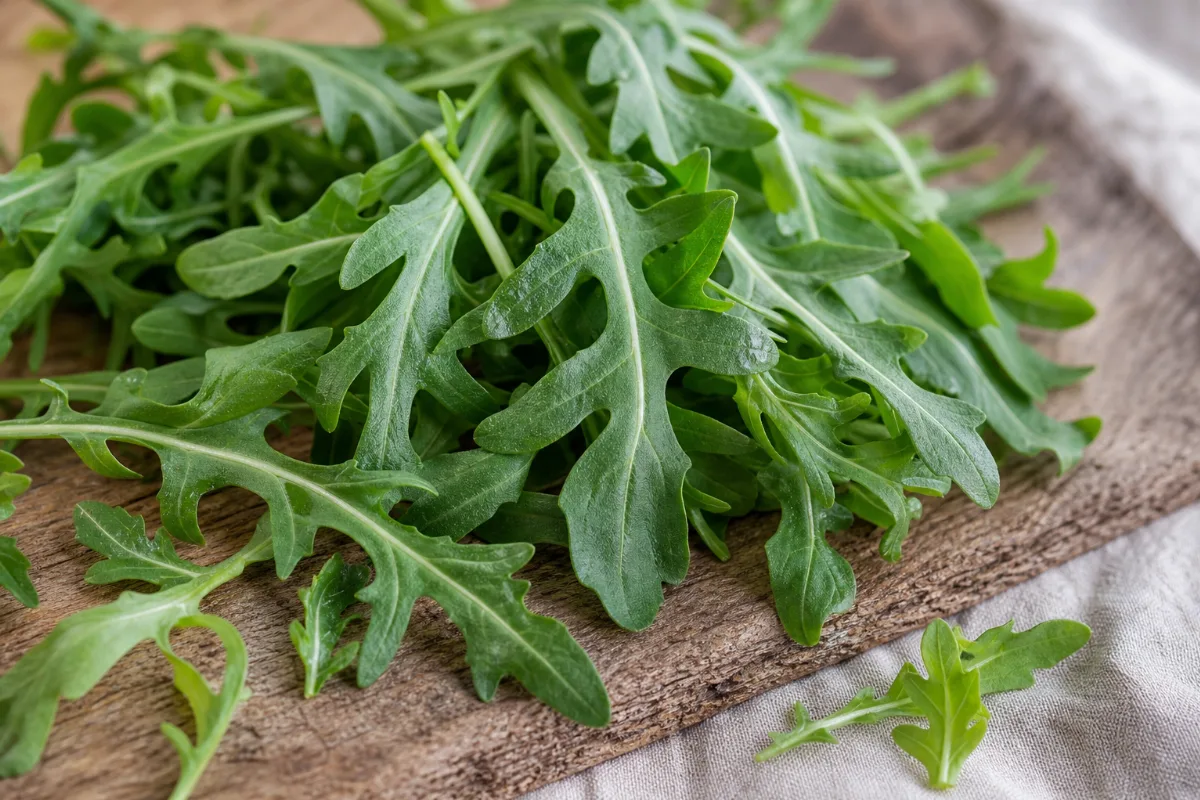
Arugula, also called rocket (Eruca vesicaria), is a peppery salad green in the cabbage family (Brassicaceae). The leaves are eaten, usually raw. People eat it for its vitamins, its plant compounds and its link to the "eat more leafy greens" advice. This page keeps the whole food apart from supplements and from hype, and says plainly what the research does and does not show.
Read this first
- Arugula is very rich in vitamin K: 100 g of raw leaves has about 90% of the Daily Value (USDA). [1] If you take warfarin, vitamin K can weaken the medicine, and the advice is to keep your intake steady from day to day, not to guess. Ask your prescriber or pharmacist. [2]
- Raw leafy greens can carry germs such as E. coli and Listeria. Wash loose leaves under running water, and keep packaged leaves cold. [10][11][12]
- A food allergy to any food is possible. For trouble breathing or swelling of the face or throat, call 911. See food allergy basics and emergency signs.
- Honest summary: arugula is a nutritious, low-calorie green. We found no trial showing that arugula itself prevents or treats a disease.
What is in it (USDA values)
| Nutrient | Per 100 g | Per 1/2 cup (10 g, USDA portion) | % Daily Value per portion |
|---|---|---|---|
| Energy | 25 kcal | 2.5 kcal | not set |
| Fiber | 1.6 g | 0.16 g | 1% |
| Total sugars | 2.05 g | 0.21 g | not set |
| Vitamin K | 108.6 mcg | 10.9 mcg | 9% (90% per 100 g) |
| Folate (DFE) | 97 mcg | 9.7 mcg | 2% (24% per 100 g) |
| Vitamin C | 15 mg | 1.5 mg | 2% (17% per 100 g) |
| Vitamin A (RAE) | 119 mcg | 11.9 mcg | 1% (13% per 100 g) |
| Potassium | 369 mg | 36.9 mg | 1% (8% per 100 g) |
| Calcium | 160 mg | 16 mg | 1% (12% per 100 g) |
| Magnesium | 47 mg | 4.7 mg | 1% (11% per 100 g) |
| Manganese | 0.32 mg | 0.03 mg | 1% (14% per 100 g) |
| Lutein + zeaxanthin | 3,555 mcg | 356 mcg | no Daily Value set |
Source: USDA FoodData Central, SR Legacy item 169387, "Arugula, raw". [1] A half cup is a small handful, so one USDA portion gives modest amounts of most nutrients. A larger salad gives proportionally more. % Daily Value uses the FDA 2016 Daily Values; values vary with variety, ripeness and storage.
Plant compounds: like other cabbage-family plants, arugula contains glucosinolates (sulfur compounds that form isothiocyanates when the leaf is chopped or chewed). A 2026 laboratory study measured glucoerucin and glucoraphanin in cut rocket leaves. [3] The best-known evidence for isothiocyanates comes from lab and animal work; human studies are limited and mixed. [5] USDA also lists carotenoids, mainly lutein and zeaxanthin and beta-carotene. [1] Arugula holds dietary nitrate too; the amount depends on growing conditions such as light. [9]
What research says
| Health goal | What the sources found | Strength of evidence | What was studied |
|---|---|---|---|
| Vitamin K intake | Leafy greens are a rich food source; deficiency is uncommon and usually linked to poor absorption or long antibiotic use. [2] | Established (essential nutrient) | Whole food, general population |
| Blood pressure (nitrate) | A 2023 meta-analysis of 19 trials: dietary nitrate lowered systolic pressure by about 2.4 mmHg in healthy people, not in people with hypertension. [8] No trial we read tested arugula itself. | Mixed | Mostly inorganic nitrate and beet juice, not arugula |
| Heart disease (leafy greens as a group) | A 2026 review: observational studies link more green leafy vegetables with lower cardiovascular risk, but seven trials found no significant gain in vascular function or blood pressure. [7] | Promising but limited (observational) | Leafy greens in general |
| Cancer risk (cabbage-family vegetables) | A 2025 dose-response meta-analysis linked higher intake with lower cancer risk overall, varying by cancer type; it is observational. [6] Evidence that isothiocyanates themselves lower risk is insufficient. [5] | Mixed | Cruciferous vegetables as a group |
| Inflammation, eye cells | A 2026 study found a freeze-dried rocket extract reduced inflammatory signals in cultured retinal cells. [4] | Lab or animal only | Cell culture, extract |
| Eye health in people (lutein) | Proper evidence not found in the sources we read for arugula itself. | Insufficient evidence | Not studied for arugula in the sources read |
Eaten as food versus taken as a supplement or extract: the human findings above come from eating vegetables, or from nitrate given as juice or salt. The retinal-cell result used an extract in a dish, not people. Nothing here shows that a rocket capsule, powder or extract works, and none of the sources read tested one in people.
How much is a normal serving
The USDA household portion in its database is 1/2 cup of raw arugula (10 g). [1] This is information, not a prescription. The WHO says people over 10 years old should eat at least 400 g of fruit and vegetables a day (fact sheet shown as dated 26 January 2026). [13] The NHS counts 80 g of fresh, canned or frozen vegetables as one portion (page last reviewed 9 June 2026). [14] Arugula is light, so 80 g is a large bowlful. We did not find a source we could read on cooking losses for arugula, so we make no claim. Cooking stops the enzyme that makes isothiocyanates, though light steaming keeps some. [5]Safety, allergy and medicines
- Warfarin and similar vitamin K antagonists: vitamin K can reduce warfarin's effect, and sudden changes in how much you eat matter more than the food itself. Ask the prescriber whether to track your intake. [2] See foods and medicine interactions.
- Food poisoning from raw leafy greens: the FDA lists outbreaks of E. coli O157:H7 linked to romaine lettuce and a 2023 Listeria outbreak linked to leafy greens. [11] In the US, two Listeria outbreaks tied to packaged salads caused 30 illnesses and 4 deaths over about eight years. [12] Listeria can be severe in people with weak immune systems. [12] Arugula was not named in the sources we read, but it is eaten raw in the same way.
- Allergy: Proper evidence not found in the sources we read about arugula allergy. Any food can cause an allergic reaction; see food allergy basics.
- Nitrate: we did not find a source we read that describes harm from the nitrate in vegetables such as arugula, and we make no claim either way. Do not stop a prescribed blood pressure medicine because of a food.
- Kidney disease, oxalate and thyroid: the sources we read did not cover arugula for these, so we make no claim. People with kidney disease can read the kidney, potassium and oxalates page.
- Pregnancy: the sources we read did not give arugula-specific advice. Wash greens carefully and see foods in pregnancy.
Choosing, storing and food safety
- Wash loose greens under running water and dry them with a clean towel; do not use soap or produce wash. Washing lowers germs but does not remove them all. [10]
- "Pre-washed" or "ready-to-eat" bagged leaves can be used as they are. [10]
- Keep greens at 40 F (4 C) or below, and choose pre-cut or bagged leaves that are chilled. [10]
- Use a separate cutting board from raw meat, poultry and seafood. [10]
Related pages
Health connections for Arugula (Rocket)
What research links to eating or drinking this food, and how strong the evidence is. Many studies are observational or use juice, powder, oil or extracts rather than the food as eaten; each card says which.
Vitamin K intake and blood clotting
Established roleArugula is a very rich food source of vitamin K, which the body needs for normal blood clotting. Deficiency is uncommon.
Supplements: Eating the food helps meet vitamin K needs; no evidence of extra benefit beyond adequate intake.
Dietary nitrate and blood pressure
Preliminary or mixedArugula contains dietary nitrate. Trials of nitrate in general show a small fall in systolic pressure in healthy people but not in people with hypertension. No arugula trial was found.
Supplements: Results are for nitrate in general, mostly juice or salts, not arugula.
Glucosinolates and isothiocyanates
Lab or animal research onlyArugula contains glucosinolates, which turn into isothiocyanates when the leaf is cut or chewed. Most evidence for their effects is lab and animal work; human studies are limited and mixed.
Supplements: No arugula supplement was tested in people in the sources read.
Cruciferous vegetables and cancer risk
Preliminary or mixedObservational studies link more cabbage-family vegetables to lower cancer risk overall, varying by cancer type. This is association, not proof, and was not specific to arugula.
Supplements: Evidence that isothiocyanates themselves lower cancer risk is insufficient (LPI).
Leafy greens and heart disease
Preliminary or mixedObservational studies link more green leafy vegetables to lower cardiovascular risk, but seven trials found no significant gain in vascular function or blood pressure.
Supplements: Observational findings do not prove that leafy greens cause the lower risk.
Lutein, zeaxanthin and eye health
Not enough evidenceUSDA lists lutein plus zeaxanthin in arugula (3,555 mcg per 100 g). No source we read tested arugula for eye health in people.
Supplements: Proper evidence not found for arugula.
Rocket extract and inflammation in cells
Lab or animal research onlyA freeze-dried rocket extract reduced inflammatory signals in cultured retinal cells. This is a laboratory result only.
Supplements: No human evidence for rocket extracts.
Allergy to arugula
Not enough evidenceNo source we read described allergy to arugula specifically. Any food can cause an allergic reaction; call 911 for trouble breathing or swelling of the face or throat.
Supplements: Proper evidence not found.
Connected topics
Open a group to see how each topic connects and how strong the evidence is.
Root causes (2)
- Medication Side EffectsDocumented risk
Arugula is high in vitamin K, which can weaken warfarin. People on warfarin should keep intake steady and ask their prescriber.
- Nutrient DeficiencyDeficiency link
Leafy greens such as arugula are a rich source of vitamin K; deficiency is uncommon and is usually due to poor absorption or long antibiotic use.
Habits (1)
- Balanced NutritionPreliminary or mixed
Vegetables like arugula can help reach the WHO figure of at least 400 g of fruit and vegetables a day; no arugula-specific health outcome is shown.
Conditions & symptoms (4)
- Escherichia Coli InfectionsDocumented risk
The FDA lists E. coli O157:H7 outbreaks linked to romaine lettuce; arugula was not named.
- Food PoisoningDocumented risk
Raw leafy greens can carry germs; wash loose leaves and keep greens cold.
- ListeriosisDocumented risk
Packaged salads were linked to two Listeria outbreaks in the US (30 illnesses, 4 deaths).
- Vitamin K DeficiencyDeficiency link
Leafy greens are rich in vitamin K; deficiency is uncommon and usually linked to poor absorption or long antibiotic use.
Documented risks and interactions (2)
- Vitamin K and warfarin. Vitamin K can reduce warfarin's effect. Keeping intake steady from day to day matters, so people on warfarin should ask their prescriber or pharmacist.
- Food poisoning from raw leafy greens. Raw leafy greens have been linked to E. coli and Listeria outbreaks. Washing lowers but does not remove germs; keep leaves cold.
Frequently asked questions
Is arugula good for you?
It is a low-calorie green with a lot of vitamin K and some folate, vitamin C and carotenoids per 100 g. [1] We found no trial showing that arugula itself prevents or treats a disease.
Can I eat arugula if I take warfarin?
Vitamin K can reduce warfarin's effect, and steady day-to-day intake matters. Ask your prescriber or pharmacist how much to eat and whether to track it. [2]
Does the nitrate in arugula lower blood pressure?
A meta-analysis of trials found a small fall in systolic pressure in healthy people but none in people with hypertension, using nitrate in general, not arugula. [8] No arugula trial was found.
Does raw arugula have more of the helpful compounds than cooked?
Chopping raw leaves lets glucosinolates turn into isothiocyanates, and cooking stops the enzyme, though light steaming keeps some. [5] Whether that changes health outcomes in people is not shown.
Is bagged arugula safe to eat without washing?
If the package says pre-washed or ready-to-eat, the FDA says you can use it as is. Keep it cold. [10] Packaged salads have been linked to Listeria outbreaks, so people with weak immune systems should ask their clinician. [12]
References
- U.S. Department of Agriculture. FoodData Central: Arugula, raw (SR Legacy, FDC 169387). April 2018 release. Read 2026-10-23.
- MedlinePlus. Vitamin K. Read 2026-10-23.
- Lolli V et al. Plasma-activated water dipping of fresh-cut Eruca sativa: glucosinolate-myrosinase system and cellular responses. Foods 2026. PMID 42883669. Abstract read 2026-10-23.
- Cho M et al. Freeze-dried extracts of Eruca sativa selectively inhibit NF-kB and VEGF levels in retinal pigment epithelial cells. Prev Nutr Food Sci 2026. PMID 42382025. Abstract read 2026-10-23.
- Linus Pauling Institute, Oregon State University. Isothiocyanates. Read 2026-10-23.
- Unveiling the effects of cruciferous vegetable intake on different cancers: a systematic review and dose-response meta-analysis. PubMed. Nutr Rev 2025. PMID 39348271. Abstract read 2026-10-23.
- Dietary green leafy vegetables and cardiovascular disease risk: a systematic review and meta-analysis. PubMed. Foods 2026. PMID 42587937. Abstract read 2026-10-23.
- Regulatory effect of dietary nitrate on blood pressure: a meta-analysis of randomized controlled trials. PubMed. Food Funct 2023. PMID 36740972. Abstract read 2026-10-23.
- Greenhouse climate shapes nitrate levels, nutritional quality and shelf life in leafy vegetables: species-specific responses. PubMed. Front Plant Sci 2026. PMID 42179523. Abstract read 2026-10-23.
- U.S. Food and Drug Administration. Selecting and Serving Produce Safely. Read 2026-10-23.
- U.S. Food and Drug Administration. Investigations of foodborne illness outbreaks. Read 2026-10-23 (first part of a long page).
- Two concurrent outbreaks of Listeria monocytogenes infections linked to packaged salads, United States, 2014-2022. PubMed. Emerg Infect Dis 2025. PMID 41490655. Abstract read 2026-10-23.
- World Health Organization. Healthy diet fact sheet. Date shown 26 January 2026. Read 2026-10-23.
- NHS. 5 A DAY: what counts. Last reviewed 9 June 2026. Read 2026-10-23.