Safflower ("false saffron"): Flavor, Cooking Use and Health Facts
Safflower petals ("false saffron") give food a golden color but almost no saffron flavor; human research on the flower is thin, and bleeding, pregnancy and daisy-family allergy are the cautions.
Content last updated . This page has not been medically reviewed.
In the kitchen at a glance
Flavor:Earthy
Aroma: Very little; the petals have almost no smell of their own.
Used in: rice and grains, soups and stews, tea and drinks
Usual amount in food: No usual recipe amount found; the sources we read give no figure, and USDA SR Legacy has no entry for safflower petals.
What it is
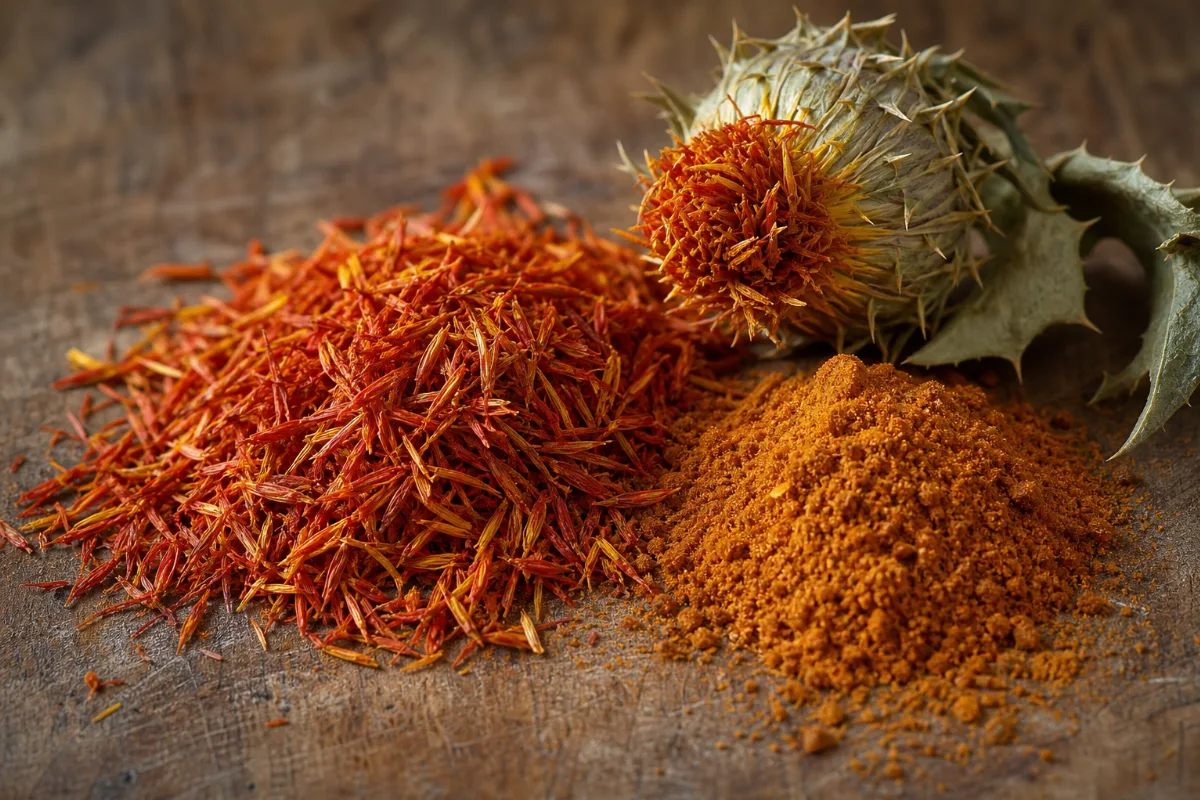
Safflower is Carthamus tinctorius, a thistle-like plant in the daisy family (Asteraceae), also called "false saffron." [1] The part used as a spice and dye is the florets, the small petal-like flowers inside the flower head. [1] Most of the crop is grown for the seeds, which are pressed for oil. [1] The flower heads are yellow, orange or red. [1] Safflower is not saffron (Crocus sativus), which is a different plant. It is sometimes sold under the names "Portuguese saffron" or "açafrão." [2]Flavor and aroma
Safflower is mainly a color, not a flavor. One spice retailer's guide says the petals have little aroma and no volatile oils to release when heated. [3] The same guide says safflower does not substitute for saffron's flavor or aroma, only its look. [3] That guide is a shop article, not a food-science source, so treat the taste description as a cook's view. Other web pages describe a mild, slightly nutty taste, but we did not open a source we trust for this, so we do not state it as fact.The color comes from pigments in the petals: one red (carthamin) and two yellows. [1] One yellow washes out in cold water. [1] The guide says carthamin breaks down above about 60 °C and bleaches in vinegar or citrus. [3]
How it is used in cooking
Cooks have used the florets as a cheaper stand-in for saffron's color, sometimes called "bastard saffron." Early Spanish settlers in New Mexico did this, and an heirloom type is still used in New Mexican cooking. [1] A review also says safflower dye has been used to flavor and color dishes in Italian, French and British cooking, and that in Iran the plant is eaten raw in some regions. [4] The florets are also made into a herbal tea. [1]A cooking guide suggests these ways to use it: [3]
- Late in cooking: add it in the last couple of minutes for a golden rice dish, because heat fades the color.
- Cold dishes and drinks: yogurt dips and cold drinks keep the color without long heat.
- Poor fits: long simmering, freezing, or any dish that depends on saffron's smell.
The guide says extra petals do not deepen the color, and soaking only releases the pigment faster. [3] We found no source with a substitution ratio, so we give none. If you want saffron's taste, use saffron. For color alone, turmeric and annatto are other kitchen options, though we did not read a source that compares them.
Normal food amounts
USDA FoodData Central SR Legacy has no entry for safflower petals, so we give no gram weights or nutrient numbers. [8]| Measure | Grams | Source |
|---|---|---|
| 1 teaspoon | Not found | USDA SR Legacy has no entry [8] |
| Typical recipe amount | Not found | We opened no source that states one |
Because the petals are used for color, the nutrient contribution of a pinch is likely tiny, but we have no data to show it.
Buying, storing and preparing
- Forms: dried petals (sometimes sold as whole threads or flakes), tea, and extracts. [1][4]
- Saffron fraud: safflower is one of several plants used to adulterate real saffron, along with calendula and turmeric, because the color and shape look alike. [5] Standard saffron lab testing (ISO 3632) is described as not suitable for finding added plant material; it is only a first screen. [5] If very cheap "saffron" has orange or yellow threads that feel like petals, it may not be saffron. This is our reading of the sources, not a test.
- Storing: the shop guide says safflower stays stable for years while saffron loses strength within months in a warm pantry. [3] Keep it dry and out of the light, as for any spice.
- Note: this page is about the flower. Seeds and oil are different products. [1][6]
Health: what research says
Using petals as a food color is very different from taking concentrated flower products.Food amounts vs supplements
| In normal cooking | In supplements and extracts | |
|---|---|---|
| Typical amount | No usual amount found | Chinese medicine uses dried flower and injections; no official amount found [4] |
| What studies mostly used | No study of petals sprinkled on food found | Extracts, isolated pigments (such as hydroxysafflor yellow A), and hospital injections [4] |
| What we can say about benefit | Nothing; not studied | Evidence is thin and mostly from China or animals [4] |
| Main safety limit | Unknown; allergy possible in daisy-family allergy [6] | Bleeding, pregnancy and allergy cautions [6][4] |
What the evidence shows
| Use | What the sources found | Strength of evidence | Form and population |
|---|---|---|---|
| Heart and circulation | A 2025 review lists clinical uses of safflower products in China but describes most studies briefly. [4] See the herb guide for a meta-analysis of an injection that combines safflower with danshen. | Insufficient evidence | Chinese products, mostly injections or extracts; people with heart disease |
| Blood clotting (lab) | In mice, a safflower yellow extract lengthened clotting time. A pigment reduced platelet clumping by up to 41.8% in lab tests. [4] | Lab or animal only | Isolated compounds in animals and cells |
| Cancer, liver, brain protection | The review reports cell and animal studies. [4] | Lab or animal only | Extracts and compounds |
| Reproductive safety of a food-grade extract | A 2021 rat study of a well-defined safflower concentrate found no harm to fertility or development at up to 1000 mg per kg of body weight per day. The authors say earlier extract studies were poorly defined. [7] | Lab or animal only | Rats; one food-grade extract, not petals |
| Safflower tea or petals as a spice | No human trial found | Insufficient evidence | Food amounts |
For supplement forms, trials and interactions in depth, see the full herb guide: Safflower.
Official statements
- FDA (US), as reported by a consumer drug reference: has not reviewed the flower for safety and effectiveness; safflower oil is generally recognized as safe as a food. [6]
- EMA, EFSA, JECFA, NCCIH: we found no statement about safflower flower in the sources we opened.
Related pages
Health connections for Safflower ("false saffron")
What research links to this spice, and how strong the evidence is. Most studies use concentrated extracts or doses far above what you eat; each card says which.
Heart and circulation (Chinese products)
Not enough evidenceA 2025 review lists clinical uses of safflower products in China for heart and circulation problems but describes most studies only briefly.
Supplements: Supplement and injection findings only, low-quality or briefly described; no study of petals in food.
Platelet and clotting effects in the laboratory
Lab or animal research onlyIn mice, a safflower yellow extract lengthened clotting time, and a pigment reduced platelet clumping by up to 41.8% in lab tests.
Supplements: Animal and cell findings on isolated compounds; not shown in people or in food amounts.
Cancer, liver and brain protection
Lab or animal research onlyThe review reports only cell and animal studies for these uses.
Supplements: Lab and animal only; no human proof.
Reproductive safety of a food-grade extract
Lab or animal research onlyA 2021 rat study of a well-defined aqueous safflower concentrate found no effect on fertility or development at up to 1000 mg per kg per day.
Supplements: Animal study of one extract; does not show safety of petals or tea in pregnant women.
Connected topics
Open a group to see how each topic connects and how strong the evidence is.
Body systems (2)
- Immune SystemDocumented risk
Allergy is possible, especially in people allergic to daisy-family plants.
- Reproductive SystemDocumented risk
Pregnancy safety of flower products is not known; one rat study of a food-grade extract found no reproductive harm.
Root causes (1)
- Medication Side EffectsDocumented risk
Blood thinners and antiplatelet drugs should be discussed with a prescriber before using safflower flower products; interactions are not well understood.
Documented risks and interactions (4)
- Bleeding risk and blood-thinner medicines. A consumer drug reference lists blood thinners and antiplatelet drugs as medicines to discuss before using safflower flower; interactions are not fully understood.
- Pregnancy and breastfeeding unknown. It is not known whether flower products affect pregnancy or pass into breast milk.
- Allergy, especially daisy-family allergy. Serious allergic reactions are possible; allergy to arnica, marigold, chamomile, yarrow, ragweed, asters or chrysanthemums may raise risk.
- Adulteration of saffron with safflower. Safflower petals are used to adulterate saffron; ISO 3632 is described as unsuitable for catching added plant material.
Frequently asked questions
Is safflower the same as saffron?
No. Safflower is a daisy-family plant; saffron is the stigma of a crocus. [1][2] Safflower gives color but little flavor. [3]
Does it taste like saffron?
The shop guide we read says no: it gives color, not saffron's smell or taste. [3]
How much is normal?
We found no usual recipe amount, and USDA lists no gram weight for safflower petals. [8]
Is it safe in pregnancy?
Not known for the flower. A consumer reference says it is unknown whether flower products affect pregnancy. [6] Ask your midwife or doctor.
Can I take it with medicines?
Blood thinners and antiplatelet drugs are the group to check, and interactions are not well understood. [6] Ask a pharmacist.
Is safflower oil the same thing?
No. The oil is pressed from seeds and is a separate product. [1][6]
More details: evidence, limits and cautions
The details behind this page: cautions, limits of the evidence and where sources disagree. Open any note to read it.
Safety note at a glance
Safety in more detail
- Medicines: a consumer drug reference lists blood thinners and antiplatelet drugs (such as aspirin, clopidogrel and ticagrelor) as medicines to discuss with a prescriber, and says flower interactions are not fully understood. [6] Lab work on clotting is the reason for the concern. [4]
- Pregnancy: that reference says it is not known whether flower products could affect pregnancy. [6] The 2025 review only notes that daisy-family plants were traditionally used to bring on abortion, without detail for safflower. [4] Another database rates the flower "likely unsafe" in pregnancy, but we could not open it (see notes). Ask a midwife or doctor.
- Breastfeeding: not known whether it passes into milk. [6]
- Children: the sources we read do not describe this.
- Allergy: do not use if allergic to safflower. Allergy to arnica, marigold, chamomile, yarrow, ragweed, asters or chrysanthemums may raise the risk. Serious signs are breathing trouble, face or throat swelling, and hives. [6]
- Liver and kidney: the sources we read do not describe this.
- Surgery: the sources we read give no timing advice. Because of the bleeding question, tell the surgical team about any safflower product. [6]
- Quality and contamination: safflower petals are used to pass off as saffron. [5] No contamination problem specific to petals was found.
- Amounts that cause trouble: the review reports no acute toxicity data, so no limit is known. [4]
References
- Wikipedia — Safflower. https://en.wikipedia.org/wiki/Safflower (accessed 2026-10-24)
- Wikipedia — Saffron (section on substitutes). https://en.wikipedia.org/wiki/Saffron (accessed 2026-10-24)
- Alibaba spice guide (retailer article; secondary source) — Safflower vs Saffron: Key Differences Explained. https://spice.alibaba.com/spice-basics/safflower-vs-saffron (accessed 2026-10-24)
- Bai H, Yang J, Wang R — Carthamus tinctorius L.: a comprehensive review of its ethnomedicine, phytochemistry, pharmacology, and clinical applications. Frontiers in Pharmacology 2025. https://www.frontiersin.org/journals/pharmacology/articles/10.3389/fphar.2025.1609299/full (accessed 2026-10-24; first 100,000 characters read)
- Avila-Sosa R et al. — Detection of Saffron's Main Bioactive Compounds and Their Relationship with Commercial Quality. Foods 2022. https://pmc.ncbi.nlm.nih.gov/articles/PMC9601577/ (accessed 2026-10-24; first 100,000 characters read)
- WebMD (consumer drug reference; secondary source) — Safflower. https://www.webmd.com/vitamins-supplements/ingredientmono-96-SAFFLOWER (accessed 2026-10-24)
- Lewin G et al. — Food grade safflower concentrate: no evidence for reproduction and early developmental toxicity. Reprod Toxicol 2021; abstract read via Europe PMC. https://pubmed.ncbi.nlm.nih.gov/33515695/ (accessed 2026-10-24)
- USDA FoodData Central, SR Legacy (April 2018) — the site's USDA spice data file has no safflower entry.