Pumpkin pie spice: What It Is, Flavor, Cooking Use and Health Facts
Pumpkin pie spice is a warm, sweet blend of cinnamon, ginger, nutmeg and cloves used in pies, baking and coffee drinks; it is not studied as a blend, and its cautions come from cassia coumarin, large amounts of nutmeg and lead in some ground spices.
Content last updated . This page has not been medically reviewed.
In the kitchen at a glance
Flavor:Warm / woodySweet
Aroma: Warm and sweet, led by cinnamon, with sharp clove and a soft nutty note from nutmeg.
Used in: baking, desserts, tea and drinks
Usual amount in food: USDA lists 1.7 g per teaspoon (5.6 g per tablespoon); one cooking site says to use less than 1/2 teaspoon per cup of a drink.
What it is
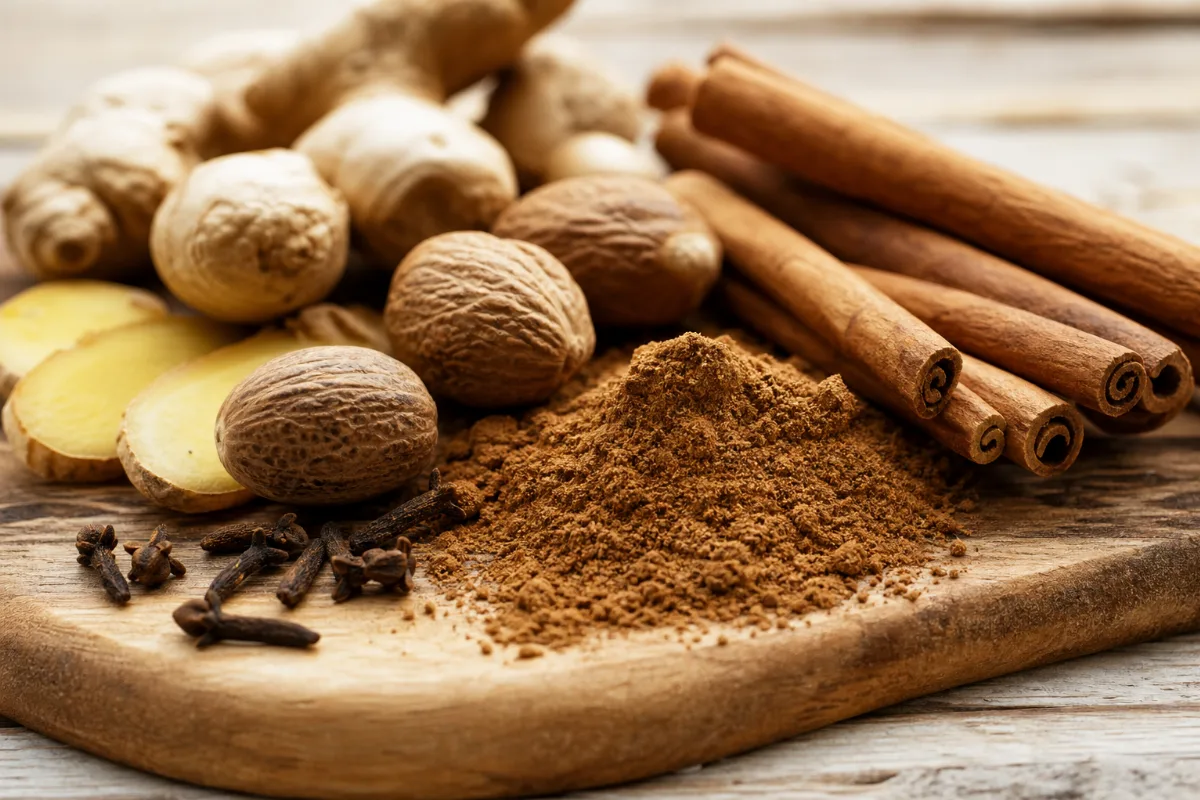
Pumpkin pie spice, also called pumpkin spice, is an American mix made to flavor pumpkin pie filling. It contains no pumpkin. [1] It is usually ground cinnamon, nutmeg, ginger and cloves, sometimes with allspice. [1] Recipes vary by maker and household, so the table shows what is typical, not a rule.| Typical ingredient | Role in flavor | Link |
|---|---|---|
| Cinnamon | The base; warm and sweet [3] | More about Cinnamon → |
| Ginger | Warm bite [3] | More about Ginger → |
| Nutmeg | Potent, soft and nutty; use sparingly [3] | More about Nutmeg → |
| Cloves | Stronger, more robust note [3] | More about Cloves → |
| Allspice | Optional; often added in place of or beside nutmeg [1][3] | More about Allspice → |
The idea is old. A Paris cookbook from the 1390s gave a sweet spice powder of mostly ginger with some cinnamon, sugar, cloves and grains of paradise. [1][2] McCormick sold a ready-made version from 1934. [1]
Flavor and aroma
It tastes warm and sweet, with cinnamon in front. [3] More cinnamon makes it cozier. A little more clove makes it sharper. Nutmeg is strong, so a small change shows. [3]How it is used in cooking
- Pie filling: the job the blend was made for. [1]
- Baking and drinks: cakes, baked goods, lattes and other drinks. [3]
- Drinks tip: one site says to keep it under 1/2 teaspoon per cup, because ground cinnamon can thicken the liquid. [3]
- Add-ins: the same site suggests a bit of allspice, black pepper for more kick, or about 1/8 teaspoon of cardamom. [3]
Wikipedia says the blend is similar to British mixed spice. [1]
Normal food amounts
| Measure | Grams | Source |
|---|---|---|
| 1 teaspoon | 1.7 g | USDA [9] |
| 1 tablespoon | 5.6 g | USDA [9] |
| Typical recipe amount | Not found | One site gives under 1/2 teaspoon per cup of a drink only [3] |
What one teaspoon (1.7 g) provides, calculated from USDA values per 100 g:
| Nutrient | One teaspoon |
|---|---|
| Energy | about 6 kcal |
| Fiber | about 0.3 g |
| Calcium | about 12 mg |
| Manganese | about 0.3 mg |
| Iron | about 0.3 mg |
| Sodium | about 1 mg |
The USDA SR Legacy data are from 2018, and real products vary. [9] We did not compare these numbers with official daily values, so we do not call the blend a "good source" of anything. A pinch is mostly flavor. The USDA entry lists very little sodium, so the plain spice mix is not a salty product. [9]
Buying, storing and preparing
- Forms: a ready-made ground blend, or your own mix of ground or freshly ground spices. [1][3]
- Storage: an airtight jar in a cool, dark place, with no moisture. [3]
- Shelf life: one site says to use a blend made from opened spices within about 12 months, and that it loses strength slowly after that. [3] Treat this as a rough guide from a single cooking site.
- Label check: read the ingredient list for added salt, sugar or anti-caking agents. US law requires sesame to be labeled on packaged foods since 2023. [8] We found no source saying this blend contains sesame.
Health: what research says
Eating a spice blend in cooking is different from taking concentrated products. Pumpkin pie spice is rarely studied as a blend. We found no source we opened that tests it for any health effect, so the evidence belongs to the single spices.Food amounts vs supplements
| In normal cooking | In supplements and extracts | |
|---|---|---|
| Typical amount | About 1.7 g per teaspoon (USDA); no usual recipe amount found [9] | Not sold as a supplement in the sources we read |
| What studies mostly used | No study of the blend found | Studies on single spices are on their own pages |
| What we can say about benefit | Nothing about the blend as a whole | Not applicable |
| Main safety limit | Cassia coumarin with heavy daily use; large amounts of nutmeg [4][6] | Not applicable |
What the evidence shows
| Use | What the sources found | Strength of evidence | Form and population |
|---|---|---|---|
| The blend as a whole | No health study found | Insufficient evidence | Blend in food |
| Cinnamon (cassia) | Contains coumarin. BfR sets 0.1 mg per kg of body weight per day, and says about 2 g of average cassia reaches it for a 60 kg adult. [4][5] | Established as a safety limit | Cassia powder; see Cinnamon |
| Nutmeg | Poison-centre cases were mostly accidental in young children or deliberate large amounts. [6] | Established as a safety concern | Large amounts; see Nutmeg |
| Ground spices and lead | A CDC-reported study found lead at or above 1 mg/kg in about 29% of spice items. [7] | Established as a contamination concern | Ground spices in general; this blend was not listed |
| Ginger, cloves, allspice | See their own pages | See each page | See each page |
Cinnamon is the base of typical recipes, but no source we read gives coumarin in the blend, so we give no estimate. [3]
Official statements
- BfR (Germany), 2012: tolerable coumarin intake 0.1 mg per kg of body weight per day. [4]
- FDA (US): sesame must be labeled on packaged foods and supplements since 1 January 2023. [8]
- CDC (US), 2018: reports lead in spices and says the US has no permissible limit. [7]
- We found no official statement about pumpkin pie spice itself.
Related pages
- Cinnamon (herb guide), Ginger (herb guide), Nutmeg (herb guide), Cloves (herb guide)
- Spice blends: garam masala, curry powder and five-spice
- Buying, storing and grinding spices
- Spice flavor and aroma guide
- Spices in food vs supplements
- Spice safety: medicines, pregnancy and allergy
- Related spices: Mace, Chinese five-spice
Health connections for Pumpkin pie spice
What research links to this spice, and how strong the evidence is. Most studies use concentrated extracts or doses far above what you eat; each card says which.
Health effects of the blend as a whole
Not enough evidenceNo source we opened tested pumpkin pie spice as a blend for any health effect.
Supplements: Not a supplement; the finding concerns food amounts of the blend.
Connected topics
Open a group to see how each topic connects and how strong the evidence is.
Root causes (1)
- Heavy Metal ExposureDocumented risk
A CDC-reported study found lead in some ground spices; pumpkin pie spice was not listed and this says nothing about any brand.
Conditions & symptoms (2)
- Food AllergyDocumented risk
Packaged spice mixes can list allergens such as sesame, which US law requires on labels; no source says this blend contains sesame.
- Lead PoisoningDocumented risk
Some ground spices tested high for lead; pumpkin pie spice was not listed in the study and this says nothing about any brand.
Documented risks and interactions (4)
- Cassia coumarin limit. If the blend uses cassia, coumarin adds to the daily total; BfR sets 0.1 mg per kg body weight per day and says about 2 g of average cassia reaches it for a 60 kg adult.
- Nutmeg in large amounts. Poison-centre cases of nutmeg were mostly accidental ingestion by young children or deliberate large amounts.
- Lead in some ground spices. A North Carolina study found at least 1 mg/kg lead in about 29% of spice items; pumpkin pie spice was not listed.
- Label allergens in packaged blends. US law requires sesame to be labeled on packaged foods since 2023; FDA's example shows it inside a spices entry.
Frequently asked questions
How much is normal?
USDA lists 1.7 g per teaspoon. [9] We found no usual recipe amount; one site says under 1/2 teaspoon per cup of a drink. [3]
Is it safe in pregnancy?
The sources we read give no advice for the blend. Food amounts of its spices are not described there as a problem, but ask your midwife or doctor about large amounts or supplements.
Can I take it with medicines?
In cooking amounts, the sources we read describe no interaction for the blend. See the pages of its spices if you take medicine.
Can I make it at home?
Yes. One recipe uses 4 teaspoons of cinnamon, 2 of ginger, 1 of cloves and 1/2 of nutmeg. [3] Other sites use different ratios.
More details: evidence, limits and cautions
The details behind this page: cautions, limits of the evidence and where sources disagree. Open any note to read it.
Safety note at a glance
Safety in more detail
- Medicines: the sources we read do not describe interactions for the blend. See the pages of the spices in it.
- Pregnancy: the sources we read give no blend-specific advice. Ask your midwife or doctor about large amounts or supplements.
- Breastfeeding: the sources we read do not describe it for this blend.
- Children: BfR says a 15 kg child reaches the coumarin limit with about 0.5 g of average cassia. [4] Ten of 17 accidental nutmeg cases in one poison-centre review were in children under 13. [6]
- Allergy: read the whole label. Sesame must be listed on US packaged foods. [8]
- Liver and kidney: coumarin has liver effects, and some people are more sensitive than animal studies suggested. [5] The sources we read do not describe kidney problems.
- Surgery: the sources we read do not describe a warning for this blend.
- Quality and contamination: the North Carolina study found at least 1 mg/kg lead in 111 of 386 samples, and the US has no permissible lead limit for spices. Named causes include polluted soil, lead dust from grinding machines and deliberate additions for color or weight. [7] It did not list pumpkin pie spice.
- Amounts that cause trouble: BfR says slight overshoot of the coumarin limit for one to two weeks is considered safe. Risk is mainly very large amounts of high-coumarin cassia over a long time. [4] The nutmeg review links trouble to large or deliberate amounts, not a pinch in food. [6]
References
- Wikipedia — Pumpkin pie spice (cites Medievalists, Business Insider, McCormick and cookbooks). https://en.wikipedia.org/wiki/Pumpkinpiespice (accessed 2026-10-24)
- Mondschein K — The Medieval Origins of Pumpkin Spice, Medievalists.net, 2021. https://www.medievalists.net/2021/10/medieval-origins-pumpkin-spice/ (accessed 2026-10-24)
- Alphafoodie — Easy homemade pumpkin pie spice, substitutions and uses (food blog; secondary source). https://www.alphafoodie.com/wprm_print/easy-homemade-pumpkin-pie-spice-substitutions-and-uses (accessed 2026-10-24)
- BfR (Germany) — FAQ on coumarin in cinnamon and other foods, 2012. https://www.bfr.bund.de/en/frequentlyaskedquestionsoncoumarinincinnamonandother_foods-8487.html (accessed 2026-10-24)
- Abraham K et al. — Toxicology and risk assessment of coumarin: focus on human data. Mol Nutr Food Res 2010; abstract read via Europe PMC. https://pubmed.ncbi.nlm.nih.gov/20024932/ (accessed 2026-10-24)
- Nutmeg poisonings: a retrospective review of 10 years experience from the Illinois Poison Center, 2001-2011. J Med Toxicol 2014; abstract read via Europe PMC. https://pubmed.ncbi.nlm.nih.gov/24452991/ (accessed 2026-10-24)
- CDC (US) — MMWR 2018;67(46): lead in spices, North Carolina. https://www.cdc.gov/mmwr/volumes/67/wr/mm6746a2.htm (accessed 2026-10-24)
- FDA (US) — The FASTER Act: Sesame is the ninth major food allergen. https://www.fda.gov/food/food-allergies/faster-act-sesame-ninth-major-food-allergen (accessed 2026-10-24)
- USDA FoodData Central, SR Legacy (April 2018) — Spices, pumpkin pie spice (fdc_id 171332), per-100 g values and household portions from the site's USDA data file.