Mastic (mastiha): Flavor, Cooking Use and Health Facts
Mastic is a pine-like, slightly sweet resin used in Greek and Middle Eastern sweets, breads and drinks; small trials on indigestion are promising but limited, and it is not advised in pregnancy.
Content last updated . This page has not been medically reviewed.
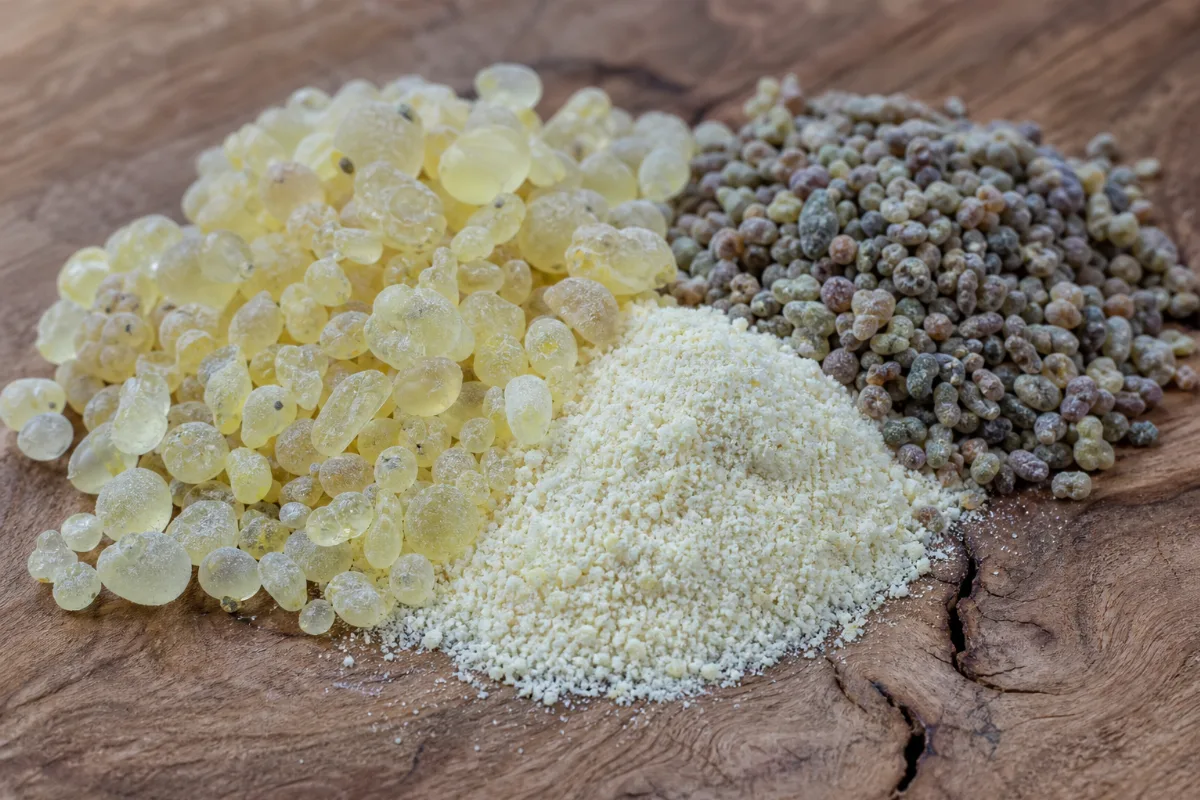
In the kitchen at a glance
Flavor:EarthyBitter
Aroma: Fresh and resinous, like pine, with a woody, slightly musky and vanilla-like depth.
Used in: desserts, baking, tea and drinks
Usual amount in food: Use only a tiny pinch; a common tip is to grind 1 teaspoon of mastic with 10 teaspoons of sugar or salt. USDA SR Legacy has no entry for mastic.
What it is
Mastic is the hardened sap, or resin, of the mastic tree, Pistacia lentiscus. [1][2] The best-known source is the Greek island of Chios, where the resin is called the "tears of Chios." [2] Growers cut the bark, and the sap hardens into small, brittle, clear pieces over about two to three weeks. [2] "Masticha Chiou" holds a protected designation of origin in the EU. [2]Flavor and aroma
Mastic is not sweet or hot. The flavor is faintly like pine, with a deep, almost musky smell. [3] Another cooking writer describes it as earthy, woody and a little like vanilla, and says some people find it an acquired taste. [4] When chewed, it first tastes bitter, then turns fresh, and the piece softens into a white chewy gum. [2] The smell is described in perfumery as balsamic, green, woody and a bit like juniper. [2] The flavor is strong, so a little goes a long way. [4]How it is used in cooking
Mastic is a Mediterranean flavoring, used mainly in sweets and baked goods.- Greece: bread, Easter cheese pastries from the Aegean islands, cookies such as koulourakia, spoon sweets, chewy ice cream, and the liqueur mastika. [2][3]
- Turkey and the Levant: Turkish delight, ice cream, and milk puddings such as muhallebi and sütlaç. [2] In the Levant it flavors the stretchy ice cream called booza. [2]
- Maghreb: cakes and pastries, and as a stabilizer in meringue and nougat. [2]
- Savory: marinades and seasoning for lamb, fish, poultry and salads, ground with salt. [4]
How to prepare it: crush the tears in a mortar and pestle with a little sugar for sweet dishes or a little salt for savory ones. [3][4] Do not use a spice grinder or food processor, because the sticky resin can damage the blades. [3] A common ratio is 1 part mastic to 10 parts sugar or salt. [4]
What to pair it with: custards, panna cotta, tarts and ice cream in sweet dishes. [4] One writer also pairs it with chocolate and fish. [3]
The sources we read do not say when to add it, whether to toast it, or what to use in its place, so we give no rules for those.
Normal food amounts
| Measure | Grams | Source |
|---|---|---|
| 1 teaspoon, ground | No USDA entry | USDA SR Legacy has no entry for mastic |
| 1 tablespoon, ground | No USDA entry | USDA SR Legacy has no entry for mastic |
| Typical recipe amount | A "pinch"; or 1 teaspoon mastic ground with 10 teaspoons sugar or salt as the working mix | Cooking writer, not a tested standard [4] |
We found no nutrient data for mastic, so we give none.
Buying, storing and preparing
- Forms: whole tears are the usual form. Some shops also sell a ready-made paste, which one writer found easier to work with. [4] Mastic is also sold as chewing gum and in liqueur. [2]
- Where to buy: Greek, Mediterranean and Middle Eastern shops. A small 10 g packet is enough to start. It is one of the most expensive food items after saffron. [4]
- Storing: keep the tears in the fridge or a cool place so they stay crisp and grind to powder. One writer advises against freezing, which may change the flavor. [4]
- Quality: a 2026 laboratory paper reports that mastic is increasingly mixed with chemically similar resins from other Pistacia species. We could not open it, so we cannot confirm the details.
- Shelf life: the sources we read give none.
Health: what research says
Using a pinch of mastic in cooking is very different from taking capsules or chewing the resin daily as a remedy.Food amounts vs supplements
| In normal cooking | In supplements and extracts | |
|---|---|---|
| Typical amount | A tiny pinch; no tested amount found [4] | The EU monograph describes 0.5 to 1 g of powdered resin twice daily for adults, as a traditional medicine [1] |
| What studies mostly used | No study of mastic used as a food flavoring was found | Chios mastic gum in capsules or powder, 350 mg to 2 g a day, for 2 to 8 weeks [5][6][7] |
| What we can say about benefit | Nothing; flavoring amounts were not studied | Small trials show some changes, but the EU regulator accepts it only for traditional use [1][5][7] |
| Main safety limit | Allergy to the resin [1] | Not recommended in pregnancy, breastfeeding or under 18; few safety data [1] |
The EU amounts describe how a regulator registers a product. They are not advice.
What the evidence shows
| Use | What the sources found | Strength of evidence | Form and population |
|---|---|---|---|
| Indigestion with no known cause | In 148 adults, the symptom score after 3 weeks was lower with mastic (14.78) than placebo (19.96), and 77% vs 40% reported marked improvement. [5] | Promising but limited | Chios mastic gum 350 mg three times daily; adults with functional dyspepsia [5] |
| H. pylori infection | Of 52 patients, the infection cleared in 4 of 13 and 5 of 13 in the two mastic-only groups, in none of 13 on mastic plus an acid reducer, and in 10 of 13 on standard antibiotic treatment. [6] | Insufficient evidence; standard treatment did better | Mastic gum for 14 days; small pilot trial [6] |
| Total cholesterol and blood glucose | In 156 healthy adults with total cholesterol above 200 mg/dl, 1 g a day of crude mastic lowered total cholesterol by 11.5 mg/dl and fasting glucose by 4.5 mg/dl after 8 weeks. LDL, HDL and triglycerides did not change, and polymer-free and powdered mastic showed no significant change. [7] | Promising but limited | Crude gum; healthy volunteers; a pilot study [7] |
| Mild indigestion and minor skin problems (EU status) | The EU committee lists mastic as a traditional herbal medicine for these uses, "exclusively based upon long-standing use." [1] | Insufficient evidence (traditional use only) | Powdered resin; adults [1] |
| Mastic as a food flavoring | No study found | Insufficient evidence | Food amounts |
For supplement-level detail, trials and interactions, see the full guide: Mastic gum.
Official statements
- EMA/HMPC (EU), 2016: powdered mastic resin is accepted as a traditional herbal medicine for mild indigestion and, as a skin preparation, for minor skin inflammation and minor wounds, based on long-standing use only. [1]
- EU (PDO): "Masticha Chiou" is a protected name. [2]
- FDA, EFSA, WHO/JECFA, NCCIH: we did not open a statement from these bodies for mastic.
Related pages
Health connections for Mastic (mastiha)
What research links to this spice, and how strong the evidence is. Most studies use concentrated extracts or doses far above what you eat; each card says which.
Indigestion without a known cause
Preliminary or mixedOne trial of 148 adults found a lower indigestion symptom score with Chios mastic gum than placebo after 3 weeks; the EU regulator accepts it only as a traditional medicine.
Supplements: Supplement finding only (350 mg three times daily for 3 weeks); no study of food amounts found.
H. pylori infection
Preliminary or mixedIn a 52-patient pilot, mastic alone cleared the infection in 4 of 13 and 5 of 13 people, while standard antibiotic treatment cleared it in 10 of 13.
Supplements: Supplement finding only; not a replacement for medical treatment.
Total cholesterol and fasting glucose markers
Preliminary or mixedIn 156 healthy adults, 1 g a day of crude mastic for 8 weeks lowered total cholesterol by 11.5 mg/dl and fasting glucose by 4.5 mg/dl; LDL, HDL and triglycerides did not change.
Supplements: Supplement finding only (crude gum, 1 g a day); no study of food amounts.
Traditional use for mild indigestion and minor skin problems
Not enough evidenceThe EU herbal committee lists powdered mastic resin as a traditional herbal medicine for mild indigestion and, on skin, for minor inflammation and wounds, based on long-standing use only.
Supplements: Traditional-use status for medicine forms; not applicable to food amounts.
Connected topics
Open a group to see how each topic connects and how strong the evidence is.
Health goals (1)
- Digestive SupportPreliminary or mixed
One trial found lower indigestion scores with mastic gum; the EU accepts it only as a traditional medicine.
Body systems (1)
- Digestive SystemPreliminary or mixed
Indigestion trial and traditional EU status are for medicine-level amounts, not cooking.
Body parts (1)
- StomachPreliminary or mixed
Studied for indigestion and H. pylori; results small and mixed.
Functional actions (1)
- Digestive SupportPreliminary or mixed
Lower indigestion symptom score in one 148-person trial.
Conditions & symptoms (1)
- DyspepsiaPreliminary or mixed
One trial of 148 adults found lower symptom scores than placebo; the EU accepts only traditional use; see a doctor if symptoms last over 2 weeks.
Documented risks and interactions (4)
- Allergy to the resin. The EU monograph lists hypersensitivity to mastic as a contraindication.
- Pregnancy and breastfeeding. The EU monograph says safety has not been established and use in pregnancy and breastfeeding is not recommended.
- Use under 18. The EU monograph does not recommend oral use under 18 (and skin use under 12) because of a lack of data.
- Product authenticity. Mastic is one of the most expensive food items after saffron, so quality and labelling can matter; we could not verify adulteration reports and make no claim about them.
Frequently asked questions
Is mastic sweet?
No. It tastes faintly like pine and is slightly bitter at first, with a woody, musky note. [3][2] It is used in sweet dishes because it adds aroma.
How much is normal?
Very little. One cooking writer suggests grinding 1 teaspoon of mastic with 10 teaspoons of sugar or salt and using that mix. [4] USDA has no entry for mastic.
Is it safe in pregnancy?
The EU herbal monograph says safety has not been established and use is not recommended in pregnancy or breastfeeding. [1] It does not study a pinch in food. Ask your midwife or doctor.
Can I take it with medicines?
The EU monograph reports no known interactions, but that is a statement about reports, not proof. [1] Ask a pharmacist before using mastic as a supplement.
Does it help indigestion?
One trial of 148 adults found lower symptom scores than placebo. [5] The EU regulator accepts it only as a traditional medicine. [1] See a doctor if symptoms last more than 2 weeks. [1]
More details: evidence, limits and cautions
The details behind this page: cautions, limits of the evidence and where sources disagree. Open any note to read it.
Safety note at a glance
Safety in more detail
- Medicines: the EU monograph lists "none reported" for interactions. [1] That is not proof of none. Ask a pharmacist if you take medicines for stomach acid, H. pylori, cholesterol or diabetes and plan to take mastic as a supplement.
- Pregnancy: the EU monograph says safety has not been established and use is not recommended. [1]
- Breastfeeding: the same statement covers breastfeeding. [1]
- Children: oral medicine use under 18 is not recommended because of a lack of data. [1] The sources we read do not describe a food pinch for children.
- Allergy: the monograph lists hypersensitivity to mastic as a contraindication. [1] The sources we read do not say whether people allergic to pistachio, cashew or mango react to mastic, so ask an allergist if you have a nut-family allergy.
- Liver and kidney: the sources we read describe no problems; the 8-week cholesterol trial recorded no liver or kidney adverse events. [7]
- Surgery: the sources we read do not describe a surgery warning. Tell the surgical team about any supplement.
- Quality and contamination: the sources we read do not describe contamination of food-grade mastic. Adulteration with other resins is reported in a paper we could not open.
- Amounts that cause trouble: the EU monograph reports no overdose and no known undesirable effects. [1] The trials reported good tolerance and no serious adverse events. [6][7]
References
- EMA (EU), HMPC — European Union herbal monograph on Pistacia lentiscus L., resina (mastic), EMA/HMPC/46758/2015, 2 February 2016. https://www.ema.europa.eu/en/documents/herbal-monograph/final-european-union-herbal-monograph-pistacia-lentiscus-l-resin-mastic_en.pdf (accessed 2026-10-24)
- Wikipedia — Mastic (plant resin). https://en.wikipedia.org/wiki/Mastic(plantresin) (accessed 2026-10-24)
- Diane Kochilas — Mastiha and how to use it. https://www.dianekochilas.com/mastiha-and-how-to-use-it/ (accessed 2026-10-24)
- SBS Food — The world's first chewing gum is also a cooking sensation. https://www.sbs.com.au/food/article/2018/10/03/worlds-first-chewing-gum-now-cooking-sensation (accessed 2026-10-24)
- Is Chios mastic gum effective in the treatment of functional dyspepsia? J Ethnopharmacol 2010; abstract read via Europe PMC. https://pubmed.ncbi.nlm.nih.gov/19961914/ (accessed 2026-10-24)
- The effect of mastic gum on Helicobacter pylori: a randomized pilot study. Phytomedicine 2010; abstract read via Europe PMC. https://pubmed.ncbi.nlm.nih.gov/19879118/ (accessed 2026-10-24)
- Effects of Chios mastic gum on cholesterol and glucose levels of healthy volunteers. Eur J Prev Cardiol 2016; abstract read via Europe PMC. https://pubmed.ncbi.nlm.nih.gov/26311707/ (accessed 2026-10-24)