Kashmiri chili: Flavor, Cooking Use and Health Facts
Kashmiri chili is a mild, fruity, deep-red chili used mostly for colour in Indian curries and tandoori dishes; research on chili in general is mixed, and cheap red powders are sometimes dyed.
Content last updated . This page has not been medically reviewed.
In the kitchen at a glance
Flavor:SweetHot / pungentSmoky
Aroma: Fruity and a little smoky, like a mild dried red pepper.
Used in: curries, grilling and rubs, pickling
Usual amount in food: We found no source for a usual recipe amount, and USDA has no entry for Kashmiri chili.
What it is
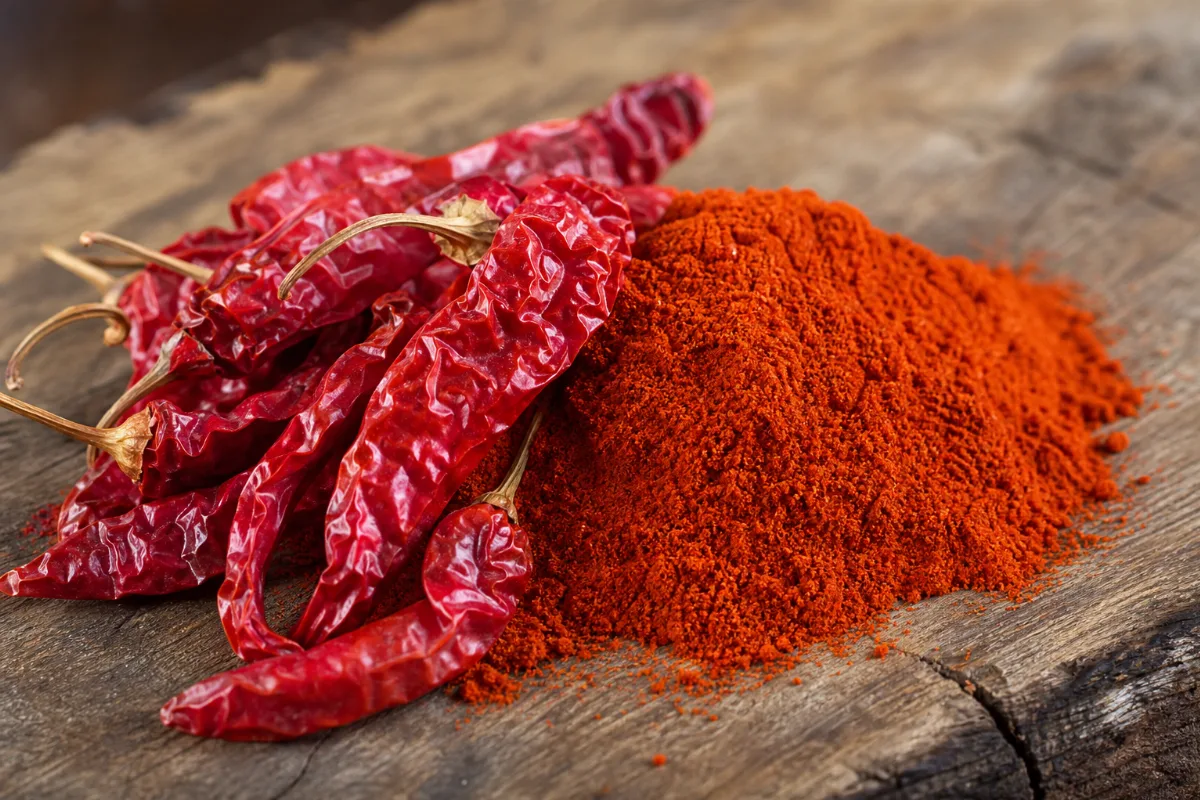
Kashmiri chili, or Kashmiri red chilli (laal mirch), is a mild variety of Capsicum annuum. The dried pod is the part used. [1] It is grown mainly in Jammu and Kashmir and Himachal Pradesh in India, with some in Goa, and it is harvested in winter. [1] It is prized for its deep red colour more than for heat. [1][2]The name is used loosely on shop shelves. Whole pods look long, thin and wrinkled, and the skin is a deep jewel red. [3] The same article says Byadagi chilies are often used in its place because demand is high. [1]
Flavor and aroma
Kashmiri chili is mild. Most sources put it at 1,000 to 2,000 Scoville heat units (SHU), about the level of a poblano. [1][2][3] The taste is fruity and slightly sweet, with a hint of smoke and a slightly bitter finish. [2][3]One caution. India's Consumer Education and Research Centre reported 48,000 and 60,000 SHU for two retail "Kashmiri" powders. [1] The source does not explain this. Products sold under the name may not all be the true mild type.
How it is used in cooking
The powder gives food a dark red colour without much heat. [1][2] It is sold ground or as whole dried pods. [3]- Curries and gravies: a common choice when you want rich red colour. [2]
- Tandoori and kebabs: tandoori chicken, chicken kabobs, tikka masala and dum biryani. [1][2]
- Marinades and masala blends: one cook's guide lists marinades and masala blends. [2]
- Pickles and chutneys: also named, along with colouring for pav bhaji and misal pav. [1]
The sources we read do not say when to add it or whether to fry it in oil first, so we give no rules here.
If you cannot find it, sweet paprika works in a pinch but loses the fruity note. [3] One guide also lists paprika, pasilla, ancho, mulato and guajillo, noting guajillo is closest in heat. [2] Swapping changes colour and flavor.
Normal food amounts
| Measure | Grams | Source |
|---|---|---|
| 1 teaspoon | No Kashmiri-specific USDA figure | USDA SR Legacy has no entry |
| 1 tablespoon | No Kashmiri-specific USDA figure | USDA SR Legacy has no entry |
| Typical recipe amount | Not found | We opened no source that states one |
USDA SR Legacy has no entry for Kashmiri chili, so we give no nutrient table. For rough scale only, USDA lists 1.8 g per teaspoon for ground red or cayenne pepper, a different product. [13] A teaspoon of any ground chili is a small amount of food. We do not call it a "good source" of anything.
Buying, storing and preparing
- Forms: whole dried pods and ground powder. Powder is the more common form. [3]
- What to look for: bright red, pliable pods. Brittle pods or faded colour suggest they are stale. [2]
- Where to find it: specialty Indian markets and online sellers. Most grocers do not stock it. [3]
- Storing: airtight, in a cool, dry place away from direct sun. One guide says homemade powder keeps up to six months. [2] We found no tested shelf life for shop powder.
- Making your own: one guide dry-roasts washed, sun-dried pods in a pan until dark red but not black, then grinds and sifts. It says to wear gloves, since the powder stains skin. [2]
- Adulteration: Wikipedia cites brick powder mixed into chilli powder. [1] A review of European food-alert reports found banned dyes such as Sudan I, III and IV, para red and rhodamine B in chilli pepper, with India the most-reported origin. [11] A review of spice fraud says powdered spices are especially open to fraud. [12] These findings are about chilli products in general, not Kashmiri powder in particular.
Health: what research says
Eating chili in cooking is different from taking capsaicin as a supplement or putting a capsaicin patch on the skin. No study we found tested Kashmiri chili itself, so everything below is about chili peppers in general.Food amounts vs supplements
| In normal cooking | In supplements and extracts | |
|---|---|---|
| Typical amount | A teaspoon or less of powder; no usual recipe amount found | We found no official amount |
| What studies mostly used | Questionnaires about how often people eat spicy food | Capsaicin capsules; creams and 8% patches for the skin [5][6] |
| What we can say about benefit | Associations only, mixed in direction [7][8][9] | Prescription patches help some people with nerve pain; capsules are unproven [4][5] |
| Main safety limit | Stomach irritation; handling burns; possible allergy [4][10] | Drug interactions; stomach bleeding case reports [4] |
What the evidence shows
| Use | What the sources found | Strength of evidence | Form and population |
|---|---|---|---|
| Death from any cause or heart disease | A 2021 pooling of 4 cohort studies (564,748 adults, median 9.7 years) found regular spicy-food eaters had 12% lower risk of death from any cause and 18% lower risk of death from heart disease. [7] Observation cannot prove cause. | Promising but limited | Chili foods; adults in 4 countries [7] |
| Stomach and gullet cancer | A 2022 pooling of 14 case-control studies found high chili intake linked to higher risk of gastrointestinal cancers (odds ratio 1.64, range 1.00 to 2.70), mainly esophageal cancer, with opposite results in South America and Europe. [9] | Mixed | Chili foods; case-control studies [9] |
| Overall health outcomes | An umbrella review of 11 reviews found the health effect of spicy food is unclear, with links to some cancers and to lower mortality and heart disease. [8] | Mixed | Spicy food; adults [8] |
| Nerve pain (postherpetic neuralgia, diabetic and HIV neuropathy) | About 10% more people improved with an 8% capsaicin patch than with a low-dose control. Evidence quality was moderate to very low. [5] | Promising but limited | Prescription patch on skin; adults [5] |
| Nerve pain with low-dose cream | Cochrane found too little data and no meaningful effect beyond placebo cream; skin irritation was common. [6] | No good evidence of benefit | 0.075% cream; adults [6] |
| Blood sugar, appetite, blood pressure | MSK calls the evidence limited and mixed; a systematic review found no effect on blood pressure or heart rate. [4] | Mixed | Capsaicin supplements and chili; adults [4] |
| Cancer treatment or prevention | MSK says cancer effects are unclear. [4] | Lab or animal only | Lab studies [4] |
For capsaicin and cayenne in more depth, see the herb guide: Cayenne pepper.
Official statements
- MSK (US): culinary amounts are generally considered safe; supplements are much more concentrated and evidence is limited and mixed. [4]
- EMA/HMPC (EU): a monograph on small-fruited Capsicum exists, but the PDF could not be read by our tool, so we state no wording.
- Cochrane, 2012 and 2017: see the nerve pain rows above. [5][6]
Related pages
Health connections for Kashmiri chili
What research links to this spice, and how strong the evidence is. Most studies use concentrated extracts or doses far above what you eat; each card says which.
Heart-related and all-cause death in spicy-food eaters
Preliminary or mixedA 2021 pooling of 4 cohort studies (564,748 adults) found 12% lower risk of death from any cause and 18% lower from heart disease in regular spicy-food eaters.
Supplements: Finding is for chili foods, not supplements.
Nerve pain from the skin (prescription 8% capsaicin patch)
Clinically supportedCochrane found about 10% more people improved with the 8% patch than with a low-dose control in postherpetic neuralgia, with evidence of moderate to very low quality.
Supplements: Applies to a prescription patch, not food or capsules.
Overall health outcomes of spicy food
Preliminary or mixedAn umbrella review of 11 reviews called the health effect of spicy food and chili unclear, with links to lower mortality and heart disease and to some cancers.
Supplements: Findings are for dietary chili, not supplements.
Blood sugar, appetite and blood pressure (capsaicin)
Preliminary or mixedMSK calls evidence limited and mixed; capsaicin may modestly lower blood glucose and a systematic review found no blood pressure effect.
Supplements: Mostly capsaicin supplements; no benefit shown for food amounts.
Low-dose capsaicin cream for nerve pain
Not enough evidenceCochrane found too little data and no meaningful effect beyond placebo cream; skin irritation was common.
Supplements: Topical cream, not food.
Connected topics
Open a group to see how each topic connects and how strong the evidence is.
Body systems (3)
- Pain & InflammationClinically supported
A prescription 8% capsaicin patch helped some people with nerve pain; this is a skin medicine, not cooking.
- Digestive SystemDocumented risk
MSK lists stomach irritation and pain; a pooled study links high chili intake with higher risk of some GI cancers.
- Heart & CirculationPreliminary or mixed
Regular spicy-food eaters had lower heart-related death in a pooled cohort analysis; this is an association for chili foods, not proof.
Body parts (2)
Functional actions (1)
- Pain ReliefClinically supported
The prescription capsaicin patch gave more people moderate or substantial pain relief than control in nerve pain; low-dose cream showed no meaningful effect.
Root causes (1)
- Medication Side EffectsDocumented risk
MSK lists possible interactions of capsaicin with blood pressure drugs, theophylline and cyclosporine, mainly for supplements.
Conditions & symptoms (3)
- Postherpetic NeuralgiaClinically supported
An 8% prescription capsaicin patch gave about 10% more people improvement than a low-dose control; this is not cooking.
- Contact DermatitisDocumented risk
MSK lists contact dermatitis in case reports with cayenne.
- Food AllergyDocumented risk
A 2025 review lists pepper among spices linked to allergy in children.
Documented risks and interactions (4)
- Possible link with gastrointestinal cancers. A 2022 pooling of 14 case-control studies linked high chili intake with higher risk of GI cancers (OR 1.64, 1.00 to 2.70), mainly esophageal; results ran the opposite way in South American and European studies.
- Medicine interactions (capsaicin). MSK lists possible effects on blood pressure drugs, ACE inhibitor cough, theophylline absorption and cyclosporine levels; some clinical relevance is unknown.
- Allergy and skin or stomach irritation. A 2025 review lists pepper among spices linked to allergy in children, with cross-reaction to pollen; MSK lists contact dermatitis, stomach irritation and rare anaphylaxis with cayenne.
- Adulteration with banned dyes in chilli products. RASFF reports show Sudan dyes, para red and rhodamine B in chilli pepper, with India the most-reported origin; Wikipedia also cites brick powder.
Frequently asked questions
Is Kashmiri chili hot?
Mostly no. Most sources put it at 1,000 to 2,000 SHU, about poblano level. [1][3] Some retail powders sold as Kashmiri were reported much hotter. [1]
How much is normal?
We found no source for a usual recipe amount, and USDA has no entry for it. Start small and taste.
Is it safe in pregnancy?
MSK advises avoiding cayenne during pregnancy. [4] We found no source on mild chili in food. Ask your midwife or doctor.
Can I take it with medicines?
In food amounts the sources name no firm problems. MSK lists possible interactions for capsaicin with blood pressure medicines, theophylline and cyclosporine, mainly for supplements. [4] Ask a pharmacist if you take these.
What can I use instead?
Sweet paprika gives colour but less fruit flavor. [3] Guajillo is closest in heat. [2]
Is it good for my heart?
Large studies of people who eat spicy food link it to lower heart-related death, but these cannot prove cause. [7] It is not a treatment.
More details: evidence, limits and cautions
The details behind this page: cautions, limits of the evidence and where sources disagree. Open any note to read it.
Safety note at a glance
Safety in more detail
- Medicines: MSK says capsaicin may affect blood pressure medicines and may increase cough from ACE inhibitors, and may raise theophylline absorption. It says to avoid it in transplant patients because it may raise cyclosporine levels. Clinical relevance is unknown for some of these. [4] These points are about capsaicin, mostly as supplements.
- Pregnancy: MSK advises avoiding cayenne. [4] The sources we read do not say whether a spoonful of mild chili in food is harmful.
- Breastfeeding: MSK describes skin inflammation in breastfed babies whose mothers ate red pepper. [4]
- Children: a 2025 review lists pepper among spices linked to allergy in children. [10] The sources we read do not describe chili amounts for children.
- Allergy: a 2025 review says spice allergy can range from mild mouth reactions to anaphylaxis, and that cross-reaction with pollen is common. [10] MSK mentions rare anaphylaxis and contact dermatitis with cayenne. [4]
- Liver and kidney: the sources we read do not describe liver or kidney problems.
- Surgery: the sources we read do not describe a surgery warning. Tell your surgical team about any supplement.
- Quality and contamination: banned dyes and unapproved pesticide residues have been reported in chilli pepper. [11]
- Amounts that cause trouble: MSK lists sweating, eye or nose irritation, stomach irritation and pain, and case reports of high blood pressure and stomach bleeding. [4] People with high blood pressure or heart conditions should ask a provider before using cayenne supplements. [4]
References
- Wikipedia — Kashmiri red chilli. https://en.wikipedia.org/wiki/Kashmiriredchilli (accessed 2026-10-24)
- Spice and Life — Kashmiri chili powder. https://www.spiceandlife.com/kashmiri-chili-powder/ (accessed 2026-10-24; food blog)
- PepperScale — Kashmiri chili guide. https://pepperscale.com/?p=16885 (accessed 2026-10-24; hot-pepper reference site)
- Memorial Sloan Kettering Cancer Center — About Herbs: Cayenne. https://www.mskcc.org/cancer-care/integrative-medicine/herbs/cayenne (accessed 2026-10-24)
- Derry S et al. — Topical capsaicin (high concentration) for chronic neuropathic pain in adults. Cochrane Database Syst Rev 2017; abstract read via Europe PMC. https://pubmed.ncbi.nlm.nih.gov/28085183/ (accessed 2026-10-24)
- Derry S, Moore RA — Topical capsaicin (low concentration) for chronic neuropathic pain in adults. Cochrane Database Syst Rev 2012; abstract read via Europe PMC. https://pubmed.ncbi.nlm.nih.gov/22972149/ (accessed 2026-10-24)
- Association of spicy chilli food consumption with cardiovascular and all-cause mortality: a meta-analysis of prospective cohort studies. Angiology 2021; abstract read via Europe PMC. https://pubmed.ncbi.nlm.nih.gov/33657876/ (accessed 2026-10-24)
- Spicy food and chili peppers and multiple health outcomes: umbrella review. Mol Nutr Food Res 2022; abstract read via Europe PMC. https://pubmed.ncbi.nlm.nih.gov/36111960/ (accessed 2026-10-24)
- Association between chili pepper consumption and risk of gastrointestinal-tract cancers: a meta-analysis. Front Nutr 2022; abstract read via Europe PMC. https://pubmed.ncbi.nlm.nih.gov/36407551/ (accessed 2026-10-24)
- Spices, herbs and allergic reactions in children: myth or reality. Front Allergy 2025; abstract read via Europe PMC. https://pubmed.ncbi.nlm.nih.gov/41306764/ (accessed 2026-10-24)
- Pesticide residues and unauthorized dyes as adulteration markers in chilli pepper and tomato. 2023; abstract read via Europe PMC. https://pubmed.ncbi.nlm.nih.gov/36684413/ (accessed 2026-10-24)
- Spice and herb frauds: types, incidence, and detection: the state of the art. 2023; abstract read via Europe PMC. https://pubmed.ncbi.nlm.nih.gov/37761082/ (accessed 2026-10-24)
- USDA FoodData Central, SR Legacy (April 2018) — Spices, pepper, red or cayenne (fdc_id 170932), household portions from the site's USDA data file.