Grains of paradise: Flavor, Cooking Use and Health Facts
Grains of paradise taste peppery with citrus and a touch of cardamom and are used in stews, rubs and drinks; trials of extracts are small and mostly company-linked, and we found no food-amount studies.
Content last updated . This page has not been medically reviewed.
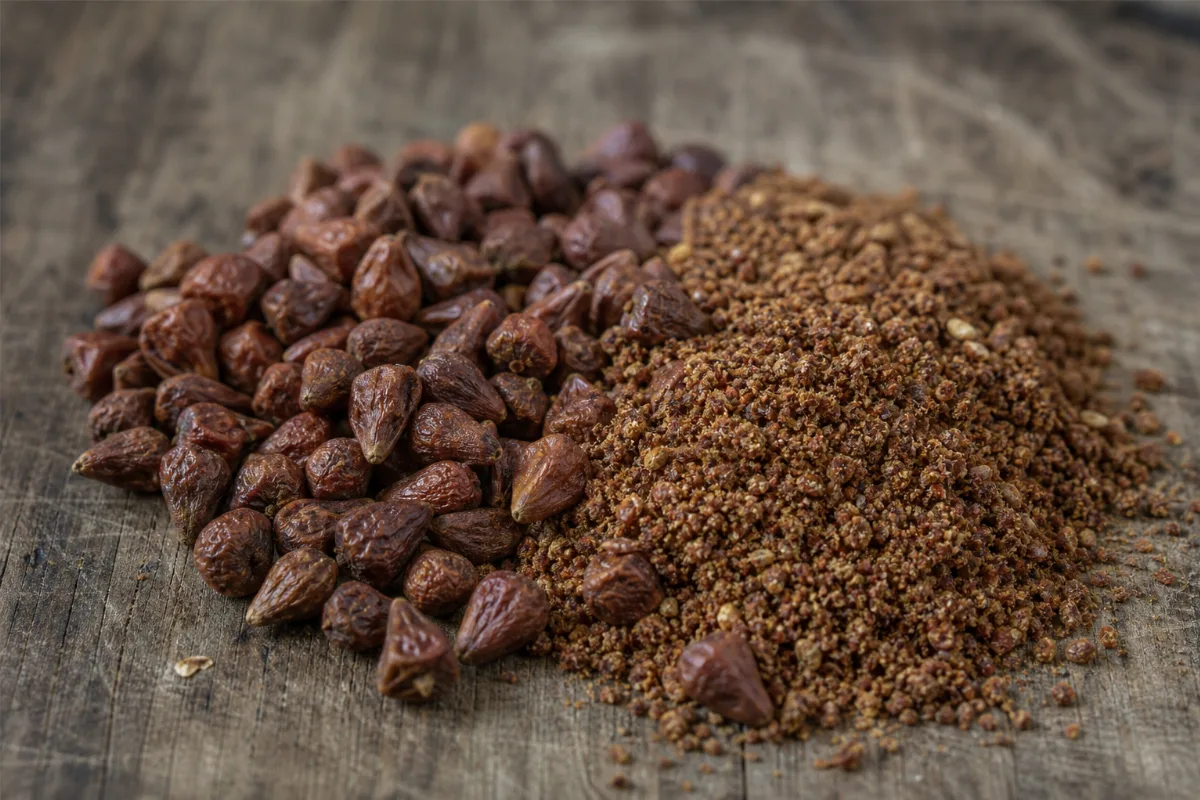
In the kitchen at a glance
Flavor:Hot / pungentCitrusyWarm / woody
Aroma: Peppery and warm, with a hint of citrus and cardamom.
Used in: soups and stews, grilling and rubs, vegetables, tea and drinks, curries
Usual amount in food: We found no source that gives a usual amount; cooking pages say only "a pinch," and USDA has no entry for this spice.
What it is
Grains of paradise are the seeds of Aframomum melegueta, a plant in the ginger family that is closely related to cardamom. [1] It grows in swampy areas along the West African coast. [1] The seeds sit in pods and are small and reddish-brown. [1] The name "alligator pepper" and "melegueta pepper" are used for the same spice. [1] It is not the same plant as black pepper. [1]Flavor and aroma
The seeds are pungent, with a black-pepper-like bite and hints of citrus. [1] One cooking guide adds a touch of cardamom, mild rounded heat and sometimes a floral note. [2] The heat comes mainly from aromatic ketones such as 6-paradol. [1] The essential oils that give cardamom most of its aroma are present only in traces here. [1] Grinding just before use gives the best flavor. [2] It suits creamy dishes, soups, stews and sauces. [2]How it is used in cooking
Use the seeds whole or ground. [1] Crush or grind them lightly to release the flavor. [2]- West and North African cooking: a common seasoning. [1]
- Stews, soups and sauces: sprinkle ground seed in. [2]
- Rubs and blends: whole seeds go into meat seasonings before grilling. [2]
- Vegetables, baking and dressings: used in roasted or sauteed vegetables, baked goods, marinades and dressings. [2]
- Drinks: a pinch goes into tea or cocktails. [2] Some craft beers, gins and Norwegian akvavit use it. [1]
- History: in the 14th and 15th centuries it became a popular stand-in for black pepper in Europe. [1]
Possible substitutes named by one cooking guide: black pepper (closest, but without citrus; use less), a little cardamom, crushed coriander seed, a little allspice, or Sichuan peppercorns. [2] The sources we read do not say when in cooking to add it or whether to toast it, so we give no rules on that.
Normal food amounts
USDA SR Legacy has no entry for this spice, so we give no grams per teaspoon and no nutrient numbers.| Measure | Grams | Source |
|---|---|---|
| 1 teaspoon, ground | Not found | USDA SR Legacy has no entry |
| Typical recipe amount | Not found | The cooking guide we read says only "a pinch" and "a little" [2] |
Because we have no nutrient data, we do not call grains of paradise a "good source" of anything. Used in pinches, it is mostly flavor.
Buying, storing and preparing
- Forms: whole seeds and ground spice. [2]
- Where to buy: spice shops, bulk sections, African or Caribbean grocery stores, and online. [2]
- Storage: one guide advises an airtight container below 21 C (70 F), away from light, heat and humidity. [2]
- Shelf life: the same guide says whole seeds keep up to about 2 years and ground spice about 6 months to 1 year. This comes from a single cooking blog, so treat it as a rule of thumb. [2]
- Freshness: smell it now and then; if the aroma is flat, it is past its best. [2]
- Adulteration or contamination: the sources we read do not describe any problem.
Health: what research says
Using grains of paradise as a pinch in cooking is very different from taking a concentrated seed extract.Food amounts vs supplements
| In normal cooking | In supplements and extracts | |
|---|---|---|
| Typical amount | A pinch; no measured amount found [2] | Trials used extracts at 30 mg a day, 500 mg a day (2% 6-paradol), and 50 to 150 mg a day (10% vanilloids) [3][4][5] |
| What studies mostly used | We found no study of the spice as eaten in food | Standardized seed extracts in small, short trials; two had authors who work for the product makers [4][5] |
| What we can say about benefit | Nothing from human studies | Small trials report changes in belly fat, energy use and anxiety scores; none is confirmed by larger work [3][4][5] |
| Main safety limit | The sources we read give none for food amounts | A rat study of a strong extract raised liver weight [6] |
What the evidence shows
| Use | What the sources found | Strength of evidence | Form and population |
|---|---|---|---|
| Belly fat and energy use | A 2014 crossover trial in 19 young women found less belly fat and higher energy use than placebo over 4 weeks. [3] A 2022 trial in 70 overweight adults reported less visceral fat and a 4 kg weight drop over 12 weeks; some authors work for the maker and lean mass also fell. [4] | Promising but limited | Extract, 30 mg a day and 500 mg a day; healthy or overweight adults [3][4] |
| Anxiety, mood and sleep | A 2025 pilot (30 completers, 3 days per dose) reported lower anxiety scores and better sleep ratings than placebo. Mood scores also improved in the placebo group. The maker's staff took part. [5] | Insufficient evidence | Extract at 50, 100 and 150 mg; adults aged 40 to 50 with moderate anxiety [5] |
| Blood sugar | Rats given a strong extract had lower blood glucose; the authors also flagged liver effects. [6] | Lab or animal only | Rat extract, 28 days [6] |
| Heart and organ effects | A 30-day rat study found changes in heart and liver markers and a heart-rhythm effect. [7] | Lab or animal only | Rat extract [7] |
| Any use of the spice sprinkled on food | No study found | Insufficient evidence | Food amounts |
There is no herb guide for this spice on the site. For a related ginger-family spice, see Cardamom.
Official statements
- FDA (US): the table of spices and natural seasonings in 21 CFR 182.10 lists grains of paradise under the name Amomum melegueta. [9]
- EFSA, EMA, WHO/JECFA, NCCIH: we found no statement on this spice.
Related pages
Health connections for Grains of paradise
What research links to this spice, and how strong the evidence is. Most studies use concentrated extracts or doses far above what you eat; each card says which.
Belly fat and energy use
Preliminary or mixedTwo small trials of seed extract report less visceral fat and higher energy use than placebo.
Supplements: Extract finding only; no study of food amounts found; not confirmed by larger trials.
Anxiety, mood and sleep ratings
Preliminary or mixedA small 2025 pilot of a standardized extract reported lower anxiety scores and better sleep ratings than placebo.
Supplements: Extract finding only (50 to 150 mg a day); too small and short to rely on.
Blood glucose in rats
Lab or animal research onlyMale rats given a strong ethanol extract for 28 days had lower blood glucose.
Supplements: Not tested in people; no food-amount data.
Connected topics
Open a group to see how each topic connects and how strong the evidence is.
Health goals (1)
- Weight ManagementPreliminary or mixed
Two small trials of seed extract report less belly fat; this is extract, not food, and not confirmed.
Body systems (3)
- Digestive SystemDocumented risk
A consumer reference says it might irritate the stomach and intestine; a secondary source with no dose range.
- Liver & DetoxDocumented risk
Rat extract raised liver weight and alkaline phosphatase; no food-amount data.
- Metabolism & WeightPreliminary or mixed
Small extract trials report higher energy use and less visceral fat; food amounts not studied.
Body parts (1)
- LiverDocumented risk
A 28-day rat study of a strong extract raised liver weight; authors said liver toxicity should be considered. Human significance unknown.
Documented risks and interactions (4)
- Liver weight increase in rats. In a 28-day rat study of a strong extract, liver weight and alkaline phosphatase rose with dose; authors said liver toxicity should be considered.
- Heart and organ marker changes in rats. A 30-day rat study of an extract reported changes in heart and liver markers and a heart-rhythm effect.
- Use in pregnancy and breastfeeding. A consumer reference says there is not enough information and advises avoiding it.
- Stomach and urinary irritation. A consumer reference says it might irritate the stomach, intestine and urinary system.
Frequently asked questions
Is it sweet?
No. It is peppery and warm, with citrus and a hint of cardamom. [1][2]
How much is normal?
We found no measured amount. Cooking pages say a pinch or a little, and it is often used in place of black pepper. [2]
Is it safe in pregnancy?
One consumer reference says there is not enough information and advises avoiding it. [8] Ask your midwife or doctor.
Can I take it with medicines?
The source we read does not list interactions, and we found no human study on this. [8] Ask a pharmacist if you plan to use an extract.
Can it replace black pepper?
Yes, in cooking. It was used that way in medieval Europe. [1] Black pepper is the closest substitute the other way, but has no citrus note. [2]
Does it burn fat?
Two small extract trials report less belly fat. Both were short and one had authors from the product maker. [3][4] Pinches in food have not been studied.
More details: evidence, limits and cautions
The details behind this page: cautions, limits of the evidence and where sources disagree. Open any note to read it.
Safety note at a glance
Safety in more detail
- Medicines: the RxList page we read does not mention interactions. [8] We could not open a source showing an effect on liver enzymes, so we make no claim. If you take regular medicines, ask a pharmacist before using extracts.
- Pregnancy: RxList says there is not enough information and advises avoiding it. [8] That advice is about supplements; we found no source on food amounts.
- Breastfeeding: RxList gives the same advice as for pregnancy. [8]
- Children: the sources we read do not describe use in children.
- Allergy: the sources we read do not describe allergy.
- Liver and kidney: in a 28-day rat study at 450 and 1,500 mg per kg, liver weight and alkaline phosphatase rose, and the authors said liver toxicity should be considered. [6] The 2022 human trial reported normal liver and kidney tests over 12 weeks. [4]
- Surgery: the sources we read do not describe a surgery warning. Tell the surgical team about any supplement.
- Quality and contamination: the sources we read do not describe any.
- Amounts that cause trouble: RxList says it might irritate the stomach, intestine and urinary system, and that no safe dose range is set. [8] The human trials reported no serious side effects, but they were short. [3][4][5]
References
- Wikipedia — Grains of paradise (cites several reference works). https://en.wikipedia.org/wiki/Grainsofparadise (accessed 2026-10-24)
- FAS Kitchen — Grains of Paradise 101: nutrition, benefits, how to use, buy, store (cooking blog). https://www.faskitchen.com/grains-of-paradise-101/ (accessed 2026-10-24)
- Sugita J et al. — Daily ingestion of grains of paradise extract and visceral fat and energy expenditure. J Nutr Sci Vitaminol 2014; 60(1):22-27; abstract read via Europe PMC. https://pubmed.ncbi.nlm.nih.gov/24759256/ (accessed 2026-10-24)
- Aframomum melegueta seed extract with standardized 6-paradol reduces visceral fat and enhances energy expenditure in overweight adults. Drug Des Devel Ther 2022; 16:3777-3791. https://pmc.ncbi.nlm.nih.gov/articles/PMC9624637 (accessed 2026-10-24)
- Aframomum melegueta seed extract's effects on anxiety, stress, mood and sleep: a randomized, double-blind, pilot clinical trial. Pharmaceuticals 2025; 18(2):278. https://pmc.ncbi.nlm.nih.gov/articles/PMC11859572/ (accessed 2026-10-24)
- Ilic N et al. — Toxicological evaluation of grains of paradise. J Ethnopharmacol 2010; 127(2):352-356; abstract read via Europe PMC. https://pubmed.ncbi.nlm.nih.gov/19883745/ (accessed 2026-10-24)
- Biobaku KT et al. — Thirty days oral Aframomum melegueta extract in rats. J Ethnopharmacol 2021; abstract summary read via Europe PMC. https://pubmed.ncbi.nlm.nih.gov/33096199/ (accessed 2026-10-24)
- RxList — Grains of Paradise (consumer supplement monograph). https://www.rxlist.com/grainsofparadise/supplements.htm (accessed 2026-10-24)
- eCFR — 21 CFR 182.10, spices and other natural seasonings and flavorings. https://www.ecfr.gov/current/title-21/part-182/section-182.10 (accessed 2026-10-24)