Dill seed: Flavor, Cooking Use and Health Facts
Dill seed tastes like a stronger, warmer cousin of caraway and is used in pickles and breads; small supplement trials on cholesterol are mixed, and food amounts have not been tested.
Content last updated . This page has not been medically reviewed.
In the kitchen at a glance
Flavor:EarthyWarm / woodyCitrusy
Aroma: Fresh, a little citrusy and like caraway, stronger than the leafy herb.
Used in: pickling, baking, soups and stews, vegetables
Usual amount in food: About 1 teaspoon (2.1 g) of dill seed is the USDA household measure; we found no source that sets a usual recipe amount.
What it is
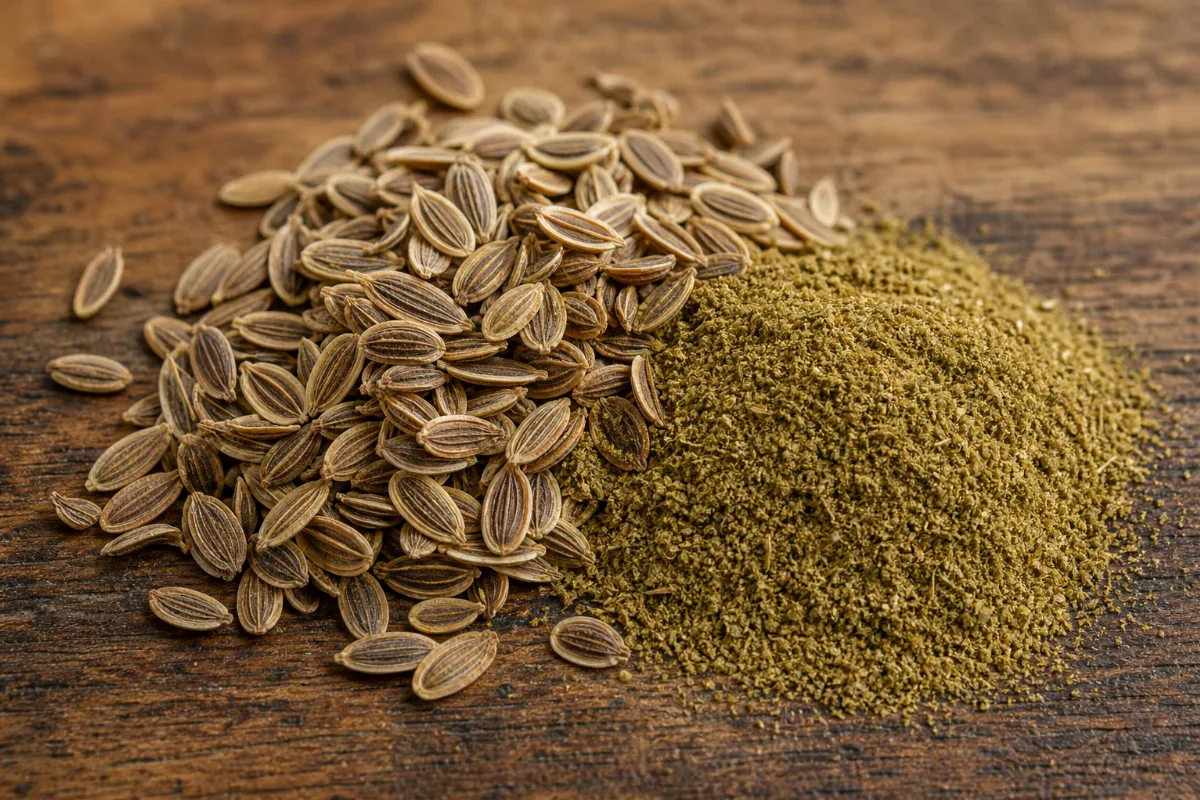
Dill seed comes from dill, Anethum graveolens, an annual plant in the celery family. [1] Dill grows 0.5 to 1.5 m tall and is native to North Africa, Iran and the Arabian Peninsula. It is now grown widely across Eurasia. [1] The "seeds" are really the dried fruits of the plant. They are 4 to 5 mm long, straight to slightly curved, and ridged. [1] The leafy part of the plant is a different product, called dill weed. This page is about the seed.Flavor and aroma
Dill seed is stronger and warmer than the fresh leaves. A study of the oils in dill fruits found carvone and limonene as main components. [4] We did not open a source that describes the taste in words, so the taste notes in this page's summary line are general kitchen knowledge, not a cited finding. In plain terms: expect a clean, slightly sharp, caraway-like note with some citrus.Because oils fade with air, whole seed keeps its aroma better than ground seed. [3] Warming whole seed in a dry pan or in oil is a common way to bring out aroma in many spices, but the sources we opened do not say this about dill seed, so we give no rule here.
How it is used in cooking
Dill is the best-known flavor of dill pickles. [1][2] Whole dill stems with their umbels and green seeds are among the spices listed for traditional brined pickles, and dill is named in Hungarian summer pickles. [2] Kosher-style dill pickles use a lot of garlic and dill in a salt brine. [2]Other uses we confirmed:
- Breads and drinks, Sweden: the seed goes into breads and the spirit akvavit. [1]
- Cold dishes, Arab countries: the seed is called "ain jaradeh" and used in dishes such as fattoush and in pickles. [1]
- Soups, stews and vegetables: common in home cooking, but the sources we opened do not describe it, so we list no dishes.
We did not find a reliable source for when to add dill seed during cooking, or for substitutes. Caraway and fennel seed are related seed spices with their own pages, but a swap will change the dish. See caraway and fennel seed.
Normal food amounts
| Measure | Grams | Source |
|---|---|---|
| 1 teaspoon dill seed | 2.1 g | USDA [13] |
| 1 tablespoon dill seed | 6.6 g | USDA [13] |
| Typical recipe amount | Not found | We opened no source that states one |
What one teaspoon (2.1 g) provides, calculated from USDA values per 100 g:
| Nutrient | One teaspoon |
|---|---|
| Energy | about 6 kcal |
| Fiber | about 0.4 g |
| Calcium | about 32 mg |
| Potassium | about 25 mg |
| Magnesium | about 5 mg |
| Iron | about 0.3 mg |
The USDA SR Legacy data are from 2018, and real products vary. [13] We did not compare these numbers with official daily values, so we do not call dill seed a "good source" of anything. A pinch is mostly flavor.
Buying, storing and preparing
- Forms: whole seed is the usual form; ground seed is sold too, though the sources we opened do not describe it. The distilled seed oil is a separate, concentrated product used in soap-making. [1]
- Shelf life: a general reference says whole dry spices last about two years and ground spices about six months. This is a rule for spices in general, not for dill seed. [3]
- Storing: keep spices away from light. Store them whole and grind as needed. [3]
- Quality problems: we found no source describing adulteration of dill seed.
Health: what research says
Eating dill seed in cooking is very different from taking dill capsules, powders or oils.Food amounts vs supplements
| In normal cooking | In supplements and extracts | |
|---|---|---|
| Typical amount | About 2.1 g per teaspoon (USDA); no usual recipe amount found [13] | A trial in type 2 diabetes used 3 g a day of dill powder in capsules [8]; a dysmenorrhea trial used 1,000 mg of powder twice a day [9] |
| What studies mostly used | We found no study of dill seed used as a seasoning | Powders, capsules and oils, in small trials, mostly in Iran [6][7][8][9] |
| What we can say about benefit | Nothing, because it has not been tested | Some pooled trials show lower LDL cholesterol or insulin markers; results differ between reviews [6][7] |
| Main safety limit | Allergy to dill in a few people [5][12] | The sources we read give no safe-dose limit for supplements [5] |
What the evidence shows
| Use | What the sources found | Strength of evidence | Form and population |
|---|---|---|---|
| LDL cholesterol and insulin resistance | A 2022 pooling of 7 trials (330 adults) found lower LDL, insulin and HOMA-IR, but no significant change in total cholesterol, triglycerides, HDL or fasting glucose. [6] | Promising but limited | Dill supplements; adults [6] |
| Cholesterol, second review | A 2022 pooling of 6 trials (171 treated adults) found lower total cholesterol, LDL and triglycerides, and also lower HDL. The authors asked for better trials. [7] | Mixed | Dill supplements; adults [7] |
| Type 2 diabetes markers | In 42 patients, 3 g a day of dill powder lowered insulin, insulin resistance, LDL and total cholesterol compared with the start. [8] | Promising but limited | Powder in capsules; adults with type 2 diabetes [8] |
| Period pain | In 75 students in Iran, dill powder lowered pain scores about as much as mefenamic acid, a painkiller. The authors asked for studies on side effects and interactions. [9] | Promising but limited | Powder; young women [9] |
| Length of labor | A 2020 review of two trials and two cohort studies reported shorter labor stages. [10] | Insufficient evidence | Seeds; pregnant women [10] |
| Milk supply when breastfeeding | LactMed says no valid clinical trials support this traditional use. [5] | No good evidence of benefit | Dill, traditional use [5] |
| Anything from dill seed in cooking | No study found | Insufficient evidence | Food amounts |
For supplement forms, trials and interactions in depth, see the full herb guide: Dill. Our summary here matches that guide.
Official statements
- FDA (US): dill is generally recognized as safe as a food, as reported by LactMed. [5]
- EMA, EFSA, WHO, NCCIH: we found no dill seed statement from these bodies in the pages we could open.
Related pages
Health connections for Dill seed
What research links to this spice, and how strong the evidence is. Most studies use concentrated extracts or doses far above what you eat; each card says which.
LDL cholesterol
Preliminary or mixedA 2022 pooling of 7 trials (330 adults) found lower LDL cholesterol with dill supplements, but not total cholesterol, triglycerides or HDL.
Supplements: Supplement finding only (powder or capsule); no study of dill seed as a seasoning found. A second review reported mixed lipid results including lower HDL.
Insulin and insulin resistance
Preliminary or mixedThe same pooling found lower insulin and HOMA-IR; one trial of 3 g a day of powder in 42 adults with type 2 diabetes found lower insulin and insulin resistance versus the start.
Supplements: Supplement finding only (powder or capsule); no study of dill seed as a seasoning found. It does not replace diabetes care.
Period pain
Preliminary or mixedIn one trial of 75 students, dill powder lowered pain scores about as much as mefenamic acid.
Supplements: Supplement finding only (powder or capsule); no study of dill seed as a seasoning found.
Length of labor
Not enough evidenceA 2020 review of two trials and two cohort studies reported shorter labor stages with dill seed.
Supplements: Seed or extract in pregnancy; not a kitchen-amount finding. Ask a midwife or doctor.
Milk supply when breastfeeding
Not enough evidenceDill is a traditional milk-supply remedy, but LactMed says no valid clinical trials support the use.
Supplements: No good evidence of benefit.
Connected topics
Open a group to see how each topic connects and how strong the evidence is.
Health goals (3)
- Blood Sugar BalancePreliminary or mixed
Supplement trials found lower insulin and insulin resistance; fasting glucose did not change significantly in the pooled result.
- Cholesterol BalancePreliminary or mixed
Pooled supplement trials found lower LDL cholesterol in one review and mixed results in another; no study of food amounts.
- Women’s WellnessPreliminary or mixed
One small trial found less period pain with dill powder; a labor review is limited.
Body systems (3)
- Blood Sugar SupportPreliminary or mixed
Insulin markers changed in small supplement trials.
- Heart & CirculationPreliminary or mixed
Only blood fat markers were studied, in supplement trials.
- Reproductive HealthPreliminary or mixed
One period-pain trial and a small labor review; both limited.
Root causes (1)
- Blood Sugar ImbalancePreliminary or mixed
Insulin resistance markers lowered in small supplement trials.
Biomarkers (4)
- LDL CholesterolPreliminary or mixed
Pooled trials of supplements found lower LDL (about 15.6 mg/dL in one analysis; a smaller change in another).
- HDL CholesterolPreliminary or mixed
One review found lower HDL; the other found no significant change.
- InsulinPreliminary or mixed
Lower serum insulin in pooled supplement trials.
- TriglyceridesPreliminary or mixed
One review found lower triglycerides; another found no significant change.
Conditions & symptoms (4)
- Food AllergyDocumented risk
Occasional allergic skin reactions, mainly from fresh dill; spice cross-reactions within the celery family are common.
- HyperlipidemiaPreliminary or mixed
Pooled supplement trials show lower LDL; reviews disagree on other blood fats and authors ask for better trials.
- Insulin ResistancePreliminary or mixed
Lower HOMA-IR in a pooling of 7 supplement trials.
- Primary DysmenorrheaPreliminary or mixed
One trial of 75 students found pain scores fell about as much as with mefenamic acid.
Documented risks and interactions (3)
- Allergy and skin reactions. Occasional allergic skin reactions are reported, especially after touching fresh dill.
- Safe as a food (US FDA GRAS). LactMed reports dill is generally recognized as safe as a food by the US FDA and generally well tolerated; nursing mothers given d-carvone had no reported side effects.
- Supplement quality varies. Supplements need no FDA approval before sale and labels often differ from contents.
Frequently asked questions
What does dill seed taste like?
It is stronger than the fresh leaves, with a caraway-like note and some citrus. This is general kitchen knowledge; a main aroma compound is carvone. [4]
How much is normal?
USDA lists 2.1 g per teaspoon. [13] We found no source for a usual recipe amount.
Is it safe in pregnancy?
Food amounts are common. For seeds or extracts used as a remedy, the sources we read give no official advice. Ask your midwife or doctor. [10]
Can I take it with medicines?
In cooking, the sources we read name no problems. If you take diabetes medicine, ask about supplements, because trials found changes in insulin markers. [8]
Does dill seed lower cholesterol?
Pooled trials of dill supplements found lower LDL in one review and mixed results in another. They did not test dill seed as a seasoning. [6][7]
Can I be allergic to it?
Yes, rarely. Dill is in the celery family, and skin reactions to fresh dill are reported. [1][5]
More details: evidence, limits and cautions
The details behind this page: cautions, limits of the evidence and where sources disagree. Open any note to read it.
Safety in more detail
- Medicines: the sources we read do not describe drug interactions. The diabetes trial changed insulin markers, so ask a pharmacist before taking dill supplements if you use diabetes medicine. [8] The dysmenorrhea authors also called for interaction studies. [9]
- Pregnancy: LactMed does not cover pregnancy. A review of labor trials suggested dill seed may shorten labor, but it is a review of a few small studies, not an official safety statement. [10] Ask your midwife or doctor before using seeds or extracts as a remedy.
- Breastfeeding: LactMed says dill is generally recognized as safe as a food by the US FDA and is generally well tolerated. Two studies gave nursing mothers the compound d-carvone and saw no side effects in mothers or babies. [5]
- Children: the sources we read do not describe dill seed in children.
- Allergy: LactMed notes occasional allergic skin reactions, especially after touching fresh dill. [5] A report titled "Allergy to fresh dill" exists, but we read only its title. [12] A 2026 review says cross-reactions among celery-family spices are common, though it names cumin, not dill. [11] If you react to celery or related spices, ask an allergist.
- Liver and kidney: the sources we read do not describe liver or kidney problems.
- Surgery: the sources we read do not describe a surgery warning. Tell your surgical team about any supplement.
- Quality and contamination: LactMed notes that supplements are not approved before sale and that labels often differ from contents. We read this in its cumin entry, which we also opened. [5]
- Amounts that cause trouble: none described in the sources we read.
References
- Wikipedia — Dill. https://en.wikipedia.org/wiki/Dill (accessed 2026-10-24)
- Wikipedia — Pickled cucumber (first 100,000 characters read). https://en.wikipedia.org/wiki/Pickled_cucumber (accessed 2026-10-24)
- Wikipedia — Spice (shelf life of whole and ground spices). https://en.wikipedia.org/wiki/Spice (accessed 2026-10-24)
- Comparison of nutritional compositions and essential oil profiles of different parts of a dill and two fennel cultivars. Foods 2021; abstract read via Europe PMC. https://pubmed.ncbi.nlm.nih.gov/34441561/ (accessed 2026-10-24)
- LactMed, NIH (US) — Dill; abstract read via Europe PMC. https://pubmed.ncbi.nlm.nih.gov/30000937/ (accessed 2026-10-24). Supplement-quality wording read in the LactMed Cumin abstract, https://pubmed.ncbi.nlm.nih.gov/30000933/
- The effects of Anethum graveolens (dill) supplementation on lipid profile and glycemic control: a systematic review and meta-analysis of randomized controlled trials. Crit Rev Food Sci Nutr 2022; abstract read via Europe PMC. https://pubmed.ncbi.nlm.nih.gov/33624557/ (accessed 2026-10-24)
- Anethum graveolens L. (dill) effect on human lipid profile: an updated systematic review. Curr Probl Cardiol 2022; abstract read via Europe PMC. https://pubmed.ncbi.nlm.nih.gov/34838903/ (accessed 2026-10-24)
- The effects of Anethum graveolens (dill) powder supplementation on clinical and metabolic status in patients with type 2 diabetes. Trials 2020; abstract read via Europe PMC. https://pubmed.ncbi.nlm.nih.gov/32503652/ (accessed 2026-10-24)
- Effect of dill (Anethum graveolens) on the severity of primary dysmenorrhea in compared with mefenamic acid: a randomized, double-blind trial. J Res Med Sci 2014; abstract read via Europe PMC. https://pubmed.ncbi.nlm.nih.gov/25097605/ (accessed 2026-10-24)
- Effect of dill (Anethum graveolens Linn) seed on the duration of labor: a systematic review. Complement Ther Clin Pract 2020; abstract read via Europe PMC. https://pubmed.ncbi.nlm.nih.gov/33130423/ (accessed 2026-10-24)
- Allergic reactions to spices: a review of sensitivities to pepper, cumin, oregano, anise, mustard and other spices. Eur Ann Allergy Clin Immunol 2026; abstract read via Europe PMC. https://pubmed.ncbi.nlm.nih.gov/40341008/ (accessed 2026-10-24)
- Allergy to fresh dill. Allergy 1999; title only, no abstract available. https://pubmed.ncbi.nlm.nih.gov/10380793/ (accessed 2026-10-24)
- USDA FoodData Central, SR Legacy (April 2018) — Spices, dill seed (fdc_id 170925), per-100 g values and household portions from the site's USDA data file.