Phycocyanin (Blue Spirulina): Nutrients, What Research Shows and Safety
Phycocyanin, the blue pigment from spirulina used in drinks, candy and lattes: FDA color rules, thin human evidence, supplement form, allergy and color stability.
Content last updated . This page has not been medically reviewed.
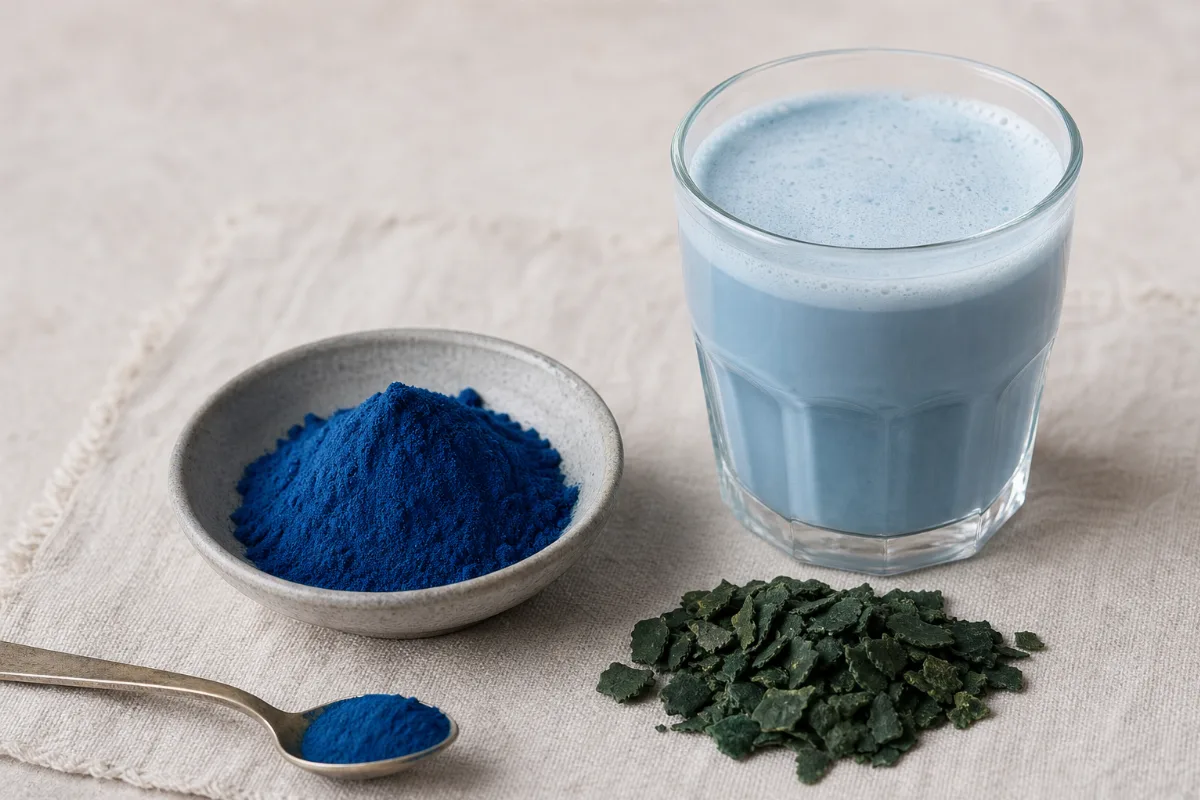
Phycocyanin is a blue pigment-protein made by spirulina (Arthrospira platensis), a blue-green alga. Companies filter it out of the alga with water to make "spirulina extract" or "blue spirulina", used to color drinks, candy, frosting and lattes, and also sold as powders and capsules. [1] This page keeps the food color apart from the supplement and from lab findings. It is separate from whole spirulina, which has its own page: spirulina.
Read this first
- As a food color it is regulated. In the U.S., the FDA rule for "spirulina extract" (21 CFR 73.530) lists many foods it may color, and sets limits for lead, arsenic (each no more than 2 mg/kg), mercury (no more than 1 mg/kg), and requires a negative test for microcystin toxin. [1]
- Human evidence for health benefits is small. In the sources we read, we found no randomized human trial of purified phycocyanin. Most findings are in cells and animals. [3] [4] [8]
- Allergy: phycocyanin was identified as a sensitizing allergen in a related blue-green alga in patient blood tests, and anaphylaxis is listed as an adverse effect of blue-green algae supplements. For trouble breathing or swelling of the face or throat, call 911 (or your local emergency number). [5] [6]
- Supplements are not the same as the food color. The color rule has a microcystin test; supplements are not regulated in the same way, and contamination has been found in blue-green algae products. [1] [6] [7]
- Color fades: heat, light, oxygen and acidity can destroy the blue. [2] [9]
What is in it (USDA values)
No USDA entry for this food. USDA FoodData Central (SR Legacy) has no record for phycocyanin or spirulina extract. The FDA describes the color additive as an aqueous extract of dried Arthrospira platensis biomass whose main coloring parts are phycocyanins. [1] We did not find a nutrient table for the extract in the sources we read. As a color, only small amounts are used ("good manufacturing practice" is the legal limit), so it adds little nutrition to a drink or candy. [1]
Plant compounds: phycocyanin and its relative allophycocyanin showed antioxidant and anti-inflammatory activity in a 2026 cell study (nerve and immune-type cells in dishes). [4] That is laboratory evidence only.
What research says
| Health goal | What the sources found | Strength of evidence | What was studied |
|---|---|---|---|
| Antioxidant and anti-inflammatory effects | Purified phycocyanin and allophycocyanin lowered reactive oxygen and nitric oxide in cultured cells. [4] | Lab or animal only | Cell dishes; purified pigments and crude extract |
| Growth and immune markers in animals | Phycocyanin in feed improved growth and some blood and immune markers in quails. [3] | Lab or animal only | 320 male quails (animal) |
| Blood fats, blood pressure and blood sugar | A systematic review of whole spirulina (13 human studies, 20 mg to 6 g, 17 to 360 days) reported benefits and credited phycocyanin among other parts. [8] | Mixed for whole spirulina; Insufficient evidence for phycocyanin alone | Whole spirulina, not purified phycocyanin; the review had a government grant |
| Inflammation in multiple sclerosis | In 80 adults with relapsing MS, 1 g a day of spirulina for 12 weeks lowered IL-1 beta and IL-6 versus placebo. [10] | Promising but limited (one trial, 20% dropped out) | Whole spirulina, form not stated |
| Exercise performance | A meta-analysis of 22 trials of spirulina and other algae found a modest gain in time to exhaustion. [11] | Mixed | Spirulina, chlorella and other algae, not phycocyanin |
| Cancer, brain protection | Cell studies only. [4] | Lab or animal only | Cells |
Food versus supplement. The blue color in foods is a small amount of extract. The trials above used whole spirulina or lab-grade pigment, not blue latte powder. A systematic review calls for clinical validation of phycobiliproteins. [2]
How much is a normal serving
There is no official serving size for phycocyanin. The FDA sets no number for the color, only "good manufacturing practice" levels. [1] This is information, not a prescription. For supplements, ask a clinician or pharmacist.
Safety, allergy and medicines
- Allergy: in blood samples from people with allergic rhinitis, phycocyanin and a linker peptide from Microcystis aeruginosa were the main sensitizing proteins. [5] MSK lists anaphylaxis among reported effects of blue-green algae supplements. [6] An EFSA opinion on a similar extract (blue galdieria) judged allergenicity risk low, using spirulina data, but that is a different product. [12]
- Toxin contamination: the FDA color rule requires microcystin-negative extract. [1] Supplements made from blue-green algae have had microcystin contamination, mostly AFA from Klamath Lake: see AFA. [7] Ask for a lab report.
- Medicines: MSK says spirulina inhibits two liver enzymes (CYP1A2 and CYP2E1), with unknown clinical meaning. This is spirulina, not purified phycocyanin. [6]
- Pregnancy and breastfeeding: Proper evidence not found in the sources we read for phycocyanin.
- PKU: Proper evidence not found in the sources we read.
- Autoimmune disease: Proper evidence not found in the sources we read. Ask a specialist.
- Regulatory note: the page we read says an amendment to this rule (91 FR 5295, Feb 2026) was delayed indefinitely. [1] Check the current rule.
Choosing, storing and food safety
- Heating, light and acid reduce the blue. A 2026 study of phycocyanin-rich powder found drying at 70 degrees C preserved phycocyanin best; hotter drying broke it down more. [9]
- Sensitivity to heat, light, oxygen and pH limits food use of phycobiliprotein pigments, and encapsulation can improve stability. [2] [13]
- A blue color on a label (for example "spirulina extract") shows the ingredient; it is not a health claim.
Related pages
Health connections for Phycocyanin (Blue Spirulina)
What research links to eating or drinking this food, and how strong the evidence is. Many studies are observational or use juice, powder, oil or extracts rather than the food as eaten; each card says which.
Blue spirulina as a food color (FDA listing)
Not enough evidenceFDA lists spirulina extract as a color additive for many foods, at good manufacturing practice levels, with limits for lead, arsenic and mercury and a negative microcystin test.
Supplements: This function is about regulatory status, not a health effect.
Phycocyanin and human health: trial evidence
Not enough evidenceIn the sources we read we found no randomized human trial of purified phycocyanin. Spirulina trials used whole spirulina.
Supplements: Proper evidence not found in the sources we read.
Phycocyanin as antioxidant and anti-inflammatory: lab findings
Lab or animal research onlyPurified phycocyanin and allophycocyanin reduced reactive oxygen species and nitric oxide in cultured cells; phycocyanin in feed improved growth and immune markers in quails.
Supplements: No human data for the pigment alone.
Spirulina and inflammation in multiple sclerosis
Preliminary or mixedIn 80 adults with relapsing MS, 1 g a day of spirulina for 12 weeks lowered IL-1 beta and IL-6 versus placebo; 20% dropped out.
Supplements: Not a treatment claim.
Spirulina and exercise performance (meta-analysis)
Preliminary or mixedA meta-analysis of 22 trials of algae supplements found a modest gain in time to exhaustion and lower creatine kinase.
Supplements: Effects described by authors as modest.
Color stability
Not enough evidenceHeat, light, oxygen and pH limit the use of phycobiliprotein pigments; drying at 70 degrees C preserved phycocyanin best in one study.
Supplements: Food-science point, not a health effect.
Connected topics
Open a group to see how each topic connects and how strong the evidence is.
Body systems (1)
- Immune SystemDocumented risk
Phycocyanin is a sensitizing allergen in a related alga; anaphylaxis is reported for blue-green algae supplements.
Functional actions (2)
- Anti-InflammatoryLab or animal research only
Lowered inflammatory signals in cultured cells; no human trial of the pure pigment found.
- AntioxidantLab or animal research only
Antioxidant activity seen in cells and animals only.
Conditions & symptoms (2)
- AnaphylaxisDocumented risk
Call 911 for trouble breathing or swelling of the face or throat.
- Food AllergyDocumented risk
Allergy to blue-green algae components is reported; anaphylaxis is an emergency.
Documented risks and interactions (2)
- Allergy to phycocyanin and blue-green algae. Phycocyanin and a linker peptide were sensitizing allergens in blood samples from allergic patients (Microcystis); MSK lists anaphylaxis for blue-green algae supplements; EFSA judged a similar extract low in allergenicity risk.
- Toxin contamination of supplement forms. The FDA color rule requires microcystin-negative extract; supplements are not held to the same rule and microcystin has been found in blue-green algae supplements.
Frequently asked questions
Is blue spirulina safe in drinks and candy?
The FDA lists spirulina extract as a color additive for many foods and requires a negative microcystin test. [1] Allergy is possible: see the emergency line above. [5] [6]
Does phycocyanin have health benefits?
In dishes and animals, it acts as an antioxidant and calms inflammation signals. [3] [4] We did not find a human trial of purified phycocyanin.
Is a blue latte the same as taking spirulina?
No. A color uses a small amount of extract, and the trials we read used whole spirulina. [1] [8] [10]
Why does my blue drink turn green or gray?
Heat, light, oxygen and acid damage the pigment. [2] [9]
Is it safe if I have an allergy to algae?
We did not find a source that says. Phycocyanin was a sensitizing protein in a related alga. [5] Ask an allergist.
References
- U.S. Code of Federal Regulations. 21 CFR 73.530 Spirulina extract (Cornell Legal Information Institute copy). Read 2026-10-24.
- Red seaweed-derived phycobiliproteins: marine bioactive colorants with functional health properties. Marine Drugs 2026 (abstract read via Europe PMC). Read 2026-10-24.
- Dietary Spirulina platensis phycocyanin enhances growth performance, antioxidant status, and immune-related gene expression in Japanese quails. Scientific Reports 2026 (abstract read via Europe PMC). Read 2026-10-24.
- Neuroprotective effects of C-phycocyanin and allophycocyanin from Spirulina. J Biol Eng 2026 (abstract read via Europe PMC). Read 2026-10-24.
- Identification of Microcystis aeruginosa peptides responsible for allergic sensitization. Environ Health Perspect 2015 (abstract read via Europe PMC). Read 2026-10-24.
- Memorial Sloan Kettering Cancer Center. Blue-green algae (Integrative Medicine herbs). Read 2026-10-24.
- Evaluation of microcystin contamination in blue-green algal dietary supplements. Heliyon 2018 (abstract read via Europe PMC). Read 2026-10-24.
- Impact of spirulina supplementation on obesity, hypertension, hyperglycemia, and hyperlipidemia: a systematic review. Scientifica 2025 (abstract read via Europe PMC). Read 2026-10-24.
- Preparation of phycocyanin-rich powder from Spirulina platensis using freeze/thaw/osmotic treatment coupled with refractance window drying, and its use in set-type yoghurt. Food Chem X 2026 (abstract read via Europe PMC). Read 2026-10-24.
- Effects of spirulina (Arthrospira) platensis supplementation in patients with relapsing-remitting multiple sclerosis. Nutr J 2025 (abstract read via Europe PMC). Read 2026-10-24.
- Effects of seaweed and microalgae supplementation on exercise performance and recovery: systematic review and meta-analysis. Nutrients 2026 (abstract read via Europe PMC). Read 2026-10-24.
- EFSA. Safety evaluation of blue galdieria extract as a food additive. EFSA Journal 2026 (abstract read via Europe PMC). Read 2026-10-24.
- Advances in natural colorants for functional confectionery. Food Chem X 2026 (abstract read via Europe PMC). Read 2026-10-24.