Dulse: Nutrients, What Research Shows and Safety
Dulse is a red seaweed from the North Atlantic. What research says about its iodine, protein and metals, who should be careful, and what is hype.
Content last updated . This page has not been medically reviewed.
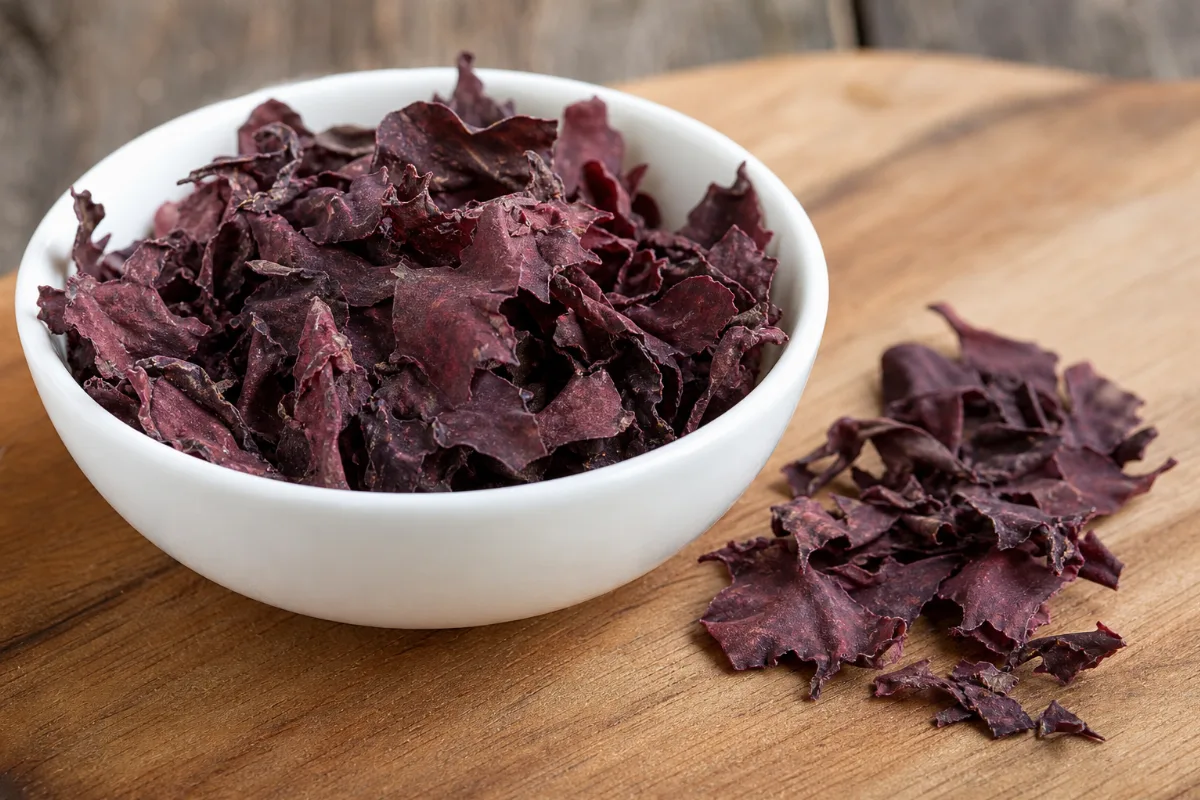
Dulse (Palmaria palmata) is a reddish-purple seaweed that grows on cool North Atlantic and Pacific coasts. People eat it dried, as flakes or powder, or soaked and added to salads, soups and breads. This page keeps the whole food apart from extracts and from hype, and it starts with the safety point that matters most: iodine.
Read this first
- Dulse is a high-iodine seaweed, and the amount changes with the season and place it was harvested. A 2025 Arctic study worked out that only 0.63 to 0.92 g of dried dulse a day would fit a 70 kg adult's iodine limit at its higher-iodine times of year. [1] That is the authors' calculation, not an official serving.
- Too much iodine can disturb the thyroid. The American Thyroid Association says intake above 1,100 mcg a day is not recommended, and that infants, older adults, pregnant or breastfeeding women and people with thyroid disease are more at risk. [2] If you have thyroid disease or take thyroid medicine, ask your clinician before eating dulse often.
- In Norway, regular seaweed eaters (dulse was one of the common species) often had intakes above the upper limit, and TSH fell when they stopped seaweed for six weeks. [5] [6]
- Arsenic, cadmium and lead were measured in Arctic dulse and changed with the season. [1]
- Evidence summary: dulse is a nutrient-rich food. Benefit claims such as "reduces inflammation" come from lab work on extracts, not from trials of eating dulse. [8]
What is in it (USDA values)
No USDA entry for this food. USDA FoodData Central (SR Legacy) has no dulse item, so we give no per-100 g table. We would rather show no number than an invented one.
What we did read: in a 2024 laboratory comparison of dulse, knotted wrack and Irish moss, dulse had the highest protein of the three. [3] A 2025 Arctic study found that dulse's protein and ash rose in late winter and spring and fell in late summer and autumn, with the lowest protein in August. [1] The same study found that sugar and dry matter were higher in late summer and autumn. [1] A 2025 laboratory analysis found the carotenoids lutein and alpha-carotene in dulse extract. [9] Those are lab measurements of a prepared extract, not trials in people.
We did not find a source with iodine in mcg per gram of dulse; the Teas 2004 survey of 12 seaweeds ranged from 16 mcg/g in nori to over 8,000 mcg/g in processed kelp granules, and its abstract does not list dulse. [4] Always check the product label, because labelling of iodine was missing for many seaweed products in Norway. [5]
What research says
| Health goal | What the sources found | Strength of evidence | What was studied |
|---|---|---|---|
| Iodine and thyroid | Regular seaweed eaters in Norway had high iodine intake; TSH fell after six weeks without seaweed. [5] [6] | Mixed (small, non-randomized) | Habitual seaweed eaters, dulse among species |
| Protein and minerals | Dulse had the highest protein of three seaweeds compared; values change by season. [3] [1] | Established as composition, not as health benefit | Dried seaweed, laboratory analysis |
| Inflammation | A dulse extract lowered inflammation signals in human white blood cells in a dish. [8] | Lab or animal only | Phenolic extract, cells |
| Weight loss, detox, thyroid support, cancer | Proper evidence not found in the sources we read. | No good evidence of benefit | Not applicable |
| "Bacon" flavor | Press reports describe a patented Oregon State University dulse strain that tastes like bacon when fried. We did not read the original university release, so this is not a health claim and we cannot confirm it. | Insufficient evidence | Not applicable |
Food vs extract. The Norwegian findings are about the whole seaweed as eaten. [5] [6] The neutrophil study used an extract, which is a different product. [8] Species, harvest place and processing change composition, so one number cannot describe every bag.
How much is a normal serving
There is no official serving for dulse that we could find. The only figure we read is the Arctic authors' calculated maximum of 0.63 to 0.92 g dry weight a day for a 70 kg adult, based on iodine at the study's higher-iodine times of year. [1] This is information, not a prescription, and your own situation may differ. In the Dutch market study, iodine in seaweed products ranged from under 0.1 to 7,910 mcg per gram fresh weight, and a quarter of regular seaweed eaters were above a 600 mcg a day limit. [7] Cooking in water may move some iodine out of food, but we did not read a dulse-specific figure. [4]
Safety, allergy and medicines
- Iodine. The ATA advises against iodine or kelp supplements giving more than 500 mcg a day, and says the upper limit is 1,100 mcg a day. [2] NHS says adults need 140 mcg a day and that long-term high doses could affect the thyroid. [10] A review warns that even small amounts of some brown seaweeds can have antithyroid action and that labels may not say. [11] Dulse is a red seaweed, and we did not find a source comparing it directly with kelp.
- Thyroid disease and medicines. The ATA says people with existing thyroid disease are susceptible to adverse effects of excess iodine. [2] Talk to your clinician before eating it regularly. We did not read a source on dulse and specific medicines.
- Pregnancy, breastfeeding, children. The ATA names these groups as more vulnerable, and gives an upper range of 500 to 1,100 mcg a day in pregnancy and breastfeeding. [2] We did not find a dulse-specific official statement.
- Metals. Arsenic, cadmium and lead were found in Arctic dulse and were higher in winter and spring. [1] We did not read which forms of arsenic dulse contains. See the heavy metals and contaminants page.
- Allergy. Allergy societies say seafood allergy is caused by proteins in fish and shellfish, not iodine. [12] Dulse is not fish or shellfish. We did not read a source on seaweed allergy. If lips, mouth or throat swell or breathing is hard after eating, call 911 or your local emergency number. [13]
- Vitamin K, potassium, kidney disease, sodium. Proper evidence not found in the sources we read for dulse specifically; check with your clinician if you take warfarin or have kidney disease.
Choosing, storing and food safety
- Look for products that state the iodine content; labelling was missing for many seaweed products in Norway. [5]
- Keep to the product's storage directions; we did not read a dulse-specific food-safety source.
- Powder and flakes pack more dry seaweed per spoon than leaves, so spoon size matters. [1]
Related pages
Health connections for Dulse
What research links to eating or drinking this food, and how strong the evidence is. Many studies are observational or use juice, powder, oil or extracts rather than the food as eaten; each card says which.
Dulse, regular seaweed eating and thyroid tests
Preliminary or mixedIn Norwegian regular seaweed eaters (dulse among the species used), iodine intake was often above the upper limit and TSH fell when seaweed was stopped for 6 weeks. These were small observational and non-randomized studies.
Supplements: Not a supplement question.
Dulse for protein and minerals
Not enough evidenceIn a 2024 comparison of dulse, knotted wrack and Irish moss, dulse had the highest protein of the three. We did not find a single reliable per-100 g figure for dulse as eaten in the sources we read, and protein changes with season.
Supplements: Not a supplement question.
Dulse extracts and inflammation: lab findings
Lab or animal research onlyA phenolic extract of dulse reduced inflammation signals in human white blood cells (neutrophils) in a laboratory dish. No trial shows that eating dulse does this in people.
Supplements: Not a supplement question.
Seafood allergy and iodine in dulse
Not enough evidenceAllergy societies say seafood allergy is caused by proteins in fish and shellfish, not by iodine. Seaweed is a plant-like alga, not fish or shellfish. We did not read a source on rare seaweed allergy.
Supplements: Not a supplement question.
Connected topics
Open a group to see how each topic connects and how strong the evidence is.
Body systems (1)
- Endocrine SystemDocumented risk
The thyroid is part of the hormone system. The risk comes from iodine intake that is too high.
Body parts (1)
- ThyroidDocumented risk
Dulse is high in iodine and the amount varies by season. Too much iodine can disturb the thyroid; people with thyroid disease should ask their clinician.
Root causes (1)
- Heavy Metal ExposureDocumented risk
Arsenic, cadmium and lead were found in Arctic dulse and varied by season. The abstract does not say how this compares with safety limits.
Biomarkers (1)
- TSHPreliminary or mixed
In Norwegian regular seaweed eaters TSH fell when seaweed was stopped for six weeks. A small non-randomized study; it does not show harm for any one person.
Documented risks and interactions (3)
- Dulse and iodine intake. Dulse is a high-iodine seaweed. A 2025 study of dulse harvested through the year in the Arctic found iodine content varied a lot by season, higher in spring and summer, and the authors worked out a daily limit of only 0.63 to 0.92 g dry weight for a 70 kg adult.
- Dulse and toxic elements. The Arctic dulse study measured arsenic, cadmium and lead and found they changed with the season, higher in winter and spring. The abstract does not say how this compares with safety limits.
- Dulse in pregnancy and for children. The American Thyroid Association lists pregnant and breastfeeding women, infants, older adults and people with thyroid disease as more vulnerable to excess iodine. We did not find a dulse-specific pregnancy source.
Frequently asked questions
Is dulse high in iodine?
Yes, the Arctic study called its iodine content high and showed it changes with the season. [1] The Teas survey did not list dulse in its abstract, so we give no single number. [4]
Does dulse taste like bacon?
Press reports describe a special Oregon State strain that does when fried. We did not read the original release, and ordinary dried dulse is a different product.
Is dulse safe for people with thyroid problems?
The ATA says people with thyroid disease are more susceptible to harm from extra iodine. [2] Ask your clinician; we cannot advise you.
Can dulse cause an allergic reaction?
Seafood allergy is caused by proteins in fish and shellfish, not iodine. [12] We did not find a source on seaweed allergy, so stop and get help if you react.
References
- Seasonal variation in the nutritional composition and potentially toxic elements of the red macroalga Palmaria palmata in the Arctic. PubMed 40382074. 2025. Read 2026-10-24 (abstract).
- American Thyroid Association. Statement on the potential risks of excess iodine ingestion and exposure. 2013. Read 2026-10-24.
- Čmiková N, et al. Seaweed nutritional value and bioactive properties. Life (Basel) 2024. Read 2026-10-24 (abstract via Europe PMC).
- Teas J, et al. Variability of iodine content in common commercially available edible seaweeds. Thyroid 2004. Read 2026-10-24 (abstract).
- Iodine status and thyroid function in a group of seaweed consumers in Norway. 2020. Read 2026-10-24 (abstract).
- Impact of habitual seaweed consumption on iodine nutrition and thyroid function. 2026. Read 2026-10-24 (abstract).
- Content, bio-accessibility and intake of iodine from seaweed-containing food products in The Netherlands. 2025. Read 2026-10-24 (abstract).
- Nutraceutical extract from dulse inhibits primary human neutrophil activation. 2019. Read 2026-10-24 (abstract).
- Metabolomic approach to explore the chemical composition and health benefits of macroalgae. 2025. Read 2026-10-24 (abstract).
- NHS. Vitamins and minerals: Iodine. Read 2026-10-24.
- Iodine, Seaweed, and the Thyroid. 2021. Read 2026-10-24 (abstract).
- AAAAI. Radiocontrast and seafood allergy: the myths and facts. Read 2026-10-24 (via search summary).
- NHS. Food allergy. Read 2026-10-24.