Kola Nuts: Nutrients, What Research Shows and Safety
Kola nuts as a food: caffeine content, West African chewing customs, history in cola drinks, cautions for heart, pregnancy and medicines, and why USDA has no entry.
Content last updated . This page has not been medically reviewed.
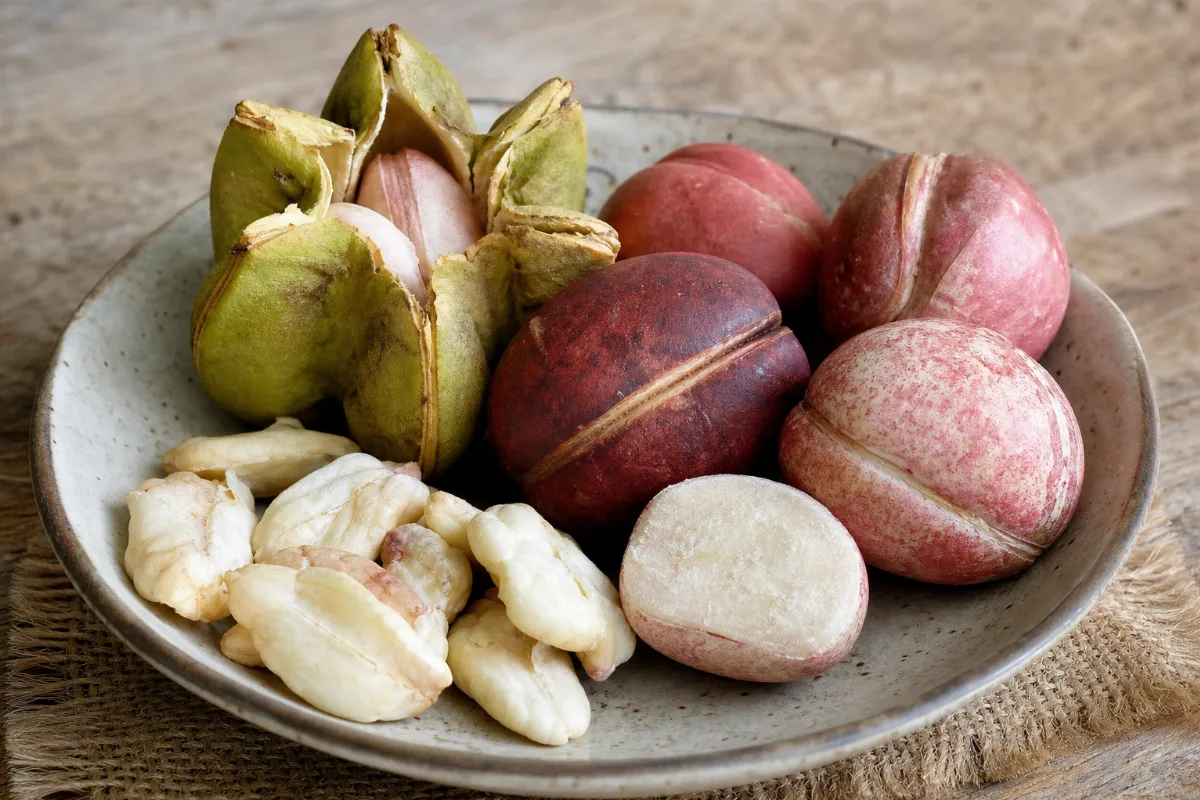
Kola nuts are the seeds of West African trees, mainly Cola nitida and Cola acuminata (family Malvaceae, older books say Sterculiaceae). They grow inside star-shaped pods, and each pod holds several lobed seeds that are called "nuts" even though they are not true nuts. The seeds are chewed fresh, mostly in West Africa, and dried seed was used to flavor drinks. [1] This page is about the kola nut as a food and chew. For capsules, tinctures and extracts see the kola nut herb page. This page separates the food from hype and from cola soft drinks.
Read this first
- Kola nut is a caffeine food. The European Medicines Agency (EMA) report says the caffeine content of the seed is usually 1.5% to 3.8%, depending on variety and how the seed is treated, so the cautions that apply to caffeine apply to kola. [1]
- Pregnancy and children: the EMA says use in pregnancy, while breastfeeding, and in children and adolescents is not recommended, because safety data are lacking. [1] For caffeine from all sources, the NHS advises pregnant women to have no more than 200 mg a day. [4]
- Heart, blood pressure and stomach: the EMA lists stomach and duodenal ulcers as contraindications and high blood pressure, heart rhythm problems and an overactive thyroid as reasons for caution. [1]
- Medicines: caffeine can interact with several medicines, and a rabbit study found kola lowered blood levels of one medicine (metoclopramide). [1][7] Ask a pharmacist.
- Honest summary: kola nut is a stimulant chew with a long cultural history. USDA has no entry for it, and we found no good human trials showing a health benefit from eating it.
What is in it (not USDA)
USDA FoodData Central has no entry for kola nuts, so there is no USDA table here. The values below come from published analyses we read. They are for raw seeds, vary a lot between samples, and are not per serving.
| Component | What the source reports | Source |
|---|---|---|
| Caffeine | 1.5% to 3.2% (average 2.5% in the dried seed) in one reference the EMA cites; 1.5% to 3.8% overall, depending on variety and curing | [1] |
| Theobromine | Traces: 0.02% to 0.08% in the EMA's summary; one analysis of accessions gave 37 to 1,570 mg per kg for C. nitida | [1] |
| Tannins (plant polyphenols) | 5% to 10%, plus catechin and epicatechin | [1] |
| Moisture (fresh seed) | 58.8% on average (range 48 to 68%) | [3] |
| Fat | 0.47% on average (range 0.15 to 0.79%) | [3] |
| Ash (minerals, total) | 2.66% on average | [3] |
| Protein | 7.33 on average (range 3.06 to 13.52); the paper does not state the unit | [3] |
Table 3 of the paper [3] covers 25 Cola nitida genotypes grown at one research station in Ghana; the paper does not state whether the values are per fresh or dry weight, so treat them as rough. We could not open the other composition papers that turned up in our search (journal pages did not load), so we have no vitamin or mineral values we can quote. Energy per 100 g and Daily Values: Proper evidence not found in the sources we read. Because the analyzed seed has a lot of water and very little fat, it is not an energy-dense nut like almonds, but we cannot give a calorie figure.
Plant compounds. Caffeine is the main active compound. Methylxanthines (caffeine and its relatives) are the group the EMA uses to standardize extracts. [1] Polyphenols are in the seed, [1][3] and a 2025 computer-modeling study of kola extract compounds flagged some as possible starting points for drug research; this is lab and computer work only, with no human evidence. [6]
What research says
| Health goal | What the sources found | Strength of evidence | What was studied |
|---|---|---|---|
| Alertness and tiredness | The EMA found no clinical trials of kola seed itself. It calls a use for temporary tiredness plausible because of the caffeine, and accepts it as a traditional use only. [1] | Insufficient evidence (for kola); caffeine itself is studied | Powder, extracts; adults |
| Safety of kola extract as a food flavoring | A 2009 safety review said the main compounds are caffeine and theobromine, so effects are likely similar to a comparable caffeine dose, and a no-effect level for repeated use could not be set. Estimated average intake from this use was 0.69 mg/kg a day. [2] We read only the abstract, so we could not check who funded it. | Mixed (limited data) | Food-flavor extract |
| Weight, blood sugar, memory, inflammation, cancer | Animal and lab findings only (rodents, cell models, computer models). [1][6] No human trials found. | Lab or animal only | Rats, mice, cells |
| Chewing and mouth or gut cancer | The EMA notes more mouth and stomach-gut tumors reported where kola chewing is most common (Northern Nigeria), and lab concern about chemicals formed from amines in the seed. It also says there are no studies of cancer from kola preparations. [1] | Insufficient evidence (association and concern, not proof) | Observation, lab chemistry |
Eaten as food vs taken as extract. Fresh seeds are chewed as food; dried seeds were ground into powders and extracts used for drinks and traditional medicine. [1] Most research uses extracts in animals. We do not know that chewing the fresh seed behaves like an extract.
How much is a normal serving
There is no official serving for kola nuts, and USDA has no portion. The EMA report says habitual chewers vary from 50 g to over 200 g of fresh seeds a day, which is a description of habit, not advice. [1] With about 1.5% to 3.8% caffeine in the seed, [1] the caffeine of a chew depends on the size of the piece and the variety, so we do not give a per-nut number. For comparison, the FDA cites 400 mg a day of caffeine as an amount not generally associated with negative effects for most adults, and advises people who are pregnant, trying to become pregnant or breastfeeding to ask a health care provider about limiting caffeine. [5] This is information, not a prescription. See caffeine in foods and drinks: official limits.Safety, allergy and medicines
- Caffeine effects. Sleep problems, over-excitability, nervous restlessness and stomach irritation are listed as possible effects. [1] The FDA lists faster heart rate, palpitations, high blood pressure, insomnia, anxiety, jitters, upset stomach, nausea and headache as signs of too much caffeine. [5]
- Ulcers and stomach. The EMA lists gastric and duodenal ulcers as contraindications, and animal tests described in its report found kola extract raised stomach acid secretion. [1]
- Heart and blood pressure. The EMA names hypertension and heart rhythm problems (arrhythmia) as reasons for caution. Animal work in its report found low extract amounts raised heart rate and force while high amounts did the opposite and, at the highest, caused heart failure in rat hearts (animal data, not a human dose). [1] People with heart conditions should ask their doctor.
- Medicines. The EMA report lists caffeine interactions with MAO-inhibitor medicines (large amounts can cause dangerous heart rhythm problems or severe high blood pressure), and says kola may interact with ephedrine, phenelzine, adenosine, clozapine, benzodiazepines, propranolol, metoprolol, phenylpropanolamine and quinolone antibiotics. [1] In five rabbits, kola given with metoclopramide lowered its blood levels (area under the curve down 51%), suggesting a possible interaction; this is animal data. [7] See foods and medicine interactions.
- Pregnancy and breastfeeding. The EMA says use in pregnancy and lactation is not recommended because data are lacking, and that no studies of kola in pregnancy exist. [1] A trade-association list cited by the EMA says it should not be used in pregnancy unless directed by a qualified expert. [1] Rat studies in which pregnant rats got kola extract found changes in the pups' brain development and behavior (cerebellum structure; memory tests). [8][9] These are animal results at the doses tested and cannot be applied directly to people, but they are a reason for caution. The NHS limit for caffeine in pregnancy is 200 mg a day from all sources (reviewed June 2026), and high caffeine has been linked to higher chances of miscarriage and stillbirth. [4]
- Children. Not recommended for children and adolescents. [1] The EMA report also quotes a suggested limit for children of 2.5 mg per kg of body weight a day for caffeine (from a 2003 review). [1]
- Overdose. The EMA report estimates an acute lethal dose of caffeine in adults around 10 g, and says death has been reported after 6.5 g of caffeine. Based on 1.5% caffeine, 10 g corresponds to about 667 g of kola. [1] These are worst-case figures, not a safe-use guide.
- Allergy. Proper evidence not found in the sources we read for kola nut allergy.
- Kidney and other conditions. Proper evidence not found in the sources we read.
- Contamination and mold. Not described for kola in the sources we read; see the general guide on storing nuts and seeds.
Choosing, storing and food safety
- Culturally, kola is shared in ceremonies and hospitality in Nigeria and other West African countries; the EMA says seeds are chewed for a stimulating effect and users say they reduce hunger, thirst and sleepiness. [1] This is tradition, not proof of benefit.
- Kola extract has a long role in cola-type drinks: the EMA report notes extracts were made into flavorings for carbonated drinks, and that kola seed is on the US "generally recognized as safe" list for food additives. [1][2] Many modern soft drinks no longer use real kola extract, and we did not read a source on current products, so check labels.
- Because caffeine adds up, count other sources (coffee, tea, energy drinks) in your day. [5]
- We did not read a source on storing kola nuts; the EMA report mentions fresh, cured and dried seed forms with different caffeine content. [1]
Related pages
Health connections for Kola Nuts
What research links to eating or drinking this food, and how strong the evidence is. Many studies are observational or use juice, powder, oil or extracts rather than the food as eaten; each card says which.
Caffeine and stimulant effect
Not enough evidenceKola seed contains about 1.5% to 3.8% caffeine, with traces of theobromine, so it acts as a caffeine product. The EMA found no trials of kola itself.
Supplements: Extracts and powders add concentrated caffeine; counts with coffee, tea and energy drinks.
Chewing in West African culture
Not enough evidenceKola is chewed fresh in many West African countries for stimulation and is part of ceremonies and hospitality. Users say it reduces hunger, thirst and sleepiness.
Supplements: Not a supplement issue; cultural food use.
Chewing and mouth or gut tumors
Not enough evidenceReports of more mouth and gut tumors where kola chewing is common (Northern Nigeria) and lab concern about amines forming nitrosamines; no studies of cancer from kola preparations.
Supplements: Not applicable.
Animal and lab findings
Lab or animal research onlyRodent and cell or computer studies report effects on weight, blood sugar, inflammation, memory and cancer cells.
Supplements: None shown in people.
Connected topics
Open a group to see how each topic connects and how strong the evidence is.
Body systems (3)
- Cardiovascular SystemDocumented risk
The EMA lists high blood pressure and heart rhythm problems as reasons for caution with kola, because of its caffeine.
- Heart & CirculationDocumented risk
Caffeine can raise heart rate and blood pressure; the EMA advises caution in heart conditions.
- Nervous SystemDocumented risk
Caffeine overstimulation (restlessness, jitters, sleep problems) is listed as a possible effect.
Body parts (2)
Root causes (2)
- Medication Side EffectsDocumented risk
Caffeine in kola may interact with MAO inhibitors and several other medicines; a rabbit study found lower blood levels of one medicine.
- Poor SleepDocumented risk
The EMA lists sleep problems as a possible effect of kola.
Conditions & symptoms (3)
- Caffeine Related DisordersDocumented risk
Kola is a caffeine source; signs of too much caffeine include palpitations, insomnia, jitters and nausea.
- Cardiac ArrhythmiaDocumented risk
The EMA names heart rhythm problems as a reason for caution with kola.
- Peptic UlcerDocumented risk
The EMA lists gastric and duodenal ulcers as a contraindication for kola.
Documented risks and interactions (5)
- Heart, blood pressure and rhythm cautions. The EMA lists hypertension and heart rhythm problems as reasons for caution, and caffeine can raise heart rate and blood pressure.
- Stomach and duodenal ulcers. The EMA lists gastric and duodenal ulcers as a contraindication; animal tests found kola extract raised stomach acid secretion.
- Medicine interactions. Caffeine interacts with MAO-inhibitor medicines and others; the EMA lists ephedrine, phenelzine, adenosine, clozapine, benzodiazepines, propranolol, metoprolol and quinolone antibiotics. A rabbit study found lower metoclopramide levels with kola.
- Pregnancy, breastfeeding and children. The EMA does not recommend use in pregnancy, lactation, children or adolescents because data are lacking. The NHS limit for caffeine in pregnancy is 200 mg a day; rat studies found changes in pups.
- Large caffeine doses. The EMA estimates a lethal adult caffeine dose around 10 g (about 667 g of kola at 1.5% caffeine); death reported after 6.5 g caffeine.
Frequently asked questions
How much caffeine is in a kola nut?
The EMA report gives 1.5% to 3.8% caffeine in the seed, varying with variety and curing. [1] That is a percentage of weight; the amount in one nut depends on its size, and we did not find a source giving mg per nut.
Is kola nut the flavor in cola drinks?
It was historically. Dried kola seed extract was used to flavor cola-type drinks, and a 2009 safety review notes cola beverages with kola extract date to the late 19th century. [1][2] We did not read a source on which products use it today.
Is kola nut safe in pregnancy?
The EMA says use is not recommended in pregnancy because safety data are lacking, and rat studies found changes in pups. [1][8][9] The NHS advises no more than 200 mg of caffeine a day from all sources in pregnancy. [4] Ask a clinician.
Can kola nut affect medicines?
It may, mainly through caffeine. The EMA lists MAO inhibitors and several other medicines, and one rabbit study found lower blood levels of metoclopramide. [1][7] Ask a pharmacist.
Does kola nut have health benefits?
The EMA found no clinical trials of kola itself and accepts it as a traditional use for temporary tiredness only. [1] Other claims rest on animal or lab studies.
References
- European Medicines Agency, Committee on Herbal Medicinal Products (HMPC). Assessment report on Cola nitida (Vent.) Schott et Endl. and its varieties and Cola acuminata (P. Beauv.) Schott et Endl., semen. EMA/HMPC/722365/2010, 22 November 2011. Full text read 2026-10-23.
- Burdock GA, Carabin IG, Crincoli CM. Safety assessment of kola nut extract as a food ingredient. Food Chem Toxicol 2009. PMID 19394393. Abstract read 2026-10-23.
- Nyadanu D et al. Genetic variability of bioactive compounds and selection for nutraceutical quality in kola (Cola nitida). PLoS One 2020. PMID 33270707. Full text (first part, including Table 3) read 2026-10-23.
- NHS. Foods to avoid in pregnancy (caffeine). Last reviewed 2026-06-15. Read 2026-10-23.
- U.S. Food and Drug Administration. Spilling the beans: how much caffeine is too much?. Content current as of 2024-08-28. Read 2026-10-23.
- Alshehri A et al. Unveiling bioactive compounds in kola nut seeds: GC-MS identification and computational analysis for anticancer potential. Front Nutr 2025. PMID 41586220. Abstract read 2026-10-23.
- Amadi CN, Nwachukwu WI. The effects of oral administration of Cola nitida on the pharmacokinetic profile of metoclopramide in rabbits. BMC Pharmacol Toxicol 2020. PMID 31907041. Abstract read 2026-10-23.
- Atiba FA et al. Kola nut from Cola nitida Vent. Schott administered to pregnant rats induces histological alterations in pups' cerebellum. PLoS One 2021. PMID 33684143. Abstract read 2026-10-23.
- Atiba FA et al. Dynamic changes in the hippocampal memory index and biochemical indices in Sprague Dawley rats exposed to intrauterine kola nut. Metab Brain Dis 2024. PMID 39546053. Abstract read 2026-10-23.