Sesame Oil on Skin and Hair: Evidence and Safety
Sesame oil on skin and hair: baby and body oil massage in South Asia, what small trials show, sesame allergy and skin contact, oil grades, and what is unproven.
Content last updated . This page has not been medically reviewed.
Quick safety points
- Sesame is a common food allergen. A literature review (a preprint, not yet peer reviewed) found case reports of hives after sesame-containing cosmetics, and some people also reacted to eating sesame. If you or your child is allergic to sesame, ask an allergist before putting sesame oil on skin. [1]
- A review of 396 skincare products for eczema found that about 1 in 3 (32.1%) contained a derivative of a major food allergen, and sesame was among the common ones. Read ingredient lists, including "Sesamum indicum" (the Latin name for sesame). [2]
- Cochrane reviewers who pooled infant skin-care trials found that emollients (skin moisturizers) probably do not prevent eczema, may raise the risk of food allergy, and probably raise the risk of skin infection. These trials were not about sesame oil specifically. [3]
- A meta-analysis of sesame oil trials on skin called for better safety reporting and for checking the purity and strength of the oil. The abstracts we read do not list side effects. [5]
- Do a small patch test first. See patch testing natural oils and butters. Stop and get care for hives, swelling or trouble breathing.
What sesame oil is
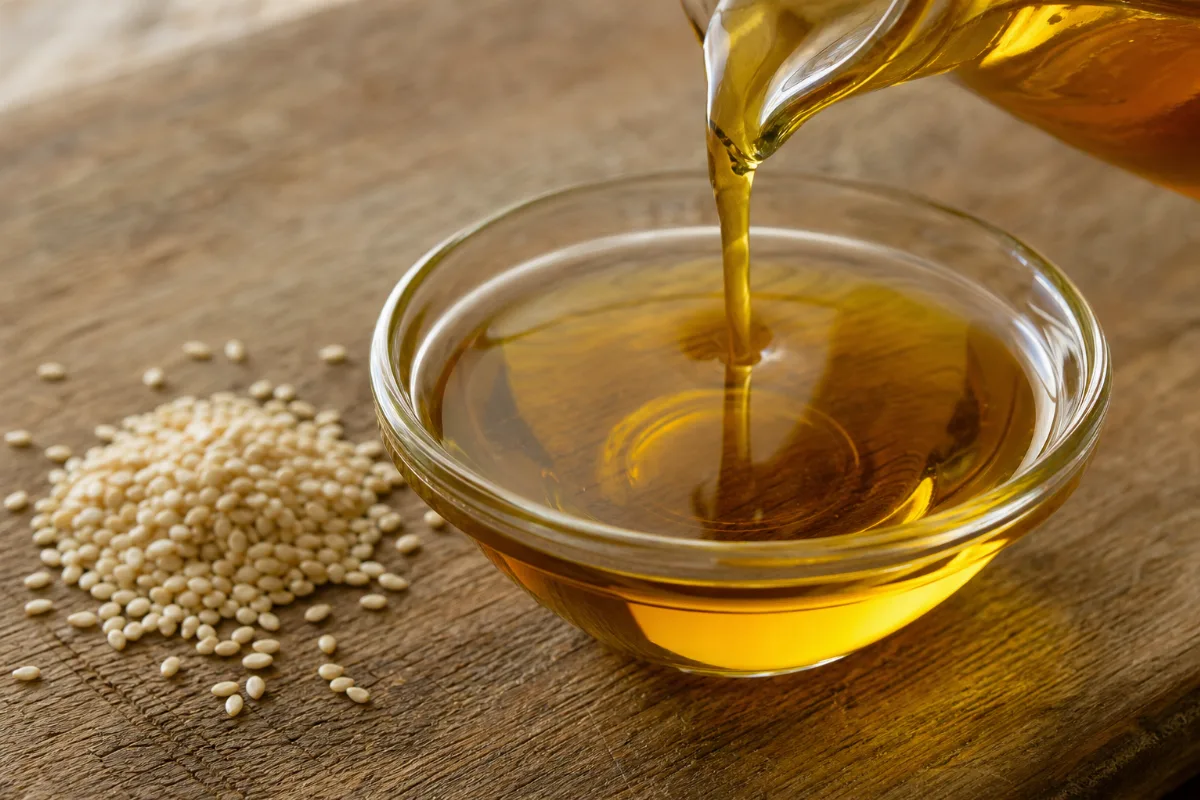
Sesame oil comes from the seeds of Sesamum indicum, an annual plant grown in warm regions. The oil is pressed from the seeds. It is sold cold-pressed (pressed without added heat), refined (treated to give a pale, mild oil) and toasted (made from roasted seeds; dark and strongly scented). Its main fats are monounsaturated and polyunsaturated, with a smaller share of saturated fat; for the food values see the dietary sesame oil page. On skin it feels medium to light: it spreads easily, soaks in fairly well and can leave a slight sheen. We did not find a source we read that measures this, so treat the feel as a general description.How it is used
- Body and baby massage: in many South Asian homes, sesame-based and other oils are rubbed on babies and adults. [6]
- Ayurvedic oil massage (abhyanga): abhyanga is the Ayurvedic name for warm-oil self-massage and baby massage. See our page on abhyanga oil massage.
- Hair and scalp: oiling hair and scalp is a widespread custom; a review of hair oils says most act mainly as emollients (they soften and coat). [7]
- Mouth: "oil pulling" is swishing oil in the mouth. Sesame oil is one of the oils used in dental studies. [8][9][10]
- Food: a cooking and finishing oil. See sesame oil as food.
Traditional use (not proof)
In a survey of 1,497 caregivers of children under 18 months in two Indian states, 93.8% massaged their babies, almost all using oil, and a sesame-based oil was the top choice in Maharashtra (36%). Families said massage made bones stronger and helped sleep and growth; 95% saw no harm. [6] A survey of 145 first-time mothers in Kerala found 71% massaged their baby with oil; coconut oil, not sesame, was used most (75.9%), and 94.5% did not know the word "abhyanga". [11] A scoping review of African newborn practices (23 studies) found families use emollients and massage for warmth, growth and infection protection; the abstract does not say which oils. [12] These are reports of what families do and believe. They do not show that sesame oil makes babies stronger or healthier. A review of Persian traditional medicine texts likewise describes oil anointing for children, and its authors say reported side effects are minimal, but it is a review of old texts and small studies. [13]What research shows
Trials of sesame oil on skin are few, small and mostly from Iran. We found no trial of sesame oil for infant weight gain, dry skin or eczema, for hair growth, or for arthritis.| Use | Who and how long | Result | Strength |
|---|---|---|---|
| Pain after minor limb injury (massage with sesame oil plus usual care) | Meta-analysis of 4 trials in adult outpatients | Pain fell more in the oil groups by day 2 to 3 (mean difference -1.10 points, 95% CI -1.62 to -0.57); only 2 trials were of good quality; certainty moderate [4] | Preliminary |
| Phlebitis (vein inflammation) from IV drugs | Meta-analysis of 8 trials, mostly adults on chemotherapy; 2 on amiodarone | Less phlebitis with sesame oil plus usual care (risk ratio 0.54, 95% CI 0.32 to 0.92); authors flagged weak methods and asked for purity checks [5] | Preliminary |
| Phlebitis from amiodarone after heart surgery | 44 patients, 22 per group, oil applied every 8 hours | Phlebitis in 20/22 with oil vs 22/22 without: no significant difference [14] | Not shown |
| Skin burn from radiotherapy | 40 women with breast cancer, 5 weeks, sesame oil or placebo after each session | Less severe redness at weeks 4 and 5 (p = 0.046, 0.032); weeks 1 to 3 no difference; authors asked for larger trials. The abstract calls the product an ointment and does not give its full recipe [15] | Preliminary |
| Plaque on teeth (oil pulling, not skin) | Two trials of 40 adults, 8 weeks, sesame oil vs water | One report found more plaque reduction with sesame (median 18.98% vs 10.49%, p = 0.023); the other, from the same group, found both groups improved with no difference. The two reports disagree [8][9] | Mixed |
| Gum health (oil pulling) | Triple-blind trial comparing sesame, coconut and sunflower oil | All three improved gingival health; coconut did best; no sample size in the abstract [10] | Preliminary |
The IV-line and injury studies tested a topical oil on the skin over a vein or injury, not a general moisturizer. The abstracts we read do not say whether the oil was cold-pressed, refined or a blend.
Lab findings: sesamol, a compound found in sesame, improved skin-barrier markers in skin cells in a dish. Cells in a dish do not show what happens on your skin. [16] A large sesame meta-analysis on blood pressure covers eating sesame, not skin use, so we do not use it here.
Proper evidence not found in the sources we read for sesame oil growing hair, treating dandruff or acne, or being a sunscreen.
Claims checked
- "Sesame oil makes babies stronger or helps them grow." Caregivers say so. [6] We found no controlled trial of sesame oil in babies. One Cochrane review of emollient trials in infants found no eczema prevention and possibly more food allergy. [3]
- "Sesame oil grows or thickens hair." The hair-oil review we read says most oils work as emollients; it does not report a sesame hair-growth trial. [7] Proper evidence not found.
- "Sesame oil protects skin from the sun." Proper evidence not found in the sources we read.
- "Sesame oil heals wounds or prevents blood clots." Trials covered phlebitis, pain and radiotherapy skin burn. Results are small and mixed, and none is about healing open wounds. [4][5][14][15]
- "It detoxifies the body through the skin." No source we read supports this. See also Ayurvedic detox and cleanse claims.
- "Natural oils on baby skin are safe because they are natural." Safety depends on the oil and the child. For allergy, see above. [1][3]
Forms, grades and why they matter
- Cold-pressed: pressed without added heat. A systematic review says cold-pressed oils keep more unsaturated fats and plant compounds than refined oils, but are also more easily damaged by air and light. [17] It does not discuss sesame specifically.
- Refined: milder smell and lighter colour. We did not find a source we read on whether refined sesame oil carries less allergy risk on skin, so do not assume it does.
- Toasted: dark, strongly scented, made from roasted seeds and sold mainly for cooking. We found no skin-safety source specific to it; a strong scent may bother sensitive skin, but we cannot cite a source for this.
- Cosmetic versus food grade, and "Ayurvedic" medicated oils: we did not find a source we read comparing them. Read the label for added fragrance or other herbs, and see cosmetic grade vs food grade oils. A meta-analysis of sesame oil trials asked for purity and potency checks. [5]
Safety and cautions
- Allergy: see Quick safety points. A review of contact urticaria (hives that start within minutes of touching something) explains that reactions can be allergic and, rarely, serious; people at risk should carry adrenaline and avoid the trigger. It does not mention sesame specifically. [18]
- Babies: a preprint review advised delaying skin use of vegetable oils in infants until after foods are introduced. This is one unreviewed paper, not a guideline. [1] Cochrane found possible harm from emollients in general. [3] Ask your child's doctor. See natural oils for baby skin and massage.
- Skin cancer or medical treatment: the radiotherapy study used a particular ointment under a research protocol. Do not apply anything to treated skin without your cancer team's approval. [15]
- IV lines and medical devices: do not put oil on a drip site yourself.
- Mouth: oil pulling studies report plaque and gum outcomes; one report notes people with keratosis may have adverse effects. [9] Never swallow the swished oil, and do not give it to young children. See coconut oil pulling.
- Pregnancy, breastfeeding, pets and medicines: not covered by the sources we read on topical sesame oil.
Quality and storage
We did not find a source we read that gives storage times for sesame oil. In general, oils rich in unsaturated fats spoil more easily with air, light and heat. [17] See rancidity and storage of natural oils. If it smells sharp or like old paint, do not use it on skin.Related pages
Uses studied and safety checks for Sesame Oil on Skin and Hair
Read the safety checks first. Each card says whether a finding comes from people, from the lab or from tradition, which product and way of use was tested, and how strong the evidence is. A finding for one product or one way of using it does not carry over to another.
Check before you use (4)
- Sesame allergy and skin contact. A preprint review gathered case reports of hives after sesame-containing cosmetics, some with reactions to eating sesame. About one third of 396 eczema skincare products contained a major-food-allergen derivative, with sesame among them.
- Emollients on infant skin: possible harms. Cochrane pooled trials of infant emollients: probably no eczema prevention, possibly more food allergy (RR 2.53, low certainty) and probably more skin infection. Not sesame-specific.
- Contact urticaria from cosmetics and topical products. A clinical review describes immediate, sometimes IgE-mediated skin reactions that can cause anaphylaxis; sesame is not named.
- Oil grade, cold-pressed versus refined. A systematic review says cold-pressed oils keep more unsaturated fats and plant compounds but are more prone to oxidation. It does not discuss sesame, toasting or skin use.
Sesame oil massage and pain after minor limb injury
Preliminary or mixedA meta-analysis of 4 trials in adult outpatients found a larger pain drop by day 2 to 3 with daily sesame oil massage plus usual care (mean difference -1.10 points). Only two trials were of good quality.
Supplements: Preliminary; moderate certainty, small trials.
Sesame oil on the skin and IV-drug phlebitis
Preliminary or mixedA meta-analysis of 8 trials reported less phlebitis with topical sesame oil plus usual care (risk ratio 0.54). A later trial of 44 heart-surgery patients on amiodarone found no significant difference (20/22 vs 22/22).
Supplements: Preliminary and mixed.
Sesame oil and radiotherapy skin burn
Preliminary or mixedIn 40 women with breast cancer, sesame oil after each radiotherapy session gave milder dermatitis than placebo at weeks 4 and 5 (p=0.046, 0.032) but not weeks 1 to 3. The product was described as an ointment.
Supplements: Preliminary; one small trial.
Sesame oil in traditional infant massage
Not enough evidenceSurveys in India show sesame-based oil is a common choice for baby massage in some states (36% in Maharashtra); in Kerala coconut oil was used most. Families report benefits; no controlled trial of sesame oil in babies was found.
Supplements: Traditional practice is not evidence of benefit.
Sesame oil pulling and dental plaque
Preliminary or mixedTwo 8-week trials of 40 adults compared sesame oil with water; one reported more plaque reduction with sesame, the other no difference between groups. A third trial found all of sesame, coconut and sunflower oil improved gum health.
Supplements: Mixed; mouth use, not skin.
Sesame oil for hair and scalp
Not enough evidenceA review says most hair oils act as emollients. No trial of sesame oil for hair growth or dandruff was found.
Supplements: Proper evidence not found.
Sesamol in laboratory skin models
Lab or animal research onlySesamol improved skin-barrier markers in cultured skin cells. Cell findings do not show effects on human skin.
Supplements: None shown for people.
Connected topics
Open a group to see how each topic connects and how strong the evidence is.
Health goals (1)
- Healthy SkinPreliminary or mixed
Small trials on skin conditions in patients; no trial in healthy skin was found.
Body systems (3)
- Integumentary SystemPreliminary or mixed
Skin trials are limited to radiotherapy burn and skin over IV lines.
- Pain & InflammationPreliminary or mixed
A meta-analysis found larger pain reduction after minor limb injury with sesame oil massage plus usual care.
- Skin, Hair & BeautyPreliminary or mixed
One small trial found milder radiotherapy skin burn with sesame oil; no trial of everyday dry skin or hair use was found.
Body parts (1)
- SkinPreliminary or mixed
Used on skin in small trials for radiotherapy dermatitis and phlebitis; results preliminary.
Functional actions (1)
- Pain ReliefPreliminary or mixed
Pain scores fell more with topical sesame oil massage in a pooled analysis of four trials.
Conditions & symptoms (2)
- Early Radiation DermatitisPreliminary or mixed
One small double-blind trial (40 women) found milder dermatitis with sesame oil at weeks 4 and 5.
- Food AllergyDocumented risk
Case reports describe hives after sesame-containing cosmetics and reactions to eating sesame (preprint review).
Frequently asked questions
Is sesame oil good for baby massage?
It is widely used in South Asia, and families report benefits. [6] We found no controlled trial of sesame oil in babies, and Cochrane found possible harms from emollients in general. Ask your child's doctor first. [3]
Can sesame oil on skin cause an allergic reaction?
Yes, in people allergic to sesame. A preprint review gathered cases of hives after sesame-containing cosmetics. [1] Do a patch test and avoid it if sesame allergy is known.
Does sesame oil help hair grow?
Proper evidence not found in the sources we read. A review says most hair oils work mainly as emollients. [7]
What does the research on sesame oil and skin show?
Small trials suggest less pain after minor injuries and less phlebitis, and one small trial found less radiotherapy skin redness. All are preliminary and one phlebitis trial found no difference. [4][5][14][15]
Is toasted sesame oil suitable for skin?
We found no source we read on this. Toasted oil is made for cooking; if you want a skin oil, check that the label says it is meant for skin.
References
- Matei I, Lafforgue C, Barbaud A, Authorea Preprints 2025 (preprint, not peer reviewed), Is the cutaneous application of vegetable oils a risk for the development of food allergies to vegetable proteins?. Read 2026-10-24.
- Ryczaj K et al., Postepy Dermatol Alergol 2023, Prevalence of major food allergens in skincare products for atopic dermatitis. Read 2026-10-24.
- Kelleher MM et al., Cochrane Database Syst Rev 2022, Skin care interventions in infants for preventing eczema and food allergy. Read 2026-10-24.
- Razani O et al., Int Wound J 2024, Alleviating severity of limb trauma pain with coadministration of topical sesame oil and standard treatments: a GRADE-assessed systematic review and meta-analysis. Read 2026-10-24.
- Nasiri M et al., Complement Ther Med 2025, Is the topical application of sesame oil combined with standard care valuable and safe for managing infusion-related phlebitis? Systematic review and meta-analysis. Read 2026-10-24.
- Chaturvedi S et al., BMC Pediatr 2020, Prevalence and perceptions of infant massage in India: Maharashtra and Madhya Pradesh. Read 2026-10-24.
- Mysore V et al., Int J Trichology 2022, Hair Oils: Indigenous Knowledge Revisited. Read 2026-10-24.
- Zurcher C et al., Clin Oral Investig 2025, The plaque reducing efficacy of oil pulling with sesame oil: a randomized-controlled clinical study. Read 2026-10-24.
- Zurcher C et al., Healthcare (Basel) 2025, Efficacy of Sesame-Based Oil Pulling in Plaque Reduction: A Randomized Controlled Trial. Read 2026-10-24.
- Mehta M et al., J Pharm Bioallied Sci 2024, Comparison of the efficacy of sesame, coconut and sunflower oil pulling on gingival health. Read 2026-10-24.
- Panicker KR et al., Front Med 2026, Traditional infant oil massage in early life: a cross-sectional study in Malappuram district, Kerala. Read 2026-10-24.
- Blanks KJH et al., Int Health 2024, Neonatal emollient therapy and massage practices in Africa: a scoping review. Read 2026-10-24.
- Mohammadian-Dameski M et al., Avicenna J Phytomed 2025, Topical application of medicinal plant oils in pediatric-related disorders (traditional Persian medicine). Read 2026-10-24.
- Gulsen M, Arslan S, Nurs Crit Care 2025, Effects of open-label sesame oil applied to cardiac surgery patients in preventing amiodarone-induced phlebitis: a randomized controlled trial. Read 2026-10-24.
- Moslemi D et al., Asia Pac J Clin Oncol 2023, Efficacy of sesame oil versus placebo in acute radiation-induced dermatitis in breast cancer patients. Read 2026-10-24.
- Zheng Q et al., Sci Rep 2025, Sesamol regulates AQP3 and HAS2 via MAPK signaling for skin barrier protection (in vitro). Read 2026-10-24.
- Dash B et al., Front Nutr 2026, Cold pressed oils: a systematic review. Read 2026-10-24.
- Bizjak M et al., Contact Dermatitis 2025, Contact Urticaria and Related Conditions: Clinical Review. Read 2026-10-24.