Macadamia Oil: Evidence and Safety
Macadamia oil for skin and hair: what the omega-7 (palmitoleic acid) claims rest on, the one small human study, tree nut allergy cautions, dogs, and storage.
Content last updated . This page has not been medically reviewed.
Quick safety points
- Macadamia is a tree nut, and tree nut allergies are often severe and can last for life. If you have a tree nut allergy, ask your allergy doctor before putting macadamia oil on skin or taking it by mouth. [8]
- Skincare made for eczema often contains nut ingredients. In a Polish store survey, almonds and macadamia nuts were among the most common food-allergen ingredients, and the authors warned that food-derived ingredients on inflamed skin may promote sensitization. [7]
- US food-labeling law does not count a highly refined oil as a "major food allergen". That is a food-label rule, not a cosmetic rule, and we did not find a source we read that measured nut protein in macadamia oil. [9]
- Macadamia nuts are listed as toxic to dogs. The source we read says nothing about the oil. [11]
- The "omega-7" claim is not proven in people: reviews say benefits of purified palmitoleic acid supplements remain unproven. [4][5]
What macadamia oil is
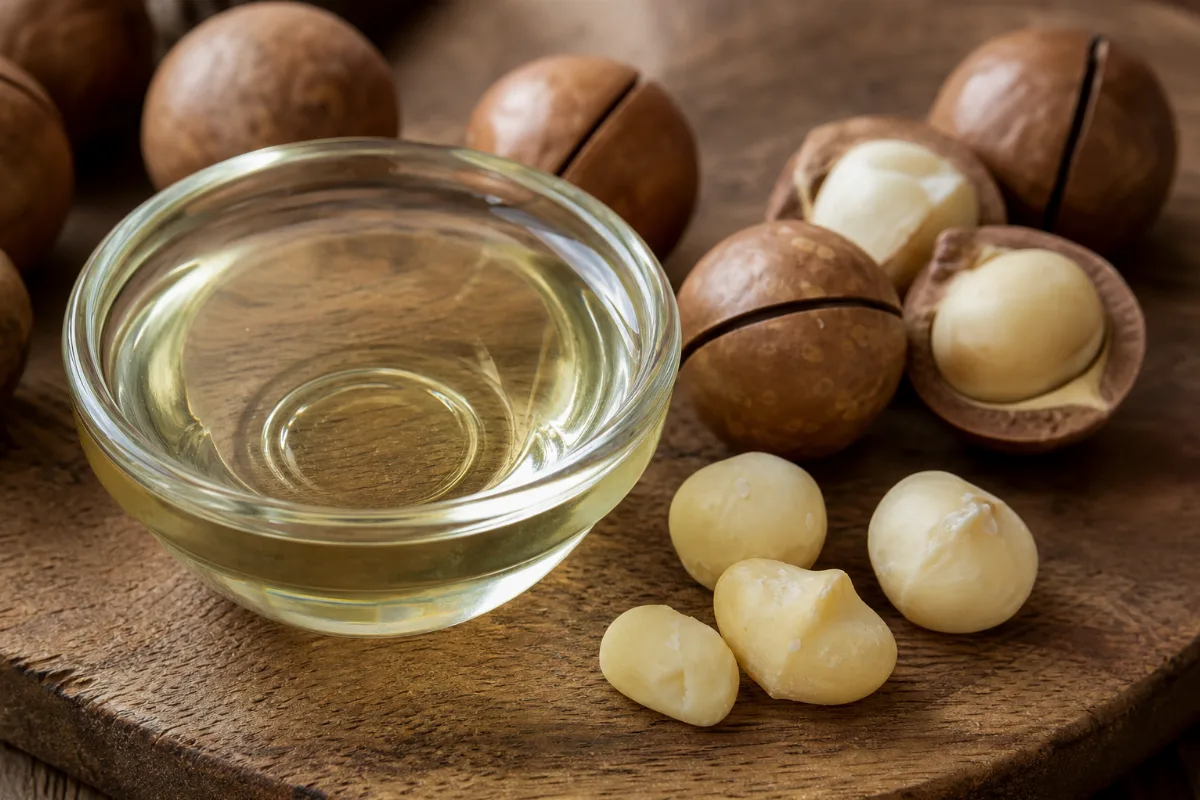
Macadamia oil comes from the kernel (the nut meat) of Macadamia integrifolia Maiden & Betche, a tree in the Proteaceae family. [1] The kernels are pressed to release the oil; research papers also describe other ways of extracting it, such as water-and-enzyme extraction. [13] In a study of 15 cultivars grown in China, pressed oils were mostly oleic acid (about 57 to 63%) and palmitoleic acid (about 12 to 19%), with small amounts of tocopherols (a vitamin E family), squalene and polyphenols. The place where the nuts grew shaped the oil more than the cultivar did. [2] In another analysis of commercial oils, palmitoleic acid was about 21 to 23%. [3] So the numbers on any bottle will vary.Palmitoleic acid is called "omega-7". It is a fatty acid the human body also makes. [5] How the oil feels on skin (often called light to medium and quick to absorb) is a common description in cosmetic writing; we did not find a source we read that measured it.
How it is used
- Skin: as a plain oil, or as an ingredient in creams, lotions and balms.
- Hair and scalp: as a leave-in or pre-wash oil. No trial we read tested it on hair.
- Massage: as a massage oil. This is a fixed oil, so essential-oil dilution charts do not apply to it.
- Food: the oil is also eaten, and the nuts are a common food. For nutrition, see macadamia nuts.
Traditional use (not proof)
The sources we read do not describe a traditional medicinal use of macadamia oil. The skin and hair uses seen today are mostly marketing and cosmetic use. A product being sold for years is not evidence that it works.What research shows
We found one small human study of macadamia oil on skin and none on hair, wounds, eczema or stretch marks.| Use | What the source found | Strength of evidence | Population and form |
|---|---|---|---|
| Skin "anti-aging" | A 4-week study applied two creams twice a day, one a "nanocream" and one a conventional cream, both containing 10% macadamia oil. The nanocream was reported to do better on skin-analyzer readings of moisture, pores, melanin and wrinkles. [6] | Very weak: it compared two cream types, not the oil against no oil; the abstract and methods we read did not state how many people took part. | Volunteers, cream with 10% oil |
| Palmitoleic acid (omega-7) supplements | A 2026 review says short trials of purified palmitoleic acid mostly found no effect on standard blood fats, blood sugar or inflammation markers. Diets rich in macadamia nuts have improved LDL cholesterol when they replaced saturated fat, but those studies cannot separate palmitoleic acid from the rest of the nut. [4] | Unproven for the acid itself | Mixed; mainly eaten, not applied to skin |
Lab and animal findings: reviews describe palmitoleic acid acting on insulin signaling, liver fat handling and inflammation in cells and animals. Results differ between studies and its role in people is not fully understood. [4][5] None of this tests a skin or hair product.
Proper evidence not found in the sources we read for macadamia oil helping hair growth, scars, stretch marks, eczema, acne or wounds.
Claims checked
- "Macadamia oil is rich in omega-7, so it fights aging." The oil does contain palmitoleic acid, but amounts differ by origin and product. [2][3] Reviews found benefits of purified palmitoleic acid unproven in people, and neither review tested skin aging. [4][5] The one skin study read compares two creams that both had the oil. [6]
- "Macadamia has the most omega-7." Not among the products compared: in one analysis, algal oil and fish-oil concentrates had far more palmitoleic acid than macadamia oil, and avocado oil had less. Sea buckthorn products varied widely. [3]
- "It is just like our skin's own oil." We did not find a source we read that tests this for macadamia oil, so we cannot confirm it.
- "It will not clog pores." We did not find a source we read that tested macadamia oil for pores or acne. The popular ratings are discussed on comedogenic ratings checked.
- "Refined macadamia oil is safe for nut-allergic people." The FDA statement that highly refined oils are not a "major food allergen" is about food labeling. [9] A large cosmetic safety review found 244 plant-derived oils safe as used in cosmetics, but the abstract we read does not say whether people with nut allergy were considered. [10] Ask an allergy doctor.
Forms, grades and why they matter
- Cold-pressed or pressed, unrefined: kernels are pressed without much heat. In one lab comparison, water-and-enzyme extraction gave an oil with lower peroxide and acid values (signs of spoilage) than a pressed oil, so how the oil is made affects its freshness. [13]
- Refined: processed further. Whether a specific refined oil still contains nut protein depends on the product; we did not find a source we read that measured it. [9]
- Cosmetic and food grade, and blends: a bottle labeled "macadamia" may be a blend, or an ingredient in a cream. Read the ingredient list. On labels you may see Macadamia integrifolia seed oil. See cosmetic vs food grade oils.
Safety and cautions
- Tree nut allergy: tree nut allergies are often severe and can cause anaphylaxis, which is treated with epinephrine. [8] Food-based allergens in skincare can matter more when the skin barrier is broken. [7]
- Patch test: the sources we read do not report macadamia oil skin reactions. A patch test is still a sensible step with any new product; see patch testing.
- Eczema and babies: the survey found nut-derived ingredients in skincare marketed for eczema and in products for infants and children. [7] Check the label and ask a clinician.
- Dogs: the ASPCA lists macadamia nuts as toxic to dogs, with weakness, vomiting and tremors. The page does not mention the oil. [11] Keep nuts and any oily nut products out of reach and call a vet or poison control if a dog eats some.
- Pregnancy, breastfeeding and medicines: not described in the sources we read.
Quality and storage
Researchers describe macadamia oil as rich in monounsaturated fat but susceptible to oxidation (spoiling on contact with air). [12] We did not find a source we read that gives a shelf life for cosmetic use. A sour, crayon-like or paint-like smell suggests it has gone off; see rancidity and storage of natural oils. Keep the bottle closed, cool and out of sunlight.Related pages
Uses studied and safety checks for Macadamia Oil
Read the safety checks first. Each card says whether a finding comes from people, from the lab or from tradition, which product and way of use was tested, and how strong the evidence is. A finding for one product or one way of using it does not carry over to another.
Check before you use (4)
- Macadamia oil and tree nut allergy. Macadamia is a tree nut; tree nut allergies are often severe and may last for life. Nut-derived ingredients are common in skincare marketed for eczema, and the authors warned about sensitization on inflamed skin.
- Macadamia oil and highly refined oil allergen rules. US food law excludes a highly refined oil from the 'major food allergen' definition. This is a food-label rule, and no source read measured nut protein in cosmetic macadamia oil.
- Dogs and macadamia (nuts; oil not addressed). The ASPCA lists macadamia nuts as toxic to dogs (weakness, vomiting, tremors); the page does not address the oil.
- Stability and storage of the oil. Authors describe macadamia oil as rich in monounsaturated fat but susceptible to oxidation; extraction method changed peroxide and acid values in a lab comparison.
Macadamia oil and skin moisture or aging
Preliminary or mixedOne 4-week volunteer study compared a nanocream and a conventional cream, both with 10% macadamia oil, on skin-analyzer readings. It did not compare the oil with no oil.
Supplements: Very weak evidence; does not show the oil works better than no oil.
Palmitoleic acid (omega-7) content
Not enough evidencePressed macadamia oils contained about 12 to 19% palmitoleic acid in one set of 15 cultivars and about 21 to 23% in commercial oils; origin and product change the amount.
Supplements: Content is documented; benefit from it is not.
Purified palmitoleic acid and metabolic health
Preliminary or mixedReviews say short trials of purified palmitoleic acid mostly found neutral effects, and benefits remain unproven. Macadamia-rich diets improved LDL cholesterol when replacing saturated fat, but the acid's share cannot be separated.
Supplements: Unproven for the acid; not a test of a skin or hair product.
Macadamia oil for hair, scars, eczema or acne
Not enough evidenceNo trial of macadamia oil for hair growth, scars, stretch marks, eczema, acne or wounds was found in the sources read.
Supplements: No verified evidence.
Connected topics
Open a group to see how each topic connects and how strong the evidence is.
Conditions & symptoms (1)
- Food AllergyDocumented risk
Macadamia is a tree nut; tree nut allergy can be severe, and nut-derived skincare ingredients were common in a survey of eczema products. Whether refined oil carries enough protein to react was not shown in sources read.
Frequently asked questions
Is macadamia oil good for skin?
It is used as a moisturizing oil, but the only human study we read compared two creams that both contained it, so it does not show the oil works better than no oil. [6]
Does macadamia oil really contain omega-7?
Yes. Analyses found palmitoleic acid (omega-7) at roughly 12 to 23% of the oil, depending on origin and product. [2][3] Whether that helps your skin has not been shown. [4][5]
Can I use macadamia oil if I am allergic to tree nuts?
Ask your allergy doctor first. Tree nut allergy can be severe. [8] Highly refined oils are not counted as "major food allergens" on food labels, but that rule is for food, and we found no measurements of nut protein in the oil. [9]
Is macadamia oil safe for dogs?
The ASPCA says macadamia nuts are toxic to dogs. The page does not address the oil, so we cannot say. [11]
How should I store it?
Closed, cool and away from light, and discard it if it smells off. Macadamia oil can oxidize like other oils. [12]
References
- GBIF Secretariat, Macadamia integrifolia Maiden & Betche, accepted name, family Proteaceae. Read 2026-10-24.
- Yan C et al., Foods 2026, Compositional characteristics of macadamia nuts and oils from major growing regions in China (abstract via Europe PMC). Read 2026-10-24.
- Correa M et al., Frontiers in Nutrition 2026, Palmitoleic acid content and composition-based nutritional quality of commercial omega-7 oils and supplements (abstract via Europe PMC). Read 2026-10-24.
- Destaillats F et al., Frontiers in Nutrition 2026, Palmitoleic (16:1 n-7) acid and metabolic health: integrating observational, clinical, and mechanistic evidence (abstract via Europe PMC). Read 2026-10-24.
- Bermudez MA et al., Cells 2022, Roles of palmitoleic acid and its positional isomers, hypogeic and sapienic acids, in inflammation, metabolic diseases and cancer. Read 2026-10-24.
- Hanum TI et al., Open Access Macedonian Journal of Medical Sciences 2019, Macadamia nuts oil in nanocream and conventional cream as skin anti-aging: a comparative study (abstract and open-access methods via Europe PMC). Read 2026-10-24.
- Ryczaj K et al., Postepy Dermatologii i Alergologii 2023, Prevalence of major food allergens in skincare products for atopic dermatitis. Read 2026-10-24.
- Jeong K, Lee S, Allergy, Asthma & Immunology Research 2025, Update on tree nut and seed allergies. Read 2026-10-24.
- US Food and Drug Administration, Inventory of petitions received under 21 USC 343(w)(6): exemptions from food allergen labeling (definition of major food allergen excludes highly refined oil). Read 2026-10-24.
- Burnett CL et al. (Cosmetic Ingredient Review Expert Panel), International Journal of Toxicology 2017, Safety assessment of plant-derived fatty acid oils (abstract only). Read 2026-10-24.
- ASPCA, Macadamia nut: toxic and non-toxic plants. Read 2026-10-24.
- Gao P et al., Food Chemistry: X 2025, Development and characterization of high-performance macadamia oil-based oleogel emulsions (abstract). Read 2026-10-24.
- Lan X et al., Food Chemistry: X 2026, Aqueous enzymatic extraction of macadamia oil: effects on physicochemical properties, composition and antioxidant activity (abstract). Read 2026-10-24.